Free spins no deposit, priced to the penny: what fifty spins at 10p actually leave you
£5.00 at face, £4.80 back at 96 per cent, and £192.00 of staking wanted
against it, so the requirement overshoots by £2.88. Every offer on this sheet is read the
same way: a credit, the debits the operator’s own terms put on it, and the line at the foot.
Licence status shown for every offerPriced in pounds and penceWorked at a 96 per cent return
What the conditions leave
These offers are paid placements: this site earns a fee when someone registers through a button, and the fee has no say in any figure.
1
Albion
700% up to £4,000 + 700 FS
Offshore licence, verify on the register
Wagering and payouton the operator's own terms page
A headline figure is a credit. Every condition written under it is a debit. The answer
is the line at the foot. That is one sentence of bookkeeping and it decides every page
here.
An advertised number is money somebody else has put on the counter, and it is real.
What follows the number is a list of charges against it, and the charges are real too.
Add the credit, subtract the debits, and read what is left. Nothing else is being asked
of a reader.
The trouble with a bonus advertisement is not that it lies. It is that it prints the
credit in large type and the debits in small. A till receipt solves that by giving both
the same column and striking a total underneath, which is why this site prints its
arithmetic in that shape. Two pence of difference at the foot is worth more than two
hundred spins in the headline.
Face value is where an advertisement starts, and a reader’s own arithmetic has to start
somewhere else: at what the face averages back. The gap between those two numbers is
4p in the pound before a single condition has been read. That is the smallest debit on
the sheet and it is the one nobody mentions.
2
Fifty cycles, priced from face to foot
Take a round of fifty cycles offered with nothing paid in, carrying a requirement of
forty times. Price the cycles first, because a count of them is not money until it is
multiplied by something.
At 10p a cycle, fifty of them put £5.00 of face on the
counter. Put 10p into a slot paying 96 per cent and the average return on it is 9.6p,
so fifty cycles average out at £4.80. That
£4.80, and not the £5.00
of face, is the credit the requirement will be charged against.
Every total on this site is struck with one line of print:
E = B × (1 − (W × (1 − RTP)) / g)
Where B is money credited, W the number of turns a cashier wants out of it, RTP the
share a game pays back and g the weight the game carries, E is what remains.
Substituting gives £4.80 times one minus forty times 0.04, which is £4.80 times minus
0.60, or minus £2.88.
What each letter stands for
Letter
Stands for
This example
B
Credit at the value it averages back
£4.80
W
Turns of that credit a cashier wants
40
RTP
Share a game hands back over time
96%
g
Weight a game carries towards the turns
1
E
What survives, which is the answer
£0.00
Read the minus sign as a shortfall rather than a debt. A balance stops at nothing, so
what the reader keeps is £0.00 and the requirement has
overshot by £2.88.
The same figure arrives from the other direction, which is the arithmetic worth
learning. Forty turns of £4.80 is
£192.00 of staking, and 4p in each staked pound stays
with a 96 per cent game, so the turnover costs £7.68.
£7.68 of charge against
£4.80 of credit leaves nothing, with
£2.88 to spare.
Held fixed on this sheet: fifty cycles, 10p apiece, a 96 per cent game, forty times
asked, and the weighting whole.
W × (1 − RTP) with the weighting whole comes to 1.60
E = £4.80 × (1 − 1.60), a shortfall of £2.88
Charge on the turnover: £192.00 staked at 4p in the pound, or £7.68
£7.68 of charge raised by £192.00 of staking on £4.80 of credit
What the fifty cycles cost in time
Fifty cycles take at least 125 seconds to run, and that is all the time the credit itself occupies. The requirement is what takes the evening. £192.00 of staking is 1,920 cycles at 10p, and at a cycle every 2.5 seconds, the pace used throughout this sheet, that is 4,800 seconds: an hour and twenty minutes with no breaks in it.
Turns asked of £4.80, and the clock behind each
Turns asked
Staking owed
Cycles at 10p
Time at 2.5 seconds a cycle
Ten times
£48.00
480
20 min
Twenty times
£96.00
960
40 min
Twenty-five times
£120.00
1,200
50 min
Thirty times
£144.00
1,440
1 h
Forty times
£192.00
1,920
1 h 20 min
Ten times asks for a quarter of that clock and twenty-five times for five eighths of it, which is the same proportion as the staking owed, because the pace is fixed and the clock is the staking in other units. The credit has no clock of its own in this arithmetic. The hour and the twenty minutes belong to the requirement, and spreading them across days changes the length of each sitting without changing the total.
3
Twenty-five turns, where the sign changes
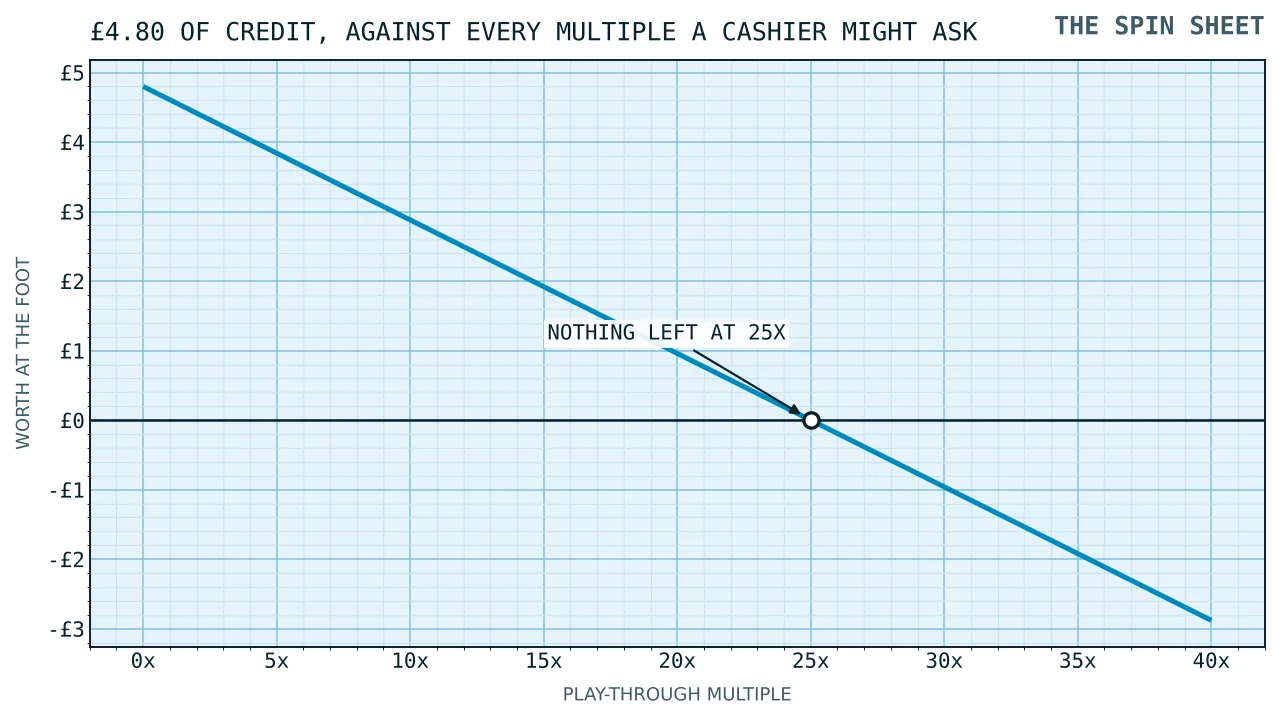
One division settles where a requirement stops being survivable. A 96 per cent game
takes 4p from each pound that goes through it, and a credit can therefore afford
twenty-five passes before it is consumed.
Twenty-five is not a rule anybody published. It is one divided by 0.04, and it moves the
moment the return moves. At a 94 per cent return the figure is sixteen and two thirds,
and at 98 per cent it is fifty.
Short of twenty-five turns a credit keeps something. At twenty-five it keeps nothing. Beyond that the arithmetic runs negative and the reader keeps nothing rather than owing anything.
Turns against a £4.80 credit
Turns asked
Cost of the turns
What the line gives
Kept in practice
None asked
£0.00
£4.80
£4.80
Ten times
£1.92
£2.88
£2.88
Twenty times
£3.84
£0.96
£0.96
Twenty-five times
£4.80
£0.00
£0.00
Thirty times
£5.76
£0.96 short
£0.00
Forty times
£7.68
£2.88 short
£0.00
The fourth row is where a credit is exactly spent on its own conditions. Rows five and
six are the arithmetic refusing to flatter a package: the charge exceeds the credit and
the reader is left with nothing at all. A ten times requirement is the strictest a
Great Britain licence now permits, and it still costs
£1.92 of the £4.80.
Figure 1.£4.80 of credit, measured
against each multiple a cashier might ask. The return used throughout is 96 per
cent. The line crosses nought at twenty-five turns, and past that point a package’s
conditions cost more than its credit is worth.Twenty-five turns at 96 per cent, where a credit is exactly spent
The three receipts, side by side
A till receipt prints every line in one column, so here are three of them in three columns, one for each case this site keeps returning to: nothing asked back, the British ceiling, and the forty times written out on the sheet. The first two lines are identical across all three. Only the turns asked differ, and everything under that line is multiplication.
One credit of £4.80 under three requirements
Line
No requirement
Ten times
Forty times
Face of fifty cycles
£5.00
£5.00
£5.00
Credit at 96 per cent
£4.80
£4.80
£4.80
Turns asked
none
10
40
Staking owed
£0.00
£48.00
£192.00
Charge on the staking
£0.00
£1.92
£7.68
The line at the foot
£4.80
£2.88
£2.88 short
What is kept
£4.80
£2.88
£0.00
The step from the first column to the second costs £1.92, the charge that ten times still leaves on the credit. The step from the second to the third costs a further £5.76, because 144 pounds more is staked at four pence in the pound, and that is the amount a ceiling of ten times keeps out of the charge. The last line reads £4.80 with nothing asked, £2.88 under the ceiling, and a shortfall of £2.88 at forty times, where what is kept is nothing.
A second set of terms, worked from the start
The method is the same whatever the terms, and a second set shows it. Suppose a set of terms gives thirty spins worth 20p each, a published return of 95 per cent and a play-through of 35 times. These are invented numbers for the purpose of the demonstration and they describe no offer. Five lines settle it, and a sixth says where the sign changes.
Thirty spins at 20p, a 95 per cent return and 35 turns, step by step
Step
Working
Result
Face
30 spins at 20p
£6.00
Credit
face times the 95 per cent return
£5.70
Staking owed
35 turns of the credit, weighting whole
£199.50
Charge on the staking
staking at five pence in the pound
£9.98
The line at the foot
credit less charge
£4.28 short
The crossing
one over the house edge of 0.05
20 turns
The crossing comes last because it is the quickest check. One over the edge of five pence is twenty turns, so a requirement of 35 is past it before any pound has been counted, and the shortfall of £4.28 is only the size of that overrun. Under a ten times ceiling the same credit would keep £2.85, which is what the absence of a ceiling costs on these terms, against £2.88 on the terms this sheet works throughout.
4
An average is not a promise about tonight
Everything priced on this site is an average, and an average is not a promise about
tonight. Fifty cycles is a short run of random events, and a slot whose prizes are
large and seldom seen will more often than not return well under its own mean.
The commonest single outcome of a small round of cycles is a figure under the mean,
because the mean is held up by prizes that almost never land. So the totals here are
built for comparing one arrangement against another, and not for forecasting an
evening. What an average does tell a reader is which of two arrangements is the better
buy repeated, and that is the only question arithmetic can answer.
One more distinction, because advertising leans on a reader missing it. No money of the
reader’s stands behind a credit, so the worst a credit can do is hand back nothing. A
condition written over that credit can consume all of it, and on the numbers worked
here it does. Those two facts sit together without contradicting each other.
Nothing on this page is advice about which offer to take, and no figure on it is a
forecast. A sheet that prices an offer at nothing has done its job as surely as one
that prices it at £2.88.
Two games with the same average, fifty cycles each
An average over fifty cycles is built from a few large events and many empty ones, and that can be shown with two games invented for the purpose, which describe no real reel set. A steady game pays 96 times the stake, £9.60 at 10p, once in every hundred cycles. A streaky game pays 960 times the stake, £96.00, once in every thousand. Each averages 9.6p a cycle, so each averages £4.80 over fifty.
Fifty cycles on each game, by the number of prizes that land
Prizes landed
Steady game: chance
Steady game: pays
Streaky game: chance
Streaky game: pays
None
60.5%
£0.00
95.1%
£0.00
One
30.6%
£9.60
4.8%
£96.00
Two
7.6%
£19.20
0.1%
£192.00
Three or more
1.4%
£28.80 or more
under 0.1%
£288.00 or more
The steady game pays nothing in about six rounds in ten, and the streaky game pays nothing in more than nine in ten. The whole of the streaky game's £4.80 average is carried by the one round in twenty that lands a prize. A round that lands nothing is the commonest outcome of both, and for the streaky game it is nearly the only one.
The table is also the reason no figure on this sheet is a forecast. £4.80 is what both games average across a vast count of rounds, and it is the one amount that neither game can pay in any single round, because their prizes come in units of £9.60 and £96.00.
5
Seven doors, each cut by one debit
This site is cut into seven parts, and the cut is made by asking which debit decides the
total. Knowing which question a reader is actually asking is most of the work of
answering it.
Offers whose outcome turns on the play-through and nothing else are priced under
the multiple. Offers with no play-through at all belong
under nothing asked back, where the face figure is
the figure kept, less any ceiling written over the winnings.
Offers priced per pound of the reader’s own money are kept apart in
matched money, because a deposit is not part of B and
the two sides have to be run separately. What the smallest sum a cashier will take
actually buys is a question about cycles for each pound paid in, and it has a section
of its own in the floor.
What a way of paying in costs before any bonus is priced at all is a separate
subtraction, often the largest one, and the rail does that
arithmetic. What is on offer away from the Great Britain licence, and precisely what
the absence costs, is set out duty by duty in
off the register. Where the credit is spent decides
the return and the weighting, both of which are inputs to the line, and that is what
the room is for.
Start anywhere. A reader who follows one line from a headline figure down to a total has
taken everything this site has to give.
The one figure each door returns
Each of the seven sheets opens with one figure, and putting the seven in a column shows what the cut by debit means in practice. The figures are not comparable with one another, because each is quoted against its own base: a pound of credit, a pound paid in, a pound at the cashier, a deposit, a turn of the reels. What they share is the method: a credit, the debits written under it, and a line at the foot.
Seven doors, the question behind each and the figure it opens with
£10.80 kept at ten turns on an £18.00 credit, the same £10.80 owed at forty
Start with the question and not with the figure. A figure that answers a question nobody asked can mislead as easily as a wrong one, and the sheets are cut by debit so that the question and the figure arrive together.
6
What a Great Britain licence puts in writing
There is no Great Britain licence behind an offer of this sort, and the rest of this
part costs the absence out. The licence is worth
£2.88 on the round of cycles priced in part 2, and here
is the working.
The ceiling over a multiple, priced
From 19 January 2026 the British ceiling on a play-through has stood at ten times the
bonus money. Ten turns of £4.80 is
£48.00 of staking rather than
£192.00, which costs
£1.92 instead of £7.68
and leaves £2.88 where forty times leaves nought.
Describing a licence as protection is weaker than pricing it, so the figure to carry
away is £2.88 on
£4.80 of credit.
One honest caveat. The cap is drafted about bonus funds, and no source settles whether a
free cycle counts as bonus money in the first place. The furthest a page can go:
winnings from a free cycle that land as bonus money carry a requirement of ten times at
most.
What else a licensee is obliged to do
Other duties come out in the same currency once a figure is put beside them. On a
licensed slot the stake per game cycle stops at £5, and at £2 for anybody who has not
reached 25. The elder ceiling began on 9 April 2025 and the younger one followed on 21
May 2025. Set those against the 10p a cycle this sheet assumes and they are fifty and
twenty times the spin price it works at, which is why they rarely bite on a bonus round
and always bite on what follows one.
Slot cycles cannot run closer together than 2.5 seconds, so fifty of them occupy
125 seconds at the very least. Nor may software take
them in a block: commitment runs cycle by cycle, which turns fifty cycles into fifty
separate decisions.
Nobody gambles at a licensee until three particulars have been obtained and checked: a
date of birth, a home address and a name. The duty does not stop at money, because a
bonus round is caught and so is a game played for nothing at all.
Documents cannot be held back for the exit. Information a licensee could have sought at
the entrance may not first be demanded as the money leaves. Once a withdrawal is asked
for, the customer may not be offered a button to take it back. A deposit balance may
not be fenced in by a withdrawal ceiling, and the clause the regulator prints as
forbidden reads £50 a day with £500 a week.
Acknowledgement of a complaint falls due inside three working days, cut to 24 hours
where the tables never close, and the file has to be shut within eight weeks. After
that the file goes to an adjudicator from the regulator’s approved list, and no other
adjudicator will do. Membership of Gamstop Online follows the licence rather than the
website, so one registration closes the whole licensed market at once. The scheme
publishes its own boundary: it cannot keep anyone away from operators that are not part
of it.
What the offshore rulebooks do contain
None of that means an offshore cashier is lawless, and a page saying so would be wrong
on the published record. Curaçao’s responsible gaming policy carries real obligations,
and its complaints guidelines allow six months to lodge one, require an answer inside
four weeks, and let that run on to eight weeks on written notice. A deposit limit cut
there bites immediately, and one raised has to sit a week before it works, where the
British wait is a single day.
Read the Curaçao policy for what is missing from it. No ceiling stands over a multiple.
No limit stands over a stake. No floor stands under the pace of a game cycle.
Automation is not barred, and nor is a fanfare over a return that merely matches what
was staked. Two sentences cover bonuses in the whole document: terms are to be
transparent, and promotion must stop short of pushing anyone into excessive play.
Exclusion there is per operator, reaching that operator’s domains and no further, and a
year is the briefest term it offers. For everywhere else, all the policy asks is that a
player be encouraged to do the same thing again elsewhere, one site at a time. Gamstop
Online offers six months as its shortest term and shuts every licensed account from one
registration, and that difference is the sharpest single thing on this sheet.
Two things that are true and are not reassurance
The statutory offence of providing gambling facilities without a licence falls on
whoever provides them, and the Act creates nothing equivalent for the customer who
plays. That is not a reason to treat an unlicensed cashier as safe, because what a
reader gives up is protection rather than liberty.
One duty does follow the player rather than the licence. Wherever a gaming provider
sits, its profits from a customer who usually lives in the United Kingdom attract
Remote Gaming Duty, and the rate since 1 April 2026 has been 40 per cent, up from 21
per cent.
7
The figures held still, and why
Four figures are held still on every sheet here, so that eighty-five documents can be
laid side by side without quietly disagreeing.
A cycle costs 10p. A game returns 96 per cent. A requirement runs to forty times. Weighting counts whole, so each pound put through a game counts for a full pound.
Not one of them is read off anybody’s terms, and that is deliberate. A default sourced
to whichever cashier happened to be standing somewhere this morning is a default that
rots, and a sheet written against it is wrong by the weekend.
No published British rule fixes what a free cycle is worth, so 10p is this site’s
assumption and is labelled as one wherever it is used. Nor is 96 per cent anybody’s
published figure here. It is a round number near the middle of the range slot software
is built to, and the only honest claim for it is that it is stated rather than
smuggled.
Forty times is taken because it is the sort of multiple this corner of the market asks
for, and the ten times a Great Britain licence now permits is quoted separately as a
ceiling rather than as a market rate. Weighting at whole value is the kindest reading
available: a game that counts for under a pound in the pound makes a requirement dearer
rather than cheaper. At the 30 per cent contribution rate the regulator’s page quotes
from a respondent, reaching £100 of contribution needs
roughly £333.33 put through the game.
A sheet that departs from any of them says so in the sentence where it does, and gives its reason there. The arithmetic behind all of it, including the places where the
method stops working, is set out on
how a receipt is struck. Who draws these sheets, and what
they do and do not do, is on who prints this sheet. The
commercial arrangement that funds the drawing, and what it does not buy, is on
how this sheet is paid.
Moving one of the four, and what it does to the line
Four figures are held still on every sheet, and a held figure is an assumption. The table moves them one at a time against the fifty cycle offer, so that the size of each assumption can be seen and not merely admitted to.
The fifty cycle offer with one assumption moved at a time
What was moved
Credit
The line at the foot
As priced on this sheet
£4.80
£2.88 short
A spin worth 5p
£2.40
£1.44 short
A spin worth 20p
£9.60
£5.76 short
A return of 94 per cent
£4.70
£6.58 short
A return of 98 per cent
£4.90
£0.98
Ten turns asked
£4.80
£2.88
Twenty-five turns asked
£4.80
£0.00
Sixty turns asked
£4.80
£6.72 short
Weighting at 0.5
£4.80
£10.56 short
Weighting at 0.3
£4.80
£20.80 short
Three things stand out. The value of a spin scales the answer without changing its sign, and each row of that kind is the first row times a ratio. The return and the multiple change the sign: a return of 98 per cent turns the shortfall into a small gain, and twenty-five turns cancels it exactly. And the weighting multiplies the damage. At thirty pence in the pound the shortfall is £20.80 on a credit of £4.80, more than four times the credit itself.
Five questions for any figure
A figure printed on a bonus page, or on this sheet, is only as good as the answers to a few plain questions about it.
Is it a credit, a debit or the line at the foot? A credit is money put on the counter, a debit is a condition written under it, and only the line says what is left.
Per what? A figure quoted per pound of credit, per pound paid in and per round of fifty cycles are three different quantities, and none compares with another until they share a base.
Which of the four held figures does it rest on? The table above shows how far each one moves the answer.
Is it an average? An average is silent about tonight, and a figure with no spread printed beside it is best read as the middle of a wide range.
What would change its sign? The crossing at twenty-five turns, or at one over the edge for another return, says how far from nothing the figure sits.
None of the five asks for trust in this sheet. They ask for the working, which is printed beside every figure so that the five can be put to it.
8
What this sheet declines to print
A method is only as honest as the gaps it admits to, so here are the gaps.
No primary source gives a cash value for a free cycle, nor a floor or ceiling on one, so
nobody can tell a reader what a spin is worth as a matter of rule. No primary source
says whether a free cycle falls inside the ten times ceiling, and this site will not
guess in either direction.
A licensed game need not publish a return to player percentage at all. The standard
offers a choice of items joined by the word or, and a house edge or a stated
probability of winning events satisfies it just as well. That is why 96 per cent is
described here as an assumption and never as an entitlement.
No citable source sets out how multiples, payout ceilings or spin values are spread
across the offshore market, so no page here prints an average of them. Which licence a
particular brand holds is not something any primary source states, so no page here
attributes a licence to a name.
HMRC has published no sentence declaring winnings untaxed. What its manuals do say is
narrower: gambling is no trade as such, so winnings are not trading income. Nothing on
this site is tax advice and nothing on it addresses anybody’s own circumstances.
Where the answer is that nothing survives, this site prints nothing and shows the
working that got there.
Questions
What does a free spins offer actually leave you with?
On the round worked on this sheet, nothing survives. Fifty cycles at 10p come to £5.00 at face, and a 96 per cent game averages £4.80 of that back. Forty times puts £192.00 of staking against the £4.80, and producing that staking costs £7.68. The credit is spent before the requirement is met, and the shortfall is £2.88.
Why does a forty times requirement wipe out the credit?
Because each pass through a 96 per cent game costs 4p in the pound. Forty passes cost 160 per cent of whatever goes through them, and a credit cannot pay 160 per cent of itself. The line reads £4.80 times one minus 1.60, which is minus £2.88.
What multiple can a credit actually survive?
Twenty-five turns, where a game returns 96 per cent. One divided by 0.04 is twenty-five, so twenty-five turns consume a credit exactly. Under that figure something is left, at it nothing is, and over it the arithmetic runs negative. Move the return and the figure moves with it.
How much is a Great Britain licence worth in money?
£2.88 on the credit priced here. Britain’s ceiling of ten times the bonus money has bound licensees since 19 January 2026, so £4.80 of credit owes £48.00 of staking at most. That costs £1.92, which leaves £2.88. Forty times owes £192.00, costs £7.68 and leaves nought.
Do the offers this site prices hold a Great Britain licence?
No, and nothing on this page pretends otherwise. A cashier outside the British register is bound by none of the duties in part 6: no ceiling over a multiple, no stake limit, no floor under the pace, no identity check before a bonus round, and no place in Gamstop Online.
Is it an offence for me to play somewhere unlicensed?
The offence in the Act is committed by whoever provides gambling facilities without a licence, and the Act writes no matching offence for the customer who plays. That is not an argument for playing. What is given up is protection rather than liberty, and part 6 lists it duty by duty.
Will Gamstop Online stop me at an offshore cashier?
No, and the scheme publishes that boundary itself: it cannot keep anyone away from a cashier that has never joined it. One registration shuts the Great Britain licensed market, because membership follows the licence rather than the website. Where that gap is what makes an offshore offer look attractive, the care note at the foot of this sheet carries the helpline number, and GamCare publishes a route to blocking software at no charge.
Why hold a cycle at 10p and the return at 96 per cent?
Because a stated assumption can be checked and a borrowed one cannot. No published British rule fixes what a free cycle is worth, so a figure has to be chosen and named; 10p is a convenient one, and 96 per cent sits near the middle of the range slot software is built to. Every sheet here works at the same four figures and says so, which is what lets two sheets be compared at all.
Does paying for a link buy a better position?
No. Links to offers are commercial and this site earns when a reader opens an account through one, which is set out in full on the page about how it is paid. Order comes out of the arithmetic in part 2, and a payment does not move it. The plainest test of that is a method which prints a nought whenever the arithmetic gives a nought.