
Sheet N07 Revision 1 Checked 15 October 2026
Deposit £5, 100 free spins and no wagering requirements
A hundred cycles at 10p carry £10.00 of face and average £9.60 back, with no multiple written over them. The multiple has not been deleted, though. It now sits on the £5.00 paid in, where turning that money over once costs 20p and the twenty-fifth turn costs the last of it.
20p off a £5.00 deposit for every turn it owes
What the conditions leave
Every destination on this spike is bought advertising. The site takes a fee if a reader goes on to register, and no figure printed below moves because of it.
The Spin Sheet
Till receipt No 01
Betportal
Lowest multiple here
For every €1 of spin credit at face per €1
Credit
Debit
No Great Britain licence
Licensed in Anjouan, Comoros, run by BetPortal Gaming Ltd, with Excite Ultra Media Ltd, reference ALSI-202601040-FI2.
Terms read 15 October 2026
Open the offer at Betportal, opens in a new tabThe Spin Sheet
Till receipt No 02
WinBeast
Five staged matches
For every €1 of spin credit at face per €1
Credit
Debit
No Great Britain licence
Licensed in Curaçao, operator not named on the site.
Terms read 15 October 2026
Open the offer at WinBeast, opens in a new tabThe Spin Sheet
Till receipt No 03
EliteSpin
Longest spin window
For every £1 of spin credit at face per £1
Credit
Debit
No Great Britain licence
Licensed in Costa Rica, run by PrimeTier Limited.
Terms read 15 October 2026
Open the offer at EliteSpin, opens in a new tabThe Spin Sheet
Till receipt No 04
Crown Jewelz
Multiple unpublished
No total struck
Credit
Debit
No Great Britain licence
Licensed in Curaçao, number not verified, operator not named on the site.
Terms read 15 October 2026
Open the offer at Crown Jewelz, opens in a new tabThe figure at the foot of a receipt is this site's own arithmetic and nothing an operator has published: the credit, less the share a spin gives back at 96 per cent return to player, less what playing the wagering through costs at the same return. It describes the offer, not one reader's afternoon. Where the conditions price above the credit the receipt prints nothing rather than a negative sum, and where a figure the sum needs is unpublished it prints the condition in the operator's words instead.
Three words stand in the amount column where no figure can. Noted is a published condition that takes value away without leaving the sum a figure to take. Unpriced is a condition whose figure nobody has published, or a credit that is not a sum until a deposit of your own sets it. Own money is money of yours, which is never part of a total.
Not one of the operators printed above holds a Great Britain licence, so the duties that licence carries do not reach them. Every online gambling company licensed in Great Britain has to be part of Gamstop Online, and a reader who has shut themselves out through the scheme is therefore not shut out here. The ceiling of ten times the bonus funds on a wagering requirement, in force since 19 January 2026, is a condition of that licence and binds the companies that hold one. Where a dispute goes instead is a matter for the authority named on the receipt, and the Gambling Commission describes what a reader faces without a British licence as a lack of recourse if things go wrong. Nobody under 18 may hold an account at any of them.
Every term printed on a receipt is the operator's own, and each receipt carries the day it was read. The oldest of those readings is 15 October 2026. What binds a reader is the operator's own full terms, and not a line printed here.
1
Nothing was deleted, something was moved
Read the key slowly and it describes two separate objects. One is a hundred game cycles, and of those the phrase about wagering is perfectly true. The other is £5.00 of the reader’s money, and the phrase says nothing whatever about that.
Start with the cycles, because they price in one step. A hundred of them at 10p apiece put £10.00 of face on the sheet, and 10p pushed through a game returning 96 per cent comes back as 9.6p. A hundred such returns average £9.60, and with no turnover written over the cycles there is nothing to bill against that average.
Now the fiver. It is real money, it can be lost, and in this structure it is also where the condition went. A package built this way wants the deposit staked some number of times before the balance may leave the account, and that number is the whole subject of this sheet.
A multiple does not care which pot it is written on. Four pence of each pound that passes stays with a 96 per cent game, which cannot tell whether that pound began life as a bonus or came out of a current account. What the move changes is who supplies the money being ground down, and here the answer is the reader.
Held fixed on this sheet, and easy for a reader to reset:
- A hundred cycles, priced at 10p each.
- A deposit of £5.00, which is the only money exposed.
- Both pots priced on a game returning 96 per cent.
- No turnover on the cycles, since that is what the key promises and this sheet takes the promise at face value.
- A range of multiples on the deposit instead of one figure, because no published rule fixes one. Where a package asks forty times, that is the figure this corner of the market tends to want, and part 3 costs it alongside one, ten and twenty-five.
- Weighting at full on both sides. A slot counting for less would raise the staking without altering the pence taken per pound.
2
The line run once for each pot
Sheet N07 settles both pots with the expression this site prices everything by:
E = B × (1 – (W × (1 – RTP)) / g)
Here W counts the turns a pot must make, RTP is the fraction a game returns, g the weighting, B the money at face or the winnings it averages, and E what is expected to survive. An arrangement made partly of somebody else’s money and partly of yours goes through the line twice, once for each pot, with the totals added at the end.
The cycles, carrying no multiple at all:
E = £9.60 × (1 – (0 × 0.04) / 1) = £9.60
The deposit, carrying ten:
E = £5.00 × (1 – (10 × 0.04) / 1) = £3.00
Add the two expectations and take out what was paid in. £9.60 and £3.00 make £12.60, less the fiver that bought entry, so £7.60 is expected to survive a ten-times condition on the deposit. Measured against the money exposed, that is £1.52 a pound.
Run the same two lines with a single pass on the deposit instead of ten and the answer climbs to £9.40, or £1.88 a pound. The gap between those answers, £1.80, is the entire price of the words that got moved. Nine tenths of the headline survived the move. Nearly two pounds in five did not.
3
Twenty pence a turn, and where that stops
Reduce the condition to a unit price and it becomes something a reader can do standing up. Turning £5.00 over once sends five pounds through a game that keeps four pence in each, so one turn costs 20p. Every further turn costs the same again. There is no curve to it, no threshold, and no point at which it gets cheaper.
| On the deposit | Staking owed | Cost of it | Deposit left | Whole package |
|---|---|---|---|---|
| 1 turn | £5.00 | £0.20 | £4.80 | £9.40 |
| 5 turns | £25.00 | £1.00 | £4.00 | £8.60 |
| 10 turns | £50.00 | £2.00 | £3.00 | £7.60 |
| 20 turns | £100.00 | £4.00 | £1.00 | £5.60 |
| 25 turns | £125.00 | £5.00 | £0.00 | £4.60 |
| 40 turns | £200.00 | £8.00 | £0.00 | £4.60 |
The last of those figures holds the cycles steady at £9.60 and subtracts the fiver, so it prices the arrangement end to end. It drops by exactly 20p for each turn added, until the row where the deposit has nothing further to give.
That row is the twenty-fifth. Twenty-five turns of a fiver is £125.00 of staking; a 96 per cent game keeps a twenty-fifth of what passes, and a twenty-fifth of £125 is the fiver itself. A condition set at that height is expected to swallow the deposit precisely, leaving the cycles as the only thing the arrangement returns.
Above twenty-five the expression goes negative, and the negative repays reading rather than being treated as a glitch. At forty turns the staking owed costs £8.00 and only £5.00 exists to pay with. Nobody loses eight pounds out of a five pound deposit. What happens instead is that the balance is expected to hit nought before the condition has been met, the staking stops for want of anything to stake, and the requirement goes unsatisfied. The sum is a statement that the job cannot be finished out of the money in hand.
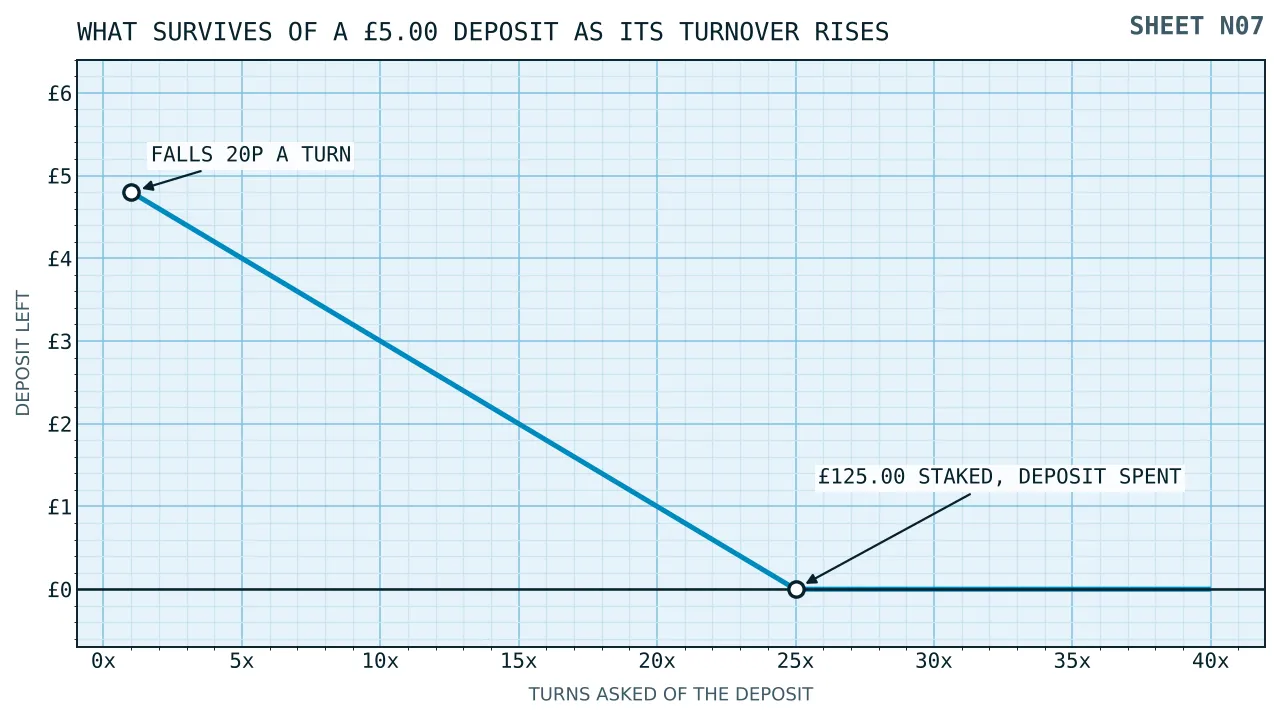
25 turns, £125.00 staked, and the deposit exactly spent
4
Stake size moves the clock, never the bill
A multiple on a deposit carries a second cost, measured in time rather than money, and that is the one readers underestimate. Staking is counted in pounds, so the question is how many cycles those pounds take.
| On the deposit | Cycles at 10p | At the 2.5 second floor |
|---|---|---|
| 1 turn | 50 | 2 min 5 s |
| 10 turns | 500 | 20 min 50 s |
| 25 turns | 1,250 | 52 min 5 s |
| 40 turns | 2,000 | 1 hr 23 min 20 s |
The pace under a British licence has a published floor. No slot may open its next cycle until 2.5 seconds have gone by since the last one opened, which turns two thousand cycles into 5,000 seconds at the very least. Nor will automation shorten the chore: a cycle starts only when the customer commits to that cycle, one commitment at a time, and the single exception the standard allows is the posting of blinds at poker.
A reader doing the sums might reasonably try to escape the clock by staking larger. It works, and it buys nothing. At £1.00 a cycle, forty turns of the fiver is two hundred cycles and 500 seconds, a little over eight minutes. The staking still costs £8.00, because the four pence is taken out of every pound that passes and the machine neither knows nor cares how many pulls delivered it.
So the two ceilings a British licence puts on a slot cycle govern how long the chore lasts and not how much it costs. A cycle is held to £5.00 where the player has reached twenty-five, which makes the entire deposit one cycle. Below that age the ceiling is £2.00, so the fiver is two cycles at the limit with a pound over. Both ceilings belong to slots alone; blackjack and roulette sit outside them.
One consequence deserves stating because it runs against instinct. A short clock makes a deposit requirement feel cheap and a long one makes it feel dear, while the expected bill is identical. Judge the condition by its multiple and the time by your evening, and keep the two judgments apart.
5
How far the published ceiling actually reaches
From 19 January 2026 the incentives code has carried a ceiling over conditions like this one, and the wording of that ceiling repays close reading. A licensee must not ask customers to play bonus funds through at above ten times, and the Commission’s definition of such a requirement is wagers that have to total some stated value before money can be withdrawn. Scope is every licence bar the machine technical and software ones, which puts a remote casino squarely inside it.
Look at what that sentence is about, which is bonus funds. A condition written on the reader’s own deposit is a different pot, and the Commission has published no worked case on a requirement reaching the deposit as well as the bonus. The honest course is to follow the published wording as far as it goes and then stop. Ten times is the published ceiling over bonus money. Nothing published says what the number may be on yours.
Which is why section 3 prices a range rather than a figure. A reader who finds forty times written on a deposit has not found a breach of the cap, and has not found anything the cap blesses either. They have found a term the published ceiling does not address, and therefore one they have to cost for themselves.
Money paid in is protected differently from money given, and the difference is published. A licensee is barred from leaning on any term that works, by design or by effect, as a ceiling over what a customer may take back out of their deposit balance. An illustration the regulator itself gives caps a week at five hundred pounds and a day at fifty. Beside it sits the entitlement: that balance, and the winnings inside it, can be taken out whenever the customer likes, with whatever limits exist on the size or frequency of a withdrawal having to be reasonable ones. Notice that the object of all this is an amount. What a bonus is allowed to win can be capped, and this particular rule does not forbid that. Telling the two apart is most of what reading a set of terms consists of.
A second rule governs which products may be bundled, live from the same January day. A single incentive may hold one type of gambling product out of betting, casino, bingo and lottery. A slot counts as a casino game, so pairing cycles with casino credit keeps an incentive inside a single type and leaves a package of this shape untouched. Three allowances run against instinct. Two products from inside one type are fine, and the published pairing is a scratchcard with a raffle. Separate betting and casino offers may travel in one email where marketing consent covers each of them. And where a credit may be spent on whatever product the customer fancies, the ban does not reach it at all.
Where a deposit requirement does get named outright is in the advertising rules. The conditions significant enough that dropping one tends to mislead are listed by the ASA, and a deposit or wagering requirement is on that list, alongside any floor under the odds or restriction of bet type, the time there is to claim an offer or use it, and who qualifies at all by age, by location or by never having held an account. CAP Code rule 8.17 then wants every significant condition carried clearly and prominently, and the Commission’s advertising page is blunter still: terms shown without enough prominence make the advertisement a misleading one. Its checklist for players aims at the same hole, telling them to look at what restricts an introductory offer, a floor under spending before the bonus is paid being the example given.
6
Five pounds through a British cashier
A first payment of £5.00 sets off a list of duties with nothing to do with the spins and everything to do with the money. Naming them one by one is the only way to show what their absence costs.
Identity, before any cycle turns
Three things have to be obtained and checked before anybody may gamble: date of birth, address and name. That duty does not stop at staked money. Bonus play sits inside it, a free bet too, and so do the free-to-play versions a licensee puts on its own website, which the Commission itself notes fall outside gambling for want of a prize. Operators once had three days to finish an age check after letting somebody play, and that latitude went with the rules brought in on 7 May 2019. A licensee also cannot hold a first withdrawal hostage to information it could reasonably have asked for when the account opened.
A limit offered first and declined on purpose
The live technical standard treats a financial limit as the thing that happens unless the customer stops it. The prompt comes either inside registration or when that first payment is made, saying no takes a deliberate act, and that refusal must be recorded before anything is deposited or staked. The sum is typed into a free text field rather than picked off a list, a limit reaches the whole account at minimum, and the durations on offer have to include a day, a week and a month. Reductions land immediately. An increase sits out twenty-four hours at the least and then needs confirming afresh. One wrinkle is worth flagging: the standard puts the prompt at registration or at that first payment, while the Commission’s summary of the October 2025 changes words it as early as possible, and those are not the same instruction.
Thresholds, counted in fivers
Above a monthly net deposit figure the light-touch financial checks engage. The threshold arrived at £500 a month from 30 August 2024, and from 28 February 2025 it has stood at £150. At £5.00 a payment it takes thirty of them to get there. The heavier assessments remain a pilot, are not running live against customers, and the Commission says neither exercise touches a credit rating.
How the fiver may travel
A credit card will not buy it. The prohibition dates from 14 April 2020, and the condition closes the obvious detour in its own words, because routing a credit card payment through a money service business leaves it a credit card payment still. Note also where the duty on the money falls. Remote gaming duty is charged on the operator at 40 per cent of its gaming profits from 1 April 2026, having been 21 per cent from 1 April 2019, and it follows the customer’s usual residence rather than the operator’s address. An operator sitting outside the United Kingdom still has to register and pay where it offers remote gambling to somebody whose usual home is here. On the player’s own side, HMRC’s published position is reached by absence rather than by a charge: betting and gambling do not of themselves amount to trading, which is why winnings are not trading income.
7
Five pounds outside the British licence
Offers at this end of the market commonly come from operators holding no Great Britain licence, and that single fact removes everything named in sections 5 and 6 at a stroke. Writing out what goes is more useful than calling the result unregulated, because the arithmetic changes in particular places.
What stops applying to the deposit
No ceiling of ten times over a requirement on bonus money, so nothing published puts an upper bound anywhere near the condition priced here. Nothing forbidding a term that limits how much comes back out of a deposit balance. Nothing stopping a cashier offering to cancel a withdrawal after it has been requested, which a British standard rules out flatly. No credit-card prohibition. No prompted financial limit with its typed figure and its required durations. No check triggered above a monthly deposit figure.
What stops applying to the cycles
No floor of 2.5 seconds under the gap from one slot cycle to the next, so two thousand of them take whatever time the software permits. Nothing barring autoplay. Nothing barring turbo, quick spin or slam stop. Nothing to stop a game dressing a losing outcome up as a near miss, and nothing to stop it making a fuss of a return that failed to cover its own stake. Nothing holding a cycle to £5.00 or £2.00. No check on identity before a bonus cycle turns, which is the floor under every offer on this site.
What the Curaçao rulebook puts there instead
Bonuses get two sentences in the policy read for this site: terms communicated transparently and clearly, and no aggressive promotion that would encourage excessive gambling. No multiple is capped anywhere in it. The mandatory list there covers deposit limits, cooling-off and self-exclusion run by the player, behaviour tracking, self-assessment, age verification, information a player can get at, training for staff, affiliates and marketing partners, and general principles for advertising. Deposit limits are genuinely required, running daily, weekly or monthly, and on one point Curaçao is the stricter of the two: an increase there sits out a full week, where Britain asks for a day. Honesty cuts both ways and that comparison belongs in the open.
Exclusion, and what it does not cover
A British licence brings membership of Gamstop Online with it, and one registration shuts the accounts at all of them from a single place. The scheme states its own boundary plainly and a reader should take it literally: it can exclude somebody from the gambling services of participating operators, and it is unable to prevent access to services run by organisations outside the scheme. Curaçao requires self-exclusion too, but operator by operator rather than across a register, and its own answer to other sites is to encourage the player to exclude themselves from each of them separately. The shortest period on offer there is a year against six months here, a lifetime option exists where the longest single British choice is five years, and once confirmed a Curaçao exclusion cannot be revoked before it expires.
Complaining about a fiver
Three working days is what a British licensee gets to acknowledge a complaint, down to twenty-four hours where its gambling runs around the clock, and the whole process has eight weeks from receipt, ending in a letter that explains how to reach an adjudicator the Commission has approved. Eight entities hold that approval and only some of them take remote casino work. Curaçao’s framework is closer than a reader might expect: six months to lodge a complaint, four weeks to answer it, extendable once in writing to eight weeks in all. Where the two part company is authorship. The British list of adjudicators is approved by the regulator, while the Curaçao policy contemplates an operator setting the parameters of its own dispute route, including whether a claim must be worth some minimum before escalation is available, and how far the result binds the player. On a £5.00 deposit that last clause is not academic.
8
Pricing a multiple that sits on your own money
Five questions, and the third is the one the headline hopes nobody asks.
| The question | Answer here |
|---|---|
| What leaves your account | £5.00 |
| The count, and the price of one | 100 at 10p |
| Which pot carries the turnover | The deposit |
| Multiply it, then take 4p a pound | £2.00 at ten turns |
| Cycles, plus the remainder, less the stake | £7.60 |
The third question is the portable one. A different spin price does not retire it, nor a different game, nor a different cashier, and it is what separates one package from another whose advertising is word for word the same. Ask it of any arrangement that pairs a payment with a count of cycles.
Two things the bottom figure is not. It is not a forecast of an evening: a hundred cycles is a short sequence of random events, and where a slot keeps its money in rare large prizes the single likeliest result sits far below £9.60, with the fiver gone as well. Nor is any of it lifted from a published set of terms. The multiple used in part 3 is this sheet’s assumption, stated plainly so that a reader with real terms in front of them can substitute the number and run the line again.
Three neighbouring sheets subtract what this one holds steady. The same trade with no condition at all on the money paid in is costed under deposit £10 get 200 free spins, where the rate doing the work is twenty cycles to the pound. A fiver handed over with no payment whatever stands at free £5 no deposit casino, which prices the same sum when it belongs to the cashier. The form the winnings are credited in, cash against bonus money, decides 30 free spins, keep what you win. A ceiling over the winnings themselves is priced under 50 free spins no deposit no wager. Every sheet in the set stands together under Nothing asked back, which lists the debit deciding each one.
Questions
- What is a £5 deposit with 100 free spins actually worth?
- £7.60 expected where the deposit carries ten turns. The hundred cycles at 10p are £10.00 of face and average £9.60 back at a 96 per cent return, with no turnover written over them. The fiver, turned over ten times, loses £2.00 of its own value and leaves £3.00. Add the two, take out the money paid in, and £7.60 remains, which is £1.52 for each pound exposed.
- If the spins carry no wagering, why is there a multiple at all?
- Because it was moved rather than removed. A package of this shape writes the turnover onto the money paid in, so the promise about the cycles can be perfectly true while the deposit stays locked until it has been staked some number of times. Cycles and deposit are separate pots, and each needs a line of arithmetic to itself.
- How much does one turn of a £5 deposit cost?
- 20p, on these figures. Push five pounds through a 96 per cent game and four pence in each pound stays behind, which on five pounds comes to twenty. Ten turns cost £2.00 and twenty cost £4.00. The loss is flat, so no multiple makes the grinding cheaper per turn than any other.
- At what multiple does the £5 disappear altogether?
- Twenty-five. That demands £125.00 of staking, the 96 per cent game keeps a twenty-fifth of what passes, and a twenty-fifth of £125 is the fiver itself, so the deposit is expected to be spent to the last penny. Above twenty-five the sum reads as a loss bigger than the deposit, which in practice means the balance empties before the condition is met and the requirement goes unsatisfied.
- Does the ten-times cap cover a requirement on my own deposit?
- Nothing published says either way. The British ceiling of ten times took effect on 19 January 2026 and its object is bonus funds, with no worked case published on a requirement that reaches the money a customer paid in. The published chain therefore stops at bonus money, and a figure written on your own deposit has to be costed rather than assumed to be capped.
- Can a licensed operator stop me taking my deposit out?
- Not by capping the amount. A term working as a maximum on what a customer draws out of their deposit balance is one a British licensee may not rely on, and the regulator’s illustration of such a clause caps a week at five hundred pounds and a day at fifty. That balance, winnings and all, is withdrawable whenever the customer asks, and any limit on the size or frequency of withdrawals has to be a reasonable one.
- How long would forty turns of a £5 deposit take?
- At 10p a cycle, two thousand cycles and 5,000 seconds at the floor, which is one hour twenty-three minutes and twenty seconds. A slot must let 2.5 seconds elapse before a further cycle can be commenced, and each cycle needs its own commitment because autoplay is not allowed. Staking a pound a cycle cuts the time to about eight minutes and leaves the £8.00 cost exactly where it was.
- What goes missing where the cashier has no British licence?
- Every duty that priced this sheet. Nothing published caps a wagering multiple out there. No rule stops a term limiting what comes back out of a deposit balance, no prohibition on paying by credit card, no prompt putting a financial limit in front of you, nothing holding two slot cycles 2.5 seconds apart, nothing barring autoplay or turbo, no ceiling of £5 or £2 on a cycle, no check on identity before a bonus cycle turns, and no membership of Gamstop Online. Curaçao does insist on deposit limits, and an increase there waits a week against Britain’s single day.