
Sheet P02 Revision 1 Checked 15 October 2026
Online casino UK
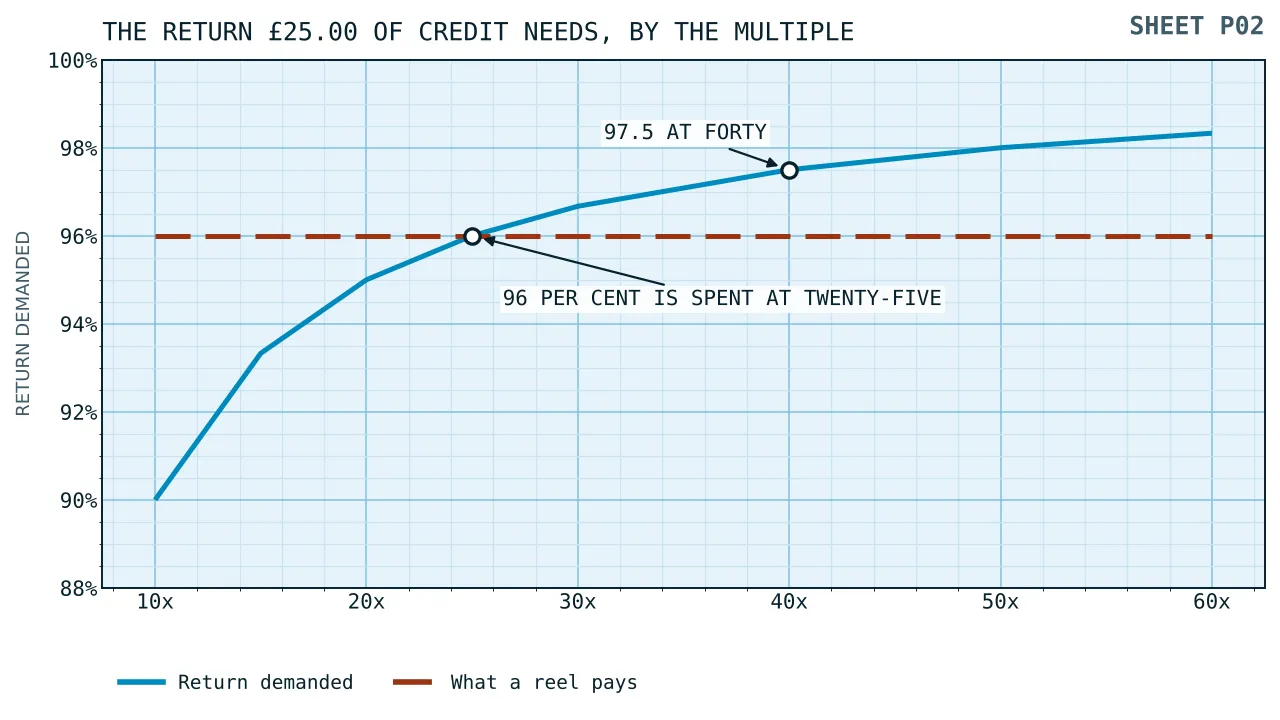
Twenty-five pounds of casino credit at forty turnovers owes £1,000.00 of staking. For a penny of it to survive, the room has to hand back more than 97.5 per cent. A competitive reel pays 96, which bills £40.00 against credit of £25.00.
97.5 per cent demanded, 96 per cent available
What the room leaves of the credit
Every destination on this spike is bought advertising. The site takes a fee if a reader goes on to register, and no figure printed below moves because of it.
The Spin Sheet
Till receipt No 01
Betportal
Lowest multiple here
For every €1 of spin credit at face per €1
Credit
Debit
No Great Britain licence
Licensed in Anjouan, Comoros, run by BetPortal Gaming Ltd, with Excite Ultra Media Ltd, reference ALSI-202601040-FI2.
Terms read 15 October 2026
Open the offer at Betportal, opens in a new tabThe Spin Sheet
Till receipt No 02
WinBeast
Five staged matches
For every €1 of spin credit at face per €1
Credit
Debit
No Great Britain licence
Licensed in Curaçao, operator not named on the site.
Terms read 15 October 2026
Open the offer at WinBeast, opens in a new tabThe Spin Sheet
Till receipt No 03
EliteSpin
Longest spin window
For every £1 of spin credit at face per £1
Credit
Debit
No Great Britain licence
Licensed in Costa Rica, run by PrimeTier Limited.
Terms read 15 October 2026
Open the offer at EliteSpin, opens in a new tabThe Spin Sheet
Till receipt No 04
Crown Jewelz
Multiple unpublished
No total struck
Credit
Debit
No Great Britain licence
Licensed in Curaçao, number not verified, operator not named on the site.
Terms read 15 October 2026
Open the offer at Crown Jewelz, opens in a new tabThe figure at the foot of a receipt is this site's own arithmetic and nothing an operator has published: the credit, less the share a spin gives back at 96 per cent return to player, less what playing the wagering through costs at the same return. It describes the offer, not one reader's afternoon. Where the conditions price above the credit the receipt prints nothing rather than a negative sum, and where a figure the sum needs is unpublished it prints the condition in the operator's words instead.
Three words stand in the amount column where no figure can. Noted is a published condition that takes value away without leaving the sum a figure to take. Unpriced is a condition whose figure nobody has published, or a credit that is not a sum until a deposit of your own sets it. Own money is money of yours, which is never part of a total.
Not one of the operators printed above holds a Great Britain licence, so the duties that licence carries do not reach them. Every online gambling company licensed in Great Britain has to be part of Gamstop Online, and a reader who has shut themselves out through the scheme is therefore not shut out here. The ceiling of ten times the bonus funds on a wagering requirement, in force since 19 January 2026, is a condition of that licence and binds the companies that hold one. Where a dispute goes instead is a matter for the authority named on the receipt, and the Gambling Commission describes what a reader faces without a British licence as a lack of recourse if things go wrong. Nobody under 18 may hold an account at any of them.
Every term printed on a receipt is the operator's own, and each receipt carries the day it was read. The oldest of those readings is 15 October 2026. What binds a reader is the operator's own full terms, and not a line printed here.
1
£25.00, and the building it is locked inside
A casino credit is a voucher for one building. It cannot be taken to the shop, moved to a rival cashier or spent on anything the terms exclude, so what it is worth is set by the games it may be spent on and by how those games count. Twenty-five pounds is the working credit on this sheet.
Two quantities belonging to the room decide the answer, and neither one appears on the front of an offer. One is the share the games give back, which this site takes at 96 per cent for a reel. The other is the fraction of each staked pound a cashier will book against the condition. Both sit inside the arithmetic rather than beside it, and between them they can turn a generous headline into nought without altering a digit of it.
So the order of reading is inverted here. The percentage on the front is the least informative line in the document. The games clause and the weighting schedule are the two most informative, and they are usually the two furthest from the button a reader came to press.
Where the credit came with no payment behind it, the credit is the whole exposure. Where a payment bought it, the payment sits in the same balance and absorbs any overshoot, which is a separate calculation and gets its own sheets elsewhere on the site. This one holds the payment at nothing so that the room, and only the room, is doing the work.
Five inputs, two of them owned by the room:
- Credit of £25.00 at face, with nothing paid in behind it.
- Forty turnovers, a magnitude written into terms once a British register has stopped applying. Ten turnovers binds a licensee.
- Stakes of 10p, which settles the count of commitments and not the money.
- A return of 96 per cent, the room’s first contribution, used for reels and asserted for nothing else.
- Full weight, the room’s second contribution, meaning a staked pound clears a pound of the condition.
2
A thousand pounds of staking, named before any percentage
One figure on this page owes nothing to the room at all. Multiply twenty-five pounds by forty and the contribution owed is £1,000.00; the credit and the multiple are the only inputs. No return enters that step and no weighting enters it.
A thousand pounds against twenty-five is the ratio worth carrying away, because the ratio is the multiple itself and survives every change to the size of the credit. Each pound of credit drags £40.00 of staking behind it. Double the credit and the obligation doubles; the ratio does not budge.
Read as a count rather than as money, £1,000.00 at 10p a commitment is 10,000 commitments. A British reel game holds the next cycle back for 2.5 seconds after the last one begins, which puts a floor of 25,000 seconds under those 10,000 commitments: six hours, fifty-six minutes, forty seconds, and a floor is not a forecast. Automatic play is barred and so is any control that shortens the wait for a result, which is what makes the floor a floor rather than a suggestion.
Nothing in that paragraph is a cost. It is a quantity of turnover and a quantity of time, both exact, and the whole remaining question on the sheet is what the room charges for them.
10,000 commitments of 10p, floored at 25,000 seconds
3
The return a multiple demands
Turn the usual question round. Instead of asking what a credit is worth at a known return, ask what return would be needed for the credit to be worth anything at all. The answer is a percentage, and it is the sharpest figure on this sheet.
Set the residue to nought. The credit divides out of both sides, which is why the size of a credit never appears in the test, and what is left is a statement about the multiple, the weight and the return together. Hold the weight at one and solve for the return: it has to beat one minus the reciprocal of the multiple. Forty turnovers therefore demands better than 97.5 per cent.
| Turnovers written into the terms | Return demanded, per pound staked | Residue on the credit at 96 per cent |
|---|---|---|
| Ten, the ceiling on a licensee | above 90p | £15.00 |
| Fifteen | above 93.33p | £10.00 |
| Twenty | above 95p | £5.00 |
| Twenty-five, where it turns | above 96p | £0.00 |
| Forty, as worked on this sheet | above 97.5p | £0.00 |
| Sixty, a figure the regulator recorded | above 98.33p | £0.00 |
The middle figures are demands and not descriptions. Nothing on this sheet asserts that a casino game pays any of them. The arithmetic simply restates a multiple as the open-handedness it would require, and the requirement escalates fast: past twenty-five turnovers it exceeds the 96 per cent a competitive reel is built around, and at sixty it wants better than 98.33 per cent. Sixty is not an invented figure either. It is the regulator’s own, put on what the ceiling was there to correct: requirements that high, it recorded, were in use at some licensees.
The residue figures beside them read the same condition at 96 per cent, and they put the entire worth of the regulated ceiling into one comparison. Ten turnovers of £25.00 owes £250.00, costs £10.00 and leaves £15.00. Forty turnovers owes £1,000.00, costs £40.00 and leaves nothing, with £15.00 of overshoot behind it. Sixty pence in every pound of credit, lost to a single line of a document, with the room and its games unchanged throughout.
4
The expression, with the return as the unknown
Everything to this point is one expression read from several ends.
E = B × (1 – (W × (1 – RTP)) / g)
Insert the credit at face for B, twenty-five pounds of it. W is the turnovers demanded, forty in all. RTP is the proportion the room returns, 0.96 on the reel figure, which hands the house four pence of each pound put through it. The weight g holds at one. E is what remains when the condition has been worked off.
Forty turnovers of B = £1,000.00 owed in contribution
Charged at four pence in the pound = £40.00 expected
E = £25.00 less £40.00, which is -£15.00
Four pence in the pound over £1,000.00 of staking comes to £40.00, charged against credit of £25.00, so the condition runs past the credit by £15.00. With no payment in the balance to take that overshoot and a balance that stops at nought, the foot prints £0.00, and the fifteen pounds is staking that never gets taken.
The useful rearrangement is the one that throws B away. Divide both sides by the credit and the test reads: the multiple over the weight, compared with twenty-five. Twenty-five is four pence in the pound turned upside down, so the room supplies it and no committee chose it. A room keeping three pence would put the hinge at 33.3; a room keeping five would put it at twenty.
Two things follow, and both are worth more than the credit’s size. The answer at forty turnovers is nought whether the credit is twenty-five pounds or two hundred and fifty. And the weight needed at forty turnovers is 1.60, which no schedule can deliver, since a staked pound is not given a worth above its own face anywhere.
W over g under 25, or the foot reads nothing
5
Weighting, which sits under the line
Weighting is the quietest line in a bonus document, and where it sits in the expression makes it the line most able to decide the answer.
It is a divisor, not a subtraction. A condition written as £1,000.00 is denominated in contribution rather than in stake. At a pound in the pound the two quantities are the same number. Where a pound contributes less, the obligation stays at £1,000.00 and the staking needed to earn it rises by the reciprocal, with the expected cost rising in step and the credit sitting exactly where it was.
Divide the multiple by the weight and out comes the effective multiple: the quantity actually faced, and the one no document has to print. At forty turnovers and half weight it is eighty. At a quarter weight it is a hundred and sixty.
| What a staked pound counts | Contribution owed | Effective turnovers | Staking needed | Expected cost | E |
|---|---|---|---|---|---|
| A pound in the pound | £1,000.00 | 40.0 | £1,000.00 | £40.00 | -£15.00 |
| Fifty pence in the pound | £1,000.00 | 80.0 | £2,000.00 | £80.00 | -£55.00 |
| Thirty pence in the pound | £1,000.00 | 133.3 | £3,333.33 | £133.33 | -£108.33 |
| Ten pence in the pound | £1,000.00 | 400.0 | £10,000.00 | £400.00 | -£375.00 |
The contribution column never moves, which is the point of printing it. Only the staking needed to earn it moves, and because the relation is a reciprocal the last step down costs more than every earlier step put together: from thirty pence to ten pence adds £6,666.67 of staking to a condition that began at £1,000.00.
Of the weights on this page only thirty pence in the pound has any provenance. In the consultation behind the ceiling, somebody responding described a hundred pound bonus carrying ten turnovers at a thirty per cent rate, with the effect that a wagered pound discharged thirty pence of it. The point was written down. Weighting was then left exactly as it stood. The rest are inputs picked to show the shape of the curve, since nobody publishes a citable table of what a given game contributes.
Rearranged into a rule a reader can use at the cashier: the weight has to beat the multiple divided by twenty-five. Ten turnovers wants better than forty pence in the pound. Twenty wants better than eighty. Twenty-five and upwards cannot be rescued at any weight whatever, which is the whole of why the multiple is read first and the weight second.
6
Four rooms, four sets of rules
A British casino is not one room with one rulebook. Design standards are drafted product by product, and a credit’s worth travels with whichever product its terms confine it to. Four cases, each with the rules that attach to it.
The reel room
A reel game carries the whole set. A floor of 2.5 seconds stands before the next cycle may be commenced, and the start control wants releasing and pressing afresh, so a held-down key begins nothing. Automatic play is out. A customer may not be permitted to shorten the wait for a result, so slam stop, quick spin and turbo all go; the guidance spares only feature rounds that take no extra stake, reveal-all and scratch-all controls, and games where the stake goes unless the player acts. Where the money coming back is no more than the money staked, the system may not celebrate it: no win-related sound, no win-related animation. Three substitutes are suggested instead: putting the amount awarded up, showing the winning lines for a moment, and sounding one short note as the credit arrives. Statute caps a single game cycle at five pounds, and at two where the customer has not yet reached 25, under an instrument made 25 February 2025. The calendar belongs to the regulator and not to the instrument: five pounds from 9 April 2025, two pounds from 21 May.
The table room
Roulette, blackjack and the rest take a different interval: five seconds, with poker between players lifted out, on a requirement the regulator’s updates page dates at 17 January 2025. No part of RTS 14 carries a commencement date on the standard, and none is asserted here. The stake caps do not follow them. Both figures are for online slots, says the regulator, and no other casino game falls inside them, roulette and blackjack being its own examples, so a credit clearable at a table meets no statutory ceiling on a single wager. That cuts both ways: a condition clears faster, and nothing stands between a customer and a very large single bet.
The ticket room
Bingo stands as a product type in its own right, and RTS 14 puts no clock on it. Nor do the stake caps reach it: an online slots game means a reel-based game played online, and a ticket has no reel on it. The bar on automatic play does reach it. That one covers gaming with bingo inside its scope, wants each game cycle committed to separately, and makes one exception only, for the blind that posts itself where poker is played player against player. The disclosure position is where this room differs most sharply from the rest. What a licensee has to put within easy reach before a customer commits is information fit to let them judge their own chances of winning, and the standard then names four items with or between them. Any one will do. They are a return percentage; a house edge or margin; the probability of winning events occurring; and a description of the way a game works, the way winners are determined and the way prizes get allocated. Where bingo is concerned the guidance treats the prize-allocation description as enough by itself, so a ticket room may publish no percentage and still be fully compliant.
The live room
A dealt table is the case where the room’s return is fixed by the rules of the game rather than by a configuration file, and where nothing on this sheet will put a figure on it. The sourced position is the disclosure duty and its four alternatives, nothing more. Pace follows the five-second requirement for casino games away from the reels, and the prohibition on running games simultaneously means an obligation cannot be divided between four windows. A further British rule bites here from 17 January 2025: functionality led by the operator for playing several products simultaneously is banned, and the illustration the release gives is a roulette table beside a blackjack table.
| The rule | Where it reaches |
|---|---|
| A 2.5-second floor between cycles | Reels only |
| A five-second floor between cycles | Casino away from the reels, poker between players apart |
| Stake caps of £5 and £2 | Reels only |
| No automatic play | All gaming, bingo inside it |
| No turbo and no slam stop | Casino |
| A published return percentage | Nowhere: three alternatives satisfy the duty |
Set that against the arithmetic and the lesson is narrow. The games clause decides which row of the schedule a reader is standing on, and the two rows that matter most to the expression are the last two, since one decides how fast £1,000.00 can be put through and the other decides whether the cost of putting it through can be computed at all.
7
What a British licence puts in the building
Three things a licence buys are worth pricing rather than listing, because each one touches a figure already on this sheet.
The first is the ceiling on the multiple. A licensee’s requirement has been stopped at ten turnovers of bonus funds since 19 January 2026, by a provision covering every licence except the technical and the software ones. Worth £15.00 on this credit, which is sixty per cent of it.
The second is the rule confining one incentive to one product type, in force the same day. Four types are counted: betting, casino, bingo and lottery. Reels and a cash match are both casino, so they may travel together; tickets and reels may not. Three carve-outs sit beside it, and all three cut against a reader’s first guess. Two items inside a single type are allowed, a raffle beside a scratchcard being the regulator’s own illustration. One email may carry two separate offers so long as the customer has opted in for both. And a credit the customer may put on any product they choose sits outside the ban completely.
The third is the standard the terms themselves must meet. An incentive’s terms have to be clear, they have to be fair, they have to be transparent, and anybody the incentive is put to has to be able to get at them easily. Licence condition 7.1.1 then applies four tests to the contract itself. Unfairness is measured by the Consumer Rights Act 2015, and a licensee must also honour whatever terms it wrote. Transparency is measured by the same Act, and the contract terms have to be somewhere a customer can easily get at. A material change is to be notified before it takes hold. And the fourth test bars unfair commercial practices right across the relationship, on the meaning given by the digital markets and consumer statute of 2024. Anybody three days into a £1,000.00 obligation cares most about the third test.
The regulator also sets a player a check of their own: a licence held; a licensed status put up where it can be seen; the public register within a click; and the register’s own record of activities and domain names tallying with the site in front of them. What gets published is a set of registers: businesses holding licences, personal licences, premises, and regulatory actions taken. What is not published is any guidance on reading a domain name recorded beside a licensee, which is why a check of that kind carries the date it was made and claims nothing further.
There is a boundary a licence does not shift. We are not an ombudsman, the regulator writes of itself, and it goes on: no powers to resolve gambling complaints or get a consumer’s money back, nothing it can do about a disputed withdrawal or a game that broke, and no sight of a customer’s account at all. Take it up with the business first, it says, and a final letter must explain the way out to an independent adjudicator. Only a body it has approved may serve as that adjudicator, and eight are named on its list, five of them covering remote play across all sectors.
8
Away from the register, where nothing is written
A room holding no Great Britain licence prices its credit by its own terms, with the weight set by the cashier and reviewed by nobody. The loss is specific rather than general, and it can be put as a question with a list for an answer.
Ask what the building would owe a player on the British register, and the answer runs: a multiple stopped at ten turnovers of bonus funds; one product type to an incentive; five pounds and two pounds as statutory ceilings on a reel stake; floors of 2.5 seconds and five seconds between game cycles; no automatic play; no turbo and no slam stop; no fanfare for a return that fails to beat the stake; no two games running at once; no losing event dressed as a near miss; no button to take a withdrawal back after it has been requested; no upper limit set on a withdrawal from the customer’s own deposit balance; identity verified ahead of every kind of play, free-to-play rounds and bonus rounds alike; no payment by credit card; a prompt to set a financial limit, with the limit as the default and reductions taking effect at once; financial vulnerability checks above a monthly threshold of £150 since 28 February 2025; a complaints process finished inside eight weeks with an escape to an approved adjudicator; and a place on the national self-exclusion register. Ask the same question away from the register and the answer is whatever that cashier chose to write.
The Curaçao rulebook read for this sheet is the fair comparison, because it exists and can be opened. Its mandatory responsible gaming list covers age verification, accessible information, player self-assessment, behaviour tracking, cooling-off periods and self-exclusion, deposit limits, the training of staff, affiliates and influencers, and general principles for marketing. Bonuses get two sentences: terms communicated transparently, and no aggressive promotion encouraging excessive play. Nothing in it caps a multiple. Nor does weighting appear, nor a stake ceiling, nor a minimum game cycle, nor a bar on automatic play, nor a word about fanfares for a return that fails to beat the stake.
It is stricter than Great Britain in one place, which is worth saying because it runs against expectation. Cutting a deposit limit there is immediate; raising one waits seven days, against a British cooling-off period before an increase of at least 24 hours. On identity it is plainly weaker. Registration asks the player to confirm a date of birth. The document check, a passport or a national identity card or a driving licence, is pinned to milestones that arrive later in the relationship, and gets pulled forward only where the operator has a doubt about age. Great Britain runs it the other way round, verifying three things before a customer gambles at all: the name, the address, the date of birth.
Self-exclusion is the cleanest difference of the lot, because the reach of the British scheme is set by the licence and not by the site. Gamstop Online comes attached to a British online licence, so the scheme reaches every operator down one side of this market and none at all down the other. The boundary is in its own terms: it cannot assist in keeping anybody away from gambling services run by operators that are not participants. Figures it released on 16 July 2026 count 614,738 registrants. Sign-ups in the first six months of that year ran 16 per cent ahead of the half-year before, and better than one registrant in two had taken the five-year period. Curaçao requires self-exclusion too, operator by operator across whatever domains that operator runs, with one year as the shortest term offered and no revocation before the period ends. No line here assists anybody round a protection they put in place for themselves, and the helpline numbers stand beneath the questions.
One sourced point runs the other way and belongs here for honesty’s sake. Offer remote gambling, spread betting apart, to a person whose usual home is the United Kingdom, and British gaming duty reaches you wherever your office sits, licence or no licence. Remote Gaming Duty went to 40 per cent of a gaming provider’s profits on 1 April 2026, having stood at 21 since 2019. The charge falls on the operator. On the player’s side HMRC’s manuals treat betting and gambling as not of themselves a trade, so the profits are not trade profits and no relief runs for the losses, and this sheet claims nothing beyond that.
9
Reading a room before the credit lands
Six readings, and the two that decide it are the two nobody takes.
| What to read | Here |
|---|---|
| Credit at face | £25.00 |
| Turnovers, from the wagering line | 40x |
| Contribution owed, exactly | £1,000.00 |
| Return, from the games the credit buys | 0.96 assumed |
| Weight, from the schedule | 1.00 assumed |
| W over g against 25, and the foot | 40.0, £0.00 |
Lines one, two and three are printed and exact. Lines four and five are the room’s own, and both are ordinarily absent from the document a reader is being asked to accept. Where either is missing, the sixth line is an estimate wearing the clothes of a figure, and saying so is more useful than filling the gap from somewhere.
Then the test, in one move. Divide the turnovers by the weight and set the answer beside twenty-five. Under it, something survives and the rest of the terms are worth reading. Over it, the foot is nought and the only question left is how many hours the nought takes to arrive at. At forty turnovers and full weight the answer is forty, so this credit is on the wrong side of the line before the games clause has even been found.
Two limits on the £0.00, and both are real. It is a mean. Over one attempt it describes nothing, and the likeliest single outcome of one attempt is an exhausted balance with the bulk of the £1,000.00 unstaked. And a term standing clear of the expression altogether can shut the answer down while the multiple, the weight and the return all stay as they were: a lid on what a bonus may win, an expiry date, or a discretion written in for the operator’s benefit. A clause of that last kind is the one bonus term anywhere carrying a published enforcement outcome. The sum was £170,000, the date 3 July 2025, and the clause a reserved right to close accounts or to forfeit winnings at the operator’s own discretion, sitting in the rules it had published for its new casino promotions. Fair and open dealing was the licensing condition the regulator held broken, and an independent third-party audit was required on top of the money. Nothing in the decision strikes the term down, and nothing here says it does.
A room is also what to read when a familiar game turns up on an unfamiliar site. The regulator has turned up games from licensed suppliers sitting on websites with no licence behind them, and £4.75m was the sum a supplier agreed to on 23 July 2026 over six such sites reaching consumers in Great Britain. Recognising a game tells a reader about its maker and nothing whatever about its host.
Where to read on depends on the room. A ticket room’s disclosure duties are taken apart at online bingo and a credit for one is priced at bingo no deposit bonus. A room with no trading record behind it is costed at new casino sites, the same credit on a short screen at mobile casinos, and the reels on their own at online slots UK. Sheets whose total depends on where a credit must be spent all sit under The room. How a receipt is struck carries the arithmetic common to them.
Questions
- What is £25 of online casino credit worth in the UK?
- Nothing at forty turnovers, and £15.00 at the British ceiling of ten. Forty turnovers of £25.00 owes £1,000.00 of contribution, which at a 96 per cent return is expected to cost £40.00 against credit of £25.00, so the residue is minus £15.00 and the foot prints £0.00. Ten turnovers owes £250.00, costs £10.00 and leaves £15.00.
- What return would a room have to pay before a forty-times condition left a penny?
- Better than 97.5 per cent. Take the reciprocal of forty away from one and that is the figure. At ten turnovers the demand drops to 90 per cent, at fifteen to 93.33, at twenty to 95 and at twenty-five to 96. Those are demands rather than descriptions, and beyond twenty-five turnovers they pass the 96 per cent a competitive reel is built around.
- Why does the size of the credit drop out of the test?
- Because it divides out of both sides. Set the residue to nought and the credit cancels, leaving a statement about the multiple, the weight and the return alone. So forty turnovers at a 96 per cent return prices a credit at nothing whether the credit is twenty-five pounds or two hundred and fifty, and the only quantities that decide the answer belong to the room rather than to the headline.
- Where does the figure of twenty-five come from?
- Invert what the room keeps and there it is. A 96 per cent return leaves four pence in the pound with the house, and one divided by four pence is twenty-five. A credit survives only where the turnovers divided by the weight land under that, and the weight has to beat the turnovers over twenty-five. A room keeping three pence would move the hinge to 33.3 and a room keeping five would move it to twenty.
- What does game weighting do to a casino bonus?
- It divides. The obligation stays at £1,000.00 whatever the weight, and the staking needed to earn it rises by the reciprocal, with the expected cost rising in step while the credit does not move. At fifty pence in the pound the staking becomes £2,000.00 and the cost £80.00. At thirty pence it is £3,333.33 and £133.33. At ten pence it is £10,000.00 and £400.00, on a credit of twenty-five pounds.
- Is a minimum spin speed the same across a casino?
- No, and the difference is written by product. A reel game carries a floor of 2.5 seconds before the next cycle may be commenced. Casino games away from the reels carry five seconds, with poker between players lifted out, on a requirement the regulator’s updates page dates at 17 January 2025. Bingo is its own product type and the standard times it at nothing. RTS 14 carries no commencement date on the standard for any of its requirements.
- Do the £5 and £2 stake caps cover roulette and blackjack?
- No. Both figures belong to online slots, which the instrument of 25 February 2025 defines as a reel-based game played over the internet, and the regulator states that they reach no other casino game, naming roulette and blackjack as games they leave alone. The calendar belongs to the regulator and not to the instrument: five pounds from 9 April 2025, two pounds from 21 May.
- Must a UK casino publish a return to player percentage?
- No, and this is routinely misread. Four items satisfy the duty and or stands between them: a return percentage, a house edge or margin, the probability of winning events occurring, or a description of how a game works and how its prizes get allocated. Where bingo is concerned the guidance treats the prize-allocation description as enough by itself.
- What is the most a UK casino can ask you to wager?
- Ten turnovers of the bonus funds. The provision took effect 19 January 2026 and covers every licence other than the technical and the software ones. Sixty times is the figure the regulator put on what it was correcting, recording that requirements that high were in use at some licensees, and it is the only market multiple the regulator itself supplies. On this credit the ceiling is worth £15.00, or sixty per cent of the twenty-five pounds.
- Does a casino game you recognise mean the site is licensed?
- No. The regulator has turned up games from licensed suppliers on sites holding no licence at all, and £4.75m was what one supplier agreed to pay on 23 July 2026 over six of them, reachable by consumers in Great Britain. A game identifies the company that built it. The register, read on the day, identifies the site.
- What does a casino with no Great Britain licence not have to do?
- A list, and each item binds a licensee. Stop the multiple at ten turnovers. Keep one incentive to one product type. Hold a reel stake under five pounds, or two for a customer under 25. Leave 2.5 seconds between reel cycles and five between other casino cycles. Offer no automatic play, no turbo and no slam stop. Decline to celebrate a return at or under the stake. Run no two games at once. Dress no losing event as a near miss. Verify identity before any play at all. Refuse credit cards. Prompt for a financial limit and apply a reduction at once. Finish a complaint inside eight weeks and point onwards to an approved adjudicator. Belong to Gamstop Online. Two sentences in the Curaçao rulebook opened for this sheet deal with bonuses. Nothing else on that list appears in it.