
Sheet M10 Revision 1 Checked 15 October 2026
100 free spins no deposit
One cycle in a hundred is worth 9.6p of winnings, and forty times loads 15.36p of expected cost on to it, which prices each advertised cycle at minus 5.76p. A hundred of them close the sheet at nothing.
minus 5.76p a cycle at forty times, nought a hundred times over
What the conditions leave
Every destination on this spike is bought advertising. The site takes a fee if a reader goes on to register, and no figure printed below moves because of it.
The Spin Sheet
Till receipt No 01
Betportal
Lowest multiple here
For every €1 of spin credit at face per €1
Credit
Debit
No Great Britain licence
Licensed in Anjouan, Comoros, run by BetPortal Gaming Ltd, with Excite Ultra Media Ltd, reference ALSI-202601040-FI2.
Terms read 15 October 2026
Open the offer at Betportal, opens in a new tabThe Spin Sheet
Till receipt No 02
WinBeast
Five staged matches
For every €1 of spin credit at face per €1
Credit
Debit
No Great Britain licence
Licensed in Curaçao, operator not named on the site.
Terms read 15 October 2026
Open the offer at WinBeast, opens in a new tabThe Spin Sheet
Till receipt No 03
EliteSpin
Longest spin window
For every £1 of spin credit at face per £1
Credit
Debit
No Great Britain licence
Licensed in Costa Rica, run by PrimeTier Limited.
Terms read 15 October 2026
Open the offer at EliteSpin, opens in a new tabThe Spin Sheet
Till receipt No 04
Crown Jewelz
Multiple unpublished
No total struck
Credit
Debit
No Great Britain licence
Licensed in Curaçao, number not verified, operator not named on the site.
Terms read 15 October 2026
Open the offer at Crown Jewelz, opens in a new tabThe figure at the foot of a receipt is this site's own arithmetic and nothing an operator has published: the credit, less the share a spin gives back at 96 per cent return to player, less what playing the wagering through costs at the same return. It describes the offer, not one reader's afternoon. Where the conditions price above the credit the receipt prints nothing rather than a negative sum, and where a figure the sum needs is unpublished it prints the condition in the operator's words instead.
Three words stand in the amount column where no figure can. Noted is a published condition that takes value away without leaving the sum a figure to take. Unpriced is a condition whose figure nobody has published, or a credit that is not a sum until a deposit of your own sets it. Own money is money of yours, which is never part of a total.
Not one of the operators printed above holds a Great Britain licence, so the duties that licence carries do not reach them. Every online gambling company licensed in Great Britain has to be part of Gamstop Online, and a reader who has shut themselves out through the scheme is therefore not shut out here. The ceiling of ten times the bonus funds on a wagering requirement, in force since 19 January 2026, is a condition of that licence and binds the companies that hold one. Where a dispute goes instead is a matter for the authority named on the receipt, and the Gambling Commission describes what a reader faces without a British licence as a lack of recourse if things go wrong. Nobody under 18 may hold an account at any of them.
Every term printed on a receipt is the operator's own, and each receipt carries the day it was read. The oldest of those readings is 15 October 2026. What binds a reader is the operator's own full terms, and not a line printed here.
1
A hundred cycles, and what one is worth
A hundred is the roundest headline in this part of the site, which makes it the right place to answer the question underneath all of them. What is one free cycle worth, once the condition attached to it has been priced?
Start at the top. A hundred cycles at 10p are £10.00 as advertised, and advertised is a gross figure. A cycle pays what the cabinet pays, and at a theoretical 96 per cent the cabinet holds back four pence from each pound that crosses it, which leaves £9.60 of average winnings. Forty pence is gone, and no condition has yet been applied.
So the credit is £9.60, or 9.6p for each advertised cycle. Hold on to the per-cycle figure, because part 3 prices the whole requirement in those terms and the answer becomes something a reader can carry away.
A cycle’s cash value is left to the operator, and no published rule fixes a floor, a ceiling, or anybody obliged to disclose it. Ten pence is the value this site works with. Double it and both the credit and the obligation double, which leaves every proportion on this sheet exactly where it was.
Forty times is the requirement throughout, since that is what gets attached to a no deposit count at this end of the market. Ten is the regulated ceiling in Britain and sixty is the figure the regulator recorded as in use before any ceiling existed, so forty sits between the two.
What the figures rest on:
- A hundred cycles priced at 10p, for £10.00 advertised and £9.60 averaged.
- A cabinet returning 96 per cent of what crosses it.
- A requirement of forty times, widened to seven values in part 3.
- A staked pound credited at its full value, which part 6 withdraws.
- Nothing paid in, which caps the exposure at the credit.
2
Nine pounds sixty inside the expression
The bill is settled by one expression, written out here before it is filled in. B stands in for the credit and W for the requirement. RTP is the theoretical return as a decimal, and g the slice of a staked pound that the requirement will count. Out of it comes E, in pounds.
E = B × (1 – (W × (1 – RTP)) / g)
With a hundred cycles in place of the letters:
40 × 0.04 = 1.60
1 – 1.60 = -0.60
E = -0.60 × £9.60 = -£5.76
The same thing arrives in two plainer steps. Forty lots of £9.60 is £384.00 of wagering before a withdrawal becomes possible, and the cabinet expects to keep four pence of each of those pounds, which is £15.36. Nine pounds sixty of credit has been sent to cover fifteen pounds thirty-six of cost.
Nobody has to find the difference. Nothing was deposited, so the balance cannot cross below nought, and the credit expires somewhere inside the £384.00. The minus five pounds seventy-six measures something else: the amount by which the condition outruns the gift.
Per cycle, that is 9.6p of credit set against 15.36p of cost, for a net of minus 5.76p. The hundred is a scale factor and the pence are the finding.
£384.00 of wagering owed against £9.60 of winnings
3
Seven requirements, priced per cycle
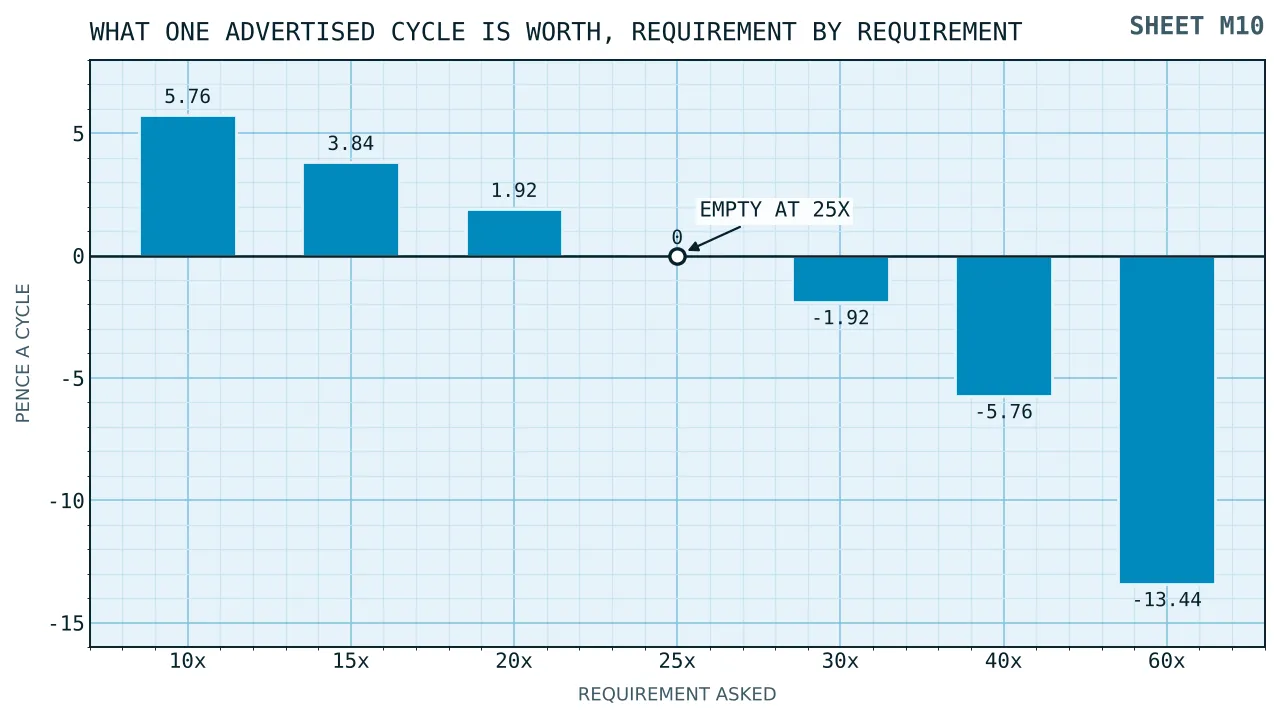
Nothing moves in the schedule below except W. The last column is the one to read, because it converts the whole exercise into the value of one advertised cycle.
| W | Wagering owed | Expected cost | Expected cash | Per advertised cycle |
|---|---|---|---|---|
| 10 times | £96.00 | £3.84 | £5.76 | 5.76p |
| 15 times | £144.00 | £5.76 | £3.84 | 3.84p |
| 20 times | £192.00 | £7.68 | £1.92 | 1.92p |
| 25 times | £240.00 | £9.60 | £0.00 | 0.00p |
| 30 times | £288.00 | £11.52 | -£1.92 | -1.92p |
| 40 times | £384.00 | £15.36 | -£5.76 | -5.76p |
| 60 times | £576.00 | £23.04 | -£13.44 | -13.44p |
The crossing sits at twenty-five however many cycles were handed over, the reciprocal of a four pence edge being twenty-five and the count having no part in it. Set the expected cash to nought in the expression and B divides out, which leaves W standing alone with the return.
Put the per-cycle column into words and a reader has a rule of thumb that survives the loss of this page. Take the regulated ceiling first: ten times leaves a 10p cycle on a 96 per cent cabinet worth something near five and three-quarter pence. At twenty-five it is worth nothing. At forty it is worth less than nothing by the same five and three-quarter pence, and at sixty it is more than thirteen pence in deficit.
Which also answers a question readers ask in the other direction. The value of a free cycle is not fixed by the count on the front, nor by the headline value of the package. It is fixed by the requirement, and a hundred cycles at twenty times is a better instrument than a thousand at forty.
Because the return decides the crossing, it decides the rule of thumb too. On a cabinet at 95 per cent the crossing moves down to twenty times, and on one at 97 per cent it climbs to 33.3 times. A single point of return is worth five whole multiples at the lower end and over eight at the upper, a wider spread than most bonus terms acknowledge anywhere.
4
Four minutes given, a hundred minutes owed
The time a count takes to play and the time its requirement takes to discharge are different quantities by two orders of magnitude, and both are governed from outside the bonus terms.
A licensed slot has to put 2.5 seconds between the commencement of one cycle and the availability of the next. A hundred cycles therefore occupy 250 seconds, four minutes and ten seconds. The £384.00 of wagering they carry is 3,840 cycles at 10p, which is 9,600 seconds, or two hours and forty minutes. The gift runs for four minutes and the condition for a hundred and sixty.
At twenty-five times, the row where the money runs out, the obligation is 2,400 cycles and a hundred minutes exactly. So a reader can read the schedule in part 3 as a clock: every ten times on W is forty minutes at 10p a cycle, and the money crosses nought while the minutes keep going up.
Nothing in the software may be used to shorten that. RTS 8A will not allow a game cycle to start without a fresh commitment from the player, excepting only the blind that posts itself at a peer-to-peer poker table, so two hours and forty minutes is 3,840 separate decisions. Under RTS 14E a system may not let a customer reduce the time before the result shows, and quick spin, turbo and slam stop are the named casualties. RTS 14C blocks the other route by forbidding functionality that would let two games run at once.
The stake is the one lever that does move the clock, and it does not move the cost. A statutory instrument of 25 February 2025 fixed a ceiling per game cycle on every remote casino licence, at five pounds, dropping to two where the player is not yet twenty-five. The calendar dates belong to the regulator’s guidance, which gives 9 April 2025 for the first figure and 21 May 2025 for the second, and keeps both inside online slots. At five pounds a cycle the £384.00 is fewer than 77 cycles and about three and a quarter minutes. The expected cost is £15.36 at either stake.
250 seconds of play given, 9,600 seconds of play-through owed
Promotions in this corner of the market come with no Great Britain licence attached, and the subtraction can be listed duty by duty. On pacing alone: no minimum interval between cycles appears in the Curaçao responsible gaming policy, no ceiling on a stake, nothing against automatic play and nothing against a turbo control, so the two hours and forty minutes above describe a licensed site and not the whole market.
5
What the 96 per cent rests on
Every figure above is built on a theoretical return, so it is worth saying where that number comes from and what a licence does and does not promise about it.
RTS 3C entitles a customer to information capable of letting them judge their chances before they commit to gamble, and sets out what that information has to include: how the game works and how winners and prizes are settled, the house edge or margin, the percentage returned to the player, or the probability of the winning events occurring. They are joined by the word or, and the consequence is routinely misread. A British licence can be satisfied without any return to player percentage being printed at all, provided one of the alternatives is there. Should the percentage appear, the guidance wants the average theoretical one.
Three companion requirements fill in the rest. RTS 3A wants an explanation of the applicable rules easily available before anybody commits to gamble, accurate, extensive enough to cover every rule, and made understandable so far as reasonable steps allow. RTS 3B asks that information letting a customer follow the current state of play be displayed as the game goes on. RTS 3D covers the prizes and payouts, or the means by which they are worked out, again before any commitment. The series ends at 3D, and there is no 3E.
Those rules are why a 96 per cent assumption is usable rather than decorative, and the randomness standards are why the percentage means what it says. Game results have to be acceptably random under RTS 7A, which also forbids adaptive behaviour, meaning a compensated game: no intervention, by hand or by software, may shift the probabilities, and outcomes have to be distributed as the theoretical probabilities say they should. RTS 7B requires random numbers to be taken in the order they arrive, with none discarded to produce adaptive behaviour. RTS 7C prohibits a game design that might reasonably be expected to mislead a customer over the likelihood of particular results, and it names two: a near-miss losing event standing in for an ordinary one, and a simulation of a real device that does not carry the device’s real probabilities.
None of that machinery appears in the offshore policy consulted here. There is no randomness standard in it, nothing on near misses, nothing requiring a return to be disclosed, and no bar on changing a game’s rules while it is in play. A 96 per cent assumption on a site holding no British licence is an assumption and nothing more, which is worth remembering before any of the pence in part 3 are relied on.
6
Contribution, the uncapped term
All the arithmetic so far credits a staked pound in full against the requirement. Where only part of a staked pound counts, the requirement holds its size and the wagering needed to discharge it swells.
Let a pound staked count thirty pence towards the requirement. Contribution owed is unchanged at £384.00, which is forty lots of £9.60. Earning that contribution now takes £1,280.00 of wagering, costing an expected £51.20, so the deficit against £9.60 of credit goes from £5.76 to £41.60.
E = £9.60 × (1 – (40 × 0.04) / 0.30)
E = £9.60 × (1 – 5.3333)
E = -£41.60
Per advertised cycle that is minus 41.6p, against minus 5.76p at full weight. One line in the terms has made a free cycle seven times more expensive.
Time rises with it. £1,280.00 at 10p is 12,800 cycles and 32,000 seconds: eight hours, fifty-three minutes and twenty seconds, taken one deliberate press at a time.
Drop W to ten, the regulated ceiling, and hold the weighting. Contribution owed becomes £96.00, wagering £320.00, cost £12.80, and expected cash -£3.20, or minus 3.2p a cycle. Inside the ceiling and still below nought, because the ceiling was drawn round the multiple and nothing at all was drawn round the weighting.
Thirty per cent is a borrowed illustration. It reached print in the regulator’s consultation response as a respondent’s example, in which thirty pence of a wagered pound counted towards a requirement, and weighting was then set aside rather than regulated. Rates actually in use are published nowhere, so what is above is this site’s own sum laid over a figure somebody else quoted. Weighting has a sheet to itself at slots free spins.
7
Terms the expression cannot price
E prices the requirement. Two clauses that commonly sit beside a requirement are outside it, and either can take the per-cycle figure to nothing on its own.
A limit on the credit’s own winnings
No primary source publishes a standard limit on the winnings a bonus may produce, so none is quoted here. The structure still needs stating, because two rules get run together. Terms of one particular kind are off limits for a licensee here: those which cap how much comes out of a deposit balance. A specimen of such a term is printed by the regulator, and it caps a day at fifty pounds and a week at five hundred. That protection is about the player’s own money. There is no deposit balance in a no deposit account, so a limit written round the credit’s winnings is a different object and the withdrawal rule does not reach it. A single cashier can present both at the same moment.
A discretion the house keeps for itself
A discretionary clause of that kind has already cost one operator £170,000. Taichi Tech Limited, trading as Fafabet, was penalised that sum on 3 July 2025, and the term at issue appeared in the bonus rules it applied to new casino promotions. The clause gave the operator a discretion of its own to close accounts or forfeit winnings.
Fair and open licensing was the condition the regulator held to have been breached, on the view that a term drafted that way lacks transparency and can leave a consumer worse off unfairly. The operator was also made to buy in an independent third-party audit covering its anti-money-laundering and safer gambling controls. Nothing else sourced for this site is as sharp a published outcome on the terms of a casino bonus.
None of that voids such a clause. A penalty was imposed on the operator; the term was not struck out. On a credit worth 9.6p a cycle, a clause of that shape is the difference between an arithmetic answer and no answer at all.
Knowing who is playing, before the first cycle
Identity has to be settled before a single cycle is played, and the rule reaches bonus play and free-to-play games as well. Licence condition 17.1.1 keeps a customer from gambling until the licensee has obtained and verified enough to establish who they are, and the information it names has to include address, date of birth and name. Bonus-funded play was brought inside the age check when those rules were announced, a free bet with it, and so were games played for nothing on a licensee’s own site. Before that, an operator had seventy-two hours in which to complete an age check.
The same condition also blocks the familiar manoeuvre at the cashier: where a licensee could sensibly have asked for information earlier, a withdrawal request is not the moment to start demanding it, save where another legal duty bites at that point. Timing is where the Curaçao policy diverges. Out there no deposit and no wager may be taken until the operator is satisfied about the player being eighteen, and the government-issued document gets checked at the milestones that regime sets for know-your-customer and money laundering work, not before a first wager.
8
Away from the register, in the regulator’s own figures
A hundred cycles on a site outside the British register are priced by the same expression and backed by none of the duties. What the regulator has published about that market is worth setting out in its own terms rather than summarising as a warning.
Start with the point most likely to mislead a reader. A game from a well-known studio proves nothing about the site it is running on. An industry notice published on 20 January 2025 records the regulator finding games supplied by licensed operators on unlicensed websites. Enforcement has reached the supplier side as well. Evolution Malta Holding Limited agreed on 23 July 2026 to pay £4.75m, six unlicensed websites within reach of consumers in Great Britain having been found running its games. Across the twelve months that ended in November 2024, the release records visits in large volumes. The findings were three failures: on customer due diligence, on keeping its games out of the British market by way of unlicensed operators, and on identifying and assessing money laundering and terrorist financing risk.
That notice sets out what such a website may lack and what it may invite: controls on social responsibility and money laundering that are not adequate, and exposure for customers to unfair practices, data privacy trouble and fraud. It also records that these sites often aim at vulnerable customers, people who have excluded themselves through the scheme included.
Speaking on 21 October 2025, the regulator’s director of enforcement and intelligence said unlicensed sites often lack secure payment systems, responsible gambling tools and age verification. Consumers, in the same words, meet heightened risk from unfair gaming practices and financial loss, and find no recourse when matters go wrong. The same post names the ways a payout fails out there: some sites block payouts, and some set withdrawal limits at a level nobody can reach. Serious concerns about data protection are recorded as well, fraud and identity theft being the risks named.
The regulator is candid about the limits of its own reach, which a page on this subject ought to be too. The illegal market is described as global in scale, digitally driven and increasingly sophisticated, and the regulator adds that the revenue involved makes it unlikely that the ecosystem will ever be fully dismantled. One figure is offered on effect: across 160 websites picked out for enforcement action, assessed traffic fell 32 per cent.
Against that stands the thing a British licence actually buys, which is enforcement in published money. The regulator’s own list of penalties runs from £122,835, paid by Stakelogic BV on 25 June 2026, up to the £10m of 22 October 2025 against Platinum Gaming Limited. In between sit the £2m of 17 December 2025 against Paddy Power Betfair, and £650,000 apiece from Videoslots Limited and NetBet Enterprises Limited in November 2025. Licences get suspended too, Targetlocal Ltd on 21 September 2026 being the most recent of those listed.
One thing that does not differ is tax. The duty on remote gaming is levied on operator profits, 40 per cent of them from 1 April 2026, and it tracks the player’s usual residence rather than the place a licence was issued. An operator based outside the United Kingdom which offers remote gaming to somebody usually living here is within it, licensed here or not. Duty is not the difference between the two sides. The duties owed to a player are.
Self-exclusion is the plainest of those. Gamstop Online membership is written into the British licence as a condition, and the scheme sets out its own boundary: services provided by organisations which are not participants lie beyond what it can stop. Curaçao requires exclusion from a single operator and that operator’s domains, a year at the shortest, and tells the operator to encourage the player to exclude elsewhere as well. No part of this sheet assists anybody past a block of their own setting, and the care note at the foot carries the numbers for free help.
9
Pricing a hundred cycles yourself
Five lines, worked here as pence so that the answer transfers to any count.
| The line | Per cycle |
|---|---|
| Advertised value | 10.00p |
| Average winnings | 9.60p |
| Wagering owed | 384.00p |
| Expected cost of it | 15.36p |
| Credit less cost | -5.76p |
Multiply the bottom line by the count and the sheet is done. A hundred cycles gives minus £5.76. Twenty gives minus £1.15. A thousand gives minus £57.60. Floor whichever answer comes out at nought, because no deposit means no exposure beyond the credit.
Three warnings to carry with the pence.
The per-cycle figure is a long-run mean. The 5.76p a cycle that ten times would leave is the centre of a distribution whose commonest single outcome is nothing, and a hundred cycles is far too few for an average to assert itself.
It prices W and g, and nothing else in the document. Part 7 lists what sits outside the brackets, and a limit on the credit’s winnings or a discretion reserved to the house can take the answer to nothing with no help from either term.
And the figures have to be yours. Lift any limit on winnings, the window, the contribution rate and W from the document you actually hold, put them through part 2, and the per-cycle answer describes the offer in front of you. Other counts are priced the same way on 40 free spins no deposit, which is this one divided by two and a half, 150 free spins no deposit, which is half again as large, and free spins no deposit, where the method itself is set out at length. The index for the section is at The multiple, arranged by the figure each sheet prices.
Questions
- What is one free spin actually worth?
- At 10p on a cabinet returning 96 per cent, a cycle averages 9.6p of winnings. Fasten a forty times requirement to it and the expected cost of clearing that requirement is 15.36p, so the cycle prices at minus 5.76p. At the regulated ten times the same cycle is worth 5.76p, and at twenty-five times it is worth nothing.
- What are 100 free spins with no deposit worth in total?
- Ten pounds as advertised and £9.60 of average winnings. Forty times that credit is £384.00 of wagering, whose expected cost is £15.36, which is £5.76 more than the credit itself. The credit gives out before the wagering does, so the total at the foot reads £0.00.
- At what requirement do a hundred cycles break even?
- Twenty-five times, where the return is 96 per cent. Break-even is the house edge inverted, which puts it at twenty times on a 95 per cent cabinet and 33.3 times on a 97 per cent one. The count on the front of the offer has no bearing on where the crossing falls.
- What does the play-through on a hundred free spins take?
- Two hours and forty minutes at the quickest, on a British licence with 10p on each cycle. The £384.00 of wagering is 3,840 cycles and a slot must leave 2.5 seconds between one cycle starting and the next being available. The hundred free cycles themselves run for four minutes and ten seconds.
- Must a licensed casino publish a slot’s return to player?
- No, and this is the most misread rule in the set. RTS 3C requires information letting a customer judge their chances before they commit. What it must include is offered as alternatives: the probability of the winning events, a percentage returned to the player, the margin or house edge, or a description covering the game’s workings and the allocation of prizes. They are joined by the word or, so any one of them will do.
- Can turbo or autoplay shorten the two hours and forty minutes?
- Not on a British licence. RTS 8A will not let a cycle begin without a fresh commitment, excepting only the blind that posts itself at a peer-to-peer poker table, so the obligation is 3,840 separate decisions. RTS 14E bars any means of reducing the wait for a result, and names quick spin, turbo and slam stop.
- How much does a 30 per cent contribution rate take off a cycle?
- It takes it from minus 5.76p to minus 41.6p. Contribution owed stays at £384.00, and at thirty pence to the pound earning it needs £1,280.00 of wagering, costing an expected £51.20. The clock runs from two hours forty to eight hours, fifty-three minutes and twenty seconds. Even ten times prices at minus 3.2p a cycle at that rate.
- Can a casino cap what a bonus wins and still obey the rules?
- Those are two separate objects. Capping a withdrawal out of a deposit balance is a term a British licensee may not use or enforce, and the regulator’s specimen of one holds a day to fifty pounds and a week to five hundred. No deposit means no deposit balance, which leaves a limit on the credit’s winnings untouched by that rule.
- Has an operator ever been penalised over bonus terms?
- Yes. On 3 July 2025 Taichi Tech Limited, trading as Fafabet, was penalised £170,000 because of a term in the bonus rules for its new casino promotions, which handed the operator a discretion of its own to close accounts or forfeit winnings. The regulator held fair and open licensing breached and required an independent audit. The term itself was not struck out.
- Does a familiar slot mean the site holding it is licensed?
- No. An industry notice dated 20 January 2025 records the regulator having found games from licensed suppliers on unlicensed websites. Evolution Malta Holding Limited then agreed, on 23 July 2026, to pay £4.75m over its games appearing on six unlicensed sites that consumers here could reach. The game on the screen says nothing about the licence behind it.
- What has the regulator published about sites without a British licence?
- That controls on money laundering and social responsibility may be inadequate, that customers are left open to unfair practices, data privacy problems and fraud, and that such sites often aim at vulnerable people, among them those who have self-excluded. Its enforcement director added that payouts get blocked and withdrawal limits set beyond reach, and that consumers find no recourse when things go wrong.