
Sheet P03 Revision 1 Checked 15 October 2026
Online bingo
A hundred and twenty tickets at ten pence apiece is £12.00 of room credit, and forty turnovers of it is £480.00 of contribution owed. Pricing that in pounds needs a percentage the room may lawfully never print. On the substituted reel figure it bills £19.20.
£480.00 owed, and the twenty-five itself unknown
What a room credit leaves
Every destination on this spike is bought advertising. The site takes a fee if a reader goes on to register, and no figure printed below moves because of it.
The Spin Sheet
Till receipt No 01
Betportal
Lowest multiple here
For every €1 of spin credit at face per €1
Credit
Debit
No Great Britain licence
Licensed in Anjouan, Comoros, run by BetPortal Gaming Ltd, with Excite Ultra Media Ltd, reference ALSI-202601040-FI2.
Terms read 15 October 2026
Open the offer at Betportal, opens in a new tabThe Spin Sheet
Till receipt No 02
WinBeast
Five staged matches
For every €1 of spin credit at face per €1
Credit
Debit
No Great Britain licence
Licensed in Curaçao, operator not named on the site.
Terms read 15 October 2026
Open the offer at WinBeast, opens in a new tabThe Spin Sheet
Till receipt No 03
EliteSpin
Longest spin window
For every £1 of spin credit at face per £1
Credit
Debit
No Great Britain licence
Licensed in Costa Rica, run by PrimeTier Limited.
Terms read 15 October 2026
Open the offer at EliteSpin, opens in a new tabThe Spin Sheet
Till receipt No 04
Crown Jewelz
Multiple unpublished
No total struck
Credit
Debit
No Great Britain licence
Licensed in Curaçao, number not verified, operator not named on the site.
Terms read 15 October 2026
Open the offer at Crown Jewelz, opens in a new tabThe figure at the foot of a receipt is this site's own arithmetic and nothing an operator has published: the credit, less the share a spin gives back at 96 per cent return to player, less what playing the wagering through costs at the same return. It describes the offer, not one reader's afternoon. Where the conditions price above the credit the receipt prints nothing rather than a negative sum, and where a figure the sum needs is unpublished it prints the condition in the operator's words instead.
Three words stand in the amount column where no figure can. Noted is a published condition that takes value away without leaving the sum a figure to take. Unpriced is a condition whose figure nobody has published, or a credit that is not a sum until a deposit of your own sets it. Own money is money of yours, which is never part of a total.
Not one of the operators printed above holds a Great Britain licence, so the duties that licence carries do not reach them. Every online gambling company licensed in Great Britain has to be part of Gamstop Online, and a reader who has shut themselves out through the scheme is therefore not shut out here. The ceiling of ten times the bonus funds on a wagering requirement, in force since 19 January 2026, is a condition of that licence and binds the companies that hold one. Where a dispute goes instead is a matter for the authority named on the receipt, and the Gambling Commission describes what a reader faces without a British licence as a lack of recourse if things go wrong. Nobody under 18 may hold an account at any of them.
Every term printed on a receipt is the operator's own, and each receipt carries the day it was read. The oldest of those readings is 15 October 2026. What binds a reader is the operator's own full terms, and not a line printed here.
1
A hundred and twenty tickets at ten pence
Credit for a bingo room buys tickets and nothing else. Reckoned at ten pence a ticket, the unit of stake this site works in, £12.00 of credit is 120 tickets, and that is the quantity a reader actually receives.
Which makes the first step of the pricing a multiplication and the second step impossible to finish without declaring an assumption. Forty turnovers of £12.00 is £480.00 of staking to be put through. Converting £480.00 of staking into a sum of expected loss takes the proportion the games return, and no rule compels a room selling tickets to print one.
A sheet in that position has two choices, and only one of them is honest. It can borrow a figure from somewhere else and label the borrowing, or it can borrow a figure and hope nobody notices. This one borrows 96 per cent from a reel, says so in every paragraph that leans on it, and spends part 5 on what happens when the borrowed figure is wrong.
The practical habit is the same one the arithmetic implies. Read the clause naming the games the credit may be spent on, and read it before the number on the front, because that clause decides whether the number on the front can be converted into money at all.
What is assumed, and which assumption carries the weight:
- Room credit of £12.00, with nothing paid in behind it, which leaves the credit carrying all of the exposure.
- Tickets at 10p, which fixes the count at 120 rather than fixing any sum of money.
- Forty turnovers, which is the order of magnitude written into terms out here. A licensee stops at ten.
- Full weight, so a staked pound discharges a pound, until part 6 presses on it.
- A return of 96 per cent substituted off a reel, and the only input on the page that could be badly out.
2
£480.00, before any percentage is named
Take the figure that no disclosure rule can remove. Forty lots of £12.00 make £480.00 of required contribution, and it is built out of the credit and the multiple alone. Returns are irrelevant to it. Weighting is irrelevant to it.
Held against what was handed over, every pound of room credit tows £40.00 of staking behind it, a ratio equal to the multiple and unaffected by the size of the credit. That ratio, rather than the headline, is the quantity that carries usefully from one room to another.
In tickets instead of pounds, the obligation reads 4,800 tickets at 10p: forty times the 120 a reader was given. Set out that way the shape of the offer is plain. A hundred and twenty tickets arrive as a gift, and four thousand eight hundred have to be bought through before the gift becomes withdrawable money.
Time will not be given here as a floor, and the reason belongs to the room. On a British reel game, 2.5 seconds is the shortest interval permitted between one cycle and the one after, which turns staking into a minimum number of seconds. Nothing in the standard times a bingo game at all, so 4,800 tickets have no published minimum duration. A reader may well get through the obligation faster than a reel would allow, which does nothing for them whatever, since the expected cost is the same however quickly it accrues.
4,800 tickets owed against 120 given
3
Prize allocation, and the word or
The absent percentage at the centre of this sheet is the published position rather than an operator’s silence, and readers get it wrong in both directions.
Before a customer commits, what has to be within easy reach is information fit for judging the chances they face, and the standard then puts four items up with or between them. A return percentage is one. The margin, or the house edge, is a second. Third comes the likelihood of a winning event turning up. Fourth is a description of the game’s working, of the way winners get determined and of the way prizes get allocated. For bingo the guidance goes further: that description will be sufficient on its own.
A room on the British register may therefore discharge its whole disclosure duty with an account of how prizes get shared out, never once naming a percentage, and remain entirely compliant. A room that holds no Great Britain licence never took the duty on in the first place. The gap is lawful in the first case and unregulated in the second, and in neither case is it filled.
Two further standards govern what may be shown while the £480.00 is worked through, and both reach gaming with bingo inside the scope. In-play changes are barred: not the rules, not the payouts, not the odds on the outcomes, and a change that is legitimate must be flagged to the customer. A term claiming that game rules can be altered at any time is given in the guidance as one that would fail. The result, and what the customer staked on it, has to be shown clearly and accurately, and shown for long enough that a reader could reasonably be expected to take it in.
What a room may not do is mislead on probability. Two designs get named for it: a losing outcome replaced by another losing outcome that looks like a near miss, and a real device whose simulation does not carry the device’s real odds.
What follows for a reader is a substitution. With no percentage to be had, what compares two rooms is the contribution owed against each pound of credit, and that stands at £40.00 here, exactly. Should a room print a margin, or set out how prizes get shared, read it: that is the published half of what the percentage would have answered.
4
The expression, on a substituted return
With the borrowing declared, the site’s standing expression can be run end to end.
E = B × (1 – (W × (1 – RTP)) / g)
Filling it in: B is the room credit at face, £12.00 of it. W is forty, the turnovers demanded. RTP is the share handed back, 0.96 on the substituted reel figure, leaving four pence of every staked pound with the house. The weight g sits at one for as long as a staked pound discharges a pound. E is the residue once the condition has been discharged.
Forty turnovers of £12.00 = £480.00 of contribution
At four pence in the pound that costs £19.20
E = £12.00 less £19.20, so -£7.20
Four pence in the pound across £480.00 of staking is £19.20 of expected cost, charged against room credit of £12.00, so the condition overruns the credit by £7.20. Nothing was paid in to take the overrun, a balance stops at nought, and the foot therefore prints £0.00 with £7.20 of staking that never gets taken.
A nought at the foot is the usual answer at forty turnovers and not a severe one. The credit cancels out of the test, so the same multiple prices twelve pounds of tickets and twelve hundred at precisely the same nothing.
Against the regulated ceiling the picture changes entirely. Ten turnovers of £12.00 is £120.00 of contribution, £4.80 of expected cost and £7.20 left at the foot. Twenty turnovers leaves £2.40. Twenty-five leaves nothing. Three figures, one credit, and only the multiple moving between them.
£19.20 of cost against £12.00 of room credit
5
The twenty-five moves with the return
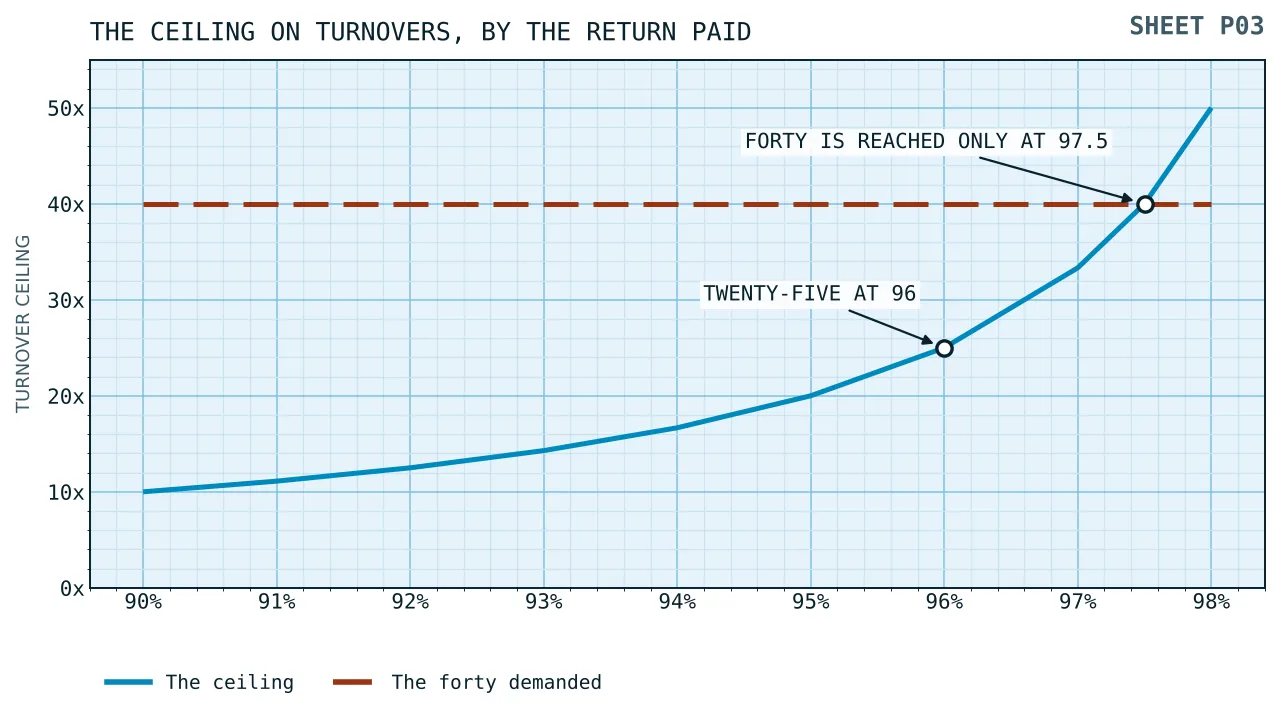
Twenty-five is not a chosen number. Set the residue at nought, cancel the credit off both sides, and what survives is one over whatever the room keeps.
At 96 per cent the room keeps four pence in the pound, the inverse of which is twenty-five, and the test reads: the multiple divided by the weight has to land under twenty-five. Elsewhere on this site that line is treated as a constant because the return is a constant. On a ticket room it is not a constant, because the return is not published, and the honest move is to show how far the line travels.
| If the room hands back | It keeps | Ceiling on W over g |
|---|---|---|
| Ninety pence in the pound | 10p | 10.0 |
| Ninety-two pence | 8p | 12.5 |
| Ninety-four pence | 6p | 16.7 |
| Ninety-six pence, as substituted | 4p | 25.0 |
| Ninety-seven pence | 3p | 33.3 |
| Ninety-eight pence | 2p | 50.0 |
Nothing in that schedule says a ticket room hands back any of those amounts. It is arithmetic on a letter, and its use is to show that the hinge is not one number but a range running from ten to fifty on returns a reader might think plausible. A room paying ninety pence in the pound cannot survive a condition above ten turnovers at all. A room paying ninety-eight could survive one as high as fifty.
Which is why the forty on this sheet is the figure to worry about rather than the absent percentage. Forty turnovers clears the hinge at 96 per cent, at 97 per cent and at every lower return. It survives only where the room hands back better than 97.5 per cent, that being one minus the reciprocal of forty, and no page here will assert that a bingo room does.
6
Weighting, where a room is not the room
There is a second quantity belonging to the room, and on a ticket offer it decides the answer more often than anything else does, because credit for a room is so frequently cleared somewhere else.
Weighting divides. A condition set at £480.00 is counted in contribution and not in stake. Where a staked pound discharges a whole pound, both come to the same figure. Below that, the obligation sits still at £480.00 while the staking required to deliver it climbs by the reciprocal, carrying the expected cost upward and leaving the credit untouched.
Only one rate on this sheet has provenance behind it, and that is thirty pence in the pound. In the consultation that produced the British ceiling, a respondent set out a hundred pound bonus at ten turnovers where each wagered pound counted thirty pence towards the requirement. The regulator wrote the submission down and then left weighting exactly as it found it. The other rates are inputs chosen to draw the curve’s shape, since no citable schedule of what a game contributes exists.
| A staked pound discharges | Owed in contribution | Turnovers in effect | Stake to put through | Cost expected | Residue |
|---|---|---|---|---|---|
| A pound in the pound | £480.00 | 40.0 | £480.00 | £19.20 | -£7.20 |
| Fifty pence in the pound | £480.00 | 80.0 | £960.00 | £38.40 | -£26.40 |
| Thirty pence in the pound | £480.00 | 133.3 | £1,600.00 | £64.00 | -£52.00 |
| Twenty pence in the pound | £480.00 | 200.0 | £2,400.00 | £96.00 | -£84.00 |
Printing the contribution column is the point of the schedule, because it is the column that never moves. What moves is only the stake required to deliver it, and the relation being a reciprocal, the lower rungs cost far more than the upper: thirty pence down to twenty adds £800.00 of staking to an obligation that began at £480.00.
A ticket offer has a particular trap here, and it follows from the disclosure position rather than from the weighting itself. Where credit must be spent on tickets but the requirement is cleared on reels, there are two rooms in play, two returns and one obligation, and the reader is told the percentage of neither. Where the credit may only be spent on tickets and tickets count at a fraction, the obligation is both unpriceable and larger than it looks. The clause to find is the one naming where the credit may go, because that clause alone decides which of those two positions a reader is in.
Put for use at a cashier, the rule is that the weight must exceed the multiple over twenty-five. At ten turnovers that means a rate above forty pence in the pound; at twenty, above eighty. Twenty-five and above, no rate saves it, because a pound staked is never booked at more than a pound.
g above W over 25, or there is nothing at the foot
7
What paces a ticket, and what does not
Two British rules nobody expects to reach a bingo room do reach it; three that everybody expects do not. Product type draws the boundary, and setting it out exactly is what this part is for.
No interval is set
RTS 14 puts a 2.5-second gap under slots and a five-second gap under casino play that is not a slot, poker among customers excepted, the latter dated 17 January 2025 by the regulator’s updates page. Neither gap is written about a ticket, and the standard carries no commencement date for any of RTS 14’s requirements.
No ceiling on the stake
Nor is a ticket caught by the stake ceilings. The instrument made 25 February 2025 attaches them to an online slots game, which it defines as a casino game that runs on reels and runs over the internet. Reels mean images that move or change, and the pattern they finish in is what settles a prize or any other advantage won. The regulator keeps the five pound and two pound figures to online slots and dates them 9 April 2025 and 21 May 2025.
Automatic play is barred, though
Automatic play is the rule that does catch a room. Gaming with bingo inside its scope owes an individual commitment to every game cycle. The guidance leaves out one thing only, a blind posted automatically where poker is played between customers. The prohibition on misleading design reaches a room too, as part 3 set out. A British bingo room can therefore run unpaced and uncapped and still be barred from presenting a loss as anything but a loss.
One incentive, one type
A licensee’s play-through has been held since 19 January 2026 to ten turnovers of the bonus funds, under a provision that catches every licence apart from the technical and the software ones. An incentive from a licensee has, from the same date, been held to one product type out of four: lottery, betting, casino, bingo. Tickets are bingo; reels are casino. Three carve-outs follow, and none of them is obvious. A pair of items inside one type is allowed, the regulator pairing a scratchcard with a raffle. One email may hold two offers where the customer consented to marketing for each. And the ban does not reach a credit whose holder may choose the product themselves.
For the arithmetic the effect is practical. Room credit arriving with reel spins beside it holds two bases, two returns and possibly two conditions, which is why one residue will not describe it. Price the halves separately and add them.
8
Two routes for a complaint
Nobody should be told there is no complaints route away from the British register, because there is one and it can be read. What differs is who drafts its terms, and that difference is worth setting out precisely.
Both sides publish a route, and what parts them is who drafts its terms. A British operator owes acknowledgement promptly, with three working days as the outside figure and twenty-four hours where its gambling never shuts. The whole process, internal escalation counted, stops at eight weeks, and the right to complain is kept open six months or more after the incident. Where a customer sits on a reasonable request for information for seven days the clock may be stopped, and it restarts from the point it stopped at. The final letter explains the decision, says the operator’s process has ended, and sets out the escape to an adjudicator, which has to be one the regulator approved. Eight such bodies appear on the published list, and five are shown as covering remote play in every sector.
Curaçao’s framework mirrors much of that on paper: six months to lodge, four weeks for a response, one extension of the same length with written notice, and adjudication both mandatory and free. What parts the two regimes is that the Curaçao policy contemplates the operator setting the parameters of the adjudication, a minimum claim value for escalation among them. A responsible gaming complaint is given priority there, with best efforts made inside five working days. An adjudication once run may not be reopened before a different body, and a player walking out of one should not count on raising the dispute again.
Neither regulator takes on the individual dispute, and they say so in similar terms. The British one denies being an ombudsman, denies any power to resolve a gambling complaint or to recover a consumer’s funds, puts a disputed withdrawal or a faulty game outside what it can settle, and states that it has no sight of a customer’s account. Its Curaçao counterpart says it will not decide or resolve player complaints over gambling transactions on an operator’s websites, and that it will put what it learns to supervisory use.
Membership of Gamstop Online follows the British licence and not the operator’s preference. The scheme sets out its own limit: it is not able to help prevent somebody reaching gambling services offered by operators outside it. Curaçao calls for self-exclusion too, operator by operator over that operator’s own domains, one year being the shortest period on offer and no early revocation available. No line on this sheet helps anybody get round a protection of their own choosing, and the numbers for help are set out after the questions.
Weighting appears nowhere in the Curaçao policy opened for this sheet. Nor does a cap on a multiple. Nor a stake ceiling, nor a floor beneath a game cycle, nor a prohibition on automatic play, nor one syllable about near misses. Bonuses take two sentences there: terms communicated transparently, and no aggressive promotion that encourages excessive play.
None of the following reaches a room away from the British register, and every one of them is a published duty on a licensee. Ten turnovers, as the most a condition may ask of the bonus money. A single product type inside one incentive. Identity settled before anybody plays, bonus rounds counted in, on a name and an address and a date of birth at the very least. No funding by credit card. A separate commitment to each game cycle. No near miss standing where a loss belongs. No lid on a withdrawal from money the customer put in, and no button offering to undo a withdrawal already requested. A financial limit prompted for, set as the default answer, and cut without delay when the customer asks. Eight weeks on a complaint, and an approved adjudicator at the end of it. A standing entry on the national register of self-exclusions.
9
Pricing a room credit yourself
Six readings, and this is the sheet where the fourth line is usually blank.
| The reading | On this credit |
|---|---|
| Face value, and the ticket count | £12.00, 120 |
| Turnovers in the wagering line | 40x |
| Contribution owed, which is exact | £480.00 |
| Return the room prints | none |
| Cost at the substituted return | £19.20 |
| At the foot of it all | £0.00 |
Lines one, two and three stay exact whatever the room publishes. Lines five and six depend on the fourth, and with the fourth blank they are estimates in the clothing of figures. Saying so is worth more to a reader than filling the gap from a source that would not survive a question about where it came from.
Then the test: turnovers over weight, measured against twenty-five, with the twenty-five itself borrowed on a ticket room and liable to be anything from ten to fifty. Below the line something survives. Above it, nought, and the only live question is the number of hours spent reaching nought.
Two cautions on the £0.00 at the foot. It is a mean taken across a great many repetitions, and one attempt is described by none of it: the likeliest single result there is a spent balance with most of the £480.00 unstaked. And a clause outside the expression, an expiry or a lid on what the credit may win, closes the answer while every letter in it stays put. One term of that family carries a published enforcement outcome behind it. The fine was £170,000, dated 3 July 2025, and the clause gave the operator a discretion to shut accounts or hold back winnings, sitting in its published rules for new casino promotions, which the regulator treated as a failure of the fair and open condition.
Where to read next depends on which end interests you. A payment behind the credit changes the base, and that version is costed at bingo no deposit bonus. The building taken whole is at online casino UK. A room with nothing behind it yet gets priced at new casino sites, and the short screen at mobile casinos. The room keeps every sheet whose total turns on where a credit has to go, with the shared arithmetic written up at How a receipt is struck.
Two of those six lines are exact. The room decides the other four.
Questions
- What is £12 of online bingo credit worth?
- Nothing at forty turnovers, on a borrowed return, and £7.20 at a licensee’s ceiling of ten. A hundred and twenty tickets at 10p make £12.00 of credit, forty turnovers of which is £480.00 of contribution owed. Priced at a substituted reel return of 96 per cent that staking costs £19.20, which overruns the credit by £7.20 and leaves the foot at £0.00.
- Why will a bingo room not publish a return to player figure?
- Because it does not have to, and that is the published position rather than a silence. The duty is to put information fit for judging the chances within easy reach before a customer commits, and four items satisfy it with or between them: a return percentage, the margin or house edge, the likelihood of a winning event turning up, or a description of the game’s working and of how prizes get allocated. For bingo the guidance treats that last description as sufficient by itself.
- How much staking does £12 of bingo credit owe?
- £480.00, exactly, and no percentage goes into the sum. Forty turnovers of £12.00 uses the credit and the multiple only. In tickets it is 4,800 at 10p against the 120 a reader was given. Per pound of credit it comes to £40.00 of staking, a ratio equal to the multiple and the quantity that carries usefully from one room to another.
- Why is twenty-five not a fixed number here?
- Because it is one over whatever the room keeps, and a ticket room does not say what it keeps. At 96 per cent the room keeps four pence in the pound and the ceiling on effective turnovers is twenty-five. At ninety pence in the pound it is ten. At ninety-four pence it is 16.7, at ninety-seven pence 33.3, and at ninety-eight pence fifty. The hinge is a range rather than a constant.
- What return would make a forty-times bingo condition worth taking?
- One better than 97.5 per cent, that figure being one minus the reciprocal of forty. Forty turnovers sits above the ceiling at 96 per cent, at 97 per cent and at every return below those, so nothing survives. No page here asserts that a bingo room hands back 97.5 per cent, because no such figure is published anywhere that could be cited.
- What does game weighting do to a bingo bonus?
- It divides. £480.00 remains owed whatever the rate, while the stake needed to deliver it grows by the rate’s reciprocal, and the expected cost grows with the stake. Fifty pence in the pound turns the stake into £960.00 and the cost into £38.40. Thirty pence turns them into £1,600.00 and £64.00. Twenty pence turns them into £2,400.00 and £96.00, against credit of twelve pounds.
- Is there a minimum time between online bingo games?
- None that the standard sets. A 2.5-second gap belongs to slots. Five seconds belongs to the casino games that are not slots, poker among customers excepted, which the regulator’s updates page dates to 17 January 2025. Bingo makes a product type by itself, and no clock is set on it. The standard carries no commencement date for any of RTS 14’s requirements.
- Does a stake cap apply inside a bingo room?
- It does not. The instrument made 25 February 2025 hangs both caps on an online slots game, which it defines as a casino game that runs on reels and runs over the internet, and the regulator holds the five pound and two pound figures to online slots. The dates given are 9 April 2025 for the first and 21 May 2025 for the second. A ticket has no reels.
- Does autoplay work in a British bingo room?
- No. The bar on automatic play covers gaming with bingo inside its scope, and each game cycle owes its own commitment. The guidance leaves out one thing only, a blind posted automatically where poker is played between customers. The prohibition on misleading design reaches a room as well, so a losing outcome may not be replaced by another that looks like a near miss.
- Can I complain about an offshore bingo room?
- There is a route, and the difference lies in who drafts its terms. A British operator acknowledges promptly and within three working days, twenty-four hours where its gambling never closes, finishes within eight weeks including its own escalation, and points onwards to an adjudicator the regulator approved. The Curaçao framework mirrors much of that: six months to lodge, four weeks for a response with one extension of the same length, and adjudication mandatory and free. What parts them is that the Curaçao policy contemplates the operator setting the parameters of the adjudication, a minimum claim value for escalation among them.
- Which duties does an unlicensed bingo room escape?
- A list of duties, each published and each binding on a licensee. Stop a condition at ten turnovers of the bonus money. Keep one incentive to a single product type. Settle identity before anybody plays, bonus rounds counted, on a name and an address and a date of birth at the very least. Refuse credit cards. Take an individual commitment to every game cycle. Let no near miss stand where a loss belongs. Place no lid on a withdrawal from money the customer put in, and offer no button to undo one already requested. Prompt for a financial limit, make it the default, and cut it without delay on request. Close a complaint inside eight weeks, with the route to an approved adjudicator spelled out. Hold a standing entry on the national register of self-exclusions. Weighting, a cap on a multiple, a stake ceiling and a minimum game cycle appear nowhere in the Curaçao policy opened for this sheet.