
Sheet M04 Revision 1 Checked 15 October 2026
Free daily spins
Fifteen cycles a day at 10p average £1.44. Forty times puts £57.60 across the reels for it, priced at £2.30. Run that for a month and £43.20 of credit has asked for £69.12.
£1.44 a day in, £2.30 a day out, thirty days running
What the conditions leave
Every destination on this spike is bought advertising. The site takes a fee if a reader goes on to register, and no figure printed below moves because of it.
The Spin Sheet
Till receipt No 01
Betportal
Lowest multiple here
For every €1 of spin credit at face per €1
Credit
Debit
No Great Britain licence
Licensed in Anjouan, Comoros, run by BetPortal Gaming Ltd, with Excite Ultra Media Ltd, reference ALSI-202601040-FI2.
Terms read 15 October 2026
Open the offer at Betportal, opens in a new tabThe Spin Sheet
Till receipt No 02
WinBeast
Five staged matches
For every €1 of spin credit at face per €1
Credit
Debit
No Great Britain licence
Licensed in Curaçao, operator not named on the site.
Terms read 15 October 2026
Open the offer at WinBeast, opens in a new tabThe Spin Sheet
Till receipt No 03
EliteSpin
Longest spin window
For every £1 of spin credit at face per £1
Credit
Debit
No Great Britain licence
Licensed in Costa Rica, run by PrimeTier Limited.
Terms read 15 October 2026
Open the offer at EliteSpin, opens in a new tabThe Spin Sheet
Till receipt No 04
Crown Jewelz
Multiple unpublished
No total struck
Credit
Debit
No Great Britain licence
Licensed in Curaçao, number not verified, operator not named on the site.
Terms read 15 October 2026
Open the offer at Crown Jewelz, opens in a new tabThe figure at the foot of a receipt is this site's own arithmetic and nothing an operator has published: the credit, less the share a spin gives back at 96 per cent return to player, less what playing the wagering through costs at the same return. It describes the offer, not one reader's afternoon. Where the conditions price above the credit the receipt prints nothing rather than a negative sum, and where a figure the sum needs is unpublished it prints the condition in the operator's words instead.
Three words stand in the amount column where no figure can. Noted is a published condition that takes value away without leaving the sum a figure to take. Unpriced is a condition whose figure nobody has published, or a credit that is not a sum until a deposit of your own sets it. Own money is money of yours, which is never part of a total.
Not one of the operators printed above holds a Great Britain licence, so the duties that licence carries do not reach them. Every online gambling company licensed in Great Britain has to be part of Gamstop Online, and a reader who has shut themselves out through the scheme is therefore not shut out here. The ceiling of ten times the bonus funds on a wagering requirement, in force since 19 January 2026, is a condition of that licence and binds the companies that hold one. Where a dispute goes instead is a matter for the authority named on the receipt, and the Gambling Commission describes what a reader faces without a British licence as a lack of recourse if things go wrong. Nobody under 18 may hold an account at any of them.
Every term printed on a receipt is the operator's own, and each receipt carries the day it was read. The oldest of those readings is 15 October 2026. What binds a reader is the operator's own full terms, and not a line printed here.
1
A drip is a column of small credits
Nothing about a daily offer is structurally new. It is one small credit with a requirement on it, repeated, and the arithmetic of a single day is the arithmetic of the whole arrangement multiplied by the number of days somebody keeps turning up. That is why the sum below is done once and then stretched.
Fifteen cycles a day, priced at 10p, is £1.50 of headline per day. Where a machine keeps four pence out of every pound crossing it, those fifteen cycles average £1.44 of winnings, and that is the daily B.
Fifteen is a working count, chosen because it is unremarkable and because the whole page scales from it. Ten a day gives £0.96 and twenty a day gives £1.92, with every other figure here moving in the same proportion. Nothing in the method cares which count a particular cashier has settled on.
Two features of a drip do matter, and both show up later. The first is that each day’s credit normally carries its own requirement and its own clock, so thirty days is thirty separate exercises rather than one large one. The second is that a drip has to be remembered. Somebody has to be told it is waiting, which drags a daily offer into a corner of the rulebook that a one-off credit never touches.
The daily inputs, fixed unless a part below moves one:
- Fifteen cycles at 10p, so £1.50 advertised and £1.44 averaged.
- The machine returns 96 per cent, leaving four pence in the pound behind.
- Requirements of the order of forty times are what this bracket attaches, so W is forty. Ten is as far as a British licence goes; sixty is what the regulator recorded in use before the limit arrived.
- Every staked pound counts in full until part 4.
- Thirty days, because a month is the period most people would picture.
2
One day, priced to the penny
Every sheet in this part of the site runs on the same line of algebra.
E = B × (1 – (W × (1 – RTP)) / g)
In that line, B is the day’s credit, W the turnovers demanded of it, RTP what the machine gives back and g the share of a stake the cashier agrees to count. E is the cash a day of this is expected to leave standing.
Do it in two steps first. Forty lots of £1.44 comes to £57.60, and that is how much money must cross the reels before anything can be withdrawn. Four pence of every pound is the house’s expected share, which prices the day’s requirement at £2.30.
Credit of £1.44, price of £2.30, so E = -£0.86 on the day.
The bracket agrees. With contribution at one, it comes to 1 – 1.60, and -0.60 of £1.44 is the same eighty-six pence.
Eighty-six pence is not a debt. No deposit has been made, so the day cannot end below nought: the credit is spent somewhere inside the £57.60 and the day finishes there. The minus is a measure of how much larger the condition was than the thing it was hung on.
Which is the awkward feature of a daily offer. A one-off credit overreaches once. A daily credit overreaches every day, by the same proportion, for as long as the habit holds.
3
Thirty days, added up
Multiply the day by thirty and the shape of the offer becomes visible. Credit of £43.20 arrives across the month. Behind it stands £1,728.00 of staking owed, carrying an expected price of £69.12. The gap between what came in and what the conditions cost is £25.92.
| Requirement | Staking, one day | Staking, 30 days | Price, 30 days | Month’s total |
|---|---|---|---|---|
| 10 times | £14.40 | £432.00 | £17.28 | £25.92 |
| 20 times | £28.80 | £864.00 | £34.56 | £8.64 |
| 25 times | £36.00 | £1,080.00 | £43.20 | £0.00 |
| 40 times | £57.60 | £1,728.00 | £69.12 | £0.00 |
| 60 times | £86.40 | £2,592.00 | £103.68 | £0.00 |
Two things to take from that schedule. The total empties at twenty-five, exactly where it empties on a single day and on every other sheet in this section, because setting the expected cash to nought removes the credit from both sides and strands the requirement as one divided by four pence. Twenty-five, whether the credit is a day’s worth or a year’s.
And a month at the regulated ceiling is worth £25.92, which is precisely the amount by which a month at forty times overshoots. Quadrupling the ceiling costs what the ceiling would have handed over, since 0.60 on either side of nought is the same distance from it.
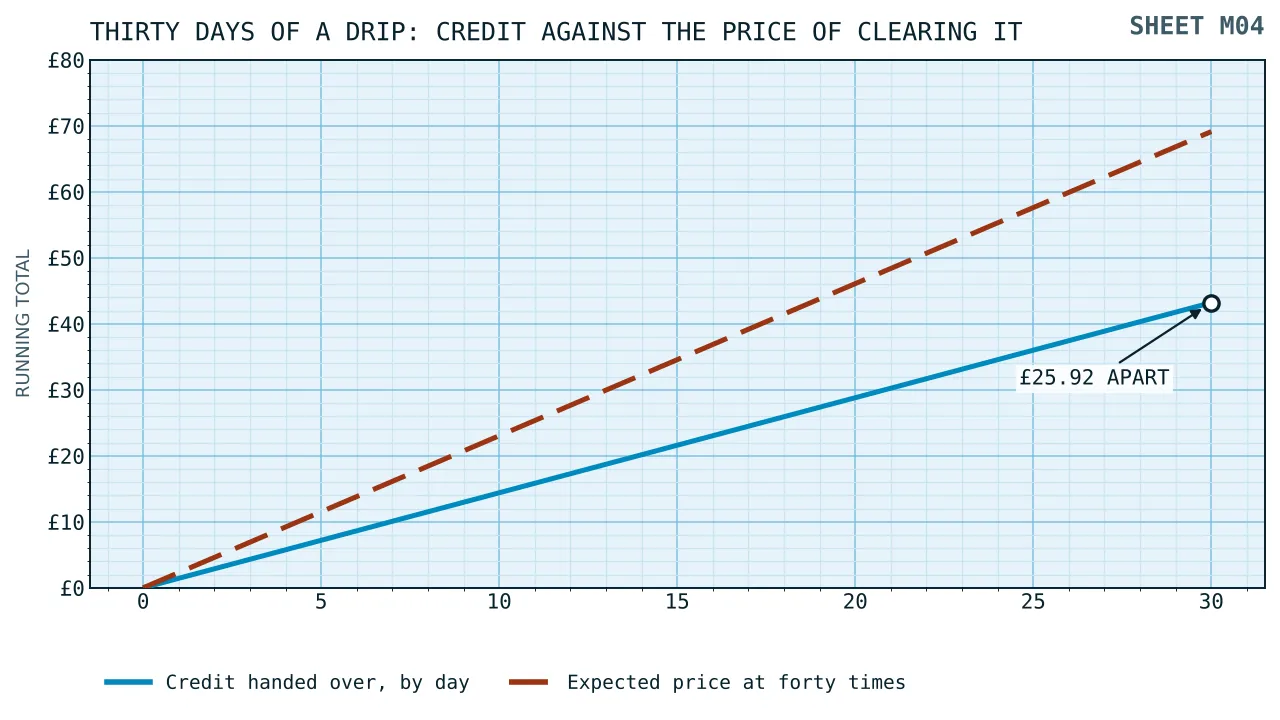
£43.20 received, £69.12 of expected price, £25.92 apart
4
Contribution, applied daily
So far every staked pound has been counted at its face. Where the eligible games count for less, the staking grows while the requirement stays exactly where it was.
Where contribution runs at 30 per cent, the day’s requirement is still £57.60 of contribution. Earning it takes £192.00 of staking, since only thirty pence in each pound is credited, and the house expects £7.68 of that. Against £1.44 handed over, the day’s overreach widens from eighty-six pence to £6.24.
Stretch that across the month and the figures stop looking like a small daily courtesy. £5,760.00 of staking, an expected price of £230.40, and £43.20 of credit set against it.
Pull the requirement down to ten times, the regulated ceiling, and hold contribution where it is. The day then needs £48.00 of staking at a price of £1.92, and E still settles at -£0.48. The regulated ceiling is written about the multiple. Nothing in it reaches the rate at which a game is allowed to count.
That rate is an illustration rather than a measurement. A respondent to the regulator’s consultation put the case of a wagered pound contributing thirty pence towards a requirement; the submission was recorded, and weighting was left where it stood. No schedule of contribution rates currently in use exists in public, so the paragraphs above apply arithmetic to a rate that somebody else supplied.
5
Twenty-four minutes a day, twelve hours a month
Money is one currency and attention is the other. A daily offer spends both, and the second is easier to underestimate because it arrives in instalments.
At 10p a cycle, the day’s £57.60 of staking works out at 576 cycles. On a British licence those cycles are paced, since RTS 14D stops a slot beginning the next game cycle until two and a half seconds have gone by. Five hundred and seventy-six cycles therefore occupy 1,440 seconds, which is twenty-four minutes, and thirty days of that is 43,200 seconds: twelve hours inside a month.
The spins themselves barely register beside their condition. Fifteen cycles a day over thirty days is 450 cycles, which at the same pacing is eighteen minutes and forty-five seconds in total. The gift takes nineteen minutes a month. The string on it takes twelve hours.
None of those cycles may be handed over to a machine either. RTS 8A wants a customer’s commitment to every individual game cycle, and the only thing its guidance excuses is a poker table posting blinds between players. Twelve hours of play-through comes to 17,280 separate decisions across a month.
Both protections belong to the British licence and to nothing else. A drip arriving from a cashier with no Great Britain licence arrives without them, so the same £1,728.00 can be run through at whatever pace that platform permits and with whatever automation it offers.
17,280 cycles over thirty days, twelve hours at the floor
6
The standard on coming back for more
An offer whose whole mechanism is a return visit runs into a design standard that one-off credits never meet.
RTS 14A applies to all gambling and sets out what a product must not do. It must not actively encourage a customer to chase losses, nor to raise a stake, nor to go beyond the amount they had decided to gamble, nor to carry on after indicating that they want to stop. The guidance beneath it is more specific than the rule. Money taken into a product should not be topped up unless the customer chooses it on each occasion, with poker buy-ins initiated by the customer and automatic re-buys ruled out. Content must not push a customer towards winning back what they have lost. And somebody who has decided to exit is not to be enticed back, the guidance naming a free game as the kind of temptation it has in mind.
That last clause is the one a daily spins offer has to be read against. A free round arriving every morning is a free game by any ordinary description. Nothing in the standard forbids running such an offer, and this sheet does not suggest otherwise. What the standard does is draw a line at the point where the offer is aimed at somebody who has already stopped.
Three neighbouring requirements fill out the picture, and each of them changes the arithmetic above rather than merely the atmosphere. RTS 14E will not let a system shorten the wait for a result, and its guidance names turbo, quick spin and slam stop as features that are out, which is what keeps the 576 daily cycles at twenty-four minutes rather than four. RTS 14F stops a system celebrating a return that is no larger than the stake, so a ten pence win on a ten pence cycle gets no fanfare. And RTS 7C prohibits designs that could reasonably be expected to mislead a customer about how likely a result is, naming the substitution of a losing outcome by a near-miss losing outcome.
Not one of those appears in Curaçao’s responsible gaming policy. What that document requires instead is a list of nine: age verification; information a player can reach; self-assessment tools; tracking of behaviour; cooling-off periods and self-exclusion in the player’s own hands; deposit limits; training for employees, affiliates, marketing partners and social media influencers; and general principles covering marketing and advertising. It sets no minimum game cycle, bars no turbo feature, leaves a small return free to be celebrated, and says nothing at all about near-misses.
7
Who may send the reminder
A daily offer only works if somebody is told about it, which puts the marketing rules inside the product rather than alongside it.
Direct marketing for online gambling in Britain has, since 1 May 2025, needed an opt-in given separately for each product type and each channel. The date repays care. January 17th of 2025 was the original fixture, and the Commission’s own release sets out the move to May, so the earlier date belongs to other changes and never to this one.
Underneath it sits social responsibility code provision 5.1.11, under which consumers are not to be approached with direct electronic marketing in the absence of informed and specific consent, unless some law expressly allows it. A separate provision, 5.1.6, requires compliance with the advertising codes themselves. Which codes those are is set out by the Commission: for non-broadcast material, the CAP sections on misleading advertising, on promotional marketing, on gambling and on lotteries, with the broadcast BCAP equivalents covering the same ground plus premium rate telephone services.
Two limits on what can be said about any of this. The Commission’s advertising page does not address affiliates, beyond asking operators to take reasonable steps over third parties they contract with in avoiding placement on copyright-infringing sites. No page should claim more published affiliate rules than that. And from 17 January 2025, in a separate change, operators have had to show customers their net spend and their time spent gambling in real time, which on a daily offer is the only figure in this part that a player sees for themselves.
Curaçao’s rulebook moves differently here, and in one respect further. Its marketing restrictions bar advertising that misleads, that is excessive or aggressive, that targets self-excluded or financially vulnerable people, that dresses gambling up as a route to financial success, that misrepresents skill against chance, that manipulates emotion, that appeals to children, or that reaches somebody inside an active cooling-off or self-exclusion period. Responsibility for affiliates is placed on the operator too: it has to hold them to responsible gaming standards by contract, check that it is happening, and penalise what is not. British advertising guidance stops some way short of that.
8
Proportion and repetition in the code
The advertising regulator has published advice aimed precisely at offers that recur, and it is the closest thing in the British rulebook to a view on daily spins.
On proportion: rewards and inducements should bear a sensible relation to the money and the time a player has put in, promotions should not grow at a faster rate as spending rises, and nothing should encourage gambling of substantial amounts at regular fixed intervals. On repetition: a promotion should not encourage repetitive or frequent participation, and nobody should be encouraged to spend beyond what they could afford to lose.
The regulator also gives an example of something that can be acceptable, and the example has to carry its condition with it. Fifty pounds wagered, followed by a single free bet as a reward, could be acceptable, so long as handing over a free bet at that level is not unusual for that kind of gambling. A one-off reward after a threshold is a different object from a credit that lands every morning, and the advice does not treat the two as equivalent.
Three recent adjudications are listed by the regulator on its online casino page, with outcomes and dates and no subject matter: HRY Games, upheld, 14 October 2026; Dribble Media Ltd, upheld, 16 September 2026; White Hat Gaming Ltd, not upheld, 16 September 2026. The page does not say what any of them concerned, so they can be named as recent casino advertising decisions and as nothing more than that.
Set against a daily drip, the arithmetic in part 3 is what gives the advice its edge. Thirty days of returning produces £43.20 of credit and £1,728.00 of required staking. Whether that is proportionate to what a player has spent in money and in hours is a judgement for the regulator and not for this sheet. Those two figures are what such a judgement would be made on.
9
Pricing a drip of your own
A daily offer is priced once and then multiplied, so the work is a single day’s.
| The step | What it gives |
|---|---|
| Daily cycles, at their value | 15 at £0.10 |
| After the machine’s return | £1.44 |
| The requirement, from the terms | 40x |
| Staking owed that day | £57.60 |
| Expected price of it | £2.30 |
| Times the days you will turn up | £69.12 |
Reduced to a pound of daily credit: sixty pence survives at ten times, nothing at all survives at twenty-five, and forty times runs sixty pence past the end of it. Multiply whichever line matches the terms by the daily credit, then by the days, and the month is priced.
Three cautions, and the third is particular to a drip.
Where E comes out positive it is still an average rather than a payment. The £25.92 a month at ten times would leave sits in the middle of a spread whose likeliest single outcome is nothing whatever. Repetition does make an average more reliable, which is the one respect in which a drip behaves better than a single credit, and it does nothing whatever to change the sign.
The daily clock is not the monthly clock. Each day’s credit normally has to be cleared inside its own window, so an unused day is gone rather than carried. That makes the month a column of independent sums and not one large one, and it is why the staking figures above never pool.
And a drip is designed around a return visit, which is the one thing worth weighing separately from the money. Twelve hours a month of required play, for a credit of £43.20, is the measurement this sheet would put in front of anybody deciding whether the habit is worth having.
Sheets nearby run the method over single credits instead: 10 free spins, the unit this page is built from, 200 free spins, where a large count arrives in one piece, and casino no deposit bonus, where the credit is cash from the start. The multiple indexes the lot.
Questions
- What are free daily spins worth over a month?
- On fifteen cycles a day at 10p, the credit comes to £1.44 a day and £43.20 across thirty days. A forty times requirement asks for £1,728.00 of staking over the same period, and the expected price of that staking is £69.12. The month therefore ends at nought, having asked for £25.92 more than it handed over.
- Is a daily offer better value than one larger credit?
- Not in proportion, no. The ratio is identical, because the expression that prices a day is the expression that prices any credit. What repetition changes is reliability rather than direction: an average turns up more dependably over thirty small exercises than over one, and the sign of that average stays exactly where it was.
- How much time does a daily spins offer actually take?
- Twenty-four minutes a day at the quickest, and twelve hours across a month. The day’s £57.60 of staking is 576 cycles at 10p, and RTS 14D stops a slot beginning the next game cycle until two and a half seconds have gone by. The spins themselves take nineteen minutes over the whole month. The condition attached to them takes twelve hours.
- At what requirement does a daily credit break even?
- A 96 per cent machine breaks even at twenty-five times, whatever size the credit happens to be. Set the expected cash to nought and the credit disappears from both sides, leaving the requirement as one divided by four pence in the pound. A point more return carries it to 33.3 and a point less brings it down to twenty.
- Can an operator offer free spins to somebody who has stopped playing?
- RTS 14A is the standard that addresses it. A product must not actively encourage a customer to chase losses, to increase a stake, to go past the amount they decided to gamble or to continue after indicating they wish to stop, and the guidance adds that somebody who has decided to leave is not to be tempted back, naming a free game as one example. Nothing there forbids running a daily offer, and the line is drawn at aiming one at a person who has already left.
- Does a casino need permission to email about daily spins?
- In Britain, yes, and since 1 May 2025 that opt-in has had to be given for each product type and each channel separately. Social responsibility code provision 5.1.11 bars direct electronic marketing without informed and specific consent unless a law expressly permits it. The date is worth getting right, because the requirement was first set for 17 January 2025 and then moved.
- What does contribution at 30 per cent cost a daily drip?
- It turns 86p a day into £6.24 a day. The requirement is unchanged at £57.60 of contribution, but thirty pence in the pound means £192.00 has to cross the reels to earn it, at an expected price of £7.68. Over a month that is £5,760.00 of staking against £43.20 of credit. At the same rate, even a ten times requirement lands on minus 48p a day.
- Does the advertising code say anything about repeated offers?
- It does. Inducements and rewards should be proportionate to the money and the time a player has spent, promotions should not increase at a faster rate as spending rises, and nothing should encourage gambling substantial amounts at regular fixed intervals. A promotion should also not encourage repetitive or frequent participation, nor push anybody into spending beyond what they could afford to lose.
- What is missing when a daily offer comes from offshore?
- A drip arriving from a cashier with no Great Britain licence arrives without the pacing, the automation ban and the ceiling on wagering. Curaçao’s policy asks instead for age verification, reachable information, self-assessment tools, behaviour tracking, player-led cooling-off and self-exclusion, deposit limits, training of staff and partners, and marketing principles. It sets no minimum game cycle, bars no turbo feature, and puts no limit on a wagering multiple at all.