
Sheet P10 Revision 1 Checked 15 October 2026
Pragmatic slots
A £14.00 credit confined to one studio’s library owes £560.00 of staking at forty turnovers. A penny of it survives only if the library counts at 160p in the pound, and a pound holds 100p.
160p demanded of a pound that holds 100p
What the conditions leave
Every destination on this spike is bought advertising. The site takes a fee if a reader goes on to register, and no figure printed below moves because of it.
The Spin Sheet
Till receipt No 01
Betportal
Lowest multiple here
For every €1 of spin credit at face per €1
Credit
Debit
No Great Britain licence
Licensed in Anjouan, Comoros, run by BetPortal Gaming Ltd, with Excite Ultra Media Ltd, reference ALSI-202601040-FI2.
Terms read 15 October 2026
Open the offer at Betportal, opens in a new tabThe Spin Sheet
Till receipt No 02
WinBeast
Five staged matches
For every €1 of spin credit at face per €1
Credit
Debit
No Great Britain licence
Licensed in Curaçao, operator not named on the site.
Terms read 15 October 2026
Open the offer at WinBeast, opens in a new tabThe Spin Sheet
Till receipt No 03
EliteSpin
Longest spin window
For every £1 of spin credit at face per £1
Credit
Debit
No Great Britain licence
Licensed in Costa Rica, run by PrimeTier Limited.
Terms read 15 October 2026
Open the offer at EliteSpin, opens in a new tabThe Spin Sheet
Till receipt No 04
Crown Jewelz
Multiple unpublished
No total struck
Credit
Debit
No Great Britain licence
Licensed in Curaçao, number not verified, operator not named on the site.
Terms read 15 October 2026
Open the offer at Crown Jewelz, opens in a new tabThe figure at the foot of a receipt is this site's own arithmetic and nothing an operator has published: the credit, less the share a spin gives back at 96 per cent return to player, less what playing the wagering through costs at the same return. It describes the offer, not one reader's afternoon. Where the conditions price above the credit the receipt prints nothing rather than a negative sum, and where a figure the sum needs is unpublished it prints the condition in the operator's words instead.
Three words stand in the amount column where no figure can. Noted is a published condition that takes value away without leaving the sum a figure to take. Unpriced is a condition whose figure nobody has published, or a credit that is not a sum until a deposit of your own sets it. Own money is money of yours, which is never part of a total.
Not one of the operators printed above holds a Great Britain licence, so the duties that licence carries do not reach them. Every online gambling company licensed in Great Britain has to be part of Gamstop Online, and a reader who has shut themselves out through the scheme is therefore not shut out here. The ceiling of ten times the bonus funds on a wagering requirement, in force since 19 January 2026, is a condition of that licence and binds the companies that hold one. Where a dispute goes instead is a matter for the authority named on the receipt, and the Gambling Commission describes what a reader faces without a British licence as a lack of recourse if things go wrong. Nobody under 18 may hold an account at any of them.
Every term printed on a receipt is the operator's own, and each receipt carries the day it was read. The oldest of those readings is 15 October 2026. What binds a reader is the operator's own full terms, and not a line printed here.
1
A key that names a studio rather than a game
A search for a studio’s reels is a search for a library, and a library is not a room with one set of numbers in it. It is a few hundred rooms with a few hundred returns, behind one name and usually behind one line in a cashier’s eligible-games document.
That makes this an unusual sheet in the section, because the thing being priced is a scope rather than a game. Where a bonus confines a credit to the output of one studio, the credit cannot be moved to a faster game, cannot be moved to a game with a higher return, and cannot be moved to a game with a better rate. Those three freedoms go together, and what is left is whatever the library happens to hold.
Two digits would settle the answer and neither is available here. No source behind this site publishes a return for any game the studio named on the front has made, nor any rate at which a cashier counts that output towards a requirement. No primary source publishes a contribution table at all, for any supplier, and a British licensee is under no duty to print a return as a percentage. So this sheet prints neither and computes the thresholds instead.
The credit is £14.00 at forty turnovers, with ten turnovers alongside it as the figure a British licensee has to stay inside. Returns are run from 94 to 98 per cent in part 4 rather than assumed at one value, since the whole subject here is a spread. The stake is ten pence a press.
What a studio-scoped credit fixes, and what it leaves loose:
- Fixed by the terms: the credit at £14.00, and forty turnovers on it.
- Fixed by the scope: that every press has to happen inside one library.
- Loose inside the library: the return, which varies game by game.
- Loose and unpublished: the rate, which may be one figure for the whole library or several.
2
Fourteen pounds against a whole library
One expression, four letters, and a library supplies two of them with a range instead of a number.
E = B × (1 – (W × (1 – RTP)) / g)
£14.00 takes the place of B. W is the turnover count, RTP is whatever a given game in the library hands back. g is the slice of a staked pound that a cashier will credit towards the requirement, and E is the closing figure in pounds and pence.
Worked at the house return with a pound counting in full: forty lots of £14.00 come to £560.00 of staking owed, and a four pence edge prices that at £22.40. The price overshoots the credit by £8.40, so the sheet closes at £0.00. At ten turnovers it wants £140.00 of staking, priced at £5.60, and £8.40 is expected to last.
Ten pence a press makes £560.00 into 5,600 presses. A licensed reel-based game keeps two and a half seconds clear between successive cycles, so those presses occupy 14,000 seconds, or three hours fifty-three minutes twenty seconds. Automatic play is barred, hurrying a result is barred, and running two casino games together is barred, so none of that compresses.
All of which is the ordinary arithmetic of this section. What makes a library different is that both unknown terms belong to it at once, and part 3 handles them together rather than one at a time.
3
The pence a pound would have to hold
Rearrange the expression for the rate and the condition reads: the rate must come out above the edge times the multiple. Put in pence, which is where it becomes useful, the requirement is for a pound to give up more pence than it contains.
Pence demanded = 100 × W × (1 – RTP)
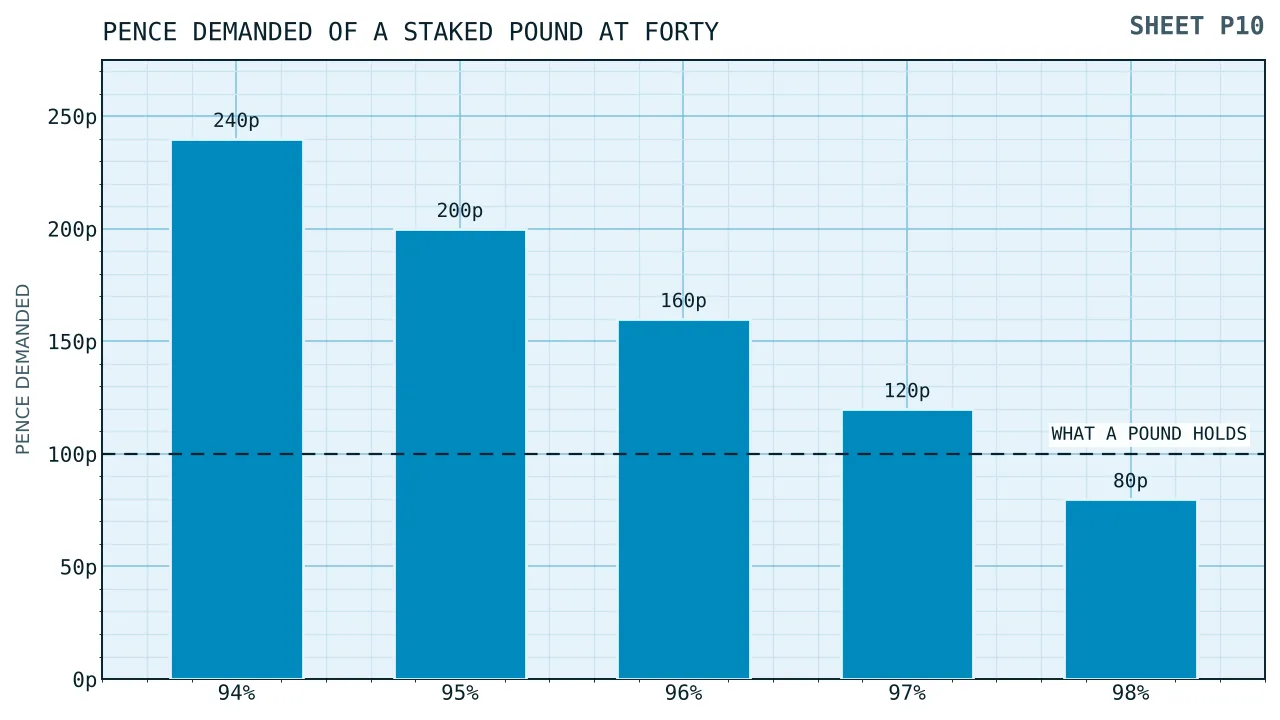
At forty turnovers against a four pence edge that is a hundred and sixty pence out of every pound staked, and a pound is a hundred pence. The demand is not merely steep. It is arithmetically unavailable, and saying so in pence rather than as a decimal above one is the clearest way to see it.
| What the library returns | Edge kept | Demanded at ten | Demanded at forty | What a pound holds |
|---|---|---|---|---|
| 94 per cent | 6p | 60p | 240p | 100p |
| 95 per cent | 5p | 50p | 200p | 100p |
| 96 per cent | 4p | 40p | 160p | 100p |
| 97 per cent | 3p | 30p | 120p | 100p |
| 98 per cent | 2p | 20p | 80p | 100p |
That last column never shifts, and printing it is the whole point of the schedule. Read the fourth column against it and one cell in five comes in under the limit: a library returning 98 per cent would need 80p of every pound counted, and that is possible. Every other row in it asks a pound for more than a pound contains.
The ten-turnover column behaves quite differently, and the contrast is the sharpest thing on this sheet. There every figure is available, from 60p down to 20p, so at the British ceiling the question stops being whether a library can qualify and becomes what rate it is actually given. A library counted in full clears the bar at any return in that table. A library counted at a fifth clears it only from 97 per cent upward.
80p is the only cell under 100p at forty turnovers
4
One library, five returns
Now the same credit priced at five returns, with the rate held at a pound counting in full so that the return is doing all the work.
| What the game returns | Staking at forty | Price of it | E at forty | E at ten |
|---|---|---|---|---|
| 94 per cent | £560.00 | £33.60 | -£19.60 | £5.60 |
| 95 per cent | £560.00 | £28.00 | -£14.00 | £7.00 |
| 96 per cent | £560.00 | £22.40 | -£8.40 | £8.40 |
| 97 per cent | £560.00 | £16.80 | -£2.80 | £9.80 |
| 98 per cent | £560.00 | £11.20 | £2.80 | £11.20 |
The staking column is the invariant one here, and it is worth a moment. Forty turnovers of a fourteen pound credit is £560.00 whatever game it goes through, because the multiple attaches to the credit and not to the reels. What the return changes is the price of putting that money through, which runs from £33.60 at the bottom of the range to £11.20 at the top. A third of the money, against a fifth of it.
Four points of return, from 94 to 98, move the forty-turnover line from minus £19.60 to plus £2.80. At ten turnovers the same four points move it from £5.60 to £11.20, which is a doubling. Either way the swing is larger than anything a reader can see on the front of an offer, and the digit producing it is the digit that is hardest to find.
5
Where the sign changes inside one lobby
Two games from the same studio, both inside the same eligible list, both carrying the same forty-turnover requirement, can sit on opposite sides of nought. That is what this sheet is for, and it follows from part 4 with nothing else assumed.
Break-even is one over the edge, which is why it travels with the return. A game returning 94 per cent breaks even at 16.7 turnovers. At 95 per cent it is 20. At 96 per cent it is 25, the figure the rest of this site runs on, for no deeper reason than that 96 per cent is the house assumption. 33.3 at 97 per cent, and 50 at 98.
So a forty-turnover requirement is survivable on a 98 per cent game and hopeless on a 96 per cent one, and both may be in the same library under the same line of the same document. A reader who takes the house assumption and stops has answered the question for the middle of the library rather than for the game they will actually open.
Where a reader cannot find a return at all, the usable output is the pair of ends. Run the 95 per cent row and the 97 per cent row and treat the answers as the band the truth sits in. On this credit that band is minus £14.00 to minus £2.80 at forty turnovers, which is a band worth having, since both of its ends sit under the line.
Move the rate as well and the band shifts bodily. Set the library at a fifth of a pound and the staking needed for £560.00 of contribution becomes £2,800.00, priced at £112.00 on a four pence edge, so E falls to minus £98.00 and the clock stretches to 28,000 presses and nineteen hours twenty-six minutes forty seconds. At ten turnovers and the same fifth of a pound, £700.00 of staking is priced at £28.00 and the line reads minus £14.00, which is the credit itself.
6
A studio name settles nothing about a licence
Recognising a studio’s artwork tells a reader about the artwork. The regulator has put on record that the output of licensed suppliers has been found running on sites that hold no licence, which means the symbols, the reel set and the feature round can all be exactly the ones a reader knows while none of the rules behind them apply.
The check the regulator actually asks for is an address check rather than a recognition test. Published instead is a register, covering businesses that hold a licence, individuals, premises and regulatory action, the first three available to search and to download. A reader is asked to confirm four things: a licence held by the business, the licensed status displayed, a route from the site through to the register, and the licence agreeing with the register on both activities and domain names. Nothing published alongside the register explains a domain name entered against a licensee, so a sheet leaning on it has to date what it read.
Out there none of the following is required of anybody. No ceiling is imposed on the multiple. No ceiling is imposed on a stake. No minimum interval is imposed between one cycle and the next. No bar is placed on automatic play, or on hurrying a result, or on running two casino games at once. No silence is imposed over a return no bigger than the stake. Nothing bars an ordinary loss from being dressed as a near miss. Nothing requires outcomes to follow the theoretical probabilities, or forbids a game’s rules being rewritten mid-play. Nothing compels identity to be established before the first press. And no obligation to join the national self-exclusion scheme arises, that obligation riding on a British licence and on nothing besides.
A credit spent in a library behind no Great Britain licence is therefore a credit priced by two numbers nobody publishes and bounded by nothing at all. The island rulebook consulted for this build carries no wagering ceiling, nothing on a minimum game cycle, no stake ceiling, and not a word about the rate a game counts at. Bonuses take up two of its sentences: one asking for clear terms, transparently put, and one asking that promotion not drive play to excess.
The honest qualification is that a library may be the library. The games may genuinely be the studio’s, and the digit this sheet could not print is one nobody out there is obliged to produce. A British licence would not make the figure appear, since the disclosure standard is satisfied without a percentage. What it would secure is that something appeared, and that the result it described had not been altered while the reels turned.
7
Ten turnovers, and a list drawn by supplier
Where a British cashier confines a credit to one studio, three rules bear on it.
The ceiling on the multiple is the first, and ten turnovers of bonus funds is what it has said since 19 January 2026. That is the sole regulated digit in the arithmetic here. The regulator recorded in the same place what the figure was correcting, noting requirements as high as sixty times then in use at some licensees. The status of a spin given away, as bonus funds for that purpose, is unpublished, and the gap stays open in both directions on this sheet, except that spin winnings credited as bonus funds are inside the limit.
The second is the ban on more than one gambling product inside a single incentive, also from 19 January 2026, with the four types being lottery, casino, bingo and betting. Reels from a studio sit in the casino type, where a cash match also sits, so pairing the two raises nothing under that rule. Carve-outs: one incentive may hold two products that belong to the same type, the instance given being a raffle alongside a scratchcard; an email may carry offers for two products where consent reaches both; and a credit spendable anywhere the holder likes escapes the ban.
The third is about the terms, and on a studio-scoped offer it is the one that matters most. The incentive provision bites wherever a licensee offers anybody an advantage, and wants the conditions clear, transparent and fair, and easy to reach for anyone the offer is made to. A restriction confining a credit to one supplier’s output is a condition of exactly that weight: it belongs where a reader meets it, not three documents away, and the advertising position is that conditions shown too faintly make an advertisement misleading.
What none of the three reaches is the rate. The ceiling speaks to bonus funds and to the multiple; weighting reached the consultation that produced it, was written down, and was left alone. A cashier may therefore ask ten turnovers, comply exactly, and set the library at a fifth of a pound, which on this credit is minus £14.00 at the foot and an effective multiple of fifty.
8
Reading a credit tied to one library
Five readings, of which a studio name supplies neither of the last two.
| What to establish | On this credit |
|---|---|
| The credit, and what it is confined to | £14.00, one library |
| The multiple, from the wagering clause | 40x |
| Contribution owed | £560.00 |
| Pence of a pound demanded | 160p of 100p |
| The return of the game you open | 94% to 98% |
Take the fourth line first, because it can be worked out without any information the offer withholds. Multiply the multiple by the edge and read the answer in pence. Above a hundred and the credit is finished before it starts, whatever the library returns and whatever rate it is given. Below a hundred, and only then, the fifth line starts to matter.
For the fifth line, open the game and look for what it discloses about itself. A percentage may be there. A margin may be there instead, or the chance of a winning event, or a plain account of how a winner gets settled, any of which satisfies a British licensee’s duty without a percentage appearing anywhere. Where nothing usable turns up, run the band in part 5 and act on both ends of it.
Three cautions. Every figure here averages a long run of such credits, and the likeliest single outcome of fourteen pounds is nothing whatever. A condition with no place in the expression can shut the answer while the multiple, the return and the rate all stand still; a ceiling over bonus winnings is one such, a reserved discretion the other, and the second carries a published fine of £170,000 dated 3 July 2025 against bonus rules holding a right to close accounts or keep winnings back. And a library is not a constant: a studio adds games, a cashier revises a list, and the band in part 5 has to be reopened when either happens.
Related sheets, same method: online slots UK prices a reel room counting in full, top 20 slots UK collapses twenty rates into one, and new online slots takes the case where a game has no history to read at all. The room holds every sheet in the set.
Questions
- What is a bonus worth if it can only be spent on one studio’s slots?
- On £14.00 at forty turnovers, nothing. The staking owed is £560.00 and a four pence edge prices it at £22.40, which overshoots the credit by £8.40. At ten turnovers, which is the British ceiling, staking of £140.00 is priced at £5.60 and £8.40 is expected to last. Confining the credit to one library does not change those totals. It changes which returns and which rate apply to them.
- Why does this sheet print no return to player figure for the studio named?
- Because no source behind this site publishes one for any game that studio has made, and a digit with no source does not get printed here. A British licensee is also under no duty to publish a return as a percentage. So the sheet computes thresholds instead: the pence a pound would have to give up, and the band the answer sits in across returns from 94 to 98 per cent.
- What is the 160p figure?
- The contribution a forty-turnover requirement demands out of each staked pound, against a four pence edge. Multiply the multiple by the edge and read it in pence: forty times four pence is a hundred and sixty. A pound holds a hundred pence, so the demand cannot be met at any rate a cashier could publish. At ten turnovers the demand is 40p, which can be.
- Does the library’s return change the amount I have to stake?
- No, and that surprises people. Forty turnovers of a £14.00 credit is £560.00 of staking whatever game it goes through, because the multiple attaches to the credit rather than to the reels. What the return changes is the price of pushing that money through, which runs from £33.60 on a 94 per cent game to £11.20 on a 98 per cent one.
- Can two games in the same library give opposite answers?
- Yes, and that is the point of this sheet. Break-even is one over the edge, so it is 16.7 turnovers at 94 per cent, 25 at 96 per cent and 50 at 98 per cent. A forty-turnover requirement is therefore survivable on a 98 per cent game and hopeless on a 96 per cent one, with both inside the same eligible list under the same wagering line.
- What should I do when the return is not published anywhere?
- Run the ends rather than guess the middle. On this credit the 95 per cent row closes at minus £14.00 and the 97 per cent row at minus £2.80, so it is a band worth having, both of its ends sitting under the line. Then check the game itself, which may disclose a margin or a probability instead of a percentage.
- How long does the staking take inside one library?
- At ten pence a press, £560.00 is 5,600 presses, and a licensed reel-based game keeps two and a half seconds clear between successive cycles, so that is 14,000 seconds or three hours fifty-three minutes twenty seconds. Set the library at a fifth of a pound and the staking becomes £2,800.00, the presses 28,000 and the clock nineteen hours twenty-six minutes forty seconds.
- Does a known studio tell me the site holds a British licence?
- No. The regulator has put on record that the output of licensed suppliers has been found running on sites that hold no licence, so the artwork, the reel set and the feature round may be exactly the ones a reader knows with none of the rules behind them applying. The check asked for is the register: a licence held, the status shown, a route through to the register, and the activities and domain names tallying.
- What is missing when the same library runs offshore?
- A credit spent in a library behind no Great Britain licence is priced by two numbers nobody publishes and bounded by nothing at all. The island rulebook consulted for this build carries no wagering ceiling, nothing on a minimum game cycle, no stake ceiling and not a word about the rate a game counts at, and bonuses take up two of its sentences. The national self-exclusion scheme goes with it, membership being something the British licence requires and nothing else does.