
Sheet O05 Revision 1 Checked 15 October 2026
High roller online casinos
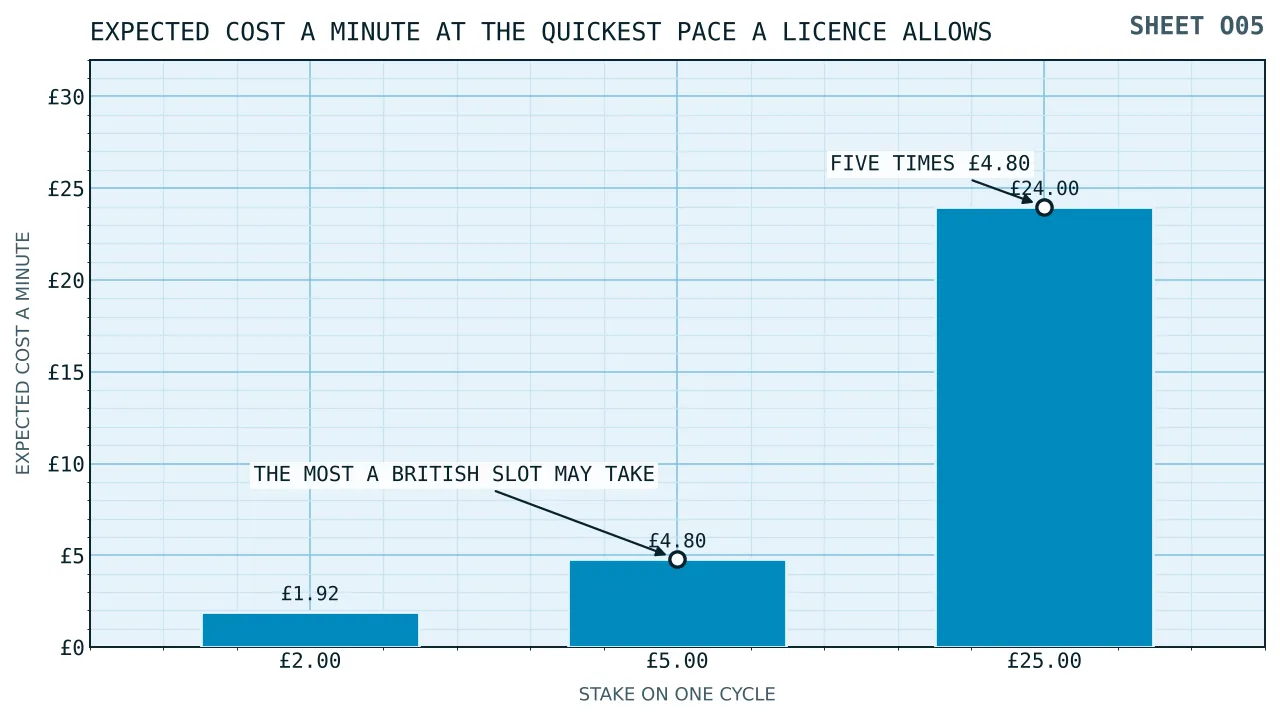
A thousand pounds matched in full is £1,000.00 of credit, worth £600.00 at the licensed ceiling of ten and worth nothing at forty times. The larger figure is the stake. Great Britain holds one slot cycle to £5.00, and lifting that to £25.00 takes the expected cost of play from £4.80 a minute to £24.00 a minute.
£24.00 a minute against £4.80, which is what the absent stake cap buys
What a large stake leaves at the foot
Every destination on this spike is bought advertising. The site takes a fee if a reader goes on to register, and no figure printed below moves because of it.
The Spin Sheet
Till receipt No 01
Betportal
Lowest multiple here
For every €1 of spin credit at face per €1
Credit
Debit
No Great Britain licence
Licensed in Anjouan, Comoros, run by BetPortal Gaming Ltd, with Excite Ultra Media Ltd, reference ALSI-202601040-FI2.
Terms read 15 October 2026
Open the offer at Betportal, opens in a new tabThe Spin Sheet
Till receipt No 02
WinBeast
Five staged matches
For every €1 of spin credit at face per €1
Credit
Debit
No Great Britain licence
Licensed in Curaçao, operator not named on the site.
Terms read 15 October 2026
Open the offer at WinBeast, opens in a new tabThe Spin Sheet
Till receipt No 03
EliteSpin
Longest spin window
For every £1 of spin credit at face per £1
Credit
Debit
No Great Britain licence
Licensed in Costa Rica, run by PrimeTier Limited.
Terms read 15 October 2026
Open the offer at EliteSpin, opens in a new tabThe Spin Sheet
Till receipt No 04
Crown Jewelz
Multiple unpublished
No total struck
Credit
Debit
No Great Britain licence
Licensed in Curaçao, number not verified, operator not named on the site.
Terms read 15 October 2026
Open the offer at Crown Jewelz, opens in a new tabThe figure at the foot of a receipt is this site's own arithmetic and nothing an operator has published: the credit, less the share a spin gives back at 96 per cent return to player, less what playing the wagering through costs at the same return. It describes the offer, not one reader's afternoon. Where the conditions price above the credit the receipt prints nothing rather than a negative sum, and where a figure the sum needs is unpublished it prints the condition in the operator's words instead.
Three words stand in the amount column where no figure can. Noted is a published condition that takes value away without leaving the sum a figure to take. Unpriced is a condition whose figure nobody has published, or a credit that is not a sum until a deposit of your own sets it. Own money is money of yours, which is never part of a total.
Not one of the operators printed above holds a Great Britain licence, so the duties that licence carries do not reach them. Every online gambling company licensed in Great Britain has to be part of Gamstop Online, and a reader who has shut themselves out through the scheme is therefore not shut out here. The ceiling of ten times the bonus funds on a wagering requirement, in force since 19 January 2026, is a condition of that licence and binds the companies that hold one. Where a dispute goes instead is a matter for the authority named on the receipt, and the Gambling Commission describes what a reader faces without a British licence as a lack of recourse if things go wrong. Nobody under 18 may hold an account at any of them.
Every term printed on a receipt is the operator's own, and each receipt carries the day it was read. The oldest of those readings is 15 October 2026. What binds a reader is the operator's own full terms, and not a line printed here.
1
Where the house assumption has to move
Every other sheet on this site works a cycle at ten pence, because that is what the offers it prices are built around. This one cannot, and the reason is the key itself: a page about large stakes has to use a stake large enough to collide with the British ceiling, and a ten pence cycle never comes near it. The working figure here is therefore £25.00 a cycle, five times the maximum a British licence permits on an online slot, and that choice is the whole subject of parts 3 and 4.
Everything else stays as it is across the site. A 96 per cent return. A play-through of forty times, with ten run alongside as the licensed limit. Slots counting at full weight, so g reads one. The deposit is £1,000.00, matched in full.
Offers of this description come from businesses that hold no Great Britain licence, and at this size the absence changes character. On a tenner the missing protections are worth a few pounds. On a thousand they are worth hundreds, and two of them, the ceiling over a stake and the floor under the pace, exist precisely to stop money leaving an account at the rate this page measures.
One honest qualification before any of the figures. There is nothing on this sheet about what a particular business will offer an account of this size, because no source this site may use records it. What can be done is to take the one stake figure in British law, the one pace figure, and the one ceiling on a multiple, and show what each is worth when it is not there.
Held fixed here, and why each figure is what it is:
- £25.00 a cycle, because the key is about stakes that meet the British ceiling, which a ten pence cycle cannot do.
- A deposit of £1,000.00, matched in full for £1,000.00 of credit.
- A 96 per cent slot, which is the site’s standing assumption and does not change with the stake.
- Forty times for the condition. Ten times runs alongside, that having been the licensed limit since the nineteenth of January 2026.
- Weighting of one, with slots counting whole against a requirement.
2
Six hundred pounds on a thousand
The credit prices the same way at any size, and the proportions are what travel.
E = B × (1 – (W × (1 – RTP)) / g)
Multiply out with B at £1,000.00, RTP at 0.96 and g at one.
Where W is ten, the furthest a licence allows, the condition calls for £10,000.00 of turnover. The edge on that is £400.00, and £600.00 is expected to reach the foot.
Where W is forty, the condition calls for £40,000.00 and the edge rises to £1,600.00. The credit covers £25,000.00 of that staking before it is spent, and the last £15,000.00 is staked out of the deposit at a further £600.00 of expected cost.
Six hundred pounds is therefore what the ceiling preserves and what its absence destroys, with £30,000.00 of turnover and £1,200.00 of edge separating the two runs. Nothing about the arithmetic changes with the size of the account. What changes is that the same proportion now names a figure a reader can feel.
| What the terms ask | Turnover demanded | Edge on it | Expected at the foot | From the deposit |
|---|---|---|---|---|
| Ten times, as a licence requires | £10,000.00 | £400.00 | £600.00 | nothing |
| Twenty times | £20,000.00 | £800.00 | £200.00 | nothing |
| Twenty-five times, the turn | £25,000.00 | £1,000.00 | £0.00 | nothing |
| Forty times, modelled here | £40,000.00 | £1,600.00 | £0.00 | £600.00 |
Sixty times is the one market multiple the British regulator itself supplies, recorded when it explained what a ceiling was for. On a credit this size it would ask £60,000.00 through the games at an edge of £2,400.00, overrunning the credit by £1,400.00, which is the whole credit and nearly half the deposit again.
Sixty times on £1,000.00 of credit overruns it by £1,400.00
3
Five pounds a cycle, and the five-fold gap
Now the figure that belongs to this key alone. British law puts a maximum on a single online slot cycle, and it is the only stake figure in the material behind this site.
Its source is a statutory instrument dated 25 February 2025, which attaches a condition to every remote casino operating licence, those issued before it took effect included. On any one game cycle the total an individual may stake is held to £5.00 from twenty-five upwards and to £2.00 below that age. A transitional period of six weeks ran a flat five pound figure for everybody first, which is why the younger limit began six weeks after the other, and the regulator gives their commencement as 9 April 2025 and 21 May 2025.
Two limits on that rule, stated exactly because overstating them is the commonest error on this subject. It is a slots rule. The regulator states that these stake limits attach to online slots alone, reaching no other casino game, and its own examples of what falls outside are blackjack and roulette. A slots game for that purpose is a reel-based game played online: images or text that move or change are put on screen through reel imagery or by other devices, and the arrangement they settle into settles the winning of a prize or of some other opportunity.
So what does the absence of that ceiling buy at this size? Take the forty times condition from part 2, which wants £40,000.00 of turnover, and count the cycles.
| Stake on one cycle | Cycles needed | Least time at 2.5 seconds | Where that figure comes from |
|---|---|---|---|
| £2.00, the under-25 ceiling | 20,000 | 50,000 seconds | British law, as of 21 May 2025 |
| £5.00, the adult ceiling | 8,000 | 20,000 seconds | British law, as of 9 April 2025 |
| £25.00, modelled on this sheet | 1,600 | no published floor | This sheet’s assumption, stated as one |
Twenty thousand seconds comes to five hours and thirty-three minutes and a further twenty seconds, which is the fastest a licensed slot could put £40,000.00 through at the adult ceiling. At £25.00 a cycle the same condition is 1,600 cycles, a fifth of the count, and no published rule outside Great Britain sets any floor under how quickly those cycles may come. Five times the stake, a fifth of the cycles, and the same £1,600.00 of expected cost reached in a fifth of the time.
Which is the argument of this sheet in one sentence. A stake ceiling is not a restriction on how much a player may lose. It is a restriction on how fast.
4
Twenty-four pounds a minute
Turn the previous part into a rate, because a rate is what a large account actually experiences.
British technical standards put a floor under the interval between slot cycles: a minimum of 2.5 seconds must pass from the moment a game is started until the next cycle may begin. Releasing and then depressing the start control, or some equivalent action, is always necessary to begin one, a player should commit to each cycle individually, and holding a button, a key or the screen down must not start another. Automation is barred outright for online gaming by a standard of its own, which requires a customer to commit to every cycle individually; the single carve-out lets blinds be posted automatically in peer-to-peer poker. A third forbids anything that shortens the wait for a result, and the features it names as not permitted are slam stop, quick spin and turbo.
Twenty-four cycles a minute is what 2.5 seconds allows at the very most. Multiply that by the stake and the picture is finished.
| Stake on one cycle | Turnover a minute | Expected cost a minute | Expected cost an hour |
|---|---|---|---|
| £2.00 | £48.00 | £1.92 | £115.20 |
| £5.00 | £120.00 | £4.80 | £288.00 |
| £25.00 | £600.00 | £24.00 | £1,440.00 |
Four pounds eighty a minute is the fastest a British licence will let a slot take from a player on average, and that figure is the ceiling and the pace multiplied together. At £25.00 a cycle it is £24.00 a minute, which is £1,440.00 across an hour. Away from the register the pace itself has no published floor, so the hourly figure has no published ceiling either, and this sheet will not invent one.
Three further design rules belong with the pace, because together they decide how much of an hour a player spends deciding. Two games may not be offered side by side on a casino licence. No celebration is allowed where the return does not beat the stake, so a twenty-five pound cycle giving twenty-five pounds back is reported rather than applauded. Nor may one losing outcome be substituted by a near-miss losing outcome, a design the standards treat as liable to mislead a customer about how likely particular results are. None of those three appears anywhere in the offshore rulebook read for this build.
5
What a licence says about a big account
Two published rules speak directly to an account of this size, and both are about what may be offered to it rather than what it may stake.
The code provision on incentives has a limb for exactly this. Where a licensee offers an incentive to a customer it has designated high value, or VIP, or something equivalent, consistency with the licensing objectives is required of that incentive, and the regulator’s guidance on high-value customer incentives has to be taken into account. That same provision carries the ceiling on a multiple, the ban on mixing product types within one incentive, the bar on altering an incentive’s value where qualifying activity finishes inside the offer period, and a requirement that the terms of any incentive be clear, fair, transparent and easily reached by whoever it is offered to.
Proportionality comes from the advertising side, in plain terms. What a reward offers has to answer to the player’s actual spending of money and of time. Offers may not climb faster than the spending does. And encouragement to gamble substantial amounts at a regular, fixed frequency is out. The advertising regulator’s one example of something that may pass arrives hedged: a single reward once fifty pounds has gone through, and only in a setting where a free bet at that stage would be ordinary for the gambling involved. A page cannot take the example without its condition.
Put those two beside the arithmetic in part 2 and an uncomfortable result falls out. A bonus scaled to a thousand pound deposit is, under a British licence, an incentive whose multiple cannot pass ten and whose terms have to be legible, and which must not accelerate as the account grows. Off the register it is an incentive with no ceiling on its multiple, worth £0.00 in expectation at forty times, and with nothing published to stop it growing as the deposits grow.
Where the Caribbean licence is named, two sentences on bonuses stand in place of all that. Terms are to be conveyed clearly and transparently. Promotion is not to drive gambling to excess. No limb addresses a high-value customer. No limb addresses proportionality. There is no guidance to take account of.
6
The checks a thousand pounds sets off
Under a British licence a deposit of this size runs into three separate mechanisms on the way in, and each has a figure.
The affordability threshold
Light-touch financial vulnerability checks bite where an online customer’s net deposits go past a monthly threshold. That threshold came in at £500.00 a month from 30 August 2024 and dropped to £150.00 a month from 28 February 2025. A single thousand pound deposit is six and two-thirds times the present figure, so it clears the threshold on the first day of any month in which it is made. Enhanced financial risk assessments are a separate matter and still a pilot, not operating in a live environment, and the regulator’s position is that neither those nor the light-touch checks bear on anybody’s credit rating.
The funding method
A credit card may not be used. The licence condition is flat. Payment for gambling by credit card must not be accepted, and a credit card payment that arrives via a money service business is caught by the same words. Its effective date is 14 April 2020, and every remote licence is covered. At this size the rule is doing real work, because a thousand pounds is a sum a card would extend and a current account might not.
The ceiling the player sets
A gambling system must carry facilities for a customer to set their own financial limits, available from the point of registration onwards, and the customer must be prompted to set one during registration or when making a first deposit or payment. A free text box takes the figure, or the telephone equivalent of one, and account level is the minimum at which the limit applies. Gross deposit limits must be offered as prominently as any other sort, and nothing but a gross deposit limit may be called one. A month, a week and a day must all be among the durations offered. The default has to be setting a limit; declining is an act the customer takes; and the decline has to be confirmed before play begins. Increases wait at least a day and then need a fresh confirmation; decreases take effect immediately.
Its worked example of two limits running at once is the useful part, and it scales. Where a daily limit of £10.00 sits beside a weekly limit of £100.00, the system must allow no more than £10.00 a day and £70.00 a week, because the tightest limit always governs. Multiply that by a hundred and a reader with a thousand pound appetite can see what a pair of limits would actually permit.
None of those three mechanisms exists off the register in the form described. The offshore policy does require deposit limits, and on one point it is stricter: a reduction takes effect at once there, while an increase waits seven days against the British minimum of twenty-four hours. What the policy omits is any prompt, any default, and any obligation to offer a particular period, and nothing in it addresses affordability at any threshold or bars a credit card.
7
A cap on winnings is not a cap on a balance
At this size the exit matters more than the entrance, and two different terms get confused with one another constantly. They bite on different money and both can be true at once.
The first is about a deposit balance, and Great Britain prohibits it. A licensee may not impose a term, nor use one, nor enforce one, nor seek to rely on one, where a maximum on what the consumer may take from a deposit balance is its purpose or its result. Withdrawal from that balance, winnings included, is a player’s entitlement at any time. No restriction may stand on the maximum. Reasonableness governs any limit put on withdrawal size or on how many are made. Nor may the option of cancelling be offered once a withdrawal has been requested, and the exit is to be kept as free of friction as an operator can manage.
The regulator’s published example of a forbidden clause is worth converting at this size, because the conversion is the point. The clause it prints allows fifty pounds inside a day and five hundred inside a week. On a £1,000.00 balance, a fifty pound daily cap is twenty days of withdrawals, and a five hundred pound weekly cap is a fortnight. What reads as an administrative nicety on a small balance is a fortnight’s delay on a large one, which is why the rule reaches what a term does and not only what it is for.
| The clause | Time to clear the balance |
|---|---|
| Fifty pounds in any day | 20 days |
| Five hundred pounds in any week | 2 weeks |
| Both at once, tightest governing | 20 days |
| Under a British licence | On request |
The second term is a cap on what can be won from a bonus, and the position has to be stated carefully because the record is thin. Nothing primary publishes a standard maximum win over a bonus, and nothing primary turns bonus winnings into bonus funds by rule, so neither appears here as a figure. What can be said is that a maximum win on a bonus is not prohibited by the rule about deposit balances, since that rule is about the deposit balance and nothing else. Both can therefore stand together: an unrestricted right to draw the deposit balance, and a cap on what the bonus itself can yield. A reader meeting a maximum win term should establish which of the two money it bites on before anything else.
Off the register neither half is in force. Two forms are what the regulator records finding instead: payouts stopped, and withdrawal limits pitched beyond reach. At this size the second form inverts. A floor of £50.00 is nothing to a thousand pound balance, which is why the device that bites on a large account is the ceiling rather than the floor, and no published source measures how often either is used.
A fifty pound daily cap turns £1,000.00 into twenty days
8
The scheme, the grievance and the exit
Three things left, and the first of them is the reason a page with this key sits in this part of the tree at all.
The national self-exclusion scheme writes itself Gamstop, with Gamstop Online as the full form adopted alongside a refreshed identity in November 2025. The British licence sets its reach, not any choice of its own, because a company licensed here to gamble online is required to be inside it. The scheme’s own terms record the consequence against itself. Exclusion from the services of participating gambling operators is what it can assist with. For an organisation outside the scheme, it records being unable to help prevent access. Those sentences state the boundary of a protection, and nothing here will help anybody cross it.
Then the grievance, where size cuts the opposite way from the rest of this page. A British complaint must be acknowledged within three working days at most, and inside twenty-four hours where gambling is offered round the clock. Eight weeks from arrival caps the whole process, internal escalation counted in. Six months at least from the incident is the window for bringing one, and no term may shorten that. A final letter must give reasons, record that the operator’s process has now ended, and explain the way through to an independent dispute resolution entity. The regulator approves those entities, and nothing but an approved one may be used.
Offshore the clocks look similar: six months to lodge, free of charge, four weeks to answer with one extension of four more, and dispute resolution that is mandatory and costs the player nothing, with the operator paying. What differs is that the policy lets the operator set the parameters. Whether court may follow only once the process is spent. Whether the player is bound by the outcome. Whether a minimum claim value stands between a grievance and escalation. On a thousand pound dispute that last one is unlikely to bite, which is a genuine point in favour of a large account and the only one on this page.
Finally the money behind a licence, which at this scale is the most legible difference of all. Within a single twelve-month span the British regulator’s published enforcement list carries land-based casino operators to pay £5m on 7 October 2026, one operator at £10m on 22 October 2025, a supplier at £4.75m on 23 July 2026, and a licensee at £900,000 on 30 June 2026 after £240,000 on 1 October 2025. Suspensions are published on the same list. Every one of those is enforcement against a licence holder. A business with no licence to suspend is outside all of it, and a thousand pounds sitting at one has no equivalent behind it.
On the duty, the position is the reverse of what a reader expects. British gaming duty tracks the customer’s home rather than the company’s licence, so a company offering remote gambling to somebody usually living here owes it from wherever it sits, with 40 per cent of profits taken by Remote Gaming Duty in accounting periods beginning 1 April 2026 or later. As for the player, the revenue’s manual puts betting and gambling outside trading in themselves, so winnings are not trade income, and nothing here is tax advice.
9
If a registration moved the stakes offshore
Some of the people searching a key like this one have a live self-exclusion. This section is written for them. It matters more than the rest of the sheet, and no route around anything appears in it.
At this size the figures are blunter than anywhere else on the site. A thousand pound credit comes to nothing at forty times with £600.00 of overrun behind it, and to nothing at sixty times with £1,400.00. The stake assumption this page uses costs £24.00 a minute in expectation against the £4.80 a British licence permits, which is £1,440.00 an hour. No affordability threshold is crossed because none exists. No limit is prompted. No pace is floored. Nothing obliges the balance to come back. There is no arrangement of those numbers in which a defeated registration is a good trade, and at this size the loss arrives faster than anywhere else this site measures.
What is published, free, and works:
- A free line, open always. GamCare runs the National Gambling Helpline, and 0808 8020 133 is the number, picked up at any hour on any day throughout the year. WhatsApp, live chat and the telephone all reach it. A call about somebody else counts the same as a call about yourself, and with that person’s consent a professional may make the referral. Its footer records company number 03297914 in England for a company limited by guarantee, charity number 1060005 in England, and SC050547 in Scotland.
- A blocker across every device. Gamban works on gambling sites and apps by the ten thousand, through layers rather than a single list, and one licence installs it on all major platforms. Its own site sells a seven-day trial, and the only free arrangement published there covers residents of a single American state, so the free British route is not found on it.
- TalkBanStop is where the free route is published. Talk is GamCare, Ban is Gamban, and Stop is the national scheme. Gamban comes at no cost, GamCare states, to anybody who rings the helpline or uses its support and treatment services. The page carrying that is an article of 12 April 2021 saying nothing about the duration, so this sheet says nothing about it either.
Two features of a registration already running, taken from terms whose last update was 20 May 2026. No lifting is available until the minimum period has expired, and the terms put that in capitals. And for seven years after a deliberate deactivation the scheme lets gambling operators know of the earlier self-exclusion, a period in which no obligation to keep that person out applies. Both are worth knowing before anybody considers the question. Staying in control is the sheet here on using the tools.
Elsewhere in this part of the tree. Sixteen questions a licence answers, each with a figure, are at best non gamstop casinos. At the far end of the scale sits a round of spins with nothing deposited behind it, under non gamstop casinos no deposit bonus. The cost of the timing of an identity check is at no kyc casinos. The six regulators, taken singly, are at non uk casinos. And independence, which shrinks an exclusion rather than widening it, is covered by independent casinos not on gamstop. The section index is Off the register. For the method behind every quantity above, read How a receipt is struck.
Questions
- Why does this page use a stake of £25.00 and not 10p?
- Because the key is about stakes large enough to meet the British ceiling, and a ten pence cycle never comes near it. The working figure here is £25.00 a cycle, five times the maximum a British licence permits on an online slot. Everything else holds as it does across the site: a 96 per cent return, a play-through of forty times with ten run alongside as the licensed limit, slots at full weight so g reads one, and a deposit of £1,000.00 matched in full.
- What is a matched £1,000.00 worth at each multiple?
- Six hundred pounds at the licensed ceiling of ten, and nothing at forty times. Where W is ten the condition calls for £10,000.00 of turnover, the edge on that is £400.00, and £600.00 is expected to reach the foot. Where W is forty it calls for £40,000.00 and the edge rises to £1,600.00; the credit covers £25,000.00 of that staking before it is spent, and the last £15,000.00 is staked out of the deposit at a further £600.00 of expected cost. The two runs are separated by £30,000.00 of turnover and £1,200.00 of edge.
- What is the British stake limit on a slot?
- On any one game cycle the total an individual may stake is held to £5.00 from twenty-five upwards and to £2.00 below that age, under a statutory instrument dated 25 February 2025 which attaches a condition to every remote casino operating licence, those issued before it took effect included. A transitional period of six weeks ran a flat five pound figure for everybody first, so the younger limit began six weeks after the other, and the regulator gives their commencement as 9 April 2025 and 21 May 2025. These stake limits attach to online slots alone and reach no other casino game.
- What does the missing stake ceiling actually buy?
- Speed, not size. Take the forty times condition, which wants £40,000.00 of turnover. At the £5.00 adult ceiling that is 8,000 cycles, and at the 2.5 second minimum between cycles it cannot be got through inside 20,000 seconds, or five hours and thirty-three minutes and a further twenty. At £25.00 a cycle it is 1,600 cycles, a fifth of the count, and no published rule outside Great Britain sets any floor under how quickly those cycles may come. A stake ceiling is not a restriction on how much a player may lose. It is a restriction on how fast.
- How fast can a licensed slot take money?
- Twenty-four cycles a minute is what the 2.5 second minimum allows at the very most, so the expected cost a minute is the stake multiplied by that pace and by the four per cent edge. At £2.00 a cycle that is £1.92 a minute. At the £5.00 ceiling it is £4.80 a minute, or £288.00 across an hour. At the £25.00 this sheet models it is £24.00 a minute, or £1,440.00 an hour. Away from the register the pace itself has no published floor, so the hourly figure has no published ceiling, and none is invented here.
- Do British rules say anything about VIP accounts?
- One limb of the code provision on incentives addresses them directly. Where a licensee offers an incentive to a customer it has designated high value, or VIP, or something equivalent, consistency with the licensing objectives is required of that incentive, and the regulator’s guidance on high-value customer incentives has to be taken into account. Proportionality comes from the advertising side, in plain terms. What a reward offers has to answer to the player’s actual spending of money and of time. Offers may not climb faster than the spending does. And encouragement to gamble substantial amounts at a regular, fixed frequency is out.
- What checks would a £1,000.00 deposit set off here?
- Three, each with a figure. Light-touch financial vulnerability checks apply once net deposits pass a monthly threshold, which came in at £500.00 a month from 30 August 2024 and dropped to £150.00 a month from 28 February 2025, so a single thousand pound deposit is six and two-thirds times the present figure. A credit card may not be used at all, and a credit card payment that arrives via a money service business is caught by the same words, with 14 April 2020 as the effective date. And a financial limit must be prompted and offered as the default, with increases waiting at least a day and decreases immediate.
- Can a term cap what I withdraw from a large balance?
- Not under a British licence, where a licensee may not impose a term, nor use one, nor enforce one, nor seek to rely on one, and where a maximum on what the consumer may take from a deposit balance is barred whether that is the term’s purpose or merely its result. The published example of a forbidden clause allows fifty pounds inside a day and five hundred inside a week. Convert that at this size and the point becomes obvious: on a £1,000.00 balance a fifty pound daily cap is twenty days of withdrawals and a five hundred pound weekly cap is a fortnight. Away from the register nothing of that kind applies.
- Is a cap on bonus winnings the same thing?
- It is not, and the two get confused constantly because they bite on different money. Nothing primary publishes a standard maximum win over a bonus, and nothing primary turns bonus winnings into bonus funds by rule, so neither appears here as a figure. What can be said is that a maximum win on a bonus is not prohibited by the rule about deposit balances, since that rule is about the deposit balance and nothing else. Both can stand together: an unrestricted right to draw the deposit balance, and a cap on what the bonus itself can yield. Establish which money a term bites on before anything else.
- Does a big dispute get further than a small one offshore?
- On one point, yes, and it is the only point on this page that favours a large account. Offshore the clocks look similar to the British ones: six months to lodge, free of charge, four weeks to answer with one extension of four more, and dispute resolution that is mandatory and costs the player nothing. What differs is that the policy lets the operator set the parameters. Whether court may follow only once the process is spent. Whether the player is bound by the outcome. Whether a minimum claim value stands between a grievance and escalation. On a thousand pound dispute that last one is unlikely to bite.
- A live registration is why I am looking. What then?
- Three published things, free of charge. GamCare runs the National Gambling Helpline, and 0808 8020 133 is the number, picked up at any hour on any day throughout the year, with WhatsApp, live chat and the telephone all reaching it, and a call about somebody else counting the same as a call about yourself. Gamban works on gambling sites and apps by the ten thousand, through layers rather than a single list, with one licence installing it on all major platforms. TalkBanStop is where the free route is published, and Gamban comes at no cost, GamCare states, to anybody who rings the helpline or uses its support and treatment services.