
Sheet F03 Revision 1 Checked 15 October 2026
£3 minimum deposit casino uk
Three pounds is thirty cycles at 10p, £2.88 of average winnings and a twelve pence toll. It is also, very often, below the figure the offer insists on, which makes the bonus worth £0.00 on a qualifying deposit of exactly this size. Where the qualifying line sits at ten pounds, the seven pounds between buys £6.00 of expectation at the British ceiling and nothing at forty times.
30 cycles, £2.88 expected back, £0.00 of credit below the qualifying line
What a three pound floor leaves after the conditions
Every destination on this spike is bought advertising. The site takes a fee if a reader goes on to register, and no figure printed below moves because of it.
The Spin Sheet
Till receipt No 01
Betportal
Lowest multiple here
For every €1 of spin credit at face per €1
Credit
Debit
No Great Britain licence
Licensed in Anjouan, Comoros, run by BetPortal Gaming Ltd, with Excite Ultra Media Ltd, reference ALSI-202601040-FI2.
Terms read 15 October 2026
Open the offer at Betportal, opens in a new tabThe Spin Sheet
Till receipt No 02
WinBeast
Five staged matches
For every €1 of spin credit at face per €1
Credit
Debit
No Great Britain licence
Licensed in Curaçao, operator not named on the site.
Terms read 15 October 2026
Open the offer at WinBeast, opens in a new tabThe Spin Sheet
Till receipt No 03
EliteSpin
Longest spin window
For every £1 of spin credit at face per £1
Credit
Debit
No Great Britain licence
Licensed in Costa Rica, run by PrimeTier Limited.
Terms read 15 October 2026
Open the offer at EliteSpin, opens in a new tabThe Spin Sheet
Till receipt No 04
Crown Jewelz
Multiple unpublished
No total struck
Credit
Debit
No Great Britain licence
Licensed in Curaçao, number not verified, operator not named on the site.
Terms read 15 October 2026
Open the offer at Crown Jewelz, opens in a new tabThe figure at the foot of a receipt is this site's own arithmetic and nothing an operator has published: the credit, less the share a spin gives back at 96 per cent return to player, less what playing the wagering through costs at the same return. It describes the offer, not one reader's afternoon. Where the conditions price above the credit the receipt prints nothing rather than a negative sum, and where a figure the sum needs is unpublished it prints the condition in the operator's words instead.
Three words stand in the amount column where no figure can. Noted is a published condition that takes value away without leaving the sum a figure to take. Unpriced is a condition whose figure nobody has published, or a credit that is not a sum until a deposit of your own sets it. Own money is money of yours, which is never part of a total.
Not one of the operators printed above holds a Great Britain licence, so the duties that licence carries do not reach them. Every online gambling company licensed in Great Britain has to be part of Gamstop Online, and a reader who has shut themselves out through the scheme is therefore not shut out here. The ceiling of ten times the bonus funds on a wagering requirement, in force since 19 January 2026, is a condition of that licence and binds the companies that hold one. Where a dispute goes instead is a matter for the authority named on the receipt, and the Gambling Commission describes what a reader faces without a British licence as a lack of recourse if things go wrong. Nobody under 18 may hold an account at any of them.
Every term printed on a receipt is the operator's own, and each receipt carries the day it was read. The oldest of those readings is 15 October 2026. What binds a reader is the operator's own full terms, and not a line printed here.
1
Thirty cycles, twelve pence of toll
Three pounds is an awkward rung. It is small enough to be advertised as a floor and large enough to look like a real deposit, and it sits almost exactly where the two floors in this market stop agreeing with each other.
Start with what the money does on its own, with nothing attached. Thirty cycles come out of three pounds at the 10p this site works at. A slot handing back 96 per cent of what crosses it turns those thirty cycles into £2.88 of average winnings, and the arithmetic of the house over one complete pass is 12p.
Of everything costed here, twelve pence is the one quantity that is at once small and certain. Every other cost here is either conditional, or larger, or both, and the business of the page is to work out which.
What is held still, and why:
- 10p a cycle, which turns the deposit into thirty of them.
- 96 per cent on slots, putting one pass of the balance at 12p.
- Forty times for a play-through, since terms drawn outside the British register commonly reach that far, and ten times beside it as the legal maximum for a licensee.
- Slots at full weight, g at one, except in part 4 where the whole subject is what happens when g is not one.
- Ten pounds as the illustrative qualifying line in part 3, because a figure is needed before a gap can be priced and no source behind this site records any particular cashier’s.
2
One cashier, two different floors
A reader searching for a three pound minimum is usually searching for one number and will meet two. The till has a floor, which is the smallest sum the cashier will accept. The offer has a floor of its own, which is the smallest sum that qualifies for whatever is being advertised. Nothing requires them to match, and at this end of the market they frequently do not.
The British regulator tells players to go looking for precisely that discrepancy. Its own consumer guidance asks a reader to check for restrictions attached to an introductory offer or a bonus, giving as its example a level of spending that has to be reached before the bonus is paid at all. That sentence is the whole of this sheet’s subject, put by the regulator in one line.
The advertising rules go further and say where the discrepancy has to be printed. Promotional material must communicate every applicable significant condition clearly and prominently wherever leaving one out is likely to mislead, which is rule 8.17 of the non-broadcast code. An online advertisement should carry its full terms roughly one click away, and the route to them belongs neither in a footer nor in small print. A qualifying minimum above the deposit minimum is exactly the sort of condition that wording is aimed at.
Two published rulings show what happens when such a condition is left where a reader will not find it, and neither of them concerns a payment method or a wagering figure.
- 17 July 2024. Qualifying for a ten pound free bet meant answering a text message, and doing so before an hour the offer had fixed. Nothing in the advertisement said so. That deadline was held to be significant, and its omission likely to mislead.
- 27 August 2025. A five pound free bet voucher could not be used on the fourteenth of March, that being Gold Cup day at Cheltenham, and nothing printed on the voucher mentioned it. Of the rulings collected on that page this is the one where the regulator’s own word for the outcome is breach.
Both of those are deadlines rather than deposit thresholds. The principle they fix is the one this sheet needs: a condition that decides whether the offer exists at all belongs in front of the reader, not a click away in a document.
3
Putting a price on the gap
Here is the arithmetic nobody does. Suppose the till takes three pounds and the offer starts at ten. What is the seven pounds in between actually buying.
At three pounds the answer is quick. Thirty cycles, £2.88 expected back, and £0.00 of credit, because the qualifying line was not reached. The deposit is accepted, the account opens, the games run, and the headline figure has nothing to do with any of it.
At ten pounds, with a full match, the credit is £10.00 and its worth depends entirely on the condition written over it. Ten times, the furthest a British licensee may go, wants £100.00 staked; the edge takes £4.00; what survives is £6.00. Forty times asks £400.00 and costs £16.00, which is six pounds more than the credit, so nothing survives and the balance behind it is six pounds down.
| Paid in | Cycles | Credit | Credit at 10x | Credit at 40x |
|---|---|---|---|---|
| £3.00, below the qualifying line | 30 | none | none | none |
| £10.00, on the qualifying line | 100 | £10.00 | £6.00 | £0.00 |
So the gap is worth £6.00 where the condition stops at the British ceiling and £0.00 where it reaches forty. That is the finding, and it reverses the question a reader arrived with. Finding seven pounds more is worth considering only when the multiple is modest enough that the credit was worth having at all.
Seven pounds of gap: £6.00 of value against ten times, nought against forty
A correction, before that figure gets misread. Seven pounds of extra deposit is not seven pounds spent. It is seven pounds committed, and it stays the reader’s money subject to whatever happens on the games. What the commitment buys is the expectation above, which is six pounds at the ceiling and nothing at all beyond twenty-five times. Below the line, by contrast, there is no commitment and no credit, which on a forty times condition is the better of the two outcomes.
4
The multiple, and the weighting beneath it
Suppose instead that three pounds does qualify, matched in full. The credit is £3.00 and the expression below settles what it comes to.
E = B × (1 – (W × (1 – RTP)) / g)
Three pounds for B. Nought point nine six for RTP. W from the terms. And g, which is the term that quietly undoes the other three, set at one for now.
Ten times asks £30.00 of staking at a cost of £1.20, leaving £1.80. Twenty times leaves 60p. Twenty-five times leaves nothing exactly, and forty times asks £120.00 of staking at £4.80 of expected cost, which is £1.80 more than the credit ever was.
| Multiple | Expected to remain |
|---|---|
| 10x, the legal maximum | £1.80 |
| 20x | £0.60 |
| 25x | £0.00 |
| 40x | £0.00 |
Now take g away from one, because this is where a small credit gets quietly ruined. Weighting survived the arrival of the ceiling. What the ceiling limits is the multiple and nothing more, so where a game counts for less than its face value each pound staked still pays in under a pound of requirement. The regulator’s own page on the consultation records a respondent describing a contribution rate of thirty pence in the pound, and the sums that follow are this sheet’s rather than the regulator’s.
A ten times condition on £3.00 of credit wants £30.00 of contribution. At thirty pence in the pound, reaching thirty pounds of contribution takes £100.00 of actual staking, which is a thousand cycles at 10p. Four per cent of a hundred pounds is £4.00, and the credit was three. So a condition that sits comfortably inside the British maximum is expected to cost a pound more than the credit it is attached to, and the offer prices at nothing while remaining entirely lawful.
Ten times at thirty pence in the pound: £100.00 staked, £4.00 of cost, £3.00 of credit
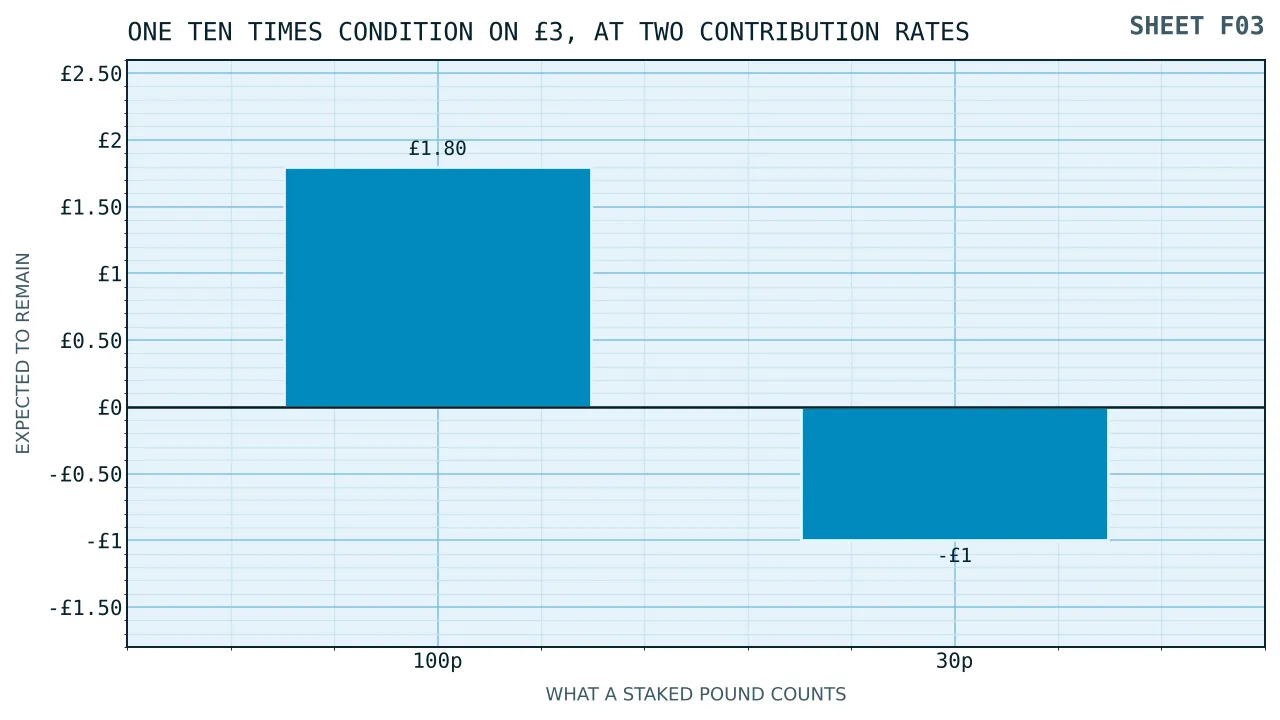
Which is the most useful line here for anybody setting two offers side by side. Two conditions can both read ten times and be worth different money, and the figure that separates them is not in the headline and not in the multiple. It is in a schedule of game contributions that no primary source publishes, so it has to be read off the terms every time.
5
What you may know before you stake
Thirty cycles is a short sequence, and a reader with three pounds has a sourced entitlement to certain information before the first of them. The entitlement is narrower than it is usually described, so here it is exactly.
An explanation of the rules has to be within easy reach before a customer commits, accurate, and sufficient to cover all the rules that apply, with reasonable steps taken to make it understandable. As the game runs, enough has to be displayed for the customer to follow the state it is in. What the prizes and payouts might be, or the means by which they are calculated, must be reachable beforehand too.
Then the requirement that gets misquoted across this whole market. Information that could reasonably be expected to let a customer judge their chances of winning has to be easily available before they commit to gamble, and that information must include at least one of the following: how the game operates and how winners and prizes get decided; or the margin or house edge; or the percentage returned to the player; or how probable a winning event is. The items in that list are joined by the word or. A licensee therefore satisfies the requirement by publishing the house edge, or the probability of winning events, instead of a return percentage, and it is wrong to say a licensed site must print one. Where a figure for the return is given, the guidance asks for the average theoretical one.
Three design rules sit behind the numbers and matter more over thirty cycles than over three thousand.
- Results have to be acceptably random, and a compensated game, meaning one whose behaviour adapts, is not allowed. An intervention shifting the probabilities is prohibited, automatic or manual alike, and a random number has to be taken in the sequence it was received rather than thrown away.
- A near miss may not be manufactured. A design that could reasonably be expected to leave a customer wrong about how probable some result is stands prohibited, and the standard names two kinds: a near-miss losing event substituted for an ordinary losing one, and a real device simulated without its real probabilities.
- Rules, payouts and outcome probabilities may not be altered while a game is in play, and any change has to be brought to the customer’s attention. The guidance names an unacceptable clause in terms: one saying the rules of a game may be changed at any time.
A result also has to be displayed clearly and accurately, for long enough to be read.
How long thirty cycles take follows from the pace floor. At a licensed cashier no slot cycle may follow another inside two and a half seconds, so thirty of them occupy 75 seconds at an absolute minimum, with a separate act of commitment required for each. The standard setting that interval states no date on which it began, and this sheet attaches none to it.
6
What three pounds sets off
The obligations a three pound payment triggers are the same ones a three hundred pound payment triggers, and two of them are worth stating precisely because they are routinely described loosely.
Identity, and when
Before a customer may gamble, enough has to be obtained and verified by the licensee to establish who that customer is, and the condition sets three particulars as a minimum rather than a limit, those being an address, a name and a date of birth. Before any money goes in, the customer must also be told what identity documents or other information might be wanted, at what point, and how to supply it. The licensee has to take reasonable steps to keep what it holds accurate.
The regulator’s consumer-facing page on this is older than most of the material behind this sheet, having gone up on 23 September 2020 with its last revision in April 2022, on the thirteenth. Its one-line summary is that every online gambling business must ask a customer to prove age and identity before they gamble, and the three reasons it gives are age, self-exclusion status, and confirming who the person is. For current wording, the licence condition rather than the guide is the place to look.
A limit, and how few clicks to it
The live standard says where limit-setting has to live, not merely that it must exist. A direct link from the home page, clearly visible and reachable. Clearly visible and reachable on deposit pages and screens, or by a link from them. And whatever pages or clicks stand between a customer and that facility have to be held down to a minimum. Reviewing is built in too. Where there has been activity inside a rolling twelve months, a prompt to look over the account and its transactions is owed at intervals of six months at most, with facilities for setting reminders oftener than that. Where no limit has been set at all, a prompt to think again is owed annually at the least.
One point of genuine inconsistency should be flagged rather than smoothed over. What the live standard requires is the prompt during registration, or else at whichever moment brings the first deposit or payment. A separate summary page of changes taking effect on 31 October 2025 instead says customers must be prompted as early as possible. Those are not the same instruction, the standard is the one with the force, and neither should be presented as the only wording.
Payment, and the distance to a threshold
No credit card may fund any of it, and none has been able to since 14 April 2020. A monthly net deposit above £150.00 brings on the light-touch checks for financial vulnerability, that threshold having replaced £500.00 on 28 February 2025. At three pounds a payment that threshold is fifty payments away. The separate enhanced assessments remain a pilot that is not running live, and the regulator states that neither they nor the light-touch checks affect a credit rating.
7
Three pounds off the register
Minimums of this size turn up constantly at cashiers that hold no Great Britain licence, and everything in parts 2, 5 and 6 then belongs to a regime that is not in force over them.
The sharpest published fact about bonus terms concerns a licensed operator rather than an unlicensed one, and it is useful here for exactly that reason. On 3 July 2025 a licensee trading as a casino brand was fined £170,000. The clause that drew it sat in the bonus rules for new casino promotions, and it kept to the operator a discretion either to shut an account or to withhold what had been won. What the regulator found breached was the fair and open licensing condition, and its reasoning was that wording of that kind lacks transparency and may produce unfair outcomes for consumers. Alongside the money, an audit by an independent third party was required, reaching how the operator controls money laundering and how it keeps play safer.
Two conclusions follow, and the second one limits the first. A reader may say, with a source behind them, that the British regulator has fined an operator over a clause of that shape and may name the condition it went against. Nobody may say such a clause is void, because what the source records is a penalty and an audit, not a term struck out. Away from the register there is no equivalent enforcement outcome to cite at all, which is the difference worth holding on to: the money was published because the licence made publication possible.
What replaces the British incentive apparatus depends on which jurisdiction the cashier names, and the three most often named differ from one another more than they resemble each other.
- The Caribbean regulator whose ordinance took effect on 24 December 2024 does publish a rulebook, and on bonuses it runs to two sentences: terms communicated transparently and clearly, and promotion that stops short of encouraging excessive play. Nothing there caps a multiple, nothing caps a stake, no minimum game cycle is set, automation is not prohibited and nothing restricts making a fuss of a return at or below its stake. Its own site stated, when checked, that its online gaming portal was offline.
- Malta is a different kind of jurisdiction and should not be grouped with the others. It operates under a Gaming Act and its directives, keeps an enforcement register and a searchable register of licensees, and runs a player hub with a formal route for lodging a complaint against an operator it licenses. What that page does not state is as relevant as what it does: no time limit, no restriction by residence, nothing about the limits of its own powers, and nothing about whether its decision binds an operator.
- The body issuing Anjouan licences publishes on a commercial domain rather than a government one, names no ordinance, Act or regulation at all, and refers only to the laws of the island in general terms. It advertises a public register, a verification tool, a player complaint process and a list of approved dispute providers. The complaint page returned an error when it was requested for this build, so nothing can be said here about its time limits, its remedies, or whether a decision binds anybody.
Where a site cites a Costa Rican registration, no regulator’s own rulebook, register or complaints route could be found to set beside the British ones, and this sheet says that and nothing more about it. The Gibraltar government’s gambling pages returned errors on every attempt, so no fact about that regulator appears here either, though two Gibraltar-incorporated licensees sit on the British enforcement list, which shows that an incorporation and a licence are different objects.
The check worth making costs nothing. A site should state its licensed status; that statement should lead, by a click, into the public register; and whatever stands recorded there against it, activities and domain names alike, should answer to the site being looked at. Neither a date nor a reading guide accompanies that register, which leaves the day of the check for the reader to record.
8
Three readings before you pay in
Three numbers decide a three pound deposit, and finding the first of the three is what this whole sheet exists for.
| The reading | On three pounds |
|---|---|
| The sum that qualifies for the offer | £10.00 illustrated |
| Any multiple fastened to the credit | 40x modelled, 10x lawful |
| What a staked pound counts for | 100p, or 30p |
Read the first and the third together and the second stops mattering nearly as much. A qualifying line above the deposit makes the credit nought whatever the multiple says. A contribution rate of thirty pence in the pound makes a lawful ten times cost a pound more than the credit. Either reading can price an offer at nothing on its own, and neither appears in a headline.
The usual caution, which is sharper on a sum this small. One pound eighty is a mean over many repetitions and not a payment. Where the prizes are few and large, thirty cycles land beneath £2.88 much more often than above it, and land on nothing often enough. The three pounds, meanwhile, is exact, and it left the account when the cashier asked for it.
Neighbouring sheets in this part of the tree. A deposit at a third of this size, where a flat charge rather than a qualifying line is what eats the money, is costed at 1 pound deposit casino. The rung above, where fifty cycles and a twenty pence toll make a charge measurable in staking, is £5 deposit casino. A ten pound floor with the whole British apparatus removed from it is priced at non gamstop casinos uk 10 deposit, duty by duty. The method behind every total on these sheets is written out at How a receipt is struck. The section’s own index of sheets stands at The floor.
Questions
- What does three pounds buy at a casino?
- Thirty cycles of a slot at 10p each, a toll of 12p over one complete pass of the balance, and, at a 96 per cent return, £2.88 of winnings on average. Twelve pence is the only cost on this page that is both small and certain. What it does not buy, in many cases, is the advertised offer, because the sum that qualifies for an offer and the sum a till will accept are two different figures.
- Why will a cashier take £3 and still not give me the bonus?
- Because the till has one floor and the offer has another, and nothing obliges them to agree. The British regulator’s consumer guidance tells a reader to look for exactly that: restrictions attached to an introductory offer, its own example being a level of spending that has to be reached before the bonus is paid. A qualifying minimum sitting above the deposit minimum is a significant condition, and rule 8.17 wants every applicable one of those put clearly and prominently in front of a reader in any case where dropping it would mislead.
- What does the gap between the two floors cost?
- Six pounds of expectation where the condition halts at the British ceiling, and nought where it runs to forty. Take ten pounds as the qualifying line. A full match there is £10.00 of credit; ten times asks £100.00 of staking at £4.00 of cost and leaves £6.00; forty times asks £400.00 at £16.00 of cost, which is six pounds more than the credit. The seven pounds of extra deposit is not spent, it is committed, and what the commitment buys is that expectation and nothing else.
- What is a matched three pounds worth after the play-through?
- One pound eighty at the legal maximum of ten times, which asks £30.00 of staking and costs £1.20. Twenty times leaves 60p. Twenty-five times leaves nothing exactly, whatever the size of the credit. Forty times asks £120.00 of staking at £4.80 of expected cost, which is £1.80 more than the credit ever was, so the offer prices at nought and the shortfall falls on the balance behind it.
- Can game weighting make a lawful ten times condition cost more than the credit?
- Yes, and this is the sharpest finding here. The British ceiling limits the multiple and nothing else, so a game contributing less than its face value still needs more staking per pound of requirement. The regulator’s consultation page records a respondent describing a contribution rate of thirty pence in the pound. Working from that rate: £3.00 of credit at ten times wants £30.00 of contribution, which takes £100.00 of actual staking, costing £4.00 against £3.00 of credit. Two conditions can both read ten times and be worth different money.
- What am I entitled to know about a game before I stake?
- An explanation of the rules within easy reach beforehand, accurate and sufficient to cover all of them. Enough displayed during play to follow the state of the game. What the prizes and payouts might be, or the means of calculating them. And information letting a customer judge their chances, which must include at least one of the following: how the game operates and how winners and prizes get decided, or the margin or house edge, or the percentage returned to the player, or how probable a winning event is. The items in that list are joined by or, so it is wrong to say a licensed site must print a return percentage.
- How long do thirty cycles take?
- Seventy-five seconds at the very least under a British licence, since no slot cycle may follow another inside two and a half seconds, and each one needs a separate act of commitment from the customer. The standard that sets the interval states no date on which it began, so none is attached to it here. A near miss may not be manufactured either: substituting a near-miss losing event for an ordinary losing one is named as prohibited, as is simulating a real device without its real probabilities.
- Has an operator ever been fined over the terms of a casino bonus?
- Yes, on 3 July 2025, for £170,000. The clause sat in the bonus rules written for new casino promotions and kept back a discretion to shut an account or withhold winnings. The regulator found a breach of the fair and open licensing condition, reasoning that wording of that kind lacks transparency and may produce unfair outcomes, and ordered an audit by an independent third party into the operator’s money-laundering controls and its safer gambling controls. Nobody may say such a clause is void: what is recorded is a penalty and an audit, not a term struck out.
- What does a three pound floor lose with no British licence over it?
- The prominence rules and the significant-conditions test, so a qualifying line may sit wherever the operator finds convenient. The ten-times ceiling, so forty times and worse become available. The information entitlements. The standards on randomness and on near misses. The pace floor of two and a half seconds. Verification of identity ahead of any play at all, the condition on credit cards, the obligations around limit-setting, and a registration that covers self-exclusion across the whole British market. The Caribbean rulebook consulted for this build gives bonuses two sentences and caps no multiple at all. Where a Costa Rican registration is cited, no regulator’s rulebook, register or complaints route could be found to set beside the British one.