
Sheet M11 Revision 1 Checked 15 October 2026
5 free spins no deposit
Fifty pence advertised, 48p of average winnings, and £19.20 of wagering demanded at forty times. Expected cost 77p against a credit of 48p, which closes the sheet at nothing on the smallest headline in the section.
48p of credit, 77p of cost, £19.20 of wagering between them
What the conditions leave
Every destination on this spike is bought advertising. The site takes a fee if a reader goes on to register, and no figure printed below moves because of it.
The Spin Sheet
Till receipt No 01
Betportal
Lowest multiple here
For every €1 of spin credit at face per €1
Credit
Debit
No Great Britain licence
Licensed in Anjouan, Comoros, run by BetPortal Gaming Ltd, with Excite Ultra Media Ltd, reference ALSI-202601040-FI2.
Terms read 15 October 2026
Open the offer at Betportal, opens in a new tabThe Spin Sheet
Till receipt No 02
WinBeast
Five staged matches
For every €1 of spin credit at face per €1
Credit
Debit
No Great Britain licence
Licensed in Curaçao, operator not named on the site.
Terms read 15 October 2026
Open the offer at WinBeast, opens in a new tabThe Spin Sheet
Till receipt No 03
EliteSpin
Longest spin window
For every £1 of spin credit at face per £1
Credit
Debit
No Great Britain licence
Licensed in Costa Rica, run by PrimeTier Limited.
Terms read 15 October 2026
Open the offer at EliteSpin, opens in a new tabThe Spin Sheet
Till receipt No 04
Crown Jewelz
Multiple unpublished
No total struck
Credit
Debit
No Great Britain licence
Licensed in Curaçao, number not verified, operator not named on the site.
Terms read 15 October 2026
Open the offer at Crown Jewelz, opens in a new tabThe figure at the foot of a receipt is this site's own arithmetic and nothing an operator has published: the credit, less the share a spin gives back at 96 per cent return to player, less what playing the wagering through costs at the same return. It describes the offer, not one reader's afternoon. Where the conditions price above the credit the receipt prints nothing rather than a negative sum, and where a figure the sum needs is unpublished it prints the condition in the operator's words instead.
Three words stand in the amount column where no figure can. Noted is a published condition that takes value away without leaving the sum a figure to take. Unpriced is a condition whose figure nobody has published, or a credit that is not a sum until a deposit of your own sets it. Own money is money of yours, which is never part of a total.
Not one of the operators printed above holds a Great Britain licence, so the duties that licence carries do not reach them. Every online gambling company licensed in Great Britain has to be part of Gamstop Online, and a reader who has shut themselves out through the scheme is therefore not shut out here. The ceiling of ten times the bonus funds on a wagering requirement, in force since 19 January 2026, is a condition of that licence and binds the companies that hold one. Where a dispute goes instead is a matter for the authority named on the receipt, and the Gambling Commission describes what a reader faces without a British licence as a lack of recourse if things go wrong. Nobody under 18 may hold an account at any of them.
Every term printed on a receipt is the operator's own, and each receipt carries the day it was read. The oldest of those readings is 15 October 2026. What binds a reader is the operator's own full terms, and not a line printed here.
1
Five cycles, forty-eight pence
Five is the smallest count this section has to price, and smallness changes which debit decides the answer. On a large count the play-through is a matter of hours and the hours are the finding. Here the play-through takes minutes, and what settles the bottom line is the absolute size of the credit measured against obstacles that do not shrink with it.
Begin with the credit. Five cycles at 10p are 50p on the front. A cycle pays what the cabinet returns, which at 96 per cent means ninety-six pence back out of every pound put across it, so five cycles average 48p of winnings. Two pence has gone before a single condition has been applied.
Forty-eight pence is B, and the whole sheet is built on it. The number five does not appear again.
Nothing published here fixes the cash value of one cycle, so 10p is a working figure and not a regulated one. At a higher value both the credit and the obligation scale together, so every proportion below holds at any value and only the pence change.
Forty times is the requirement used here, that being what no deposit counts tend to carry at the small end of this market. A British licence stops at ten times, and the regulator’s own record of what was in use before any ceiling existed goes up to sixty.
Inputs, stated so that any of them can be replaced:
- Five cycles priced at 10p, so 50p at face and 48p on average.
- A cabinet returning 96 per cent in theory.
- W at forty, with five further values in part 3.
- A staked pound counted in full, until part 6.
- Nothing deposited, which stops the exposure at the credit.
2
Forty-eight pence through the expression
One expression prices the whole of it, and the substitution is below the line that states it. B is the credit as advertised, W the number of turnovers asked for, RTP the theoretical return expressed as a decimal, and g the proportion of a staked pound that counts. What comes out, in pence here, is the expected cash.
E = B × (1 – (W × (1 – RTP)) / g)
And with five cycles in it:
1 – (40 × 0.04) = -0.60
E = 48p × -0.60 = -28.8p
The same result in money rather than algebra. Forty lots of 48p is £19.20 that has to go across the reels before any withdrawal, and of each of those pounds the cabinet expects to keep four pence, which comes to 77p. Forty-eight pence of credit has been pointed at seventy-seven pence of cost.
No part of that twenty-nine pence falls due from anybody. Nothing was deposited, so the balance cannot go below nought, and the credit expires somewhere within the £19.20. What the negative sign records is the extent of the overreach, which on this count is measured in pennies and in exactly the same proportion as it would be on a thousand pounds.
£19.20 of wagering fastened to 48p of winnings
Forty times a very small credit is still forty times. The ratio of obligation to gift is forty to one whatever the figures, which is the reason a count of five and a count of five hundred belong on the same sheet of paper.
3
Six requirements, counted in pence
Only W changes below. Minutes are the quickest lawful passage at 10p a cycle, and part 4 explains why that column turns out not to matter here.
| Requirement | Wagering demanded | Expected cost | Expected cash | Minutes at 10p |
|---|---|---|---|---|
| 10 times | £4.80 | 19p | 29p | 2 |
| 20 times | £9.60 | 38p | 10p | 4 |
| 25 times | £12.00 | 48p | 0p | 5 |
| 30 times | £14.40 | 58p | -10p | 6 |
| 40 times | £19.20 | 77p | -29p | 8 |
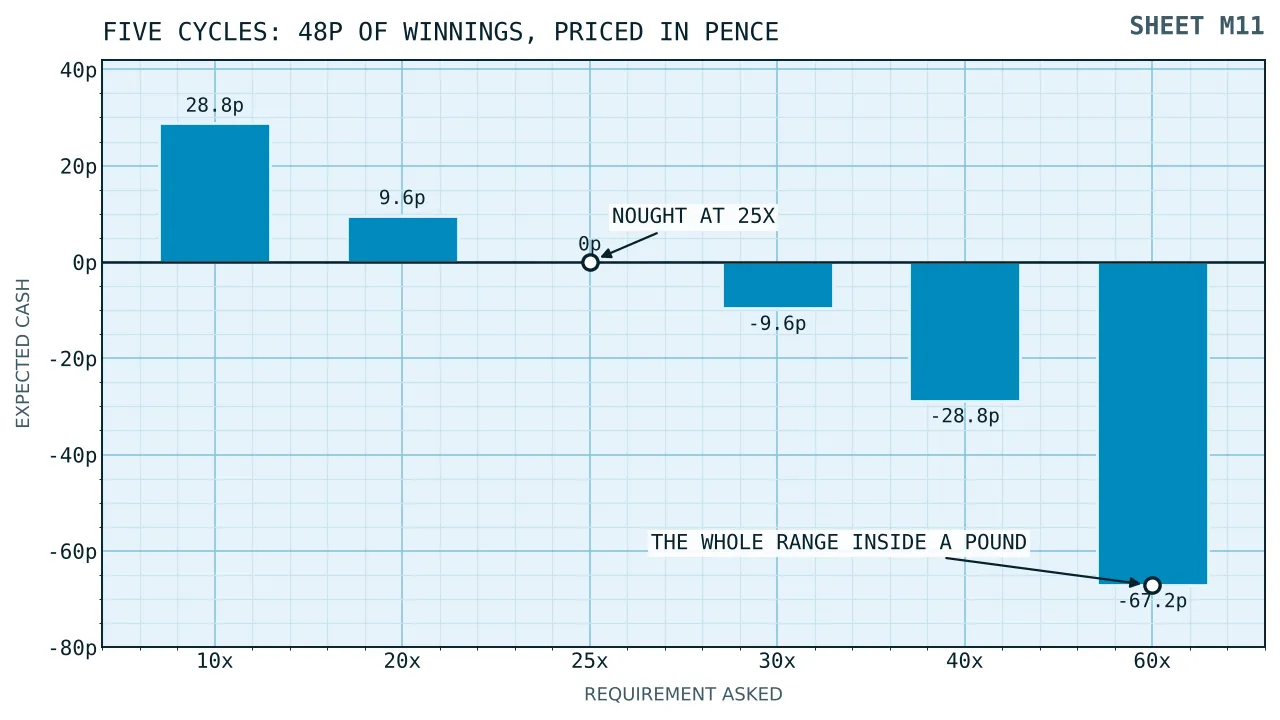
| 60 times | £28.80 | £1.15 | -67p | 12 |
Twenty-five times is the balance point on a 96 per cent machine, and 48p meets it at precisely the spot a credit of £48 would. Send the expected cash to nought and B falls out of the working, so what fixes the crossing is the cabinet and not the size of the gift.
What the pence column shows, and no larger count shows as plainly, is how little is in play at any requirement. The best row on the schedule is the regulated ceiling, and it leaves twenty-nine pence. The worst leaves a deficit of sixty-seven. Every honest reading of a five cycle offer starts from that span of under a pound, and most of what follows on this sheet is about obstacles larger than the span itself.
Two pence of the fifty went before the terms were read, which is the four per cent the cabinet keeps. At twenty-five times the whole forty-eight pence goes the same way, in twelve pounds of wagering rather than in fifty pence of it. The mechanism is identical and only the scale differs.
4
Why the clock is not the obstacle here
On every larger count in this section the time owed is the headline finding. On five cycles it is almost an irrelevance, and it is more useful to say so than to recite a rule that does not bite.
£19.20 of wagering at 10p a cycle is 192 cycles. A British licence requires 2.5 seconds to pass before a slot cycle may follow the one before it, which puts the obligation at 480 seconds. Eight minutes. The five free cycles themselves take twelve and a half seconds.
Raise the stake to the lawful maximum and the eight minutes almost vanish. A statutory instrument of 25 February 2025 puts a ceiling on what may be staked in a single game cycle on an online slot: five pounds, or two for a player younger than twenty-five. The regulator’s guidance dates the first to 9 April 2025 and the second to 21 May 2025, and keeps both away from games such as roulette and blackjack. At five pounds a cycle, £19.20 is four cycles and ten seconds of elapsed time. The expected cost is 77p whichever stake is used, wagering demanded being a sum of money whose division into pieces is all the stake decides.
192 cycles at 10p, four cycles at the £5 ceiling, 77p either way
So the pacing rules a licence imposes, which decide the answer on a count of a hundred or more, make no practical difference on a count of five. Automatic play is barred, turbo and slam stop cannot be offered, and two games may not be run side by side, but eight minutes was never the thing standing between a reader and twenty-nine pence.
Nor is the expiry window. A twenty-four hour window holds thousands of cycles at the 2.5-second floor, against the 192 this requirement asks for. Only a window measured in minutes could reach the answer before the multiple does, and on this count almost nothing else in the terms is smaller than the credit.
Packages of that sort hold no Great Britain licence, which is a list of particular obligations rather than a general warning. On the pacing side the list is short and makes little odds here: no minimum interval between cycles in the Curaçao policy, no stake ceiling, and nothing on automatic play. The parts of that list which do matter on forty-eight pence are in parts 5 and 7.
5
What a forty-eight pence credit cannot carry
Here is the finding of this sheet. On a credit of this size, the things that decide the answer are fixed obstacles rather than proportional ones, because a fixed obstacle of any size at all is larger than the credit.
A cap on the credit’s winnings
No primary source sets out a standard cap on what a bonus may win, and none is invented here. What can be set out is the structure, since two rules are easily confused. A licensee here may not impose, use or lean on a term capping the sum a consumer withdraws from a deposit balance, and the regulator’s guidance carries a specimen of one, allowing fifty pounds out in a day and five hundred across a week. That protects money the player paid in. A no deposit account contains none, so there is nothing for that rule to protect, and a cap written around what a bonus may win stands outside it entirely.
A floor under a withdrawal
No primary source publishes a standard minimum withdrawal, so this sheet quotes none. The arithmetic is still worth stating as a conditional, because it is the one piece of reasoning a five cycle offer cannot survive. Where a cashier sets any minimum at all on taking money out, and the expected cash at the regulated ceiling is twenty-nine pence, the condition that decides the outcome is not the multiple. It is a threshold the credit was never large enough to clear. The reader’s work is therefore to find that figure in the terms, not to argue about W.
A minimum before a dispute is heard
The same shape appears in the complaints machinery on the offshore side. Out there the dispute resolution is compulsory and the player pays nothing for it, the operator footing the bill, and the parameters are left to the operator by the policy itself, among them whether a claim has to reach a minimum value before anybody will escalate it. On a credit of forty-eight pence, a minimum claim value of any size closes the route. In Britain the dispute resolution entities are approved by the regulator, only an approved one may be used, and the published list names eight.
The word on the front
On the word free, an offer of five cycles passes the advertising regulator’s test, which turns on whether qualifying requires the customer to stake money of their own. Nothing is staked here. The same advice adds that the pairing of that word with the language of hazard should be avoided unless a customer’s own funds genuinely cannot be touched.
Proportionality is the part of that advice which bears on a small offer. Rewards are meant to stay in proportion to what a player has already spent in money and in time. The regulator’s instance of something capable of passing is one free bet, handed over after fifty pounds of wagering, and it passes only where a free bet at that stage is unremarkable for the type of gambling involved. Five cycles given away at the door is the opposite case: an inducement offered before any spending at all, whose function is to open an account rather than to reward anything. Part 7 prices what that account is worth to the other side.
6
Weighting on a credit this small
So far a staked pound has counted in full against the requirement. Where a cabinet counts only part of a pound, the requirement is untouched and the wagering needed to clear it multiplies.
Let thirty pence of each staked pound count. Contribution owed stays at £19.20, forty lots of 48p. Earning that much contribution takes £64.00 of wagering, whose expected cost is £2.56, so forty-eight pence of credit now faces a bill of more than two and a half pounds.
40 × 0.04 = 1.60
1.60 ÷ 0.30 = 5.3333
E = 48p × (1 – 5.3333) = -£2.08
The time stops being trivial at that point, though it never becomes the obstacle. £64.00 at 10p is 640 cycles and 1,600 seconds, twenty-six minutes and forty seconds at the floor between cycles.
Now take the requirement down to ten, which is what a British licence permits, and leave the weighting alone. Contribution owed falls to £4.80, wagering to £16.00, cost to 64p, and the expected cash to minus 16p. Inside the regulated ceiling and below nought all the same, because the ceiling was drawn around W while g was left alone.
That thirty per cent is borrowed and has to be labelled. A respondent to the regulator’s consultation gave an example in which a wagered pound moved a requirement along by thirty pence, and the regulator recorded the point without regulating weighting. The rates in use are published nowhere, so the figures just given are sums of this site’s own applied to a rate from elsewhere. Contribution is the subject of its own sheet at slots free spins.
7
What signing up actually buys
A five cycle offer is not really a prize. It is the price of opening an account, and on the reader’s side of the ledger the account is the thing worth pricing. Under a British licence the account comes with a set of duties, and away from it the duties are the part that is missing rather than the twenty-nine pence.
Identity, settled first of all
Under licence condition 17.1.1 nobody may gamble until the licensee has got and checked information that establishes who they are, and what the condition names as a minimum is address, date of birth and name. When those rules were announced the age check was extended to play funded by a bonus, to a free bet, and to the versions of games a licensee offers at no charge. So five free cycles cannot be played anonymously on a licensed site, and the identity work happens before the cycles rather than at the cashier: a licensee that could have sought information at an earlier stage may not make it the price of a payout, unless another legal duty bites at that moment.
A limit, offered before a first deposit
RTS 12A obliges a gambling system to provide facilities, easily reached, by which a customer sets financial limits of their own, available from the moment of registration onwards. The prompt is compulsory: a limit has to be put to the customer during registration, or else at the point of a first deposit or payment, and the customer must be told when it will take effect. Setting a limit is the default under RTS 12E, so declining one calls for an action from the customer, confirmed before any deposit or play proceeds.
The shape of the facility is specified too. RTS 12B wants a free text box, limits applied at account level as a minimum, and gross deposit limits offered with at least the same prominence as any other kind. Under RTS 12C the facilities need a direct link from the homepage, visibility on or beside the deposit screens, and as few clicks and pages as the system can manage. Three durations at least are compulsory: a month, seven days and twenty-four hours. Reductions take effect at once. An increase sits for a day, after which the customer has to return and confirm it. Of two overlapping periods, the tighter governs.
None of that machinery is in the Curaçao rulebook in the same form. Deposit limits it does require, daily, weekly or monthly, with a reduction immediate and an increase held for seven days, where Britain holds one for twenty-four hours. What it does not do is make a limit the default, or specify the prompt, or the free text box, or the prominence of one limit type against another.
Checks that are not a credit check
Checks of a light-touch kind on financial vulnerability begin above a threshold set on net deposits in a month. It opened at 500 pounds a month from 30 August 2024, falling to 150 pounds a month from 28 February 2025. The separate enhanced financial risk assessments remain a pilot, with nothing running in a live environment, and the regulator says a consumer’s credit rating is unaffected by either exercise. A duty that began on 17 January 2025 puts a customer’s net spend and elapsed playing time in front of them as they play.
What the account is worth to the other side
The honest answer to what five cycles cost is a marketing relationship, and British rules put a price on that too. Since 1 May 2025 direct marketing for online gambling has needed opt-in consent, given by product type and by channel. That date was changed from 17 January 2025 by the regulator itself, so the earlier one should never be attached to this rule. Under social responsibility code 5.1.11, direct electronic marketing may not reach a consumer who has not given informed and specific consent to it, unless the law expressly permits.
The Curaçao rulebook gives promotions two lines, asking that they be put across with clear terms and that excessive play not be pushed by aggressive promotion. It carries no ceiling on a multiple and no equivalent of the consent regime, though it does reach affiliates directly, holding the operator responsible for their compliance through binding contracts, audits and penalties, which is more than the British advertising guidance says about affiliates at all.
Self-exclusion is the last item, and the plainest. Gamstop Online membership comes with a British licence as a condition of holding one, and the scheme states where its reach ends: it cannot stop a registered person using services run by organisations outside it. Exclusion on the Curaçao side is taken at one operator and over the domains it runs, with a year the shortest term available, and for every other site the policy merely recommends that the player repeat the exercise. Nothing here helps anybody past a block they have put in place, and free help is listed at the foot.
8
Pricing five cycles yourself
Four lines and a floor, worked here in pence because that is the unit the answer comes out in.
| The line | In pence |
|---|---|
| Count by the price of a cycle | 50p |
| By the theoretical return | 48p |
| By the requirement, over g | 1,920p |
| By the house edge | 77p |
| Credit less cost, floored | 0p |
Every line scales with the count, so a count of ten doubles each of them and a count of fifty multiplies each by ten. The expected cash per cycle holds at minus 5.76p across the whole range at forty times, so a reader who compares headline counts is comparing the figure that decides least.
Three limits on the answer, and on this count the third is the one that matters.
It is a mean taken over many repetitions. Twenty-nine pence at the regulated ceiling describes the centre of a spread, and on five cycles the commonest single result is nothing whatever. Five cycles is nowhere near enough for an average to show up.
W and g are what it prices. The rest of the document is outside it. Part 5 lists the fixed obstacles that sit outside the brackets, and on a credit of forty-eight pence any one of them can finish the matter.
And the smaller the credit, the more the fixed obstacles matter and the less the multiple does. That is the real lesson of this count, and it inverts the usual advice. Read the minimum withdrawal, any cap on bonus winnings and any minimum claim value before reading W, because at this size those are the figures that decide the outcome. Larger counts are priced elsewhere in the section: 10 free spins doubles this one, 40 free spins no deposit multiplies it by eight, while 25 free spins on registration no deposit hands the credit over at sign-up. The full index sits at The multiple, sorted by the figure on each front.
Questions
- What are 5 free spins with no deposit worth?
- Fifty pence advertised, 48p of average winnings, each cycle priced at 10p against a theoretical return of 96 per cent. Forty times that credit is £19.20 of wagering, whose expected cost is 77p. The cost stands twenty-nine pence above the credit, so the credit runs out and the sheet closes at nothing.
- Is the best case on a count of five worth having?
- Twenty-nine pence, which is what the regulated ten times leaves. That is the best row of the whole schedule, and the worst is a deficit of sixty-seven pence. The entire range of outcomes on a five cycle offer fits inside a pound, which is the figure to weigh against any fixed condition in the terms.
- At what requirement do five cycles come to nothing?
- Twenty-five times, given a 96 per cent return. Edge of four pence, levied twenty-five times, consumes a pound of credit exactly, and the crossing belongs to the return rather than to the count, so 48p reaches it where £48 would.
- How long does the play-through on 5 free spins take?
- Eight minutes at 10p a cycle, and about ten seconds at the five pound slot ceiling. The £19.20 of wagering is 192 cycles, and a slot on a British licence must leave 2.5 seconds before one cycle follows another. On a count this small the clock is not the obstacle, and saying otherwise would be padding.
- Why does the minimum withdrawal matter more than the multiple here?
- Because a fixed obstacle does not shrink with the credit. No primary source publishes a standard minimum withdrawal, so no figure is quoted here, but the reasoning holds as a conditional: where a cashier sets any floor on taking money out, twenty-nine pence of expected cash will not clear it, whatever W happens to be.
- Can an offer cap what a small bonus wins?
- That is a separate object from the withdrawal rule. A licensee here may not impose or lean on a term capping what a consumer draws from a deposit balance, and the regulator’s specimen of one lets fifty pounds out in a day and five hundred across a week. A no deposit account has no such balance, so a cap on what the credit may win is outside that rule.
- How does a 30 per cent contribution rate hit 48p of credit?
- It turns a twenty-nine pence deficit into £2.08. Contribution owed stays at £19.20, and thirty pence to the pound means £64.00 of wagering to earn it, costing £2.56. Eight minutes becomes twenty-six minutes and forty seconds. At that rate the ten times a licence permits still prices at minus 16p.
- Is identity checked before five free spins?
- On a licensed site, yes, and before the cycles rather than after. Under licence condition 17.1.1 nobody may gamble until the licensee has got and checked information establishing who they are, with address, date of birth and name named as the minimum, and the age check reaches bonus-funded play and games offered at no charge.
- What does a licensed account come with that an offshore one does not?
- Financial limits that must be offered from registration, prompted for, and presented as the default, with a free text box, account-level application and a direct link from the homepage. Light-touch vulnerability checks above a net deposit threshold of 150 pounds a month since 28 February 2025. A real-time display of net spend and time played. And opt-in consent before any direct marketing.
- Is a small offer worth the marketing consent it asks for?
- That is the trade to weigh, and the arithmetic puts the credit at forty-eight pence. Since 1 May 2025 direct marketing for online gambling has needed consent given by product type and by channel, and under code provision 5.1.11 no consumer may be sent direct electronic marketing without having given informed and specific consent, unless the law expressly permits. Away from a British licence neither rule applies.