
Sheet D03 Revision 1 Checked 15 October 2026
Deposit 10 get 300 free spins
Priced at 10p apiece on a 96 per cent game, three hundred spins average £28.80. The turnover owed is £1,152.00, whose expected cost of £46.08 runs £7.28 beyond everything a tenner and an award of that size can between them cover.
£10 carries 173 spins at forty times, and 300 arrive
What a spin count leaves
Every destination on this spike is bought advertising. The site takes a fee if a reader goes on to register, and no figure printed below moves because of it.
The Spin Sheet
Till receipt No 01
Betportal
Lowest multiple here
For every €1 of spin credit at face per €1
Credit
Debit
No Great Britain licence
Licensed in Anjouan, Comoros, run by BetPortal Gaming Ltd, with Excite Ultra Media Ltd, reference ALSI-202601040-FI2.
Terms read 15 October 2026
Open the offer at Betportal, opens in a new tabThe Spin Sheet
Till receipt No 02
WinBeast
Five staged matches
For every €1 of spin credit at face per €1
Credit
Debit
No Great Britain licence
Licensed in Curaçao, operator not named on the site.
Terms read 15 October 2026
Open the offer at WinBeast, opens in a new tabThe Spin Sheet
Till receipt No 03
EliteSpin
Longest spin window
For every £1 of spin credit at face per £1
Credit
Debit
No Great Britain licence
Licensed in Costa Rica, run by PrimeTier Limited.
Terms read 15 October 2026
Open the offer at EliteSpin, opens in a new tabThe Spin Sheet
Till receipt No 04
Crown Jewelz
Multiple unpublished
No total struck
Credit
Debit
No Great Britain licence
Licensed in Curaçao, number not verified, operator not named on the site.
Terms read 15 October 2026
Open the offer at Crown Jewelz, opens in a new tabThe figure at the foot of a receipt is this site's own arithmetic and nothing an operator has published: the credit, less the share a spin gives back at 96 per cent return to player, less what playing the wagering through costs at the same return. It describes the offer, not one reader's afternoon. Where the conditions price above the credit the receipt prints nothing rather than a negative sum, and where a figure the sum needs is unpublished it prints the condition in the operator's words instead.
Three words stand in the amount column where no figure can. Noted is a published condition that takes value away without leaving the sum a figure to take. Unpriced is a condition whose figure nobody has published, or a credit that is not a sum until a deposit of your own sets it. Own money is money of yours, which is never part of a total.
Not one of the operators printed above holds a Great Britain licence, so the duties that licence carries do not reach them. Every online gambling company licensed in Great Britain has to be part of Gamstop Online, and a reader who has shut themselves out through the scheme is therefore not shut out here. The ceiling of ten times the bonus funds on a wagering requirement, in force since 19 January 2026, is a condition of that licence and binds the companies that hold one. Where a dispute goes instead is a matter for the authority named on the receipt, and the Gambling Commission describes what a reader faces without a British licence as a lack of recourse if things go wrong. Nobody under 18 may hold an account at any of them.
Every term printed on a receipt is the operator's own, and each receipt carries the day it was read. The oldest of those readings is 15 October 2026. What binds a reader is the operator's own full terms, and not a line printed here.
1
Three hundred spins, priced one at a time
Spin counts are the one headline on this site written in a unit that is not money. A percentage at least tells you what it multiplies. A count of three hundred tells you nothing at all until somebody says what a spin is worth, and nothing published in Great Britain says what a spin is worth.
Who sets that value, what must be disclosed about it, whether any floor or ceiling exists: on all three the regulator’s own material says nothing. The price of a spin is a commercial decision and no rule reaches it. So 10p is named here as a working price, named openly as one, and anybody preferring a different price can rerun every figure on the page at it.
At 10p, three hundred spins carry a face of £30.00. Face is the sum staked across the round, and no round pays its face. A 96 per cent slot hands back ninety-six pence of each pound through it, so three hundred cycles at 10p average £28.80 of winnings. That £28.80 is the credit this page prices, and the £1.20 between face and average is a debit charged before a single condition has been read.
Then there is the tenner. It was the reader’s before any of this and stays theirs in every line here. A match offer is the one shape where that distinction does real work, because the money paid in is what funds the shortfall when the condition runs past the credit. It is never a winning, and it is never netted off as one.
Fixed throughout, and changeable by anyone who wants a different answer:
- A spin costs 10p and the stake stays at 10p through the turnover.
- The game returns 96 per cent and contributes at full weight.
- Turnover is demanded forty times over, which is the sort of multiple asked out here. Nothing above ten is permitted under a Great Britain licence.
- The requirement runs on the winnings from the spins, not on the tenner as well.
- The whole award lands at once. Part 6 prices what happens when it does not.
2
What the count is as a percentage
A spin count and a match percentage are the same instrument in different clothes, and converting one into the other is the quickest way to see what is being offered.
Divide the face of the spins by the sum paid in and the answer is a percentage. Three hundred spins at 10p is £30.00 of face against £10.00 paid in, so the advertisement is a 300 per cent match wearing a spin count. Divide the average winnings instead and the honest figure is 288 per cent, because the four per cent the game keeps has already gone.
| The offer | Face | At face | Priced | Staking owed |
|---|---|---|---|---|
| £10 and 100 spins | £10.00 | 100% | 96% | £384.00 |
| £10 and 200 spins | £20.00 | 200% | 192% | £768.00 |
| £10 and 300 spins | £30.00 | 300% | 288% | £1,152.00 |
| £5 and 200 spins | £20.00 | 400% | 384% | £768.00 |
Two things fall out of that conversion. The first is that a spin count flatters itself. Three hundred sounds like a quantity of fun and reads, once converted, as a tripled match with all the obligation a tripled match carries.
The second is that the sum paid in is half the ratio and the advertisement usually fixes it for you. The same two hundred spins are a doubled match on a tenner and a quadrupled one on a fiver, and nothing about the spins has changed. What changed is the denominator, and the smaller it is the more lopsided the thing becomes.
3
5.76p, the price of one free spin
There is a single constant underneath every offer of this shape, and once it is in hand the arithmetic can be done on a bus.
One 10p spin averages 9.6p of winnings. Those winnings owe forty times themselves in turnover, which is £3.84 of staking, costing 15.36p at four pence in the pound. Set 15.36p of cost against 9.6p of winnings and the spin runs 5.76 pence short.
Short of what, exactly. Short of paying for itself, which means the shortfall is charged against whatever else is in the account. On a no-deposit offer there is nothing else and the matter ends at nought. Here there is a tenner, and every spin in the award takes 5.76 pence out of it in expectation.
Divide £10.00 by 5.76 pence and the answer is 173.6. So a tenner will carry 173 spins at forty times, and the offer on the front of this page hands over three hundred. The excess is not a bonus. It is 127 spins whose cost has nowhere to go.
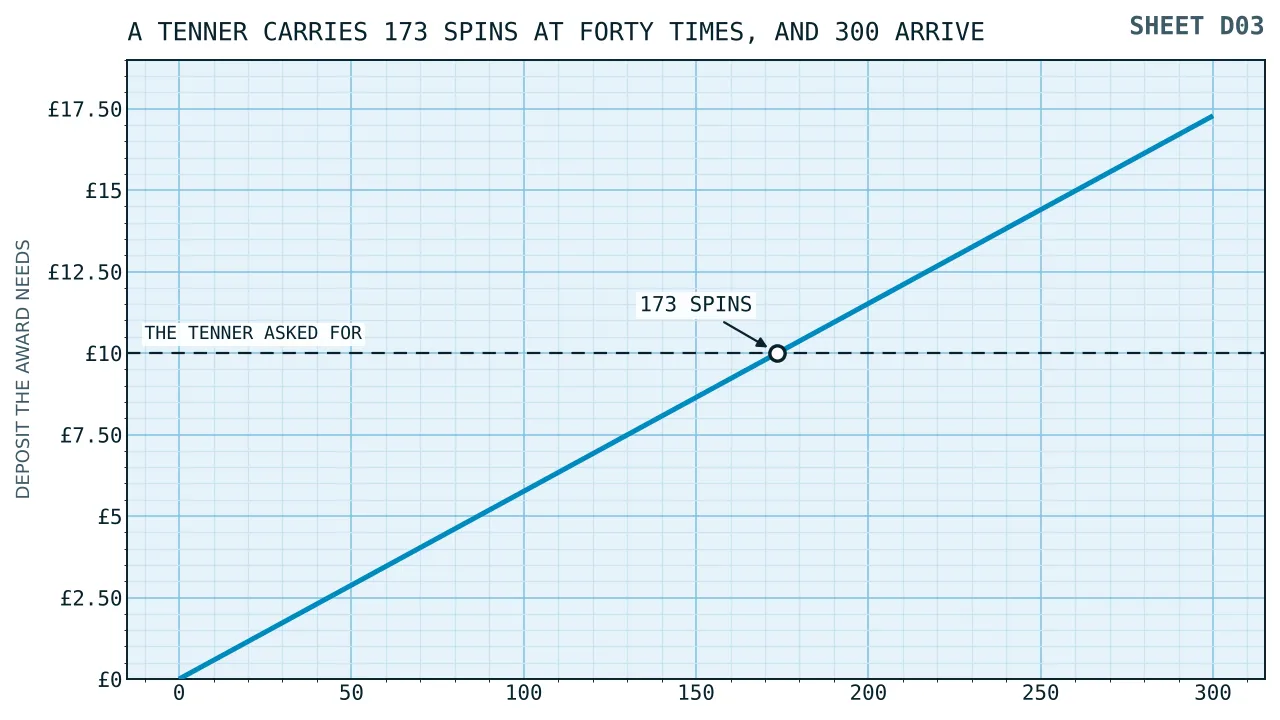
5.76p of your own, per 10p spin, at forty times
4
The expression, and £7.28 past the tenner
The per-spin constant is a shortcut and the long way round is worth seeing once, so the count is turned into a credit and run through this site’s arithmetic.
E = B × (1 – (W × (1 – RTP)) / g)
Each letter has a job. B holds the credit at face, £28.80 of average winnings here rather than the £30.00 advertised. W holds the turnover multiple, forty. RTP holds 0.96. g holds the weighting, one. Out of the other side comes E, the residue the credit is expected to leave.
E = £28.80 × (1 – (40 × 0.04) / 1)
E = £28.80 × (1 – 1.60)
E = -£17.28
The middle step in pounds: £28.80 turned over forty times is £1,152.00 of staking, and a game keeping four pence in each pound is expected to take £46.08 of it.
Now put the tenner alongside. The account holds £38.80 in all, being the paid-in £10.00 and the £28.80 of winnings the spins are expected to produce. A cost of £46.08 exceeds that by £7.28. Nothing closes the account with anything in it, and the condition is still seven pounds and twenty-eight pence from being satisfied.
That figure also arrives by the shortcut, which is a useful check. One hundred and twenty-seven spins past what a tenner carries, at 5.76 pence apiece, is £7.32, the four pence of difference being rounding on the 173.6.
£46.08 of expected cost against £38.80 in the account
5
Counts from a hundred to three hundred
Hold the tenner and the forty times still and vary only the count. Credit is the count multiplied by 9.6 pence. Closing line is what the whole account is expected to come to, floored at nothing because nothing was lent.
| Spins | Average winnings | Turnover owed | Edge takes | Left at the foot |
|---|---|---|---|---|
| 100 | £9.60 | £384.00 | £15.36 | £4.24 |
| 150 | £14.40 | £576.00 | £23.04 | £1.36 |
| 200 | £19.20 | £768.00 | £30.72 | £0.00 |
| 250 | £24.00 | £960.00 | £38.40 | £0.00 |
| 300 | £28.80 | £1,152.00 | £46.08 | £0.00 |
The closing line falls by £2.88 for every fifty spins added, which is fifty lots of 5.76 pence, and it hits the floor somewhere between a hundred and fifty and two hundred. A reader looking for the best of that column should want the smallest count on offer, which is an uncomfortable conclusion and an arithmetically unavoidable one at forty times.
It flips entirely at the British ceiling. At ten times, each 10p spin owes £0.96 of staking, costs 3.84 pence and returns 9.6 pence, so it contributes 5.76 pence rather than consuming it. Three hundred spins at ten times leave £17.28 on top of the tenner, for a closing line of £27.28. The identical headline, the identical count, and a difference of twenty-seven pounds and twenty-eight pence turning on one term.
Twenty-five times is where the crossing sits, a spin there paying for its own condition exactly and adding nothing. Under twenty-five, more spins is better. Over it, more spins is worse. And twenty-five is simply one over the house edge, which means the return to player moves it and no other term does.
6
Instalments, windows and eight hours
Three hundred spins is also a quantity of time, and the staking that follows them is a much larger one.
Count the award as cycles and it is three hundred of them. Under RTS 14D a further cycle waits 2.5 seconds on a slot, which puts a floor of 750 seconds under the award by itself. Twelve and a half minutes, and the pleasant part.
The turnover is the rest. £1,152.00 at 10p a cycle is 11,520 cycles and 28,800 seconds at that same floor. Eight hours precisely, and software may not be left to do it: a British licensee has to take a fresh commitment to every single cycle, the one exception written anywhere being blinds at a poker table.
Awards of this size are commonly paid in instalments, thirty a day across ten days being a usual shape, and the arithmetic of that deserves care. Instalments do not change the credit, the staking or the cost. They change when the clock on each tranche starts, and they can mean a reader meets several windows rather than one. A tranche of thirty spins is £2.88 of credit owing £115.20 of staking, which is 1,152 cycles and forty-eight minutes at the floor before that tranche is cleared.
Measured against those forty-eight minutes, a twenty-four hour window is generous. The floor allows 34,560 cycles in a day, and at 10p that is more staking than the whole award requires. Expiry decides some offers. On a count this large it is the multiple that decides, every time.
11,520 cycles, eight hours at the 2.5-second floor
7
Who you are, before the first cycle
Hosting changes none of it, a 96 per cent slot being a 96 per cent slot in any country. The jurisdiction settles the obligations standing underneath instead, and an award advertised in this shape comes with no Great Britain licence at all. Taking that one duty at a time is more useful than a label.
Identity, and when it is settled
Date of birth, address and name: a British licensee has to hold all three, verified, before a customer may gamble at all, under licence condition 17.1.1. The same condition seals the exit as well, so a request for further information cannot be sprung at the moment of withdrawal if there was a reasonable chance to ask for it sooner.
What gives that teeth on a page about spins is how far the regulator pushed it. Free-to-play versions of games, where no prize exists whatever, fall inside the age-check rule; so does gambling paid for with a bonus or a free bet. Operators had once been allowed seventy-two hours to finish an age check, and the rules replacing that came into force on 7 May 2019. Three hundred spins on a British site are three hundred cycles that wait for the checking.
Curaçao gets to a similar place more slowly. No deposit and no wager is allowed there unless the operator is satisfied the player has turned eighteen, which at registration may rest on a stated date of birth, a tick box and the payment method used. The check against a government-issued document hangs off milestones in that regime’s own rules on knowing the customer and on money laundering, brought forward only where there is doubt about age. So identity and first wager are two separate moments offshore and a single moment here.
The ceiling, in pounds on this award
Ten turnovers of the bonus funds is the furthest a British licensee may push a wagering requirement, a ceiling live since 19 January 2026 under Social Responsibility Code 5.1.1. Price it on this award. Turnover drops from £1,152.00 to £288.00, expected cost from £46.08 to £11.52, and the foot reads £27.28 where out here it reads nothing.
A caveat belongs with that, and it bites hardest on a page counting spins. Bonus funds is the term the ceiling uses. Nobody has published whether a spin by itself answers to that description. Safe ground is narrow. Spin winnings credited into an account as bonus funds carry a requirement that stops at ten, and that is the whole of it. Push the claim either way past that point and it stops being honest.
What a stake cap does to a spin
A stake on a British online slot stops at £5 for each game cycle, and at £2 for a player under twenty-five. The statutory instrument behind that was made on 25 February 2025; the regulator gives 9 April 2025 for the five and 21 May 2025 for the two. Reel games are the whole of its reach, roulette and blackjack being outside it. A 10p spin is nowhere near either figure, which is the useful observation: a stake cap governs how quickly money can be put at risk and not how large a promotion may be. The Curaçao rulebook read for this site has no stake cap in it at all.
8
Taking a spin count apart
Five steps turn any count into a figure, and the second is the one that gets skipped.
| The step | Here |
|---|---|
| Face of the award | £30.00 |
| Winnings after the return | £28.80 |
| Turnover at W over g | £1,152.00 |
| Edge of the turnover | £46.08 |
| Against a balance of £38.80 | £0.00 |
Or skip to the constant. Multiply the count by 5.76 pence, compare the answer with what the cashier wants paid in, and the sign of the difference is the answer. Three hundred spins want £17.28 behind them and the offer asks for £10.00, so the answer is negative before any of the long arithmetic is done.
That constant moves with the multiple and nothing else, which makes it portable. At thirty times a 10p spin wants 2.88 pence behind it. At twenty-five it wants nothing. At ten times it hands 5.76 pence back instead.
Two warnings on spending any of this.
An expected closing line is an average over many repetitions and never a forecast of one attempt. Most single attempts at an award this size end with the balance gone long before the turnover is met, and the expression is silent on that by construction.
And these figures belong to this sheet while the terms belong to a cashier. Six things need lifting off whatever document is published: how many spins, at what price each, under what multiple, at what weighting, against what lid on winnings, inside what window.
The same method runs on neighbouring offers at deposit 5 get 200 free spins, where a smaller sum paid in buys the steepest ratio in this section, deposit 10 get 100 free spins, the one award here that leaves a tenner with something on it, and 300% deposit bonus, which is this page’s offer stated as a percentage instead. The rest sit under Matched money.
Questions
- What are 300 free spins worth on a £10 deposit?
- Nothing is expected to survive, on the assumptions used here. The face of three hundred spins at 10p is £30.00, and a 96 per cent return turns that into £28.80 of average winnings. Forty turnovers of £28.80 demand £1,152.00 of staking, whose expected cost is £46.08. The account holds £38.80 once the tenner is counted, so it empties with £7.28 of condition left unsatisfied.
- What percentage match is 300 spins on a tenner?
- Three hundred per cent at face and 288 per cent once priced. Three hundred spins at 10p is £30.00 of face against £10.00 paid in, and dividing one by the other gives the headline percentage. Using average winnings of £28.80 instead gives 288 per cent, which is the honest figure, because the four per cent the game keeps has gone before any condition is read.
- How much does one free spin cost me at forty times?
- 5.76 pence of your own money. Average winnings on a 10p spin are 9.6 pence. Forty turnovers of 9.6 pence is £3.84 of staking, and the edge takes four pence in the pound, or 15.36 pence. Take the 9.6 pence back off and the spin is 5.76 pence short, which is charged to whatever else the account holds.
- How many spins will a £10 deposit actually carry?
- About 173 at forty times. Dividing £10.00 by the 5.76 pence each spin costs gives 173.6, so a tenner covers the condition attached to roughly that many. An award of three hundred is 127 spins past the point the deposit can fund, which is where the £7.28 of unmet condition comes from.
- Is my £10 treated as winnings anywhere in this?
- No. The tenner belonged to the reader before any offer existed and stays on the debit side of every line here. Credit means the £28.80 of average spin winnings and nothing else. Striking the foot against a balance of £38.80 rather than against nought is what keeps the two apart, and an advertisement adding the deposit to the award and calling the sum a prize has counted somebody else’s money as its own.
- How long does the play-through on 300 spins take?
- Eight hours at the fastest a British licence permits, plus twelve and a half minutes for the spins themselves. The staking of £1,152.00 at 10p a cycle is 11,520 cycles, each owing 2.5 seconds before another may start, which is 28,800 seconds. Software may not run them either, so every cycle is a separate decision.
- Do spins paid in daily instalments change the figures?
- Not the credit, the staking or the cost. Instalments change when each tranche starts its clock and can put a reader in front of several windows instead of one. Thirty spins is £2.88 of credit owing £115.20 of staking, which is 1,152 cycles and forty-eight minutes at the floor, so each daily tranche is a small obligation rather than a small gift.
- What would 300 spins leave under a British licence?
- £27.28 on a £10 deposit, where out here it is nothing. Ten turnovers of bonus funds has been the British ceiling since 19 January 2026 under Social Responsibility Code 5.1.1, and applying it cuts £1,152.00 of staking to £288.00 and £46.08 of expected cost to £11.52. Whether a spin by itself answers to the description bonus funds is unpublished, so the narrow safe ground is this: a requirement on spin winnings credited as bonus funds stops at ten.
- What checks would a British site have made before the first spin?
- Date of birth, address and name, all three obtained and verified, before a customer may gamble. That is licence condition 17.1.1, and its reach takes in free-to-play games where no prize exists as well as gambling paid for by a bonus, under rules that came into force on 7 May 2019 and ended a seventy-two hour grace period for age checks. Offshore the sequence differs: Curaçao bars a deposit or a wager until the operator is satisfied the player is eighteen, while the document check hangs off milestones in its own rules on knowing the customer and on money laundering.