
Sheet D04 Revision 1 Checked 15 October 2026
100% deposit bonus
A matched tenner is £10 of credit, £400.00 of turnover owed and £16.00 of expected cost at 96 per cent. Four pounds of the original ten is expected to come back, which makes this the only headline in its family that leaves anything.
40p survives of every £1 paid in at forty times
What a matched pound leaves
Every destination on this spike is bought advertising. The site takes a fee if a reader goes on to register, and no figure printed below moves because of it.
The Spin Sheet
Till receipt No 01
Betportal
Lowest multiple here
For every €1 of spin credit at face per €1
Credit
Debit
No Great Britain licence
Licensed in Anjouan, Comoros, run by BetPortal Gaming Ltd, with Excite Ultra Media Ltd, reference ALSI-202601040-FI2.
Terms read 15 October 2026
Open the offer at Betportal, opens in a new tabThe Spin Sheet
Till receipt No 02
WinBeast
Five staged matches
For every €1 of spin credit at face per €1
Credit
Debit
No Great Britain licence
Licensed in Curaçao, operator not named on the site.
Terms read 15 October 2026
Open the offer at WinBeast, opens in a new tabThe Spin Sheet
Till receipt No 03
EliteSpin
Longest spin window
For every £1 of spin credit at face per £1
Credit
Debit
No Great Britain licence
Licensed in Costa Rica, run by PrimeTier Limited.
Terms read 15 October 2026
Open the offer at EliteSpin, opens in a new tabThe Spin Sheet
Till receipt No 04
Crown Jewelz
Multiple unpublished
No total struck
Credit
Debit
No Great Britain licence
Licensed in Curaçao, number not verified, operator not named on the site.
Terms read 15 October 2026
Open the offer at Crown Jewelz, opens in a new tabThe figure at the foot of a receipt is this site's own arithmetic and nothing an operator has published: the credit, less the share a spin gives back at 96 per cent return to player, less what playing the wagering through costs at the same return. It describes the offer, not one reader's afternoon. Where the conditions price above the credit the receipt prints nothing rather than a negative sum, and where a figure the sum needs is unpublished it prints the condition in the operator's words instead.
Three words stand in the amount column where no figure can. Noted is a published condition that takes value away without leaving the sum a figure to take. Unpriced is a condition whose figure nobody has published, or a credit that is not a sum until a deposit of your own sets it. Own money is money of yours, which is never part of a total.
Not one of the operators printed above holds a Great Britain licence, so the duties that licence carries do not reach them. Every online gambling company licensed in Great Britain has to be part of Gamstop Online, and a reader who has shut themselves out through the scheme is therefore not shut out here. The ceiling of ten times the bonus funds on a wagering requirement, in force since 19 January 2026, is a condition of that licence and binds the companies that hold one. Where a dispute goes instead is a matter for the authority named on the receipt, and the Gambling Commission describes what a reader faces without a British licence as a lack of recourse if things go wrong. Nobody under 18 may hold an account at any of them.
Every term printed on a receipt is the operator's own, and each receipt carries the day it was read. The oldest of those readings is 15 October 2026. What binds a reader is the operator's own full terms, and not a line printed here.
1
One pound in, one pound credited
The simplest match there is doubles what a reader hands over. Pay in a pound, hold two. Nothing in that sentence is false and nothing in it is a sum of money either, because a percentage has no value until somebody supplies the number it multiplies.
So this sheet supplies one. Ten pounds goes to the cashier, ten pounds of bonus credit appears beside it, and the balance reads £20.00. Half of that was yours before you started.
Keeping the halves separate is the whole discipline of this section. The tenner moved address and did not change owner. The £10.00 of credit is an entry that turns into money only if a turnover condition is met, and may turn into nothing instead. Adding the two and calling the total twenty pounds of value counts the reader’s own wallet as part of the offer.
A doubled headline is the useful place to start on a sheet like this, because it is the plainest case and because it sets a unit. Everything that follows is measured per pound paid in, which makes a hundred per cent, two hundred, three hundred and four hundred directly comparable without any arithmetic beyond multiplication.
Held constant, and all of them changeable:
- Ten pounds paid in, matched at a hundred per cent.
- A slot returning 96 per cent, so four pence in each pound staked is expected to stay behind.
- Full weight on every stake, one pound of play counting as one pound.
- Forty turnovers demanded, the order of figure asked out here, against a British ceiling of ten.
- The condition runs on the credit alone. Part 5 prices the version that does not.
2
Forty pence, and where it comes from
Strip the offer down to a single pound and the entire page fits in three lines.
One pound paid in buys one pound of credit. Turned over forty times, that pound of credit demands £40.00 across the reels, on which the edge expects £1.60. The account holds £2.00, so forty pence is the residue.
Forty pence per pound paid in. On a tenner, £4.00. On fifty pounds, £20.00. Nothing about that ratio shifts when the payment does, and that is precisely what makes it a unit instead of a result.
Two observations follow, and both of them are uncomfortable.
The first is that forty pence is a loss. A reader who never claimed the offer still holds their pound. Claiming it and clearing the condition is expected to leave forty pence of it, so the match costs sixty pence of the reader’s own money for every pound they put through it. The headline is a hundred per cent and the expected transfer runs the other way.
The second is that the forty pence falls as the percentage rises. Two pounds of credit per pound paid in generates £1.20 of overrun against £1.00 of stake, which is twenty pence underwater. Three pounds generates £1.80, which is eighty pence underwater. The whole family of percentage headlines sits on one straight line, and a matched pound is the only point on it with anything left over.
£40.00 across the reels for each £1 handed over
3
The expression, run on a tenner
Reasoning per pound is quick, and the long form earns one outing, so this sheet’s arithmetic now takes the matched tenner entire.
E = B × (1 – (W × (1 – RTP)) / g)
Everything on the right of it is known before a single cycle is played. The face of the credit is B, £10.00. The turnovers demanded are W, forty of them. The proportion the game gives back is RTP, 0.96. The weighting is g, one here. And E is the credit’s worth once the condition has been discharged.
E = £10.00 × (1 – (40 × 0.04) / 1)
E = £10.00 × (1 – 1.60)
E = -£6.00
Put it in pounds. Forty turnovers of £10.00 sends £400.00 across the reels, the edge takes four pence of each of those pounds, and the bill is £16.00. That is six pounds beyond the credit it was fastened to.
A negative E on a no-deposit offer stops at nothing, because nothing of the reader’s is exposed. A matched offer has somewhere for the excess to go. The account holds £20.00, the cost is £16.00, and the foot reads £4.00. Six pounds of a tenner has been spent buying the right to keep four.
Time comes out of the same figure. At 10p a cycle, £400.00 is 4,000 cycles, and a British slot cannot run them faster than one every 2.5 seconds, putting a floor of 10,000 seconds under the lot. Just under two and three quarter hours, in cycles that have to be committed to individually because RTS 8A keeps autoplay off the table.
£16.00 of expected cost against £20.00 held
4
Ten times to fifty, the whole range
W is the term that varies most between one set of terms and another, so the matched tenner gets priced at seven of its values. Credit holds at £10.00 throughout, the game returns 96 per cent, and weighting stays at one.
| Multiple | Turnover owed | Edge takes | Foot reads | Kept per £1 |
|---|---|---|---|---|
| 10x | £100.00 | £4.00 | £16.00 | 160p |
| 15x | £150.00 | £6.00 | £14.00 | 140p |
| 20x | £200.00 | £8.00 | £12.00 | 120p |
| 25x | £250.00 | £10.00 | £10.00 | 100p |
| 30x | £300.00 | £12.00 | £8.00 | 80p |
| 40x | £400.00 | £16.00 | £4.00 | 40p |
| 50x | £500.00 | £20.00 | £0.00 | 0p |
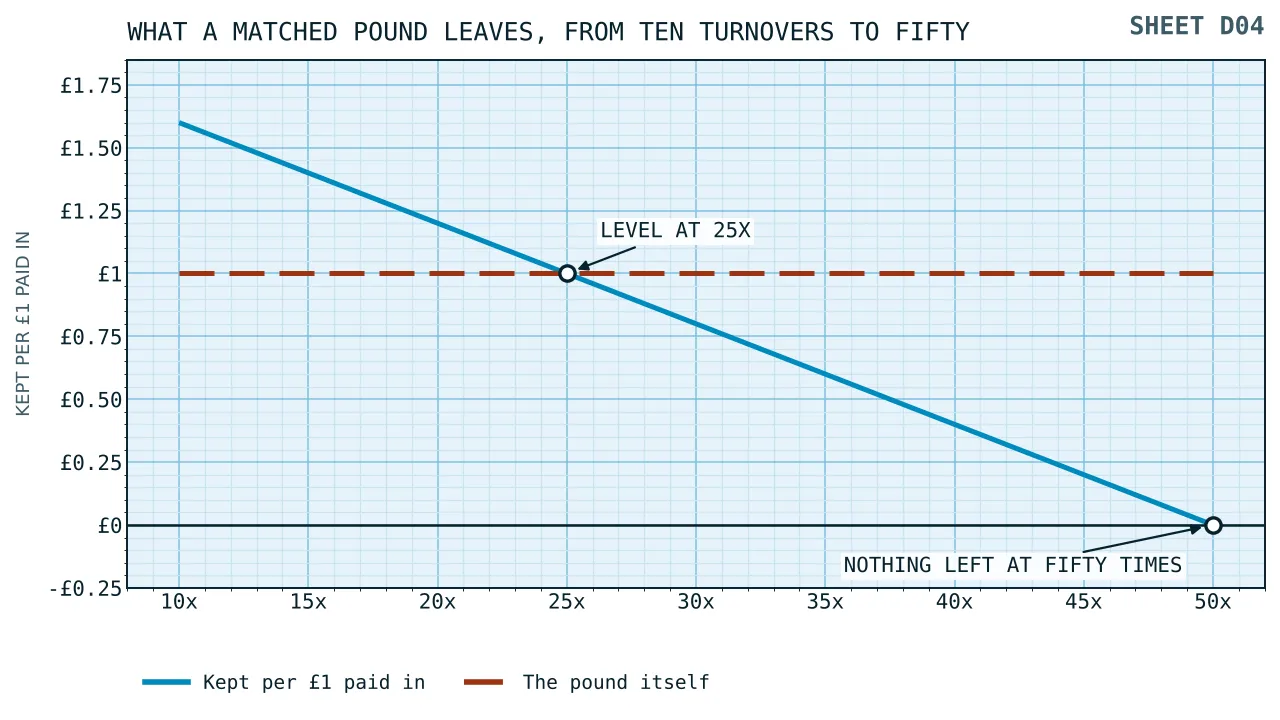
Two multiples on that schedule do something worth naming.
Twenty-five times puts the foot at exactly the tenner that went in, the credit having bought its own condition and added nothing at all. These particular pence have nothing to do with it. Solve the expression for E of nothing and W comes out as the reciprocal of the house edge: twenty-five on a 96 per cent game, twenty on a 95, and 33.3 on a 97. Any match at any percentage breaks even in the same place.
At fifty times the foot reads nothing at all. A doubled headline survives up to fifty because it only has one pound of credit per pound of stake to pay for, which is the mirror of the result on heavier headlines: a tripled match dies at 33.3 times and a quadrupled one at thirty. The bigger the number on the front, the earlier the multiple kills it.
5
The word and, priced
One conjunction in a set of bonus terms is worth more than any percentage on the front of the advertisement, and it is routinely skimmed.
Where the turnover is demanded on the credit alone, a matched tenner owes £400.00. Where it is demanded on the deposit and the bonus, the base is £20.00 rather than £10.00, the turnover is £800.00, and the expected cost is £32.00 against the same £20.00 in the account. The foot reads nothing and the condition is still twelve pounds from being satisfied.
| The requirement | Foot reads |
|---|---|
| 40x on £10 of credit | £4.00 |
| 40x on credit and deposit | -£12.00 |
| 40x on £30 of credit, a tripled match | -£8.00 |
Read the middle row against the bottom one. A doubled headline whose requirement reaches the deposit is a worse instrument than a tripled headline whose requirement does not. The percentage on the front went up by two hundred points and the outcome improved, because the base the multiple bites on matters more than the size of the gift.
Nowhere public has it been settled how the British ceiling handles that wording. Bonus funds is the phrase the ten-times limit uses, and nothing the regulator has put out works through a requirement reaching a player’s own balance as well. So the chain of published wording gets stated here and the page stops there.
6
A limit caps the match as well
Anything that caps a deposit caps everything downstream of it, because a percentage match is a multiple of the deposit and the turnover is a multiple of the match. One number at the top governs three below it.
Financial limits have to be available on a British system from the moment of registration. A prompt to set one comes either inside the registration process or at a first payment. Setting a limit is the default choice, so declining it takes a positive act by the customer. A day, a week and a month are among the durations that must be offered. Lowering a limit happens at once. Raising one waits a cooling-off period of twenty-four hours and then has to be confirmed a second time.
Where two limits overlap, the regulator publishes a worked case that drops straight into this page. A daily cap of £10 alongside a weekly cap of £100 resolves to the tighter of the two at every moment, so what the system may allow is £10 in a day and £70 in a week. Matched at a hundred per cent, that is £70.00 of credit in a week, £2,800.00 of turnover at forty times, £112.00 of expected cost and a foot reading £28.00 against £140.00 held.
Curaçao handles the two directions differently again, and on this one point it is the harder of the two regimes. Lowering a limit there is immediate as well. Raising one sits out seven days before implementation, against twenty-four hours in Great Britain. That runs against what a reader would expect, which is exactly why it is worth printing.
Method, not amount, is capped as well. Borrowed money cannot fund gambling on a British site: licence condition 6.1.2 shuts out payment by credit card, shuts out the same payment routed through a money service business, and has done so from 14 April 2020. A matched deposit there comes from money a reader already has. The Curaçao policy read for this sheet leaves that door open.
7
What a licence adds to a matched pound
The arithmetic on this page is indifferent to geography. The obligations underneath it are not, and a matched headline of this sort comes with no Great Britain licence behind it. Each missing duty is given below in pounds on the same tenner.
Ten rather than forty
Since 19 January 2026 a British wagering requirement has stopped at ten times bonus funds. On £10.00 of credit that is £100.00 of turnover, £4.00 of expected cost and a foot reading £16.00. Out here the same headline reads £4.00. The ceiling is worth twelve pounds on a tenner, and it is the single largest term on the page.
Checks that follow the money in
Light-touch financial vulnerability checks apply to a British online customer above a monthly net deposit threshold. That threshold started at £500 a month on 30 August 2024 and came down to £150 a month on 28 February 2025. Separate enhanced assessments remain a pilot rather than a live requirement, and the regulator states that neither affects a consumer’s credit rating. Matched at a hundred per cent, £150 of deposits in a month carries £150 of credit and £6,000.00 of turnover at forty times, which is 60,000 cycles at 10p.
What the rulebook offshore leaves out
The Curaçao responsible gaming policy of 21 February 2025 lists what an operator must do: verify age, make information accessible, offer self-assessment, track behaviour, allow cooling-off and self-exclusion, offer deposit limits, train staff and affiliates, and advertise responsibly. Read it twice and five things are still absent: any ceiling on a wagering multiple, any stake limit, any minimum interval between cycles, any bar on autoplay, and any objection to a game throwing a fanfare over a return no better than the stake.
Affiliates are reached there directly, where the British regulator’s own advertising page does not reach them. An operator there is made responsible for affiliate compliance through binding contracts, audits and penalties. That is one place the offshore rulebook is more explicit, and it is worth recording honestly on a page that exists to be found through advertising.
Self-exclusion, from one place or many
Holding a British licence puts an operator inside Gamstop Online whether it fancies the idea or not, and the scheme states the edge of its reach without dressing it up: where an organisation has not joined, it cannot keep a registered person away. Offshore the unit is the operator rather than the market. A Curaçao exclusion covers one licensee and the domains it runs, and that policy’s answer to everywhere else is that the player should be encouraged to exclude themselves there too.
8
Pricing a match of your own
Five steps, and the last two are where a reader learns something.
| The step | Here |
|---|---|
| Sum you will actually pay in | £10.00 |
| Credit the percentage buys | £10.00 |
| Turnover at W over g | £400.00 |
| Edge of the turnover | £16.00 |
| Against a balance of £20.00 | £4.00 |
The shortcut, for anyone comparing offers in a hurry, is to multiply the percentage by the multiple and read the answer as turnover per pound. One hundred per cent at forty times is forty pounds per pound. Two hundred at twenty times is also forty pounds per pound, and the two offers are identical in everything but how they are advertised.
Two cautions before anybody spends it.
What the foot gives is an average across many repetitions, never a forecast of one. Four pounds is the long-run worth of a matched tenner, while the commonest result of a single attempt is an empty balance long before the turnover has been met.
And a term beats a figure every time. Five things come off the cashier’s own document rather than this one: W, g, the base the requirement bites on, whatever lid is put on the credit’s winnings, and how long the window runs.
Neighbouring headlines are priced the same way on 200% deposit bonus, the first of the family to stop leaving anything, 400% deposit bonus, the largest and the worst of them, and deposit 10 get 100 free spins, which is roughly this page’s offer paid in spins instead of cash. The index at Matched money lists the rest.
Questions
- What is a 100% deposit bonus worth on £10?
- Four pounds of the original ten, expected. The match credits £10.00, so the balance is £20.00. Forty turnovers of the credit demand £400.00 across the reels, and the edge on a 96 per cent game takes four pence of every pound of it, which comes to £16.00. Take that from £20.00 and the foot reads £4.00, meaning the match has cost six pounds of the reader’s own tenner.
- Why is a matched deposit better than a tripled or quadrupled one?
- Because the credit and the obligation grow together, and past twenty-five times the obligation grows faster than the credit is worth. At forty times, a pound of credit costs £1.60 of expected play and returns a pound, so every pound of credit carries sixty pence of overrun. Where the credit is a pound for a pound, forty pence survives. Where it is three pounds for a pound, the reader ends eighty pence underwater.
- How much turnover does a 100% match owe per pound?
- £40.00 at forty times. A pound buys a pound of credit, and turning that over forty times puts forty pounds across the reels. Percentage times multiple gives the same figure for any headline at all, which is also why a doubled match at twenty times and a matched deposit at forty times are the same instrument wearing different advertisements.
- At what multiple does a matched deposit leave nothing?
- Fifty times, on a 96 per cent return. Four pence of expected cost attaches to each pound of credit per turnover, so fifty of them cost two pounds against the two pounds held. The foot reads exactly the deposit at twenty-five times, where the credit has bought its own condition and added nothing. Twenty-five is simply the house edge inverted, so the figure becomes twenty on a 95 per cent game and 33.3 on a 97 per cent one.
- Is my deposit counted as a winning anywhere here?
- Never. The tenner belonged to the reader before the offer existed, and it sits on the debit side of every line. Only the £10.00 of match counts as credit. That is why the foot is struck against a balance of £20.00 rather than against nought, and why an advertisement that adds the deposit to the bonus and calls the total twenty pounds of value is counting the reader’s own money as part of the gift.
- Does wagering the deposit as well change the answer much?
- More than tripling the headline would. On the credit alone, forty times £10.00 is £400.00 of staking costing £16.00, and the foot reads £4.00. On the deposit and the bonus together the base is £20.00, the staking £800.00 and the cost £32.00, so the foot reads nothing with twelve pounds of condition unmet. A tripled match on the credit alone is only eight pounds short, which makes the conjunction worse than two hundred extra percentage points.
- Can a deposit limit control how big the match gets?
- Yes, because every figure downstream is a multiple of the deposit. A British system must offer limits from registration, prompt for one at registration or first payment, present setting one as the default and offer durations including a day, a week and a month. Where a daily cap of £10 and a weekly cap of £100 are both set, the regulator’s own example gives £10 a day and £70 a week, which matched at a hundred per cent is £70.00 of credit, £2,800.00 of turnover and £112.00 of expected cost.
- How long would the £400.00 take at 10p a cycle?
- Ten thousand seconds at the quickest, which is a little under two and three quarter hours. Four thousand cycles is what the turnover divides into, each owing 2.5 seconds on a British slot before another may be commenced, which multiplies out to 10,000 seconds. Software is not allowed to run them under RTS 8A, so the figure is also a count of individual decisions. Raise the stake to a pound a cycle and 400 cycles take under seventeen minutes, while the expected cost of £16.00 does not move by a penny.
- What is missing from a match without a Great Britain licence?
- Twelve pounds on this tenner, for a start, because a British requirement stops at ten turnovers rather than forty. Beyond the money: borrowed money has been barred from funding gambling on a British site since 14 April 2020, credit cards included; light-touch affordability checks follow net deposits above £150 a month; limits must be prompted, defaulted and reducible on the spot; and Gamstop Online covers every licensed operator. The Curaçao policy has no wagering ceiling, no stake cap, no minimum game cycle and no autoplay ban anywhere in it, though it does make an operator answerable for its affiliates in a way the British advertising guidance does not.