
Sheet R10 Revision 1 Checked 15 October 2026
Visa casino
A debit card is the one rail here that charges nothing and arrives whole. £60.00 goes in, £60.00 is credited, and a full match leaves £36.00 expected at the British ceiling of ten. The price is paid at the exit instead: days of waiting, and a cancel button that costs £1.44 the first time it is pressed.
£0.00 to arrive, £36.00 expected at ten times, £1.44 per reversal
What a free entrance costs at the other end
Every destination on this spike is bought advertising. The site takes a fee if a reader goes on to register, and no figure printed below moves because of it.
The Spin Sheet
Till receipt No 01
Betportal
Lowest multiple here
For every €1 of spin credit at face per €1
Credit
Debit
No Great Britain licence
Licensed in Anjouan, Comoros, run by BetPortal Gaming Ltd, with Excite Ultra Media Ltd, reference ALSI-202601040-FI2.
Terms read 15 October 2026
Open the offer at Betportal, opens in a new tabThe Spin Sheet
Till receipt No 02
WinBeast
Five staged matches
For every €1 of spin credit at face per €1
Credit
Debit
No Great Britain licence
Licensed in Curaçao, operator not named on the site.
Terms read 15 October 2026
Open the offer at WinBeast, opens in a new tabThe Spin Sheet
Till receipt No 03
EliteSpin
Longest spin window
For every £1 of spin credit at face per £1
Credit
Debit
No Great Britain licence
Licensed in Costa Rica, run by PrimeTier Limited.
Terms read 15 October 2026
Open the offer at EliteSpin, opens in a new tabThe Spin Sheet
Till receipt No 04
Crown Jewelz
Multiple unpublished
No total struck
Credit
Debit
No Great Britain licence
Licensed in Curaçao, number not verified, operator not named on the site.
Terms read 15 October 2026
Open the offer at Crown Jewelz, opens in a new tabThe figure at the foot of a receipt is this site's own arithmetic and nothing an operator has published: the credit, less the share a spin gives back at 96 per cent return to player, less what playing the wagering through costs at the same return. It describes the offer, not one reader's afternoon. Where the conditions price above the credit the receipt prints nothing rather than a negative sum, and where a figure the sum needs is unpublished it prints the condition in the operator's words instead.
Three words stand in the amount column where no figure can. Noted is a published condition that takes value away without leaving the sum a figure to take. Unpriced is a condition whose figure nobody has published, or a credit that is not a sum until a deposit of your own sets it. Own money is money of yours, which is never part of a total.
Not one of the operators printed above holds a Great Britain licence, so the duties that licence carries do not reach them. Every online gambling company licensed in Great Britain has to be part of Gamstop Online, and a reader who has shut themselves out through the scheme is therefore not shut out here. The ceiling of ten times the bonus funds on a wagering requirement, in force since 19 January 2026, is a condition of that licence and binds the companies that hold one. Where a dispute goes instead is a matter for the authority named on the receipt, and the Gambling Commission describes what a reader faces without a British licence as a lack of recourse if things go wrong. Nobody under 18 may hold an account at any of them.
Every term printed on a receipt is the operator's own, and each receipt carries the day it was read. The oldest of those readings is 15 October 2026. What binds a reader is the operator's own full terms, and not a line printed here.
1
The rail that charges nothing to arrive
Nothing is charged to put £60.00 on a debit card, and the arithmetic of this rail is therefore a question of time rather than of pence. The figure that leaves a current account is the figure a cashier credits. There is no spread to find, no network charge to pay, no face value to round up to and no second balance standing in the way.
Which makes it the right rail to price the other half of the journey against. On every other sheet in this section the entrance takes something, so the exit is a second deduction on top of a first. Here the entrance takes nothing, and whatever the reader pays is paid at the far end, in days and in options.
Two things are modelled on this page and neither is a sourced figure. The first is the clearing wait, set at one to three working days for a payout returning to a card, with the cashier’s own processing window ahead of it, modelled at up to twenty-four hours. The second is the length of time a payout stays reversible, modelled at those same seventy-two hours. Both are assumptions. The arithmetic attached to them is not.
What a free entrance does to the sum:
- B is the whole deposit, so the bonus is calculated on the figure the reader chose.
- Nothing has to be subtracted from E afterwards, which is unusual in this section.
- So the multiple in the terms is the only thing deciding the line at the foot.
2
£60.00 in, £36.00 at the best lawful multiple
A full match on £60.00 credits £60.00. Against a 96 per cent return and a weighting of one, nothing is left to vary except the multiple.
| Multiple | Staking owed | Expected cost | Left standing | Overrun on the deposit |
|---|---|---|---|---|
| 10x | £600.00 | £24.00 | £36.00 | none |
| 20x | £1,200.00 | £48.00 | £12.00 | none |
| 25x | £1,500.00 | £60.00 | £0.00 | none |
| 40x | £2,400.00 | £96.00 | £0.00 | £36.00 |
Ten times is the ceiling a British licence imposes, and it has read ten since 19 January 2026. At that multiple the condition asks £600.00 of staking. The expected cost of it is £24.00, at four pence in every pound, so £36.00 of the credit should survive. That £36.00 is the figure the rest of this sheet spends, loses and waits for.
At forty times the same credit owes £2,400.00 of staking, whose expected cost is £96.00. Nothing survives, and the last column is the part worth reading twice: the credit covers £60.00 of that expected cost and the remaining £36.00 comes out of the reader’s own deposit. A free entrance does not make a bonus free.
£36.00 expected at ten times, £36.00 of overrun at forty
3
The line, and the twenty-five times that empties it
A credit’s expected value is settled by one expression, and on this rail it is settled by that expression alone, nothing having been taken off at the entrance.
E = B × (1 – (W × (1 – RTP)) / g)
Letters first: the credit is £60.00, intact. The multiple is whatever the terms say. The return stands at 0.96 and the weighting at one, so a pound on the reels is a pound off the requirement.
Taken at forty: forty lots of four pence is 1.60, the expression lands on minus six-tenths, and six-tenths of £60.00 is £36.00 on the wrong side of nought. Taken at ten, the product is 0.40, the expression lands on plus six-tenths, and the same six-tenths is £36.00 on the right side. One multiple is four times the other and the figure is identical with its sign reversed, which is the arithmetic worth carrying away from this page.
Between them sits a multiple where the expression gives nothing at all. Four pence multiplied by twenty-five is a pound, so a twenty-five times condition is expected to take a credit of any size down to nothing. It is the one figure here that is indifferent to the size of the offer, and every term above it falls on the wrong side of the line.
4
Days at the exit, and what the days are for
A payout to a card does not move at the speed the deposit moved. The cashier’s own handling comes first, modelled here at up to a day, and the clearing back to the card follows, modelled at one to three working days. Nothing in that is charged for, so a reader looking for a fee will not find one.
The cost is what the delay makes possible. A payout that has been requested but not yet settled is money in a state nobody has a good name for: it has left the balance for some purposes and not for others, and on a cashier without a British licence it can commonly be fetched back into the balance with one press of a button.
British rules close that door, and they close it in terms. Ask a licensed cashier for a payout and it may not then offer you a button to take the request back. The same standard tells an operator not to hand back the option of depositing out of money already on its way home, and to keep the route out as free of friction as it can manage. The requirement reaches all gambling, not only slots.
So the British position is that a withdrawal is a decision taken once. The offshore position, in the policy read for this build, says nothing about withdrawals being reversible in either direction, which leaves the matter to whatever the terms happen to say.
5
What one press of a cancel button costs
Put a figure on the button and the section’s arithmetic finally bites. The £36.00 standing at the end of part 2 is the sum in question, and what a reversal costs depends on how much staking the money meets before somebody asks for it back again.
| What happens to the £36.00 | Staking | Expected cost | Expected to remain |
|---|---|---|---|
| It is left alone | £0.00 | £0.00 | £36.00 |
| Fetched back, staked once | £36.00 | £1.44 | £34.56 |
| Fetched back, staked five times | £180.00 | £7.20 | £28.80 |
| Fetched back, staked ten times | £360.00 | £14.40 | £21.60 |
| Fetched back, staked forty times | £1,440.00 | £57.60 | £0.00 |
One pass through the reels is the cheapest version and it still costs £1.44, because four pence in the pound is charged on staking whether the money came from a deposit, a bonus or a payout somebody changed their mind about. Ten passes cost £14.40, which is two pounds forty more than the whole of what a twenty times condition would have left in the first place. Forty passes cost more than the payout contains.
£1.44 for one press, £14.40 for ten passes, the lot at forty
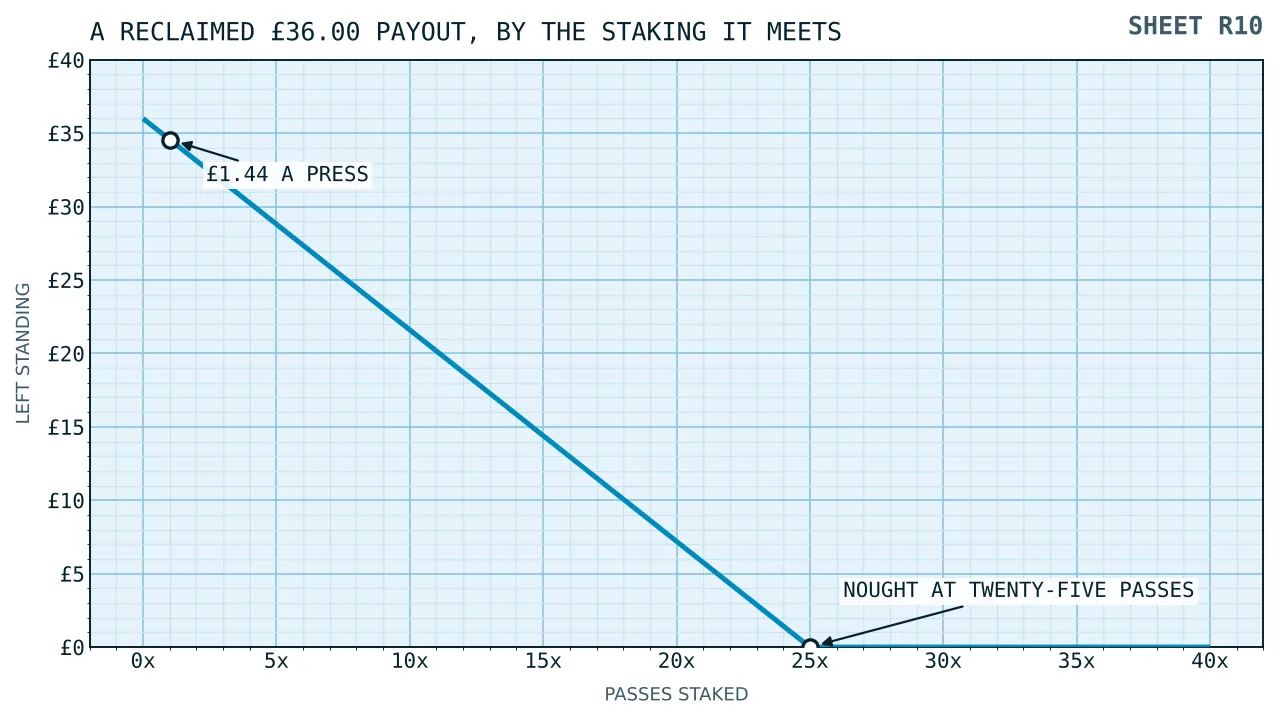
And the unwelcome part. A payout fetched back and staked once is not a small mistake repeated cheaply: the figures above are per press, so a reader who does it on three successive evenings has spent £4.32 of expectation on three decisions, each of which felt like no decision at all. The British requirement exists because the button is the cheapest thing in the cashier to build and the dearest thing in the account to use.
6
Eighteen days to collect £900.00
A charge is one way to make an exit expensive. A ceiling is another, and it costs nothing to print.
A term rationing withdrawals from money the player deposited is prohibited in Britain, and the regulator’s specimen of an unacceptable one allows fifty pounds a day with five hundred across a week. Put a balance against those figures and the point is plain. Nine hundred pounds under a fifty pound daily ceiling takes eighteen days to collect, and under a five hundred pound weekly one it takes a fortnight. Drawing on a deposit balance is something a player may do whenever they like, and a cap on how large a withdrawal is, or on how many are allowed, must itself be reasonable.
No date of publication and no date of revision appears on the page carrying that rule. It is quoted here for what it says and not for how fresh it is.
One distinction has to be kept straight, since the two protections are often read as one. A cap on bonus winnings and a cap on a deposit balance are separate objects, and the prohibition reaches only the second. So a licensed cashier may not ration a player’s own money, and may still put a ceiling over what a bonus is permitted to produce.
That second kind of ceiling has an arithmetic consequence this sheet should admit. Nothing published fixes a standard figure for it, so a cap is modelled here or not at all; what can be said without a figure is that a cap removes the top of the distribution. Where a win cap sits in the terms, every expected value on this sheet is a ceiling rather than a forecast, and the truncation falls entirely on the outcomes a reader was hoping for.
7
Two cards on one badge, and one of them refused
The same scheme issues cards that borrow and cards that do not, and the British prohibition follows the borrowing rather than the badge. A debit card is accepted at a licensed cashier. A credit card on the identical scheme is not, and has not been since 14 April 2020, which is priced in full on the sheet next door.
Out here, neither distinction is drawn by anybody, and the cashiers paying welcome offers on this rail hold no Great Britain licence. Set out one duty at a time, this is what the badge on the card does not bring with it.
| Under a British licence | Out here |
|---|---|
| No option to cancel a withdrawal | £1.44 a press |
| Ten times as the cap on wagering | 40x here |
| No ceiling on drawing a deposit balance | Unbound |
| Credit cards refused outright | Accepted |
| Identity established before a spin | Deferred |
| Inside the national self-exclusion scheme | No |
The first row is the one this sheet is built on, and it is also the one a reader can act on without anybody’s permission: a payout left alone is worth £36.00 and a payout fetched back is worth less, every time, by an amount the staking decides.
A word for the other direction, since a page that pretends there is nothing offshore is as misleading as one that pretends there is nothing wrong. The island rulebook consulted here does ask for deposit limits, over periods of a day, a month and a week, makes a cut to one immediate, and holds a rise for seven days, longer than Britain holds it. It says nothing about a cancel button, nothing about a ceiling on a wagering requirement, and nothing about a ceiling on withdrawals.
8
Four readings before the card is typed in
Three of them are in the terms and not on the banking page, which is the reverse of where a reader looks.
| Reading | Here |
|---|---|
| Paid to make the deposit | £0.00 |
| Multiple written into the terms | 40x |
| Whether a payout can be fetched back | £1.44 a press |
| Any ceiling on what may be withdrawn | Days, not pence |
| Expected value at the stated multiple | £0.00 |
Take the second reading first, because it decides whether any of the others matter. A condition at or above twenty-five times leaves nothing to withdraw in expectation, so the cancel button, the clearing days and any ceiling on a payout are all charges on a sum that was never expected to exist. Below twenty-five times they are charges on something, and that is when they should be read.
Then do the subtraction this site exists for. Take the credit’s expected value at the multiple printed, subtract the staking cost of however many reversals a reader honestly expects to make, and subtract whatever a ceiling on withdrawals does to the timetable. On these figures, at ten times and one reversal, £36.00 becomes £34.56. At forty times it is nought before any of it starts.
The caution about averages belongs here as everywhere. Thirty-six pounds is an average taken across many identical attempts and not a sum anybody is handed, and a single attempt at sixty pounds of credit usually finishes on nothing. The £1.44 is a mean too, and it is the one figure on the page that a reader controls completely, since it is only charged if the button is pressed.
Along the rail, the same method against other charges. The scheme whose own payment facility can be pulled from an unlicensed business is at mastercard casino. Borrowed money, refused outright at a licensed cashier, is priced at credit card casino. A wallet round trip, where the floor is paid on the way out, is at skrill/neteller/trustly casino, and the prepaid case, with no way back at all, is at paysafecard casino. The rest of the section sits under The rail.
Questions
- Does a debit card deposit cost anything?
- On the figures modelled here, nothing. The sum leaving a current account is the sum the cashier credits, with no spread, no network charge and no face value to round up to. So this is the only rail here whose bonus is worked out on precisely the sum the reader picked, with nothing left over to subtract from the expected value.
- What is a full match on £60.00 worth after the play-through?
- The British ceiling has read ten times since 19 January 2026. A condition at that multiple asks £600.00 of staking, and at four pence in the pound its expected cost comes to £24.00, which leaves £36.00 of the credit standing. Make it forty times and the staking owed is £2,400.00, the expected cost £96.00, so nothing survives and £36.00 of that cost falls on the deposit.
- Why does twenty-five times keep appearing?
- Because four pence multiplied by twenty-five is exactly a pound. At that multiple the play-through is expected to cost the whole credit, whatever size the credit is, so it is the one figure here that takes no notice of how large the offer was. Below it a credit is expected to leave something; at or above it the credit is expected to leave nothing.
- How long does a payout to a card take?
- On the assumptions used here, up to a day of handling at the cashier and then one to three working days of clearing back to the card. Neither is charged for, so a reader hunting for a fee will not find one. What the delay buys the cashier is a window in which the payout has not settled, and on a site without a British licence that window is commonly a window in which it can be fetched back.
- Can a casino let me cancel a withdrawal?
- Not a British licensed one. Ask a licensed cashier for a payout and it may not then offer you a button to take the request back. The same standard tells an operator not to hand back the option of depositing out of money already on its way home, and to keep the route out as free of friction as it can manage. It reaches all gambling rather than slots alone. The offshore rulebook read for this build says nothing on the subject either way.
- What does pressing that button actually cost?
- Four pence in the pound of whatever staking the money then meets. A £36.00 payout fetched back and staked once over is expected to be worth £34.56, so the press costs £1.44. Staked ten times over it is expected to be worth £21.60, and staked forty times it is expected to be worth nothing. The figures are per press, so three such evenings cost £4.32 of expectation on the one-pass version.
- Can a casino cap how much I withdraw at a time?
- A term rationing withdrawals from money the player deposited is prohibited in Britain, and the regulator’s specimen of an unacceptable one allows fifty pounds a day with five hundred across a week. Nine hundred pounds under that daily ceiling takes eighteen days to collect and under the weekly one a fortnight. The entitlement runs the other way: money may be drawn from a deposit balance at any time the player likes, and whatever cap is put on the size of a withdrawal, or on how often one may be made, has to be reasonable.
- Is a maximum win on a bonus the same thing?
- No, and conflating the two is a common error. A cap on bonus winnings and a cap on a deposit balance are separate objects, and the prohibition reaches only the second. Nothing published fixes a standard figure for a win cap, so none is stated here. What follows without a figure is that a cap removes the top of the distribution, so where one sits in the terms every expected value on this sheet is a ceiling rather than a forecast.
- Why is a credit card on the same scheme treated differently?
- Because the British prohibition follows the borrowing rather than the badge. The same scheme issues cards that borrow and cards that do not; the debit one is accepted at a licensed cashier and the credit one has not been since 14 April 2020. Out here neither distinction is drawn by anybody, which is why the sheet on borrowed money prices a handling charge and interest that a licensed cashier would never have let you incur.
- What am I giving up by using the card at an offshore cashier?
- The bar on being offered a cancel button, which is worth £1.44 a press on these figures. The cap that stops a wagering requirement at ten times, which is why forty is the figure in part 2. The rule against rationing a deposit balance. The refusal of credit cards. Identity established before a single spin, free games and bonus play along with it. Also the scheme for national self-exclusion, whose reach a British licence settles rather than the site. Cashiers paying welcome offers on this rail hold no Great Britain licence.