
Sheet N08 Revision 1 Checked 15 October 2026
Free £5 no deposit casino
Five pounds arrives as money rather than as cycles, nothing is paid in to get it, and one journey through a 96 per cent game leaves £4.80 of it. That answer holds whatever stake is chosen: fifty turns at 10p and a single turn at £5.00 price identically. What eats the £4.80 is the second journey, and the third.
£4.80 left of £5.00 after one pass, at any stake
What the conditions leave
Every destination on this spike is bought advertising. The site takes a fee if a reader goes on to register, and no figure printed below moves because of it.
The Spin Sheet
Till receipt No 01
Betportal
Lowest multiple here
For every €1 of spin credit at face per €1
Credit
Debit
No Great Britain licence
Licensed in Anjouan, Comoros, run by BetPortal Gaming Ltd, with Excite Ultra Media Ltd, reference ALSI-202601040-FI2.
Terms read 15 October 2026
Open the offer at Betportal, opens in a new tabThe Spin Sheet
Till receipt No 02
WinBeast
Five staged matches
For every €1 of spin credit at face per €1
Credit
Debit
No Great Britain licence
Licensed in Curaçao, operator not named on the site.
Terms read 15 October 2026
Open the offer at WinBeast, opens in a new tabThe Spin Sheet
Till receipt No 03
EliteSpin
Longest spin window
For every £1 of spin credit at face per £1
Credit
Debit
No Great Britain licence
Licensed in Costa Rica, run by PrimeTier Limited.
Terms read 15 October 2026
Open the offer at EliteSpin, opens in a new tabThe Spin Sheet
Till receipt No 04
Crown Jewelz
Multiple unpublished
No total struck
Credit
Debit
No Great Britain licence
Licensed in Curaçao, number not verified, operator not named on the site.
Terms read 15 October 2026
Open the offer at Crown Jewelz, opens in a new tabThe figure at the foot of a receipt is this site's own arithmetic and nothing an operator has published: the credit, less the share a spin gives back at 96 per cent return to player, less what playing the wagering through costs at the same return. It describes the offer, not one reader's afternoon. Where the conditions price above the credit the receipt prints nothing rather than a negative sum, and where a figure the sum needs is unpublished it prints the condition in the operator's words instead.
Three words stand in the amount column where no figure can. Noted is a published condition that takes value away without leaving the sum a figure to take. Unpriced is a condition whose figure nobody has published, or a credit that is not a sum until a deposit of your own sets it. Own money is money of yours, which is never part of a total.
Not one of the operators printed above holds a Great Britain licence, so the duties that licence carries do not reach them. Every online gambling company licensed in Great Britain has to be part of Gamstop Online, and a reader who has shut themselves out through the scheme is therefore not shut out here. The ceiling of ten times the bonus funds on a wagering requirement, in force since 19 January 2026, is a condition of that licence and binds the companies that hold one. Where a dispute goes instead is a matter for the authority named on the receipt, and the Gambling Commission describes what a reader faces without a British licence as a lack of recourse if things go wrong. Nobody under 18 may hold an account at any of them.
Every term printed on a receipt is the operator's own, and each receipt carries the day it was read. The oldest of those readings is 15 October 2026. What binds a reader is the operator's own full terms, and not a line printed here.
1
A sum, not a count
Almost everything in this section of the site is counted. Spins, cycles, instalments, days. A cash credit is the exception: it arrives as a quantity of money with a label attached, and the label is the only thing separating it from the rest of the balance.
That changes the arithmetic in one specific way. Where an offer hands over cycles, the terms have already decided how many stakes will be made and how large each one is. Where an offer hands over £5.00, nobody has decided either. The player does, one stake at a time.
Price the common part first. Nothing of the reader’s own goes in, so there is no payment to set against the credit and no exposure beyond the credit itself. The gross is £5.00, and the single debit that cannot be avoided is the journey a credit has to make through a game before it turns into money a cashier will pay out. A 96 per cent game takes 20p for making that journey, which leaves the fiver expected to be worth £4.80.
Fifty cycles at 10p carry the same £5.00 of face and average the same £4.80. The totals agree exactly, which is worth saying out loud, because the two offers do not feel alike and the feeling is about something else: who chose the stake, how long the whole thing takes, and how lumpy the result is allowed to be.
Taken as given here, and all of it adjustable by a reader with real terms open:
- £5.00 of credit, with no payment required to obtain it.
- A game handing back 96 per cent, which is this site’s working figure throughout.
- One obligatory journey through a game, since a credit taken straight to the cashier is not a win and no cashier treats it as one.
- No multiple over the credit, which is what the key says. Forty times, the working figure on the wagered sheets here, is therefore absent from the total, although part 2 costs it for comparison.
- Full weighting. A game contributing at less than its face would lengthen any requirement without changing the pence lost per pound.
2
One compulsory journey, priced at 20p
The house expression takes the credit down to its total:
E = B × (1 – (W × (1 – RTP)) / g)
W counts the times the money has to be turned over, B is that money at face, RTP the share a game pays back, g the weighting, and E the expectation at the foot. A reader looking at a no-wagering key will set W to nought, and that is the one mistake this part exists to prevent.
W is one. Not nought. A credit sitting in an account is not winnings, and it becomes withdrawable only by being staked, so a single pass is built into the offer whether or not any term mentions it:
The credit, with its one unavoidable pass:
E = £5.00 × (1 – (1 × 0.04) / 1) = £4.80
Put ten where that one stands and the same line gives £3.00, so the words in the key are worth £1.80 on a fiver, measured against the stiffest requirement a British licence now permits. Measured against something looser the gap widens fast, and it reaches the floor sooner than most readers expect.
Keep running the line and the floor arrives at twenty-five. Twenty-five times £5.00 is £125.00 of staking, four per cent of that is the whole credit, and E comes out at £0.00. A five pound credit carrying twenty-five times is not a small offer. On these assumptions it is not an offer at all, and any multiple above twenty-five is worth less than nothing.
£0.00 expected from £5.00 of credit at twenty-five times
3
Fifty turns or one, as the player decides
A credit is divisible and a round of cycles is not. Five pounds can be spent as fifty stakes of 10p, as one stake of five pounds, or as anything between, and the choice belongs to whoever is holding it.
| Stake chosen | Turns it buys | Least time taken | Expected after one pass |
|---|---|---|---|
| £0.10 | 50 | 125 s | £4.80 |
| £0.25 | 20 | 50 s | £4.80 |
| £0.50 | 10 | 25 s | £4.80 |
| £1.00 | 5 | 12.5 s | £4.80 |
| £2.50 | 2 | 5 s | £4.80 |
| £5.00 | 1 | 2.5 s | £4.80 |
The last of those columns never moves, and that is the whole lesson of the schedule. Four pence leaves every pound that passes through a 96 per cent game, and the game has no interest in whether the pound arrived in one piece or in ten.
Three things do move down the rows, and each is worth a sentence.
Time moves. A slot under a British licence waits 2.5 seconds between starting one cycle and being allowed to start the next, so the top row is at least 125 seconds of sitting there and the bottom row is over in a moment. Automation will not compress it, because the standards require a fresh commitment for each cycle and the solitary exception is posting blinds at poker.
The shape of the outcome moves, and it moves a great deal. Fifty small stakes produce something close to the average most evenings. One stake of £5.00 produces nothing at all on the great majority of occasions and something much larger on a few. Identical expectation, utterly different experience, and a reader who wants a withdrawal rather than a story should notice which row they are on.
The ceiling moves into view. A British licence holds one slot cycle to £5.00 once a player has turned twenty-five, and to £2.00 for anybody younger, so the bottom row sits at the older limit exactly and the bottom two rows are out of reach for an eighteen-year-old. Both figures are slots rules attached to remote casino licences; roulette and blackjack are outside them. The £5 ceiling arrived on 9 April 2025 and the £2 ceiling on 21 May 2025, six weeks apart, those being the Commission’s dates rather than anything the instrument of 25 February 2025 prints.
What no rule does is fix the value of a cycle. No British source fixes the value of a spin, names who does, or says what a licensee must disclose about it. On a credit that gap hardly matters, because the reader fills it themselves; on an offer paid in cycles it is the single most important number in the terms.
4
The journeys nobody insisted on
Here is the debit that belongs to this sheet alone. A requirement charges for turnover somebody demanded. A credit with no requirement still gets turned over, repeatedly, because a player holding £4.80 in a slot rarely stops at that point, and each further pass is charged for at the same four pence in the pound.
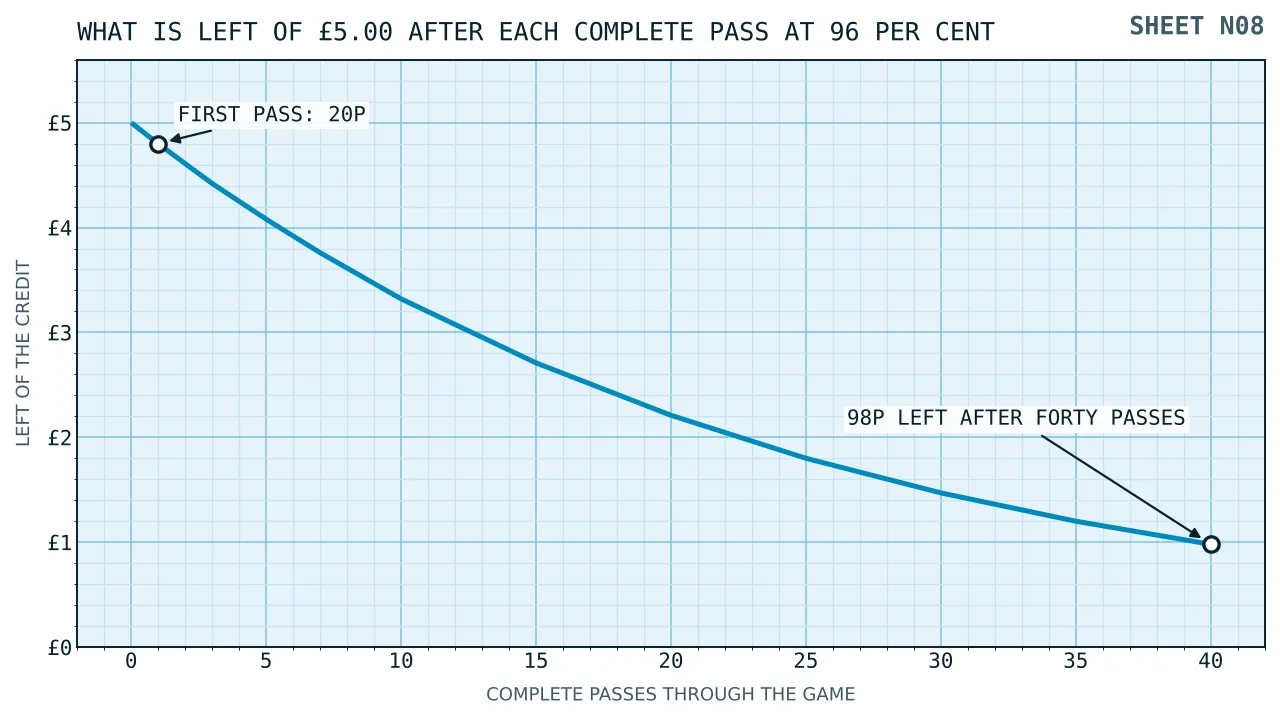
| Complete passes | Left of the credit | Gone |
|---|---|---|
| 1 | £4.80 | £0.20 |
| 2 | £4.61 | £0.39 |
| 3 | £4.42 | £0.58 |
| 5 | £4.08 | £0.92 |
| 10 | £3.32 | £1.68 |
| 25 | £1.80 | £3.20 |
| 40 | £0.98 | £4.02 |
Two models are at work in this sheet and they answer different questions, so neither replaces the other.
The line in part 2 prices turnover that has been demanded. It bills ten times a fiver as £50.00 of staking and £2.00 of cost, because a requirement counts stakes and does not care that a shrinking balance makes them harder to find.
The schedule here prices turnover that has been chosen. Ten complete passes of whatever happens to be left leave £3.32 rather than £3.00, since a player staking only what survives stakes a little less on every circuit. The difference, 32p, is small. The lesson is not: a credit with nothing asked back can still be ground down to a figure that would have been a scandal as a published requirement, and the grinding is done voluntarily, by the holder, in good spirits.
Which gives a reader one practical rule. Decide the number of passes before the credit lands, not during. Anybody who intends to take £4.80 out needs to stop after one.
5
Where that adjective is doing honest work
The first word of the key is the one British advertising rules police hardest, and on an offer of this construction it survives the policing comfortably.
On the regulator’s test an offer forfeits that word as soon as qualifying for it means the customer putting up money of their own, and nothing here is asked of anybody beyond opening an account. The same advice discourages the companion phrase, the one pairing that word with the idea that nothing is at stake, unless a customer is truly unable to lose funds of their own. This sheet does not use that phrase anywhere, and the reason is a rule rather than a preference.
What has to be carried with the offer is set out plainly enough. CAP Code rule 8.17 wants all applicable significant conditions communicated clearly and prominently wherever leaving one out would be likely to mislead, and the regulator’s worked list of what counts starts with eligibility, new customers only, age or location, then deposit or wagering requirements, then any time limit on claiming or using the thing, then minimum odds or bet types. For a cash credit the live ones are eligibility, the time limit and whatever ceiling sits over the winnings.
Two further duties bear on a credit this size. Under the incentives code an incentive’s terms have to be fair, clear and transparent, and within easy reach of anybody it is offered to. The advertising advice for online casinos asks for proportion: a reward should answer to how much a player has spent and how long they have spent it, generosity should not accelerate as spending climbs, and nothing should encourage somebody to gamble substantial amounts on a fixed, regular schedule. Its own illustration of something that can pass muster is one reward, a free bet, once £50 has gone through, and the illustration comes with a condition attached: a reward at that level must not be unusual for the kind of gambling in question.
The regulator’s online casino advice lists recent rulings with an outcome and a date apiece and no subject matter: not upheld against White Hat Gaming Ltd on 16 September 2026, upheld against Dribble Media Ltd on the same day, and upheld against HRY Games on 14 October 2026. Since the page says nothing about what was at issue in any of them, neither does this sheet. They show that casino advertising is ruled on, and show nothing more specific than that.
6
Nothing paid in, so nothing to protect
British withdrawal protection is written about a particular pot, and on a no-deposit offer that pot is empty. The distinction decides what a reader can rely on.
The rule, and the pot it names
No licensee may use such a term, enforce one, impose one or lean on one: a consumer term built to work, or working anyway, as a maximum on withdrawals out of a deposit balance. Winnings included, that balance can be drawn on whenever the player likes; no restriction may sit over the maximum sum taken at one time; and where a limit governs the size of a withdrawal or the number of them, it has to be a reasonable one. The guidance carrying all of that states no publication date, so it is cited here for the rule and for nothing about its freshness.
Read the words and the problem appears. Pay in nothing and there is no deposit balance, which leaves the protection with nothing to attach to. Separately, a ceiling on what a bonus is permitted to win is a different object altogether and the withdrawal rule does not prohibit one. Both of those can be true at once, and on a free credit both are: the strongest British rule about getting paid is silent here, and the condition most likely to be in the terms is one that rule was never aimed at.
What remains is the fair terms condition, and it is not nothing. It has four limbs. Unfair commercial practices are barred at every point of dealing with a consumer, the meaning being taken from the Digital Markets, Competition and Consumers Act of 2024. A material change must reach customers before it binds them, and must itself clear the fairness and transparency tests. Contract terms must be transparent as the Consumer Rights Act 2015 uses that word, and must be kept where a customer can get at them easily. And the terms on which gambling is offered, with the notices around them, must not be unfair in that same Act’s sense, the licensee being obliged to keep to them as well.
The desk a no-deposit player meets at the end
Identity is established before any gambling under a British licence, and that includes gambling with a credit. The same condition closes the trapdoor at the other end: a withdrawal request must not set off a demand for further information where the licensee could reasonably have asked for it earlier, and a licensee is not excused merely because it finds the question convenient then. Anti-money-laundering questions belong early rather than at the point somebody asks to be paid, unless another legal duty forces the request then.
What a check may cover is left open on purpose. Passports, driving licences and household bills are the examples listed, with the Commission declining to prescribe which of them a business should want. Where a withdrawal is held up because identity information is insufficient, its guidance says the operator may be in breach of licence condition 17. That consumer guidance is older than most of what this sheet cites, published on 23 September 2020 and last revised on 13 April 2022, and the Commission’s current wording on identity sits in the licence condition itself.
Why it matters on a sum this small: a free credit is often the first and only transaction on the account, so the compliance desk and the player meet for the first time at the withdrawal. £4.80 is a cheap way to find out how that meeting goes, and it is a dear way to find out that it does not go at all.
7
Getting paid away from the register
Offers at this end of the market frequently come from cashiers with no Great Britain licence, and on a credit whose entire value is the hope of a withdrawal that is the most expensive fact on the sheet.
The regulator’s own account of what goes missing
Its Director of Enforcement and Intelligence put it in plain terms on 21 October 2025: unlicensed sites often lack age verification, responsible gambling tools and secure payment systems, and consumers face greater exposure to unfair gaming practices, to financial loss, and to having no recourse when something goes wrong. The same post names the two payout failures it has actually seen, and they are precisely the ones that matter to a fiver: payouts simply blocked, and withdrawal limits pitched so high that reaching them is not realistic. It records serious data protection concerns alongside, with identity theft and fraud among them.
The structural version sits in an industry warning notice dated 20 January 2025. Unlicensed websites, it says, may run social responsibility and money laundering controls that are not adequate, which leaves a customer open to unfair practices, to issues of data privacy and to fraud. Such sites often pick their targets among vulnerable people, and the notice names those who have self-excluded through the scheme.
A game you recognise proves nothing
The same notice records the Commission becoming aware of casino games from licensed suppliers running on unlicensed websites. So a familiar reel set is not evidence of a licence, and the point is not hypothetical. On 23 July 2026 Evolution Malta Holding Limited agreed to pay £4.75m, the Commission having found its games reachable from Great Britain on six unlicensed websites, with visits in large volume across the year from December 2023 to November 2024. The findings included failures in money laundering risk assessment, in customer due diligence, and in the controls meant to stop unlicensed operators running its games for British players.
Enforcement against licensees is published in money, which is the clearest difference a reader can check for themselves. Platinum Gaming Limited paid £10m on 22 October 2025 and Paddy Power Betfair £2m on 17 December 2025. Licence suspensions are published too. The Commission is candid about the limits of all this as well: given the revenue involved it thinks it unlikely ever to dismantle the illegal market entirely, while traffic data from 160 websites targeted for action showed a drop of 32 per cent.
What a Curaçao licence puts in place of it
Absent from the policy read for this sheet, duty by duty: any cap on a wagering multiple; any ceiling on a slot stake; any minimum interval between game cycles; any bar on autoplay, on turbo or on slam stop; any prohibition on celebrating a return at or under the stake; any rule against a game faking a near miss; and any ban on paying by credit card. Bonuses get two lines in it. One wants clear terms, transparently communicated. The other tells an operator not to promote so aggressively as to encourage excessive gambling.
What it does provide should be stated as well, because a sheet claiming there is no route at all would be wrong. Complaints there may be lodged free of charge within six months of the incident, an operator answers inside four weeks and may extend once in writing, and dispute resolution is compulsory and costless to the player. The regulator declines to decide individual disputes, much as the British one says it is not an ombudsman and cannot get a customer’s money back. The difference is who writes the terms of the route, and offshore that can be the operator.
The scheme, and the edge of what it reaches
Membership of Gamstop Online follows from a British licence, and the scheme is frank about where its reach stops. It can shut a registered person out of what participating operators offer. It is unable to keep that person away from a service whose operator never joined. Treat it as the boundary of a protection, which is what it is. The scheme reported 614,738 people registered on 16 July 2026, registrations up 16 per cent over the first half of that year, and a record 12,236 sign-ups in May 2026. Blocking software is the other half of the picture. Gamban’s own pages offer a seven-day trial and a free route for residents of Ohio, while GamCare publishes a British route to the same software at no charge through the National Gambling Helpline, under the TalkBanStop name, in an article dated 12 April 2021 that does not say how long the free access runs.
8
Four lines on a cash credit
Four lines will price any offer of this shape, and the fourth is the one that decides whether the first three matter.
| The line | Answer here |
|---|---|
| What arrives, at face | £5.00 |
| The pass that cannot be dodged | £0.20 |
| Expected once it is made | £4.80 |
| Passes you will actually make | Your answer |
Fill the bottom line honestly and the rest follows from the schedule in part 4. Somebody who knows they will play until the balance is interesting should price this offer at a pound or two, not at £4.80, and they are not being pessimistic. They are reading their own schedule correctly.
Two notes on the figures, since both get misread. None of them is a forecast: a single evening on a slot with rare large prizes most often returns nothing whatever, and the expectation describes the arrangement repeated rather than the next hour. And none of them is read off a set of published terms. The spin value, the return and the multiples are this sheet’s stated assumptions, put in the open precisely so a reader can swap in the real ones.
Three sheets alongside take the next debits in turn. A credit twice this size, priced against the chance of never being paid at all, is at free £10 no deposit. The compulsory pass on a larger sum is the subject of £20 free no deposit casino, where the same 4 per cent costs 80p. A payout ceiling against a big credit is costed at £30 free no deposit. And where a payment is required, the multiple tends to land on the money paid in, which deposit £5 for 100 free spins costs out turn by turn. All of them are indexed under Nothing asked back, debit by debit.
Questions
- What is a free £5 no deposit casino credit worth?
- £4.80 on these assumptions. Nothing is paid in, so the gross is the whole £5.00, and the one debit that cannot be avoided is the pass a credit has to make through a game before it becomes withdrawable money. That pass costs 20p where a game returns 96 per cent. Every pass after the first costs four pence in the pound again, which is where most of the value actually goes.
- Is £5 of credit the same as 50 free spins?
- In money, yes. Fifty cycles at 10p carry £5.00 of face and average £4.80, which is what the credit averages too. What differs is control. The cycles fix the stake and the number of stakes in advance, while a credit leaves both to the player, and that decides the clock, the lumpiness of the result and whether a stake ceiling comes into play at all.
- Why does a no-wagering credit still lose 20p?
- Because a credit is not winnings until it has been staked. A cashier pays out money won with the credit, not the credit itself, so one journey through a game is built into the offer whether any term mentions it or not. On a 96 per cent game that journey takes four pence from every pound, which on £5.00 is twenty.
- How much does playing on with the winnings cost?
- Four pence in the pound each time, charged on a smaller sum every round. Two complete passes leave £4.61, three leave £4.42, five leave £4.08 and ten leave £3.32. Nobody demanded any of those passes, which is what makes them easy to make. Deciding the number before the credit arrives is the only defence this sheet can offer.
- Can a casino cap what the £5 is allowed to win?
- The British withdrawal rule does not stop it. That rule bars a term setting a maximum on withdrawals from a deposit balance, and a reader who paid nothing in has no such balance for it to protect. A ceiling on what a bonus may win is a separate object which the same rule does not prohibit, so a cap on a free credit falls to be read against the fair terms condition and the incentives code instead.
- Will I have to prove who I am to withdraw £5?
- At a British licensee the proving happens before any play, bonus play included, and a withdrawal request must not become the occasion for demanding information the licensee had every chance to ask for earlier. A passport, a driving licence and a household bill are the examples given, with the Commission declining to specify which documents a business should ask for. Where a payout is delayed for want of identity information, its guidance says the operator may be in breach of licence condition 17.
- Why is this offer allowed to call itself free?
- Because nothing of the customer’s own has to be staked to qualify, which is the regulator’s own test. Advertising advice withholds that word from an offer that can only be qualified for by staking the customer’s own money, and a no-deposit credit asks for nothing of the sort. The conditions that still have to be carried clearly and prominently are eligibility, any time limit, and any ceiling over the winnings.
- What does a £5 credit lose where the site has no British licence?
- Chiefly the machinery for getting paid. The Commission’s own account of unlicensed sites names payouts that are blocked outright and withdrawal ceilings pitched too high to reach, alongside missing age checks, missing safer gambling tools and no recourse when something goes wrong. Nothing in the Curaçao rulebook used for this site caps a wagering multiple, limits a stake, spaces out game cycles or bans autoplay. And a recognisable game is no evidence of a licence, since games supplied by licensed firms have appeared on websites with no licence at all.