
Sheet R Revision 1 Checked 15 October 2026
The rail
A rail charges before a bonus has a face value at all, and it charges against the only money a reader ever keeps. At 96 per cent a credit is worth nothing once twenty-five turnovers are asked of it. Where the journey in and out takes eight per cent of that credit the figure drops to 23, and where it takes a quarter the figure is 18.75.
25 turnovers at no toll, 18.75 where the rail takes a quarter
What the journey leaves at the foot
Every destination on this spike is bought advertising. The site takes a fee if a reader goes on to register, and no figure printed below moves because of it.
The Spin Sheet
Till receipt No 01
Betportal
Lowest multiple here
For every €1 of spin credit at face per €1
Credit
Debit
No Great Britain licence
Licensed in Anjouan, Comoros, run by BetPortal Gaming Ltd, with Excite Ultra Media Ltd, reference ALSI-202601040-FI2.
Terms read 15 October 2026
Open the offer at Betportal, opens in a new tabThe Spin Sheet
Till receipt No 02
WinBeast
Five staged matches
For every €1 of spin credit at face per €1
Credit
Debit
No Great Britain licence
Licensed in Curaçao, operator not named on the site.
Terms read 15 October 2026
Open the offer at WinBeast, opens in a new tabThe Spin Sheet
Till receipt No 03
EliteSpin
Longest spin window
For every £1 of spin credit at face per £1
Credit
Debit
No Great Britain licence
Licensed in Costa Rica, run by PrimeTier Limited.
Terms read 15 October 2026
Open the offer at EliteSpin, opens in a new tabThe Spin Sheet
Till receipt No 04
Crown Jewelz
Multiple unpublished
No total struck
Credit
Debit
No Great Britain licence
Licensed in Curaçao, number not verified, operator not named on the site.
Terms read 15 October 2026
Open the offer at Crown Jewelz, opens in a new tabThe figure at the foot of a receipt is this site's own arithmetic and nothing an operator has published: the credit, less the share a spin gives back at 96 per cent return to player, less what playing the wagering through costs at the same return. It describes the offer, not one reader's afternoon. Where the conditions price above the credit the receipt prints nothing rather than a negative sum, and where a figure the sum needs is unpublished it prints the condition in the operator's words instead.
Three words stand in the amount column where no figure can. Noted is a published condition that takes value away without leaving the sum a figure to take. Unpriced is a condition whose figure nobody has published, or a credit that is not a sum until a deposit of your own sets it. Own money is money of yours, which is never part of a total.
Not one of the operators printed above holds a Great Britain licence, so the duties that licence carries do not reach them. Every online gambling company licensed in Great Britain has to be part of Gamstop Online, and a reader who has shut themselves out through the scheme is therefore not shut out here. The ceiling of ten times the bonus funds on a wagering requirement, in force since 19 January 2026, is a condition of that licence and binds the companies that hold one. Where a dispute goes instead is a matter for the authority named on the receipt, and the Gambling Commission describes what a reader faces without a British licence as a lack of recourse if things go wrong. Nobody under 18 may hold an account at any of them.
Every term printed on a receipt is the operator's own, and each receipt carries the day it was read. The oldest of those readings is 15 October 2026. What binds a reader is the operator's own full terms, and not a line printed here.
1
What is debited before a bonus is read
Sixteen sheets hang under this one and not one of them is about a bonus. They are about the two journeys a sum of money makes, in to the table and out again, and what each journey is charged for. The debit that sorts this part of the tree is settled before any condition has been read, which is why nobody prices it.
A bonus page is written as though the money were already in the account. It is not, and the sixteen sheets under this one are about the gap between the two states.
Eighty pounds leaves a British bank account. Eighty pounds does not always reach the table. At ten pence a cycle that deposit is 800 separate commitments, and one complete pass of it through a reel paying 96 per cent expects £76.80 back, with £3.20 kept by the house. Those three figures move for nobody. What moves is the sum a cashier actually credits, because a rail may keep something as the money goes through.
A rail is the least discussed debit on a bonus page and the only one settled in advance. Nothing about a charge of this kind is concealed, and that is what makes it easy to miss: a cashier prints the bonus, a bank prints the charge, and the two figures are never shown together.
Held throughout this sheet, each with its reason:
- Ten pence a cycle, which makes eighty pounds 800 commitments.
- A reel returning 96 pence in the pound, which puts one pass of the deposit at £3.20.
- Forty times as the working condition, that being the order of figure drafted where no ceiling is enforced, with ten beside it as the furthest a British licensee may go.
- Weighting at one, since a reel hands a condition the full pound.
- A flat match, so the credit equals whatever the cashier saw arrive.
Offers reached through keys of this shape belong to businesses holding no Great Britain licence, and part 8 sets out what that takes away from each end of the journey.
2
The toll is paid twice over
A match is struck on the figure a cashier sees and not on the figure a bank sees. Send eighty pounds down a rail that keeps five per cent and £76.00 is credited. A flat match on that credits £76.00 rather than £80.00, so a charge of £4.00 has removed £8.00 of face: four pounds of deposit, and four pounds of the credit struck against it.
That doubling is the first thing a rail does which no bonus schedule mentions. Where the headline is taller the loss is taller in the same proportion, so three hundred per cent turns a four pound entrance charge into sixteen pounds of face gone.
| What the rail keeps | Sent | Kept | Credited | Face removed |
|---|---|---|---|---|
| Nothing at all | £80.00 | none | £80.00 | none |
| A fortieth | £80.00 | £2.00 | £78.00 | £4.00 |
| A twentieth | £80.00 | £4.00 | £76.00 | £8.00 |
| A tenth | £80.00 | £8.00 | £72.00 | £16.00 |
Nothing in that depends on the charge being hidden. It is usually printed, and printed by the wrong party.
Two things are true of every sheet in this section at once. The deposit’s own expectation does not move: eighty pounds through a reel at 96 per cent expects £76.80 back whatever carried it. And the credit’s expectation does move, because the credit is struck on a smaller figure once a rail has taken its share.
3
Twenty-five, less a quarter per cent
The credit’s worth comes out of one expression, and what survives the rail comes out of that same expression rearranged.
E = B × (1 – (W × (1 – RTP)) / g)
Toll stands outside that line, since a rail charges money rather than turnover. At 96 per cent every turnover asked of a credit costs four per cent of it, so twenty-five turnovers cost the whole of it and the line returns nought.
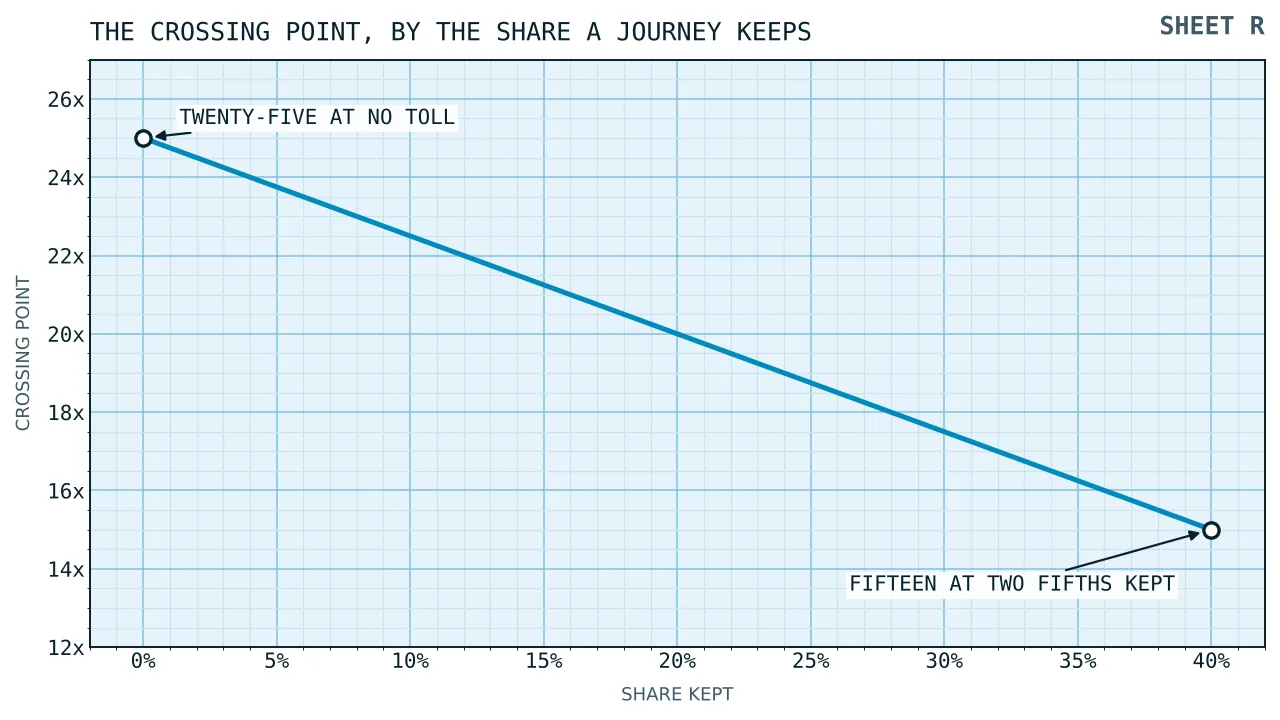
Put the round trip at T and the credit at B. The credit is worth exactly T at the multiple where twenty-five is multiplied by one less T over B.
Crossing point = 25 × (1 – T / B)
Read that as a rate rather than as an expression. Each one per cent of the credit a rail keeps strikes a quarter of a turnover off the crossing point. Which is why a flat sum of a pound or two bites hardest where the credit is smallest, and why the crossing point belongs to the pair and not to either figure alone.
| Share of the credit the journey keeps | Crossing point, in turnovers | Turnovers lost to the rail |
|---|---|---|
| Nothing at all | 25.00 | none |
| One twenty-fifth | 24.00 | one |
| Two twenty-fifths | 23.00 | two |
| Four twenty-fifths | 21.00 | four |
| A quarter | 18.75 | six and a quarter |
| Two fifths | 15.00 | ten |
Where a rail keeps £1.50 flat, a ten pound deposit matched in full crosses at 20.59 turnovers and a two hundred and fifty pound one at 24.85.
4
Flat, proportional, or two hops
A charge is flat, proportional or compound, and the three behave differently as a deposit changes size. A flat sum ignores the amount sent, so its rate falls as the deposit climbs. A proportional charge holds its rate and is therefore indifferent to size. A compound journey, two hops carrying one charge of each kind, has a rate that falls to a floor and stops there.
| Sum leaving the bank | A flat £1.50 as a rate | Two per cent as a rate | Both charges together |
|---|---|---|---|
| Ten pounds | 15.00 per cent | 2.00 per cent | 17.00 per cent |
| Twenty-five pounds | 6.00 per cent | 2.00 per cent | 8.00 per cent |
| Eighty pounds | 1.88 per cent | 2.00 per cent | 3.88 per cent |
| Two hundred and fifty pounds | 0.60 per cent | 2.00 per cent | 2.60 per cent |
So the smallest deposit pays the steepest rate on a flat charge and the largest pays almost nothing for the identical service. The crossing point follows that rate, which is the arithmetic reason a small deposit on a charged rail is the worst arrangement available.
A charge is a certainty and an expectation is an average, so the two are not comparable in kind, and that is the honest caveat on every figure here. Four per cent of a turnover is a long-run rate and a flat £1.50 is a fact, and the arithmetic treats them alike only because there is no better way to set them side by side.
5
The exit is a different rail
A withdrawal is not a deposit run backwards. Several ways of paying in cannot pay out at all, so the money leaves by a route nobody chose, charging on terms of its own. A charge at the exit is worse than the same charge at the entrance, because it falls on a balance that has already survived the condition.
Where a flat charge meets a ceiling on the size of one payment, the ceiling multiplies the charge by the number of payments it forces. Four payments at £2.50 collect one balance for £10.00, and it was the ceiling that did the multiplying.
£2.50 a payment, four payments, and £10.00 to collect one balance
Great Britain forbids the term which makes that worst case. A term that would put a roof over the deposit balance is barred four ways at once: a licensee may not write one, act on one, press one, or shelter behind one, and the bar reads what a term does as well as what it was meant to do. The regulator prints one example of the forbidden kind, and it allows five hundred pounds across a week with fifty of them in any single day.
Cancelling a withdrawal may not be offered to a customer once the request is in, and the guidance beside that asks for the way out to carry as little friction as can be managed. Away from that licence the regulator reports two patterns in place of it: payouts stopped, and payout floors pitched at a height nobody reaches.
Identity is the other thing a rail is sometimes mistaken for. A card number, a wallet address or a mobile account is not an answer to the question a cashier is obliged to ask. The condition’s floor is a date of birth with an address and a name alongside it, and the condition states in terms that this floor is not the whole of what may be sought. It also shuts the door that would otherwise open at the exit: nothing may be demanded of a customer at withdrawal where the licensee had a fair opportunity to ask for it sooner. Information the law on money laundering requires is to be sought early in the relationship and never banked against a future payout request. A payout held up for want of identity information may put the licensee in breach of the condition covering identity.
6
Sixteen ways in, one question each
Sixteen sheets, sorted by the shape of the debit rather than by the name printed on the button. Six of them describe a rail that keeps something as the money arrives. Seven describe a rail that arrives whole and then charges at the far end. Three describe a debit that is no kind of charge.
Six rails that keep something on the way in
A round trip that begins with buying the money before any of it can be sent is priced at crypto casino. What hours of holding a bought unit add to a condition already settled in pounds is the subject of best bitcoin casino. Why one fixed sum is a different animal at ten pounds and at two hundred is worked through at ethereum casino. What is still chargeable once the unit itself has stopped moving against the dollar is at usdt casino. Where two hops cross, and which of them costs more at which size, is the question at muchbetter casino. What happens when the whole of a rail’s charge lands on the only money there was ever going to be to keep is at crypto casino no deposit bonus.
Seven that arrive whole and charge at the far end
What a rail that arrives whole charges at the far end instead is priced at visa casino. What a condition costs in presses and in hours before a penny may leave is counted at mastercard casino. What a single line about eligible methods does to a bonus’s face value is at paypal casino. What a floor under each payment does to winnings collected in pieces is at skrill, neteller and trustly. What the hours are worth, and what a ceiling does to a flat charge, is at fast withdrawal casinos. What stands behind a token, on a rail where the token itself keeps nothing, is at apple pay casino. Which direction a device wallet runs in, and which end of it charges, is settled at google pay casino.
Three debits that are not charges
What a sum billed to a mobile account can and cannot do in reverse is at pay by phone casino. What borrowed money costs behind a deposit that arrived whole is at credit card casino. What a fixed face value does to a figure somebody actually meant to pay in is at paysafecard casino.
7
The rail a British cashier refuses
One rail is not a question of cost. It is prohibited. Credit cards are refused at a British cashier by licence condition and not by choice, and the same condition names a card payment passed through a money service business, so the detour shuts as well.
It took effect on 14 April 2020. Every remote licence is in scope, ancillary remote betting and ancillary remote lottery among them, and so is each non-remote licence for general betting, for pool betting and for betting intermediation. Outside it sit the licences for gaming machine technical work, for gambling software and for hosts.
The Caribbean policy opened for this build mentions a credit card once, and in the opposite role. Among the things it suggests an operator may use at registration to satisfy itself that a player is not a minor is confirmation of a payment method, and the example it gives is a credit card. So the instrument that cannot lawfully fund play on one side of the line is offered as evidence of age on the other.
Interest on a borrowed deposit sits on no statement a cashier sends, which makes it the one debit on this sheet a reader has to fetch from somewhere else entirely.
8
Eight places on one journey
Eight places on one journey, and what a licence fixes at each.
| Where on the journey | What a British licence fixes there | What stands there without one |
|---|---|---|
| Before the first cycle | Who the customer is, verified rather than asserted, with the condition naming three items as a floor and refusing to treat them as a ceiling | A date typed into a box, documents attached to a later milestone |
| The method itself | A credit card refused, and refused a second time where a money service business is put in the middle of the payment | A credit card named as one way of confirming that a player is not a minor |
| The deposit screen | Limit facilities on a direct link, a limit as the default choice, declining one a positive act the customer has to confirm | Nothing obliging a ceiling to be offered at all |
| While the money is in play | A slot cycle no quicker than 2.5 seconds, no stake over £5.00 and none over £2.00 below twenty-five | No pace and no ceiling, so eighty pounds can be one instruction |
| When a payout is asked for | No ceiling over the deposit balance, and no offer to cancel the request | Floors the regulator reports as unreachable, and payouts simply stopped |
| If information is wanted late | Nothing demanded at withdrawal that could reasonably have been sought earlier | The question arrives at the moment the money is trying to leave |
| Once a month of deposits passes £150.00 | A light-touch financial vulnerability check | Two deposits of this size clear that figure unremarked |
| If it goes wrong | Eight weeks, then an independent body carrying the regulator’s approval | A last stage the other party is free to design |
Eight rows, and only two of them carry the arithmetic above. The other six carry its assumptions, which is a different kind of debt.
9
Four readings, taken in advance
Four readings price any rail, and every one of them can be taken before a single cycle runs. Subtract the credited figure from the sum that left, which gives the entrance toll. Add whatever the way out costs, keeping the flat part and the percentage part apart. Divide the pair by the credit, multiply by twenty-five and take the answer from twenty-five. The number left is the multiple at which the credit is worth exactly the journey.
A reader who takes those readings before paying anything in has priced the journey, and the journey is the part of the arithmetic nobody can argue with afterwards. Price the journey first, then the bonus, because that is the order the money travels in.
The rest of the tree sorts offers by whichever other debit decides them. Play-through on its own is at The multiple, and offers carrying none at all are at Nothing asked back. Credit priced per pound of a reader’s own is at Matched money, and the smallest sum a cashier will take is at The floor. Where the credit is spent, and what a room does to the division, is at The room. What a licence buys, duty by duty, and what its absence costs, is at Off the register. How a receipt is struck holds the working behind every total here, and the front page of this site is The Spin Sheet.
Questions
- What does a rail actually charge for?
- A rail is charged for carrying money, and it charges in both directions, which is the part a bonus page never sets out. The charge is settled before a bonus has a face value to be priced against, so it is the one debit on the page that does not depend on a single word of the terms. Eighty pounds leaving a bank at ten pence a cycle is 800 commitments and expects £76.80 back from a reel paying 96 per cent, whatever carried it. What the rail decides is the figure the cashier credits, and therefore the figure a match is struck on.
- Why does a four pound charge cost eight pounds of face?
- Because a match is struck on the figure a cashier sees rather than the figure a bank sees. Send eighty pounds down a rail keeping five per cent and £76.00 arrives, so a flat match credits £76.00 instead of £80.00. Four pounds has left twice over, first from the deposit and then from the credit struck against the remainder. At three hundred per cent the same four pounds removes sixteen pounds of face, because the headline multiplies the shortfall along with everything else it multiplies.
- Where is the crossing point on a charged rail?
- At twenty-five turnovers multiplied by one less the share of the credit the journey keeps. The reason is that every turnover asked of a credit spends four per cent of it where a reel returns 96 pence in the pound, so twenty-five turnovers spend the credit entire and the expression returns nought. A toll brings that point forward, and it does so at a fixed rate: a quarter of a turnover for each one per cent of the credit the rail keeps. A journey keeping a fortieth crosses at twenty-four, and one keeping two fifths crosses at fifteen.
- Does a bigger deposit pay a smaller rate?
- On a flat charge it does, and the saving is the whole of the difference in rate. A flat £1.50 is 15.00 per cent of ten pounds and 0.60 per cent of two hundred and fifty, so the small deposit pays twenty-five times the rate for an identical service. A proportional charge is indifferent to size by construction. A compound journey, two hops with one charge of each kind, has a rate that falls until the proportional part is all that is left, and then stops falling. None of that is an argument for a larger deposit, since a larger deposit is a larger sum at stake.
- Which end of a rail is the expensive end?
- The exit, nearly always, and for two reasons. A charge at the far end falls on a balance that has already paid for the condition, so it comes out of the only money anybody was ever going to take home. And several ways of paying in cannot pay out at all, which means the money leaves by a route nobody chose, on terms set elsewhere. Worse again where a ceiling stands on the size of one payment: four payments at £2.50 collect one balance for £10.00, and it was the ceiling rather than the charge that did the multiplying.
- Can a cashier put a ceiling on what leaves?
- Not under a British licence, where a term putting a roof over the deposit balance is barred four ways at once, and the bar reads what a term does as well as what it was meant to do. The regulator prints one example of the forbidden kind, allowing five hundred pounds across a week with fifty of them in any single day. Cancelling a withdrawal may not be offered once the request is in. Away from that licence the regulator reports two patterns in its place: payouts stopped, and payout floors pitched at a height nobody reaches.
- Is a credit card deposit lawful in Great Britain?
- No licensee may accept one, and the condition shuts the obvious detour by naming a card payment passed through a money service business. It took effect on 14 April 2020. Every remote licence is in scope, ancillary remote betting and ancillary remote lottery among them, and so is each non-remote licence for general betting, for pool betting and for betting intermediation. The Caribbean policy opened for this build mentions a credit card once, and in the opposite role: confirming a payment method is among the things it suggests at registration to satisfy an operator that a player is not a minor.
- What does a licence fix that a rail cannot?
- The pace of a cycle, the size of a stake, the moment the identity question is put, the ceiling nobody may place over a balance, and the body a complaint reaches once the operator has finished with it. Each line there binds whoever holds a British licence, and no line there binds a business that holds none. Two of them carry figures this sheet leans on: ten turnovers as the furthest a licensee may ask, and a net £150.00 deposited inside one month as the point a light-touch affordability check begins. Two deposits of the size modelled here clear that figure.