
Sheet R06 Revision 1 Checked 15 October 2026
Paypal casino
A wallet deposit of £35.00 costs nothing to make and can cost the entire bonus. Where the method qualifies, a full match is worth £21.00 at the British ceiling of ten. Where the method is excluded, the same deposit buys £0.00 of bonus at every multiple there is.
£21.00 of value, or £0.00, decided by one line in the terms
What a method decides before the multiple does
Every destination on this spike is bought advertising. The site takes a fee if a reader goes on to register, and no figure printed below moves because of it.
The Spin Sheet
Till receipt No 01
Betportal
Lowest multiple here
For every €1 of spin credit at face per €1
Credit
Debit
No Great Britain licence
Licensed in Anjouan, Comoros, run by BetPortal Gaming Ltd, with Excite Ultra Media Ltd, reference ALSI-202601040-FI2.
Terms read 15 October 2026
Open the offer at Betportal, opens in a new tabThe Spin Sheet
Till receipt No 02
WinBeast
Five staged matches
For every €1 of spin credit at face per €1
Credit
Debit
No Great Britain licence
Licensed in Curaçao, operator not named on the site.
Terms read 15 October 2026
Open the offer at WinBeast, opens in a new tabThe Spin Sheet
Till receipt No 03
EliteSpin
Longest spin window
For every £1 of spin credit at face per £1
Credit
Debit
No Great Britain licence
Licensed in Costa Rica, run by PrimeTier Limited.
Terms read 15 October 2026
Open the offer at EliteSpin, opens in a new tabThe Spin Sheet
Till receipt No 04
Crown Jewelz
Multiple unpublished
No total struck
Credit
Debit
No Great Britain licence
Licensed in Curaçao, number not verified, operator not named on the site.
Terms read 15 October 2026
Open the offer at Crown Jewelz, opens in a new tabThe figure at the foot of a receipt is this site's own arithmetic and nothing an operator has published: the credit, less the share a spin gives back at 96 per cent return to player, less what playing the wagering through costs at the same return. It describes the offer, not one reader's afternoon. Where the conditions price above the credit the receipt prints nothing rather than a negative sum, and where a figure the sum needs is unpublished it prints the condition in the operator's words instead.
Three words stand in the amount column where no figure can. Noted is a published condition that takes value away without leaving the sum a figure to take. Unpriced is a condition whose figure nobody has published, or a credit that is not a sum until a deposit of your own sets it. Own money is money of yours, which is never part of a total.
Not one of the operators printed above holds a Great Britain licence, so the duties that licence carries do not reach them. Every online gambling company licensed in Great Britain has to be part of Gamstop Online, and a reader who has shut themselves out through the scheme is therefore not shut out here. The ceiling of ten times the bonus funds on a wagering requirement, in force since 19 January 2026, is a condition of that licence and binds the companies that hold one. Where a dispute goes instead is a matter for the authority named on the receipt, and the Gambling Commission describes what a reader faces without a British licence as a lack of recourse if things go wrong. Nobody under 18 may hold an account at any of them.
Every term printed on a receipt is the operator's own, and each receipt carries the day it was read. The oldest of those readings is 15 October 2026. What binds a reader is the operator's own full terms, and not a line printed here.
1
The £35.00 that might not count
Of every rail in this section, a wallet is the one whose charge is most often nothing and whose cost is most often everything. The deposit arrives whole. The figure on the cashier’s screen is the figure that left the wallet. And then a line somewhere in the bonus terms decides whether the deposit qualified for anything at all.
So this sheet prices an eligibility condition rather than a fee, which makes it the odd one out here. A fee can be worked out in pence. An exclusion is worth the whole of whatever it excludes, and the only way to find out what that is worth is to price the bonus twice.
The working deposit is £35.00, matched in full, so the bonus credit is £35.00 where the method counts and £0.00 where it does not. Slots return 96 per cent, as on every sheet here. Forty is the multiple, that being what gets written into terms once the British register is out of the picture, and ten runs beside it as the furthest a licensed cashier may reach.
Nothing is modelled as a charge on this page, because there is nothing to model. What is assumed is the exclusion itself, since no source behind this site records which methods any particular cashier excludes, and no such record could be kept current if it existed. Exclusion lists are a commercial choice and they change. The arithmetic of being on one does not.
Three questions a wallet deposit has to answer, in this order:
- Will the wallet make the payment at all.
- Does the payment qualify for the offer attached to it.
- Can winnings come back the same way, and only the same way.
2
A wallet is a second gate
A debit card has one gatekeeper, the bank that issued it. A wallet has two: the bank behind the wallet and the wallet itself, each with its own view about gambling and its own right to change that view without telling anybody in advance.
This sheet does not quote a wallet’s terms, and the reason is the same reason it does not quote a fee schedule. Those documents are the wallet’s property, they are revised when the wallet likes, and nothing in the sourced material behind this site records what they say. What can be done is to price the consequence of a refusal, which is the same whichever party does the refusing.
And there is a third consequence that belongs to wallets in particular. Where a cashier pays winnings back to the method that funded the deposit, the wallet is not just the way in but the only way out, which puts the exit on the same single point of failure as the entrance. A rail with two gates in series is less reliable than either gate, not more.
A British licence does one thing about all of this, and the protection is worth naming because it reaches the document the exclusion is written in. Condition 7.1.1 has four limbs. Terms and consumer notices must not be unfair, and the test of fairness is the one in the Consumer Rights Act 2015; the licensee must also keep to its own terms. They must be transparent on the same Act’s test, and available somewhere easily reached. A material change has to be told to the customer before it takes effect. Barred as well, throughout any dealing with a consumer, are unfair commercial practices of the sort the 2024 Act on digital markets, competition and consumers defines. Those limbs are the only reason an exclusion has to be legible at all.
3
Twenty-one pounds, or nothing
Price the deposit both ways and the finding is sharper than expected.
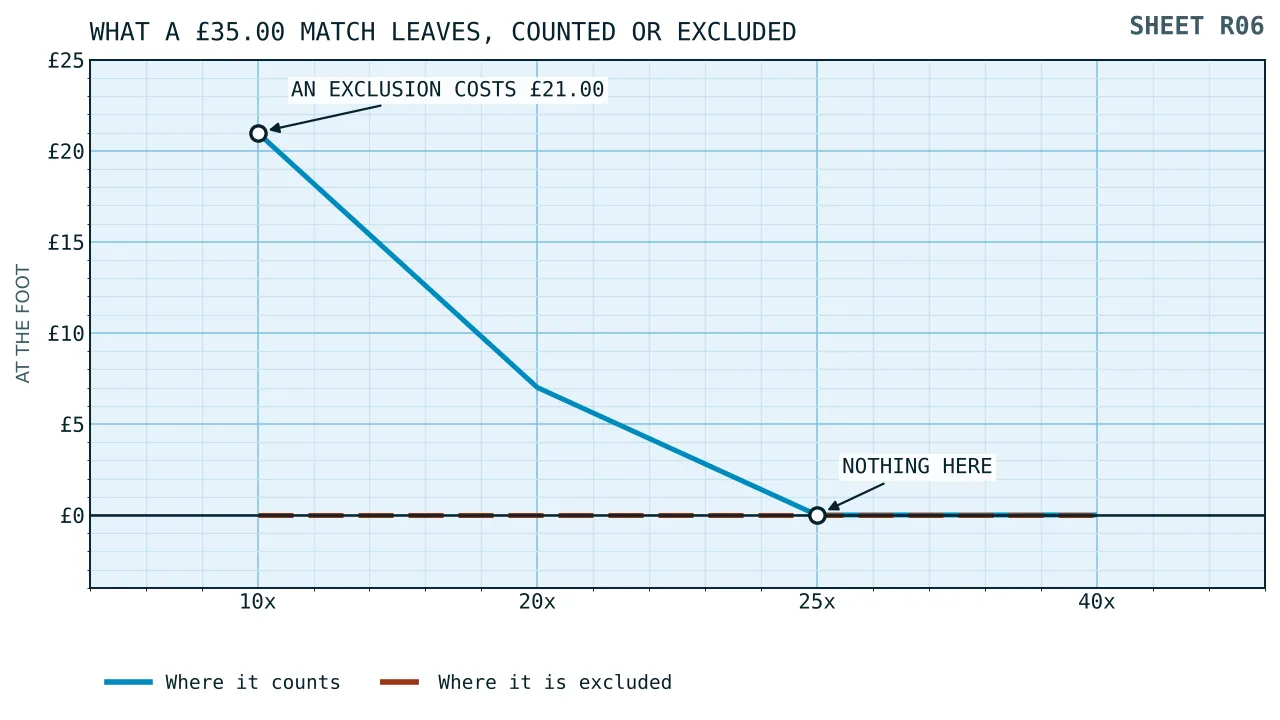
Where the wallet qualifies, £35.00 of bonus is credited and the multiple settles its value. Ten times, the most Britain permits, leaves £21.00 expected. At twenty times it is £7.00. At twenty-five it is £0.00, and at the forty this sheet models it is £0.00 again with an overrun of £21.00 behind it.
Where the wallet is excluded, the bonus is £0.00 and so is the expectation, at every multiple from one to a thousand.
Put the two columns next to each other and the exclusion is worth precisely what the bonus was worth, meaning a good deal where the multiple is low and nothing whatever where it is high. An excluded method costs £21.00 against a ten times condition and £0.00 against a forty times one, because at forty times there was nothing there to lose.
| Multiple | Turnover to clear | If the method counts | If it is excluded | Cost of the exclusion |
|---|---|---|---|---|
| 10x | £350.00 | £21.00 | £0.00 | £21.00 |
| 20x | £700.00 | £7.00 | £0.00 | £7.00 |
| 25x | £875.00 | £0.00 | £0.00 | £0.00 |
| 40x | £1,400.00 | £0.00 | £0.00 | £0.00 |
An exclusion costs £21.00 at ten times and £0.00 at forty
Which reframes the whole question a reader arrived with. Whether the wallet is on the list is only worth knowing where the multiple is low enough for the bonus to have been worth having. Where the terms ask forty times, the method on the exclusion list has saved the reader the trouble.
4
The line, run twice over
A wallet decides whether B exists. Once it does, one expression decides what it is worth.
E = B × (1 – (W × (1 – RTP)) / g)
Take g first, because it is the term that quietly undoes the rest: it stands at one here, meaning slots count at their whole value towards the condition. RTP is 0.96. W is the multiple. B is £35.00 or £0.00, and that is the entire subject of this sheet.
Said in words at forty times: 1.60 is what four pence of edge comes to when it is taken forty times over, so the bracket sits at minus 0.60, and six-tenths of £35.00 is £21.00, carrying a minus sign.
The sums behind it. The condition wants forty lots of £35.00 across the tables, which is £1,400.00 of turnover. A 96 per cent return means a four per cent toll on turnover, so £56.00 is the expected cost. Twenty-one pounds more than the credit, so the credit goes first and nothing reaches the foot.
The British maximum for W has read ten since the third week of January 2026. At ten the condition wants £350.00 of turnover for £14.00 of expected cost, and £21.00 is expected to remain. That £21.00 is the whole of what an eligibility line is worth on this deposit, and it is the figure a reader is really being asked to risk on the small print.
Now run it with B at nought. Forty times nothing is nothing, so no turnover is owed, no cost is expected and nothing is credited. The player is left with their own £35.00, free of any condition, which is the one case on this site where an offer failing is better than an offer working.
5
Where an exclusion has to be printed
British advertising rules have something exact to say about this, and it is the sharpest sourced material on the page.
Begin from the figure. An eligibility line worth £21.00 is a condition with a price on it, and rule 8.17 of the advertising code asks for conditions of that weight to be put where a reader will actually meet them, wherever dropping one would mislead. Four kinds count as significant in a gambling promotion. Odds and bet types make one kind, with nothing to say about a £35.00 slots match. The time allowed for claiming and for using makes another. The deposit or the wagering asked for makes a third, which here is £1,400.00 of turnover. The fourth is who may take the offer up at all, sorted by where they live, by age, or by newness to the cashier, and a requirement about payment method belongs in that fourth kind.
That fourth kind has been tested on facts identical to this page’s. A ruling dated 31 July 2024, against the operator of a well-known online betting brand, dealt with an offer whose excluded method had been tucked into small print inside the full terms. Insufficiently prominent was the regulator’s conclusion on it. The ruling settles nothing about any particular wallet. What it settles is where a £21.00 condition has to be printed.
The gambling regulator supplies a blunter sanction than the advertising code manages. Terms of that significance belong inside the advertisement and beside the headline figure wherever a reader lands or signs up, and an advertisement failing on prominence is a misleading one. Separately, the code provision on incentives wants an offer’s terms fair, clear, transparent and within easy reach.
Out here, none of it applies. Wallet-friendly offers out here hold no Great Britain licence, so the prominence test goes, the four kinds go, the incentive provision goes, and an exclusion may sit wherever an operator finds convenient. Two sentences is what bonuses get in the island policy consulted for this build. The first wants clear terms, transparently communicated. The second wants promotion that does not drive excessive play. Prominence is not mentioned. Neither is significance.
6
One product or two: the rule on mixing
Welcome packages funded from a wallet are usually bundles, and bundling has been restricted in Britain since 19 January 2026: one incentive, one type of gambling product. Four types are named by the rule, and bingo, lottery, casino and betting is as good an order as any to learn them in.
That rule reads a particular way on the offers this section is about. A cash match with free spins attached stays inside one type, because slots are a casino product. A match with bingo tickets attached crosses two, and so does a casino match that comes with a free bet. The distinction follows from the four types the rule itself names, which is why it can be stated as a reading of the rule rather than as a guess.
Three carve-outs cut against what a reader would assume, and all three are published. A credit the customer may spend on anything they choose falls outside the ban entirely, the published example being ten pounds usable on betting or on casino. Two products of one type may share an incentive, the example there being a scratchcard beside a raffle. And a single email may hold a betting offer beside a casino offer, kept separate, where marketing consent covers both products.
The aim is stated narrowly: what is banned is mixing products inside one incentive where the terms are linked and shared. So the thing to look for is not a list of products but a single set of conditions covering them, and that is worth a figure. Where a £35.00 match and a round of spins share one forty times condition, the turnover is calculated on the whole credit, so a spins round worth £4.80 added to the £35.00 lifts the turnover owed from £1,400.00 to £1,592.00 and the expected cost from £56.00 to £63.68.
Linked terms are therefore not a technicality. They are the mechanism by which an extra £4.80 of headline costs £7.68 of expected play.
7
The clause that lets a cashier walk away
One published enforcement outcome sits squarely on the terms of a casino bonus, and a reader weighing a wallet deposit against a set of terms should know about it.
The date is 3 July 2025, the sum is £170,000, and the operator fined was trading as a casino brand. What drew the fine was a set of bonus rules written for that brand’s new casino promotions, inside which sat two reserved discretions, one to shut an account and one to withhold winnings. Breached, on the regulator’s finding, was the fair and open licensing condition. Wording of that kind, it said, falls short on transparency and may land the customer with an unfair result. Besides the money, it required an independent audit reaching the operator’s controls on money laundering and on safer play.
Two things follow, and the second limits the first. A published consequence stands behind a clause of that shape, so a reader may say with a source that this regulator has fined an operator over one and may name the condition that went. Nobody may say the clause is void. The money was paid; the wording survived.
Set that against part 3. Forfeiture attaches to a balance rather than to a bonus, so it can carry off the £21.00 of expectation and the £35.00 of deposit together, which is £56.00. An exclusion list costs a bonus and announces itself as a condition. A discretion costs the lot and reads like housekeeping.
One distinction is worth holding on to, because two protections are easy to run together. What a licensed cashier may never do is ration the money a player paid in. What it may do, so far as anything published says, is put a ceiling on the winnings a bonus can produce. Those are separate objects, the rule covers only the first, and both can appear in one set of terms at one moment.
8
Checking a method before you pay
Six readings. Only one of them is on the banking page; the rest are buried in the terms.
| What to establish | On this deposit |
|---|---|
| Whether the method is on an exclusion list | Decides B |
| The deposit, as the cashier will see it | £35.00 |
| The multiple the terms fasten to it | 40x |
| Turnover that follows | £1,400.00 |
| Expected cost, at four per cent | £56.00 |
| Value of the eligibility line | £21.00 at 10x, £0.00 at 40x |
Read the first and third lines together, which nobody does, because reading them together is what tells you whether the first line matters. A method excluded from an offer asking forty times has cost you nothing. A method excluded from an offer asking ten has cost you £21.00 on a thirty-five pound deposit, which is the only version of this question worth being annoyed about.
And the usual caution. Twenty-one pounds is a mean across many repetitions, not a payment: the likeliest single result of a thirty-five pound bonus at any multiple is nothing whatever. The deposit, by contrast, is thirty-five pounds exactly, and the wallet took it the moment it was asked.
Neighbouring sheets, same method: skrill/neteller/trustly casino prices three more wallets and the bank push behind one of them, muchbetter casino takes the two-hop case where each hop charges, and visa casino is the single-gate comparison with a clearing delay instead of an exclusion. The section index is at The rail.
Questions
- Why do some bonuses exclude wallet deposits?
- It is a commercial choice, and no source behind this site records which methods any particular cashier leaves out, nor could such a record stay current. What can be priced is the consequence. A £35.00 deposit that qualifies carries £35.00 of bonus; one that does not carries nothing, and the difference is worth £21.00 at the British ceiling of ten and nothing at all at forty.
- What is an excluded payment method actually costing me?
- Exactly what the bonus was worth, which depends entirely on the multiple. At ten times, £35.00 of credit is expected to leave £21.00, so the exclusion costs £21.00. At twenty times it costs £7.00. At twenty-five times and above the credit was expected to leave nothing, so being excluded costs nothing and saves the turnover.
- Does a wallet deposit arrive in full?
- Ordinarily yes, which is what makes this rail unusual in this section. The figure that leaves the wallet is the figure the cashier shows, so there is no spread, no carriage and no conversion to find. The cost sits in eligibility rather than in pence, and an eligibility line is worth the whole of whatever it excludes.
- Must a British cashier tell me a method is excluded?
- Prominently, yes. Rule 8.17 asks for a promotion’s significant conditions to be put where a reader will meet them, wherever dropping one would mislead, and four kinds are counted significant: odds and bet types, the time allowed to claim and use, the deposit or wagering asked, and who may take the offer up at all. Payment method belongs to the fourth. The sanction comes from the gambling regulator, which treats an advertisement failing on prominence as misleading.
- Has that rule ever been enforced?
- Yes. A ruling dated 31 July 2024 against the operator of a well-known online betting brand turned on an excluded method tucked into small print inside the full terms, and insufficiently prominent was the conclusion reached on it. The ruling fixes nothing about any particular wallet. It fixes where a condition worth £21.00 on this page’s figures has to appear.
- Can a package combine a match with bingo tickets?
- Not inside one incentive at a British cashier, and the date is 19 January 2026. One incentive may carry one product type, out of the four the rule names, which are bingo, lottery, casino and betting. Free spins beside a cash match stay within casino, slots being a casino product; bingo tickets beside a cash match make two types. Carve-outs: a credit spendable on anything escapes the ban, two products of a single type may share an incentive, and one email may hold a betting offer and a casino offer separately where the customer opted in to each.
- Why do linked terms matter on a bundled offer?
- Because turnover is calculated across the whole credit at once. Put a round of spins worth £4.80 alongside a £35.00 match under one forty times condition and the turnover owed goes from £1,400.00 to £1,592.00, while the expected cost goes from £56.00 to £63.68. In other words £4.80 of added headline brings £7.68 of added expected play with it. That is the mechanism, not a technicality.
- Could a cashier simply refuse to pay the winnings?
- One published outcome sits squarely on that. The date is 3 July 2025, the sum £170,000, and the operator was trading as a casino brand; the bonus rules behind the fine held two reserved discretions, one to shut an account and one to withhold winnings. Breach was found of the condition on fair and open dealing, and an audit by an independent party, covering the controls over money laundering and over safer play, was ordered alongside the payment. The money was paid and the wording survived, so nobody should treat such a clause as void. Forfeiture attaches to a balance rather than a bonus, which on these figures is £56.00 and not £21.00.
- What do I lose by using a wallet at an offshore cashier?
- Wallet-friendly offers out here hold no Great Britain licence, so the apparatus around an exclusion disappears with it. Nothing tests prominence. Nothing lists which conditions count as significant. No provision demands that an incentive’s terms be fair, clear, transparent and within easy reach. And the multiple is loose, which is how forty times and £1,400.00 of turnover become available where ten would have been the limit. The island policy consulted for this build spends two sentences on bonuses, wanting clear terms and no aggressive promotion, and stops there.