
Sheet R01 Revision 1 Checked 15 October 2026
Pay by phone casino
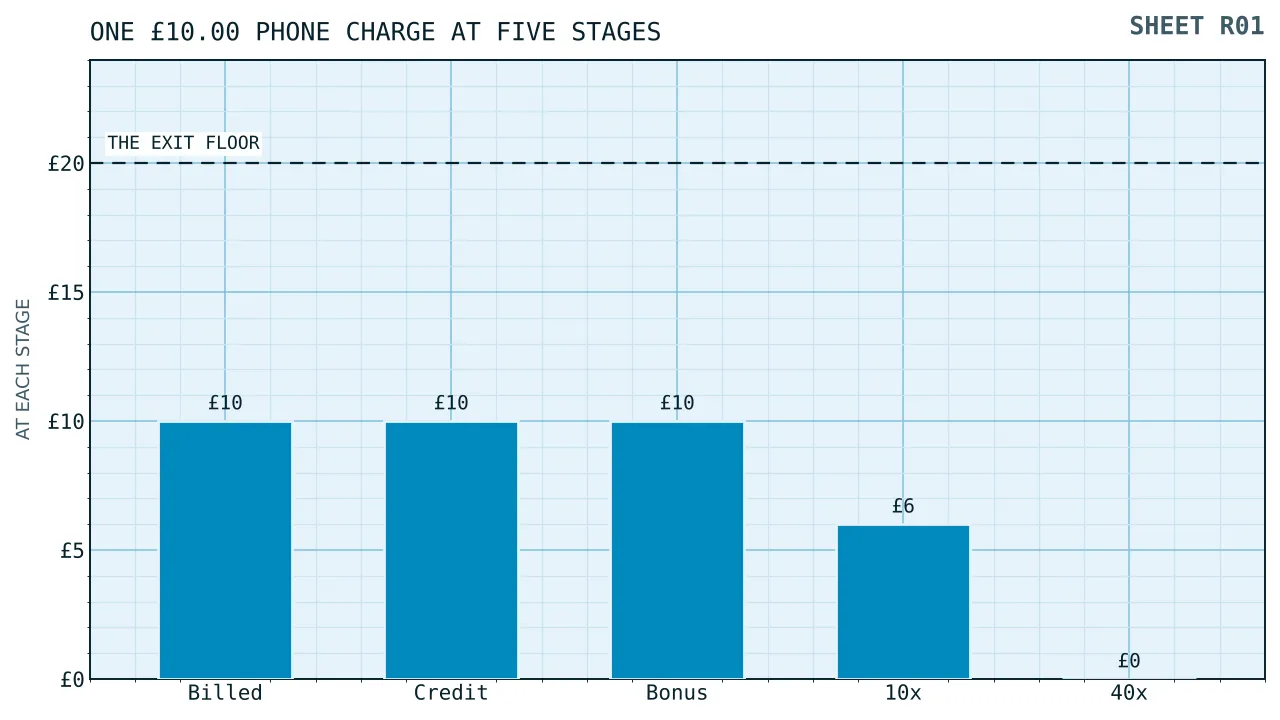
A £10.00 charge to a mobile bill arrives as £10.00 of balance, which is the one thing this rail does cleanly. Nothing comes back the same way. Price the one-way journey first and a 100 per cent match on that £10.00 is worth £6.00 at ten times and nought at forty.
£10.00 in on the bill, £0.00 out on the bill
What the rail leaves before a bonus
Every destination on this spike is bought advertising. The site takes a fee if a reader goes on to register, and no figure printed below moves because of it.
The Spin Sheet
Till receipt No 01
Betportal
Lowest multiple here
For every €1 of spin credit at face per €1
Credit
Debit
No Great Britain licence
Licensed in Anjouan, Comoros, run by BetPortal Gaming Ltd, with Excite Ultra Media Ltd, reference ALSI-202601040-FI2.
Terms read 15 October 2026
Open the offer at Betportal, opens in a new tabThe Spin Sheet
Till receipt No 02
WinBeast
Five staged matches
For every €1 of spin credit at face per €1
Credit
Debit
No Great Britain licence
Licensed in Curaçao, operator not named on the site.
Terms read 15 October 2026
Open the offer at WinBeast, opens in a new tabThe Spin Sheet
Till receipt No 03
EliteSpin
Longest spin window
For every £1 of spin credit at face per £1
Credit
Debit
No Great Britain licence
Licensed in Costa Rica, run by PrimeTier Limited.
Terms read 15 October 2026
Open the offer at EliteSpin, opens in a new tabThe Spin Sheet
Till receipt No 04
Crown Jewelz
Multiple unpublished
No total struck
Credit
Debit
No Great Britain licence
Licensed in Curaçao, number not verified, operator not named on the site.
Terms read 15 October 2026
Open the offer at Crown Jewelz, opens in a new tabThe figure at the foot of a receipt is this site's own arithmetic and nothing an operator has published: the credit, less the share a spin gives back at 96 per cent return to player, less what playing the wagering through costs at the same return. It describes the offer, not one reader's afternoon. Where the conditions price above the credit the receipt prints nothing rather than a negative sum, and where a figure the sum needs is unpublished it prints the condition in the operator's words instead.
Three words stand in the amount column where no figure can. Noted is a published condition that takes value away without leaving the sum a figure to take. Unpriced is a condition whose figure nobody has published, or a credit that is not a sum until a deposit of your own sets it. Own money is money of yours, which is never part of a total.
Not one of the operators printed above holds a Great Britain licence, so the duties that licence carries do not reach them. Every online gambling company licensed in Great Britain has to be part of Gamstop Online, and a reader who has shut themselves out through the scheme is therefore not shut out here. The ceiling of ten times the bonus funds on a wagering requirement, in force since 19 January 2026, is a condition of that licence and binds the companies that hold one. Where a dispute goes instead is a matter for the authority named on the receipt, and the Gambling Commission describes what a reader faces without a British licence as a lack of recourse if things go wrong. Nobody under 18 may hold an account at any of them.
Every term printed on a receipt is the operator's own, and each receipt carries the day it was read. The oldest of those readings is 15 October 2026. What binds a reader is the operator's own full terms, and not a line printed here.
1
What a charge to the bill buys
Bill-to-mobile is the shortest deposit on any cashier screen. A number is typed, a code arrives, the code is typed back, and a figure appears in the balance. Nothing is skimmed on the way through: a £10.00 charge shows up as £10.00 of spendable balance, and the same £10.00 lands on the next statement from the network that sells the airtime.
So on the entry leg this rail is honest in a way few others manage. Its price sits somewhere else entirely, and a reader who prices only the entry leg will never find it. The charge cannot be reversed, the money cannot come back along the wire it went down, and the balance it created is therefore trapped behind whatever second rail the cashier will pay out on.
This sheet works that trap in pounds. Four figures do the whole job. The charge is £10.00. A hundred per cent match on it credits another £10.00. Slots return 96 per cent, which is the figure used across this site unless a page names a particular game. The play-through multiple is forty, taken because that is the sort of multiple this part of the market asks for rather than because any one promotion was read.
And one assumption more, which carries the second half of the sheet: a withdrawal floor of £20.00 on the exit rail. No primary source consulted for this site publishes a minimum withdrawal, a carrier margin, or a daily ceiling on a phone charge, so every figure of that kind below is named as an assumption of this sheet and may be swapped for the one actually printed on the document in front of you.
The four things that decide this page, in the order they bite:
- What the carrier bills, which is the figure typed in.
- What the cashier credits, which here is the same figure.
- What the match adds, and the multiple fastened to it.
- What the exit rail will accept as a smallest payment.
2
A rail with one direction only
Money moves down a phone bill in one direction. The charge is a sale of airtime credit, settled weeks later by the network that issued the number, and nothing in that arrangement lets a carrier hand winnings to a player. A cashier accepting phone charges therefore settles the other way elsewhere: onto a debit card, into a current account, or through a wallet the player has to open and verify first.
That turns one deposit into two relationships. The rail that took the money has no part in the rail that returns it, and the second rail arrives with conditions of its own: its own smallest payment, its own clearing time, its own demand for a document. None of those conditions was visible on the screen where the number was typed.
Price it. A £20.00 floor on the exit is the assumption set out in part 1. A hundred per cent match on a £10.00 charge produces £10.00 of bonus credit, and part 3 shows that credit is worth £6.00 at the regulated ceiling of ten times and nothing at all at forty. Six pounds of expectation against a twenty pound floor does not leave the building. It sits in the account until it is staked away or until more money is charged to the bill to lift it over the bar.
Which is the whole finding on this rail, and it has nothing to do with wagering. A withdrawal floor above the expected value of the offer converts the offer into a reason to deposit again. The second deposit is the product.
£6.00 of expectation against a £20.00 exit floor
3
The match, substituted into the line
One expression prices every bonus on this site.
E = B × (1 – (W × (1 – RTP)) / g)
On this page B is the matched credit the phone charge bought, so £10.00. W is the multiple fastened to it, forty. RTP is the slot’s return, 0.96. The weighting g stays at one unless a game’s own terms knock it down. E is the expectation left standing once the condition has been worked off.
Forty times four pence in the pound is 1.60, so the bracket closes at minus 0.60.
Minus 0.60 of the matched £10.00 is minus £6.00.
Two sums underneath that make it legible. Forty lots of £10.00 is £400.00 that has to be wagered before the balance turns into money. Of every pound wagered, four pence is the share the house expects to keep, which puts the cost of £400.00 of turnover at £16.00. A cost of sixteen pounds hung on ten pounds of credit is a string half again longer than the parcel.
Drop the multiple to ten, the highest a Great Britain licence permits, and the sign turns over: £100.00 of turnover, £4.00 of cost, £6.00 expected. That six pounds is the number part 2 measures against the exit floor, and it is the best case rather than the usual one.
| Multiple | Turnover owed | Expected |
|---|---|---|
| 10x | £100.00 | £6.00 |
| 20x | £200.00 | £2.00 |
| 25x | £250.00 | £0.00 |
| 40x | £400.00 | £0.00 |
The crossing at twenty-five times is not a coincidence of these pence. Set E to nought and W has exactly one solution, the reciprocal of the house edge. Four pence in the pound puts that reciprocal at twenty-five, and B falls out of the sum altogether, which is why the crossing recurs on sheet after sheet here.
4
Ceilings on the charge, and what they force
A mobile account is not a current account, and the sum that may be charged to it at once is small by design. This sheet models a £10.00 ceiling on a single charge and a £30.00 ceiling on a day, both named as assumptions because no source read for this site publishes either.
Those ceilings interact with a bonus in a way nobody advertises. A promotion with a £30.00 qualifying deposit cannot be reached in one movement on this rail. It takes three charges, each with its own code and its own confirmation, and the player is three decisions deep before the offer is even live. Every one of those decisions is taken after the first charge has already gone through, which is the wrong order for anybody trying to stop at ten pounds.
Then the arithmetic scales without mercy. Thirty pounds matched at a hundred per cent is £60.00 of balance, £30.00 of it bonus, and forty times that bonus is £1,200.00 of turnover owed. At four pence in the pound the expected cost of clearing it is £48.00, against £30.00 of bonus credit. The overrun grows with the headline, because W multiplies whatever B it is given.
A licensed cashier has to put a brake near that pedal. The remote technical standard on financial limits treats the setting of a limit as the default rather than the alternative: the facility has to be offered at registration or at the first payment, it has to sit on the deposit screen or one link from it, and a customer who wants no limit has to act to decline one and confirm the decline before going on. The regulator’s own worked example of two limits held at once is a daily ten pounds beside a weekly hundred, where the stricter always rules, so the system may pass ten pounds a day and seventy pounds a week and no more. Set that against a rail built to take a code every thirty seconds.
£1,200.00 of turnover owed on a £30.00 bonus at forty times
5
A bill is not a credit card, and the ban says so
Paying from a bill that has not arrived feels like borrowing, and it is reasonable to ask whether the credit-card ban reaches it. The honest answer is drawn from the words of the condition rather than from the feeling.
Licence condition 6.1.2 runs to two sentences. The first forbids a licensee to take payment for gambling on a credit card at all. The second reaches a credit-card payment arriving at the licensee by way of a money service business, which shuts the detour of funding a wallet from the card and the cashier from the wallet. Live since 14 April 2020, the condition covers remote licences of every kind, the ancillary remote betting and lottery ones included, together with non-remote general betting, pool betting and betting intermediary licences. Three sorts sit outside: host, gambling software, and gaming machine technical.
What the condition names is the instrument. A charge to a mobile account is not a credit card and the condition’s words do not reach it, and this sheet will not pretend otherwise in either direction. Two consequences follow, and they point opposite ways. A player who could not fund a deposit by credit card at a licensed cashier can fund one from a bill payable in three weeks, which is deferred payment by any ordinary reading. And the rule binds the licensee, not the customer: the duty is the operator’s, so a cashier holding no Great Britain licence carries no part of it, and whether a card may be used there is settled by that cashier and its own regulator.
One source read for this site makes the gap concrete. The Curaçao responsible gaming policy, in setting out how an operator should satisfy itself that a new player is an adult, lists confirmation of a payment method among the signals it may use and gives a credit card as its example. A rulebook that treats a credit card as evidence of age is plainly not a rulebook that forbids one.
6
Who the cashier thinks you are
A phone number is a weak claim about a person. It proves somebody had access to a handset at the moment a code arrived, and nothing else. That weakness is the reason this rail is popular and the reason the exit leg is where the questions land.
A British licence does not allow that. Under condition 17.1.1 the operator has to establish and verify who it is dealing with before any gambling happens, and the condition’s own floor for that is three items: a date of birth, an address, a name. Ahead of a first deposit it also has to set out which documents may be wanted, at what point, and by what route they should be sent. When the regulator announced the rules it put the age check on bonus-funded play and on free-bet play too, and on free-to-play versions of the games, so the ten pound charge in part 1 would be the second thing to happen on a licensed account rather than the first.
The trapdoor is shut by the same condition. Information the licensee could sensibly have asked for earlier may not be demanded as the price of a payout. The regulator’s consumer guide spells out the same thing for players and adds that money-laundering material should be sought promptly instead of at the moment somebody wants their balance. That guide dates from September 2020 and was last revised in April 2022, which makes it older than most of the sourced material behind this site, so the licence condition is the authority to lean on.
On a rail with no return leg, that protection is worth more than it looks. The exit is already a different rail with a different floor. A demand for a passport arriving at the same moment, on a site under no obligation to have asked earlier, is a third condition landing on the same pound.
7
Four duties this rail never carries
Part 3 works out the same wherever the server sits. What differs is the floor laid under it. A cashier reached by a phone charge from a page of this sort holds no Great Britain licence, which makes the four duties set out here absent rather than weakened, and an absence is worth itemising.
Ten, not forty
W may not pass ten at a British cashier, a limit Social Responsibility Code 5.1.1 has carried since 19 January 2026. Put that ceiling on the match in part 3 and the turnover owed drops from £400.00 to £100.00 while the expectation climbs from nought to £6.00. The ceiling exists because the regulator had found wagering set as high as sixty times, which against this £10.00 would be £600.00 of turnover for £24.00 of expected cost. Read the Curaçao responsible gaming policy from end to end and no ceiling of that sort is in it, at ten times or at sixty.
Your own money, uncapped
No term may ration what a player takes back out of a deposit balance at a licensed cashier. The regulator prints a specimen of the barred kind, and it reads as a fifty pound daily and five hundred pound weekly allowance. The £20.00 floor modelled here is a different animal, a smallest payment rather than an upper limit, and no published rule touches it. So the protection is precise: the balance cannot be rationed on the way out, and the size of the smallest payment is nobody’s business but the cashier’s.
A withdrawal that cannot be taken back
Remote technical standard 14B refuses a licensee the option of letting a customer cancel a request to withdraw, and the guidance beside it adds that money already requested should not be usable as a fresh deposit. That bites hardest on a one-way rail, where the balance is waiting on a slower second route and a change of mind is the one thing the wait invites.
A clock, and a list of names
Complaints at a licensed cashier run against time limits: an acknowledgement inside three working days, inside twenty-four hours where the gambling never closes, and the whole thing finished within eight weeks, after which the player is pointed at an alternative dispute resolution entity drawn from the eight the regulator has approved. At least six months are allowed from the incident to the complaint. The regulator is also candid that it is no ombudsman, with no power to settle a dispute over a payment or recover a stake, so the clock and the approved list are the protection rather than the regulator’s own arm.
Two more things, and they pull against each other. The licence is what obliges a company to join Gamstop Online, and the scheme publishes its own boundary: a registration cannot reach operators that have never joined. Self-exclusion is required in Curaçao as well, though the unit there is a single operator with its own domains, and a year is the shortest term available. Nothing on this page assists anybody past a block they have put up. Meanwhile the tax travels where the licence does not. Remote gaming sold to somebody who usually lives in the United Kingdom carries Remote Gaming Duty on the operator’s profit, charged at 40 per cent from April 2026, wherever the operator is registered. Revenue crosses the water easily enough. The player’s protections stay behind.
8
Pricing your own charge
Six readings and the answer is yours rather than this sheet’s. Four of them are on the cashier’s banking page and two are in the bonus terms.
| What to read | Here |
|---|---|
| The charge, and the ceiling on it | £10.00 |
| What the cashier credits | £10.00 |
| The match, as bonus credit | £10.00 |
| The multiple in the terms | 40x |
| Credit times multiple, costed at 4p | £16.00 |
| The smallest payment the exit will make | £20.00 |
Read the last line first and the rest of the page often stops mattering. Where the exit floor stands above the expected value of the whole offer, the offer cannot pay out on its own terms, and no multiple low enough to help is on the table.
Two cautions before anyone spends the six pounds. It is an average and not a payment: the commonest single outcome of a ten pound bonus at ten times is nothing whatever, and the figure describes a great many repetitions rather than this evening. And the charge itself is not an average. It is ten pounds, certainly, on a bill that arrives whatever the balance does.
Other rails price differently and the method is the same on each. Paysafecard casino is the other one-way rail on this site, where the denomination rather than the carrier sets the floor. Visa casino has a return leg and a clearing delay instead. Fast withdrawal casinos prices the exit clock on its own, and Apple pay casino takes the other one-tap rail and the limit prompt that is supposed to sit beside it. The section index at The rail holds the rest.
Questions
- Can I withdraw winnings back to my phone bill?
- No. A charge to a mobile account is a sale of airtime credit settled on a later statement, and there is no route in that arrangement for a carrier to pay a player. Winnings leave by a second rail instead, which is usually a debit card or a transfer to a current account, and the second rail brings along its own smallest payment, its own clearing time and its own demand for documents.
- What is a £10 phone deposit with a 100 per cent match worth?
- Six pounds at ten times, nothing at forty. The credit is the £10.00 match. Forty lots of it come to £400.00 that must be wagered, and a house edge of four pence prices that turnover at £16.00, overshooting the credit by £6.00. Drop W to the ten a British licence permits and the three figures become £100.00 wagered, £4.00 of cost and £6.00 expected.
- Why does the deposit arrive in full when other rails take a cut?
- Because the carrier is paid out of the margin on the airtime sale rather than out of the player’s balance, so the figure typed in and the figure credited match. The cost of this rail is not a percentage at the entrance. It is the absence of a return leg, and the withdrawal floor on whatever rail the cashier pays out on.
- Does the credit card ban cover paying by phone bill?
- Not on the words of the condition. Since 14 April 2020 condition 6.1.2 has barred a British licensee from taking gambling payment on a credit card, and its second sentence chases the card through a money service business so the wallet detour is shut too. What it names is the instrument, and a mobile account is not that instrument. A bill falling due in three weeks is deferred payment all the same, which is worth knowing even where no rule says it.
- Who does the credit card ban actually bind?
- The holder of the licence, never the player. The duty belongs to the operator because it is a licence condition, and its reach is set by licence type: every remote licence, the ancillary remote betting and lottery ones among them, and on the non-remote side general betting, pool betting and betting intermediaries. Three types fall outside, those being host, gambling software and gaming machine technical. A cashier with no British licence carries none of it.
- Why would a bonus be unwithdrawable even after the wagering is done?
- Because the exit rail will not make a payment smaller than its own floor. The £20.00 minimum used here is modelled, not published anywhere. Six pounds of expected value does not clear a twenty pound bar, so what is left sits in the account until it has been staked away or until a further charge lifts it over. A floor standing above the value of the offer turns the offer into a reason to deposit again.
- How many charges does a £30 qualifying deposit take?
- Three, on the ceilings modelled here, because a single charge is assumed to stop at £10.00 and a day at £30.00. Each one needs its own code and its own confirmation, and all three are decided after the first has already gone through. Thirty pounds matched in full owes £1,200.00 of turnover at forty times, at an expected cost of £48.00 against £30.00 of bonus.
- What protections am I giving up on a site without a British licence?
- Seven of them, named rather than gestured at. Wagering kept at or under ten times, a rule dated 19 January 2026, which on the match priced here is the gap between £100.00 and £400.00 of turnover. No term rationing what leaves a deposit balance. No option to call a withdrawal back once it has been asked for. Identity settled before any play at all, bonus play included. A financial limit offered as the default at registration or at a first payment. A complaints process closed inside eight weeks and then escalated to one of the eight approved dispute entities. Membership of Gamstop Online. A cashier found by searching for this rail holds no Great Britain licence, so not one of those is owed, and the Curaçao policy read for this site sets no wagering ceiling anywhere in it.
- Is a phone number enough identification for a cashier?
- It is evidence that somebody held a handset when a code arrived, and nothing more. A British licensee cannot stop there: condition 17.1.1 requires a date of birth, an address and a name, obtained and verified before any gambling, bonus play and free-to-play included. It also bars the operator from springing that request at the withdrawal when it could have asked earlier. Offshore, the timing is tied to that regime’s own money-laundering milestones instead.