
Sheet O01 Revision 1 Checked 15 October 2026
Best non gamstop casinos
Two hundred per cent on £25.00 is £50.00 of credit. Under a ceiling of ten that credit is worth £30.00 expected; at the forty times written where the British register has no purchase it is worth nothing and overruns itself by the same £30.00. Thirty pounds is what the superlative in this title costs, and no star rating prints it.
£30.00 on a £50.00 credit, which is the figure a comparison leaves out
What a superlative cannot strike off
Every destination on this spike is bought advertising. The site takes a fee if a reader goes on to register, and no figure printed below moves because of it.
The Spin Sheet
Till receipt No 01
Betportal
Lowest multiple here
For every €1 of spin credit at face per €1
Credit
Debit
No Great Britain licence
Licensed in Anjouan, Comoros, run by BetPortal Gaming Ltd, with Excite Ultra Media Ltd, reference ALSI-202601040-FI2.
Terms read 15 October 2026
Open the offer at Betportal, opens in a new tabThe Spin Sheet
Till receipt No 02
WinBeast
Five staged matches
For every €1 of spin credit at face per €1
Credit
Debit
No Great Britain licence
Licensed in Curaçao, operator not named on the site.
Terms read 15 October 2026
Open the offer at WinBeast, opens in a new tabThe Spin Sheet
Till receipt No 03
EliteSpin
Longest spin window
For every £1 of spin credit at face per £1
Credit
Debit
No Great Britain licence
Licensed in Costa Rica, run by PrimeTier Limited.
Terms read 15 October 2026
Open the offer at EliteSpin, opens in a new tabThe Spin Sheet
Till receipt No 04
Crown Jewelz
Multiple unpublished
No total struck
Credit
Debit
No Great Britain licence
Licensed in Curaçao, number not verified, operator not named on the site.
Terms read 15 October 2026
Open the offer at Crown Jewelz, opens in a new tabThe figure at the foot of a receipt is this site's own arithmetic and nothing an operator has published: the credit, less the share a spin gives back at 96 per cent return to player, less what playing the wagering through costs at the same return. It describes the offer, not one reader's afternoon. Where the conditions price above the credit the receipt prints nothing rather than a negative sum, and where a figure the sum needs is unpublished it prints the condition in the operator's words instead.
Three words stand in the amount column where no figure can. Noted is a published condition that takes value away without leaving the sum a figure to take. Unpriced is a condition whose figure nobody has published, or a credit that is not a sum until a deposit of your own sets it. Own money is money of yours, which is never part of a total.
Not one of the operators printed above holds a Great Britain licence, so the duties that licence carries do not reach them. Every online gambling company licensed in Great Britain has to be part of Gamstop Online, and a reader who has shut themselves out through the scheme is therefore not shut out here. The ceiling of ten times the bonus funds on a wagering requirement, in force since 19 January 2026, is a condition of that licence and binds the companies that hold one. Where a dispute goes instead is a matter for the authority named on the receipt, and the Gambling Commission describes what a reader faces without a British licence as a lack of recourse if things go wrong. Nobody under 18 may hold an account at any of them.
Every term printed on a receipt is the operator's own, and each receipt carries the day it was read. The oldest of those readings is 15 October 2026. What binds a reader is the operator's own full terms, and not a line printed here.
1
A superlative needs a scale
The word at the front of this key is a comparative with nothing behind it. Rank one cashier over another and a reader is entitled to ask what the units were. This sheet supplies units, and they are pounds and pence.
Begin with the deposit, since that part holds wherever a company is incorporated. Twenty-five pounds at a tenth of a pound a cycle is 250 cycles. A slot paying 96 per cent gives back £24.00 of average winnings over one complete pass of that sum, and £1.00 stays with the house. The licensing question touches none of those three figures.
It touches everything built around them. Offers written against a key of this shape come from businesses holding no Great Britain licence, and such a licence is not a mark of quality. It is a schedule of specific duties, each carrying a figure or a date, and part 6 reads the schedule out. Parts 2 to 4 price the absences in order of size, largest first, so a reader who stops early still leaves with the expensive one.
One absence has no figure at all, and it is the one the title points at. The national self-exclusion scheme takes its reach from the British licence rather than from its own choices, which is set out in part 5. This sheet explains that mechanism and assists nobody in exploiting it.
Held constant throughout, and the reason for each:
- A tenth of a pound a cycle, making the deposit 250 cycles.
- Slots at 96 per cent, so one pass of £25.00 expects £24.00 back.
- Forty times is the working multiple, that order of condition being what gets drafted once British supervision has nothing to grip, and ten runs beside it as the figure a licence would have compelled.
- Game weighting at one, since slots count whole towards a condition.
- A headline of two hundred per cent in part 2, with the ladder from a flat match to four hundred per cent in part 3.
2
Thirty pounds, arrived at twice
Two hundred per cent of £25.00 credits £50.00, and one expression settles what that is worth under either regime.
E = B × (1 – (W × (1 – RTP)) / g)
Fifty pounds is B. The return stands at 0.96, g reads one, and W is the only term the terms are free to pick.
Set W to ten, the ceiling a British licensee cannot pass. Turnover owed is then £500.00, four per cent of it comes to £20.00, and the credit should bring £30.00 to the foot.
Set W to forty instead. Turnover owed climbs to £2,000.00, expected cost on it to £80.00, and because the credit is fifty pounds it runs out a quarter of the way along, leaving £30.00 of cost for the deposit behind it to carry. The offer settles at nought with a thirty pound overrun.
Thirty pounds therefore shows up on both sides of the same page. It is what ten times preserves and what forty times destroys, and the whole of the difference between those two runs is one licence. Beside it sit £1,500.00 of staking nobody has to do and £60.00 of edge nobody has to pay.
| Condition in words | Turnover owed | Expected cost | Reaches the foot | Overrun |
|---|---|---|---|---|
| Ten times, a licensee’s outer figure | £500.00 | £20.00 | £30.00 | none |
| Twenty times | £1,000.00 | £40.00 | £10.00 | none |
| Twenty-five times, where it turns | £1,250.00 | £50.00 | £0.00 | none |
| Forty times, modelled here | £2,000.00 | £80.00 | £0.00 | £30.00 |
| Sixty times, seen by the regulator | £3,000.00 | £120.00 | £0.00 | £70.00 |
The last row is the regulator’s observation rather than a model. Explaining the point of a ceiling, it noted licensees applying as much as sixty times, which is the sole market multiple this site’s material draws from the regulator. On a fifty pound credit that condition asks £3,000.00 through the reels and overruns the credit by £70.00, nearly three times the deposit.
Since the nineteenth of January 2026 a licensee has had ten as its outer figure for W, and the code provision behind that number is written about bonus funds becoming withdrawable. Whether a spin credit counts as bonus funds for that purpose is not something any published source settles, so this sheet does not settle it either. What it can say is that where winnings from spins land as bonus funds, the turnover demanded of them stops at ten times.
3
A taller headline, a deeper hole
A reader weighing one package against another weighs percentages, because the percentage is printed largest. On a twenty-five pound deposit at forty times, the percentage can be shown to work backwards.
A ceiling, where one is in force, binds the multiple and ignores the percentage. Raise the percentage and the credit rises, the turnover owed rising in the very same proportion, so the ratio between the two stands still. Beyond twenty-five times a pound of credit expects to cost more than its face, so a taller headline digs rather than pays.
| Headline in words | Credit | Turnover at forty times | Kept at a ceiling of ten | Lost at forty times |
|---|---|---|---|---|
| A flat match | £25.00 | £1,000.00 | £15.00 | £15.00 |
| Twice the deposit | £50.00 | £2,000.00 | £30.00 | £30.00 |
| Three times over | £75.00 | £3,000.00 | £45.00 | £45.00 |
| Four times over | £100.00 | £4,000.00 | £60.00 | £60.00 |
Four times over on £25.00 keeps £60.00 at ten and loses £60.00 at forty
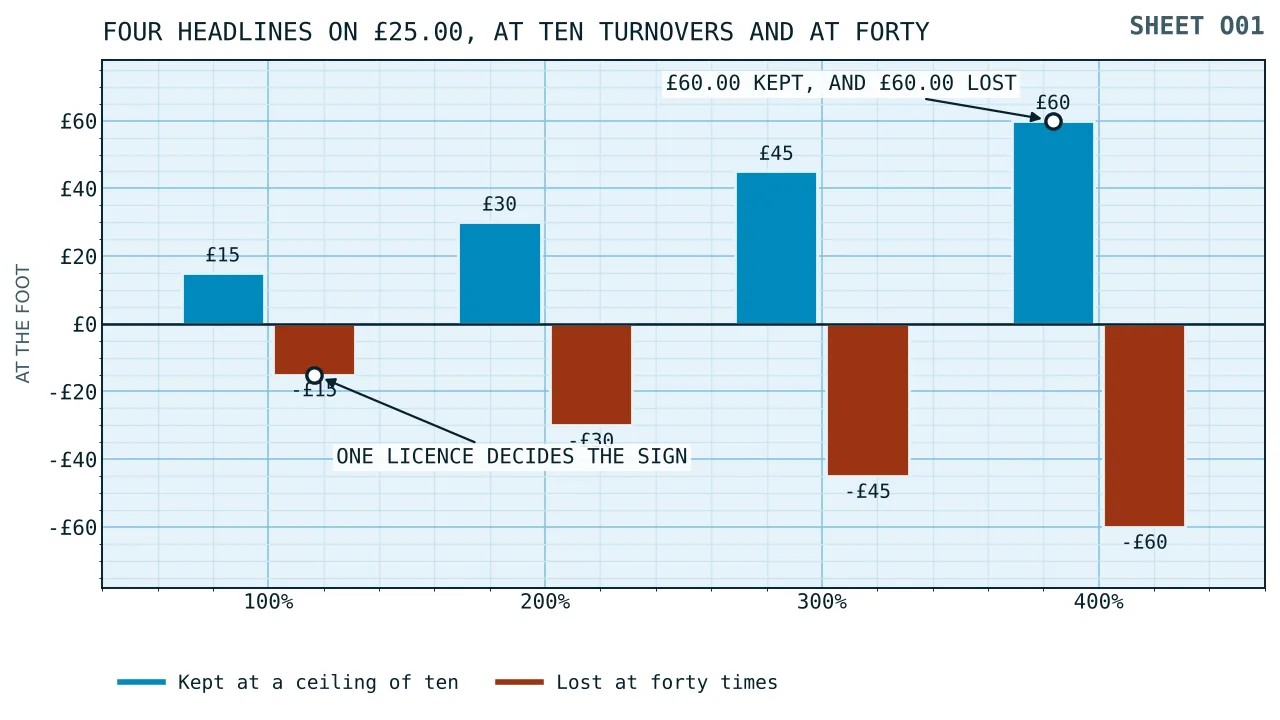
Which is the tidiest way to put what a ceiling does. Sixty pence of every pound of credit survives at the licensed maximum, which would have made four times the deposit worth £60.00 in expectation. At forty times, away from the register, that identical headline is a sixty pound hole instead. The licence decides the sign in front of the figure, and nothing else does.
4
Five absences, each with a figure
Weighing one offshore package against another is a comparison of the smaller terms. Here are the five larger ones, missing from all of them at once, with a price written against each on this deposit.
The ceiling on the multiple
Worth £30.00 on a fifty pound credit, which is the whole of part 2, and worth £1,500.00 of staking not owed and £60.00 of edge not paid alongside it.
The size of one cycle
A statutory instrument of 25 February 2025 fastens a per-cycle maximum to every remote casino licence, licences granted before it existed included, and it is a rule about online slots rather than about casino games at large. The ceiling reads £5.00 a cycle, falling to £2.00 below the age of twenty-five, which the regulator dates to 9 April 2025 and to 21 May 2025. So this deposit is five lawful cycles at the adult figure and twelve at the younger one. No maximum is put on a cycle anywhere in the Caribbean rulebook this sheet read, so a twenty-five pound deposit can be gone in one instruction.
The facility for a ceiling of the reader’s own
British technical standards oblige a gambling system to carry limit-setting facilities reachable at any point from registration onwards, by direct link from the home page and from the deposit screens, with the number of clicks held down. Choosing a limit has to be the default, declining one has to be a positive act by the customer, and that declining has to be confirmed before deposit or play carries on. A day, a week and a month have to be among the periods on offer. Reductions bind at once. An increase waits twenty-four hours at minimum and then wants a fresh act of confirmation. The regulator’s own worked overlap is the useful part: £10.00 a day set beside £100.00 a week yields a weekly maximum of £70.00, because the tighter figure always governs.
The right to take a balance out
Great Britain prohibits the clause outright: a maximum limit on what a consumer may withdraw from a deposit balance may not be imposed, used, enforced or relied upon by a licensee, and the ban reaches the effect of a term as well as its object. Nor may a licensee offer a customer the chance to cancel a withdrawal after requesting it. Expected back from this deposit is £24.00, so a payout floor pitched anywhere above that converts into a demand for a win before the money moves.
A grievance that ends somewhere
The window for raising one runs six months at minimum, answering it is capped at eight weeks from arrival, and the final letter has to point onwards to a body the regulator has approved. The largest sum this page could ever put in dispute is £50.00 of credit, of which £30.00 was ever expected, and part 7 shows what that does to a grievance.
5
The scheme, and the line that bounds it
The scheme styles itself Gamstop, and its full name has read Gamstop Online since a refreshed identity arrived in November 2025. Most readers and most search phrases still use the older capitals. What it does is block a registered person’s access to accounts at gambling websites and apps, and it charges nothing for that.
One published rule fixes its edge, and that edge is the subject of this whole section. An online gambling company licensed in Great Britain has no choice about belonging to Gamstop Online, and that single rule is what draws the boundary.
The scheme is candid about where its help stops. Participating operators are inside what it can assist with; an organisation that has not joined is something it states it cannot help prevent access to. That sentence bounds the protection a registered person holds, and it is a statement of coverage rather than an opening.
On 16 July 2026 the scheme published its half-year count: 614,738 consumers registered, a rise of sixteen per cent since the turn of that year, and 12,236 sign-ups during May, which set a monthly record. Of those registrants, better than one in two chose five years, the longest single term available. A quarter took six months, the shortest, which rises to 38 per cent where the registrant is under twenty-five, a group whose registrations climbed 26 per cent year on year and which supplies close to one in three self-exclusions. Men made up better than seven in ten of the new sign-ups.
Two sourced points keep this honest in both directions. To run a gambling business without a licence from the Commission is to act illegally, and two consequences follow on the regulator’s own account: it may move against the operator, and the business may lose its payment facilities at the hands of major payment systems organisations, MasterCard being its published example. The statutory offence, though, is drafted about whoever provides the facilities and not about the customer. It carries imprisonment of up to fifty-one weeks, or a level five fine on the standard scale, or the pair of them, and Scotland reads the fifty-one weeks as six months. What a reader surrenders at a cashier of that sort is the schedule in part 6, not their liberty.
A warning notice dated 20 January 2025 is blunter about what such a place tends to be. Money laundering controls and social responsibility controls may both be inadequate there. Fraud, unfair practices and data privacy difficulties are the exposures named. It records too that unlicensed websites often go looking for vulnerable customers, among them those who took a self-exclusion through the scheme. A reader who reached this page because a registration is holding is in the very group the notice describes as a target.
6
Sixteen questions a licence answers
Every line below is a duty on the holder of a British licence. None of them binds a business without that licence, and none appears in the Caribbean rulebook opened for this build. The left column is the question; the right column is what a licence answers, priced on this deposit wherever a figure exists.
| What a reader may reasonably ask | What a British licence answers |
|---|---|
| Is anything holding the multiple down? | Ten times the bonus funds, so £30.00 stays and £1,500.00 of turnover is never owed |
| May one cycle be any size at all? | £5.00 a cycle, or £2.00 below twenty-five, making this deposit five lawful cycles or twelve |
| May software set the pace? | 2.5 seconds between slot cycles, so 250 of them occupy 625 seconds at the very fastest |
| Can the reels be told to hurry? | No slam stop, no quick spin and no turbo, and no automation either, which leaves 250 separate commitments |
| Will a nothing return look like a win? | Winning effects are barred where the return fails to exceed the stake, so 10p back on a 10p cycle is shown and nothing more |
| Can a loss be dressed as a near miss? | A losing outcome may not stand in for a different losing outcome |
| May two games run side by side? | Functionality that facilitates simultaneous play is not permitted |
| Can the rules change part way? | Mid-game, the rules, the payouts and the probabilities all have to stay put |
| Is the generator allowed to compensate? | Outcomes must be acceptably random, and a compensated game is prohibited |
| Is there a ceiling on what I withdraw? | No term may cap the deposit balance, by object or by effect |
| Can a payout request be talked back? | Cancelling a requested withdrawal may not be offered as an option |
| When is my identity settled? | Settled before the first cycle runs, and the rule takes in prize-free play and play paid for by a bonus |
| May £25.00 arrive on credit? | No, and not through a money service business either |
| Will anything invite me to set a ceiling? | A limit is the default choice, reductions bind at once, increases wait a day |
| Does anyone look at affordability? | Light-touch checks above £150.00 of net deposit a month, which is six payments of this size |
| Where does a grievance finish? | Eight weeks, then an approved independent body, with six months to raise it |
What replaces the first of those sixteen answers, where a cashier names the Caribbean licence, is two sentences about bonuses. Terms are to be put across clearly and transparently. Promotion must stop short of pushing play to excess. Nothing limits a multiple. Nothing confines an incentive to one product type. No cycle is capped and no cycle is paced.
That rulebook is not a blank, and a page pretending otherwise would be arguing rather than measuring. It requires self-exclusion. It requires cooling-off at twenty-four hours, seven days, one month and three months, each reachable by one click with no email and no approval, each effective at once, each selectable by product, and it forbids an operator from talking a player out of taking one. On deposit limits it runs tighter than Great Britain in one place: an increase there waits seven days against the British twenty-four hours, with reductions immediate under both. And it binds affiliates directly, by contract, audit and penalty, which the British regulator’s own advertising material does not attempt.
7
The clause no comparison shows you
The sharpest published fact about bonus terms is a fine. On 3 July 2025 an operator trading under a casino brand paid £170,000 over the bonus rules on its new casino promotions, which reserved a right, at its own discretion, to shut accounts or to forfeit winnings.
A discretionary term of that shape breached the condition under which a licensee must deal fairly and openly, was described by the regulator as lacking transparency and as capable of unfair outcomes for consumers, and brought with it an audit by an independent third party reaching the operator’s safer gambling controls and its controls against money laundering.
Two things follow for a reader comparing one package with another. A clause of that shape is the single item in a bonus schedule with a published enforcement outcome behind it, so it is the clause worth looking for. And the outcome was a fine on the operator rather than a term struck out, which this sheet will not overstate.
A forfeiture discretion is also the point at which the arithmetic of this page stops mattering. Thirty pounds of expectation at a ceiling of ten assumes the money is paid when it is asked for. Where a term lets an operator decline at its own discretion, the expected value of any credit is whatever the operator later decides it is, and no comparison between packages can see that in advance.
Which leads to the grievance, and to a figure. Fifty pounds is the largest sum ever in dispute here. At a ceiling of ten, £30.00 is the most that was ever expected from it. Those two numbers are what a complaints route has to be worth handling.
| What decides it | Under a British licence | Where no British licence is held |
|---|---|---|
| Window for raising it | Six months at minimum from the incident | Six months in the Caribbean policy, free of charge |
| Time to answer it | Eight weeks from arrival, escalation counted inside | Four weeks, and one further four |
| Who approves the last stage | The regulator, from a published list | Nobody: the operator may set the parameters |
| Minimum value to escalate | None permitted | Contemplated, and £50.00 is the ceiling here |
| Who decides the dispute itself | Not the regulator, which is not an ombudsman | Not the regulator there either |
The fourth row is the one that bites. Where a dispute process may be made to carry a minimum claim value, any floor above £50.00 removes this page’s largest possible grievance before it is heard, and any floor above £30.00 removes everything that was ever expected. The Caribbean regulator says all relevant circumstances get weighed when it judges whether a restriction of that sort is justified, and it names the admission of a self-excluded person as a case to be taken seriously however small the sum. That is the sentence a reader of this sheet should keep.
8
Twenty-four pounds, and the way back
Two questions are left for a reader holding twenty-five pounds at an offshore cashier. What happens when the money is asked for, and whether anybody taxes it.
Part 4 priced the British prohibition on capping a deposit balance. What the regulator reports finding where that prohibition does not reach is specific: payouts blocked, and withdrawal limits pitched so high as to be unattainable. The second is the quiet one, and on this deposit it can be computed before a penny moves. A balance of £25.00 expecting £24.00 back over one pass has to grow fourfold before a payout floor of £100.00 is cleared. Divide a published floor by the sum you mean to pay in and the quotient is the multiple your luck has to supply.
| Floor in the terms | Growth the balance needs |
|---|---|
| Twenty pounds | 0.8x, already cleared |
| Fifty pounds | 2x |
| One hundred pounds | 4x |
| Two hundred and fifty pounds | 10x |
A £100.00 payout floor asks a £25.00 balance to grow fourfold
The same material sets down serious data protection concerns, with identity theft and fraud among the exposures, and an absence of any recourse once things have gone wrong.
On the duty the position runs opposite to what a reader expects. Duty follows the player’s home rather than the operator’s licence, so a cashier with no British licence that takes this deposit is inside the scope of a British duty and outside every answer in part 6 at the same time. What is charged is a percentage of the provider’s profit on remote gaming played by somebody whose usual residence is British, and that percentage reads 40 for accounting periods from the first of April 2026. On the player’s side the revenue’s manual says that betting and gambling, of themselves, do not constitute trading, which is why winnings are not the income of a trade, and no page of government declares them untaxed in terms. Nothing here addresses anybody’s circumstances and none of it is tax advice.
9
When a registration is the reason
Some proportion of the people who search this phrase are registered with the scheme and have discovered that it works. This part is for them, it matters more than anything above it, and there is no way round anything in it.
Take the arithmetic first, because the arithmetic is the argument. Two hundred per cent on twenty-five pounds prices at £0.00 at forty times with £30.00 of overrun behind it. Four times the deposit prices at £0.00 with £60.00 of overrun. No arrangement of these figures leaves the offer worth a defeated registration, and the deposit would sit where no multiple has a ceiling, no cycle has a maximum, no balance has to be paid out on request, and no approved independent body is within reach. A superlative improves none of that, because the absences are identical whichever cashier is picked.
What is published, free, and does work:
- A telephone number. Ringing the National Gambling Helpline costs nothing. 0808 8020 133 is the number, GamCare answers it round the clock and every day in the year, and live chat and WhatsApp sit beside the telephone. Calls about a friend or a relative are taken on the same footing as calls about the caller, and the international form of the number is +44 8088 020 133. GamCare’s own footer gives a company limited by guarantee, England number 03297914, a charity in England at 1060005, and a Scottish registration of SC050547.
- Software that blocks. Gamban is blocking software. Its layered approach covers gambling websites and apps running into the tens of thousands, one licence installs it on every major device platform, and the download routes named are the Apple App Store and Google Play. A seven-day free trial is what its own pages advertise, and no British no-cost route appears there, so the no-cost British route comes from GamCare instead of from the software company.
- TalkBanStop, which joins the three. Talk is the helpline, Ban is the software, Stop is the national scheme, and GamCare publishes that the software costs nothing for anybody who rings the helpline or uses GamCare’s support and treatment. That page is a news item carrying the date 12 April 2021, and it puts no length on the free access, so none is stated here.
The scheme’s terms, last updated on 20 May 2026, carry two features of a live registration worth knowing. Ending one before its minimum period has run is not possible, and the terms say so in capitals. A deliberate deactivation runs through the contact centre with twenty-four hours of cooling off at minimum, the exclusion staying live throughout. Those are the mechanism working, and a six-month registration may be extended at its end by a further six months, by a year or by five years. Where this site writes about keeping control, the sheet is Staying in control.
Related sheets. A round of spins claimed with nothing deposited behind it, priced the same way, is at no deposit bonus away from the scheme. What an identity check is for, and what deferring it to the exit costs, is at no kyc casinos. Jurisdiction by jurisdiction, with what each regulator publishes and what it does not, is at non uk casinos. Where the stake assumption has to move, the figures stand at high roller online casinos, and a single-site operator makes an exclusion smaller rather than larger at independent casinos not on gamstop. This part of the tree is indexed at Off the register, and How a receipt is struck sets out the working behind every total on the site.
Questions
- What can a superlative actually be measured in here?
- Pounds and pence, which is why this sheet sets a scale before it weighs anything. Twenty-five pounds at a tenth of a pound a cycle is 250 cycles. A slot paying 96 per cent gives back £24.00 of average winnings over one complete pass of that sum, and £1.00 stays with the house. The licensing question touches none of those three figures. It touches everything built around them, because offers written against a key of this shape come from businesses holding no Great Britain licence, and such a licence is a schedule of specific duties rather than a mark of quality.
- What does the absent ceiling cost on a twenty-five pound deposit?
- Thirty pounds on a credit of £50.00, which is two hundred per cent of the deposit. Set W to ten, the ceiling a British licensee cannot pass: turnover owed is then £500.00, four per cent of it comes to £20.00, and the credit should bring £30.00 to the foot. Set W to forty instead and turnover owed climbs to £2,000.00, expected cost on it to £80.00, and because the credit is fifty pounds it runs out a quarter of the way along, leaving £30.00 of cost for the deposit behind it to carry. Beside the thirty pounds sit £1,500.00 of staking nobody has to do and £60.00 of edge nobody has to pay.
- Is a bigger percentage a better offer away from the register?
- Not at forty times, where the arithmetic reverses it. A ceiling binds the multiple and ignores the percentage. Raise the percentage and the credit rises, the turnover owed rising in the very same proportion, so the ratio between the two stands still. Beyond twenty-five times a pound of credit expects to cost more than its face. On £25.00 at forty times a flat match loses £15.00, twice the deposit loses £30.00, three times over loses £45.00 and four times over loses £60.00. Under a ceiling of ten those same headlines would have been worth £15.00, £30.00, £45.00 and £60.00 in expectation.
- Which five absences does a comparison leave out?
- The ceiling on a multiple, worth £30.00 here. The maximum size of one cycle, which reads £5.00 a cycle under a British licence and £2.00 below the age of twenty-five, making this deposit five lawful cycles or twelve. The facility for a ceiling of the reader’s own, where choosing a limit has to be the default, reductions bind at once and an increase waits twenty-four hours at minimum. The prohibition on capping withdrawals from a deposit balance. And a grievance that ends somewhere, answered inside eight weeks and then escalated to a body the regulator has approved.
- Why does the national scheme not reach a cashier like this?
- Because one published rule fixes its edge. An online gambling company licensed in Great Britain has no choice about belonging to Gamstop Online, and that single rule is what draws the boundary. The scheme is candid about where its help stops: participating operators are inside what it can assist with, and an organisation that has not joined is something it states it cannot help prevent access to. That sentence bounds the protection a registered person holds. A warning notice dated 20 January 2025 adds that unlicensed websites often go looking for vulnerable customers, among them those who took a self-exclusion through the scheme.
- Is playing at a site without a British licence an offence by me?
- The statutory offence is drafted about whoever provides the facilities and not about the customer. It carries imprisonment of up to fifty-one weeks, or a level five fine on the standard scale, or the pair of them, and Scotland reads the fifty-one weeks as six months. What a reader surrenders at a cashier of that sort is the schedule of sixteen answers this sheet sets out, not their liberty. To run a gambling business without a licence from the Commission is to act illegally, and the regulator may move against the operator, while the business may lose its payment facilities at the hands of major payment systems organisations.
- What is the clause a comparison cannot show me?
- A discretion to forfeit, and the sharpest published fact about bonus terms is a fine over one. On 3 July 2025 an operator trading under a casino brand paid £170,000 over the bonus rules on its new casino promotions, which reserved a right, at its own discretion, to shut accounts or to forfeit winnings. A discretionary term of that shape breached the condition under which a licensee must deal fairly and openly, was described by the regulator as lacking transparency and as capable of unfair outcomes for consumers, and brought with it an audit by an independent third party. The outcome was a fine on the operator rather than a term struck out, which this sheet will not overstate.
- Can a thirty pound grievance be escalated offshore?
- There is a route, and the clocks nearly agree. The British window for raising one runs six months at minimum, answering it is capped at eight weeks from arrival, and the final letter has to point onwards to a body the regulator has approved. The Caribbean policy gives six months free of charge and four weeks to answer it, with a single extension of four more weeks. The difference is who approves the last stage, because there the operator may set the parameters, a minimum claim value among them. Fifty pounds is the largest sum ever in dispute on this page and £30.00 the most ever expected, so a floor above either figure ends the matter before it is heard.
- What stops an offshore cashier keeping a twenty-five pound balance?
- Nothing that Great Britain prohibits reaches it. Under a licence a maximum limit on what a consumer may withdraw from a deposit balance may not be imposed, used, enforced or relied upon, and the ban reaches the effect of a term as well as its object. What the regulator reports finding instead is specific: payouts blocked, and withdrawal limits pitched so high as to be unattainable. A balance of £25.00 expecting £24.00 back over one pass has to grow fourfold before a payout floor of £100.00 is cleared, so divide a published floor by the sum you mean to pay in and the quotient is the multiple your luck has to supply.
- If a live registration is what brought me here, what works?
- Three published things, and not one of them costs a penny. Ringing the National Gambling Helpline costs nothing: 0808 8020 133 is the number, GamCare answers it round the clock and every day in the year, and live chat and WhatsApp sit beside the telephone. Gamban is blocking software, covering gambling websites and apps running into the tens of thousands, with one licence installing it on every major device platform. TalkBanStop joins the three, and GamCare publishes that the software costs nothing for anybody who rings the helpline or uses GamCare’s support and treatment. That page is a news item carrying the date 12 April 2021, and it puts no length on the free access, so none is stated here.