
Sheet P11 Revision 1 Checked 15 October 2026
New online slots
A £20.00 credit at ten turnovers lets the room keep 10.00p of every staked pound. At forty turnovers the allowance falls to 2.50p. This sheet works at 4.00p, which clears the first and fails the second.
4.00p of edge, against 10.00p allowed and 2.50p allowed
What the conditions leave
Every destination on this spike is bought advertising. The site takes a fee if a reader goes on to register, and no figure printed below moves because of it.
The Spin Sheet
Till receipt No 01
Betportal
Lowest multiple here
For every €1 of spin credit at face per €1
Credit
Debit
No Great Britain licence
Licensed in Anjouan, Comoros, run by BetPortal Gaming Ltd, with Excite Ultra Media Ltd, reference ALSI-202601040-FI2.
Terms read 15 October 2026
Open the offer at Betportal, opens in a new tabThe Spin Sheet
Till receipt No 02
WinBeast
Five staged matches
For every €1 of spin credit at face per €1
Credit
Debit
No Great Britain licence
Licensed in Curaçao, operator not named on the site.
Terms read 15 October 2026
Open the offer at WinBeast, opens in a new tabThe Spin Sheet
Till receipt No 03
EliteSpin
Longest spin window
For every £1 of spin credit at face per £1
Credit
Debit
No Great Britain licence
Licensed in Costa Rica, run by PrimeTier Limited.
Terms read 15 October 2026
Open the offer at EliteSpin, opens in a new tabThe Spin Sheet
Till receipt No 04
Crown Jewelz
Multiple unpublished
No total struck
Credit
Debit
No Great Britain licence
Licensed in Curaçao, number not verified, operator not named on the site.
Terms read 15 October 2026
Open the offer at Crown Jewelz, opens in a new tabThe figure at the foot of a receipt is this site's own arithmetic and nothing an operator has published: the credit, less the share a spin gives back at 96 per cent return to player, less what playing the wagering through costs at the same return. It describes the offer, not one reader's afternoon. Where the conditions price above the credit the receipt prints nothing rather than a negative sum, and where a figure the sum needs is unpublished it prints the condition in the operator's words instead.
Three words stand in the amount column where no figure can. Noted is a published condition that takes value away without leaving the sum a figure to take. Unpriced is a condition whose figure nobody has published, or a credit that is not a sum until a deposit of your own sets it. Own money is money of yours, which is never part of a total.
Not one of the operators printed above holds a Great Britain licence, so the duties that licence carries do not reach them. Every online gambling company licensed in Great Britain has to be part of Gamstop Online, and a reader who has shut themselves out through the scheme is therefore not shut out here. The ceiling of ten times the bonus funds on a wagering requirement, in force since 19 January 2026, is a condition of that licence and binds the companies that hold one. Where a dispute goes instead is a matter for the authority named on the receipt, and the Gambling Commission describes what a reader faces without a British licence as a lack of recourse if things go wrong. Nobody under 18 may hold an account at any of them.
Every term printed on a receipt is the operator's own, and each receipt carries the day it was read. The oldest of those readings is 15 October 2026. What binds a reader is the operator's own full terms, and not a line printed here.
1
What is actually new about a new game
A new game is new in one sense only that matters to this arithmetic: nobody has yet published anything about it that a reader could use. The artwork is new, the feature round is new, and neither of those appears anywhere in the expression this site works from.
What does appear is a return and a rate, and on a release neither has a history behind it. There is no published figure for what a game launched this month pays back, no published rate at which a cashier counts it towards a requirement, and no published table of rates for anything at all. A reader is therefore in the position this sheet is designed for: half the terms are blank, and the useful output is the figure at which the answer flips sign.
This page runs that calculation on the edge rather than on the return, which is the same inequality seen from the other end and much easier to carry in the head. An edge is what the room keeps out of each pound staked, and a requirement sets a ceiling on how large an edge it can afford to keep. Part 3 gives that ceiling in pence.
The credit is £20.00. Forty turnovers ride on it, the order of requirement a launch package tends to carry once the British register is not in the picture, with ten turnovers alongside as the furthest a licensee may go. The stake is ten pence a press, and an edge of four pence a pound is what the sheet assumes, labelled as such throughout.
What a release supplies, and what it withholds:
- Supplied by the cashier: a credit of £20.00, and forty turnovers on it.
- Supplied by the rulebook: 2.5 seconds between cycles, a £5.00 ceiling on a cycle, and the bars on automatic play and on hurrying a result.
- Withheld: the return, which the disclosure standard does not compel as a percentage.
- Withheld: the rate, which no published source records for any game, new or old.
2
Twenty pounds on a release with no history
Four letters, and a release that opened this week supplies two of them with nothing at all.
E = B × (1 – (W × (1 – RTP)) / g)
£800.00 is what forty turnovers of B come to, B being £20.00, with g the rate a launch list gives the game and RTP the digit nobody has published. W is that forty, and E is the figure at the foot in pounds and pence.
Run it at the house edge with a pound counting in full and the shape is familiar. Forty lots of £20.00 make £800.00 of staking owed, priced at £32.00 where the room keeps four pence, so the price exceeds the credit by £12.00 and the sheet closes at £0.00. Ten turnovers want £200.00 of staking at a price of £8.00, and £12.00 is expected to come through.
The clock is the one quantity a release cannot alter, because the interval is set by rule rather than by design. £800.00 at ten pence a press is 8,000 presses, and 8,000 cycles spaced two and a half seconds apart run to 20,000 seconds, five hours and thirty-three minutes and twenty more. A new game cannot be built faster than an old one.
So the launch offer behaves exactly like any other offer in this section until the two blank terms are filled in. Everything interesting about a release is in how those blanks get filled, and whether anything compels them to be filled at all.
3
The edge a new room is allowed to keep
Turn the condition round and it prices an edge rather than a return. What a room may keep out of each staked pound is the rate divided by the multiple, and in pence that is a figure a reader can hold in mind.
Edge allowed = 100 × g ÷ W, in pence
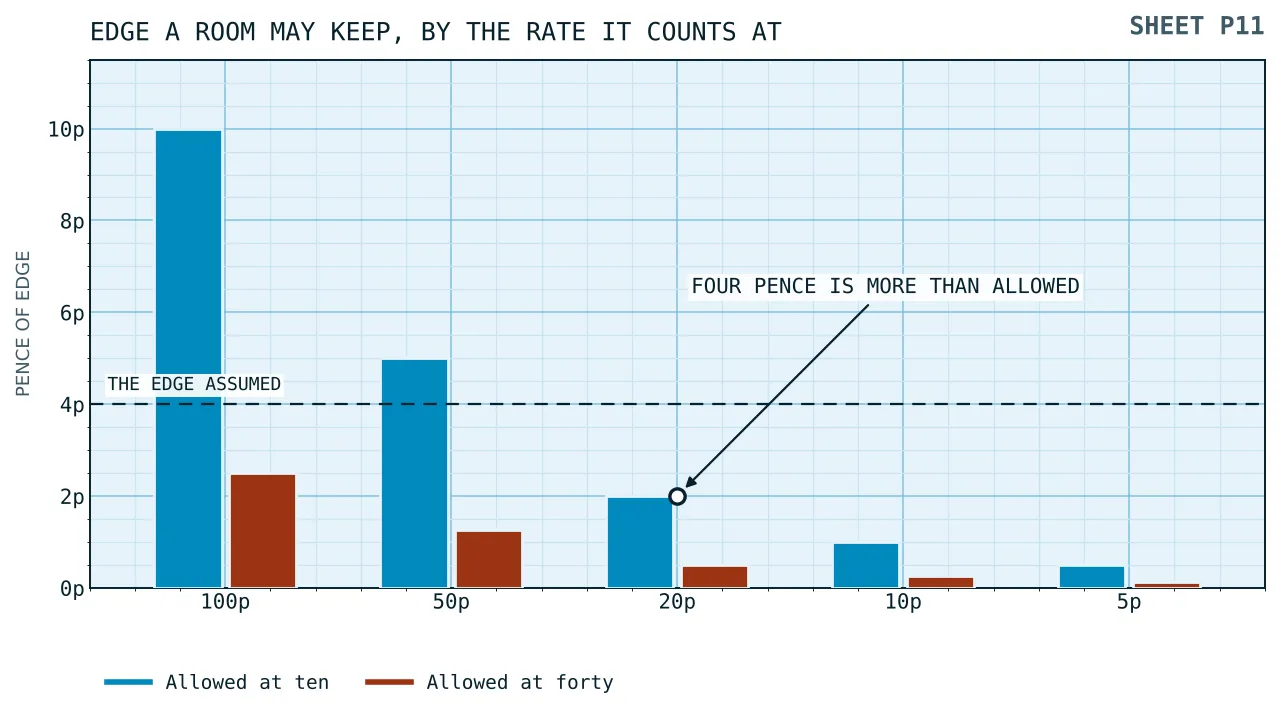
At a pound counted in full and ten turnovers a room may keep ten pence of each pound, and this sheet assumes four, so the credit lives. At forty turnovers the allowance drops to two and a half pence, and four pence is more than that, so the credit dies whatever the release turns out to pay.
That is the whole test, and it is read by comparing one column against one invariant.
| What the launch list counts | Allowed at ten | Allowed at forty | Assumed here | E at ten |
|---|---|---|---|---|
| Every pound counted | 10.00p | 2.50p | 4.00p | £12.00 |
| Half counted | 5.00p | 1.25p | 4.00p | £4.00 |
| A fifth counted | 2.00p | 0.50p | 4.00p | -£20.00 |
| A tenth counted | 1.00p | 0.25p | 4.00p | -£60.00 |
| A twentieth counted | 0.50p | 0.125p | 4.00p | -£140.00 |
The fourth column holds still at 4.00p all the way down, and the reading is then arithmetic. Four pence comes in under the ten pence allowed on the first row and under the five pence allowed on the second, which is why those two rows close above nought. From the third row down it exceeds the allowance, and the closing line goes from minus £20.00 to minus £140.00.
Nothing in the third column is reachable at all. Two and a half pence, a penny and a quarter, half a penny, a quarter of a penny, an eighth of a penny: a reel-based game keeping an eighth of a penny in the pound would be returning 99.875 per cent, and no published source describes anything of the sort. That is the honest summary of a launch offer asking forty turnovers. The release does not have to be bad. It has to be arithmetically impossible.
2.50p allowed at forty turnovers, 4.00p assumed
4
Five rates against one assumed edge
The same five rates priced in pounds, with the staking and the clock beside them, because a launch offer with a short window is as likely to fail on time as on money.
| What the launch list counts | Owed | Staking at forty | Presses at 10p | Clock | E at forty |
|---|---|---|---|---|---|
| Every pound counted | £800.00 | £800.00 | 8,000 | 5h 33m 20s | -£12.00 |
| Half counted | £800.00 | £1,600.00 | 16,000 | 11h 6m 40s | -£44.00 |
| A fifth counted | £800.00 | £4,000.00 | 40,000 | 27h 46m 40s | -£140.00 |
| A tenth counted | £800.00 | £8,000.00 | 80,000 | 55h 33m 20s | -£300.00 |
| A twentieth counted | £800.00 | £16,000.00 | 160,000 | 111h 6m 40s | -£620.00 |
What is owed sits in the second column and never alters, which is the fact every one of these sheets turns on. Contribution of £800.00 is what forty turnovers of a twenty pound credit demand, whatever rate a launch list happens to carry. The rate decides the staking, the staking decides the clock, and the clock on the bottom row runs to a hundred and eleven hours.
Raising the stake is the only lever available, and statute bounds it on reels. The £8,000.00 on the fourth row is 1,600 presses of five pounds instead of 80,000 of ten pence, which is one hour six minutes forty seconds instead of fifty-five hours thirty-three minutes twenty seconds. A player under 25 is held to two pounds and so to 4,000 presses, or two hours forty-six minutes forty seconds. On every one of those routes the expected price is £320.00 on every one of those routes, because the edge takes four pence out of the pound however the presses are sized.
A launch window matters here in a way it does not on an open-ended credit. Where a package has to be cleared inside a fixed period, the clock column is the binding constraint rather than the closing line, and a rate of a tenth turns a twenty pound credit into an obligation no ordinary week accommodates.
5
What a release owes a reader on day one
A new game arrives under exactly the same disclosure duty as a game five years old, and the duty is weaker than most readers assume.
Before anybody commits to gamble, whatever would let a customer judge the chance of winning has to be within easy reach, and the standard then sets out what that has to include, with its items joined by or. The chance of a winning event is one. The margin, or house edge, is another. The return to player percentage is a third. An account of the way the game works, together with how winners are settled and prizes allocated, is the fourth. Any single one of them discharges the duty, and where the percentage is the item chosen the guidance asks for the theoretical average.
So a release that prints a margin and no percentage has complied in full. For this sheet’s purposes a margin is in fact the more useful of the two, since part 3 is written in pence of edge and a margin is an edge. A reader who finds one can read the answer straight off the table instead of subtracting from a hundred.
Three neighbouring requirements come with it. The rules in force have to be reachable beforehand, have to be accurate, have to cover every one of them, and have to be put in terms a customer can follow, so far as reasonable steps go. As the game proceeds, enough has to be on screen for the customer to know where it stands. And prizes and payouts, or how they get worked out, have to be reachable before the commitment is made. The standard has four parts and stops there.
None of which is affected by a game’s age. What is affected by a game’s age is the amount of informal information in circulation about it, and a sheet built on primary sources cannot use any of that. The gap on a release is therefore identical in kind to the gap on an old game and merely more complete.
6
The rule that stops a game changing under you
One requirement matters more on a release than on anything else in this section, because a release is where a change is most likely.
Rules, payouts and the probabilities of an outcome are all frozen once a game is in play, and wording that reserves a right to change the rules at any moment is called out as unacceptable. A change belongs to a game that has been suspended or taken down, the customer has to be told, and a bonus round described properly to the player counts as a permitted change.
Alongside it sit the requirements that make any published figure mean something over a long run. Acceptable randomness is required of results and a compensated game is not permitted, read as barring any intervention, by hand or automatic, that would move the probabilities, with outcomes required to follow the theoretical figures. Random numbers go in the order they arrive and none may be discarded to achieve adaptive behaviour.
Then the pacing and presentation rules, which apply to a release from its first day. On a reel-based game two and a half seconds must stand between successive cycles, and the control has to be let go of and depressed afresh. No system may undertake a cycle on the player’s behalf, across gaming and bingo alike. Nobody may be given a way to bring a result forward, which keeps turbo, quick spin and slam stop out. No pair of casino games may be run together. A return equal to the total staked, or smaller, draws nothing win-related in sound and nothing win-related in motion. And any design apt to leave a customer mistaken about the chance of a result is prohibited, the two instances named being a near miss standing where an ordinary loss belonged, and a simulated device run on probabilities the real one does not have.
The standard that carries the paced cycle was itself last revised on 12 January 2026, its change note recording that the wording of one requirement now speaks of games where it had spoken of slot games. Which is worth a sentence on a page about new things: the rulebook is not fixed either, and a sheet citing it has to say which version it read.
8,000 presses, 20,000 seconds, none of them hurried
7
Ten turnovers on a launch offer
Two provisions govern the credit rather than the game, and both have applied since 19 January 2026.
The ceiling on the multiple stands at ten turnovers of bonus funds, the one regulated figure in this page’s arithmetic. The regulator published what it was correcting at the same time, recording that requirements as steep as sixty times had been applied by some licensees. Nothing has been published on whether a spin handed over free is bonus funds for the purpose, and this sheet fills the gap in neither direction, beyond noting that spin winnings landing as bonus funds are inside the limit.
One incentive may carry one type of gambling product, the four being bingo, betting, lottery and casino. A new reel-based game is a casino product, as is a cash match, so a launch package combining them stays within one type; add bingo tickets and it does not. Three carve-outs apply. An incentive may hold a pair of products belonging to one type, the example given being a raffle with a scratchcard. Offers for two products may travel in one email where consent reaches each. And a credit spendable at the holder’s discretion lies outside the ban.
Neither provision reaches the rate, and on a launch offer that gap is at its widest, because a new game’s rate is the term with the least public history of all. The ceiling addresses the multiple and bonus funds; weighting went before the consultation that produced the ceiling, was noted, and was left as it stood. A cashier asking ten turnovers may comply to the letter and still put the new game at a fifth, which on this credit reads minus £20.00 with an effective multiple of fifty.
The terms themselves are held to a standard. The incentive provision reaches any licensee holding out an advantage to anybody, and wants conditions clear and fair and transparent, within easy reach of whoever is offered the thing. On a launch package the conditions most likely to be missed are the window and the rate, and the advertising position is that a condition shown too faintly makes the advertisement misleading.
8
Reading a release before the credit lands
Five readings, and the fifth is the only one that needs the game itself.
| The reading | On this launch credit |
|---|---|
| Credit, and the window it runs in | £20.00 |
| The multiple, as the terms state it | 40x |
| The rate the launch list gives it | decides it |
| Edge allowed, rate over multiple | 2.50p at 1.00 |
| Edge the game discloses | 4.00p assumed |
Work the fourth line before looking for the fifth, because the fourth needs nothing the offer withholds. Divide the rate by the multiple and read the answer in pence. Anything under about two pence is below what a reel-based game has ever been described as returning, and a credit asking for that has closed before it opened.
The fifth line means opening the game and reading what it says about itself. A margin goes straight into the table. A return percentage subtracts from a hundred to give one. A probability of winning events or a plain account of the mechanics satisfies the licensee’s duty without giving a reader anything the arithmetic can use, and where that is all there is, the fourth line has to carry the decision on its own.
Three cautions. Every total here is an average taken over a long run of such credits, and twenty pounds most often comes to nothing whatever. A condition with no home in that expression can close the answer down while the rate, the return and the multiple hold still: a ceiling over bonus winnings, or a discretion the operator reserved. On the latter there is a fine of £170,000 on the public record, dated 3 July 2025, levied over bonus rules that kept a right to close accounts or withhold winnings. And a launch rate is the most perishable figure on this page: a game moved from one band of a list to another has changed the answer without a word of the offer altering.
Had the release been licensed here it would have had to hold two and a half seconds between cycles, cap a cycle at five pounds, refuse turbo and refuse automatic play. It would have had to leave a return no better than the stake unannounced, and keep a near miss out of the place where an ordinary loss belonged. It would have had to distribute its outcomes as the theoretical figures say, and leave its own rules alone while anybody was playing. It would have had to stop the multiple at ten turnovers, and to establish an identity before the first press. And it would have had to belong to the national self-exclusion scheme. A release that opens behind no Great Britain licence has had to do none of it, and the island rulebook consulted for this build supplies no substitute: no wagering ceiling, no stake ceiling, no minimum interval between cycles, and not one word on the rate a game counts at.
Enforcement is working and is not finishing the job, and the regulator says both. Traffic data across 160 websites targeted for enforcement came back 32 per cent down. Given the scale of the revenue involved, the regulator’s own expectation is that the ecosystem will never be wholly dismantled, and it puts no revenue figure to the illegal market at all.
Other rooms, same arithmetic: online slots UK measures a reel room in pence a second, pragmatic slots takes a credit confined to one studio’s output, and new casino sites asks the same question about a cashier rather than a game. The room holds the whole set.
Questions
- Are new slots better or worse for clearing a bonus?
- Neither, on the arithmetic. A release carries the same two unknown terms as any other game, a return and a rate, and the same requirement sits on top of them. On £20.00 at forty turnovers the staking owed is £800.00, priced at £32.00 where the room keeps four pence, so the sheet closes at £0.00. Ten turnovers leave £12.00 expected.
- What edge is a new game allowed to keep?
- The rate divided by the multiple, read in pence. At a pound counted in full and ten turnovers that is 10.00p of each staked pound, and this sheet assumes 4.00p, so the credit lives. At forty turnovers the allowance is 2.50p, which 4.00p exceeds, so the credit dies whatever the release turns out to pay.
- Why work in pence of edge rather than per cent of return?
- Because it makes one comparison out of two. A margin disclosed by a game is already an edge and goes straight into the table, and a requirement sets a ceiling on the edge a room can afford. At a fifth of a pound and ten turnovers the allowance is 2.00p; at a tenth it is 1.00p; at a twentieth 0.50p. Four pence exceeds all three, and the closing lines are minus £20.00, minus £60.00 and minus £140.00.
- Does a new slot have to publish its return to player?
- No, and its age makes no difference. The disclosure standard lists four items joined by or: the chance of a winning event, the margin or house edge, the return to player percentage, and an account of how the game works with how winners and prizes are settled. Any one of them discharges the duty, and where the percentage is chosen the guidance asks for the theoretical average.
- Can a new game be changed after it launches?
- Not while it is in play. Rules, payouts and outcome probabilities are frozen once a game is running, and wording reserving a right to change the rules at any moment is called out as unacceptable. A change belongs to a game suspended or taken down, the customer has to be told, and a bonus round set out properly for the player is a permitted change.
- How long does a launch offer take to clear?
- Five hours thirty-three minutes twenty seconds, at ten pence a press, since £800.00 comes to 8,000 presses with two and a half seconds standing between successive cycles. At a fifth of a pound it becomes £4,000.00, 40,000 presses and twenty-seven hours forty-six minutes forty seconds. Where a package has a fixed window, the clock binds before the closing line does.
- Can bigger stakes beat a short launch window?
- Within the statutory ceiling, yes. Owed at a tenth of a pound, £8,000.00 is 1,600 presses of five pounds rather than 80,000 of ten pence, which is one hour six minutes forty seconds instead of fifty-five hours thirty-three minutes twenty seconds. A player under 25 is held to two pounds and so to 4,000 presses. The expected price is £320.00 on every route, because the edge takes four pence out of the pound however the presses are sized.
- Does the ten turnover ceiling help on a launch offer?
- Only where the rate is high enough, and a new game’s rate has the least public history of any term here. The ceiling addresses the multiple and bonus funds; weighting went before the consultation that produced it, was noted, and was left as it stood. Ten turnovers asked, complied with exactly, and the new game set at a fifth gives minus £20.00 and an effective multiple of fifty.
- What would a release have had to do under a British licence?
- Hold two and a half seconds between cycles, cap a cycle at five pounds, refuse turbo and refuse automatic play, leave a return no better than the stake unannounced, keep a near miss out of the place where an ordinary loss belonged, distribute its outcomes as the theoretical figures say, leave its own rules alone during play, stop the multiple at ten turnovers, establish an identity before the first press, and belong to the national self-exclusion scheme. A release behind no Great Britain licence has had to do none of it.
- Is the offshore market shrinking?
- Partly, on the regulator’s own figures, and not enough to rely on. Traffic data across 160 websites targeted for enforcement came back 32 per cent down. Given the scale of the revenue involved, its own expectation is that the ecosystem will never be wholly dismantled, and it puts no revenue figure to the illegal market at all.