
Sheet O08 Revision 1 Checked 15 October 2026
Non gamstop paypal casinos
Sending £20.00 down a wallet costs nothing, and the nothing is the trap. A full match on it is worth £12.00 under a ceiling of ten and worth nought at forty times, while the £2.00 the wallet wants for sending a balance home is a sixth of that twelve. Twenty-two and a half times is where the charge eats the offer whole.
Nothing to arrive, £2.00 to leave, and £12.00 at the very best to carry
What a round trip costs away from the register
Every destination on this spike is bought advertising. The site takes a fee if a reader goes on to register, and no figure printed below moves because of it.
The Spin Sheet
Till receipt No 01
Betportal
Lowest multiple here
For every €1 of spin credit at face per €1
Credit
Debit
No Great Britain licence
Licensed in Anjouan, Comoros, run by BetPortal Gaming Ltd, with Excite Ultra Media Ltd, reference ALSI-202601040-FI2.
Terms read 15 October 2026
Open the offer at Betportal, opens in a new tabThe Spin Sheet
Till receipt No 02
WinBeast
Five staged matches
For every €1 of spin credit at face per €1
Credit
Debit
No Great Britain licence
Licensed in Curaçao, operator not named on the site.
Terms read 15 October 2026
Open the offer at WinBeast, opens in a new tabThe Spin Sheet
Till receipt No 03
EliteSpin
Longest spin window
For every £1 of spin credit at face per £1
Credit
Debit
No Great Britain licence
Licensed in Costa Rica, run by PrimeTier Limited.
Terms read 15 October 2026
Open the offer at EliteSpin, opens in a new tabThe Spin Sheet
Till receipt No 04
Crown Jewelz
Multiple unpublished
No total struck
Credit
Debit
No Great Britain licence
Licensed in Curaçao, number not verified, operator not named on the site.
Terms read 15 October 2026
Open the offer at Crown Jewelz, opens in a new tabThe figure at the foot of a receipt is this site's own arithmetic and nothing an operator has published: the credit, less the share a spin gives back at 96 per cent return to player, less what playing the wagering through costs at the same return. It describes the offer, not one reader's afternoon. Where the conditions price above the credit the receipt prints nothing rather than a negative sum, and where a figure the sum needs is unpublished it prints the condition in the operator's words instead.
Three words stand in the amount column where no figure can. Noted is a published condition that takes value away without leaving the sum a figure to take. Unpriced is a condition whose figure nobody has published, or a credit that is not a sum until a deposit of your own sets it. Own money is money of yours, which is never part of a total.
Not one of the operators printed above holds a Great Britain licence, so the duties that licence carries do not reach them. Every online gambling company licensed in Great Britain has to be part of Gamstop Online, and a reader who has shut themselves out through the scheme is therefore not shut out here. The ceiling of ten times the bonus funds on a wagering requirement, in force since 19 January 2026, is a condition of that licence and binds the companies that hold one. Where a dispute goes instead is a matter for the authority named on the receipt, and the Gambling Commission describes what a reader faces without a British licence as a lack of recourse if things go wrong. Nobody under 18 may hold an account at any of them.
Every term printed on a receipt is the operator's own, and each receipt carries the day it was read. The oldest of those readings is 15 October 2026. What binds a reader is the operator's own full terms, and not a line printed here.
1
Twenty pounds in, and nothing taken
A wallet payment is the cleanest entrance on any cashier screen. £20.00 leaves the wallet and £20.00 appears in the balance, with nothing skimmed in between, which is why a reader pricing only the outward leg of the trip finds this rail free and stops looking.
The debit is struck before any credit gets counted, and on this rail it is struck at the other end. A wallet that carried money in is where money comes back to, and a balance resting in a wallet has one more move to make, at a price, before anybody would call it cash. So the sum worth pricing is a round trip, and a flat charge at the far end of one does not shrink because the trip was cheap.
Nothing on the entry leg explains why a wallet belongs in a section about the absent licence. What does is the far end of it: every offer answering to this key sits behind a cashier with no Great Britain licence, and a wallet’s own rulebook governs the wallet and stops there. Parts 6 to 8 take that apart. Parts 2 to 5 do the arithmetic first.
Four figures carry this sheet, and not one of them is a sourced fact:
- Nothing to send £20.00 in, so the credited figure is the figure that left.
- A flat £2.00 to move a balance out of the wallet and into a bank account.
- A match at a hundred per cent, so the credit comes to £20.00 of credit.
- Forty times over that credit, being the sort of condition drafted beyond the reach of a British register, with ten times alongside as the ceiling a licence would have fixed.
Nobody this site may cite publishes a wallet’s tariff, and a tariff of that kind is rewritten whenever its owner feels like it, so the two pound figure is a shape and not a fact. The shape is what counts. A fixed sum and a percentage behave differently, and parts 3 and 5 are about nothing else.
2
Two gates, neither of them the cashier’s
One gatekeeper stands behind a debit card, which is the bank that issued the card. Behind a wallet stand two, the account funding it and the wallet itself, and both hold opinions about gambling which either is free to revise without warning anybody.
Neither party’s terms get quoted here, for the reason a tariff does not get quoted either. Both documents are their owners’ property, both are revised at their owners’ convenience, and the material behind this site carries no record of what either says. Pricing the consequence is what remains available, and the consequence comes out identical whichever of the two is doing the declining.
And a reader should know what the two gates do to reliability. Where a cashier returns winnings only down the route the deposit came in by, the wallet turns from the way in into the only way out, which sets entrance and exit on one point of failure. Two gates in series are less reliable than either gate alone, not more, and part 8 prices what happens when the exit is the one that fails.
One thing is worth saying flatly and then leaving alone. A bar a reader has asked their bank or their wallet provider to put on gambling payments is a protection of exactly the same kind as a registration with the national scheme. Nothing on this sheet addresses how such a bar behaves or what to do about one. The numbers in part 6 are what this page has to offer anybody for whom that question is live.
3
Two pounds out, a sixth of twelve
Two pounds against a twenty pound deposit is ten per cent, which sounds survivable. Two pounds is not charged against the deposit, though. It is charged against whatever is being fetched home, and what is being fetched home on this rail is small.
Part 4 shows that £20.00 of credit is expected to leave £12.00 at the most generous condition a British licence ever allowed. Two pounds on twelve is 16.7 per cent. The rate a reader actually pays is decided by the size of the withdrawal and not by the size of the deposit, and no choice the cashier makes touches it.
So a smallest sensible withdrawal exists, and these charges put a figure on it. At £20.00 the flat sum is taking a tenth. At £10.00 it is taking a fifth. At £4.00 it is taking half, and at £2.00 it is taking everything, so a withdrawal of that size arrives as nothing whatever. A cashier will process it regardless.
A £2.00 charge is 10 per cent of £20.00 and 100 per cent of £2.00
4
The line, and twenty-two and a half times
Charges have no place in the expression that converts a credit into an expected sum, which is why pricing a rail on charges alone goes wrong. The whole of it sits in four letters.
E = B × (1 – (W × (1 – RTP)) / g)
Twenty pounds is what B comes to where the match pays in full, and the other three letters are already settled: the return reads 0.96, the weighting reads one, and that leaves the multiple as the only term the terms themselves get to choose.
Choose forty, which is what gets chosen away from the British register. £800.00 of staking is owed. Four pence in each pound of that comes to £32.00 of expected cost against £20.00 of credit, so the credit goes first, the foot reads nought, and the deposit behind it carries the remaining £12.00.
| What the terms ask | Staking owed | Expected cost | Standing at the foot | In hand after the charge |
|---|---|---|---|---|
| Ten times, a licensee’s ceiling | £200.00 | £8.00 | £12.00 | £10.00 |
| Fifteen times | £300.00 | £12.00 | £8.00 | £6.00 |
| Twenty times | £400.00 | £16.00 | £4.00 | £2.00 |
| Twenty-two and a half times | £450.00 | £18.00 | £2.00 | £0.00 |
| Twenty-five times | £500.00 | £20.00 | £0.00 | £0.00 |
| Forty times, modelled here | £800.00 | £32.00 | £0.00 | £0.00 |
Run the sum backwards and the sharpest figure on the page falls out. Set the credit’s expected value against the two pounds the exit wants and the two balance at twenty-two and a half times. Under it, a reader is expected to finish the errand holding something. At it, the bonus has bought a single withdrawal charge. Above it, the charge outweighs the whole expected value of what it is attached to.
Twenty-two and a half times: where £20.00 of credit buys one exit charge
Which settles the entrance question in a direction nobody expects. The cheapest exit on the schedule is the exit nobody gets to use. Forty times leaves nothing expected to be worth collecting, so the fixed sum is never met, and a wallet and a bank transfer and everything else read one identical nought. Every charge on this page only bites where the multiple was gentle enough to leave something behind.
5
Twelve pounds fetched in pieces
A flat charge is paid once for each movement, so the number of movements decides the bill. That is arithmetic, not a rule, and it can be worked out before any money moves.
| How the twelve pounds comes home | Charged in all |
|---|---|
| In one movement | £2.00, a sixth |
| Two movements of £6.00 | £4.00, a third |
| Three movements of £4.00 | £6.00, a half |
| Six movements of £2.00 | £12.00, the whole win |
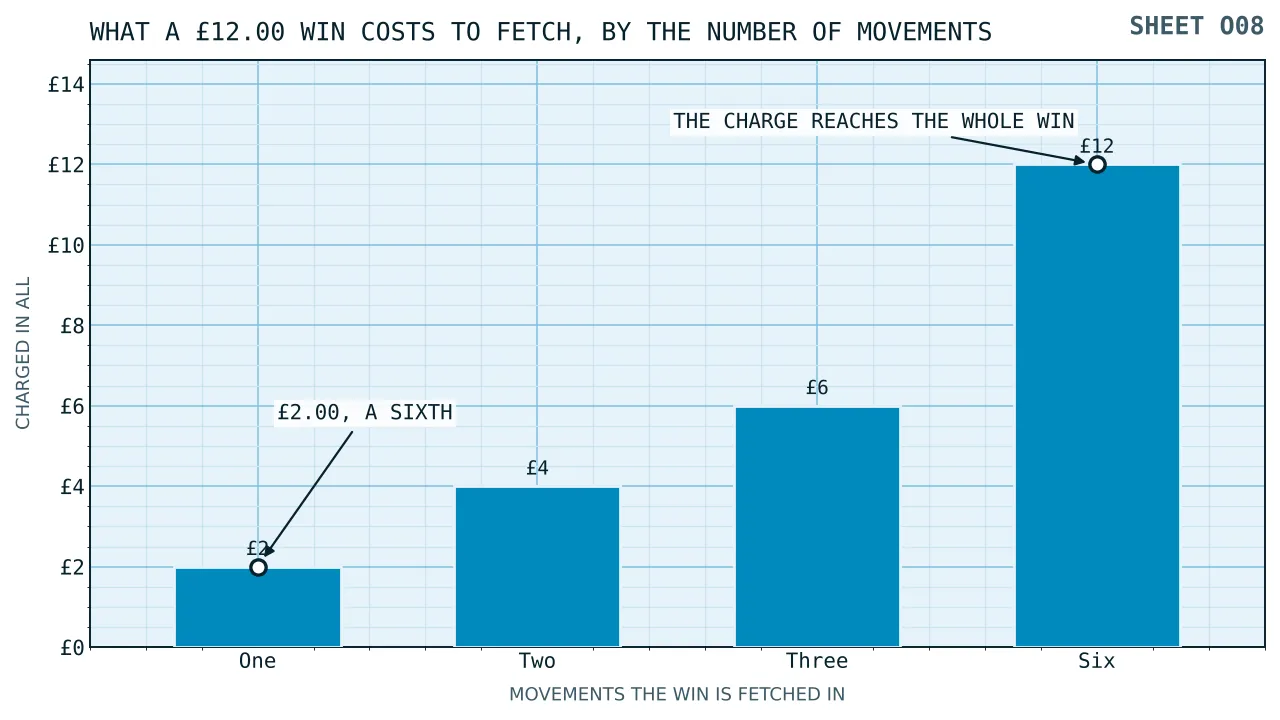
Six small movements and one large one carry identical sums of money and differ by £10.00. Nothing in the bonus terms mentions it, because it is not the cashier’s charge. It belongs to the rail, and it is the single easiest sum on this sheet for a reader to get wrong.
6
Why no wallet reaches the scheme
A wallet cannot reach the scheme, and the reason sits in the rule rather than in the wallet. Membership of Gamstop Online is not optional for a company licensed here to offer online gambling, which is why the licence draws that boundary and the scheme draws none. A payment method has no standing in the question at all.
The scheme says as much against its own interest: services offered by participating operators are what it can help exclude somebody from, and where an organisation stays outside it cannot help keep that person away. What a registered person is protected against is bounded by exactly that, and no route round it appears here. The regulator adds the part that matters most, in its warning notice of 20 January 2025: vulnerable customers are often what such sites go after, and a self-exclusion taken through the scheme is one of the things that marks a customer out.
Three things are published, cost nothing, and are not workarounds. The National Gambling Helpline belongs to GamCare, and 0808 8020 133 reaches it at any hour on any day, by phone, by live chat or over WhatsApp, with a caller free to be ringing about somebody else. Gamban is blocking software, and what it blocks runs to tens of thousands of gambling sites and applications under a single licence covering major platforms. GamCare, rather than the software company, publishes the free British route under the name TalkBanStop, pairing the helpline and the blocker with the national scheme. That page is a news article of 12 April 2021 naming no duration, so none is given here, and this site’s own page on all of it is Staying in control.
The arithmetic belongs in this section too, because it is the argument rather than the decoration. Twenty pounds matched in full and run at forty times is expected to leave £0.00, with £12.00 of cost beyond the credit and a flat charge waiting on anything that survives. There is no setting of those figures in which a wallet payment of this size repays defeating a registration.
7
Had the cashier held a licence
The missing thing is not a badge but a list, and the clearest way to show a list that is absent is in the conditional. Had the cashier at the far end of this wallet held a British licence, each of the following would have been imposed on it, and each is worth the figure beside it on a twenty pound deposit. Not a single item on it appears in the offshore rulebook that was read for this build.
| The duty it would have carried | What that is worth here |
|---|---|
| Ten times, and no multiple above it | £12.00 of expectation, with £600.00 of staking never owed |
| A single product type inside one incentive | Casino credit on this deposit could not share terms with bingo tickets |
| A stake ceiling of £5.00 on a slot cycle, £2.00 under twenty-five | The deposit buys four lawful cycles at that ceiling, ten for a younger player |
| A floor of 2.5 seconds under the pace of a slot | Two hundred cycles cannot be got through inside 500 seconds |
| Nothing automatic and nothing hurried | Two hundred separate decisions, taken one at a time |
| A return no bigger than its stake shown plainly | Ten pence returned on a 10p cycle gets displayed, with no celebration over it |
| No near miss fabricated out of a loss | One losing outcome may not stand in for another |
| Nothing capping what leaves a deposit balance | The deposit and its winnings payable at whatever hour the player picks |
| No invitation to call a withdrawal back | A payout once asked for cannot turn into a stake again |
| Identity settled ahead of the first cycle | A birth date, an address and a name, bonus and prize-free rounds included |
| A credit card refused as a route in | This deposit could not arrive on credit, nor through a money service business |
| A limit on deposits prompted for, and offered as the default | A figure typed in by the day, the week or the month, with cuts immediate |
| A light-touch check above a monthly figure | Eight payments of this size carry past the £150.00 mark |
| Eight weeks, and an approved dispute body after that | A way out of a disagreement which the regulator itself has signed off |
| The national self-exclusion scheme, joined by every licensee | One registration standing over every licensed account at once |
What stands in place of the first row, where a cashier names the Caribbean licence most common in this corner, is a pair of sentences on the subject of bonuses. Clarity and transparency in the terms is the first. The second asks that promotion stay mild enough not to encourage excessive play. Neither sentence holds a multiple down. No incentive is confined there to one kind of product, and no stake and no interval between cycles is touched at all.
That rulebook is not empty, and a page pretending so would be misleading the other way about. Deposit limits are required of a licensee there over daily, weekly and monthly periods, with a cut biting immediately where a rise has to wait seven days, six days beyond the British minimum. Cooling off has to bite immediately and to be reachable in one click, over a quarter of a year, a month, a week or a day, and the operator is forbidden to talk a player out of it. Affiliate compliance is made the operator’s responsibility there, enforced through penalties, audits and contracts that bind, where the British regulator’s advertising material says nothing of affiliates at all.
8
The exit every figure here assumes
Everything priced above is an exit charge, and an exit charge presupposes an exit. That presupposition is the largest unpriced item on the sheet.
A deposit balance comes with a prohibition fastened to it under a British licence, and the drafting runs four ways at once. A term whose object is a ceiling over withdrawals from that balance, or whose effect is one, may not be relied upon, nor enforced, nor used, nor imposed. Fifty pounds inside any day and five hundred inside any week is the regulator’s own specimen of a term of the forbidden kind. Winnings included, that balance comes out at whatever hour the player picks. The maximum carries no permitted restriction, and where a limit touches the size or the number of withdrawals, reasonableness is the test. A cancelled withdrawal is not something a licensee may offer either, once the request has gone in, and the guidance asks for the exit to carry as little friction as it can. No date appears on the page carrying that prohibition, so this sheet attaches none to it.
What the regulator reports finding instead is twofold: payouts stopped, and withdrawal thresholds pitched so far above reach that they cannot be met. The second converts into arithmetic, and on these figures it is brutal. Twelve pounds of expectation against a published floor of £25.00 needs the balance to double and then some before the floor stops being a refusal. Divide any published floor by the sum a reader expects to be withdrawing and the answer is the multiple their luck has to supply. That is a sum anybody can do in advance, and almost nobody does.
A payment that never completes is the one case this page prices at nothing in both columns. No credit arrives, so no condition attaches; no charge arrives either, since a flat sum at the exit is only ever levied on money that exists. At forty times the offer was worth £0.00 anyway, so the arithmetic of a payment that does not happen is a nought against a nought. This sheet has no more to say about it than that.
9
Five readings before the first twenty pounds
A round trip needs its return leg read before the outward leg is paid for. Five readings do that, and the last two are the ones nobody takes.
| What to read before paying | This page |
|---|---|
| Charged to send the deposit | £0.00 |
| Charged to bring a balance home | £2.00, flat |
| Multiple written into the terms | 40x modelled, 10x if licensed |
| Expected to survive the condition | £0.00, against £12.00 |
| Multiple at which the charge wins | 22.5x |
Set the last two rows side by side and the decision makes itself. Where the terms carry a multiple above the figure in the last row, collecting the offer is expected to cost more than the offer is worth, and no choice of payment method shifts that by a penny. Where it stands below, the choice of rail is worth something between nought and two pounds, which is real and is small against the twelve the multiple decides.
And the mean needs its usual caution. Twelve pounds is a mean over a great many identical attempts rather than a sum that gets handed over, and one pass at twenty pounds of credit most often ends on nothing, whichever wallet brought the deposit in. The two pounds is not an average at all, and it is charged only on money that has survived.
Three neighbouring sheets run the same round trip across different ground. A voucher, which no cashier can pay back to and which therefore needs a second rail at the exit, is priced at paysafe cashiers off the register. A charge to a mobile bill, which cannot be reversed at all, is at pay by phone off the register. The jurisdiction behind most of these cashiers is read line by line at Curaçao licensed sites, and the identity question a wallet raises at the exit is priced at no verification casinos. The section is indexed at Off the register, and this same wallet under a British licence is at paypal casino.
Questions
- Is there anything to pay to send a wallet deposit?
- On the charges modelled here, nothing, and the nothing is the trap. £20.00 leaves the wallet and £20.00 appears in the balance, with nothing skimmed in between, so a reader pricing only the outward leg finds the rail free and stops looking. The debit is struck at the other end instead: a flat £2.00 to move a balance out of the wallet and into a bank account.
- Why does a flat two pounds matter on a twenty pound deposit?
- Because it is charged against the withdrawal rather than against the deposit. Two pounds on £20.00 is ten per cent, but £20.00 of credit is expected to leave £12.00 at the most generous condition a British licence ever allowed, and two pounds on twelve is 16.7 per cent. At £10.00 the flat sum takes a fifth, at £4.00 it takes half, and at £2.00 it takes everything, so a withdrawal that size arrives as nothing.
- What is a full match on twenty pounds expected to leave?
- Ten is the furthest multiple open to a British licensee, and there £20.00 of credit owes £200.00 of staking, costing £8.00 at four pence in the pound, which leaves £12.00 expected. At the forty times terms carry away from the register, £800.00 of staking is owed and £32.00 is the expected cost, so the credit goes first, the foot reads nought, and the deposit behind it carries the remaining £12.00.
- At what multiple does the exit charge swallow the offer?
- Twenty-two and a half times. Put the expected value of £20.00 of credit equal to the two pounds the exit wants and that is where the two balance. Under it a reader is expected to finish holding something. At it the bonus has bought a single withdrawal charge. Above it the charge outweighs the whole expected value of what it is attached to.
- Does it cost more to withdraw winnings in instalments?
- Exactly, because a fixed sum falls once for every movement, which makes the number of movements the whole of the bill. Twelve pounds fetched in one movement costs £2.00, a sixth. Two movements of £6.00 cost £4.00, a third. Three of £4.00 cost £6.00, a half. Six of £2.00 cost £12.00, which is the whole win. Six small movements and one large one carry identical money and differ by £10.00.
- Why does a payment method not reach the national scheme?
- Because the rule is about licences and not about payments. Membership of Gamstop Online is not optional for a company licensed here to offer online gambling, which is why the licence draws that boundary and the scheme draws none. The scheme says as much against its own interest: services offered by participating operators are what it can help exclude somebody from, and where an organisation stays outside it cannot help keep that person away. A wallet has no standing in the question at all.
- What would a British licence have put behind this deposit?
- Fifteen duties, each of them carrying a date or a figure. Ten times as the furthest a play-through may reach, worth £12.00 of expectation here and £600.00 of staking never owed. One product type to an incentive. A stake ceiling of £5.00 on a slot cycle and £2.00 under twenty-five. A floor of 2.5 seconds under the pace. Nothing automatic and nothing hurried. Small returns shown plainly and near misses not fabricated. Nothing capping what leaves a deposit balance, and no invitation to call a withdrawal back. Identity settled ahead of the first cycle. No credit card as a route in. A deposit limit prompted for. A light-touch check above a monthly figure. Eight weeks and then an approved dispute body. And the national self-exclusion scheme.
- Is the offshore rulebook empty on all of that?
- No, and saying so would be misleading the other way about. Deposit limits are required there over daily, weekly and monthly periods, with a cut biting immediately where a rise has to wait seven days, six days beyond the British minimum. Cooling off has to bite immediately and to be reachable in one click, over a quarter of a year, a month, a week or a day, and the operator is forbidden to talk a player out of it. It reaches affiliates directly, by binding contract, compliance audit and penalty. What it does not do is hold a multiple down, cap a stake, or touch the interval between cycles.
- Can an offshore cashier simply refuse to pay the balance out?
- The British prohibition reaches nothing out here. Where a licence applies, a term whose object is a ceiling over withdrawals from that balance, or whose effect is one, may not be relied upon, nor enforced, nor used, nor imposed, and the regulator’s own specimen of the forbidden kind lets a week reach five hundred pounds and a day reach fifty. What it reports finding instead is twofold: payouts stopped, and withdrawal thresholds pitched so far above reach that they cannot be met. Twelve pounds of expectation against a floor of £25.00 needs the balance to double and then some.
- What does it cost if the payment never goes through?
- Nothing in either column, and that is the only clean nought on the sheet. No credit arrives, so no condition attaches, and no charge arrives either, because a flat sum at the exit is levied only on money that exists. At forty times the offer was worth £0.00 in any case. A bar a reader has asked their bank or their wallet provider to put on gambling payments is a protection of the same kind as a registration with the national scheme, and this sheet has nothing to say about how one behaves.
- Which rail is cheapest, then?
- The question is answered by the multiple rather than by the rail. At forty times nothing is expected to be worth fetching, so the flat charge is never met and every method reads the same nought, which makes the cheapest exit the one that never happens. Below twenty-two and a half times the choice of rail is worth something between nought and two pounds on these assumptions, against the twelve pounds the multiple itself decides.