
Sheet D10 Revision 1 Checked 15 October 2026
Slots sign up bonus
Twenty-five pounds paid in, matched with £25.00 of reel credit, carries forty turnovers and so owes £1,000.00 of staking. Priced at 96 per cent that costs £40.00 against the £50.00 held, which leaves £10.00 of the payment standing.
10,000 pulls at 10p to discharge £1,000.00
What a reel welcome leaves
Every destination on this spike is bought advertising. The site takes a fee if a reader goes on to register, and no figure printed below moves because of it.
The Spin Sheet
Till receipt No 01
Betportal
Lowest multiple here
For every €1 of spin credit at face per €1
Credit
Debit
No Great Britain licence
Licensed in Anjouan, Comoros, run by BetPortal Gaming Ltd, with Excite Ultra Media Ltd, reference ALSI-202601040-FI2.
Terms read 15 October 2026
Open the offer at Betportal, opens in a new tabThe Spin Sheet
Till receipt No 02
WinBeast
Five staged matches
For every €1 of spin credit at face per €1
Credit
Debit
No Great Britain licence
Licensed in Curaçao, operator not named on the site.
Terms read 15 October 2026
Open the offer at WinBeast, opens in a new tabThe Spin Sheet
Till receipt No 03
EliteSpin
Longest spin window
For every £1 of spin credit at face per £1
Credit
Debit
No Great Britain licence
Licensed in Costa Rica, run by PrimeTier Limited.
Terms read 15 October 2026
Open the offer at EliteSpin, opens in a new tabThe Spin Sheet
Till receipt No 04
Crown Jewelz
Multiple unpublished
No total struck
Credit
Debit
No Great Britain licence
Licensed in Curaçao, number not verified, operator not named on the site.
Terms read 15 October 2026
Open the offer at Crown Jewelz, opens in a new tabThe figure at the foot of a receipt is this site's own arithmetic and nothing an operator has published: the credit, less the share a spin gives back at 96 per cent return to player, less what playing the wagering through costs at the same return. It describes the offer, not one reader's afternoon. Where the conditions price above the credit the receipt prints nothing rather than a negative sum, and where a figure the sum needs is unpublished it prints the condition in the operator's words instead.
Three words stand in the amount column where no figure can. Noted is a published condition that takes value away without leaving the sum a figure to take. Unpriced is a condition whose figure nobody has published, or a credit that is not a sum until a deposit of your own sets it. Own money is money of yours, which is never part of a total.
Not one of the operators printed above holds a Great Britain licence, so the duties that licence carries do not reach them. Every online gambling company licensed in Great Britain has to be part of Gamstop Online, and a reader who has shut themselves out through the scheme is therefore not shut out here. The ceiling of ten times the bonus funds on a wagering requirement, in force since 19 January 2026, is a condition of that licence and binds the companies that hold one. Where a dispute goes instead is a matter for the authority named on the receipt, and the Gambling Commission describes what a reader faces without a British licence as a lack of recourse if things go wrong. Nobody under 18 may hold an account at any of them.
Every term printed on a receipt is the operator's own, and each receipt carries the day it was read. The oldest of those readings is 15 October 2026. What binds a reader is the operator's own full terms, and not a line printed here.
1
Twenty-five in, twenty-five credited
Reels are where almost all of this money goes. In the year to March 2026 the remote casino, betting and bingo sector produced £8.3 billion of gross gambling yield, of which online casino games accounted for £5.7 billion and slots games alone for £4.8 billion, on figures the regulator published on 17 September 2026. A welcome offer aimed at reels is therefore the common case rather than a special one.
Take a payment of twenty-five pounds matched once over. The cashier credits £25.00, the balance reads £50.00, and half of that was in the reader’s own account an hour earlier. The two halves stay apart in every line below, because adding a payment to a bonus and calling the sum fifty pounds of value counts the reader’s wallet as part of the gift.
What distinguishes a reel welcome from any other match is not the arithmetic. It is that the thing the credit gets spent on carries two restrictions no other casino product carries: a stake ceiling fixed by statutory instrument, and a floor under the interval between spins. On top of those sit the wider rules: no software taking the spins, no speeding up the result, no celebrating a spin that gave back less than it took, and no dressing a loss up as a near miss. Parts 4 and 5 price that list. Out here none of it applies, and the arithmetic in part 3 is indifferent to the difference.
Five figures held still, with the reasons they can move:
- Twenty-five pounds paid in and matched at a hundred per cent.
- Forty turnovers of the credit, which is the order of magnitude this part of the market sets. Ten is the British ceiling.
- A theoretical return of 96 per cent. No rule obliges a licensee to publish such a figure at all, which part 6 works through.
- A stake of 10p a spin, this site’s working figure, since nothing in the rules fixes what a spin costs or what a free one is worth.
- Full contribution, and the requirement set against the credit rather than the payment.
2
£1,000.00, and three stakes that clear it
Forty turnovers of £25.00 is £1,000.00 that has to go through the reels. That figure is fixed by the multiple and the credit, and the stake has nothing to do with it. What the stake decides is how long the thousand pounds takes and how many separate decisions it consists of, and on a British reel game two of the three stakes below are not a matter of choice.
| Stake a spin | Spins needed | Floor on the time | In hours and minutes | Expected cost |
|---|---|---|---|---|
| 10p, this site’s figure | 10,000 | 25,000s | 6h 56m 40s | £40.00 |
| £2, the cap under 25 | 500 | 1,250s | 20m 50s | £40.00 |
| £5, the cap at 25 and over | 200 | 500s | 8m 20s | £40.00 |
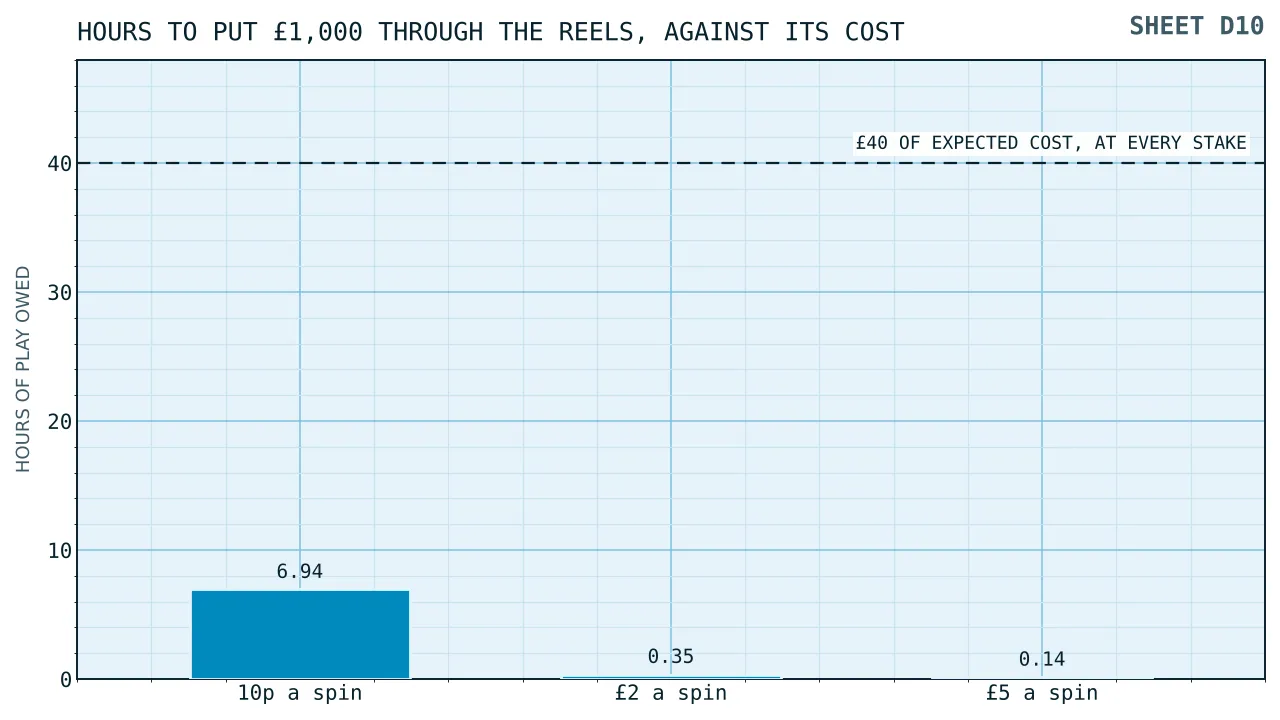
Expected cost is the figure to read in each row, and it does not move. Forty pounds is what the edge takes out of £1,000.00 of staking whether that staking is assembled from two hundred spins or ten thousand, because four pence in the pound is four pence in the pound. Raising the stake buys time back and buys nothing else.
Which is worth saying plainly, because the opposite belief is common. A bigger stake does not clear a requirement more cheaply. It clears the same requirement faster, with a wider spread of outcomes around the same expectation, and it brings the moment the balance empties a great deal closer.
The time floors come from the standard, not from the software. Between the start of a cycle and the earliest the next may be commenced, a British reel game owes 2.5 seconds, and 10,000 of those is the 25,000 seconds in the top row.
£40.00 of expected cost at every stake on that schedule
3
The expression on £25.00 of credit
One line of algebra settles every total on this site, and here is what it does to a matched twenty-five.
E = B × (1 – (W × (1 – RTP)) / g)
Term by term. The bonus at face is B, £25.00 of it. W is the number of turnovers the terms demand, forty here. RTP is the proportion a reel returns over the long run, 0.96, leaving the house four pence in each pound staked. g is the contribution weight, one on a slot counting in full. E is what the bonus comes to once its condition is satisfied.
£25.00 × 40 = £1,000.00 of staking
£1,000.00 × 0.04 = £40.00 of expected cost
E = £25.00 – £40.00 = -£15.00
So the condition costs fifteen pounds more than the bonus it is attached to. On an offer asking for no payment that excess would simply stop, there being nothing else in the account to take. Here the payment sits in that same balance and the staking takes from whatever it can reach: £50.00 held less £40.00 spent leaves £10.00.
Forty pence of every pound handed over, which makes this one of the better totals in its section and still a loss of £15.00 against leaving the offer alone. The ratio holds at any payment, because the credit and the obligation both scale with it: a fiver would leave two pounds, a hundred pounds would leave forty.
The multiple this shape of offer can bear is fifty. Each turnover of £25.00 costs a pound in expectation, the balance is £50.00, and fifty pounds divided by one is fifty. Forty turnovers is therefore ten short of the point where a matched payment is worth nothing at all, and a reader who finds a fifty on the document has found an offer with no expected value left in it.
£10.00 left of £25.00 paid in at forty turnovers
4
What the statute counts as a reel
The stake ceilings in part 2 are not licence conditions invented by a regulator. They come from a statutory instrument, and the definition it uses decides which games they touch.
25 February 2025 is the date the Regulations were made. Its new provision caps the total an individual may stake on any one game cycle: no more than £5 for anybody of twenty-five or over, and no more than £2 for anybody younger. The condition is attached to each remote casino licence, the ones granted before the Regulations arrived included, and six transitional weeks ran first with a flat £5 for everybody.
The dates need care, because the instrument and the guidance say different things. The instrument gives a formula rather than a calendar: six weeks after the day it was made. The regulator’s guidance supplies the calendar: the £5 limit from 9 April 2025, the £2 limit from 21 May 2025. Those two dates are the only published ones, and they are the guidance’s and not the instrument’s.
An online slots game, in the instrument’s words, is a casino game, reel-based, and played over the internet. Reel-based then gets a definition of its own: images or text made to move or change, shown by visual representations of reels or by some other method, with the arrangement they settle into deciding whether a prize or another advantage falls to the player.
That definition is why the ceilings stop where they do. Its guidance is explicit that the two figures are for online slots and touch no other casino game, roulette and blackjack being the examples it gives. A reel welcome is therefore one of the few bonus offers in Great Britain whose play is stake-capped by statute, and it is capped at a figure fifty times this sheet’s working stake.
Run that through the arithmetic and a British licence puts an interesting floor under the time. At the £5 ceiling, £1,000.00 of staking cannot be assembled from fewer than two hundred game cycles, and two hundred cycles at two and a half seconds each cannot be taken in under five hundred seconds. Out here, with no statutory ceiling on the stake, the same thousand pounds can be put through in forty cycles at £25 a spin, and the expected cost is still £40.00. What changes is the chance of surviving the variance long enough to see the condition discharged.
5
Features a British reel may not have
Seven design rules sit on a reel game inside Great Britain, and each one bars a feature a reader may meet on the offshore side. The absences priced in part 7 are the ones this sheet has checked the Curaçao rulebook against.
The pace, and who sets it
The 25,000 seconds in part 2 is not a property of the software. A cycle, on the guidance’s own account, runs from the player starting the game to the moment everything staked or won has been lost or handed over and the control is free again. The start control has to be released and pressed again, or something equivalent done, before another cycle may begin, and holding a finger on the screen must not start one. So 10,000 spins is 10,000 decisions, and the floor under the clock follows from that rather than from any throttle in the game.
Software that cannot take the spins
RTS 8A states the autoplay prohibition as a positive duty, requiring a commitment to each game cycle separately. Its guidance exempts a single thing, the blinds posted automatically at a poker table. On a licensed reel the 10,000 spins cannot be handed to software; out here they can, and the 25,000-second floor goes with them.
No shortening the wait
A British system may not hand a customer a means of bringing the result forward. The guidance lists turbo, quick spin and slam stop among the things that are not permitted, and the rule bites however fast the game runs natively. Two carve-outs are worth knowing: a bonus round where no further stake goes in is outside it, and a reveal-all or scratch-all mechanic is not prohibited.
Silence on a losing spin
Where a return is no bigger than the total staked, the game may not celebrate it. Win-related noise and win-related animation are both out for such a result, and the guidance suggests three things a game may do in their place: display the total awarded, show the winning lines briefly, and play a short sound when the money is credited. A 50p stake returning 40p is a loss, and on a licensed reel it may not be made to sound like anything else. Across 10,000 spins the difference that makes to the arithmetic is nil, and the difference it makes to a player’s judgement is the whole reason the rule exists.
No near miss standing in for a loss
A game may not be built so that a customer is likely to come away wrong about how probable a result was. Two builds are named for it. In one, a near-miss loss is slipped in where an ordinary loss belonged. In the other, a real device is simulated without its real probabilities being simulated with it. The guidance reduces it to two clauses: no false display of a near miss, and no swapping of one losing outcome for another.
Probabilities that hold still
Acceptable randomness is required of a result, and a compensated game is forbidden, so interventions that shift the probabilities are shut out whether a hand or a program makes them. The order in which random numbers arrive is the order they must be used in, and throwing one away to get adaptive behaviour is barred. The rules, the payouts and the probabilities may not be changed during play either, and the guidance rejects one clause by name: a rule saying the rules can change whenever the operator likes.
One game at a time
Functionality easing simultaneous play is not to be offered, split-screen and multi-screen arrangements included. Since 17 January 2025 a British operator has also owed the customer a live reading of their net outlay and of the minutes they have put in, and operator-led ways of running several products at once went in the same set of changes.
6
The return you may never be shown
Every figure on this sheet after the thousand pounds rests on 96 per cent, so the standing of that number needs stating exactly.
What has to be easy to reach before a customer commits is whatever information would let them judge their own chances sensibly. What counts as that information is then given as a list of alternatives, and the alternatives are what matter. One item is the chance of the winning events coming up. One is the house edge, or the margin. One is the return to player figure, and the guidance adds that a percentage offered should be the average theoretical one. One is an account of how the game runs, how a winner is arrived at and how the prizes get shared out.
Any single item discharges the duty, which is why nobody should write that a licensed reel must display a return percentage: a licensee may publish an edge, or a set of event probabilities, and never print one.
Two neighbouring duties finish the picture. A game’s rules have to be on hand beforehand, accurate, and full enough to cover the lot. And a description of the prizes and payouts, or of how they are calculated, has to be on hand before the commitment as well.
As for what a spin costs, nothing fixes it. There is no floor, no ceiling and no duty aimed at the figure itself, so the 10p this site works to is a convention for keeping its sheets consistent and nothing more. The sourced statements available about the value of a spin are the disclosure duty above and the requirement that the terms of an incentive be fair, clear, transparent and simple to find for whoever it is offered to.
The consequence at the till: where no percentage is printed, the cost of £1,000.00 of staking cannot be derived from the document a reader is looking at. At 96 per cent it is £40.00 and the foot reads £10.00. At 94 per cent it is £60.00 and the foot reads nothing. Two points of return are worth the entire residue.
7
£30.00, and the rest of the ledger
Reel welcomes out here run under no Great Britain licence, and the reel rules a British player takes for granted go with it. The arithmetic does not change; the obligations underneath it do, and the biggest of them has a price.
Ten turnovers instead of forty
A British licensee’s ceiling is ten turnovers of the bonus funds, effective 19 January 2026. Ten turnovers of £25.00 means £250.00 of staking, whose expected cost is £10.00, lifting the foot to £40.00 from £10.00. Thirty pounds on a twenty-five pound payment, from one capped term. The regulator’s stated reason for capping it was that requirements running to sixty times were in use.
A stake nobody has to cap
Part 4 priced the British ceilings. Out here there are none, and the Curaçao policy this sheet reads carries no stake limit of any kind, no minimum interval between cycles, no autoplay ban, no bar on turbo or slam stop and nothing to say against a game trumpeting a result no better than the stake. Its whole treatment of bonuses runs to two sentences: promote them with clear terms, and do not use aggressive promotion to push excessive play. Not one number appears in it, which is why the £30.00 above is the only part of this comparison that can be expressed in money.
Limits the system has to offer you
A British gambling system must make financial limits easy to reach from the point of registration onwards, and must prompt for one either inside the registration process or when the first payment is made. Setting a limit is the default, so declining it takes a positive act. A day, seven days and a month all have to appear among the durations, with the limit applied at account level as a floor and a free text box for typing the figure in. Reductions are implemented immediately. An increase sits out a cooling-off of a day at the least, and then has to be confirmed afresh. Curaçao is the harder of the two regimes here: a reduction is immediate there as well, but an increase waits seven days.
Checks that arrive with the deposits
A monthly net-deposit threshold triggers light-touch financial checks on a British online customer. The figure opened at £500 in a month on 30 August 2024 and fell to £150 in a month on 28 February 2025. Enhanced assessments are a different exercise and have not gone live, and the regulator’s position is that no part of this touches a credit rating. One payment of twenty-five pounds is nowhere near the threshold; six in a month clears it.
One block, or none
A Great Britain licence carries membership of Gamstop Online with it, which is why the scheme reaches every licensed operator and no unlicensed one. Its own terms are explicit: where an organisation does not take part, the scheme cannot help keep a registered person away from the gambling services it offers. Offshore, exclusion is arranged with one operator at a time, across whatever domains that operator runs, and the Curaçao policy’s shortest term is a year with no revocation before it ends. No line on this sheet will help anybody past a protection of their own, and the helpline details sit below.
8
Pricing a reel welcome yourself
Six lines, and on a reel offer the second is the one most likely to be missing from the document.
| The line | Here |
|---|---|
| Payment, and the credit it buys | £25.00 |
| Return published for the reels | 96% |
| Staking at W over g | £1,000.00 |
| Edge of that staking | £40.00 |
| Balance it is charged to | £50.00 |
| At the foot | £10.00 |
The quick test, for anybody comparing two reel welcomes, is to work out how many turnovers the balance can absorb: fifty pounds held over the pound a single turnover of the credit is expected to cost, which comes to fifty. If the figure printed on the document is below that, something survives; if it is above, nothing does, and the percentage on the front is irrelevant to the result.
Two cautions before anyone treats the £10.00 as spendable.
It is the mean of a very large number of attempts and not a forecast of one. The modal outcome of a single attempt at £1,000.00 of staking is an empty balance with the requirement unfinished, and the expression does not describe that spread because it was not built to.
And on a reel offer in particular, two unstated terms can take the ten pounds away without touching W. A maximum stake while a bonus is live shortens nothing but lengthens everything. A lid on the bonus’s winnings is a separate instrument from the bar on capping a deposit balance, and the deposit protection does not reach it.
Sheets that take the same method elsewhere: 100% deposit bonus runs the percentage on a tenner instead, bingo sign up bonus shows what happens when no return figure is published at all, and 400% deposit bonus is the same instrument with the headline turned up until nothing is left. Start from Matched money for the section, or from How a receipt is struck for the working.
A reel welcome has now been priced three ways: in pounds, in spins and in seconds.
Questions
- What is a slots sign up bonus worth on £25?
- Ten pounds of the twenty-five, expected. Matched once over, the credit is £25.00 and the balance £50.00. Forty turnovers of the credit put £1,000.00 through the reels, and at 96 per cent the edge expects four pence in each of those pounds, or £40.00. Fifty pounds held less forty spent leaves £10.00, which is forty pence for each pound handed over.
- Does a bigger stake clear the wagering more cheaply?
- No. The expected cost is four pence of each pound of the staking owed, and the staking owed is fixed by the multiple, so £1,000.00 costs £40.00 at any stake. What the stake changes is the time and the spread. At 10p the requirement is 10,000 spins and at least 25,000 seconds; at £5 it is 200 spins and at least 500 seconds. The expectation is identical and the chance of an empty balance along the way is not.
- What is the maximum stake on a British slot?
- £5 a game cycle at twenty-five years old and over, and £2 a game cycle below that age. The figures come from Regulations made on 25 February 2025, which attach the condition to every remote casino operating licence, including licences granted earlier. A transitional six weeks ran first with a flat £5 for everybody. The calendar comes from the guidance rather than the instrument, which gives 9 April 2025 as the start of the £5 limit and 21 May 2025 as the start of the £2 one.
- Do those stake limits cover roulette and blackjack?
- No, and the guidance is explicit: the limits are for online slots and do not apply to other casino games. The instrument’s definition of an online slots game has it as a casino game, reel-based, played over the internet; a reel-based game is one showing images or text that move or change, by means of visual representations of reels or otherwise, where the arrangement reached settles whether a player takes a prize or another advantage.
- How long would £1,000.00 of staking take?
- Six hours, fifty-six minutes and forty seconds at the quickest, if the stake is 10p. Ten thousand spins is what the staking divides into, and a British reel game owes 2.5 seconds between a cycle starting and the earliest the next may be commenced, which gives 25,000 seconds. Each spin is a separate commitment, because the standard asks for a commitment to every game cycle on its own.
- Must a licensed slot show its return to player?
- Not necessarily, and this is the detail most often got wrong. Before a commitment, what must be reachable is enough information to weigh the chances of winning, and the items listed are alternatives: the chance of the winning events coming up, the house edge or margin, the return to player figure, or a statement setting out a game’s workings together with the way its winners and prizes are settled. Publishing any one of them discharges the duty, so a licensee may give an edge or a set of probabilities and never print a percentage.
- Which features are barred on a British reel game?
- Six features, and a seventh restriction on the pace. Autoplay is out, the one exemption being blinds a poker table posts automatically. Turbo, quick spin and slam stop all appear on the list of what is not permitted. A result that does not exceed the total staked may not be dressed as a win with sound or animation. A near-miss loss may not be slipped in where an ordinary loss belonged. Compensated games are forbidden, and random numbers must be taken in the order they come. And functionality that eases playing several games at once, split-screen included, may not be offered.
- At what multiple does a matched payment leave nothing?
- Fifty turnovers, on a 96 per cent reel game. One turnover of £25.00 of credit is expected to cost a pound, the balance holding that cost is £50.00, and fifty divided by one is fifty. Forty turnovers is ten short of it, which is why this offer leaves ten pounds rather than nothing. The figure does not depend on the size of the payment, only on the percentage and the return.
- What does a reel welcome with no Great Britain licence drop?
- Thirty pounds of ceiling on this payment, plus a list. The multiple could not pass ten. The stake would be capped by statute at five pounds a cycle, falling to two for anybody under twenty-five. Two and a half seconds would separate one cycle from the next and software could not take them. Turbo and slam stop would be unavailable, a near miss could not stand in for a loss, and a spin returning no more than it took would get no fanfare. Limits would be prompted, set as the default and reducible at once. Membership of Gamstop Online would come with the licence. Not one of those capped or barred duties turns up in the Curaçao policy this sheet reads, which holds no number anywhere either.