
Sheet R09 Revision 1 Checked 15 October 2026
Skrill/neteller/trustly casino
Nothing is charged to put £75.00 on any of these three rails. Getting the winnings home is where the money goes, and a £1.50 floor on the way out of a wallet is 6.7 per cent of a £22.50 win. A half match at the British ceiling of ten leaves £21.00 in hand, and twenty-four times is the multiple where even that disappears.
£0.00 to arrive, £1.50 to leave, £21.00 in hand at ten times
What a round trip costs before the terms do
Every destination on this spike is bought advertising. The site takes a fee if a reader goes on to register, and no figure printed below moves because of it.
The Spin Sheet
Till receipt No 01
Betportal
Lowest multiple here
For every €1 of spin credit at face per €1
Credit
Debit
No Great Britain licence
Licensed in Anjouan, Comoros, run by BetPortal Gaming Ltd, with Excite Ultra Media Ltd, reference ALSI-202601040-FI2.
Terms read 15 October 2026
Open the offer at Betportal, opens in a new tabThe Spin Sheet
Till receipt No 02
WinBeast
Five staged matches
For every €1 of spin credit at face per €1
Credit
Debit
No Great Britain licence
Licensed in Curaçao, operator not named on the site.
Terms read 15 October 2026
Open the offer at WinBeast, opens in a new tabThe Spin Sheet
Till receipt No 03
EliteSpin
Longest spin window
For every £1 of spin credit at face per £1
Credit
Debit
No Great Britain licence
Licensed in Costa Rica, run by PrimeTier Limited.
Terms read 15 October 2026
Open the offer at EliteSpin, opens in a new tabThe Spin Sheet
Till receipt No 04
Crown Jewelz
Multiple unpublished
No total struck
Credit
Debit
No Great Britain licence
Licensed in Curaçao, number not verified, operator not named on the site.
Terms read 15 October 2026
Open the offer at Crown Jewelz, opens in a new tabThe figure at the foot of a receipt is this site's own arithmetic and nothing an operator has published: the credit, less the share a spin gives back at 96 per cent return to player, less what playing the wagering through costs at the same return. It describes the offer, not one reader's afternoon. Where the conditions price above the credit the receipt prints nothing rather than a negative sum, and where a figure the sum needs is unpublished it prints the condition in the operator's words instead.
Three words stand in the amount column where no figure can. Noted is a published condition that takes value away without leaving the sum a figure to take. Unpriced is a condition whose figure nobody has published, or a credit that is not a sum until a deposit of your own sets it. Own money is money of yours, which is never part of a total.
Not one of the operators printed above holds a Great Britain licence, so the duties that licence carries do not reach them. Every online gambling company licensed in Great Britain has to be part of Gamstop Online, and a reader who has shut themselves out through the scheme is therefore not shut out here. The ceiling of ten times the bonus funds on a wagering requirement, in force since 19 January 2026, is a condition of that licence and binds the companies that hold one. Where a dispute goes instead is a matter for the authority named on the receipt, and the Gambling Commission describes what a reader faces without a British licence as a lack of recourse if things go wrong. Nobody under 18 may hold an account at any of them.
Every term printed on a receipt is the operator's own, and each receipt carries the day it was read. The oldest of those readings is 15 October 2026. What binds a reader is the operator's own full terms, and not a line printed here.
1
Two wallets and a push, priced as a round trip
Three rails share this sheet because they share an entrance. Skrill and Neteller hold a balance of their own and pass it on. Trustly holds nothing and pushes money straight out of a bank account. On all three the deposit arrives at face value and the cashier charges nothing for taking it, which is why a reader comparing them at the cashier sees no difference at all.
The difference is at the other end. A wallet that took the money in is where the money returns to, and a balance parked there has still to be moved once more, at a price, before it counts as cash in a bank. A push had no balance to begin with, so there is nothing to bring back from, and the return journey is made by ordinary bank transfer instead.
So this sheet prices the round trip rather than the deposit, which is the only honest way to compare an entrance that costs nothing with an exit that does not. Four charges are modelled and every one of them is an assumption:
The modelled charges, to be swapped for the ones on your own statements:
- Nothing to deposit, on a sterling wallet or on a push.
- Two per cent inside the rate where a wallet holds another currency.
- Two per cent to move a balance out of a wallet, with a £1.50 floor under it.
- Nothing for a bank transfer, and one to three working days of waiting.
A wallet’s schedule of charges is published by nobody this site may cite, and schedules of that sort do not stay still, so none of the four figures is offered as a fact. What is not an assumption is the shape: a floor behaves one way and a percentage behaves another, and the shape is what the arithmetic below is really about.
2
£75.00 in, and what comes back
Take £75.00 down each rail, attach a half match to it, serve a ten times condition, and bring home whatever the arithmetic leaves. Ten is used here because it is the British ceiling and therefore the most favourable multiple anybody could lawfully have offered; the forty times case comes in part 4 and is shorter.
| Rail | Credited | Half match | Expected at 10x | In hand after the exit |
|---|---|---|---|---|
| Wallet, held in sterling | £75.00 | £37.50 | £22.50 | £21.00 |
| Wallet, held in another currency | £73.50 | £36.75 | £22.05 | £20.14 |
| Push, straight from a bank | £75.00 | £37.50 | £22.50 | £22.50 |
The middle row is charged twice for one decision. Two per cent inside the rate takes £1.50 off the deposit, and because a cashier matches what it can see, the same two per cent takes £0.75 off the bonus as well. Then the exit takes the floor and a further two per cent on the way back into sterling. Measured by what reaches the hand, the wrong currency costs £2.36 on this errand: £0.45 of it is the smaller credit, £1.50 the floor and £0.41 the conversion home. The sterling wallet costs £1.50, and the push nothing at all.
The push looks the cheapest rail on the sheet and on these charges it is, but the column it wins is not the only column. What it cannot do is hold a balance back from the cashier, so money that has been pushed is money in the account, and the waiting it carries at the exit is one to three working days of a balance a reader can still reach and still stake. A rail with no float is cheap and quick in both directions, which is not entirely a compliment.
£1.50 to leave a wallet, £0.00 to leave a push, £2.36 for the wrong currency
3
A £1.50 floor prices taking winnings in pieces
Two per cent of a withdrawal is nothing much. A floor underneath it is the whole charge on any sum below seventy-five pounds, and a win on this rail is almost always below seventy-five pounds.
On the £22.50 the sterling wallet is expected to produce, two per cent would be £0.45. The floor is £1.50, so £1.50 is what the exit costs, and that is 6.7 per cent of the win rather than the 2 per cent the schedule advertises. The rate a reader pays is set by how small the withdrawal is, and nothing the cashier does moves it.
Taking the money out in instalments multiplies that. Three withdrawals of £7.50 each meet the floor, which is £4.50 of charges and a fifth of the whole win, against £1.50 for taking the £22.50 at once. Six withdrawals of £3.75 would cost £9.00, which is two-fifths of the win, and a withdrawal of £1.50 would arrive as nothing whatever.
| How £22.50 is withdrawn | Charges |
|---|---|
| All at once | £1.50 |
| Two of £11.25 | £3.00 |
| Three of £7.50 | £4.50 |
| Six of £3.75 | £9.00 |
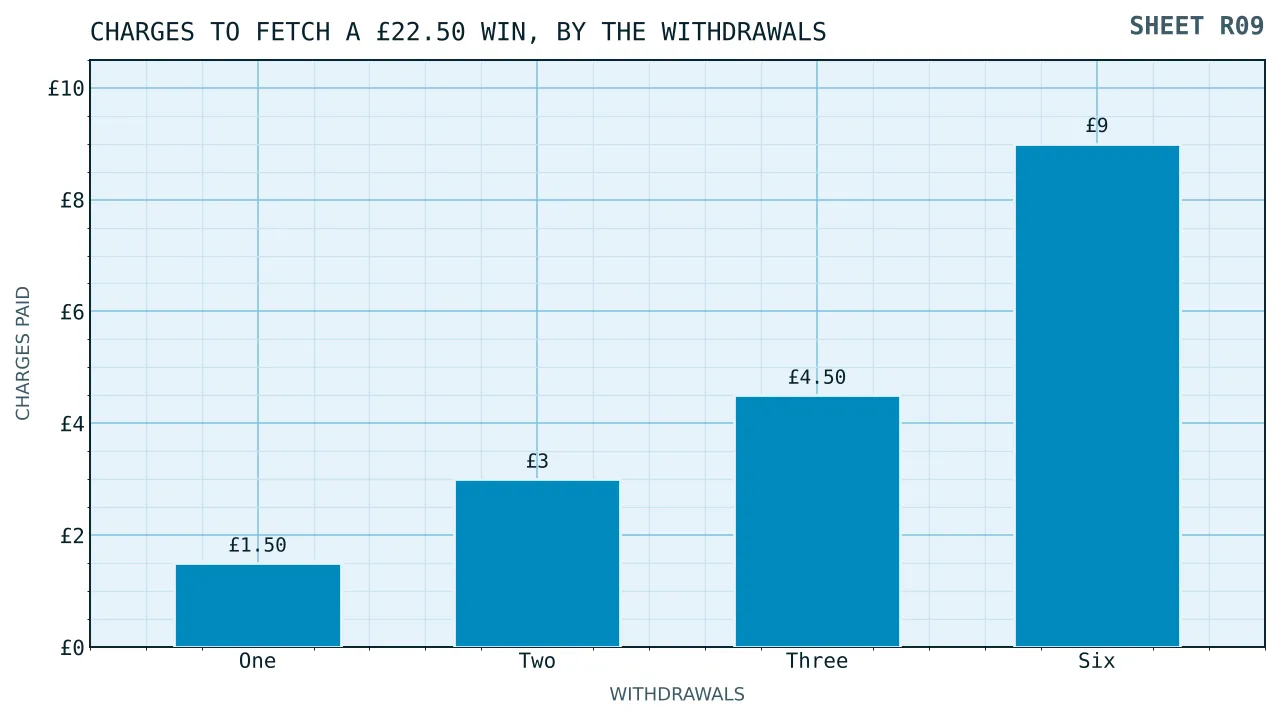
There is a smallest withdrawal worth making, and on these charges it can be named. Below £15.00 the floor is taking a tenth or more of whatever is being fetched, and at £1.50 it takes all of it. A cashier will happily process a withdrawal well under that figure, and the arithmetic of the rail says not to.
4
£37.50 of credit against forty times
Everything above assumed the gentlest multiple on the market. Terms away from the British register carry the other sort, and the other sort takes the whole credit.
A half match on £75.00 is £37.50 of credit. Ninety-six per cent is the return worked with throughout this site, the weighting is one, and the multiple decides what happens next.
| Multiple | Staking owed | Expected cost | Left standing | In hand after £1.50 |
|---|---|---|---|---|
| 10x | £375.00 | £15.00 | £22.50 | £21.00 |
| 20x | £750.00 | £30.00 | £7.50 | £6.00 |
| 24x | £900.00 | £36.00 | £1.50 | £0.00 |
| 25x | £937.50 | £37.50 | £0.00 | £0.00 |
| 40x | £1,500.00 | £60.00 | £0.00 | £0.00 |
At forty times the condition asks for £1,500.00 of staking. The expected cost of staking that much, at four pence in every pound, is £60.00, and the credit it is fastened to is £37.50. The credit goes first, the foot shows £0.00, and £22.50 of expected cost is left to come out of the deposit.
Which settles the entrance question in an unexpected direction. The cheapest exit in the schedule is the one nobody reaches: at forty times there is no withdrawal to make, so the floor is never paid, the currency is never converted back, and all three rails read the same nought. Every charge priced on this page only matters where the multiple is low enough to leave something to fetch.
5
The line, and twenty-four times
The expression that turns a credit into an expected sum has four letters in it and this section’s charges touch none of them.
E = B × (1 – (W × (1 – RTP)) / g)
Wallets sit outside the whole line, which is exactly the trouble. B is the credit, £37.50 on the sterling rail. W is whatever the terms fasten to it. At 0.96 for the return and one for the weighting, a pound staked on slots counts as a pound against the condition.
Read at forty times: the multiple times the four pence of edge gives 1.60, the expression resolves to minus six-tenths of the credit, and six-tenths of £37.50 is £22.50 with the sign against the reader. A balance cannot go under nought, so what the sign records is a credit spent before the condition was served.
Run it backwards and the page’s sharpest figure appears. Set the expected value of the credit equal to the £1.50 the exit costs, and the multiple that balances the two is twenty-four, exactly. Below twenty-four times a reader on this rail is expected to end the errand with something; at twenty-four times the bonus buys the withdrawal charge and nothing else; above it, the charge is larger than the whole expected value of the offer it is attached to.
Twenty-four times: where £37.50 of credit is worth one withdrawal charge
On the converted wallet the same sum lands at a different place, because both the credit and the charge have moved: £36.75 of credit against £2.36 of round trip balances just under twenty-three and a half times. The push, charging nothing, has no such threshold at all, and its arithmetic is the plain one every other sheet in this section uses.
6
The one thing that puts the friction back
A wallet exists to make a top-up effortless, and a bank push exists to make it effortless without even a wallet. That is the product, not a criticism of it. The consequence is that nothing in the arrangement slows a second deposit except a limit the player set before the evening began.
British rules take the term seriously enough to reserve it. The phrase deposit limit may describe only a ceiling on what enters an account across a stated period, so a cap on losses or on stakes, useful as either may be, cannot be called one. A limit of that kind cannot be shown less prominently than any other sort, it binds a whole account at the very least, and a day, a month and a week must all be among the periods on offer.
Where two periods are set together the tighter of them governs. The regulator’s own worked example is a tenner a day set against a hundred a week, which yields ten pounds in the day and seventy across the week rather than the hundred the weekly figure seems to promise. Once the limit is met, deposits stop. They stay stopped until the period comes round again, or until the customer asks for a higher figure, waits a day and confirms the request.
Put that machinery against this sheet’s figures and it earns its place. A reader who set £15.00 a day beside £75.00 a week gets £15.00 in a day and £75.00 in the week, not the £105.00 seven daily limits would otherwise allow. On a rail where a top-up takes two taps, that is the difference between one deposit of £75.00 and five of them.
The access rules matter as much as the figures. A direct link on the home page, the same facility visible on the deposit screens, and as few clicks between a reader and the limit as the system can manage: all three are British requirements, and all three exist because a limit nobody can find is a limit nobody sets.
7
What is not standing behind these rails
Wallets and bank pushes are ordinary British payment arrangements, and the cashiers at the far end of them, in the corner of the market this site writes about, hold no Great Britain licence. A reader can tell the two apart by remembering that a wallet’s rules govern the wallet and nothing else.
Named duty by duty, here is what is absent at the cashier rather than at the wallet. No ceiling of ten times binds a wagering requirement, which is why part 4 can model forty. Nobody must settle who the customer is before the first spin, bonus play and free-to-play games included. No rule bars a term rationing what may be drawn out of a deposit balance. No limit-setting machinery of the kind in part 6 is required, with its reserved terminology and its prompts. And the account is outside the national self-exclusion scheme, whose reach is set by the British licence and by nothing else.
The offshore rulebook read for this build is not empty, and a page pretending otherwise would be misleading in the other direction. It requires deposit limits to exist, with daily, weekly and monthly periods, and a reduction takes effect at once while a rise waits a week, which is a longer wait than Britain imposes. What it does not do is cap a wagering requirement, cap a stake, prompt anybody to set a limit at registration, or reserve the words a limit is described in.
One figure is worth carrying out of this section. Payouts blocked outright, and withdrawal thresholds pitched beyond reach, are both on the British regulator’s own record of what unlicensed operators do. Those are failures of an exit rather than of an entrance, and everything priced on this page is an exit charge, which assumes the exit works.
8
Four readings before the first top-up
The sum on this rail is a round trip, so it needs the return leg read before the outward one is paid for. Four readings do it.
| Reading | Here |
|---|---|
| Charged to deposit | £0.00 |
| Charged to move a balance home | £1.50 floor |
| Multiple printed in the terms | 40x |
| What the credit is expected to leave | £0.00 |
| Multiple at which the exit eats it | 24x |
Divide the second reading by the sum a reader expects to withdraw rather than by the sum deposited. That is the arithmetic nobody does, and it is the one that matters: a floor is a trivial rate on a deposit of seventy-five pounds and a heavy one on a win of twenty-two.
Then compare the last two readings and stop. Where the multiple in the terms sits above the figure in the bottom row, the offer is expected to be worth less than the charge for collecting it, and no choice of wallet alters that. Where it sits below, the choice of rail is worth between nothing and £2.36 on these figures, which is real but small against the £22.50 the multiple decides.
And the caution this site attaches to every mean. Twenty-one pounds in hand is an average across a long run of identical attempts, not a sum anybody collects: a single pass at thirty-seven pounds fifty of credit most often finishes at nothing, whichever rail carried the deposit in. The £1.50 is not an average, but it is only ever charged on money that exists.
Three neighbours take the same round trip over different ground. A wallet whose eligibility line can void the bonus outright is at paypal casino. The rail a British licence will not accept at all, with a handling charge and interest behind it, is at credit card casino. A prepaid voucher, which cannot be paid back to and strands the remainder, is at paysafecard casino, and a card whose clearing delay sits at the exit is at visa casino. The section index is The rail.
Questions
- Is there anything to pay to deposit by wallet or bank push?
- On the charges modelled here, nothing at all, and that is the trap. All three rails take £75.00 and credit £75.00, so a reader comparing them at the cashier finds no difference. The charges are at the exit: two per cent to move a balance out of a wallet with a £1.50 floor under it, nothing for a bank transfer, and two per cent inside the rate where the wallet holds a currency other than sterling.
- Which of the three is cheapest over a round trip?
- The push, on these assumptions, because it charges nothing in either direction. A sterling wallet costs £1.50 on the way home, and a wallet holding another currency costs £2.36 in all: two per cent off the deposit, two per cent off the bonus that was matched to the smaller deposit, the floor at the exit, and two per cent again converting back. What the push cannot do is hold a balance away from the cashier.
- Why does a £1.50 floor matter so much?
- Because it is charged against a win rather than against a deposit, and wins on this rail are small. Two per cent of the £22.50 the sterling wallet is expected to produce would be £0.45, so the floor is what is actually paid, and £1.50 on £22.50 is 6.7 per cent. The advertised rate is 2 per cent. The rate a reader pays is decided by how little is being withdrawn.
- Is it dearer to withdraw winnings in instalments?
- By a figure that can be set down exactly. The floor is paid once per movement, so three withdrawals of £7.50 cost £4.50 against £1.50 for taking the £22.50 in one go, and six of £3.75 cost £9.00, which is two-fifths of the win. Below about £15.00 the floor is taking a tenth or more of whatever is being fetched, and a withdrawal of £1.50 would arrive as nothing.
- What does a half match on £75.00 come to after the play-through?
- Ten times is as far as a licensed cashier may go. There the £37.50 of credit owes £375.00 of staking, whose expected cost at four pence in the pound is £15.00, so £22.50 is expected to remain. At the forty times usual on this side the staking owed is £1,500.00 and the expected cost £60.00, so the foot shows £0.00 and £22.50 of that cost falls on the deposit instead.
- At what multiple does the exit charge eat the whole offer?
- Twenty-four times, exactly, on the sterling wallet. Set the expected value of £37.50 of credit equal to the £1.50 the withdrawal costs and the multiple balances at twenty-four. Below it the errand is expected to end with something in hand, at it the bonus buys one withdrawal charge, and above it the charge is bigger than the whole expected value of the offer. The push, charging nothing, has no such threshold.
- Does the exit charge apply if the bonus fails?
- No, and it is the one consolation on the page. At forty times there is nothing expected to be left to withdraw, so the floor is never met, the currency is never converted back, and all three rails read the same nought. Every charge priced here only bites where the multiple was low enough to leave something worth fetching.
- What stops a wallet making it too easy to deposit again?
- A limit set before the evening starts, and nothing else in the arrangement. British rules reserve the phrase deposit limit for a ceiling on what enters an account over a stated period, require it to be shown no less prominently than any other kind, bind it to the account at the least, and insist that a day, a month and a week are all among the periods available. The route to it has to be a direct link on the home page and visible on the deposit screens.
- How do a daily and a weekly limit work together?
- The tighter of them governs. The regulator’s own worked example is a tenner a day set against a hundred a week, which yields ten pounds in a day and seventy across the week rather than a hundred. On this sheet’s figures, £15.00 a day beside £75.00 a week gives £15.00 in a day and £75.00 in the week, not the £105.00 that seven daily limits would allow. Raising a limit carries a day’s wait and a confirmation; a reduction is immediate.
- What is missing at the cashier end of these rails?
- A wagering requirement with nothing over it, where a licence would have capped it at ten. Identity settled before any play, bonus and free-to-play included. The bar on a term rationing what may be drawn from a deposit balance. The limit-setting machinery with its prompts and its reserved wording. Membership of the national self-exclusion scheme too, since the licence is what fixes that scheme’s reach. The offshore rulebook read for this build does require deposit limits, and on raising one it waits a week where Britain waits a day.