
Nine sheets Section N Revision 1 Checked 15 October 2026
Nothing asked back
Nine sheets sit under this heading because the term that usually settles the answer has been struck out of their terms before a reader arrives. With the multiple at nought the expression returns the credit untouched, so £1 of credit is £1. That makes the absence worth 40p in each pound set against a ten times requirement, and the whole pound set against the forty times written out here.
The word no is worth 40p in the pound against a British ceiling, and a pound against forty times
What the conditions leave
Every destination on this spike is bought advertising. The site takes a fee if a reader goes on to register, and no figure printed below moves because of it.
The Spin Sheet
Till receipt No 01
Betportal
Lowest multiple here
For every €1 of spin credit at face per €1
Credit
Debit
No Great Britain licence
Licensed in Anjouan, Comoros, run by BetPortal Gaming Ltd, with Excite Ultra Media Ltd, reference ALSI-202601040-FI2.
Terms read 15 October 2026
Open the offer at Betportal, opens in a new tabThe Spin Sheet
Till receipt No 02
WinBeast
Five staged matches
For every €1 of spin credit at face per €1
Credit
Debit
No Great Britain licence
Licensed in Curaçao, operator not named on the site.
Terms read 15 October 2026
Open the offer at WinBeast, opens in a new tabThe Spin Sheet
Till receipt No 03
EliteSpin
Longest spin window
For every £1 of spin credit at face per £1
Credit
Debit
No Great Britain licence
Licensed in Costa Rica, run by PrimeTier Limited.
Terms read 15 October 2026
Open the offer at EliteSpin, opens in a new tabThe Spin Sheet
Till receipt No 04
Crown Jewelz
Multiple unpublished
No total struck
Credit
Debit
No Great Britain licence
Licensed in Curaçao, number not verified, operator not named on the site.
Terms read 15 October 2026
Open the offer at Crown Jewelz, opens in a new tabThe figure at the foot of a receipt is this site's own arithmetic and nothing an operator has published: the credit, less the share a spin gives back at 96 per cent return to player, less what playing the wagering through costs at the same return. It describes the offer, not one reader's afternoon. Where the conditions price above the credit the receipt prints nothing rather than a negative sum, and where a figure the sum needs is unpublished it prints the condition in the operator's words instead.
Three words stand in the amount column where no figure can. Noted is a published condition that takes value away without leaving the sum a figure to take. Unpriced is a condition whose figure nobody has published, or a credit that is not a sum until a deposit of your own sets it. Own money is money of yours, which is never part of a total.
Not one of the operators printed above holds a Great Britain licence, so the duties that licence carries do not reach them. Every online gambling company licensed in Great Britain has to be part of Gamstop Online, and a reader who has shut themselves out through the scheme is therefore not shut out here. The ceiling of ten times the bonus funds on a wagering requirement, in force since 19 January 2026, is a condition of that licence and binds the companies that hold one. Where a dispute goes instead is a matter for the authority named on the receipt, and the Gambling Commission describes what a reader faces without a British licence as a lack of recourse if things go wrong. Nobody under 18 may hold an account at any of them.
Every term printed on a receipt is the operator's own, and each receipt carries the day it was read. The oldest of those readings is 15 October 2026. What binds a reader is the operator's own full terms, and not a line printed here.
1
W at nought, and what collapses
Every other section of this site is organised around a debit. This one is organised around a deletion, and the deletion is the same in all nine cases. The site’s one expression is where to see what it does, and the line itself is unremarkable until the multiple is set to nothing.
E = B × (1 – (W × (1 – RTP)) / g)
Strike W out and the bracket in it collapses to one, whatever the return and the weighting happen to be. The arithmetic finishes in a single step, because the term that normally does the damage has been deleted by the offer itself. E comes back as B, and the figure advertised is the figure the sum gives.
That is a reason to read the rest of the document rather than a reason to stop reading it. A promotion costs a cashier money, and striking out its one expensive condition costs more, unless that cost has gone to a clause the expression cannot reach. Every sheet under this heading is an inventory of where it went.
Fixed here, and changeable by anybody holding a different document:
- A cycle costs 10p, so a count of ten cycles carries £1.00 of face.
- The game gives back 96 per cent, which is where every four pence in the pound comes from.
- The multiple is nought. Where a sheet needs a comparison it uses ten times, the British ceiling, or forty times, the order of figure written on the offshore side.
- Nothing is paid in on seven of the nine. On the two that ask for a qualifying payment, that payment is the only sum genuinely exposed.
2
What the absence is worth
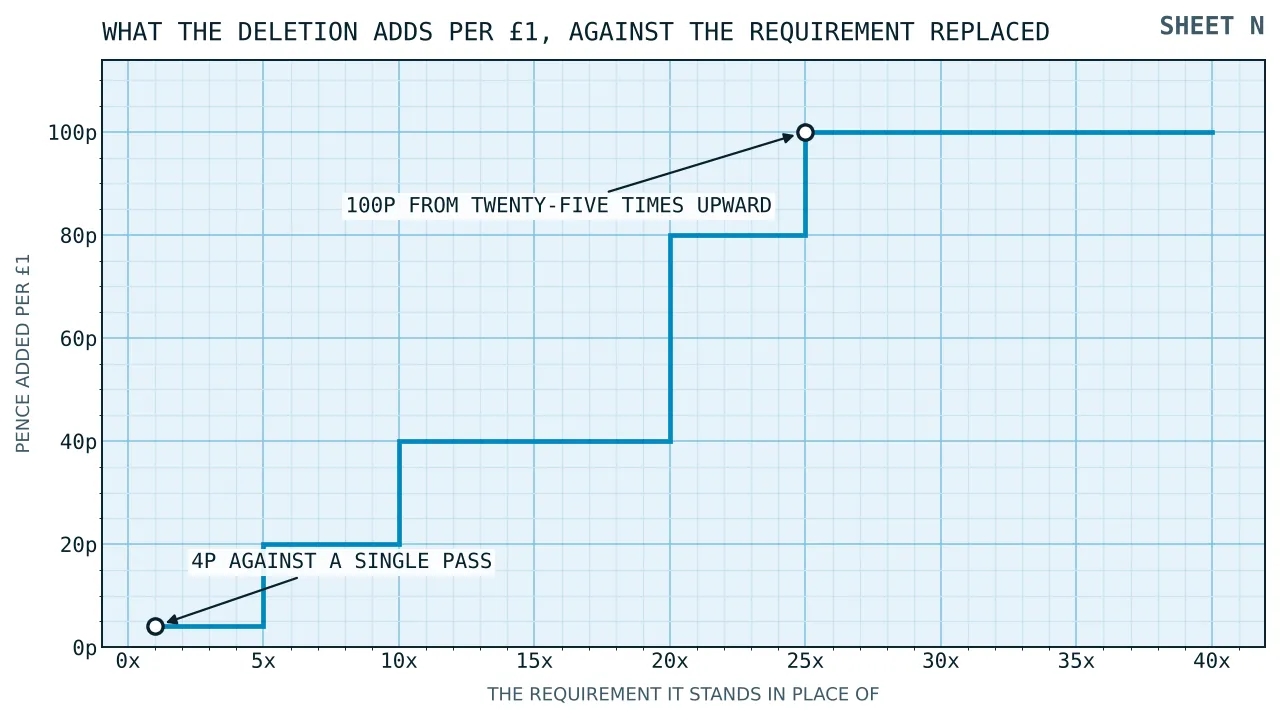
An absence is only worth something against the thing it replaces, so the comparison has to be stated before the figure means anything. A single turn of the credit takes four pence in the pound at a 96 per cent return, and that is the smallest requirement anybody writes. Ten times, the ceiling in Britain since January 2026, takes forty pence in the pound. Twenty-five times takes the whole pound, and anything above twenty-five takes the pound and leaves a balance owing.
| Instead of | Kept per £1 | The absence adds |
|---|---|---|
| No requirement at all | 100p | nil, this is the baseline |
| One pass | 96p | 4p |
| Five times | 80p | 20p |
| Ten times | 60p | 40p |
| Twenty times | 20p | 80p |
| Twenty-five times | 0p | 100p |
| Forty times | 0p | 100p |
So the phrase that heads this section is worth four pence in the pound at its least and a hundred pence at its most, and the figure depends entirely on what the alternative would have been. A reader comparing a no-wager offer against a British licensee is looking at 40p in the pound. A reader comparing it against the requirements written out here is looking at the lot.
Read the last two rows together. Past the crossing point the absence stops gaining value, because a credit at twenty-five times already leaves nothing and a credit at sixty times cannot leave less than nothing. The deletion is worth most against a requirement that would have killed the credit outright, and the extra damage above twenty-five times was never the reader’s to lose.
4p the floor, 100p the ceiling, on the value of a deletion
3
The cost did not vanish, it moved
Four shapes of clause can take a credit back after the multiple has been deleted, and they work on different parts of the same distribution.
A ceiling cuts the top off it. A floor under the payout removes everything below a line. A clock removes whatever is left unused. A definition decides whether the credit is money at all. Two of the nine sheets add a fifth thing, which is a price of admission paid in the reader’s own money.
Not one of those shapes appears anywhere in the expression, and each of them can take the closing line to nought on its own. That is the awkward finding of this section: the offer with no wagering requirement is not the simple one. It is the one whose cost has been relocated to a part of the document that carries no figure a reader can multiply.
Which is also why the arithmetic has to be done in a particular order here. Price the credit first, then price each clause against that credit, and keep the two apart. An offer advertising a hundred pounds and paying a maximum of ten has not given anybody a hundred pounds with a condition. It has given them ten, in a sentence a hundred words further down.
4
A ceiling cuts the top off a distribution
A maximum win does something simple and brutal to a distribution: everything beneath the line is paid as it stands and everything above it is cut back to the line. It can never add anything, so whatever it does lies between nothing and the whole credit, and where in that range depends on a number the bonus terms do not print.
Take a pound of face: ten cycles at 10p, and 96p expected back where the game returns 96 per cent. Now put two games underneath it, both invented here as arithmetic rather than offered as descriptions of any real reel set.
Shape A pays 96 times the stake once in a hundred cycles, which at 10p is a prize of £9.60. Shape B pays 960 times the stake once in a thousand cycles, which at 10p is a prize of £96.00. Both average 96p across the ten cycles, both satisfy the same disclosure, and nothing in a set of bonus terms tells them apart.
Drop a £10 ceiling over each. Shape A loses nothing, because its prize was already underneath. Shape B keeps 10p instead of 96p. One clause, nothing taken from the first game and 89.6 per cent taken from the second. Ten times the face is what that ceiling is, and it is the shape of the game rather than the size of the ceiling that decides the damage.
Restating a ceiling as a multiple of the face is the single most useful conversion in this section. At £1.00 of face a ten pound ceiling is ten times face and generous. At £20.00 of face the same clause is half a times face and is the whole offer. The figure in the clause did not move. The offer around it did.
89.6 per cent taken from one game, nothing from the next, by one clause
5
A pass, a floor, a clock and a noun
No wagering and one times wagering are not the same phrase, and four pence in the pound is what separates them. A single compulsory pass is the commonest version, and it leaves 96p of each pound rather than the whole of it. Whether that counts as wagering is a question about words, and the arithmetic answers it without needing to: a pass costs the house edge, every time it is made.
A floor under the payout works the other way about, and it is the one clause that can price a no-wager credit at nothing without touching a single figure in the sum. Where a cashier will not process a withdrawal below a stated figure, and that figure stands above the credit, the credit is worth nought until a win lifts the balance over the line. Nothing in the arithmetic moved. The whole of it was made unreachable by a sentence about administration.
A clock does the third job. Credit that expires unused is credit that paid nothing, and a drip of instalments is a column of small credits with its own deadline on each. Ten cycles a day for seven days is not seventy cycles. It is seven rounds of ten, six of which can be missed.
A definition does the fourth. Winnings that arrive as bonus funds are not money yet, and winnings that arrive as cash are. The published rules are no help on which is which. Bonus funds is the noun the wagering ceiling attaches to, and no source says whether a spin is one. What can be said is narrower and more useful. Where the winnings land as bonus funds, ten times becomes the furthest a requirement on them may reach, and the headline’s promise turns out to be about which pot they arrive in.
6
Nine sheets, and the clause each one is about
Two sheets price a ceiling, two price a clock, two price the way out, two price a qualifying payment, and one prices a noun. Read in that order they come to a reasonably complete account of what a deleted requirement costs.
A ceiling over the winnings is the term left holding a round of fifty, which is where 50 free spins no deposit no wager starts. Seventy cycles arriving ten a day is a clock rather than a ceiling, and 70 free spins no deposit no wager counts what each unused day costs.
Thirty pounds of credit is worth whatever a cashier will pay against it, and £30 free no deposit puts that figure where the headline was. Twenty pounds with one compulsory pass attached prices the word no at eighty pence, which £20 free no deposit casino works through. A tenner that nobody has yet verified is not money, and free £10 no deposit asks what the chance of being paid is worth. Five pounds of cash credit prices the same at any stake, and free £5 no deposit casino shows why the stake drops out.
Two sheets have a reader paying in. Two hundred cycles bought with a tenner of a reader’s own are priced in deposit £10 and get 200 free spins, where the rate per pound is the thing that travels. A hundred cycles bought with a fiver shift the requirement on to the deposit, which is what deposit £5, 100 free spins works out.
And one turns on the noun. Thirty cycles with a promise about the form of the winnings is 30 free spins, keep what you win, where cash and bonus funds are the two readings.
7
Being paid is an event, not a term
The figure kept is only kept if it is paid, and no symbol in the expression stands for that. Multiply the closing line by the chance of being paid and the arithmetic is honest: a one in ten failure costs ten pence in every pound, and nothing in a set of bonus terms puts a value on the chance.
What a Great Britain licence does about it is specific. Identity has to be settled before any play, so the check cannot be sprung at the window. A withdrawal request may not become the occasion for a demand the licensee could reasonably have made sooner. Money laundering checks belong at the start too, and not at the moment somebody wants their balance. A licensee may not cap what comes out of the sum a player paid in, and may not offer a customer the option of cancelling a withdrawal once it has been requested.
On the far side of the register, what the regulator reports finding is worth repeating: withdrawal limits pitched so high that nobody reaches them, and payouts simply blocked. It also records serious data protection concerns, with the risks of identity theft and fraud named alongside them. A familiar game is no evidence either way. The Commission has recorded licensed suppliers’ games showing up on unlicensed sites, and £4.75m was the sum one supplier agreed to pay in July 2026 over six such sites reachable by consumers here.
The honest other half of that picture is that a complaints route does exist offshore. Six months to lodge one free of charge is what the Curaçao policy gives a player, with four weeks for the operator to answer and a single extension of the same length. Neither authority settles the dispute. The British regulator describes itself as no ombudsman, without power to get anybody’s money back, and its Curaçao counterpart declines to rule on complaints about play on an operator’s own sites. Where the two regimes diverge is over who sets the terms of an escalation, since a British licensee has to use an adjudicating body off the Commission’s approved list.
8
What a licence puts round a free credit
What a Great Britain licence puts around a credit that asks nothing back, item by item.
- A ceiling over the multiple: ten, counted against bonus funds, binding from 19 January 2026, on every licence bar gambling software and gaming machine technical.
- A ceiling over the stake: £5 on a slot cycle, and £2 for anybody who has not yet turned twenty-five.
- A floor under the pace: 2.5 seconds from one slot cycle to the next, and five seconds for a casino game other than a slot, peer-to-peer poker aside.
- A bar on autoplay: a commitment from the player before each cycle, with an automatic poker blind the only thing excepted.
- A bar on undoing a withdrawal: no option to cancel one, once the request is in.
- A bar on capping withdrawals: no maximum at all on what comes out of the sum a player paid in.
- Identity settled first: date of birth, address and name, all verified before a single cycle, with free-to-play games and bonus-funded play both inside the rule.
- A limit the customer sets: prompted at registration or at the first payment, with 24 hours, 7 days and a month among the periods offered, cut at once on request and raised only a day later.
- A route for a complaint: eight weeks at the outside, and then an approved adjudicator, with eight entities on the published list.
- A place in the national scheme: a condition of the British licence itself, rather than a choice the site makes.
Not one of those is owed by a cashier holding no Great Britain licence, which is the position of the offers under this heading. Read the Curaçao policy instead and self-exclusion arrives at the level of one operator and its domains, with a year as the minimum period and six months to lodge a complaint. It has nothing resembling a wagering ceiling, nothing on stakes, nothing on pace, and two lines on bonuses.
One place where that policy is stricter than the British rulebook deserves stating, because it runs against expectation: a request to reduce a deposit limit takes effect at once, while a request to raise one waits seven days, where the British cooling-off period is at least twenty-four hours.
The scheme is plain about its own limit, and that limit matters more under this heading than anywhere else: a non-participating operator is beyond its help, and the register of British licences is what decides which operators participate. No line on this sheet assists anybody in doing that, and the numbers that help are in the note below.
9
Four readings, and the multiple is not one
Four readings settle an offer under this heading, and the multiple is not one of them.
- Read the ceiling, and restate it as a multiple of the face so it can be compared with the prizes the game actually pays.
- Read the floor under the payout, and set it beside the credit rather than beside the balance.
- Read the clock, and count the instalments rather than the days.
- Read the noun the winnings are credited as, because cash and bonus funds are different objects with the same arithmetic.
Where every one of them is harmless, what was advertised is what gets kept, and this is the only section here where that sentence is ever true. Where any one of them bites, the figure on the front is a gross and the clause is the deduction, which is the arrangement every other section of this site is built to price.
Each of the other six is cut by a different debit. Where the play-through decides everything and the headline count decides nothing, the arithmetic is in The multiple. Where a reader’s own payment is matched and the match is a coefficient on that payment, it is Matched money. Where the smallest payment a cashier accepts is the subject, a flat charge outweighs any percentage, which is The floor. Where the cost of paying in is settled before any bonus exists, that is The rail. Where the licence itself is the subject, Off the register names what is missing one duty at a time. And The room takes the place the credit is spent in, pricing the return, the pace and the prizes there. Seven sections stand on the front page of The Spin Sheet, with the method set out once on How a receipt is struck.
Questions
- Does no wagering mean the credit is already mine?
- Not by itself. It means the closing line equals the credit, which is the figure the arithmetic gives before any other clause is read. A pound of credit stays a pound where no multiple is attached, and then a ceiling, a payout floor, a clock or the noun the winnings are credited as can each take some or all of it back. Every sheet under this heading is about one of those clauses.
- What is the absence actually worth?
- Against a single compulsory pass it is worth four pence in the pound. Against ten times, the ceiling in Britain, forty pence. Against twenty-five times or anything above it, the whole pound, because twenty-five times is where a 96 per cent game leaves nothing at all. So the phrase is worth between 4p and 100p per pound of credit, and which end of that range applies depends on the requirement it replaced.
- How much can a maximum win clause take?
- A ceiling can only take money away, so what it does lies between nothing and the credit in full. Where it lands is decided by the shape of the prizes rather than by the figure in the clause. Two games can return the same 96 per cent, one paying 96 times the stake once in a hundred cycles and the other 960 times once in a thousand. A £10 ceiling takes nothing from the first and 89.6 per cent from the second, and no set of bonus terms tells a reader which game it has.
- Is one times wagering the same as none?
- Not quite. One pass through the credit on a 96 per cent game costs four pence in each pound, so £1 of credit leaves 96p rather than 100p. The phrase one times wagering therefore has a price, and it is a tenth of the price of ten times. Whether a single pass ought to be called wagering is an argument about words; the house edge settles the figure either way.
- What can a minimum withdrawal do to a credit this size?
- It prices the credit at nought without altering a single number in the sum. Where a cashier declines to process a withdrawal below a stated figure, and that figure stands above the credit, nothing can be taken out until a win lifts the balance over the line. A British licensee may not cap what comes out of money a player paid in, but a minimum on the way out and a cap on the way out are different clauses, and the published rule addresses the second.
- Do any of these offers want a deposit?
- Two of the nine sheets under this heading do ask for one, and on those two the reader’s own payment is the only sum genuinely at risk. The spins attached to it are exposed only to their own value. A qualifying payment also moves the requirement: with the multiple struck off the award it frequently reappears on the deposit, where turning over a fiver once costs twenty pence and twenty-five turns exhaust it.
- Are winnings from an offer like this taxed?
- HMRC publishes a position reached by absence: gambling is not in itself a trade, so winnings are not trading income. It is built out of the manuals rather than out of any sentence declaring winnings untaxed, and no line here speaks to one person’s circumstances. The duty that does exist falls on the operator: Remote Gaming Duty, 40 per cent from 1 April 2026, charged on what a gaming provider makes from remote gaming played by somebody whose home is in the United Kingdom.
- What should be read first on a no-wager offer?
- The maximum win, restated as a multiple of the face. A ten pound ceiling on a pound of face is ten times face and takes nothing from most games. The same ten pound ceiling on twenty pounds of face is half a times face and is effectively the whole offer. After that, the minimum withdrawal, the clock on each instalment, and the pot the winnings are paid into.
- Is a British licence behind any of these offers?
- None of them holds one. A credit with no multiple on it is still an offer made without the ten times ceiling behind it, without a stake limit, without a floor under the pace, without a bar on autoplay, without identity settled before the first cycle, and without a place in Gamstop Online. Where the offer asks nothing back, the term a reader has to price is the one on the way out, and the regulator reports having seen payouts blocked and withdrawal limits set beyond reach.