
Sheet P04 Revision 1 Checked 15 October 2026
New casino sites
Fifteen pounds of credit at forty turnovers owes £600.00 of staking, which a 96 per cent return bills at £24.00, and leaves nought. None of those three figures knows how old the room is. The one published enforcement outcome about a new-casino bonus is a fine of £170,000.
£600.00 owed, and nothing about it dated
What a new room's conditions leave
Every destination on this spike is bought advertising. The site takes a fee if a reader goes on to register, and no figure printed below moves because of it.
The Spin Sheet
Till receipt No 01
Betportal
Lowest multiple here
For every €1 of spin credit at face per €1
Credit
Debit
No Great Britain licence
Licensed in Anjouan, Comoros, run by BetPortal Gaming Ltd, with Excite Ultra Media Ltd, reference ALSI-202601040-FI2.
Terms read 15 October 2026
Open the offer at Betportal, opens in a new tabThe Spin Sheet
Till receipt No 02
WinBeast
Five staged matches
For every €1 of spin credit at face per €1
Credit
Debit
No Great Britain licence
Licensed in Curaçao, operator not named on the site.
Terms read 15 October 2026
Open the offer at WinBeast, opens in a new tabThe Spin Sheet
Till receipt No 03
EliteSpin
Longest spin window
For every £1 of spin credit at face per £1
Credit
Debit
No Great Britain licence
Licensed in Costa Rica, run by PrimeTier Limited.
Terms read 15 October 2026
Open the offer at EliteSpin, opens in a new tabThe Spin Sheet
Till receipt No 04
Crown Jewelz
Multiple unpublished
No total struck
Credit
Debit
No Great Britain licence
Licensed in Curaçao, number not verified, operator not named on the site.
Terms read 15 October 2026
Open the offer at Crown Jewelz, opens in a new tabThe figure at the foot of a receipt is this site's own arithmetic and nothing an operator has published: the credit, less the share a spin gives back at 96 per cent return to player, less what playing the wagering through costs at the same return. It describes the offer, not one reader's afternoon. Where the conditions price above the credit the receipt prints nothing rather than a negative sum, and where a figure the sum needs is unpublished it prints the condition in the operator's words instead.
Three words stand in the amount column where no figure can. Noted is a published condition that takes value away without leaving the sum a figure to take. Unpriced is a condition whose figure nobody has published, or a credit that is not a sum until a deposit of your own sets it. Own money is money of yours, which is never part of a total.
Not one of the operators printed above holds a Great Britain licence, so the duties that licence carries do not reach them. Every online gambling company licensed in Great Britain has to be part of Gamstop Online, and a reader who has shut themselves out through the scheme is therefore not shut out here. The ceiling of ten times the bonus funds on a wagering requirement, in force since 19 January 2026, is a condition of that licence and binds the companies that hold one. Where a dispute goes instead is a matter for the authority named on the receipt, and the Gambling Commission describes what a reader faces without a British licence as a lack of recourse if things go wrong. Nobody under 18 may hold an account at any of them.
Every term printed on a receipt is the operator's own, and each receipt carries the day it was read. The oldest of those readings is 15 October 2026. What binds a reader is the operator's own full terms, and not a line printed here.
1
Fifteen pounds on a room with no record
Fifteen pounds of credit on a room that opened last month prices exactly as fifteen pounds on a room that opened in 2014, because none of the quantities in the arithmetic is a quantity about the operator. The credit, the multiple, the return and the weight are what decide it, and three of them sit in a document a reader can open before depositing.
Which is the useful thing about an arithmetic approach to a newly opened cashier. Everything else a reader might want to know about a room, whether it pays out, whether the support desk answers, whether a complaint goes anywhere, is a question about conduct over time, and a room with no time behind it has no answer to any of them. The arithmetic needs no history at all.
So this sheet does two jobs and keeps them apart. It prices the credit, which can be done on day one. And it sets out what is genuinely unknowable about a room on day one, with the sourced facts that bear on it, rather than offering a judgement dressed up as a figure.
One of those sourced facts is sharper than anything else on the site about bonus terms, and it happens to be about promotions aimed at new casino customers precisely. It gets its own part.
Four inputs, and which of them a new room controls:
- Credit of £15.00 at face, and no payment standing behind it. Published, and the operator’s choice.
- Forty turnovers, which is the magnitude terms carry once the British register has dropped away. Published, and the operator’s choice. A licensee stops at ten.
- A return of 96 per cent on reels, which this site holds constant. The operator picks the games; the supplier sets the configuration.
- Full weight, a staked pound discharging a pound, until part 4. The operator’s choice, and the one a reader is least likely to find printed.
- Stakes of 10p, which settles a count of commitments rather than a sum of money.
2
£600.00, and the four readings available on day one
Forty turnovers of £15.00 is £600.00 of staking owed, and the only inputs are the credit and the multiple. Nothing about the room enters that line.
Per pound credited it comes to £40.00 of staking, which is the multiple restated and holds whatever the size of the credit. Two rooms can be compared on that ratio the hour they open, which is more than can be said for any other comparison available at the time.
At 10p a cycle, £600.00 is 6,000 commitments, and a British reel game will not let one start inside 2.5 seconds of the last, which floors the exercise at 15,000 seconds: four hours and ten minutes. The floor holds because automatic play is out and nothing may be offered that cuts short the wait for a result. Away from the British register none of that applies, and the same £600.00 can be put through as fast as the software allows. The expected cost is unchanged by the speed.
Four readings, then, all of them available before a penny is deposited: the credit, the multiple, the contribution owed and the clock. Every one of them is arithmetic on published figures. What is not available on day one is a payout record, a complaint record or a regulatory history, and no amount of arithmetic manufactures those.
6,000 commitments of 10p, floored at 15,000 seconds
3
The expression, with nothing in it dated
One expression takes all of it, and nothing in it asks how old the room is.
E = B × (1 – (W × (1 – RTP)) / g)
Plugging the figures in: B is the credit at face, £15.00 of it, W is forty and RTP is 0.96, so four pence in each staked pound stays behind. The weight g holds at one for now. E is what the credit comes to once the condition is behind the player.
Forty turnovers of £15.00 = £600.00 owed
At four pence in the pound that bills £24.00
E = £15.00 less £24.00, so -£9.00
Four pence in the pound across £600.00 of staking bills £24.00 against credit of £15.00, so the condition overshoots by £9.00 and the foot reads nought. Nothing was paid in to absorb the overshoot, a balance has nought for a floor, and the nine pounds is staking that goes untaken.
Set against a ceiling of ten turnovers, the same credit owes £150.00, costs £6.00 and leaves £9.00, or sixty pence out of every pound credited. Twenty turnovers leaves £3.00. Twenty-five leaves nothing. The credit cancels out of the test entirely, which is why a larger headline from a newly opened cashier changes the obligation and not the answer.
£24.00 of cost against £15.00 of credit
4
The game list, which fixes g
The weight is the term a new room sets for itself, nobody reviews, and few readers find. On a room with no record behind it, the game list is therefore the only document that tells you anything about how the cashier intends to behave.
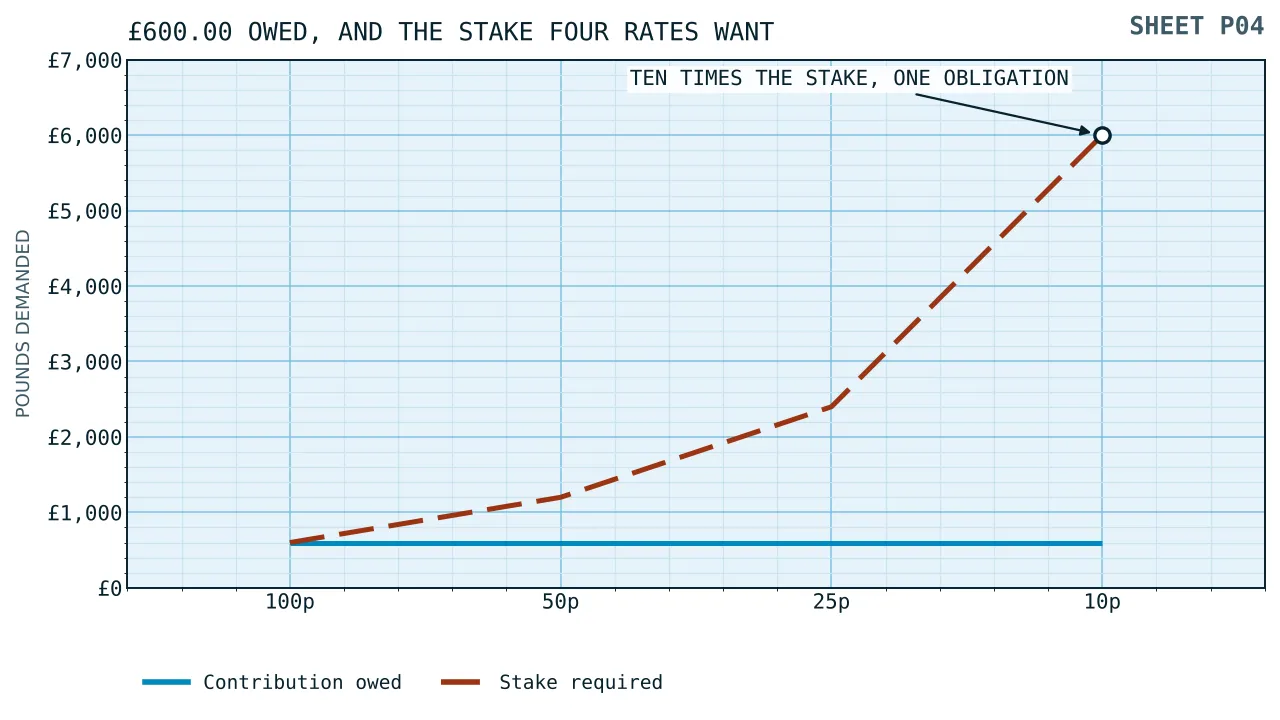
Weighting divides rather than subtracts. The obligation stays at £600.00 of contribution however the rate is written; what changes is the stake required to deliver that contribution, which rises by the reciprocal, dragging the expected cost up and leaving the credit alone.
| What a staked pound is booked at | Obligation in contribution | Turnovers once divided | Stake required | Cost at four pence | Left at the foot |
|---|---|---|---|---|---|
| A full pound | £600.00 | 40.0 | £600.00 | £24.00 | -£9.00 |
| A half | £600.00 | 80.0 | £1,200.00 | £48.00 | -£33.00 |
| A quarter | £600.00 | 160.0 | £2,400.00 | £96.00 | -£81.00 |
| A tenth | £600.00 | 400.0 | £6,000.00 | £240.00 | -£225.00 |
Printing the obligation beside the stake is the whole point of the schedule. The obligation is the figure a cashier publishes. The stake is the figure a reader actually has to put through. At a tenth they differ by £5,400.00, on credit of fifteen pounds, and the gap between them is a term that need not appear on the same page as the multiple.
Thirty pence in the pound is the only rate with any provenance behind it, and it comes from a consultation rather than from a cashier. Somebody responding set out a bonus of a hundred pounds at ten turnovers, with each wagered pound booked at thirty pence against the requirement. The regulator noted the point and did nothing about weighting. Every rate in the schedule here is an input picked to draw a curve, because no citable table of game contributions exists.
For a new room the practical reading is this. A cashier that opens with a large headline and a game list counting its best-returning reels at a fifth has published a generous offer and an ungenerous instrument, and the two statements are in different documents.
5
Where the weight has to beat W over 25
The condition for a residue is that the weight beats the multiple divided by twenty-five, twenty-five being one over the four pence in the pound a 96 per cent return keeps.
Ten turnovers wants a game counting above forty pence in the pound, twenty wants above eighty, and from twenty-five upwards no weight on any schedule can help, since a staked pound is never credited with more than its face.
| Turnovers in the terms | Rate demanded | Achievable? |
|---|---|---|
| Ten, a licensee’s ceiling | above 40p | yes |
| Fifteen | above 60p | yes |
| Twenty | above 80p | yes |
| Twenty-five | above 100p | no |
| Forty, as worked on this sheet | above 160p | no |
| Sixty, a figure the regulator recorded | above 240p | no |
Sixty belongs to the regulator and not to this site. Explaining what its ceiling was put there to correct, it recorded requirements of up to sixty times in use at some licensees, which is the one market multiple traceable to the regulator itself.
Read downwards, the schedule is a test a reader can run in a cashier’s lobby. Read across, it says something harder: that only the first three rows are reachable at all, and that a condition above twenty-five turnovers is not a demanding offer but an arithmetically closed one. A new room publishing forty has published a closed one, whatever its game list goes on to say.
A room on the British register cannot publish forty. Away from the register nothing stops it, which is why the figure appears out here and why the ratio in part 2 is the comparison worth making.
6
The one fine about a new-casino bonus
One clause in a set of bonus rules carries an enforcement outcome that has been published, and it concerns promotions for new casino customers precisely. On a sheet about rooms with no record, it is the most useful fact there is, because it describes a term rather than an operator and a term can be read before depositing.
The regulator fined an operator £170,000 on 3 July 2025. What it objected to was a right the operator had kept for itself, exercisable as it pleased, to shut accounts or to withhold winnings, sitting in the bonus rules published for new casino promotions.
A discretionary term with no clear justification behind it put the operator in breach of its duty of fair and open dealing, and the regulator went on to say that such terms want transparency and can give consumers unfair outcomes. An independent third-party audit was required as well, reaching the operator’s anti-money-laundering arrangements and its safer gambling arrangements alike.
What a page may not say is that a clause of that shape has no effect. A fine and an audit are what got published, rather than a term removed, and the distinction matters to a reader deciding what to do about one.
Set that clause against the expression in part 3 and the point is plain. The multiple is inside the arithmetic and can be priced. A discretion to forfeit is outside the arithmetic and prices the whole of it at nothing whenever it is exercised. A reader comparing two new rooms on their headline percentages is comparing the term with a price against the term with a known enforcement history, and getting it backwards.
What the published standards ask of the document itself:
- An incentive’s terms are to be clear, fair and transparent, and easily reachable by anybody the incentive is put in front of.
- Licence condition 7.1.1 runs four tests over the contract. Terms and consumer notices are not to be unfair, measured against the Consumer Rights Act 2015, with the licensee obliged to comply with the ones it set. They are to be transparent on the same measure, with contract terms easily accessible. Material changes go to customers before they take effect. And across every dealing with a consumer, unfair commercial practices are out, on the meaning the 2024 digital markets and consumers statute carries.
- A room holding no Great Britain licence has taken on none of these tests, and the Curaçao policy opened for this build asks only that bonus terms be communicated transparently and that promotions not push excessive play.
7
A familiar game is not a licence
A room nobody has heard of often carries games everybody has. That is worth pricing properly, because it is the single most common reason a reader takes an unfamiliar cashier on trust.
A game a reader recognises is not evidence of a licence. Games put out by licensed suppliers have turned up, on the regulator’s own record, on websites holding no licence, and £4.75m was agreed by one supplier on 23 July 2026 over six unlicensed sites that consumers in Great Britain could reach. The findings in that case ran to the assessment of money-laundering risk, to the controls that should have kept its games away from British customers via operators without licences, and to customer due diligence; the regulator said the weaknesses were serious enough that it had considered suspending the licence.
So the lobby tells a reader about the supply chain. The register tells them about the site. The check the regulator sets a player is its own register: a licence held, a licensed status displayed, the register a click away, and the activities and domain names recorded against the licence matching the site in front of them.
The register held 2,154 licensed operators and 3,097 licensed activities at the end of March 2026, on figures published 17 September 2026. A room absent from it is not new. It is unlicensed.
Two cautions on using the register well. It carries no guidance on how to read a domain name recorded against a licensee, and no explanation of what an active or inactive status means, so a check of that kind is reported with the date it was made and nothing further. And the regulator has published what it will not do: it is no ombudsman, it cannot settle a dispute over a gambling transaction or get anybody’s stake back, a blocked withdrawal or a game that failed is beyond what it can resolve, and a customer’s account is invisible to it. What a licence buys is an eight-week clock on a complaint, with an adjudicator from the approved list waiting at the end, rather than an arbitrator of first resort.
Where a room cites a registration this build could find no regulator’s own rulebook for, that absence is the fact and nothing is inferred from it. No Costa Rican gambling regulator’s primary source could be located during this build, and the Anjouan complaint process could not be read at all, so this sheet says only that the body advertises one.
8
The loss, sorted by date
Sorted by the date each duty began, the loss on a room away from the British register reads as a calendar.
From 1 November 2014, the licence requirement has followed the player rather than the equipment, so an operator outside Great Britain offering facilities used here needs one. The statutory offence of providing facilities without a licence falls on the provider, and the Act creates no matching offence for a customer, which is a point about criminal liability and not about protection.
From 7 May 2019, identity is established before any gambling at all, bonus play and free-to-play rounds included, on an address, a name and a birth date as the minimum. A withdrawal request may not be the trigger for a demand the operator could reasonably have made earlier.
From 14 April 2020, no payment for gambling may be taken by credit card, a money service business in the middle making no difference.
From 17 January 2025, a customer sees net spend and time spent as they play, and functionality put up by the operator for running several products together is out.
From 28 February 2025, a light-touch financial vulnerability check applies above a net deposit of £150 a month, down from the £500 figure that started on 30 August 2024. The heavier assessments remain a pilot and the regulator says consumers are unaffected by it.
From 9 April 2025 a single reel cycle may not take a stake over five pounds, and from 21 May 2025 not over two where the customer is under 25.
Direct marketing for online gambling went opt-in, by product type and by channel, on 1 May 2025. The date was changed from 17 January 2025, and the release records the change expressly.
From 19 January 2026, a condition may not ask more than ten turnovers of bonus funds, and one incentive may no longer stretch across a second product type. Worth £9.00 on the credit at the head of this sheet, which is the whole of what survives.
Not one of those dates appears in the Curaçao rulebook behind this sheet, which has no cap on a multiple, no weighting, no ceiling over a stake, no floor under a game cycle and two sentences on bonuses. Self-exclusion it does require, one licensee at a time across whichever domains that licensee operates, with a year as the shortest term available and no revocation while it runs. Membership of Gamstop Online, by contrast, follows the British licence, and the scheme’s own terms draw the limit: it is unable to assist in preventing access to gambling services offered by non-participants. Nothing on this page is of the least use to anybody trying to get round a protection they set for themselves, and the support numbers come after the questions.
9
Checking a room on its first week
Six readings, and a first week cannot supply the last two.
| The reading | On this credit |
|---|---|
| Credit at face | £15.00 |
| The multiple, from the terms | 40x |
| Staking owed, and it is exact | £600.00 |
| W over g, measured against 25 | 40.0 |
| Payout record | none yet |
| Complaints record | none yet |
Lines one to four can all be taken before depositing, and together they settle the answer. Lines five and six are blank on any newly opened cashier and will stay blank for months, which is a reason to weigh the first four more heavily rather than a reason to guess at the last two.
Then the test, in one move: turnovers divided by weight, set beside twenty-five. Under it there is something at the foot. Over it there is nought, and a new room asking forty at full weight is at forty, four rows down the schedule in part 5 and well past the last reachable one.
Two cautions on the nought. It is an average over many repetitions of the same credit, and a single attempt is not described by it at all: there the commonest result is a drained balance and most of the £600.00 never staked. And a clause sitting outside the expression shuts the answer down with W, g and the return all unmoved, which is where part 6 comes in.
Where to read next depends on what you want checked. The building taken as a whole, and the return each room has to pay, is at online casino UK. A ticket room’s disclosure duties are at online bingo, five pounds of ticket money is priced at bingo no deposit bonus, and the short screen is at mobile casinos. The room gathers the sheets whose totals turn on where a credit goes. How a receipt is struck holds the arithmetic they all share.
Questions
- Can a new casino site be priced before it has a record?
- The credit can, and that is most of the answer. Forty turnovers of £15.00 owes £600.00 of contribution. A 96 per cent return bills that at £24.00 against credit of £15.00, so the residue is minus £9.00 and the foot reads nought. None of the inputs is a fact about the operator. What cannot be priced on day one is a payout record or a complaints record, and no arithmetic manufactures either.
- What does £15 of credit at a new casino owe?
- £600.00 of staking at forty turnovers, exactly, from the credit and the multiple alone. Per pound credited it comes to £40.00, a ratio equal to the multiple. At 10p a cycle that is 6,000 commitments, floored at 15,000 seconds on a British reel game because 2.5 seconds must pass before the next cycle begins. Four hours and ten minutes, as a minimum.
- Has any operator been fined over a new-casino bonus term?
- Yes, and it is the one bonus clause with a published enforcement outcome behind it. On 3 July 2025 a fine of £170,000 went to an operator over a right it had kept for itself, exercisable as it pleased, to shut accounts or to withhold winnings, which sat in the bonus rules published for new casino promotions. The breach was of the duty of fair and open dealing, with an independent third-party audit demanded on top.
- Does that mean a forfeiture clause is unenforceable?
- No, and the distinction matters. What got published was a fine and an audit requirement, not a term struck out, so a page can say the regulator has penalised an operator for a clause of that shape and name the condition breached. It cannot say such a clause has no effect. The regulator’s own words were that terms of that kind want transparency and can give consumers unfair outcomes.
- Does a familiar game mean a new site is licensed?
- No. Games put out by licensed suppliers have turned up, on the regulator’s own record, on websites holding no licence, and £4.75m was agreed by one supplier on 23 July 2026 over six unlicensed sites that consumers in Great Britain could reach. The lobby tells a reader about the supply chain. The register tells them about the site.
- How do I check a new casino is on the register?
- The regulator sets the check itself: a licence held, a licensed status displayed on the site, the public register a click away, and the activities and domain names recorded against that licence matching the site you are looking at. At the end of March 2026 the register held 2,154 licensed operators and 3,097 licensed activities, on figures published 17 September 2026. A room absent from it is not new. It is unlicensed.
- What does game weighting do to a new room’s offer?
- It divides, and it is the term a new cashier sets for itself. The obligation stays at £600.00 whatever the rate; the stake required to deliver it rises by the reciprocal. A full pound needs £600.00 put through at a cost of £24.00. A half needs £1,200.00 and £48.00. A quarter needs £2,400.00 and £96.00. A tenth needs £6,000.00 and £240.00, on credit of fifteen pounds.
- What rate does a multiple need before anything survives?
- Above the multiple over twenty-five, that twenty-five being one divided by the four pence in the pound a 96 per cent return keeps. Ten turnovers wants above forty pence in the pound, fifteen above sixty, twenty above eighty. From twenty-five upwards nothing reaches it, because a staked pound is never credited with more than its face.
- Why do new offshore rooms ask forty times when a licensee asks ten?
- Because nothing out there stops them. The British ceiling of ten turnovers of bonus funds has applied since 19 January 2026 across every licence but the technical and software ones, and the regulator recorded requirements of up to sixty times in use at some licensees before it. The Curaçao rulebook behind this sheet caps no multiple anywhere.
- What does a new site with no Great Britain licence skip?
- A calendar of duties, each with a start date. Point-of-consumption licensing from 1 November 2014. Identity settled from 7 May 2019 before a customer plays anything at all, a free-to-play round and a bonus round counted in. No credit cards from 14 April 2020. Real-time net spend and no operator-led multi-product play from 17 January 2025. Financial vulnerability checks above £150 a month from 28 February 2025. Reel stake caps of £5 and £2 from 9 April and 21 May 2025. Opt-in direct marketing from 1 May 2025. Ten turnovers, and one product type to an incentive, from 19 January 2026. Not a single one of those dates turns up in the Curaçao rulebook behind this sheet.
- What if a new room cites a licence this site cannot check?
- Then the absence is the fact and nothing gets inferred from it. No Costa Rican gambling regulator’s own primary source could be located during this build, and the Anjouan complaint process page could not be read, so all that can be said is that the body advertises one. Where a regulator does publish, as Curaçao does, the rulebook can be opened and set against the British duties line by line, which is the honest comparison and the only one made here.