
Sheet M02 Revision 1 Checked 15 October 2026
Casino no deposit bonus
Ten pounds posted to an account for nothing is already cash, so no game return shaves it at the door. Forty times then demands £400.00 put across the tables, which the house edge prices at £16.00. Ten pounds cannot pay sixteen.
£10.00 of credit, £400.00 of turnover owed, £0.00 at the foot
What the conditions leave
Every destination on this spike is bought advertising. The site takes a fee if a reader goes on to register, and no figure printed below moves because of it.
The Spin Sheet
Till receipt No 01
Betportal
Lowest multiple here
For every €1 of spin credit at face per €1
Credit
Debit
No Great Britain licence
Licensed in Anjouan, Comoros, run by BetPortal Gaming Ltd, with Excite Ultra Media Ltd, reference ALSI-202601040-FI2.
Terms read 15 October 2026
Open the offer at Betportal, opens in a new tabThe Spin Sheet
Till receipt No 02
WinBeast
Five staged matches
For every €1 of spin credit at face per €1
Credit
Debit
No Great Britain licence
Licensed in Curaçao, operator not named on the site.
Terms read 15 October 2026
Open the offer at WinBeast, opens in a new tabThe Spin Sheet
Till receipt No 03
EliteSpin
Longest spin window
For every £1 of spin credit at face per £1
Credit
Debit
No Great Britain licence
Licensed in Costa Rica, run by PrimeTier Limited.
Terms read 15 October 2026
Open the offer at EliteSpin, opens in a new tabThe Spin Sheet
Till receipt No 04
Crown Jewelz
Multiple unpublished
No total struck
Credit
Debit
No Great Britain licence
Licensed in Curaçao, number not verified, operator not named on the site.
Terms read 15 October 2026
Open the offer at Crown Jewelz, opens in a new tabThe figure at the foot of a receipt is this site's own arithmetic and nothing an operator has published: the credit, less the share a spin gives back at 96 per cent return to player, less what playing the wagering through costs at the same return. It describes the offer, not one reader's afternoon. Where the conditions price above the credit the receipt prints nothing rather than a negative sum, and where a figure the sum needs is unpublished it prints the condition in the operator's words instead.
Three words stand in the amount column where no figure can. Noted is a published condition that takes value away without leaving the sum a figure to take. Unpriced is a condition whose figure nobody has published, or a credit that is not a sum until a deposit of your own sets it. Own money is money of yours, which is never part of a total.
Not one of the operators printed above holds a Great Britain licence, so the duties that licence carries do not reach them. Every online gambling company licensed in Great Britain has to be part of Gamstop Online, and a reader who has shut themselves out through the scheme is therefore not shut out here. The ceiling of ten times the bonus funds on a wagering requirement, in force since 19 January 2026, is a condition of that licence and binds the companies that hold one. Where a dispute goes instead is a matter for the authority named on the receipt, and the Gambling Commission describes what a reader faces without a British licence as a lack of recourse if things go wrong. Nobody under 18 may hold an account at any of them.
Every term printed on a receipt is the operator's own, and each receipt carries the day it was read. The oldest of those readings is 15 October 2026. What binds a reader is the operator's own full terms, and not a line printed here.
1
Cash is not a count of spins
A credit handed over in pounds behaves unlike a credit handed over in spins, and the difference lands in the opening step. Spins have to be played before they become money, and a slot paying back 96 pence in the pound hands back less than the round was advertised at. Pounds posted straight to a bonus balance skip that. They are already the figure the requirement multiplies.
So B opens at £10.00 here, not at 96 per cent of a headline. That is the one courtesy a cash credit does its holder, worth four pence in the pound, and it is spent immediately: everything after it runs against a larger base.
Ten pounds is used throughout because it is round and because the answer scales without a kink. Halve the credit, halve every pound figure. Treble it, treble them. Part 8 gives the per-pound line for anyone holding some other sum.
Forty times is the multiple worked here. We take forty because that is the order of requirement this part of the market attaches, and because it sits between ten, which is as far as a British licence now permits, and sixty, which the Commission recorded some licensees applying before the ceiling existed. Swap it for whatever figure the document in hand prints.
Held still, so that one term at a time can move:
- B is £10.00 of bonus balance. No deposit sits behind it and no spin count stands in front of it.
- The game pays 96 per cent, leaving four pence of every pound crossing it with the house.
- Contribution counts in full until part 5.
- Where cycles are counted, stakes are 10p. That moves the clock and never the money.
- Nothing was paid in, so the exposure ends at the credit.
2
Ten pounds through the expression
One line carries every total this site prints.
E = B × (1 – (W × (1 – RTP)) / g)
Five symbols, four of them inputs. W counts the turnovers demanded, g the share of a staked pound that is credited towards them, RTP the slice a game gives back, and B the credit before anything happens to it. E is what is expected to survive.
Work it in the order a reader can check against a set of bonus terms. Ten pounds forty times over is £400.00, and that is a quantity of turnover rather than a tally of rounds. Out of that turnover the house expects to retain four pounds in every hundred, putting a price of £16.00 on the requirement. Sixteen demanded, ten supplied, so the balance is -£6.00.
The one-step form reaches the same place. With g at one, the bracket is 1 – 1.60, which is -0.60, and six-tenths of ten pounds the wrong way is -£6.00 again.
A minus six is not a bill anybody receives. No deposit stands behind the credit, so the account has no route below nought: the ten pounds gets consumed somewhere inside the £400.00 and the session ends there. The minus measures something else, which is the distance between the obligation and the thing it was fastened to. Six pounds of expected price had nowhere to come from, the closing line reads £0.00, and the excess is simply where the exercise stops.
That distance is what this part of the site exists to print. A ten pound headline with forty times attached is not a small gift wearing a condition. It is a condition priced at sixteen pounds with ten pounds offered towards it.
3
Six multiples, one closing line
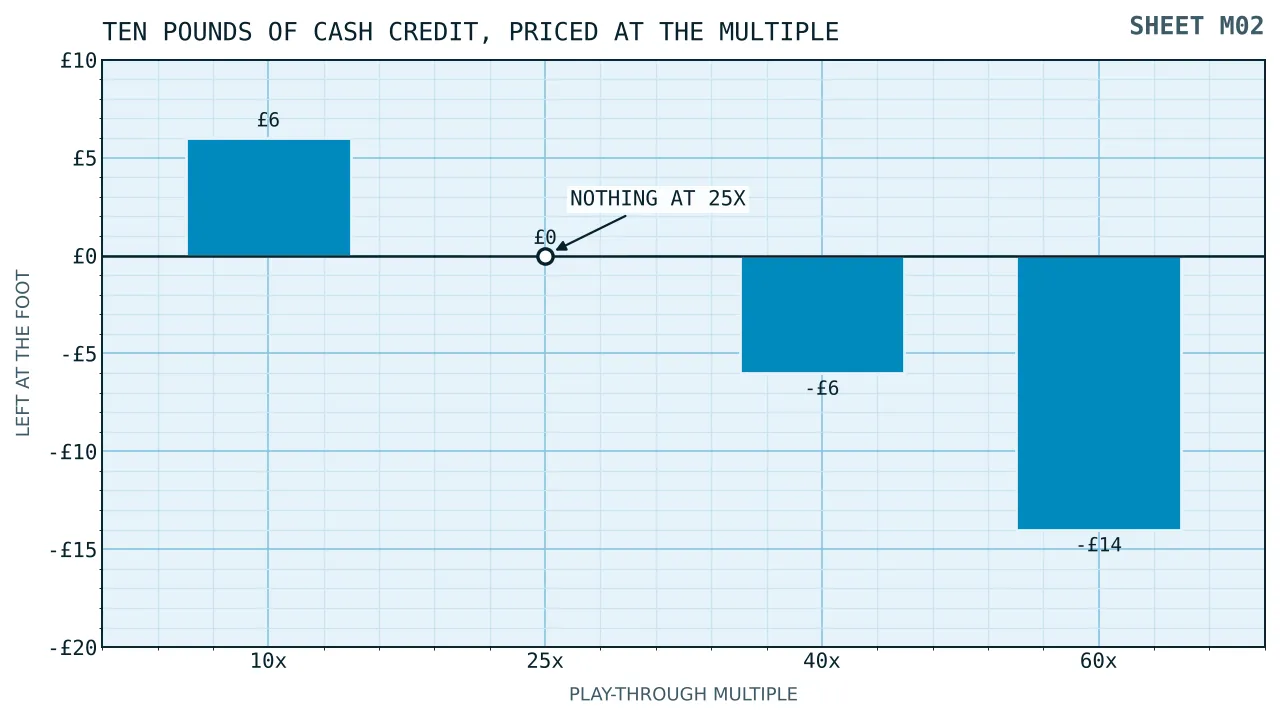
W is the term that varies far enough between documents to decide the answer by itself. Below it runs from ten to sixty with every other input pinned.
| W | Turnover owed | Edge takes | E | Closing line |
|---|---|---|---|---|
| 10 times | £100.00 | £4.00 | £6.00 | £6.00 |
| 20 times | £200.00 | £8.00 | £2.00 | £2.00 |
| 25 times | £250.00 | £10.00 | £0.00 | £0.00 |
| 30 times | £300.00 | £12.00 | -£2.00 | £0.00 |
| 40 times | £400.00 | £16.00 | -£6.00 | £0.00 |
| 60 times | £600.00 | £24.00 | -£14.00 | £0.00 |
The totals expire at twenty-five, and the size of the credit has nothing to do with it. Put E at nought and B leaves both sides, which strands W as the reciprocal of the edge. Divide one by 0.04 and twenty-five falls out, for a pound as surely as for a thousand of them.
That promotes the game’s return from a detail into a lever on the terms. A 95 per cent game empties the credit by twenty times. A 97 per cent game carries it to 33.3. The first point of return is worth five on the break-even multiple and the second is worth more than eight, which is a large consequence for a figure that bonus terms and game information are rarely printed next to each other.
4
Turnover is a sum of money
Read the expression again and notice the absent term. Stake size is nowhere in it. Turnover owed works out as W × B / g, which is pounds, and pounds do not care how many bets they arrive in. Betting larger buys back the evening, not the obligation.
Count it out at 10p a cycle and £400.00 comes to 4,000 cycles. On a British licence, slot cycles are spaced, because RTS 14D will not allow a further cycle to begin until 2.5 seconds have gone by. Four thousand of them therefore take up 10,000 seconds as an absolute floor: two hours, forty-six minutes and a final forty seconds.
Stake 50p instead and the identical £400.00 is reached in 800 cycles and thirty-three minutes. The expected price is unchanged at £16.00, and so is the nought at the bottom.
Those cycles also have to be asked for singly. Under RTS 8A a gaming system may not begin a cycle unless the customer has committed to that cycle, and the guidance spares one case only, where a poker table between players posts its blinds without being asked. So four thousand cycles means four thousand decisions to go on.
4,000 cycles, 2 hours 46 minutes 40 seconds, as a minimum
Which puts the expiry clause in proportion on a credit of this size. A day of play at the 2.5-second spacing runs to 34,560 cycles, worth roughly £3,456.00 of turnover at 10p, so a twenty-four hour clock is eight times longer than this obligation needs. The window is not what decides a ten pound credit. It becomes decisive once the headline grows, which is the subject of 100 free welcome bonus no deposit required.
5
Contribution, the uncapped term
g is the term readers skip and the one most able to turn a survivable requirement into a dead one. It is the proportion of each staked pound credited towards the requirement, and below one it inflates the staking without touching what is owed.
Put the available games at 30 per cent. The requirement is unmoved: forty times ten pounds remains £400.00 of contribution. Arriving at that contribution now costs £1,333.33 of staking, because a pound across the game is written down to thirty pence.
With g at 0.30, the bracket becomes 1 – 1.60 / 0.30, or 1 – 5.3333.
Ten pounds multiplied by -4.3333 gives E = -£43.33.
The edge expects £53.33 out of that staking. Against ten pounds of credit the shortfall widens from six pounds to £43.33, better than seven times worse, and the number on the front of the offer never moved.
Leave the weighting there and pull W down to ten, which is as high as a British licence permits. Contribution owed drops to £100.00, staking to £333.33, expected price to £13.33, and E settles at -£3.33. A requirement sitting well inside the regulated limit can still come to nothing once contribution works against it. W has a ceiling over it. g has none.
£1,333.33 of staking to clear £400.00 of contribution at 30 per cent
Thirty per cent is a worked rate and has to be read as one. It reaches this sheet from the Commission’s consultation response, where a respondent illustrated the point with a pound putting thirty pence towards a requirement. The regulator noted the illustration and did not go on to regulate weighting. Nothing published anywhere gives a current schedule of contribution rates, so the lines above are arithmetic run against that quoted rate rather than a statement about any cashier.
6
The ceiling on W and the ban on mixing
Nothing above depends on who is dealing. The sums come out the same in any jurisdiction, and what changes across the line is the rulebook underneath them. A cashier operating out here holds no Great Britain licence, so the pair of rules that began on 19 January 2026 reaches it nowhere whatever.
Ten times, and what ten times would do here
The cap written into Social Responsibility Code 5.1.1 keeps a British licensee at ten times the bonus funds and no turnover beyond it. Its definition of the thing being capped covers wagers that have to reach a stated total before money can be taken out, which is what this sheet has been calling turnover owed. Put the regulated ceiling on ten pounds and the figures invert: £100.00 across the tables, £4.00 expected to stay with the house, and £6.00 of the credit coming through intact. The regulator put its reason in a single figure, recording that requirements as high as sixty times were then being applied. Sixty times a ten pound credit demands £600.00 of turnover, leaving the credit fourteen pounds short. Only gaming machine technical and software licences fall outside the cap, which means it reaches every remote casino licence issued here.
One qualification belongs with it. The provision speaks of bonus funds, and that is the whole of its language. A page cannot responsibly say the ceiling catches a free spin in its own right, nor that it misses one, because neither has been published. The narrower statement is still useful: once a spin’s winnings have been credited as bonus funds, ten times is the furthest the requirement on them may go.
One product to a promotion
The companion rule, in force the same day, stops a licensee folding more than one type of gambling product into a single incentive. Lottery, bingo, casino and betting are the four it names. A slot is a casino product, so slot spins beside a cash credit remain inside one type, while bingo tickets beside the same credit put a foot in two. Three carve-outs run against the instinct here. Two products of the same type are fine, and the regulator’s illustration pairs a scratchcard with a raffle. A single email may carry a casino offer and a betting offer where the recipient has opted in on both counts. And an open credit, spendable on whichever product its holder prefers, is untouched by the ban: the example given is ten pounds good across betting and casino.
Neither rule has a counterpart in the responsible gaming policy that Curaçao issues to the operators it licenses. Promotions get two sentences in that document and no more: terms are to be clear and transparently communicated, and operators are not to push excessive play by promoting aggressively. Nothing in it caps a multiple, nothing forbids several products inside one incentive, and nothing enumerates the conditions that count as significant. In one respect the island’s document goes further than ours. It holds the operator answerable for its affiliates through binding contracts, compliance audits and penalties, whereas British advertising guidance addresses third parties only over where an advertisement is placed.
7
Lines the expression never sees
E prices the requirement and stops there. Two further clauses, common enough to expect and absent from the arithmetic, can take the answer to nothing without any help from W.
A limit on what the credit may win
Nobody has published a standard ceiling on bonus winnings, and none is invented here. The shape repays straightening, because two protections get run together constantly. One of them is real and covers deposited money. British licensees are shut out of any term that caps what a customer draws from a deposit balance, and the clause the regulator offers as forbidden allows fifty pounds daily and five hundred weekly. The other does not exist. Capping the payout from a bonus is a different object entirely, outside the reach of that withdrawal rule, and the same cashier may respect the one while writing the other.
A discretion wide enough to cancel everything
Fafabet is a trading name of Taichi Tech Limited, and a penalty of £170,000 reached it on 3 July 2025 over wording in the bonus rules written for its new casino promotions. By that wording the operator kept a discretion to close accounts or confiscate winnings. The condition held to have been breached was the one on fair and open dealing; the regulator’s view was that such terms are wanting in transparency and capable of producing unfair outcomes; and an independent audit was imposed covering the operator’s safer gambling arrangements together with its controls against money laundering. Nothing else sourced for this site lands so squarely on the terms of a casino promotion. The clause was not declared void. A penalty landed on the operator, and striking out the wording is a separate matter altogether.
Read against the arithmetic, a clause of that shape is a term with no number in it at all, which is precisely why it does not appear in E. Every figure on this sheet assumes the credit survives to be played and the winnings survive to be paid. A discretion to close an account prices both assumptions at whatever the operator decides on the day.
8
Per pound, and what to read off a document
Five lines, and the middle two are the ones nobody does.
| Line | Per £1, at 40x |
|---|---|
| The credit, as cash | £1.00 |
| Turnover owed, W over g | £40.00 |
| Edge of that turnover | £1.60 |
| Credit less edge | -£0.60 |
| Floored at nought | £0.00 |
Per pound is the portable version. Forty times keeps nothing from a pound and overshoots by sixty pence. Ten times keeps sixty pence. Twenty-five keeps nothing and overshoots by nothing. Multiply whichever line fits by the credit in front of you and the total arrives in a single step.
Two cautions before anyone spends an answer.
A positive E is a mean, not a payment. Six pounds at ten times describes the average of a spread whose commonest single outcome is nothing whatever. The expression says what a credit of that shape is worth across many repetitions, and it says nothing about one credit on one evening. No rearrangement of the terms will make it say more.
The inputs are the work. Find W in the bonus terms, find g in the game contribution list, check whether winnings off the bonus are capped, note the expiry, and put the lot through part 2. The total then belongs to its reader rather than to this sheet, and where it comes to nothing, it has at least come to nothing in pounds and pence.
Three neighbouring sheets run the same five lines over different headlines: free spins no deposit, where the credit arrives as spins and gives up four per cent before a condition touches it, 10 free spins, the unit everything else on this site scales from, and slots free spins, where contribution does the damage. Everything else sits under The multiple.
Questions
- What is a £10 casino no deposit bonus worth once the wagering is priced?
- Nothing, on a forty times requirement. Ten pounds of credit owes £400.00 of turnover, and on a 96 per cent game the expected retention is four pounds in every hundred, which is £16.00. Sixteen demanded against ten supplied puts the closing line at £0.00, with six pounds of the obligation having no source.
- Why does a cash credit open higher than a round of free spins?
- Because no play is needed to turn it into money. Spins carry a headline that is never received in full: they must be run off, and a game paying 96 per cent hands back 96 pence in the pound, so the credit is four per cent smaller before any condition reaches it. Pounds posted to a bonus balance are already the figure a requirement multiplies.
- Which multiple takes a no deposit credit to nothing?
- On a 96 per cent game, twenty-five times. Put the expected cash at nought and the credit’s size falls out of both sides, stranding the multiple as one divided by the house edge. Ninety-five per cent empties it by twenty, ninety-seven carries it to 33.3, so a single point of return moves that figure by five or more.
- Does betting bigger clear the requirement for less?
- No, because stake size has no term in the calculation. Turnover owed comes out as the credit multiplied by the requirement and divided by the contribution rate, and that product is pounds rather than rounds. Staking 50p instead of 10p turns 4,000 cycles into 800 and two hours forty-six minutes into thirty-three, while the expected price stays at £16.00.
- What does a 30 per cent contribution rate do to ten pounds?
- It more than triples the staking and leaves the requirement untouched. Forty times ten pounds is still £400.00 of contribution owed, but at thirty pence in the pound that takes £1,333.33 of staking, which the edge prices at £53.33. Even a ten times requirement comes out at minus £3.33 on that rate. There is a ceiling over the multiple and none over the rate.
- Can a casino cap what the bonus itself pays out?
- Two different objects get confused here, and only one of them is barred. British licensees are shut out of any term that caps withdrawals from a deposit balance, and the clause the regulator offers as an example allows fifty pounds daily and five hundred weekly. A ceiling on what a bonus pays out is not that thing at all, and since no published source gives a standard figure for one, this sheet quotes none.
- How long does £400.00 of turnover take at 10p a cycle?
- On a British licence the floor is two hours, forty-six minutes and forty seconds. That is 4,000 cycles, and RTS 14D bars a further slot cycle from starting within 2.5 seconds of the one before, which comes to 10,000 seconds. RTS 8A also wants each cycle committed to on its own, so those are 4,000 decisions rather than one instruction.
- What does the ten times cap change about a no deposit credit?
- On these figures it turns a nought into six pounds. The cap at Social Responsibility Code 5.1.1 arrived on 19 January 2026 and keeps a British licensee at ten times the bonus funds. Ten times ten pounds asks £100.00 of turnover, of which the edge expects £4.00, and £6.00 comes through intact. A cashier operating out here holds no Great Britain licence, so nothing at all pins its multiple down.
- Can a casino bonus be mixed with bingo tickets?
- On a British licence, not inside one incentive, and offshore no rule addresses it. A licensee has been barred since 19 January 2026 from folding lottery, bingo, casino and betting, more than one of them, into a single incentive. A slot counts as casino, so slot spins beside a cash credit keep to one type. Two products of the same type are allowed, a casino offer and a betting offer may share an email where the recipient opted in on both counts, and an open credit spendable anywhere is outside the ban.