
Sheet P06 Revision 1 Checked 15 October 2026
Best gambling sites
A credit of £22.00 is expected to leave £13.20 where a staked pound counts as a pound and the requirement halts at ten turnovers. Hand the identical credit to a room counting at ten pence in the pound and the overrun is £330.00.
A room clears 25 turnovers at best, and most clear fewer
What the conditions leave
Every destination on this spike is bought advertising. The site takes a fee if a reader goes on to register, and no figure printed below moves because of it.
The Spin Sheet
Till receipt No 01
Betportal
Lowest multiple here
For every €1 of spin credit at face per €1
Credit
Debit
No Great Britain licence
Licensed in Anjouan, Comoros, run by BetPortal Gaming Ltd, with Excite Ultra Media Ltd, reference ALSI-202601040-FI2.
Terms read 15 October 2026
Open the offer at Betportal, opens in a new tabThe Spin Sheet
Till receipt No 02
WinBeast
Five staged matches
For every €1 of spin credit at face per €1
Credit
Debit
No Great Britain licence
Licensed in Curaçao, operator not named on the site.
Terms read 15 October 2026
Open the offer at WinBeast, opens in a new tabThe Spin Sheet
Till receipt No 03
EliteSpin
Longest spin window
For every £1 of spin credit at face per £1
Credit
Debit
No Great Britain licence
Licensed in Costa Rica, run by PrimeTier Limited.
Terms read 15 October 2026
Open the offer at EliteSpin, opens in a new tabThe Spin Sheet
Till receipt No 04
Crown Jewelz
Multiple unpublished
No total struck
Credit
Debit
No Great Britain licence
Licensed in Curaçao, number not verified, operator not named on the site.
Terms read 15 October 2026
Open the offer at Crown Jewelz, opens in a new tabThe figure at the foot of a receipt is this site's own arithmetic and nothing an operator has published: the credit, less the share a spin gives back at 96 per cent return to player, less what playing the wagering through costs at the same return. It describes the offer, not one reader's afternoon. Where the conditions price above the credit the receipt prints nothing rather than a negative sum, and where a figure the sum needs is unpublished it prints the condition in the operator's words instead.
Three words stand in the amount column where no figure can. Noted is a published condition that takes value away without leaving the sum a figure to take. Unpriced is a condition whose figure nobody has published, or a credit that is not a sum until a deposit of your own sets it. Own money is money of yours, which is never part of a total.
Not one of the operators printed above holds a Great Britain licence, so the duties that licence carries do not reach them. Every online gambling company licensed in Great Britain has to be part of Gamstop Online, and a reader who has shut themselves out through the scheme is therefore not shut out here. The ceiling of ten times the bonus funds on a wagering requirement, in force since 19 January 2026, is a condition of that licence and binds the companies that hold one. Where a dispute goes instead is a matter for the authority named on the receipt, and the Gambling Commission describes what a reader faces without a British licence as a lack of recourse if things go wrong. Nobody under 18 may hold an account at any of them.
Every term printed on a receipt is the operator's own, and each receipt carries the day it was read. The oldest of those readings is 15 October 2026. What binds a reader is the operator's own full terms, and not a line printed here.
1
What best has to mean once a credit is involved
A superlative attached to a whole site cannot be priced, so this sheet does not try to price one. What can be priced is the room a credit has to be spent in, and that is a narrower and far more useful question, because two sites with identical headline figures can hand a reader rooms worth £13.20 and minus £330.00 on the same arithmetic.
Scale is no help in choosing. Across April 2025 to March 2026 the remote sector covering casino, betting and bingo reported £8.3 billion, of which online casino games made up £5.7 billion and slots games £4.8 billion, on figures released on 17 September 2026. The register carried 3,097 licensed activities between 2,154 operators when it was counted at the close of March 2026. A reader choosing between that many is not choosing between operators at all. They are choosing between game lists, and a game list is arithmetic.
So the subject here is narrow and the method is one inequality. Every room has a rate at which it counts a staked pound towards a requirement, and a return it pays back on what passes through it. Those two numbers decide what a credit is worth, and neither of them appears on the front of an offer.
The inputs, and which of them a reader can actually read:
- A credit of £22.00, which is a figure a reader is given.
- Forty turnovers, the order of requirement fastened to credits of that size away from the register, with ten beside it as the British ceiling.
- A return of 96 per cent on reel-based play, assumed, because the digit belongs to a game rather than to a cashier.
- A rate, which decides the whole answer and is published by nobody.
- No deposit behind it, which leaves the credit standing as the entire exposure.
2
Twenty-two pounds, and the two numbers a room owns
The whole sheet runs off one expression, and two of its four letters belong to the room.
E = B × (1 – (W × (1 – RTP)) / g)
£22.00 stands at B. W counts the turnovers demanded, RTP is the share a room gives back, g is how much of each staked pound a room will let count, and E is the closing line in pounds and pence.
Half of them belong to the cashier and half to the room. The cashier writes the credit and writes the multiple, and both are printed where a reader can find them. The room supplies the rate and the return, and neither has to be printed anywhere near the offer.
Worked at the house figures, with a pound counting as a pound: forty lots of £22.00 make £880.00 of staking owed. A room keeping four pence of every pound expects to take £35.20 of that, which is £13.20 more than the credit was ever worth. The foot reads £0.00 and the overrun is the measure of how far the condition outran the gift.
At the British ceiling the same credit behaves differently. Ten turnovers call for £220.00 through the room, priced at £8.80, which leaves £13.20 standing. One credit, one room, two multiples, and the answer moves by £26.40 between them.
3
Clearance, the number that sorts one room from another
Divide the rate by the edge and the answer is the only figure on this site that can rank one room against another. This sheet calls it clearance: the count of turnovers a room is able to absorb before a credit is used up.
Clearance = g ÷ (1 – RTP), and it has to beat W
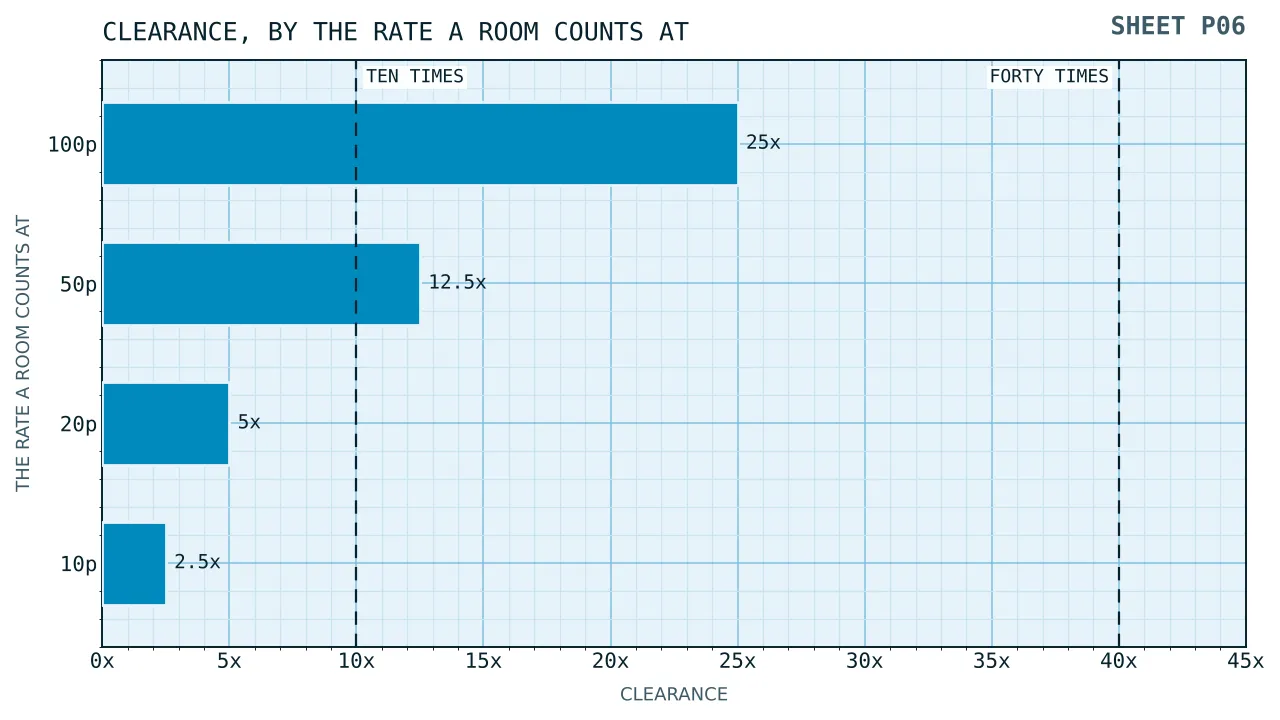
A room counting in full at a 96 per cent return has a clearance of 25.0. Halve the rate and it becomes 12.5. Take the rate to a fifth and it is 5.0, and to a tenth and it is 2.5. Lift the return instead, leaving the rate alone, and a 98 per cent room clears 50.0 while a 94 per cent room clears 16.7.
The test is then a comparison between two whole numbers rather than an arithmetic exercise. Where clearance exceeds the multiple, something reaches the foot. Where it does not, nothing does, and the only remaining question is how much staking the nothing costs. Rearranged into the form the rest of this section uses, the same condition reads g above W divided by twenty-five, twenty-five being the clearance of a room at full rate and the house return.
Twenty-five is not a choice anybody made, and it is worth knowing why. Set E to nought, cancel B from both sides, and what survives is the reciprocal of the edge. Four pence in the pound inverts to twenty-five. A room keeping two pence inverts to fifty and a room keeping six pence to 16.7, so the threshold is a property of the return quite as much as of the rate.
4
Five rooms, one credit
The credit never changes and the staking owed never changes. What changes is how much has to go through the room to earn it.
| What the room counts | Clearance | Staking for £880.00 | Expected price | Overrun at forty |
|---|---|---|---|---|
| A pound of each pound | 25.0 | £880.00 | £35.20 | £13.20 |
| Half of each pound | 12.5 | £1,760.00 | £70.40 | £48.40 |
| A fifth of each pound | 5.0 | £4,400.00 | £176.00 | £154.00 |
| A tenth of each pound | 2.5 | £8,800.00 | £352.00 | £330.00 |
| Not a penny of it | 0 | no sum reaches it | none | the credit entire |
Read down the last column and the shape of the thing is plain. Dropping the rate from a pound to a tenth multiplies the overrun by twenty-five, because the staking is a reciprocal of the rate and the price follows the staking. The step from a fifth to a tenth costs more on its own than the three steps above it put together.
Now hold the rate where it is and bring the multiple down to the figure a British licence permits. The same five rooms produce a different sort of answer, and two of them produce a positive one.
| What the room counts | E at ten | E at forty |
|---|---|---|
| A pound of each pound | £13.20 | -£13.20 |
| Half of each pound | £4.40 | -£48.40 |
| A fifth of each pound | -£22.00 | -£154.00 |
| A tenth of each pound | -£66.00 | -£330.00 |
Which is the finding this sheet exists to state. A ten-times requirement, the strictest ceiling any gambling regulator in this market has published, still fails in a room counting at a fifth. The ceiling binds the cashier. Nothing binds the room.
5
The room this ladder cannot hold
Every row above assumes a 96 per cent return, which is a reel-based assumption and nothing wider. A dealt or spun table is a different object: its return falls out of the rules of the game rather than out of a configuration file, and this sheet carries no sourced figure for any of them. So no table room goes on the ladder in part 4, and the gap is stated rather than filled.
The arithmetic still has something exact to say, by running the inequality backwards. Instead of asking what a room is worth, ask what return it would need before it was worth anything. The condition rearranges to a return above one minus the rate divided by the multiple.
At ten turnovers and a tenth of a pound counted, that is a return above 99.0 per cent. At forty turnovers and the same rate it is 99.75 per cent. At forty turnovers with a pound counting in full it is 97.5 per cent. Those are crossing values, not claims about any table, and they are what the sheet can honestly supply where the return is unpublished.
The whole of that calculation, rate by rate and multiple by multiple, is set out on live casino UK, where the unpublished return is the subject rather than a footnote.
A tenth-rate room needs 99.0 per cent to survive ten turnovers
6
What paces which room
A British licence does not touch the rate, and that is this sheet’s central complaint. What it does touch is everything around the rate, and it touches different rooms differently. The schedule below is the licensed estate set out by room rather than by rulebook, which is the order a reader needs it in.
| The duty | The room it reaches |
|---|---|
| 2.5 seconds between one cycle and the next | Reel-based games |
| 5 seconds between one cycle and the next | Casino play that is not reel-based, poker between players excepted |
| £5.00 a cycle, and £2.00 below the age of 25 | Reel-based games alone |
| No cycle committed to on a player’s behalf | Gaming, bingo included |
| No turbo, no slam stop, no shortened wait | The casino |
| No fanfare where a return fails to beat the stake | The casino |
| No functionality for two games at once | Casino, with poker between players left out |
| No losing result dressed as a near miss | Games generally |
| Ten turnovers of bonus funds at the most | Any incentive a licensee offers |
Two details in that schedule are worth drawing out, because both are read too widely elsewhere. The stake ceilings and the shorter interval are written about reel-based games and go no further: the regulator’s guidance confines the limits to online slots and names blackjack and roulette among the games they leave alone. And the longer interval, five seconds, is the one that reaches a dealt or spun table.
A room away from the British register is paced by none of it. An offshore room of that sort holds no Great Britain licence, which turns the schedule above from a comparison into an inventory of what is missing. In the island rulebook consulted for this build there is no stake ceiling, no multiple ceiling, no minimum interval, and not one word about the rate at which a game counts. Two sentences in it touch bonuses at all. One asks for clear terms. The other asks that promotion not push play to excess.
7
What the licence is worth in pounds
Ranking sites is a reader’s instinct and checking one is the regulator’s advice, and the two are not the same activity. What is published is a register covering licensed businesses, individuals, premises and regulatory action, each of the first three searchable and downloadable. Nothing published explains how to read a domain name listed against a licensee, or what an active entry signifies, so a sheet leaning on register data has to date its own reading of it.
Four checks are asked for, and the order they are given in is not the order they matter in: a Commission licence held, that status shown on the site, a route through to the register, and agreement between register and licence on activities and on domain names. Those are four checks on a room’s address, and none of them looks at its arithmetic.
Enforcement, by contrast, is published as money, which makes it the one part of this comparison that can be counted. Penalties are published with their dates, £10m on 22 October 2025 and £4.75m on 23 July 2026 among them, with five suspensions falling between 30 October 2025 and 21 September 2026. Operating these facilities with no Commission licence is unlawful, and two consequences follow in the regulator’s own account: enforcement aimed at the operator, and payment facilities pulled by the major payment systems organisations.
None of which answers the question a reader actually has, so here it is answered in pounds. The licence is worth exactly the difference the ten-turnover ceiling makes to E, and that difference depends on the room. Put the ceiling on this credit in a room counting a pound as a pound and the line moves from minus £13.20 to plus £13.20, a swing of £26.40 on £22.00 of credit. Where half of each pound counts, the swing is £52.80, from minus £48.40 to plus £4.40.
In a room counting a tenth the same ceiling moves the line from minus £330.00 to minus £66.00, a swing of £264.00 that still leaves nothing at the foot. So the licence is worth most where the room is already good, and worth nothing at all where the room is bad. Which is the honest version of the commercial argument on a page with this title: a licence does not fix a room, and a reader who reads the game list first has done the more useful half of the work.
One protection has no arithmetic at all behind it and is still the largest single thing on this sheet. Membership of the national self-exclusion scheme is set by the British licence rather than by the site, which is the hinge this whole comparison turns on. The scheme marks its own edge, stating that where an organisation takes no part in it the scheme is unable to keep a registered person away from that organisation’s services. When it published half-year figures on 16 July 2026, the five-year option accounted for over half of all registrations, the six-month one for a quarter across every age, and for 38 per cent of registrations by the under-25s.
8
Reading a room before the credit lands
Four readings settle it, and the order matters because the cheapest one to find is the least decisive.
Start with the multiple, which the bonus terms print. Then find the game list, which is usually a separate document, and read the rate attached to the games the credit may actually be spent on rather than the best rate in the list. Then the return, which belongs to the game and may be given as a house edge, as a probability, or as a plain account of how a winner is settled, because the standard offers alternatives rather than demanding a percentage. Then divide the rate by the edge and compare the answer with the multiple.
On this sheet’s figures that sequence gives 40, then a rate somewhere between a tenth and a pound, then 96 per cent, then a clearance between 2.5 and 25.0 against a requirement of 40. The requirement wins in every version, which is the honest summary of a forty-times credit wherever it is spent.
Three limits on all of this, stated so that nobody reads the sheet as a forecast. The figures are means, and the commonest single result of a small credit is nothing whatever, so a mean describes a long run of such credits and not one evening. A condition sitting outside that expression can close the answer with the rate, the return and the multiple all untouched: a win ceiling written over the bonus, or a discretion the cashier held back for itself. And a rate is a commercial choice that moves: nothing published anywhere records the rates in use, so every rate on this sheet is an input rather than a finding.
Rooms taken one at a time, with the same arithmetic: online slots UK prices the reel-based room where the rate is usually a pound and the pace is statutory, online bingo takes a room whose return is settled by how many are in it, and mobile casinos asks what a handset changes. The room gathers the sheets that turn on where a credit must be spent.
Questions
- Which gambling site is best for a bonus?
- That is not a question arithmetic can answer, because a site is not what prices a credit. The room is. A £22.00 credit at forty turnovers is expected to leave nothing wherever it is spent, while the same credit at ten turnovers leaves £13.20 in a room counting a pound as a pound and minus £66.00 in a room counting a tenth. Two sites printing identical headlines can differ by £79.20 on that line alone.
- What is clearance, and how do I work it out?
- It is the rate at which a room counts a staked pound, divided by the edge the room keeps. At a pound counted in full and a 96 per cent return the answer is 25.0, meaning the room can absorb twenty-five turnovers before the credit is used up. Halving the rate halves it to 12.5. A tenth takes it to 2.5. Compare the answer with the multiple in the bonus terms, and if the multiple is larger there is nothing at the foot.
- Why does the rate matter more than the multiple?
- Because it divides rather than adds. The staking owed stays at £880.00 on this credit whatever the rate, but earning it takes £880.00 of play at a pound counted in full and £8,800.00 at a tenth. Dropping the rate from a pound to a tenth multiplies the overrun by twenty-five, from £13.20 to £330.00, with the advertised figure and the wagering line both unchanged.
- Does the ten times ceiling make an offer survivable?
- Only in a room with the clearance for it. Ten turnovers on £22.00 leave £13.20 where a pound counts in full and £4.40 where half of it counts, but minus £22.00 at a fifth and minus £66.00 at a tenth. The ceiling binds what a British cashier may demand. No published rule anywhere binds the rate at which a game counts towards the demand.
- Why is there no return to player figure for a table game here?
- Because no source in this site’s evidence file carries one, and an unsourced digit is not printed here. What the arithmetic can supply instead is the crossing value, which is the figure a table would need to return before anything survived. At ten turnovers with a tenth of a pound counted that is 99.0 per cent, and at forty turnovers it is 99.75 per cent.
- Which rules apply to which room?
- The 2.5 second interval and the £5.00 and £2.00 stake ceilings are written about reel-based games and reach nothing else, the regulator’s guidance naming blackjack and roulette among the games the limits leave alone. The 5 second interval reaches casino play that is not reel-based, poker between players excepted. The bars on automatic play, on turbo, on two games at once and on a losing result dressed as a near miss run wider, and the ten-turnover ceiling attaches to any incentive a licensee offers.
- What is a British licence worth on a credit of this size?
- Exactly the difference its ten-turnover ceiling makes to the closing line, which depends on the room. In a room counting a pound as a pound the swing is £26.40, from minus £13.20 to plus £13.20. Where half of each pound counts it is £52.80. In a room counting a tenth it is £264.00 and the line is still minus £66.00, so the ceiling cannot rescue a bad room. A licence also puts the site inside the national self-exclusion scheme, which no offshore licence does.
- What should I read first in a set of bonus terms?
- The game list, not the headline. The multiple is printed where anyone can find it and the credit is printed larger still, but the rate attached to whichever games the credit is confined to sits in a separate document and decides the whole answer. Read the rate for the games actually permitted rather than the best rate in the list, divide it by the edge, and compare the result with the multiple.