
Sheet O Revision 1 Checked 15 October 2026
Off the register
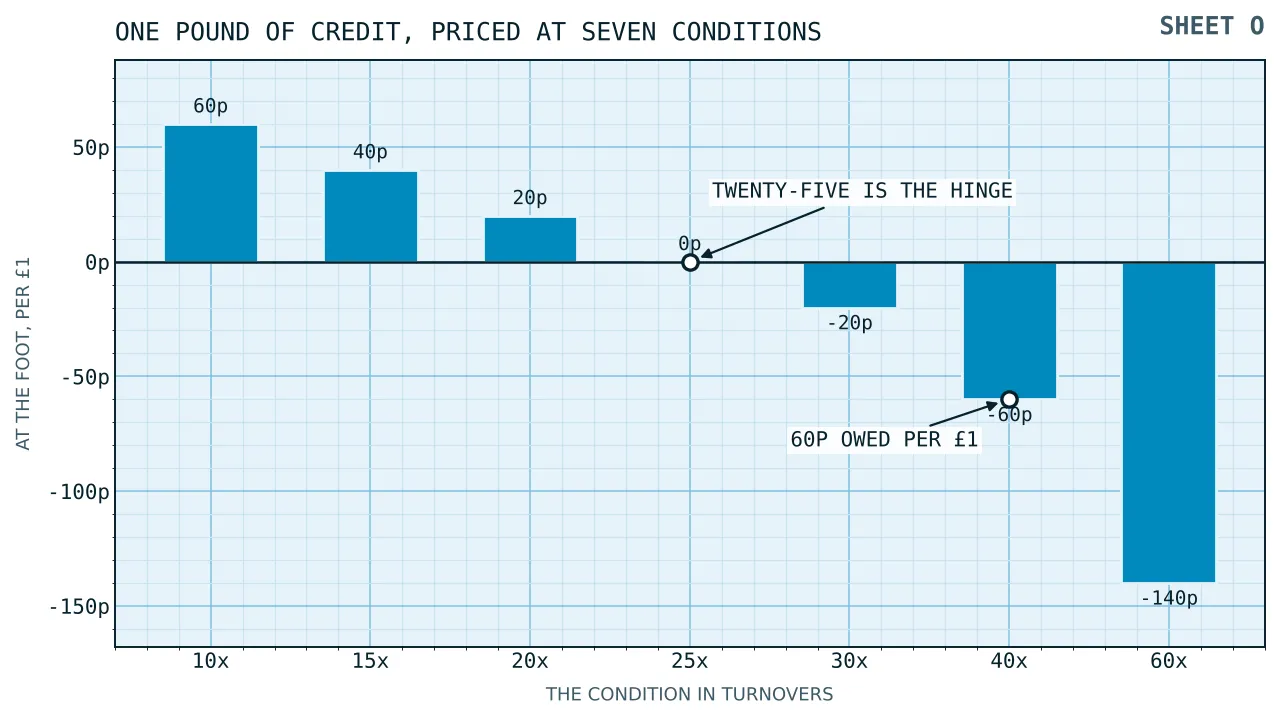
A pound of credit is worth 60p where ten turnovers is the ceiling, nothing at twenty-five, and minus 60p at forty. Multiply that last figure by the credit and the whole of this section is priced: £40.00 of credit owes £24.00 at forty turnovers, and a headline of four hundred per cent owes £96.00. A percentage multiplies whichever sign the multiple has put in front of it.
60p kept per pound at ten turnovers, 60p owed per pound at forty
What the absences leave at the foot
Every destination on this spike is bought advertising. The site takes a fee if a reader goes on to register, and no figure printed below moves because of it.
The Spin Sheet
Till receipt No 01
Betportal
Lowest multiple here
For every €1 of spin credit at face per €1
Credit
Debit
No Great Britain licence
Licensed in Anjouan, Comoros, run by BetPortal Gaming Ltd, with Excite Ultra Media Ltd, reference ALSI-202601040-FI2.
Terms read 15 October 2026
Open the offer at Betportal, opens in a new tabThe Spin Sheet
Till receipt No 02
WinBeast
Five staged matches
For every €1 of spin credit at face per €1
Credit
Debit
No Great Britain licence
Licensed in Curaçao, operator not named on the site.
Terms read 15 October 2026
Open the offer at WinBeast, opens in a new tabThe Spin Sheet
Till receipt No 03
EliteSpin
Longest spin window
For every £1 of spin credit at face per £1
Credit
Debit
No Great Britain licence
Licensed in Costa Rica, run by PrimeTier Limited.
Terms read 15 October 2026
Open the offer at EliteSpin, opens in a new tabThe Spin Sheet
Till receipt No 04
Crown Jewelz
Multiple unpublished
No total struck
Credit
Debit
No Great Britain licence
Licensed in Curaçao, number not verified, operator not named on the site.
Terms read 15 October 2026
Open the offer at Crown Jewelz, opens in a new tabThe figure at the foot of a receipt is this site's own arithmetic and nothing an operator has published: the credit, less the share a spin gives back at 96 per cent return to player, less what playing the wagering through costs at the same return. It describes the offer, not one reader's afternoon. Where the conditions price above the credit the receipt prints nothing rather than a negative sum, and where a figure the sum needs is unpublished it prints the condition in the operator's words instead.
Three words stand in the amount column where no figure can. Noted is a published condition that takes value away without leaving the sum a figure to take. Unpriced is a condition whose figure nobody has published, or a credit that is not a sum until a deposit of your own sets it. Own money is money of yours, which is never part of a total.
Not one of the operators printed above holds a Great Britain licence, so the duties that licence carries do not reach them. Every online gambling company licensed in Great Britain has to be part of Gamstop Online, and a reader who has shut themselves out through the scheme is therefore not shut out here. The ceiling of ten times the bonus funds on a wagering requirement, in force since 19 January 2026, is a condition of that licence and binds the companies that hold one. Where a dispute goes instead is a matter for the authority named on the receipt, and the Gambling Commission describes what a reader faces without a British licence as a lack of recourse if things go wrong. Nobody under 18 may hold an account at any of them.
Every term printed on a receipt is the operator's own, and each receipt carries the day it was read. The oldest of those readings is 15 October 2026. What binds a reader is the operator's own full terms, and not a line printed here.
1
Where the edge of the register falls
Two words in the name of this section are doing different jobs, and only one of them is about a company. The register is the national self-exclusion scheme, and what puts a company on it is a licence rather than a decision.
Membership is compulsory for the holder of a British online gambling licence. That one rule is what draws the boundary, so the edge of the scheme sits exactly where the edge of the licence sits.
Gamstop is how the scheme writes itself. November 2025 brought a refreshed identity and the longer form, Gamstop Online, while the typed phrase a reader arrives on usually keeps the old capitals. Registration costs nothing and blocks the registrant’s accounts across gambling sites and gambling apps alike.
The limit is stated by the scheme and not inferred here. Where an operator participates, exclusion is something it says it can assist with. Where a business has stayed outside, it says plainly that stopping access is not within its power.
Every key in this section points at companies holding no Great Britain licence. Such a licence is not a compliment. It is a list of obligations, most of them carrying a number or a date, and part 6 prints twenty of them.
Twelve sheets hang under this one. Each takes one key, fixes a deposit, and prices the same absences against it in pounds and pence. Not one line here, or on any of the twelve, helps a person get back behind a door they closed on themselves. A bank’s gambling block, a bar on a phone bill and blocking software on a device are protections of exactly the same kind, and nothing here is of any use against one.
Fixed for this sheet, with the reason beside each:
- A credit of one pound as the unit, because every figure in this section is that figure multiplied.
- Ten pence a cycle, and a reel giving back 96 pence of the pound, which prices one turnover at four pence per pound of credit.
- Forty turnovers as the working condition, that order of figure being what gets drafted once no ceiling is being enforced, with ten alongside it as the licensed maximum.
- A weighting of one, slots counting whole against a condition.
- A deposit of £40.00 wherever a deposit is needed, with the headline run from a flat match up to four hundred per cent.
2
One pound, priced seven times
Price one pound of credit and the section follows at scale. One expression does the work on every sheet here, and of its four terms only the multiple is the cashier’s to choose.
E = B × (1 – (W × (1 – RTP)) / g)
Set the credit at a pound, the return at 0.96 and the weight at one.
Ten turnovers then wants £10.00 of staking, four per cent of which is 40p, so 60p of the pound reaches the foot. Twenty-five turnovers wants £25.00 of staking at £1.00 of expected cost, which is the pound exactly, so nothing reaches the foot.
Forty turnovers wants £40.00 of staking at £1.60 of cost. A pound pays for the first £25.00 of that and is then spent, which leaves 60p of cost to be carried by whatever stands behind it.
Sixty turnovers, which is the figure the regulator itself reported seeing when it explained why a ceiling was needed, wants £60.00 of staking at £2.40, and owes £1.40 for every pound credited.
| The condition in turnovers | Staking per pound of credit | Expected cost per pound | At the foot, per pound |
|---|---|---|---|
| Ten, the licensed ceiling | £10.00 | 40p | 60p kept |
| Fifteen | £15.00 | 60p | 40p kept |
| Twenty | £20.00 | 80p | 20p kept |
| Twenty-five, where it turns | £25.00 | £1.00 | nothing |
| Thirty | £30.00 | £1.20 | 20p owed |
| Forty, the figure used here | £40.00 | £1.60 | 60p owed |
| Sixty, reported by the regulator | £60.00 | £2.40 | £1.40 owed |
Twenty-five is therefore the hinge, and it is a property of the return rather than of anybody’s rulebook. Multiply the closing figure by the credit and every total in this section falls out, so the twelve sheets underneath are twelve substitutions.
3
A taller headline past the crossing
Percentages are what get compared, for the simple reason that the percentage is set in the biggest type. But the percentage is not what a ceiling binds. A ceiling binds the multiple. Lift the percentage and the credit lifts with it, the staking owed lifts by the same proportion, and the ratio between the two is where it was.
Which is harmless while the ratio is positive and ruinous once it is not. Past twenty-five turnovers the figure at the foot is a debit, and a percentage multiplies a debit quite as willingly as it multiplies a credit. So the taller headline, which is the thing this corner of the market prints largest, is the deeper hole once nothing is holding the multiple down.
| The headline in words | Credit | Kept at ten turnovers | Owed at forty turnovers | Owed at sixty |
|---|---|---|---|---|
| A flat match | £40.00 | £24.00 | £24.00 | £56.00 |
| Twice the deposit | £80.00 | £48.00 | £48.00 | £112.00 |
| Three times over | £120.00 | £72.00 | £72.00 | £168.00 |
| Four times over | £160.00 | £96.00 | £96.00 | £224.00 |
Nineteenth of January 2026 is the date ten acquired, and the provision behind it speaks of bonus funds and of the point at which those funds become withdrawable. No published source decides whether a credit of spins is bonus funds in that sense, and this sheet declines to decide it either. The sayable part is narrower. Ten bounds the turnover demanded of spin winnings in the one case where those winnings arrive as bonus funds.
4
Twelve sheets, one question each
Twelve sheets, sorted by which word in the key is doing the work.
Where an adjective is doing the work
What a superlative can be measured in, with the measurement taken in pounds, is at best non gamstop casinos. How much smaller the word independent makes an exclusion is shown at independent casinos not on gamstop. Which rules follow the player and which follow the company is settled at non uk casinos. What happens to all of this once the stake assumption has to move is at high roller online casinos.
Where a question has been postponed rather than dropped
What moving the identity question to the exit puts at stake, and why the figure is the whole balance, is at no kyc casinos. The same question from the other side, with the waiting priced, is at no verification casinos.
Where the round itself is the subject
What the absence of a clock and a stake ceiling does to a bankroll is counted at slots not on gamstop. Who funds the tail of a condition when no deposit stands behind the spins is answered at non gamstop casinos no deposit bonus.
Where the cost is in the carrying
What a wallet charges to send a balance home, as a share of the best case, is at non gamstop paypal casinos. A voucher’s face value against the sum somebody had in mind is priced at non gamstop paysafe casinos. What a charge to a mobile account cannot do in reverse is at non gamstop pay by phone casinos.
Where one rulebook is opened and read
One named rulebook, read line by line for what it holds and what it omits, is at non gamstop curacao casino sites.
5
One rulebook, read both ways
Calling the far side of the line unregulated is wrong about the jurisdiction that most often stands behind a cashier out there, and a page that says so is arguing instead of measuring.
Nineteen ninety-nine is the year the authority there was incorporated, as a foundation, covering the whole of the gaming industry in and from the territory, and it traces itself to a mutual evaluation report of the year before. Its governing ordinance has 24 December 2024 as the date it took effect, a date its own pages give twice and contradict once with a 2025 version. At the moment this build looked at the site, its online gaming portal was described as offline.
Three things in that rulebook run tighter than a reader would expect, and they belong here for honesty rather than for balance. A reduction to a deposit limit bites immediately there, and an increase is held for seven days there against one day here. Four cooling-off periods are required, running three months, one month, seven days and a day, each taking effect the moment it is chosen, each selectable by product, and each reachable by one click without an email or anybody’s approval. The operator may not question the choice, may not offer reassurance that would delay it, and may not put a bonus in front of it. Affiliates are reached directly, and the instruments named are a contract that binds, an audit, and a penalty for falling short, which is further than the British regulator’s advertising pages attempt.
The complaint route exists too, and the clocks nearly agree: six months to raise one free of charge, four weeks to answer it, extendable once by a further four.
What is missing is the thing this whole section turns on. Self-exclusion is required there, but taken operator by operator. Whatever domains a single business runs are inside it, the shortest term on offer is a year, and nothing revokes it while it runs. No register spans more than one operator, and the rulebook’s answer to the rest of the market is encouragement: the player should be urged to go and do the same elsewhere.
Set that beside a scheme whose reach is drawn by a licence, and the difference is not the length of the exclusion. It is the number of places one act of excluding reaches.
Absent from it altogether: a ceiling over a multiple, a maximum on a stake, a bar on automation, a floor beneath the interval separating two cycles, and any rule at all about dressing up a return that did not beat its stake. Bonuses get two lines: terms communicated transparently, and no aggressive promotion of excess.
Three further things cannot be said here, and the reason is the same in each case. No primary source states which licence any named company holds, nor how many companies hold a given one, so this site describes what a licence requires and never attaches one to a name. A licensing body publishing on a commercial domain, naming no ordinance and no Act, had its complaint pages unreadable when they were fetched, so nothing about that route is stated here at all. For one jurisdiction cashiers name, nothing published by a regulator there could be found at all: no rulebook, no register, no complaints route. The absence is recorded as an absence.
6
Twenty figures, and what stands opposite
Twenty lines, each a figure a British licence fixes and the figure standing opposite it.
- The multiple: ten, against forty.
- One reel cycle: £5.00, against no figure.
- A reel cycle for a player under twenty-five: £2.00, against no figure.
- The gap between reel cycles: 2.5 seconds, against no figure.
- The gap on a dealt cycle: five seconds, against no figure.
- Who commits to a cycle: the customer, every time, against silence.
- The time to a result: not shortenable, against silence.
- A return at or below the stake: uncelebrated, against silence.
- A losing outcome: itself and not a near miss, against silence.
- The generator: acceptably random and uncompensated, against silence.
- Two games at once: refused, against silence.
- A term capping the deposit balance: barred four ways over, against silence.
- Cancelling a payout already requested: not to be offered, against silence.
- Identity: settled before the first cycle, against documents left to a later milestone.
- A credit card: refused, against a credit card named as a way of confirming an age.
- A financial limit: the default choice, against daily, weekly or monthly limits with seven days on an increase.
- Net deposits past £150.00 inside a month: a light-touch check, against silence.
- Product types in one incentive: one, against silence.
- A complaint: eight weeks, then a body the regulator has approved, against four weeks and one extension with the last stage the operator’s to design.
- The national scheme: compulsory for a licensee, against an exclusion taken one operator at a time.
Twenty figures on the licensed side, and nothing at all opposite fourteen of them
7
One clause, and the exit
Exactly one bonus term carries an enforcement outcome anybody has published. It is not a figure at all. It is a discretion.
A hundred and seventy thousand pounds was paid on 3 July 2025 by an operator whose new-casino bonus rules kept it a discretion: accounts could be closed, or winnings forfeited, as that operator saw fit. Fair and open dealing is the condition the regulator found breached. Transparency was what it said such terms lack, unfair consumer outcomes what it said they can produce, and what it required afterwards was an independent third party’s audit, reaching the controls on money laundering and the safer gambling controls.
Two readings follow, the second holding the first in check. Look for a clause of that shape, since nothing else in a bonus schedule has an enforcement outcome attached. But the outcome was money, not a term voided, and the difference is not one to blur.
A discretion of that kind is also where every figure on this sheet stops being useful, since each of them assumes a payout happens on request.
Great Britain is categorical about the exit. Writing such a term is barred, so is acting on one, so is pressing one, and so is hiding behind one, and the bar catches a term by its effect as surely as by its aim. Fifty pounds a day with five hundred in the week is the specimen the regulator prints as the kind that is not allowed.
Two patterns are what the regulator reports where that bar does not reach. Payouts get blocked. And withdrawal limits get pitched at heights nobody attains. The second needs no refusal in words and can be priced before a penny moves. Divide a published payout floor by the credit and the quotient is the growth somebody’s luck has to supply.
| Floor printed in the terms | Growth the balance has to supply |
|---|---|
| Fifty pounds | 1.25 times |
| One hundred pounds | 2.5 times |
| Two hundred and fifty pounds | 6.25 times |
| Five hundred pounds | 12.5 times |
One distinction needs holding. A cap over a bonus’s winnings and a cap over what leaves a deposit balance are two different objects; the British prohibition reaches the second only, and a single set of terms can carry both.
8
Who is charged, and who is not
The tax runs on residence, not on licensing, and that is the one line on this sheet that surprises people. Offer remote gaming to somebody usually resident in the United Kingdom and a British charge reaches the provider wherever the provider happens to sit. The charge lands on profit, which is what was staked less what was paid out in winnings.
The rate reads forty per cent once an accounting period starts on 1 April 2026 or later. Before that it was twenty-one per cent, dating from April 2019, with fifteen per cent in the years ahead of that. A cashier off the register therefore sits inside one British obligation and outside all twenty in part 6 at the same moment, which is a peculiar position and an entirely sourced one.
An absence is how the revenue’s manual settles the player’s side: trading is not what betting and gambling of themselves constitute, so the proceeds are not a trade’s income. A 1925 case supplies it. A man whose only living came from backing horses at starting prices was found to be carrying on no trade, and the judgment disposed of it in a sentence denying that a habit is taxable. Having a system, drawing a living from the proceeds, and studying form are each recorded as insufficient to turn the activity into a trade. No government page says in terms that winnings go untaxed, so this sheet puts no such sentence into anybody’s mouth. None of this addresses an individual’s position and none of it is advice about tax.
A British licence is also enforced with published money, which is a difference that can be shown instead of asserted. A games supplier agreed to pay four and three-quarter million pounds, the date being 23 July 2026. Six unlicensed websites within reach of British consumers had been carrying its games, and the release records large volumes of visits across roughly a year from December 2023.
Which kills a familiar inference. A licensed supplier’s game appearing on a website with no licence is something the regulator reports having seen, so recognising a reel proves nothing whatever about the cashier running it. The same published list carries a ten million pound payment on 22 October 2025 and a two million pound payment on 17 December 2025, and licence suspensions are published beside the penalties.
Candour runs both ways in the regulator’s own account. The revenue at stake makes full dismantling of the ecosystem unlikely, it says. And where it had targeted a hundred and sixty sites, the traffic assessment came back 32 per cent down.
One further point belongs here because readers get it wrong in both directions. Unlicensed provision of gambling facilities is an offence drafted around the provider. No companion offence for the person playing exists in the Act. Up to fifty-one weeks of imprisonment, or a fine on the standard scale at level five, or both at once, with the Scottish reading of those weeks being six months. Running a gambling business without the Commission’s licence is acting illegally, and action against the operator is one of the two consequences the regulator names. So what is surrendered at a cashier of that sort is twenty lines of protection, and not anybody’s liberty.
9
If a registration is the reason
A share of the people typing these phrases hold a live registration and have discovered that it does what it says. This last part is written for them. Nothing above it matters as much, and nothing in it is a way round anything.
Take the figures first, because the figures are the argument and they do not need any help. A pound of credit owes 60p at forty turnovers. Forty pounds of credit owes £24.00. Four hundred per cent on a forty pound deposit owes £96.00, and the taller the headline the larger that figure gets.
Set against those debits is a cashier at which the multiple has no upper figure, the cycle has no upper figure, nothing bars a term from capping a balance, no payout is owed on request, and nothing the British regulator has approved is in reach. There is no arrangement of those figures in which the offer is worth a registration defeated. An adjective in the key changes none of it, since the missing lines are the same wherever the deposit lands.
Published, free, and effective, in three items:
- The helpline. GamCare’s is the National Gambling Helpline, free to ring and answered at any hour on any day in the year. The number: 0808 8020 133. Beside the telephone there are live chat and WhatsApp. A call about somebody else is taken on the same terms as a call about yourself, and the number reads +44 8088 020 133 from outside the country.
- The blocking software. Gamban works in layers, reaching tens of thousands of gambling websites and gambling apps, and a single licence installs it on every major platform, by way of the Apple and Google stores. Its own pages advertise a seven-day trial and no British route at no cost, which is why the free route is published by somebody else.
- TalkBanStop, which is where the free British route is published. Three letters, three bodies: Talk is GamCare, Stop is the national scheme, and Ban is the software. GamCare publishes that the software is at no charge to anybody ringing the helpline, and to anybody inside its own support or treatment. April 2021 is the date on that page, the twelfth of it, and it fixes no duration on the free access, so none is fixed here.
The scheme’s own terms, last updated on 20 May 2026, describe a registration that holds. A registration will not come off before its minimum period has run, a point the terms make in capitals. Neither does it fall away on its own. Leave it alone when a minimum period ends and it runs on, by as much as seven more years. The alternatives are a fresh period of five years, of one year or of six months, or a deliberate deactivation taken through the contact centre, which carries a cooling-off of at least a day with the exclusion live right through it. Seven years after a deactivation the scheme is still telling operators that the person once self-excluded, and across those years they carry no duty to keep that person out.
Four periods are offered when somebody registers: five years with automatic renewal, five years without, a year, and six months. The renewal can be turned off only once a five-year term has reached its final six months. Those are the mechanics of a protection working, set out so that a reader can use it rather than wonder about it.
Six hundred and fourteen thousand seven hundred and thirty-eight consumers were registered when the scheme last published, on 16 July 2026. Across that half-year registrations were up sixteen per cent, and May’s 12,236 was a record for a month. More than half took the full five years. A quarter took the shortest term, and among registrants under twenty-five that figure was 38 per cent, in a group whose registrations were 26 per cent up on the year and which supplies something near a third of every self-exclusion. Seven in ten of the new registrations and more were men.
The other six sections are cut by whichever debit decides the bottom line. The multiple is for offers settled by the play-through alone, and Nothing asked back is for offers carrying none of it. Matched money prices a credit against a reader’s own pound, and The floor takes the smallest sum a cashier will accept. The rail prices the journey in and out, and The room prices the divisor underneath the condition. Staying in control is this site’s sheet about holding on to a protection, and the front of the whole set is The Spin Sheet.
Questions
- What does being away from the register actually mean?
- It means a company that holds no Great Britain licence, and therefore a company the national self-exclusion scheme has no hold over. Membership is compulsory for the holder of a British online gambling licence, so one rule draws both edges at once. The scheme states its own limit rather than leaving it to be guessed: where an operator participates, exclusion is something it says it can assist with, and where a business has stayed outside, it says plainly that stopping access is not within its power. That is a statement of how far a protection reaches.
- What is a pound of credit worth away from the register?
- Sixty pence where ten turnovers is the ceiling, nothing at twenty-five, and minus sixty pence at forty. Ten turnovers wants £10.00 of staking, four per cent of which is 40p, so 60p of the pound survives. Twenty-five turnovers wants £25.00 of staking at £1.00 of cost, which is the pound entire. Forty turnovers wants £40.00 at £1.60, the pound covers the first £25.00 and dies, and 60p of cost falls on whatever stands behind it. Multiply by the credit and every total in this section falls out.
- Why is a taller headline worse rather than better?
- Because the percentage is not what a ceiling binds. A ceiling binds the multiple. Lift the percentage and the credit lifts with it, the staking owed lifts by the same proportion, and the ratio between the two is where it was. That is harmless while the figure at the foot is positive. Past twenty-five turnovers it is a debit, and a percentage multiplies a debit quite as willingly as it multiplies a credit. On a forty pound deposit a flat match owes £24.00 at forty turnovers and four hundred per cent owes £96.00.
- Is the far side of the line simply unregulated?
- No, and a page saying so would be arguing instead of measuring. On one point the commonest rulebook out there is the stricter of the two: a reduction to a deposit limit bites immediately there, and an increase is held for seven days there against one day here. It requires four cooling-off periods, each reachable by one click. It binds affiliates by contract, audit and penalty. What it has nowhere is a ceiling over a multiple, a maximum on a stake, a bar on automation or a floor beneath the interval separating two cycles.
- How far does one act of excluding reach out there?
- To the edge of a single business, and no further. Self-exclusion is required there, but taken operator by operator. Whatever domains a single business runs are inside it, the shortest term on offer is a year, and nothing revokes it while it runs. No register spans more than one operator, and the rulebook’s answer to the rest of the market is encouragement: the player should be urged to go and do the same elsewhere. Against a scheme whose reach is drawn by a licence, the difference is not the length of the exclusion but the number of places one act of excluding covers.
- Is there a complaints route at all?
- There is, and the clocks nearly agree. Six months to raise one free of charge, four weeks to answer it, extendable once by a further four, which comes to the same eight weeks Great Britain allows. Where the two part company is the last stage. In Great Britain the independent bodies are approved by the regulator, and nothing unapproved may be used by a licensee. Elsewhere the parameters are the operator’s to fix, and one of the parameters contemplated is a minimum value below which a claim does not escalate.
- Who pays tax on a deposit made away from the register?
- The provider, and residence rather than licensing is what decides it. Offer remote gaming to somebody usually resident in the United Kingdom and a British charge reaches the provider wherever the provider happens to sit, levied on profit, which is what was staked less what was paid out in winnings. The rate reads forty per cent once an accounting period starts on 1 April 2026 or later. An absence is how the revenue’s manual settles the player’s side: trading is not what betting and gambling of themselves constitute, so the proceeds are not a trade’s income. None of this is advice about tax.
- Is playing at such a site an offence by the player?
- Unlicensed provision of gambling facilities is an offence drafted around the provider. No companion offence for the person playing exists in the Act. It carries up to fifty-one weeks of imprisonment, or a fine on the standard scale at level five, or both at once, with the Scottish reading of those weeks being six months. So what is surrendered at a cashier of that sort is twenty lines of protection, and not anybody’s liberty. Running a gambling business without the Commission’s licence is acting illegally, and action against the operator is one of the two consequences the regulator names.
- Suppose a registration is what brought me here?
- Three published things, all free. GamCare’s is the National Gambling Helpline, free to ring and answered at any hour on any day in the year, and the number is 0808 8020 133. Gamban works in layers, reaching tens of thousands of gambling websites and gambling apps, and a single licence installs it on every major platform. TalkBanStop is where the free British route is published, and what GamCare publishes there is that the software is at no charge to anybody ringing the helpline. The figures settle the rest: there is no arrangement of them in which the offer is worth a registration defeated.