
Sheet P01 Revision 1 Checked 15 October 2026
Bingo no deposit bonus
Five pounds of ticket money, nothing paid in, and £200.00 of staking owed at forty turnovers. Turning that into pounds wants the proportion a game hands back, and a bingo room owes nobody such a figure. Billed on reels at 96 per cent it costs £8.00, which overshoots the gift by £3.00.
£200.00 owed, against a room that prints no return
What a ticket credit leaves
Every destination on this spike is bought advertising. The site takes a fee if a reader goes on to register, and no figure printed below moves because of it.
The Spin Sheet
Till receipt No 01
Betportal
Lowest multiple here
For every €1 of spin credit at face per €1
Credit
Debit
No Great Britain licence
Licensed in Anjouan, Comoros, run by BetPortal Gaming Ltd, with Excite Ultra Media Ltd, reference ALSI-202601040-FI2.
Terms read 15 October 2026
Open the offer at Betportal, opens in a new tabThe Spin Sheet
Till receipt No 02
WinBeast
Five staged matches
For every €1 of spin credit at face per €1
Credit
Debit
No Great Britain licence
Licensed in Curaçao, operator not named on the site.
Terms read 15 October 2026
Open the offer at WinBeast, opens in a new tabThe Spin Sheet
Till receipt No 03
EliteSpin
Longest spin window
For every £1 of spin credit at face per £1
Credit
Debit
No Great Britain licence
Licensed in Costa Rica, run by PrimeTier Limited.
Terms read 15 October 2026
Open the offer at EliteSpin, opens in a new tabThe Spin Sheet
Till receipt No 04
Crown Jewelz
Multiple unpublished
No total struck
Credit
Debit
No Great Britain licence
Licensed in Curaçao, number not verified, operator not named on the site.
Terms read 15 October 2026
Open the offer at Crown Jewelz, opens in a new tabThe figure at the foot of a receipt is this site's own arithmetic and nothing an operator has published: the credit, less the share a spin gives back at 96 per cent return to player, less what playing the wagering through costs at the same return. It describes the offer, not one reader's afternoon. Where the conditions price above the credit the receipt prints nothing rather than a negative sum, and where a figure the sum needs is unpublished it prints the condition in the operator's words instead.
Three words stand in the amount column where no figure can. Noted is a published condition that takes value away without leaving the sum a figure to take. Unpriced is a condition whose figure nobody has published, or a credit that is not a sum until a deposit of your own sets it. Own money is money of yours, which is never part of a total.
Not one of the operators printed above holds a Great Britain licence, so the duties that licence carries do not reach them. Every online gambling company licensed in Great Britain has to be part of Gamstop Online, and a reader who has shut themselves out through the scheme is therefore not shut out here. The ceiling of ten times the bonus funds on a wagering requirement, in force since 19 January 2026, is a condition of that licence and binds the companies that hold one. Where a dispute goes instead is a matter for the authority named on the receipt, and the Gambling Commission describes what a reader faces without a British licence as a lack of recourse if things go wrong. Nobody under 18 may hold an account at any of them.
Every term printed on a receipt is the operator's own, and each receipt carries the day it was read. The oldest of those readings is 15 October 2026. What binds a reader is the operator's own full terms, and not a line printed here.
1
Five pounds of ticket money, nothing paid in
Ticket money handed over before any payment is the smallest instrument in this part of the tree and the one whose answer depends most on where it has to be spent. Nothing leaves a bank account to collect it, so the credit is the whole exposure and the whole possible gain at once. £5.00 is the figure worked through on this sheet.
Half of the pricing is then a multiplication and half of it cannot be finished without an assumption stated out loud. Forty turnovers of £5.00 comes to £200.00 of staking owed, and no percentage of any sort enters that step. Rendering those £200.00 as a quantity of expected loss is the step that needs the share a game gives back, and a room selling tickets is not obliged to publish such a share at all.
So the sheet runs two answers in parallel and refuses to merge them. One is exact and holds whatever the room pays. The other is conditional, labelled, and worked on a substitute the page declares out loud: a reel at 96 per cent, standing in for a quantity tickets do not carry.
The habit worth taking from the page is narrow. Read the games clause before the percentage on the front, because the games clause decides whether the percentage can be priced in pounds and pence or only described.
What goes in, and which input is load-bearing:
- Ticket money of £5.00, with no payment behind it, so the base is the credit and nothing else.
- Forty turnovers, a magnitude this corner of the market fastens on once the British register stops applying. Ten turnovers is a licensee’s ceiling.
- Stakes of 10p throughout, which fixes the count of commitments rather than the money.
- Full count, a staked pound discharging a pound of requirement, until part 5 puts pressure on it.
- A substituted return of 96 per cent, borrowed from reels, which is the one assumption capable of being wrong by a wide margin.
2
£200.00, which one multiplication settles
Begin with the figure no disclosure rule can take away. Forty lots of £5.00 make £200.00 of required contribution, and the two quantities that produce it are the multiple and the credit. Returns play no part. Game weighting plays no part. Forty fives are two hundred.
Put beside what was handed over, every pound of ticket money carries £40.00 of staking behind it. That ratio is the multiple itself and it survives any change to the size of the credit, which is why the ratio travels better between two offers than the headline does.
The same obligation reads as a count. At 10p a commitment, £200.00 of staking is 2,000 separate commitments. Were they taken on a British reel game, where nothing may start until 2.5 seconds have gone by, those 2,000 commitments floor at 5,000 seconds: an hour, twenty-three minutes and twenty seconds, and that as a minimum rather than a forecast.
The floor is borrowed, mind, and part 7 hands it back. RTS 14 attaches its 2.5 seconds to slots and its five seconds to the casino’s other games, poker among players apart. Tickets belong to neither of those product types, and the standard sets no interval for them whatever. A reader clearing £200.00 in a ticket room may well get through it faster than the arithmetic above suggests, which helps the reader not at all, since the expected cost is unaltered by the speed at which it accrues.
2,000 commitments of 10p to clear £5.00 of ticket money
3
Where the twenty-five comes from
Twenty-five is the number this section keeps arriving at, and nobody chose it. It falls out of a return.
Set the residue to nought, divide the credit away from both sides, and what is left is the reciprocal of whatever the room keeps. Keep four pence in the pound and the reciprocal is twenty-five. So a credit survives its condition only where the multiple divided by the count rate lands under twenty-five, and the condition on the rate itself is that it has to beat the multiple over twenty-five.
Both halves of that matter here, and the second half is the one a ticket room makes unanswerable. The rate is unpublished. The return is unpublished. Twenty-five is itself a derived figure that moves whenever the return moves, so a room that keeps three pence in the pound would put the threshold at 33.3 and a room that keeps six would put it at 16.7. Nothing in this corner of the market prints enough for a reader to know which.
What that does to the headline is worth stating flatly. At forty turnovers the rate would have to reach 1.60 before a penny survived, and no schedule grants a staked pound a worth above its own face, so the requirement defeats every rate a cashier could write. The answer at forty is nought and no weighting schedule rescues it. The live question is therefore not what the rate is but whether the multiple was ever under twenty-five to begin with.
g above 1.60 at forty turnovers, which no schedule can give
4
The expression, billed on a reel assumption
With the substitute return declared and labelled, the standing expression of this site can be worked right through.
E = B × (1 – (W × (1 – RTP)) / g)
Substitute the ticket money for B, £5.00 of it. Forty is W. The share given back is RTP, standing at 0.96 on the borrowed reel figure, which parts the house from four pence in each pound. The count rate g holds at one while a staked pound clears a pound. E is the residue when the condition has been discharged.
B × W = £200.00 of required contribution
£200.00 × 0.04 = £8.00 of expected cost
E = £5.00 – £8.00 = -£3.00
In money: four pence in the pound across £200.00 of staking bills £8.00, set against ticket money of £5.00, so the condition exceeds the gift by £3.00. Nothing was paid in to absorb that overshoot, and a balance bottoms out at nought, so the foot prints £0.00 and the £3.00 turns into staking nobody ever takes.
Nought at the foot is the ordinary answer in this part of the tree rather than a harsh one. Forty turnovers at 96 per cent prices every credit at nothing, whether the credit is five pounds or five hundred, because the multiple has passed twenty-five and the size of B cancels out of the test entirely.
The reel return is doing all the work in that paragraph and it is the one figure here with no provenance for a ticket room. Were the room’s real return above 97.5 per cent, the same forty turnovers would leave something; were it below 96, the overshoot grows. Part 5 prices both directions rather than guessing.
£8.00 of expected cost on £5.00 of ticket money
5
97.5 per cent, and ten turnovers
A page that cannot price a thing should say where the thing crosses, and this one crosses twice over.
Hold the multiple at forty and solve for the return. Something survives only where the share given back beats 97.5 per cent, which is one minus the reciprocal of forty. Hold the return at the borrowed 96 per cent and solve for the multiple instead: anything under twenty-five leaves a residue and anything over it does not. Two crossings, one condition, and a reader who knows either can stop reading the rest of the terms.
| Turnovers demanded | Return needed | Residue at 96 per cent |
|---|---|---|
| Ten, a licensee’s ceiling | above 90.00% | £3.00 |
| Twenty | above 95.00% | £1.00 |
| Twenty-five, the hinge | above 96.00% | £0.00 |
| Thirty | above 96.67% | £0.00 |
| Forty, as modelled here | above 97.50% | £0.00 |
| Sixty | above 98.33% | £0.00 |
The percentages there are demands rather than descriptions. Nothing says a ticket room pays any of them, and nothing obliges one to say. What that step does is convert a multiple into the generosity it would need to survive, and the demands grow absurd quickly: a sixty-turnover condition wants better than 98.33 per cent, which is finer than the 96 per cent this site assumes for a competitive reel game.
Read the same condition at the borrowed 96 per cent instead and the regulated ceiling prices itself in one step. Ten turnovers of £5.00 is £50.00 of contribution and £2.00 of expected cost, leaving £3.00 of the five. Forty turnovers leaves nothing. The difference between the two lines is three pounds on a five pound gift, which is sixty pence in every pound of ticket money, and the only thing that moved was a multiple.
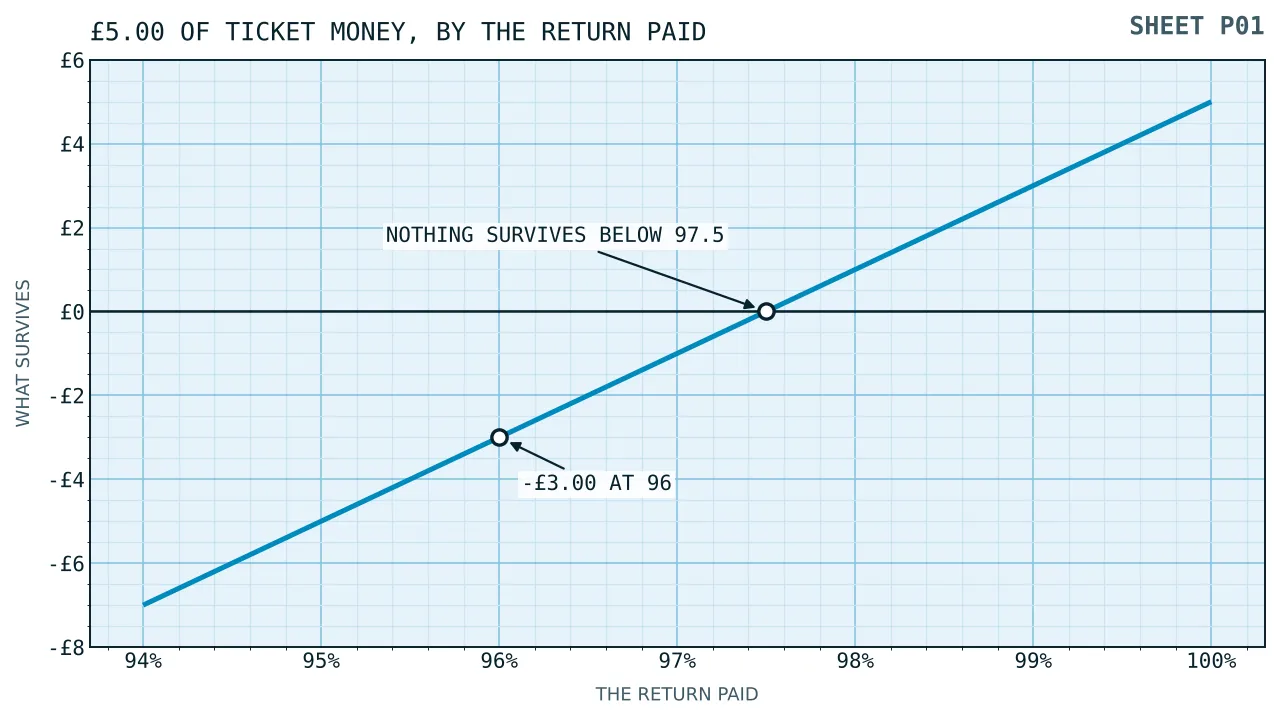
One caution on the shape of that line. It crosses once and it crosses steeply, so a small error in the assumed return moves the answer a long way. That sensitivity is the argument for reading the games clause first: it is the clause that tells a reader which point on the horizontal axis they are standing on.
6
What a ticket room must disclose
The gap at the centre of this page is not an oversight by anybody. It is the published position, and it gets misread in both directions.
Before a customer commits, a British licensee owes them information sufficient to judge their chances of winning, and the standard then lists what will do. They are strung together by or, and not by and. First, a run-down of the way the game works, the way winners get settled and the way prizes are handed round. Second, the margin, or the house edge. Third, the probability attaching to the winning events. Fourth, a return percentage. Meeting any single item on that list meets the duty.
For tickets the guidance is plainer still: a description of the way prizes get allocated will suffice by itself. So a room on the British register can discharge the whole of its disclosure obligation without a percentage ever appearing, and a room holding no Great Britain licence took on no such obligation in the first place. The honest sentence is that the number is absent by design, not withheld in breach.
Two further standards shape what the room may show while the £200.00 is being worked through, and both apply to gaming with bingo inside it. While a game is in play its rules may not move, nor its payouts, nor the odds on its outcomes, and a legitimate change has to be put in front of the customer; the guidance picks out, as unacceptable, a term announcing that game rules are alterable whenever the operator pleases. A result, and what was staked on it, has to go up accurately and stay up for a period a reader could reasonably be expected to need.
What follows for a reader is a short list of substitutes. Where no percentage exists, the comparable quantity between two offers is contribution owed per pound of credit, which here is £40.00 and is exact. Where a room does print a margin or a prize-allocation statement, that is the thing to read, because it is the published half of the same question.
7
Pace, stakes and the product types
Three British rules a reader would expect to cover ticket money do not, and two that nobody expects do. Getting the boundary right is most of what this part is for.
Nothing paces a ticket
RTS 14D hangs its 2.5 seconds on slots: that much has to elapse before a following cycle may be commenced. RTS 14G doubles it and adds a bit, to five seconds, over casino play that is not a slot, with poker among customers struck out, and 17 January 2025 is the date the regulator’s updates page attaches to that one. The standard itself carries no commencement date for any part of RTS 14, and this sheet asserts none. Tickets are a product type of their own on the regulator’s list, and no minimum interval attaches to them anywhere in the standard.
Nor is there a statutory ceiling on the stake
Two properties make an online slots game on the instrument made 25 February 2025: reels, and the internet. Reel-based then means a game whose images move or change, with the arrangement they land in deciding whether a prize, or some further advantage, has fallen due. Both caps, says the regulator’s guidance, are for online slots alone and extend to no other casino game. It dates the five pound figure to 9 April 2025 and the two pound figure to 21 May that year. A ticket carries no reel, so neither limit touches the £200.00 on this page.
Two rules that do reach it
Automatic play is barred across gaming, with bingo named inside the scope, since a customer owes a separate commitment to each cycle; the guidance carves out nothing but the blind a poker table posts for itself. The prohibition on misleading design reaches it as well: a losing event may not be dressed as a near miss, and a simulated device may not run on probabilities other than the real ones. So the room may be unpaced and uncapped while still being forbidden to lie about a result.
Where a single incentive stops
From 19 January 2026 a British licensee’s incentive has been confined to a single product type, and the provision counts four: betting, then casino, then bingo, then lottery. Ticket money is bingo. Reel spins are casino. Strap the two together under shared terms and two types have been combined. Three carve-outs sit beside the rule: two items inside one type are fine, with a raffle beside a scratchcard as the regulator’s illustration; two separate offers may travel in one email where consent covers each product; and a credit the holder spends wherever they like is outside the ban altogether.
For the arithmetic the consequence is practical. Ticket money with spins strapped on carries a base apiece, a return apiece and perhaps a condition apiece, so one residue cannot stand for it. Price each half and add the halves.
8
Pricing ticket money yourself
Six readings, and the second one is where this exercise usually stops.
| What to read | Here |
|---|---|
| Ticket money at face | £5.00 |
| Return printed for the games it buys | none |
| Turnovers demanded | 40x |
| Contribution owed, exactly | £200.00 |
| Cost of it, on reels at 96 per cent | £8.00 |
| At the foot | £0.00 |
With the second line blank, the fifth and the sixth are estimates wearing the clothes of figures, and nobody need accord them any more standing than that. Lines one, three and four stay exact however little the room prints, which is the argument for comparing two ticket offers on contribution owed per pound of credit and nothing nearer the front.
Were this five pounds offered under the British register instead, each of the following would bind the room that issued it. Ten turnovers of bonus funds would be the ceiling on its condition, worth £3.00 against this credit. The incentive could not reach across two product types. Identity would be settled before any play whatever, bonus rounds and free-to-play rounds counted in, and the minimum content of that check runs to birth date, name and address. A credit card could not fund the account. Each cycle would want its own commitment, and no near miss could be substituted for a losing event. A ceiling could not be placed on withdrawals from money the customer paid in, and a withdrawal once requested could not be handed back for restaking. A complaint would run on a clock of eight weeks and escape to an adjudicator the regulator had approved. The scheme at Gamstop Online would hold the operator. Set against all that, the Curaçao rulebook read for this sheet spends two sentences on bonuses, asking for transparent terms and for promotions that do not push excessive play, and contains no ceiling on a multiple, no mention of weighting, no stake cap and no minimum game cycle.
What a reader gives up is therefore a list rather than a feeling, and the list has a price on this credit: three pounds of the five, which is the whole of what a capped multiple would have left.
Two limits on the £0.00. It averages over a great many repetitions of the same credit, and on one attempt the likeliest single result is a spent balance and most of the £200.00 never staked. And a term sitting right outside the expression, a lid on what the bonus itself may win, or a discretionary power the operator kept back for its own use, can shut the answer down with multiple, rate and return every one of them untouched. On 3 July 2025 the regulator took £170,000 off an operator over a clause of that second shape, found in the bonus rules it published for new casino promotions, and counted the condition requiring fair and open dealing as broken by it. Nothing else in a set of bonus rules carries a published outcome of that kind behind it.
Where to read on depends on which half interests you. The room itself, its disclosure duties and its pace, is taken apart at online bingo. The whole building and the return it has to pay sits at online casino UK, a room with no trading history behind it is priced at new casino sites, and the same credit read on a short screen is at mobile casinos. Every sheet in this part of the tree hangs on where a credit must be spent, and The room gathers them. How a receipt is struck writes out the arithmetic beneath the lot.
Questions
- What is a bingo no deposit bonus worth on £5?
- Nothing at forty turnovers, on a stated assumption. Five pounds of ticket money owes £200.00 of contribution, which is exact. At a borrowed reel return of 96 per cent, each staked pound counting in full, the expected cost of that staking is £8.00, which puts the residue at minus £3.00 and the foot at £0.00. Under a licensee’s ceiling of ten turnovers the same credit leaves £3.00.
- Why can ticket money not be priced exactly?
- Because converting staking into expected cost needs the share a game gives back, and a room selling tickets is under no duty to print one. A British licensee owes a customer enough to form a view of their own chances before committing, and the standard then offers four ways of satisfying that, strung together by or: the house edge or margin, the probability of the winning events, a return percentage, or a description of the way the game works, the way winners get picked out and the way prizes are distributed. Where bingo is concerned the guidance says the prize-allocation account will do on its own.
- How much staking does £5 of ticket money owe?
- £200.00, and that figure needs no percentage at all. Forty turnovers of £5.00 draws on the multiple and on the credit and on nothing else whatever. Per pound of ticket money that is £40.00 to be put through, a ratio equal to the multiple, and it carries between two offers where a headline does not.
- Where does the twenty-five in the test come from?
- It is the reciprocal of what the room keeps. Set the residue to nought and divide the credit out of both sides, and the surviving quantity is one over four pence in the pound, which is twenty-five. A credit therefore leaves something only where the multiple divided by the count rate falls under twenty-five, and the rate has to beat the multiple over twenty-five. Keep three pence in the pound and the threshold moves to 33.3; keep six and it moves to 16.7.
- What return would a room need to pay for forty turnovers to leave anything?
- Better than 97.5 per cent, which is one minus the reciprocal of forty. Ten turnovers wants better than 90 per cent, twenty wants better than 95, twenty-five wants better than 96 and sixty wants better than 98.33. Those are demands rather than descriptions: nothing says a ticket room pays any of them, and nothing obliges a room to say.
- Could game weighting save a forty-turnover ticket credit?
- No. At forty turnovers against a 96 per cent return the rate would need to reach 1.60, and nothing lets a staked pound count above its own face. Above twenty-five turnovers no weighting schedule anywhere rescues the arithmetic, so the live question is whether the multiple was under twenty-five to begin with.
- Is there a minimum interval between bingo game cycles?
- None that RTS 14 states. Slots own the 2.5-second interval. Five seconds goes on the games outside that, poker among players set aside, and the regulator’s updates page dates it at 17 January 2025. Bingo stands as its own product type, and nothing in the standard times it. Automatic play is barred there, though, since gaming with bingo inside its scope wants a separate commitment to every cycle.
- Does the £5 stake cap reach a bingo ticket?
- No. No, and nor does the £2 one. An online slots game, on the instrument of 25 February 2025, is reel-based and played over the internet, and the regulator’s guidance confines both caps to online slots and leaves the rest of the casino alone. It dates the five pound cap at 9 April 2025 and the two pound cap at 21 May 2025. There is no reel on a ticket.
- Can ticket money arrive with free spins attached?
- A British licensee has been barred from doing so since 19 January 2026. One incentive may hold one product type, and the provision counts four: betting, casino, bingo, lottery. Ticket money is bingo and reel spins are casino, so the pair crosses two types under shared terms. More tickets alongside the credit keep a package inside a single type. Three carve-outs sit beside the rule, one of them a credit spendable on any product the holder fancies.
- What does a ticket credit with no Great Britain licence leave out?
- A list of duties, each of which binds a licensee. Ten turnovers caps the wagering, worth £3.00 on this credit. One incentive may hold only one product type. Nobody gambles at all, bonus play included, until a birth date, a name and an address have been checked. Credit cards cannot fund an account. Every game cycle is committed to individually and no near miss stands in for a loss. Withdrawals from paid-in money carry no ceiling and cannot be handed back once requested. A complaint runs eight weeks and escapes to an approved adjudicator. Gamstop Online holds the operator. The Curaçao rulebook read for this sheet gives bonuses two sentences and none of that.