
Sheet M05 Revision 1 Checked 15 October 2026
20 free spins on registration no deposit
Twenty cycles at 10p are £2.00 on the front and £1.92 once a 96 per cent machine has had its share. Forty times then calls for £76.80 of staking, priced at £3.07, inside whatever window the terms allow.
£1.92 of winnings, £76.80 to turn over, 32 minutes at the floor
What the conditions leave
Every destination on this spike is bought advertising. The site takes a fee if a reader goes on to register, and no figure printed below moves because of it.
The Spin Sheet
Till receipt No 01
Betportal
Lowest multiple here
For every €1 of spin credit at face per €1
Credit
Debit
No Great Britain licence
Licensed in Anjouan, Comoros, run by BetPortal Gaming Ltd, with Excite Ultra Media Ltd, reference ALSI-202601040-FI2.
Terms read 15 October 2026
Open the offer at Betportal, opens in a new tabThe Spin Sheet
Till receipt No 02
WinBeast
Five staged matches
For every €1 of spin credit at face per €1
Credit
Debit
No Great Britain licence
Licensed in Curaçao, operator not named on the site.
Terms read 15 October 2026
Open the offer at WinBeast, opens in a new tabThe Spin Sheet
Till receipt No 03
EliteSpin
Longest spin window
For every £1 of spin credit at face per £1
Credit
Debit
No Great Britain licence
Licensed in Costa Rica, run by PrimeTier Limited.
Terms read 15 October 2026
Open the offer at EliteSpin, opens in a new tabThe Spin Sheet
Till receipt No 04
Crown Jewelz
Multiple unpublished
No total struck
Credit
Debit
No Great Britain licence
Licensed in Curaçao, number not verified, operator not named on the site.
Terms read 15 October 2026
Open the offer at Crown Jewelz, opens in a new tabThe figure at the foot of a receipt is this site's own arithmetic and nothing an operator has published: the credit, less the share a spin gives back at 96 per cent return to player, less what playing the wagering through costs at the same return. It describes the offer, not one reader's afternoon. Where the conditions price above the credit the receipt prints nothing rather than a negative sum, and where a figure the sum needs is unpublished it prints the condition in the operator's words instead.
Three words stand in the amount column where no figure can. Noted is a published condition that takes value away without leaving the sum a figure to take. Unpriced is a condition whose figure nobody has published, or a credit that is not a sum until a deposit of your own sets it. Own money is money of yours, which is never part of a total.
Not one of the operators printed above holds a Great Britain licence, so the duties that licence carries do not reach them. Every online gambling company licensed in Great Britain has to be part of Gamstop Online, and a reader who has shut themselves out through the scheme is therefore not shut out here. The ceiling of ten times the bonus funds on a wagering requirement, in force since 19 January 2026, is a condition of that licence and binds the companies that hold one. Where a dispute goes instead is a matter for the authority named on the receipt, and the Gambling Commission describes what a reader faces without a British licence as a lack of recourse if things go wrong. Nobody under 18 may hold an account at any of them.
Every term printed on a receipt is the operator's own, and each receipt carries the day it was read. The oldest of those readings is 15 October 2026. What binds a reader is the operator's own full terms, and not a line printed here.
1
Twenty cycles, and what survives the machine
Twenty cycles priced at 10p apiece carry a face of £2.00. Nobody receives a face. The cycles have to be run, and a machine built to return 96 per cent of what crosses it will, over twenty of them, hand back £1.92 on average. Eight pence has already gone before a single condition applies.
That £1.92 is what the rest of the sheet prices. It is B in the line of algebra below, and it is a smaller number than the one printed on the front of any such offer.
Ten pence a cycle is an assumption, stated so that it can be swapped out. No published British rule says what a free spin is worth, who decides, or whether the figure has to be disclosed at all. A spin’s value is a commercial choice and the sheet on a named Big Bass round takes the identical twenty cycles across five values to show what that choice is worth.
Forty times carries through the sheet. A requirement near that level is what this bracket tends to set, with ten the ceiling a British licence imposes and sixty the figure the regulator quoted when imposing it. Forty lies between them and is read off neither.
Two clocks also come with a registration offer, and they are the reason this sheet spends two of its parts on time. One governs how long there is to claim. The other governs how long there is to finish. They are different objects and they fail differently.
What is pinned down, leaving one term free to be varied:
- Twenty cycles, 10p each: £2.00 advertised, £1.92 averaged.
- Return to player at 96 per cent, so four pence in the pound stays behind.
- W at forty until part 3 moves it.
- Contribution at one until part 6.
- Nothing deposited, so the credit is the only money exposed.
2
One pound ninety-two, substituted
The algebra is the same on every sheet here and the inputs are what change.
E = B × (1 – (W × (1 – RTP)) / g)
There are four inputs and one answer. The credit is B; the turnovers demanded of it are W; the proportion a machine returns is RTP; and g is the part of a stake a cashier is willing to count. Out of them comes E, the cash expected to be left over.
Done as two sums rather than one. Forty lots of £1.92 is £76.80 of staking owed. The house expects four pence out of every one of those pounds, which comes to £3.07 once rounded to the penny, or £3.072 before.
Credit £1.92, price £3.07, difference -£1.15.
The bracket produces the same thing: at 1 – 1.60 it is -0.60, and -0.60 of £1.92 is £1.152.
Nobody pays that £1.15. There was no deposit, so the balance has no road below nought: somewhere inside the £76.80 the credit dries up and play simply stops. That minus measures reach. A condition was set a pound and fifteen pence beyond the thing it was fixed to.
A twenty-cycle round is a useful size precisely because the numbers stay small enough to hold in the head. Two pounds advertised. One pound ninety-two in hand. Seventy-six pounds eighty to turn over. Three pounds and seven pence of expected cost. Nothing at the bottom.
3
Five requirements, with the clock beside them
Of the four inputs, W is the one that differs most from document to document. Here it runs across five values, with the minutes of play shown alongside the money, because on a round this size the minutes are the part a reader feels.
| W | Staking owed | Cycles at 10p | Minutes, at least | Left over |
|---|---|---|---|---|
| 10 times | £19.20 | 192 | 8 | £1.15 |
| 20 times | £38.40 | 384 | 16 | £0.38 |
| 25 times | £48.00 | 480 | 20 | £0.00 |
| 40 times | £76.80 | 768 | 32 | £0.00 |
| 60 times | £115.20 | 1,152 | 48 | £0.00 |
Nothing at all survives past twenty-five, and how big the credit is has no bearing on where that boundary sits. With E held at nought, B vanishes from either side and the requirement is left equal to one divided by four pence. Twenty cycles and two thousand of them give out in the same place.
The minutes column deserves a second look. At the regulated ceiling of ten times, the whole obligation is eight minutes of play and £1.15 comes through. At forty times it is thirty-two minutes and nothing comes through. Four times the play for none of the money is the trade this bracket of the market offers, and it is worth seeing stated in minutes.
4
What a window can hold
Bonus terms almost always set a period for using the credit, and readers worry about it more than the arithmetic warrants on a round this small. The way to settle that is to convert the window into money.
On a British licence the pace of slot play has a floor beneath it. Two and a half seconds is the gap RTS 14D requires before one game cycle may follow another, which caps an hour at 1,440 cycles. At 10p that is £144.00 of staking an hour, and the figure scales: £432.00 in three hours, £864.00 in six, and £3,456.00 in a full day of unbroken play.
Set £76.80 against those ceilings and the question answers itself. A single hour would absorb just over half the obligation. Three hours would absorb under a fifth of it. A twenty-four hour window would have the whole thing done inside two and a quarter per cent of its capacity.
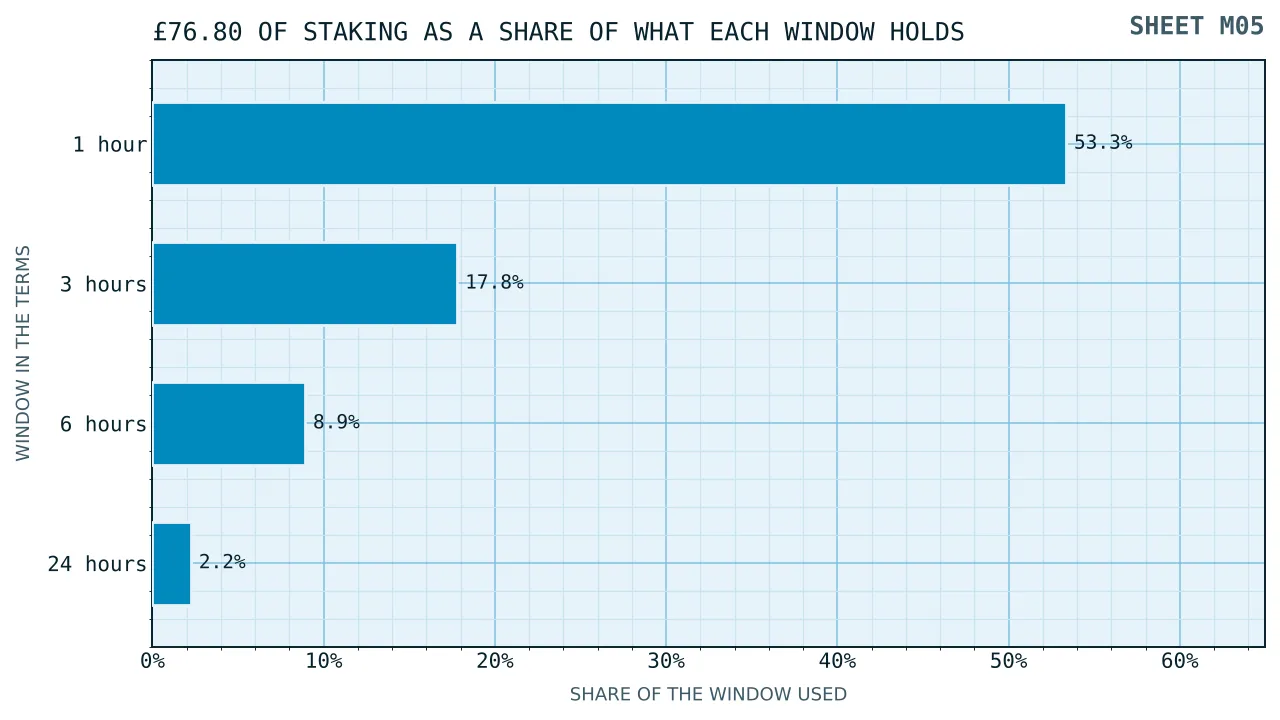
So the usage window is rarely what decides a twenty-cycle round. It becomes decisive once the credit is large, which is why 100 free welcome bonus no deposit required spends most of its length on a clock rather than on a multiple.
One caution on the figures above. They assume unbroken play at the fastest rate a British licence allows. Nobody plays for twenty-four hours, and the point of the column is not that they should. It is that a window measured in hours is a far larger container than a requirement measured in tens of pounds, and the two are routinely weighed the wrong way round.
£144.00 of staking an hour, at 10p and 2.5 seconds
5
The claiming clock, which is the sharper one
The second clock is the one with a published history of going wrong. It governs how long there is to take up the offer in the first place, and it has been the subject of advertising adjudications where the usage window has not.
Significant conditions have to be put across clearly and prominently under CAP rule 8.17, in any case where an omission would be apt to mislead. Among the things the advertising regulator counts as significant in a gambling promotion are the time limits, both for claiming an offer and for using it, which sit alongside eligibility restrictions, deposit and wagering demands, and any floor on odds or limit on bet type. A registration round carries every one of those kinds.
The sharpest published case is about a deadline nobody was told about. On 17 July 2024 the regulator ruled on a ten pound free bet which depended on a text message being answered by a particular hour. The advertisement did not mention it. The deadline was treated as a significant condition whose omission was likely to mislead.
The placement of the terms is specified as well. Roughly one click away is where full terms belong online, with the link to them kept out of footers and small print. The Commission supplies the consequence directly: an advertisement whose significant conditions lack sufficient prominence will be seen as misleading, and such terms are to be displayed inside the advertisement and near the headline offer on the pages where a customer lands and signs up.
Where a cashier holds no Great Britain licence none of that machinery runs. Bonuses get two sentences in the Curaçao policy and nothing else: transparent communication with clear terms, and no encouragement of excessive gambling by aggressive promotion. There is no enumeration of what counts as significant, no test of prominence, and no body of published decisions of the sort set out above.
6
Contribution, and a thirty-two minute job
Everything so far has counted a staked pound as a whole pound. Where the eligible games count for less than that, the requirement stays put and the staking swells to meet it.
At a contribution rate of three pounds in ten, forty times £1.92 is still £76.80 of contribution owed, but earning it now calls for £256.00 across the reels. The house anticipates £10.24 of that, set against a credit of £1.92, so the overreach runs from £1.15 out to £8.32.
The minutes move with the money. £256.00 at 10p is 2,560 cycles, which at the 2.5-second floor is 6,400 seconds: one hour and forty-seven minutes against the thirty-two minutes full contribution would have taken. A window of a few hours, which looked generous in part 4, is now doing real work.
Drop the requirement to the British ceiling of ten times and leave contribution alone. Staking falls to £64.00, the expected price to £2.56, and E to -£0.64. Even at the regulated limit the round is worth nothing, because that limit speaks to the multiple and says not one word about how much of a stake a game is allowed to count.
Three pounds in ten is an illustration and not a survey. It comes from a respondent to the regulator’s consultation, who described a pound wagered contributing thirty pence towards a requirement; the Commission recorded that and chose not to regulate weighting. No schedule of contribution rates in current use is published anywhere, so the figures here apply arithmetic to a rate that came from elsewhere.
One further protection belongs to the minutes. Under RTS 8A, no game cycle may begin until the customer has committed to that particular cycle, and the guidance excuses nothing beyond blinds posted automatically at a poker table between players. Thirty-two minutes of play-through amounts to 768 separate decisions rather than a single instruction left to run.
7
A day one way, a week the other
Registering is also the moment a player can put a ceiling on their own spending, and the two regimes handle the mechanics differently in a way that runs against expectation.
In Britain the delay depends on which way the limit is moving. A reduction led by the customer is to be implemented at once under RTS 12D, barring a technical failure that prevents it. An increase travels the slow road: only on request, only once at least a day of cooling off has gone by, and only after the customer returns at the end of it and takes a positive step to confirm. The same requirement adds a review prompt, so that an account with activity inside a rolling twelve months is prompted to look at its own transaction history at least every six months, with more frequent reminders available on request.
Curaçao reaches the same idea and turns the dial further. Its policy gives immediate effect to a request that lowers a deposit limit, and holds back a request to raise one for a week. The durations differ too: Britain requires twenty-four hours, seven days and one month to be among those offered, while the island offers daily, weekly or monthly. On this single point the offshore rulebook is the stricter of the two, and a page that treated the offshore side as uniformly weaker would be wrong.
On everything else the comparison runs the other way, and it runs on arithmetic. Look through the Curaçao policy for a ceiling on a wagering multiple and there is none. Look for a minimum gap between game cycles and there is none. Automatic play is unrestricted, a slot stake is uncapped, and a win display over a return that only matches the stake is nowhere forbidden. Those are the rules that produced every figure in parts 3, 4 and 6, and an offer taken up at a cashier outside the British register is an offer with none of them underneath.
Self-exclusion divides along the same line. Holding a British licence is what puts an operator inside Gamstop Online, so every company licensed here belongs to it, and the scheme states frankly that it is unable to prevent a registered person reaching services run by anyone outside. Curaçao also requires self-exclusion, though operator by operator and domain by domain, its shortest term running a year against the six months on offer at British sign-up. Nothing on this sheet helps anybody back into a service they have locked themselves out of.
8
Pricing the offer in front of you
Six steps, and the two in the middle are the ones that get left out.
| The step | What it gives |
|---|---|
| Cycles, at their value | 20 at £0.10 |
| After the machine’s share | £1.92 |
| W, out of the bonus terms | 40x |
| Staking owed, W over g | £76.80 |
| Expected price of it | £3.07 |
| Difference, floored at nought | £0.00 |
Reduced to a single pound of credit, the lines are these. At ten times, sixty pence survives. At twenty times, twenty pence. At twenty-five, nothing exactly. At forty, nothing and sixty pence of overshoot. Multiply the line matching the terms by whatever credit is on the table.
Two things the answer will not do.
It will not predict an afternoon. A positive E, such as the £1.15 that ten times leaves here, is the centre of a spread whose commonest result is nothing. Averages describe many repetitions and say nothing about one.
And it will not survive bad inputs. The requirement, the contribution rate, any cap on what the credit may win and the two clocks all have to come off the document in hand. Where that produces a nought, the nought is at least arrived at in pence rather than assumed.
The same six steps run on other counts nearby: a round of twenty-five on registration, five cycles longer, where the verification duties are priced, 10 free spins, which halves everything here, and 40 free spins no deposit, which doubles it. The index sits at The multiple.
Questions
- What are 20 free spins on registration worth in cash?
- Twenty cycles at 10p carry a face of £2.00 and average £1.92 on a 96 per cent machine. A forty times requirement then calls for £76.80 of staking, priced at £3.07. That price being £1.15 larger than the credit, the credit gives out partway through and the sheet closes at £0.00.
- How long does the play-through take on twenty spins?
- On a British licence the floor is thirty-two minutes. The £76.80 of staking comes to 768 cycles at 10p, and two and a half seconds is the gap RTS 14D requires before one game cycle may follow another, giving 1,920 seconds in total. Under RTS 8A nothing starts until the customer commits to that particular cycle.
- Is the expiry window the thing that decides this offer?
- Rarely, at this size. An hour of unbroken play at the fastest pace a British licence allows is 1,440 cycles, or £144.00 of staking at 10p. The obligation here is £76.80, so an hour would absorb just over half of it and a twenty-four hour window would use about two and a quarter per cent of its capacity. The window becomes decisive on much larger credits.
- Which requirement empties a twenty-spin round?
- On a 96 per cent machine, twenty-five times. Hold E at nought and B drops out of either side, which leaves the requirement equal to one over four pence in the pound. That boundary falls in the same place for twenty cycles and for two thousand.
- What happens if the eligible games contribute only 30 per cent?
- The requirement is still £76.80 of contribution, and the staking swells to £256.00 before that much has been earned, at a price of £10.24. The overreach runs from £1.15 out to £8.32, and the time from thirty-two minutes to one hour and forty-seven. Even the regulated ceiling of ten times comes out at minus 64p once contribution is that low.
- Can a casino cut short the time allowed to claim an offer?
- It can set a deadline, and in Britain that deadline is a significant condition which has to be communicated clearly and prominently. On 17 July 2024 the advertising regulator ruled on a ten pound free bet that depended on a text message being answered by a particular hour, which the advertisement did not mention, and treated the omission as likely to mislead.
- How quickly does a deposit limit take effect?
- A reduction is immediate in both regimes. An increase is where they part. RTS 12D makes a British increase wait at least twenty-four hours and then requires the customer to come back and positively confirm it. The Curaçao policy makes an increase wait seven days, which on this one point is the stricter of the two rulebooks.
- What does a registration offer lose when the site is offshore?
- Most of the arithmetic’s foundations. Hold no Great Britain licence and there is no ten times ceiling on wagering, no minimum gap between game cycles, no bar on automatic play, no stake limit on a slot, and nothing against a win display over a return that merely matches the stake. The Curaçao policy carries not one of them.
- Does being on Gamstop Online stop these offers reaching me?
- Only where the operator is inside the scheme, and membership follows from holding a British licence. The scheme states frankly that it is unable to stop a registered person reaching services provided by organisations outside it. Curaçao requires self-exclusion operator by operator and domain by domain, its shortest term a year where six months is offered at British sign-up.