
Sheet P07 Revision 1 Checked 15 October 2026
Live casino UK
A credit of £16.00 carrying forty turnovers wants £640.00 through the table, and £6,400.00 where the table counts a tenth of each pound. Nobody publishes what a dealt table pays back, so this sheet prints the return it would need instead: 99.75 per cent.
99.75 per cent needed, where a tenth of a pound counts
What the conditions leave
Every destination on this spike is bought advertising. The site takes a fee if a reader goes on to register, and no figure printed below moves because of it.
The Spin Sheet
Till receipt No 01
Betportal
Lowest multiple here
For every €1 of spin credit at face per €1
Credit
Debit
No Great Britain licence
Licensed in Anjouan, Comoros, run by BetPortal Gaming Ltd, with Excite Ultra Media Ltd, reference ALSI-202601040-FI2.
Terms read 15 October 2026
Open the offer at Betportal, opens in a new tabThe Spin Sheet
Till receipt No 02
WinBeast
Five staged matches
For every €1 of spin credit at face per €1
Credit
Debit
No Great Britain licence
Licensed in Curaçao, operator not named on the site.
Terms read 15 October 2026
Open the offer at WinBeast, opens in a new tabThe Spin Sheet
Till receipt No 03
EliteSpin
Longest spin window
For every £1 of spin credit at face per £1
Credit
Debit
No Great Britain licence
Licensed in Costa Rica, run by PrimeTier Limited.
Terms read 15 October 2026
Open the offer at EliteSpin, opens in a new tabThe Spin Sheet
Till receipt No 04
Crown Jewelz
Multiple unpublished
No total struck
Credit
Debit
No Great Britain licence
Licensed in Curaçao, number not verified, operator not named on the site.
Terms read 15 October 2026
Open the offer at Crown Jewelz, opens in a new tabThe figure at the foot of a receipt is this site's own arithmetic and nothing an operator has published: the credit, less the share a spin gives back at 96 per cent return to player, less what playing the wagering through costs at the same return. It describes the offer, not one reader's afternoon. Where the conditions price above the credit the receipt prints nothing rather than a negative sum, and where a figure the sum needs is unpublished it prints the condition in the operator's words instead.
Three words stand in the amount column where no figure can. Noted is a published condition that takes value away without leaving the sum a figure to take. Unpriced is a condition whose figure nobody has published, or a credit that is not a sum until a deposit of your own sets it. Own money is money of yours, which is never part of a total.
Not one of the operators printed above holds a Great Britain licence, so the duties that licence carries do not reach them. Every online gambling company licensed in Great Britain has to be part of Gamstop Online, and a reader who has shut themselves out through the scheme is therefore not shut out here. The ceiling of ten times the bonus funds on a wagering requirement, in force since 19 January 2026, is a condition of that licence and binds the companies that hold one. Where a dispute goes instead is a matter for the authority named on the receipt, and the Gambling Commission describes what a reader faces without a British licence as a lack of recourse if things go wrong. Nobody under 18 may hold an account at any of them.
Every term printed on a receipt is the operator's own, and each receipt carries the day it was read. The oldest of those readings is 15 October 2026. What binds a reader is the operator's own full terms, and not a line printed here.
1
A room whose return comes out of the rules
Every other room in this part of the tree pays back whatever its configuration says it pays back. A dealt or spun table does not. Its return is a consequence of how the game is scored, settled long before any software exists, so nobody can say that one table pays better than another because a dial was turned.
That makes a table the awkward case in this section, and the awkwardness runs in two directions at once. The return is the one term nobody has to publish as a number, and the rate at which a table counts towards a wagering requirement is the term most often cut to a fraction or struck out altogether. A credit that has to be cleared at a table is therefore priced by two figures, neither of which appears beside the headline.
So this sheet does what it can do, which is to run the arithmetic backwards. Where a figure is unpublished, the honest output is not a guess at it but the value at which the answer changes sign. Part 4 is that calculation, and it is the reason the page exists.
The credit worked through is £16.00. Forty turnovers ride on it, which is the sort of requirement a table credit attracts off the register, and ten rides beside it as the most a licensee may ask. Four pence in the pound is the edge assumed wherever reel-based play has to be compared, and it is assumed nowhere else on this sheet.
Four terms, and who owns each of them:
- The credit, £16.00, written by the cashier.
- The multiple, forty here and ten at the British ceiling, also written by the cashier.
- The rate, cut to a fraction at a table more often than anywhere else, written by the cashier and printed in a separate document.
- The return, a property of the rules of the game, published as a number by nobody and modelled here as a crossing value.
2
Sixteen pounds against a tenth of a pound
Four letters, and the room owns the two that are not printed anywhere.
E = B × (1 – (W × (1 – RTP)) / g)
£16.00 is what B holds on this sheet. W is forty, RTP is the share the table gives back, g is the proportion of a staked pound the table is allowed to count, and E closes the sheet in pounds and pence.
Note where g sits. It sits underneath the multiple rather than next to it, and a denominator does not swell an obligation. It cuts into it. Which is why a table counting at a tenth does ten times the damage of a table counting in full, while the contribution owed has not moved by a penny.
The contribution owed is forty lots of £16.00, or £640.00, and it stays at £640.00 whatever the rate. What the rate decides is the staking needed to earn it. Counting in full, that is £640.00 of play. At a tenth it is £6,400.00. At a twentieth, £12,800.00, on a credit of sixteen pounds.
Divide the multiple by the rate and what comes out is the effective multiple, a figure no table offer has ever been required to print. Forty turnovers at a tenth of a pound make 400. The wagering line still reads forty. Nothing published requires the larger number to appear at all, and no source anywhere records the rates actually in use, so every rate below is an input rather than a finding.
£640.00 owed, £6,400.00 to stake, an effective 400
3
The digit this sheet will not print
A table’s return is not in this site’s evidence file, and nothing goes on a page here without a source behind it. That is a deliberate gap and not an oversight, so it is worth saying exactly how wide it is.
Nor does a British licence close it. The standard governing what a game owes a player before they commit sets out four items and separates them with or. One is the chance of winning events occurring. One is the return to player percentage. One is the margin, or house edge. The last is a plain account of how the game operates alongside the way winners and prizes get settled. Meeting any one of those items is enough on its own. Pick the percentage and the guidance asks for the theoretical average.
At a table the item that comes most naturally is the edge, because the edge is a consequence of the rules a player can read in the game itself. A licensee printing it has complied in full and printed no percentage anywhere. So a reader at a licensed table is owed one item from a list of four, and the item the arithmetic wants is one candidate among them.
Three neighbouring requirements fill in around it. An explanation of the rules that apply has to be within easy reach beforehand, has to be accurate, has to be enough to cover every one of them, and has to be made understandable so far as reasonable steps can manage. As play proceeds, enough has to be shown for a customer to follow where the game has got to. And the potential prizes and payouts, or the method of working them out, have to be available ahead of any commitment. There the standard stops.
One further rule matters more at a table than anywhere else on this site. Prohibited outright is any design apt to mislead a customer over how probable a result is, and two examples are named in the standard itself. One is a near-miss losing event put in place of an ordinary losing event. The other is a real device simulated on probabilities that are not the device’s own. The second of those is the rule separating a simulated wheel from a filmed one, and it is the only published handhold a reader has on the subject.
4
The return a table would have to pay
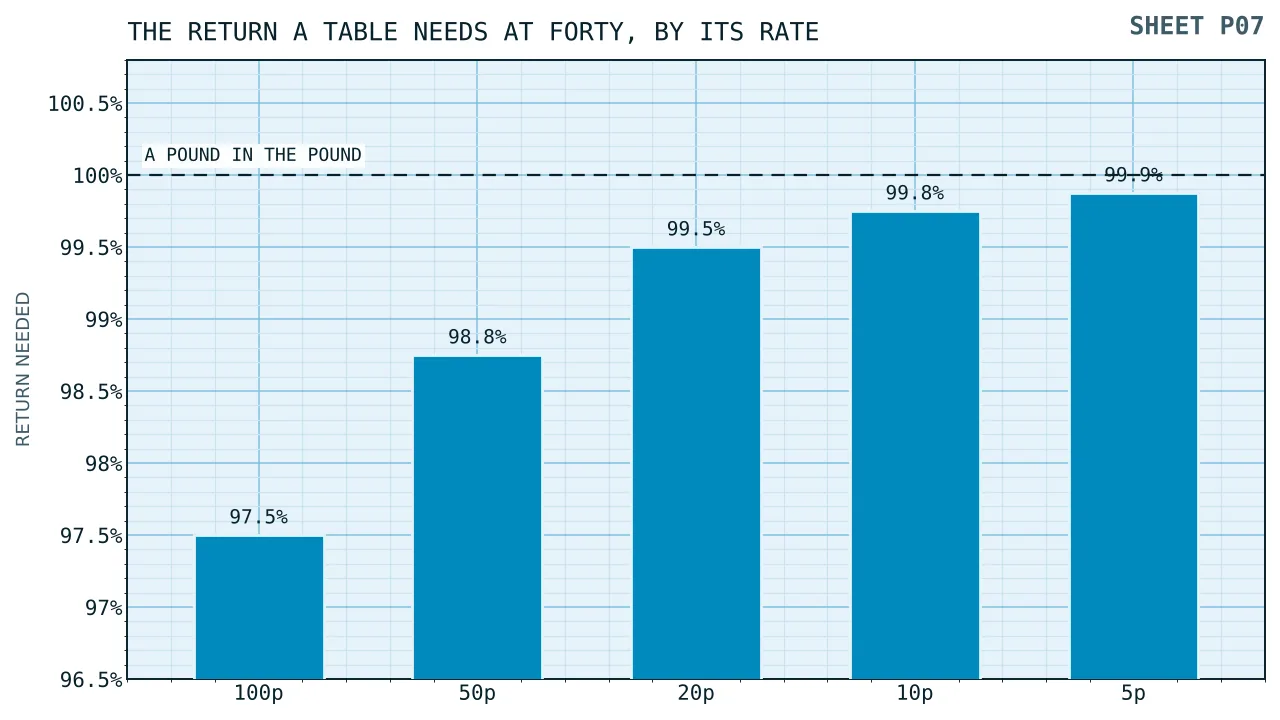
Here is the backwards calculation. Anything survives only where the price of the staking comes in under the credit, so rearrange the expression for the return and the condition reads: the return must exceed one, less the rate divided by the multiple.
RTP above 1 – g ÷ W, or the foot reads nothing
Worked at five rates, against both multiples, with the staking owed alongside so that the two halves of the answer sit on one line.
| What the table counts | Staking at forty | Effective multiple | Return needed at ten | Return needed at forty |
|---|---|---|---|---|
| A pound of each pound | £640.00 | 40 | 90.0% | 97.5% |
| Half of each pound | £1,280.00 | 80 | 95.0% | 98.75% |
| A fifth of each pound | £3,200.00 | 200 | 98.0% | 99.5% |
| A tenth of each pound | £6,400.00 | 400 | 99.0% | 99.75% |
| A twentieth of each pound | £12,800.00 | 800 | 99.5% | 99.875% |
Read the last column first. At a tenth of a pound and forty turnovers, a table has to hand back 99.75 per cent of everything that passes across it before a sixteen pound credit leaves a penny behind. At a twentieth the figure is 99.875 per cent, which is one part in eight hundred away from a table that keeps nothing at all. Those are not claims about any table. They are the values at which the sign of the answer changes, and the point of printing them is that a reader can compare them with whatever the game itself discloses.
The ten-times column is the more useful one, because it is the only column a British cashier may write terms inside. Even there the ladder gets steep quickly. A table counting in full needs 90.0 per cent, which is an undemanding figure. Cut the rate to a fifth and the requirement is 98.0 per cent. Cut it to a twentieth and it is 99.5 per cent, at the regulated ceiling, on the strictest multiple anybody in this market is obliged to observe.
Put the other way round, with the house edge held at four pence, the condition on the rate is the one this section is built on: the rate has to exceed the multiple divided by twenty-five. Forty turnovers demand 1.60, and no pound holds 160 pence. Ten turnovers demand 0.40, so a table struck out of the eligible list or counted at a fifth has failed the test before the first card is dealt. Where that threshold comes from, rate by rate, is worked through on online slots UK.
5
Five seconds, and the clock it builds
A table is paced by a different figure from the reels, and it is the slower of the two. Casino games that are not reel-based, poker between players excepted, carry a minimum of five seconds from one game starting to the point where the next cycle may be commenced. Releasing and pressing the start control again is required as well, so holding anything down starts nothing.
The date wants care. The standard itself attaches no commencement date to any part of that requirement, and the five-second figure is given by its identifier on a separate page listing what changed on 17 January 2025. That is why a date can be attached to it at all, and the shorter interval for reel-based games is not named on the same page, so the date does not travel to it.
Five seconds and a pound a round turn the staking in part 4 into a diary.
| What the table counts | Rounds | At five seconds |
|---|---|---|
| A pound of each pound | 640 | 53m 20s |
| Half of each pound | 1,280 | 1h 46m 40s |
| A fifth of each pound | 3,200 | 4h 26m 40s |
| A tenth of each pound | 6,400 | 8h 53m 20s |
| A twentieth of each pound | 12,800 | 17h 46m 40s |
Those are floors rather than estimates, and three rules hold them in place. No system may commit to a game cycle for the player, the single exception across gaming and bingo being a blind posted automatically in poker between players. No customer may be allowed to shorten the wait for a result, which strikes turbo, quick spin and slam stop off the list for any remote game whatever its native speed. And no functionality may be offered that would let casino games run alongside each other, split screens and multiple screens included, which keeps an obligation of nearly nine hours inside a single window.
A fourth rule arrived on the same date as the five seconds and is aimed squarely at a table room. An operator may no longer build functionality for running several products at once, the illustration given being roulette and blackjack tables. The same change requires net spend and time played to be shown as they accrue, which on an obligation of nearly nine hours is the only running total a player is handed without doing the sum themselves.
6,400 rounds, 32,000 seconds, 8h 53m 20s
6
The stake nobody caps
The statutory stake ceilings everyone has heard of do not reach this room, and that is worth a figure rather than a restatement. Guidance from the regulator keeps the stake limits inside online slots, roulette and blackjack being named as games they do not touch. The instrument behind them was made on 25 February 2025 and describes what it covers as an online casino game built on reels. Calendar dates come from the regulator and not from the instrument: 9 April 2025 for the five pound ceiling, and for the two pound one, which binds anybody under 25, the 21st of May.
So at a table the stake is a choice, and the arithmetic cuts both ways. The £6,400.00 owed at a tenth of a pound is 6,400 rounds at a pound a go and nearly nine hours. At five pounds a round it is 1,280 rounds and one hour forty-six minutes forty seconds. At twenty pounds a round it is 320 rounds and twenty-six minutes forty seconds. The expected price is £256.00 whichever of those routes is taken, since four pence of every pound is taken whatever size the wagers come in, and the spread about that mean grows wider as the parcels grow.
Which is the uncomfortable half of the finding. On reels a player under 25 cannot stake above two pounds in a single cycle, and nobody may stake above five. At a table there is no such line. The only published restraint is a broad one: a product is barred from actively urging anybody to chase a loss, to put a stake up, to go past the sum they had settled on, or to keep going after saying they wish to stop. Its guidance asks that funds taken into a product be topped up only where the customer elects it on each occasion, and records that the requirement is not meant to reach familiar features, the blackjack split among them.
A maximum stake of the bonus terms’ own devising is common while a credit remains live. No published rule fixes one, so it joins the lines a reader must locate instead of calculating. Set beside part 4, a low rate and a low maximum stake in one document are the pair that turn a table offer from unprofitable into unfinishable.
7
A table is a casino product, and what follows
Two provisions bear on a table credit, and 19 January 2026 is the date both of them began.
The first stops the multiple. A licensee may not push the requirement past ten turnovers of bonus funds, and that ten is the only regulated digit in this page’s arithmetic. The regulator recorded what it was correcting when it set the figure: some licensees were then applying up to sixty times. Nothing published settles the status of a free spin as bonus funds for that purpose, and this sheet declines the gap in both directions, though winnings off a spin that arrive as bonus funds are reached by the ten-turnover limit.
The second will not let a single incentive hold two types of gambling product. The rule names four: lottery, bingo, betting and casino. A dealt table and a reel-based game are both casino, so a package pairing a table credit with free spins keeps to a single type. Set either beside bingo tickets and the incentive now holds two types, which is what the rule reaches. Three carve-outs cut against expectation. A pair of products inside one type may share an incentive, the regulator instancing a raffle with a scratchcard. Consent covering both products lets a casino offer and a betting offer travel in one email. And a credit the holder may spend wherever they like is untouched by the ban.
What neither provision touches is the rate. Bonus funds and the multiple are what the ceiling is written about. Weighting was put to the consultation that produced it, noted, and left exactly as it was. A licensee may therefore sit exactly inside ten turnovers and still hand a reader an effective multiple of 400. That is the thing most worth knowing about a regulated table bonus.
Standards do apply to the terms themselves. The code provision on incentives bites the moment a licensee offers anybody an advantage, money, goods or services, and it asks that the conditions be clear, be transparent, be fair, and be easy to reach for anyone offered the thing. A rate schedule reached only at the third click sits awkwardly against that standard, and no published rule counts the clicks. The advertising side is firmer. A restriction on which games count is significant enough to belong inside the advertisement, and where conditions are shown too faintly the advertisement is taken to mislead.
8
A studio feed settles nothing about a licence
Out on the offshore side the platform holds no Great Britain licence, and the first thing that costs a reader is the thing a table room is best at: looking exactly like the licensed article. A dealer, a wheel, a shoe and a chat window are furniture, and furniture is not a licence.
The regulator has recorded the general version of this: casino games supplied by licensed operators have been found appearing on unlicensed websites, so a familiar game says nothing whatever about the site running it. Its industry notice of 20 January 2025 also records what such sites tend to be missing, naming social responsibility and anti-money-laundering controls as inadequate and listing fraud, data privacy and unfair practices among the exposures.
The specific version carries a figure. A payment of £4.75m was settled on 23 July 2026 by Evolution Malta Holding Limited, its games having been found on six unlicensed websites reachable from Great Britain, with visits in volume recorded from December 2023 to November 2024. The regulator made three findings. Risk of money laundering and of terrorist financing had gone without proper identification or assessment. Controls had not been effective enough to stop the games reaching Great Britain through unlicensed operators. Due diligence on customers had fallen short. Serious weaknesses in the risk assessment were the enforcement director’s words, with the failings grave enough that suspending the licence was considered.
Now the list of what a table credit loses out there, said one clause at a time. The five-second floor goes. The bar on committing to a cycle for the player goes. The bar on hurrying a result goes. The prohibition on two games side by side goes. The silence demanded of a return no better than the stake goes. The ten-turnover ceiling goes, and with it the only regulated number in the whole calculation. The near-miss prohibition goes. Verification before any play whatever, free-to-play and bonus play included, of a name, of an address and of a date of birth, goes: under the island policy consulted here no deposit and no wager may happen before the operator is sure the player is over 18, with full identity checking hung on later milestones.
The complaints route does not go, and a sheet saying it did would be wrong. The island rulebook gives a player six months from the incident, an operator four weeks to respond with one four-week extension on written notice, and adjudication that is compulsory and free with the operator bearing the cost. Its regulator then stands back from individual disputes, in wording close to the British equivalent. Where the two part company is authorship: that policy leaves the parameters of adjudication for the operator to set.
9
Pricing the table in front of you
Five readings, and the fourth is the one nobody takes.
| The reading | Here |
|---|---|
| The credit, as the cashier writes it | £16.00 |
| The multiple, from the wagering line | 40x |
| Contribution owed, W times B | £640.00 |
| The rate, from the game list | 0.10 |
| Staking, and the effective multiple | £6,400.00 at 400 |
| The return the table would need | 99.75% |
Hunt for the fourth line in the game list rather than the bonus terms, and where several rates are given, take the rate for the tables the credit may actually be spent at. A nought in that line is not an edge case. A credit struck out of a table room altogether has an effective multiple of infinity and a crossing return above one hundred per cent, which is this sheet’s way of saying the thing cannot be done.
Then compare. Divide the multiple by the rate, divide that by twenty-five, and if the answer exceeds one there is nothing at the foot. Or take the last line and set it against whatever the game discloses about itself. Either route reaches the same place, and the second is the one a table makes possible, because a table is where a house edge is likeliest to be the published item.
Two limits on all of it. These are means. A mean stands for many repetitions of such a credit and not for one evening, the commonest single outcome of sixteen pounds at a table being nothing whatever. And a condition standing outside the expression can shut the answer down while the rate, the multiple and the return stay exactly where they were: a win ceiling over the bonus, say, or a discretion the operator kept. One published outcome sits on the second of those, a fine of £170,000 on 3 July 2025 over bonus rules for new casino promotions holding a reserved right to close accounts or withhold winnings. The money was paid and the wording was not struck down, so nobody should read that as making such a clause void.
Rooms either side of this one, run on the same arithmetic: best gambling sites sets out the clearance test a room has to pass, online bingo takes a room whose return depends on how many are in it, and top 20 slots UK shows what a list of twenty rates does to a single credit. The room holds the rest.
Questions
- What is a live casino bonus actually worth?
- On a £16.00 credit at forty turnovers, nothing, and the shortfall depends on the rate. Counting a pound as a pound the staking is £640.00 at an expected price of £25.60, so E is minus £9.60. At a tenth of a pound the staking is £6,400.00, the price £256.00 and E minus £240.00. At ten turnovers, the British ceiling, a table counting in full leaves £9.60.
- Why does this page not give a return to player figure for a live table?
- Because a table’s return is not in this site’s evidence file, and nothing goes on a page here without a source behind it. A table’s return is also a consequence of how the game is scored rather than of a configuration, so there is no single digit to quote. What it prints instead is the crossing value, meaning the return a table must reach before a credit lives through the staking.
- What return would a live table need for a bonus to survive?
- Above one, less the rate divided by the multiple. At forty turnovers that is 97.5 per cent where a pound counts in full, 99.5 per cent at a fifth and 99.75 per cent at a tenth. At ten turnovers it is 90.0 per cent counting in full, 98.0 per cent at a fifth and 99.0 per cent at a tenth. At a twentieth and forty turnovers the figure is 99.875 per cent, which is one part in eight hundred from a table keeping nothing.
- Why are live tables weighted so low or left out altogether?
- No published source gives a reason or a figure, so this sheet treats every rate as an input rather than a finding. What can be said is what a low rate does. The contribution owed stays at £640.00 whatever the rate, because the rate divides into the obligation instead of adding to it, so a tenth multiplies the staking by ten and turns forty turnovers into an effective 400.
- How long does a live casino play-through take?
- At a pound a round and five seconds a round, £640.00 of staking is 640 rounds and 53 minutes 20 seconds. At a tenth of a pound counted it becomes 6,400 rounds and 8 hours 53 minutes 20 seconds. Those are floors: no system may commit to a cycle for the player, nobody may shorten the wait for a result, and no functionality may allow two games to run side by side.
- Do the statutory stake ceilings reach a live table?
- No. Online slots are the whole of their reach, and guidance from the regulator puts blackjack and roulette outside the limits by name, while the instrument behind them describes what it covers as an online casino game built on reels. At a table the stake is a choice, which cuts both ways: £6,400.00 of staking is 6,400 rounds at a pound and 320 rounds at twenty pounds, with the expected price £256.00 on either route and the spread far wider on the second.
- Is five seconds really the minimum between live rounds?
- For casino games that are not reel-based, poker between players excepted, yes, measured from one game starting to the point where the next cycle may be commenced. The standard itself attaches no commencement date to any part of that requirement; the five-second figure is given by its identifier on a separate page listing what changed on 17 January 2025, which is why a date can be attached to it at all.
- Can a package hold a live table credit and free spins together?
- Yes, because both are casino products and one incentive may carry one product type. Set either beside bingo tickets and two of those types sit in one incentive, which the rule has reached since 19 January 2026. A pair of products inside one type may share an incentive, the regulator instancing a raffle with a scratchcard, and a credit the holder may spend anywhere is outside the ban.
- Does the ten times ceiling fix the problem?
- Only where the rate is high enough. What the ceiling binds is the cashier’s demand, and nothing at all binds the rate, so ten turnovers at a tenth of a pound still produce an effective multiple of 100 and a crossing return of 99.0 per cent. Put the other way: the rate must exceed one twenty-fifth of the multiple, which is 0.40 at ten turnovers and 1.60 at forty, and no pound holds 160 pence.
- What does a reader lose at an offshore live casino?
- An offshore platform of that kind holds no Great Britain licence, so the five-second floor, the bar on committing to a cycle for the player, the bar on hurrying a result, the prohibition on two games at once, the silence demanded of a return no better than the stake, the near-miss prohibition and the ten-turnover ceiling are all absent. Identity verification before any play goes too. A complaints route does survive: the island rulebook gives six months from the incident and compulsory free adjudication, but contemplates the operator setting the terms of it.