
Sheet D02 Revision 1 Checked 15 October 2026
300% deposit bonus
Three hundred per cent of a £10 stake is £30 of credit and £1,200.00 of turnover owed on it. At 96 per cent that turnover is expected to cost £48.00, which is £8.00 more than everything in the account. Here is the working.
£1,200.00 of staking bought with a £10 stake
What a tripled headline leaves
Every destination on this spike is bought advertising. The site takes a fee if a reader goes on to register, and no figure printed below moves because of it.
The Spin Sheet
Till receipt No 01
Betportal
Lowest multiple here
For every €1 of spin credit at face per €1
Credit
Debit
No Great Britain licence
Licensed in Anjouan, Comoros, run by BetPortal Gaming Ltd, with Excite Ultra Media Ltd, reference ALSI-202601040-FI2.
Terms read 15 October 2026
Open the offer at Betportal, opens in a new tabThe Spin Sheet
Till receipt No 02
WinBeast
Five staged matches
For every €1 of spin credit at face per €1
Credit
Debit
No Great Britain licence
Licensed in Curaçao, operator not named on the site.
Terms read 15 October 2026
Open the offer at WinBeast, opens in a new tabThe Spin Sheet
Till receipt No 03
EliteSpin
Longest spin window
For every £1 of spin credit at face per £1
Credit
Debit
No Great Britain licence
Licensed in Costa Rica, run by PrimeTier Limited.
Terms read 15 October 2026
Open the offer at EliteSpin, opens in a new tabThe Spin Sheet
Till receipt No 04
Crown Jewelz
Multiple unpublished
No total struck
Credit
Debit
No Great Britain licence
Licensed in Curaçao, number not verified, operator not named on the site.
Terms read 15 October 2026
Open the offer at Crown Jewelz, opens in a new tabThe figure at the foot of a receipt is this site's own arithmetic and nothing an operator has published: the credit, less the share a spin gives back at 96 per cent return to player, less what playing the wagering through costs at the same return. It describes the offer, not one reader's afternoon. Where the conditions price above the credit the receipt prints nothing rather than a negative sum, and where a figure the sum needs is unpublished it prints the condition in the operator's words instead.
Three words stand in the amount column where no figure can. Noted is a published condition that takes value away without leaving the sum a figure to take. Unpriced is a condition whose figure nobody has published, or a credit that is not a sum until a deposit of your own sets it. Own money is money of yours, which is never part of a total.
Not one of the operators printed above holds a Great Britain licence, so the duties that licence carries do not reach them. Every online gambling company licensed in Great Britain has to be part of Gamstop Online, and a reader who has shut themselves out through the scheme is therefore not shut out here. The ceiling of ten times the bonus funds on a wagering requirement, in force since 19 January 2026, is a condition of that licence and binds the companies that hold one. Where a dispute goes instead is a matter for the authority named on the receipt, and the Gambling Commission describes what a reader faces without a British licence as a lack of recourse if things go wrong. Nobody under 18 may hold an account at any of them.
Every term printed on a receipt is the operator's own, and each receipt carries the day it was read. The oldest of those readings is 15 October 2026. What binds a reader is the operator's own full terms, and not a line printed here.
1
Three hundred per cent of what
A percentage is not a sum. It is an instruction waiting for a number, and until a reader supplies one it names no quantity of money whatever. That makes a tripled headline unusual among the things this site prices: the figure on the front cannot be put on a till roll until the reader decides how much of their own to hand over.
So this sheet picks a stake and sticks to it. Ten pounds goes in. Three hundred per cent of £10.00 is £30.00 of bonus credit, and the balance that results holds £40.00, of which a quarter is the reader’s own and three quarters is the operator’s instrument.
The two parts are different kinds of object and no honest total merges them. The tenner was yours this morning and is yours now; it merely changed address. The £30.00 is a conditional entry that becomes money only when a turnover condition is satisfied, and the whole business of this sheet is pricing that condition.
Where a headline adds the two and announces forty pounds, it is counting your wallet as part of its own generosity. The till roll keeps them apart, which is why the credit prints unpriced until a stake is named.
What this sheet holds fixed, so that the arithmetic can be checked line by line:
- The stake paid in is £10.00, and the credit is three times it.
- The slot returns 96 per cent, so four pence in every pound staked is expected to stay with the house.
- Turnover is counted at full weight, one pound of staking contributing one pound.
- Forty times is the working multiple here, that being the order of figure asked at this end of the trade. A British licensee stops at ten. Sixty was recorded in use before any ceiling existed.
- The requirement falls on the credit alone, not on the stake as well.
2
£120 of turnover for every pound
Reduce a tripled match to one pound and the shape of it becomes impossible to misread. A pound paid in buys three pounds of credit. Three pounds of credit at forty times owes £120.00 of staking. So each pound a reader contributes commits them to putting a hundred and twenty pounds across the reels before anything at all can be drawn out.
That ratio is the product of two numbers the advertisement separates. The percentage sets how much credit a pound buys. The multiple sets how much turnover a pound of credit owes. Their product is turnover per pound paid in, and a reader who multiplies three by forty before clicking has done the only sum that matters.
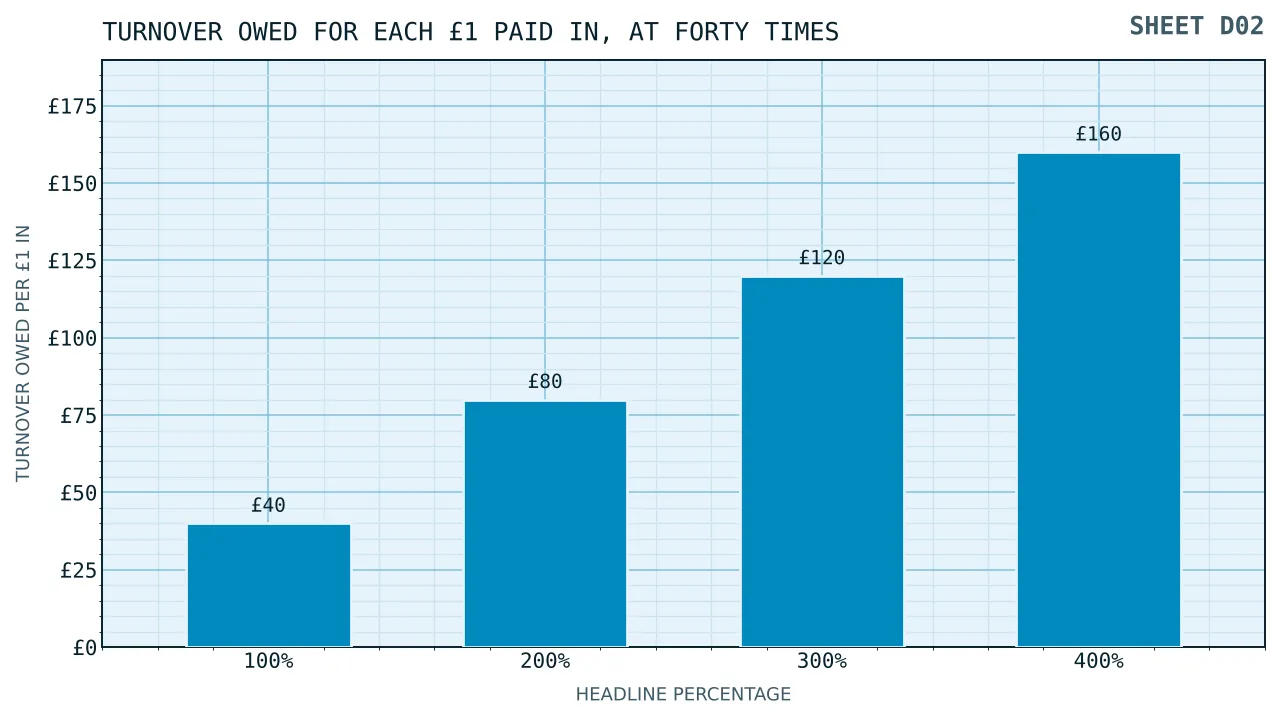
The ceiling on wagering a British licence imposes is ten rather than forty, and it binds the multiple without touching the percentage. A tripled headline inside that ceiling owes thirty pounds of turnover per pound paid in instead of a hundred and twenty. The headline is identical. The obligation is a quarter of the size.
£120.00 of turnover owed for each £1 paid in
3
The substitution, and the £8.00 overrun
Every total here resolves out of a single expression, and a tripled match drops straight into its first term.
E = B × (1 – (W × (1 – RTP)) / g)
Price it rather than reading it as algebra. The face of the credit is B, which on a tenner tripled is £30.00. The count of turnovers is W, forty of them. The portion a slot gives back is RTP, 0.96 of each pound through it. Nothing is discounted for the game chosen, so g is one. What drops out as E is the credit’s expected residue once the condition has been satisfied.
E = £30.00 × (1 – (40 × 0.04) / 1)
E = £30.00 × (1 – 1.60)
E = -£18.00
Unpack the middle of that. Forty lots of £30.00 comes to £1,200.00 that has to cross the reels. Four pence in the pound is what a 96 per cent game keeps, so £1,200.00 carries £48.00 of expected cost. Eighteen pounds beyond the credit the condition was fastened to.
This is the point at which a matched offer parts company with one asking for nothing. Something has to fund a shortfall, and the account holds exactly one other source of funds, which is the tenner. Charge £48.00 of expected cost against a balance of £40.00 and the balance runs dry with £8.00 of condition left unsatisfied.
So the closing line is nothing, and the tenner is part of what produced the nothing. The condition did not merely consume the credit it was attached to. It consumed the credit, then the stake, then stopped only because there was nothing left to consume.
£48.00 of expected cost against £40.00 in the account
4
Six multiples against one headline
Hold the tripled match and the tenner still, and move only W. Credit stays at £30.00 throughout, the return at 96 per cent, the weighting at one. Closing line is what the whole balance is expected to come to, and it cannot fall below nothing because nothing was borrowed.
| Multiple | Staking owed | Expected cost | Closing line | Still owing |
|---|---|---|---|---|
| 10x | £300.00 | £12.00 | £28.00 | £0.00 |
| 20x | £600.00 | £24.00 | £16.00 | £0.00 |
| 25x | £750.00 | £30.00 | £10.00 | £0.00 |
| 30x | £900.00 | £36.00 | £4.00 | £0.00 |
| 40x | £1,200.00 | £48.00 | £0.00 | £8.00 |
| 60x | £1,800.00 | £72.00 | £0.00 | £32.00 |
Three readings come out of that schedule.
At twenty-five times the closing line is exactly the tenner. The credit has paid for its own condition precisely and contributed nothing, which is not a coincidence of these particular pence. Set E to nothing in the expression and it resolves to W being one divided by the house edge, so twenty-five at 96 per cent, twenty at 95, and 33.3 at 97. Every tripled match everywhere breaks even at the same multiple, because the percentage cancels out of that equation entirely.
Between twenty-five and roughly thirty-three the stake survives in part. At thirty times, £4.00 of the tenner comes back. The exact point at which the stake is expected to disappear altogether is the multiple that makes the overrun equal to the stake, and for a tripled match that is 33.3 times.
Past that, the sum still owing is a measure of how far the condition reaches beyond everything a reader has put at risk. At sixty times, the multiple the regulator recorded some licensees applying before the British ceiling arrived, the reach is £32.00 past a balance of £40.00.
5
Why a bigger number buys a worse deal
A reader comparing headlines reasonably assumes they are comparing sizes of gift. On these assumptions they are comparing sizes of obligation, and the two run in opposite directions once the multiple passes twenty-five.
| Headline | Credit | Staking owed | Expected cost | Closing line |
|---|---|---|---|---|
| 100% | £10.00 | £400.00 | £16.00 | £4.00 |
| 200% | £20.00 | £800.00 | £32.00 | £0.00 |
| 300% | £30.00 | £1,200.00 | £48.00 | £0.00 |
| 400% | £40.00 | £1,600.00 | £64.00 | £0.00 |
Only the smallest headline in that schedule gives the stake back in part. One ratio explains it. Forty times at 96 per cent asks £1.60 of expected cost for each pound of credit and hands £1.00 back, so sixty pence per pound is overrun. Three pounds of credit per pound paid in therefore generates £1.80 of overrun against £1.00 of stake. A tripled match is eighty pence underwater on every pound before the first cycle is commenced.
Which fixes the tipping point for any percentage at all. Sixty pence of overrun per pound of credit covers a pound of stake when the credit is one pound divided by sixty pence, or 1.667 pounds. In headline terms, 167 per cent. Anything advertised below that leaves a reader something at forty times; anything above it does not.
Three hundred is nearly double the tipping point, which is the entire reason this sheet exists as a separate page from a doubled or a matched headline. The number on the front is the thing making the outcome worse.
6
Eight hours and twenty minutes of it
Turnover is a quantity of money and not a count of rounds, which means the stake per cycle decides how long the obligation takes and changes nothing about what it costs.
At 10p a cycle, £1,200.00 of staking works out at 12,000 separate cycles. RTS 14D asks 2.5 seconds of a slot before one game cycle may follow another, so 12,000 of them occupy 30,000 seconds or more. Eight hours and twenty minutes, at a tempo nobody actually sustains.
Nor may the obligation be handed to software and left running. RTS 8A wants the customer to commit to each game cycle one at a time, with a single carve-out written for poker blinds. So 12,000 is also a count of decisions, each one a fresh choice to keep going rather than a single instruction and a wait.
Stake a pound a cycle instead and the count falls to 1,200 and the floor to fifty minutes. The expected cost stays at £48.00 to the penny, because four pence in the pound of £1,200.00 is indifferent to how the twelve hundred pounds is parcelled up. Speed is the only thing a stake buys.
Weighting can make the clock worse than any of that, and it is the term readers skip. Suppose a game contributing at thirty pence in the pound. The contribution owed does not move: forty lots of £30.00 is still £1,200.00 owed. Reaching it now takes £4,000.00 of staking, at an expected cost of £160.00, in 40,000 cycles and twenty-seven hours and three quarters at the floor. Thirty pence is a rate quoted to the regulator by a respondent and worked here as this site’s own arithmetic; no current table of contribution rates is published anywhere.
12,000 cycles, 30,000 seconds at the floor
7
The rulebook that is not underneath
Where a company is incorporated changes none of the arithmetic. It changes the rules standing under the arithmetic, and a tripled headline of this sort carries no Great Britain licence at all. Pricing the missing rules beats describing them, so each one below is given in pounds on this page’s own stake.
The ceiling, priced on this stake
Limb 3(a) of Social Responsibility Code 5.1.1 caps a British wagering requirement at ten times bonus funds, and has done from 19 January 2026. Everything but gaming machine technical and software licences falls inside its scope, which takes in remote casino and therefore every licensed slot in the country. Price it on this page. Ten times over, £30.00 comes to £300.00 of turnover, £12.00 of expected cost, and a closing line of £28.00 where the same headline out here closes at nothing. The ceiling is worth twenty-eight pounds on a tenner.
The regulator gave a reason for picking ten, and the reason is a number: some licensees were then applying requirements of up to sixty times. That is the only market multiple anywhere in the material behind this site which can be attributed to the regulator itself, and on a tripled match it means £1,800.00 of staking owed against a £10.00 stake.
A rulebook with no arithmetic in it
Curaçao’s responsible gaming policy for licensed operators, version 1.0, dated 21 February 2025, was read in full for this site. It carries no cap on a wagering multiple, no limit on a stake, no minimum interval between game cycles, nothing barring autoplay, and nothing preventing a game celebrating a return no bigger than the stake that produced it. Incentives get two sentences: clear terms, transparently put, and no aggressive bonus promotions pushing excessive play. Two sentences and not one figure, where the British side has a ten.
The British regulator publishes its own measure of how big the unlicensed market is and how far enforcement reaches into it. Traffic data drawn from 160 websites it had targeted showed a drop of 32 per cent. It also wrote that the scale of revenue makes full dismantling of the ecosystem unlikely ever to happen, and described what it is dealing with as sophisticated, digital and worldwide. Both halves of that belong on a page like this: the enforcement is real, and so is the part of the market it does not reach.
Enforcement you can count in money
A British licence is a thing with published consequences attached. Penalties on the regulator’s own enforcement list include £10m against Platinum Gaming Limited on 22 October 2025 and £2m against Paddy Power Betfair on 17 December 2025, and suspensions are published alongside them. For scale against this page, that £10m is a third of a million times the £30.00 of credit priced here.
The regulator’s own account of what an unlicensed site costs a customer is worth repeating without decoration: weak controls on money laundering and social responsibility, exposure to fraud, data privacy problems and unfair practice, and a tendency to go after vulnerable people, including those who have self-excluded. It has also described payouts being blocked and withdrawal limits set so high as to be out of reach.
One register, one block
Coverage of Gamstop Online is set by the licence rather than by choice, which is what makes it complete on one side of the line and nowhere to be found on the other. The scheme writes its own limit into its terms: operators outside it are past the point where it can keep a registered person away. Registrations stood at 614,738 when last published on 16 July 2026, a rise of 16 per cent over six months, with May 2026 the record month at 12,236. No line here assists anyone in getting round any of that.
8
Reading a percentage off a page
A match headline can be resolved into money in five steps, and the fourth is where most readers stop early.
| What to do | On these figures |
|---|---|
| Name the stake you will actually pay | £10.00 |
| Apply the percentage to it | £30.00 |
| Multiply the credit by W over g | £1,200.00 |
| Take the house edge of the staking | £48.00 |
| Set it against the whole balance | £0.00 |
Run the same five steps on a stake of £50.00 and the shape repeats at scale. Credit becomes £150.00, the staking £6,000.00, the expected cost £240.00, and a balance of £200.00 closes at nothing with £40.00 of the condition unmet. Scaling the stake scales everything in proportion and moves the answer not at all, because the ratio of overrun to stake is fixed by the percentage and the multiple together.
Two cautions on using any of it.
What the expression yields is a long-run average and not a prediction about one attempt. The single commonest result of claiming a tripled match once is losing the stake quickly, and the expression says nothing about that spread by design.
And a figure is only as good as the document it came from. Lift the multiple, the weighting, any lid on winnings and the length of the window out of the terms a cashier has actually published, substitute them, and the answer belongs to the reader rather than to this sheet.
Neighbouring headlines get the same treatment on three further sheets: 400% deposit bonus, where the largest advertised multiplier produces the smallest residue, 200% deposit bonus, which sits just past the point where a stake stops surviving, and casino welcome bonus, where spins are bolted onto the percentage and priced with it. The index for Matched money holds the others.
Questions
- What does a 300% deposit bonus actually leave on £10?
- Nothing, on the assumptions used here. Three hundred per cent of £10 is £30 of credit, and forty times that is £1,200.00 of staking. A slot returning 96 per cent is expected to keep four pence in every pound of it, which is £48.00. The account holds £40.00 in total, so it empties with £8.00 of the condition still unsatisfied.
- Why is a bigger match percentage worse rather than better?
- Because the percentage enlarges the obligation at the same rate it enlarges the credit. Clearing a pound of credit at forty times on a 96 per cent game has an expected cost of £1.60 and returns a pound, so each pound carries sixty pence of overrun. Three pounds of credit per pound paid in produces £1.80 of overrun against £1.00 of stake. Below a multiple of twenty-five the sign flips and a bigger percentage is genuinely better, which is why the ceiling a British licence sets changes the answer entirely.
- At what match percentage does my own stake stop surviving?
- 167 per cent, at forty times and a 96 per cent return. Sixty pence of overrun accrues on each pound of credit, and that covers a pound of stake once the credit reaches 1.667 pounds per pound paid in. Anything advertised under 167 per cent leaves something behind on these assumptions, and anything over it does not.
- How much turnover does a tripled match owe per pound deposited?
- £120.00 at forty times. A pound buys three pounds of credit, and three pounds of credit at forty times is a hundred and twenty pounds of staking. Multiplying the percentage by the multiple before clicking is the only arithmetic that matters, and under the British ceiling of ten times the same headline would owe £30.00 instead.
- Does my deposit count as winnings in any of these totals?
- No. The £10 was the reader’s money before the offer existed and remains a debit of theirs in every line on this sheet. Only the £30 of match is treated as credit. That is why the closing line is measured against the whole balance of £40.00 rather than against nought, and why a headline announcing forty pounds is counting somebody else’s tenner as part of its own generosity.
- How long does £1,200.00 of staking take to clear?
- Eight hours and twenty minutes at the absolute minimum, at 10p a cycle. The staking divides into 12,000 cycles; RTS 14D asks 2.5 seconds of a slot before one cycle may follow another; and the product is 30,000 seconds. RTS 8A will not allow software to run them, so all 12,000 are decisions taken one at a time. Staking a pound a cycle cuts it to 1,200 cycles and fifty minutes while leaving the £48.00 of expected cost exactly where it was.
- What would a 300% match leave under a British licence?
- £28.00 on a £10 stake, against nothing out here. A British wagering requirement has been capped at ten times bonus funds from 19 January 2026 by limb 3(a) of Social Responsibility Code 5.1.1. Turned over ten times, £30.00 asks £300.00 of staking and £12.00 of expected cost, so twenty-eight pounds of the forty survives. The regulator put a number on what it was fixing: requirements of up to sixty times were then in use, and sixty lots of this credit would be £1,800.00.
- How much of the unlicensed market does enforcement actually reach?
- Some of it, on the regulator’s own published measure, and not all of it by its own admission. Traffic data taken from 160 targeted websites showed a fall of 32 per cent. In the same post the regulator wrote that the revenue involved makes it unlikely the ecosystem will ever be fully dismantled, and described the illegal market as sophisticated, digitally driven and global. Enforcement is real and partial at once, which is why the arithmetic on this page is worth running before the licence question is settled.
- What else is missing without a Great Britain licence?
- A specific list rather than a vague absence. Read right through Curaçao’s responsible gaming policy of 21 February 2025 and there is no multiple capped, no stake limited, no interval set between game cycles, no autoplay barred, and nothing said about a game celebrating a return no larger than the stake behind it. Incentives get two sentences there: clear terms put transparently, and no aggressive promotion of excessive play. Gamstop Online is tied to the British licence as well, and its terms say outright that operators outside the scheme are past where it can help.