
Sheet N09 Revision 1 Checked 15 October 2026
30 free spins, no deposit required, and you keep what you win
Thirty cycles at 10p average £2.88 of winnings, and the last four words of that key promise something about the form the winnings take rather than their size. Priced against the stiffest multiple a British licence now permits, the promise is worth £1.15. Priced against twenty-five times, it is worth the whole £2.88.
£2.88 kept outright, against £1.73 where a ten-times requirement attaches
What the conditions leave
Every destination on this spike is bought advertising. The site takes a fee if a reader goes on to register, and no figure printed below moves because of it.
The Spin Sheet
Till receipt No 01
Betportal
Lowest multiple here
For every €1 of spin credit at face per €1
Credit
Debit
No Great Britain licence
Licensed in Anjouan, Comoros, run by BetPortal Gaming Ltd, with Excite Ultra Media Ltd, reference ALSI-202601040-FI2.
Terms read 15 October 2026
Open the offer at Betportal, opens in a new tabThe Spin Sheet
Till receipt No 02
WinBeast
Five staged matches
For every €1 of spin credit at face per €1
Credit
Debit
No Great Britain licence
Licensed in Curaçao, operator not named on the site.
Terms read 15 October 2026
Open the offer at WinBeast, opens in a new tabThe Spin Sheet
Till receipt No 03
EliteSpin
Longest spin window
For every £1 of spin credit at face per £1
Credit
Debit
No Great Britain licence
Licensed in Costa Rica, run by PrimeTier Limited.
Terms read 15 October 2026
Open the offer at EliteSpin, opens in a new tabThe Spin Sheet
Till receipt No 04
Crown Jewelz
Multiple unpublished
No total struck
Credit
Debit
No Great Britain licence
Licensed in Curaçao, number not verified, operator not named on the site.
Terms read 15 October 2026
Open the offer at Crown Jewelz, opens in a new tabThe figure at the foot of a receipt is this site's own arithmetic and nothing an operator has published: the credit, less the share a spin gives back at 96 per cent return to player, less what playing the wagering through costs at the same return. It describes the offer, not one reader's afternoon. Where the conditions price above the credit the receipt prints nothing rather than a negative sum, and where a figure the sum needs is unpublished it prints the condition in the operator's words instead.
Three words stand in the amount column where no figure can. Noted is a published condition that takes value away without leaving the sum a figure to take. Unpriced is a condition whose figure nobody has published, or a credit that is not a sum until a deposit of your own sets it. Own money is money of yours, which is never part of a total.
Not one of the operators printed above holds a Great Britain licence, so the duties that licence carries do not reach them. Every online gambling company licensed in Great Britain has to be part of Gamstop Online, and a reader who has shut themselves out through the scheme is therefore not shut out here. The ceiling of ten times the bonus funds on a wagering requirement, in force since 19 January 2026, is a condition of that licence and binds the companies that hold one. Where a dispute goes instead is a matter for the authority named on the receipt, and the Gambling Commission describes what a reader faces without a British licence as a lack of recourse if things go wrong. Nobody under 18 may hold an account at any of them.
Every term printed on a receipt is the operator's own, and each receipt carries the day it was read. The oldest of those readings is 15 October 2026. What binds a reader is the operator's own full terms, and not a line printed here.
1
Thirty cycles and two separate promises
The key makes two claims and they are not the same claim. One concerns the size of the round. The other concerns what happens to the proceeds afterwards, and it is the one this sheet is mainly about.
Size first, since it takes a line. Thirty game cycles priced at 10p apiece amount to £3.00 of face. A slot handing back 96 per cent returns 9.6p of each 10p staked, so thirty of them average £2.88. Small, exact, and the starting point for everything that follows.
Now the proceeds. A phrase about keeping winnings is doing a job that the words about wagering do not quite cover. No play-through means no multiple is set over the money. Keeping what you win means something narrower and more useful: that the credit the round produces arrives as money and not as a second bonus wearing the first one’s clothes.
Those are different protections and either can be present without the other. A round can be free of any multiple and still credit its proceeds as bonus money that cannot be withdrawn until something else happens. A round can credit cash and still carry a ceiling over how much cash there is. Reading the two claims separately is the only way to price them.
Assumptions, stated so a reader can replace them:
- Thirty cycles, 10p each, giving £3.00 at face.
- A slot returning 96 per cent, which is the working figure throughout this site.
- No multiple over the winnings, which is what the key says. The forty times used on the wagered sheets here is therefore not in the total, though part 2 prices it as a comparison.
- Weighting at full, so a pound staked counts as a pound towards anything that has to be cleared.
- No payment of any kind, so none of the reader’s own money is exposed and the worst outcome of the round itself is nought.
2
The ladder this offer does not climb
Sheet N09 prices the promise by costing its opposite. The expression is the one used on every sheet here:
E = B × (1 – (W × (1 – RTP)) / g)
Weighting is g, the proportion a game returns is RTP, W is the turnover demanded of the money, B the money itself, and E what is left once the demand has been satisfied. Put the average winnings in as B and nought in as W:
With the promise honoured:
E = £2.88 × (1 – (0 × 0.04) / 1) = £2.88
And with ten times written over the same winnings:
E = £2.88 × (1 – (10 × 0.04) / 1) = £1.73
So one round of the line gives the headline and the next gives its price. The promise is worth £1.15 on these figures, against the hardest requirement a British licensee may now impose. Against anything looser it is worth more, and the ladder runs out faster than most readers would guess.
| Multiple written over it | Staking owed | Cost of the staking | Kept at the foot |
|---|---|---|---|
| None, as the key says | £0.00 | £0.00 | £2.88 |
| 5 times | £14.40 | £0.58 | £2.30 |
| 10 times | £28.80 | £1.15 | £1.73 |
| 20 times | £57.60 | £2.30 | £0.58 |
| 25 times | £72.00 | £2.88 | £0.00 |
| 40 times | £115.20 | £4.61 | £0.00 |
| 60 times | £172.80 | £6.91 | £0.00 |
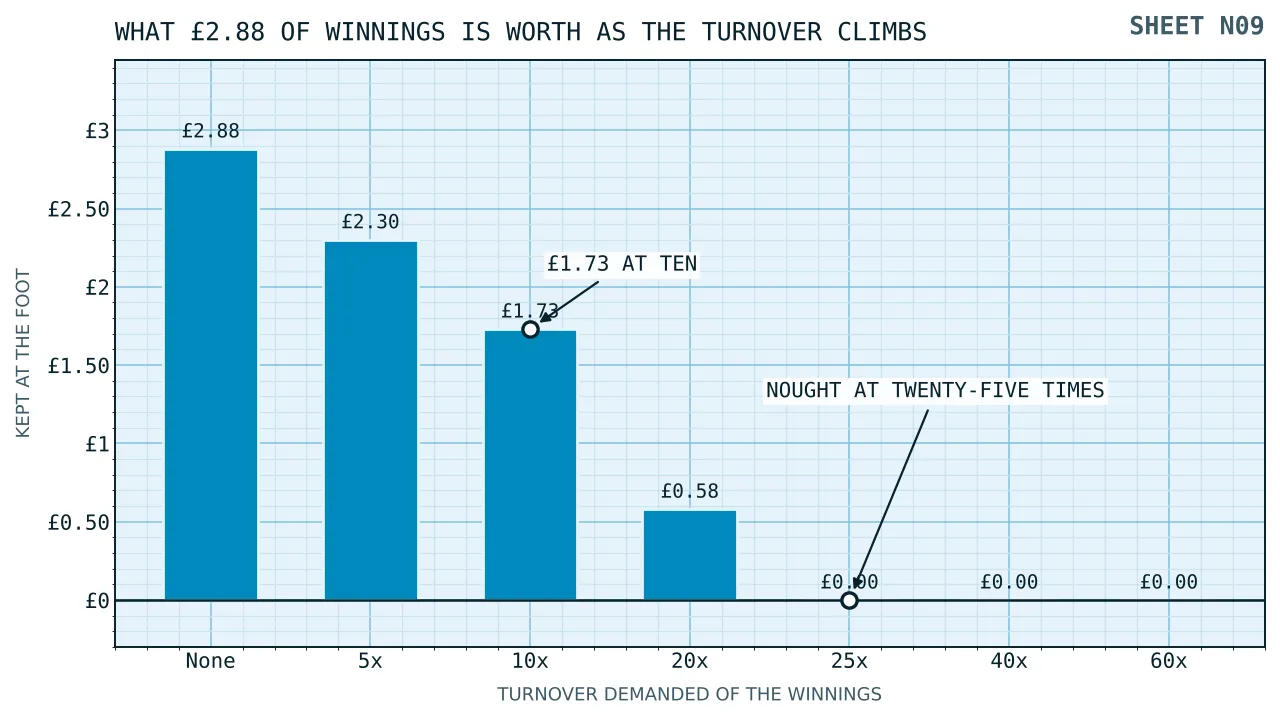
The bottom two rows are not academic. The regulator’s own account of what the cap was for records licensees applying up to sixty times before it arrived, which is its figure and not this site’s. A round like this one carrying sixty times would ask for £172.80 of staking out of £2.88 of winnings, and the expected cost of that staking is more than twice the winnings themselves. Such an offer is not worth less than it looks. It is worth nothing, and a sheet that showed the working any other way would be flattering it.
The ceiling that stopped that is worth stating exactly. From 19 January 2026 a requirement to play bonus funds through may not exceed ten times, under the incentives code, on every licence except the machine technical and software ones. Its definition is about multiples and nothing else: wagers which have to reach a stated total before the money can be withdrawn.
£0.00 kept at twenty-five times, from £2.88 of winnings
3
Cash or bonus money, which decides it
Part 2 priced a multiple. This part explains why the multiple can appear at all on a round advertised as having none, and the answer is in the form the proceeds take when they land.
Two forms are possible. Winnings credited as cash sit in the balance as money and go out when the player asks. Winnings credited as bonus funds are a fresh credit, and a fresh credit is the kind of thing a requirement can be written over. The key’s last four words are a claim that the first form applies.
What is published on this runs exactly so far and then stops, so here is the chain in order. The ten-times ceiling is drafted about bonus funds. Where a free cycle’s proceeds land as bonus funds, the ceiling covers any multiple written over them. Whether a free cycle is itself bonus funds has not been published either way, so this sheet does not say that the ceiling covers cycles as such, and does not say that it fails to.
That is less tidy than a reader would like, and it is the honest position. What it leaves is a practical test with nothing speculative in it: find out which form the winnings arrive in, because the answer decides whether any multiple can attach afterwards, and the figures in part 2 show what attaches when one does.
One more distinction, since the two get confused. A ceiling on the amount a bonus may win is a different object from a multiple over the winnings. A multiple makes money harder to take out. A ceiling makes there be less of it. Neither is the British withdrawal rule’s subject: that rule protects a deposit balance, and on a round needing no payment there is no deposit balance for it to protect. The ceiling over the winnings is costed on 50 free spins no deposit no wager, which prices a prize-shaped distribution against a flat cap.
One thing a British licensee cannot do with the form of a credit is change its mind about it in play. The standards forbid altering the rules, the payouts or the probabilities of a game while it is running, require that any change be put in front of the customer, and name as unacceptable a rule saying that game rules may be changed at any time. Changes belong to a game that is offline or suspended.
4
The clause that takes winnings back
There is one condition in a no-deposit offer’s terms with a published enforcement outcome standing behind it, and it is aimed squarely at the promise in this key.
On 3 July 2025 the Commission fined Taichi Tech Limited, trading as Fafabet, £170,000. The offending term lived in the operator’s rules for new casino bonuses, and it kept back a discretion, the operator’s own, to shut accounts or to confiscate winnings. What the Commission found was a breach of the licensing condition on fairness and openness: a term handing the house that sort of discretion, with no clear justification for it, is short on transparency and may land a consumer with an unfair result. An independent third-party audit was required of the operator as well, covering its anti-money-laundering and its safer gambling controls.
Two things follow, and a third does not.
First, a reader looking at a promise to keep winnings now has somewhere specific to look. A clause letting the house decide after the event whether winnings survive is the one thing in this part of the market that a regulator has actually fined somebody over, and it is worth finding before the round rather than after.
Second, the duty behind that finding bites on how a term is drafted rather than on what the term does. Its four limbs reach unfairness in the consumer-protection sense, transparency and easy access to the contract itself, notice of a material change before it binds, and a bar on unfair commercial practices at any stage of dealing with a customer. They are set out limb by limb on free £5 no deposit casino.
What does not follow is that such a clause is void. The published outcome is a fine on an operator, not a ruling striking a term out, and this sheet will not upgrade the one into the other. A reader whose winnings are taken by a clause like that has a complaint to make and an adjudicator to escalate it to; what they do not have is a precedent saying the clause never existed.
Where to take it, in order. A British licensee acknowledges a complaint within three working days, or within a day where its gambling runs at all hours, and must finish the whole process inside eight weeks. A complaint can be brought for six months after the incident at the least. The closing letter has to explain the route onward to an adjudicator from the Commission’s approved list, which runs to eight, of which some are listed for remote work and some are not. The Commission is explicit that it will not do this job itself: it is not an ombudsman, it cannot resolve a dispute about a withdrawal or a game fault, and it has no view of an account’s contents.
5
Keeping it, and what HMRC has published
A sheet about keeping winnings should say what the tax position actually is, and say it in the shape the published material has rather than in the shape readers expect.
No page on the government’s own site was found stating in terms that gambling winnings go untaxed. The position is reached by absence. HMRC’s business income manual records that betting and gambling do not, as such, constitute trading, from which it follows that winnings are not trading income. The same manual adds that an organised activity designed to profit from the gambling public will normally amount to a trade, and illustrates the division with spread betting: the taxpayer placing the bet is not normally trading, is not taxable on the profits and gets no relief for the losses, while the bookmaker on the other side of it is taxable on its own.
The case law is older and blunter. In Graham v Green, reported at 9 TC 309 in 1925, a man who lived on nothing but starting-price bets on horses was held not to be carrying on a trade, and the judgment of Rowlatt J contains the sentence there is no tax on a habit. HMRC’s own summary of what does not turn gambling into a trade is equally plain: having a system for placing bets does not do it, living on the proceeds does not do it, and expertise or the systematic study of form does not do it either. The manual notes the other side as well, giving appearance money for a television programme as a case where the answer would turn on the facts.
So the useful formulation for a reader keeping £2.88 is that HMRC publishes a position on whether gambling is a trade, not a declaration that winnings are exempt. Nothing on this sheet is tax advice, and nothing here addresses anybody’s own circumstances.
The duty in this market is charged elsewhere, which is worth knowing because it does not follow the licence. Remote gaming duty lands on an operator’s gaming profits rather than on the player, at 40 per cent from 1 April 2026 and 21 per cent in the years from 1 April 2019. It is owed wherever the operator sits, provided it offers remote gambling to a person whose usual home is in the United Kingdom.
6
The rules standing behind the figure
The £2.88 in this sheet rests on a 96 per cent return and on thirty cycles behaving like thirty independent events. Under a British licence several published standards make that assumption defensible, and each is worth naming because each of them is absent from the rulebook read in part 7.
Randomness, and the ban on a game that adapts
Game results and the numbers behind them have to be acceptably random, a compensated game is not allowed, and the standards describe that as prohibiting interventions, automatic or manual, which alter the probabilities. Outcomes have to fall in line with the theoretical probabilities. Random numbers get used in the sequence they come in, and discarding one to make a game adapt is not allowed. Without those rules the 96 per cent in this sheet would be a figure about nothing in particular.
What a near miss is not allowed to be
Game designs that might reasonably be thought to mislead a player about the chance of a given result are outside the standards. Two are named: a losing event replaced by a near-miss losing event, and a simulation of a real device whose probabilities are not the device’s own. The guidance puts it as directly as a regulator ever does, saying a game may not display near-miss results falsely and may not substitute one losing outcome for a different losing outcome. Thirty cycles of honest losses are worth more to a reader than thirty cycles of theatrical ones.
Celebration, and the arithmetic of a 4p win
Nothing at or under the total staked may be dressed up as a win, and sound or vision of the winning sort is not permitted for such a return. Three alternatives are suggested instead: display the amount awarded, show the winning lines briefly, and let a short sound mark the crediting. On a 10p cycle this rule has real work to do: a return of 4p is a loss of 6p, and a game free to announce it as a win would make a round of thirty cycles feel like a success while 12p went quietly.
What you are entitled to be told first
A customer is entitled to be able to find, before committing, the information that bears on their chances of winning. The standard names four ways of supplying it and the word joining them is or: an account of the way the game runs and how winners and prizes get settled; the margin the house keeps; the figure returned to players; or the likelihood of the winning events. Publishing any one of them satisfies the duty, which matters a great deal, since a licensee may publish the margin or the probabilities and print no percentage at all. Where the figure is published, the guidance says it should be the average theoretical return.
Pace, which sets the clock on the round
A slot cycle cannot start until 2.5 seconds have elapsed since the previous one started, so thirty cycles occupy 75 seconds at the very least. Each cycle needs a commitment of its own, because autoplay is not permitted for online gaming, and no feature may let a customer hurry the result along, which puts turbo, quick spin and slam stop outside the standards. A minute and a quarter is the shortest this round can be. By contrast, the staking a ten-times requirement would have demanded is 288 cycles, or twelve minutes, so the requirement priced in part 2 costs about nine and a half times the round’s own duration as well as £1.15.
7
Thirty cycles with no British licence
Operators with no Great Britain licence run a great many of the offers in this bracket. Everything named in part 6 then becomes a commercial choice rather than a duty, and so does the ceiling in part 2. Setting the two rulebooks side by side is more honest than describing the result as unregulated.
| On the point | Under a British licence | In the Curaçao policy |
|---|---|---|
| Multiple over bonus funds | Ten times at most, from 19 January 2026 | Not capped at all |
| Stake on one slot cycle | £5, or £2 under twenty-five | Nothing stated |
| Gap between cycles | 2.5 seconds on slots | Nothing stated |
| Autoplay, turbo, slam stop | All prohibited | Nothing stated |
| A losing spin shown as a near miss | Prohibited | Nothing stated |
| Cheering a sub-stake return | Prohibited | Nothing stated |
| Identity before bonus play | Checked in full first | Date of birth at sign-up, documents later |
| Self-exclusion | One register, every licensee | Operator by operator, a year at minimum |
| Raising a deposit limit | A day of cooling off | Seven days of waiting |
The last row runs the other way and stays in because leaving it out would be dishonest. On that one point the offshore rulebook asks for more patience than the British one does.
Bonuses themselves get two lines in that policy. Terms are to be clear and communicated transparently, and promotion must not be so aggressive as to encourage excessive gambling. Nothing there corresponds to the ten-times ceiling, nothing to the mixed-product rule, and nothing to the advertising regulator’s list of conditions a promotion must carry prominently. Product design is missing from its mandatory list altogether, which is why six rows of that schedule read as they do.
On self-exclusion the difference is structural rather than a matter of degree. A British licence carries membership of Gamstop Online, where one registration covers every licensed online operator, and the scheme is candid that it can do nothing about services run by organisations that have not joined it. Read that as the limit of a protection. The offshore policy requires exclusion at the level of the operator and its domains, and what it says about the rest of the market is a matter of encouragement: the player ought to be urged to shut themselves out of other sites as well. The shortest period there is a year, against six months as the shortest British option, and once it is confirmed it cannot be lifted early.
A route does exist offshore and this sheet will not pretend otherwise. Six months is the window for lodging a complaint there, the first answer is due within a month, one written extension is allowed, and the dispute route beyond that is compulsory, with the operator paying for it rather than the player. What differs is authorship. Whose terms govern that route can be the operator’s, down to whether a claim has to clear a minimum value before anybody will hear it, and the regulator there keeps out of individual disputes just as the British one refuses the ombudsman’s job.
8
Four lines on a promise
Four lines will price any round advertised this way, and the second is the one that does the work.
| The line | Answer here |
|---|---|
| Count the cycles, price one | 30 at 10p |
| The form the winnings arrive in | Cash, as claimed |
| Average winnings at 96 per cent | £2.88 |
| What a ten-times multiple would cost | £1.15 |
Answer the second line with bonus funds instead of cash and the fourth line stops being hypothetical. That is the whole of this sheet in two sentences, and it is why a round of thirty cycles is worth reading the terms of rather than skimming.
Two cautions about £2.88, both of which apply to every figure on this site. It is an average and not a prediction: thirty cycles is a very short sequence, and on a slot that keeps its money for rare large prizes the single most likely result of such a sequence is nothing whatever. And it is built from stated assumptions, not from anybody’s published terms, so a reader holding real terms should substitute the real spin value and the real return and run the lines again.
Three neighbouring sheets carry the debits this one sets aside. The clock over an instalment schedule is costed under 70 free spins no deposit no wager, at 96p for each day left unused. The single pass a cash credit has to make is priced at £20 free no deposit casino, and a smaller credit of the same shape at free £5 no deposit casino. Where a payment is asked for, the multiple usually lands on it, which deposit £5 for 100 free spins works through turn by turn. All of them sit under Nothing asked back, one debit apiece.
Questions
- What are 30 free spins with no deposit worth?
- £2.88 on these assumptions. Thirty cycles priced at 10p make £3.00 of face, and a 96 per cent return hands 9.6p back for each 10p staked. Nothing of the reader’s own is exposed, no multiple is written over the winnings, and nothing is billed against that average. The round itself takes 75 seconds at the shortest.
- What does a promise to keep what you win actually mean?
- It is a claim about form rather than size. Winnings credited as cash sit in the balance and leave when the player asks for them. Winnings credited as bonus funds are a fresh credit, and a fresh credit is the sort of thing a multiple can be written over. The phrase says the first of those applies, which is narrower and more useful than a general promise about wagering.
- How much would a wagering requirement have cost?
- £1.15 at ten times, which is the stiffest a British licensee may now impose. Ten times over £2.88 means £28.80 of staking, the game keeps four pence in each pound of that, and £1.73 is left. At twenty times only 58p survives, and at twenty-five times the arithmetic reaches nought, so a round like this one carrying twenty-five times is worth nothing at all.
- Can winnings be taken away after they have been credited?
- A term of that kind has been fined. On 3 July 2025 the Commission penalised Taichi Tech Limited, trading as Fafabet, £170,000 over a clause in its rules for new casino bonuses which kept back a discretion to shut accounts or confiscate winnings. The breach was of the fair and open licensing condition, because a discretionary term of that shape lacks transparency and can produce unfair outcomes. The published result is a fine on an operator, not a ruling that the term never applied.
- Do I pay tax on what I keep?
- No government page was found saying in terms that winnings go untaxed, and the position is assembled from what HMRC does publish: betting and gambling are not, as such, a trade, so a win is not trading income. Graham v Green, at 9 TC 309 in 1925, held that a man living entirely on starting-price bets was not trading, and HMRC adds that a system, a livelihood or the study of form does not turn gambling into a trade. None of this is tax advice.
- Is there a limit on what 30 free spins can win?
- There can be, and it is a separate condition from a multiple. A ceiling says there is less money; a multiple says the money is harder to get out. The British rule against capping withdrawals protects a deposit balance, and a round requiring no payment leaves no deposit balance for it to protect, so a ceiling over the winnings has to be read against the fair and transparent terms duty instead.
- How long do 30 free spins take?
- 75 seconds, as a floor, where a British licence applies: 2.5 seconds have to pass between one slot cycle beginning and the next being allowed to. Autoplay cannot shorten it, because each cycle needs its own commitment, and features such as turbo, quick spin and slam stop are not permitted either. The staking that a ten-times requirement would have demanded runs to 288 cycles, or twelve minutes.
- What changes where the site has no British licence?
- The ceiling in part 2 and every standard in part 6. The Curaçao policy read for this site caps no multiple, states no stake limit, sets no gap between cycles, and says nothing of autoplay, turbo, near misses or celebrating a return that did not cover its stake. Self-exclusion there is operator by operator rather than one register, with a year as the shortest period. On one point it asks for more: a deposit limit increase waits seven days where Britain asks for a day.