
Sheet N02 Revision 1 Checked 15 October 2026
70 free spins no deposit no wager
£7.00 of face, seventy cycles at 10p each, and on a slot paying back 96 per cent that is £6.72 of average winnings. No requirement is attached, so a play-through never bills against that figure. The calendar does. Where the seventy arrive ten a day across a week, each day left alone takes 96p off the total, and the round is really seven small rounds in a row.
96p gone for each daily instalment nobody uses
What the conditions leave
Every destination on this spike is bought advertising. The site takes a fee if a reader goes on to register, and no figure printed below moves because of it.
The Spin Sheet
Till receipt No 01
Betportal
Lowest multiple here
For every €1 of spin credit at face per €1
Credit
Debit
No Great Britain licence
Licensed in Anjouan, Comoros, run by BetPortal Gaming Ltd, with Excite Ultra Media Ltd, reference ALSI-202601040-FI2.
Terms read 15 October 2026
Open the offer at Betportal, opens in a new tabThe Spin Sheet
Till receipt No 02
WinBeast
Five staged matches
For every €1 of spin credit at face per €1
Credit
Debit
No Great Britain licence
Licensed in Curaçao, operator not named on the site.
Terms read 15 October 2026
Open the offer at WinBeast, opens in a new tabThe Spin Sheet
Till receipt No 03
EliteSpin
Longest spin window
For every £1 of spin credit at face per £1
Credit
Debit
No Great Britain licence
Licensed in Costa Rica, run by PrimeTier Limited.
Terms read 15 October 2026
Open the offer at EliteSpin, opens in a new tabThe Spin Sheet
Till receipt No 04
Crown Jewelz
Multiple unpublished
No total struck
Credit
Debit
No Great Britain licence
Licensed in Curaçao, number not verified, operator not named on the site.
Terms read 15 October 2026
Open the offer at Crown Jewelz, opens in a new tabThe figure at the foot of a receipt is this site's own arithmetic and nothing an operator has published: the credit, less the share a spin gives back at 96 per cent return to player, less what playing the wagering through costs at the same return. It describes the offer, not one reader's afternoon. Where the conditions price above the credit the receipt prints nothing rather than a negative sum, and where a figure the sum needs is unpublished it prints the condition in the operator's words instead.
Three words stand in the amount column where no figure can. Noted is a published condition that takes value away without leaving the sum a figure to take. Unpriced is a condition whose figure nobody has published, or a credit that is not a sum until a deposit of your own sets it. Own money is money of yours, which is never part of a total.
Not one of the operators printed above holds a Great Britain licence, so the duties that licence carries do not reach them. Every online gambling company licensed in Great Britain has to be part of Gamstop Online, and a reader who has shut themselves out through the scheme is therefore not shut out here. The ceiling of ten times the bonus funds on a wagering requirement, in force since 19 January 2026, is a condition of that licence and binds the companies that hold one. Where a dispute goes instead is a matter for the authority named on the receipt, and the Gambling Commission describes what a reader faces without a British licence as a lack of recourse if things go wrong. Nobody under 18 may hold an account at any of them.
Every term printed on a receipt is the operator's own, and each receipt carries the day it was read. The oldest of those readings is 15 October 2026. What binds a reader is the operator's own full terms, and not a line printed here.
1
Seventy cycles and the rate behind them
Seventy is a count of game cycles. Priced at 10p apiece it adds to £7.00, and nothing is paid at face, because a cycle pays whatever the game gives back rather than what it cost.
Push 10p through a game that pays 96 per cent back and 9.6p returns on average. Seventy of those is £6.72 of average winnings, and that is the number this sheet works from. The rate matters more than the total, so keep hold of it: one cycle, 9.6p.
The 10p is this site’s working value and no rule anywhere sets it. The British regulator publishes nothing on what a spin is worth, nothing on who decides it, and nothing a licensee must disclose about it. Where a set of terms prints 25p instead, multiply every cash figure below by two and a half and leave the proportions where they are.
Fixed for this sheet, and easily changed by a reader with different terms in front of them:
- Seventy cycles, each priced at 10p.
- A slot returning 96 per cent.
- Not a penny of play-through, which is what the key is about. Forty times, the working multiple elsewhere on this site, is set aside here because the offer deletes the requirement.
- Weighting at full, since there is nothing to clear and so nothing for a contribution rate to slow down.
- Spins released in instalments of ten across seven days, each instalment living a day. This is the structure the sheet prices and it is stated as an assumption, not read off anybody’s terms.
2
A credit the formula cannot spend
Sheet N02 reaches its total down the same single line:
E = B × (1 – (W × (1 – RTP)) / g)
£6.72 is B before anything else is read. The weighting is g, the return as a share of one is RTP, the multiple a player must turn the credit over by is W, and the expected remainder is E. Set W to nought, as this offer does, and the bracket becomes one exactly:
E = £6.72 × (1 – (0 × 0.04) / 1)
E = £6.72
So the expression is satisfied and the question is not. What it prices is the cost of turning a credit over. A clock prices something else entirely: not the cost per pound of credit used, but the number of pounds of credit that ever get used at all. The formula assumes the whole of B reaches a game. A window decides whether that assumption is true.
Put another way, a play-through attacks the rate and a window attacks the quantity. A page that prices the first and ignores the second will tell a reader that seventy free cycles with no requirement are worth £6.72, and in a great many real cases they are worth about two thirds of that.
3
An unused cycle is 9.6p, dropped
Everything in this section follows from one small figure. A cycle left unplayed is not a cycle saved. It is 9.6p of expected winnings that nobody ever collects, and it cannot be carried anywhere.
So the arithmetic of a window is a subtraction, and it is linear. Ten cycles missed is 96p. Twenty is £1.92. Thirty-five, exactly half the round, is £3.36. There is no curve to it and no threshold effect, which makes it one of the few debits on this site a reader can do in their head.
Compare that with the two conditions the rest of this section is about. A ceiling on the win removes the upper part of a distribution and leaves the rest. A floor under the withdrawal converts a near-certain small sum into a small chance of a larger one. A window does neither. It simply deletes credit, at a flat 9.6p a cycle, and says nothing while doing it.
9.6p a cycle, deleted at a flat rate
4
Ten a day for seven days, costed
Instalments are the structure worth pricing, because they turn one offer into several. Ten cycles a day across a week, each day’s ten living until the day ends, is seven separate obligations to remember something. Miss one and 96p goes.
| Days used | Cycles played | Face reached | Winnings kept | Left behind |
|---|---|---|---|---|
| 7 of 7 | 70 | £7.00 | £6.72 | £0.00 |
| 6 | 60 | £6.00 | £5.76 | £0.96 |
| 5 | 50 | £5.00 | £4.80 | £1.92 |
| 4 | 40 | £4.00 | £3.84 | £2.88 |
| 3 | 30 | £3.00 | £2.88 | £3.84 |
| 2 | 20 | £2.00 | £1.92 | £4.80 |
| 1 | 10 | £1.00 | £0.96 | £5.76 |
The right-hand column is the whole argument of this sheet. A reader who takes the offer on a Monday, remembers it on Tuesday and Wednesday, and then does not think of it again has collected £2.88 from a headline of seventy. Nobody broke a term. Nothing was forfeited by a rule. The credit simply expired in instalments while being described, accurately, as free spins with no wagering.
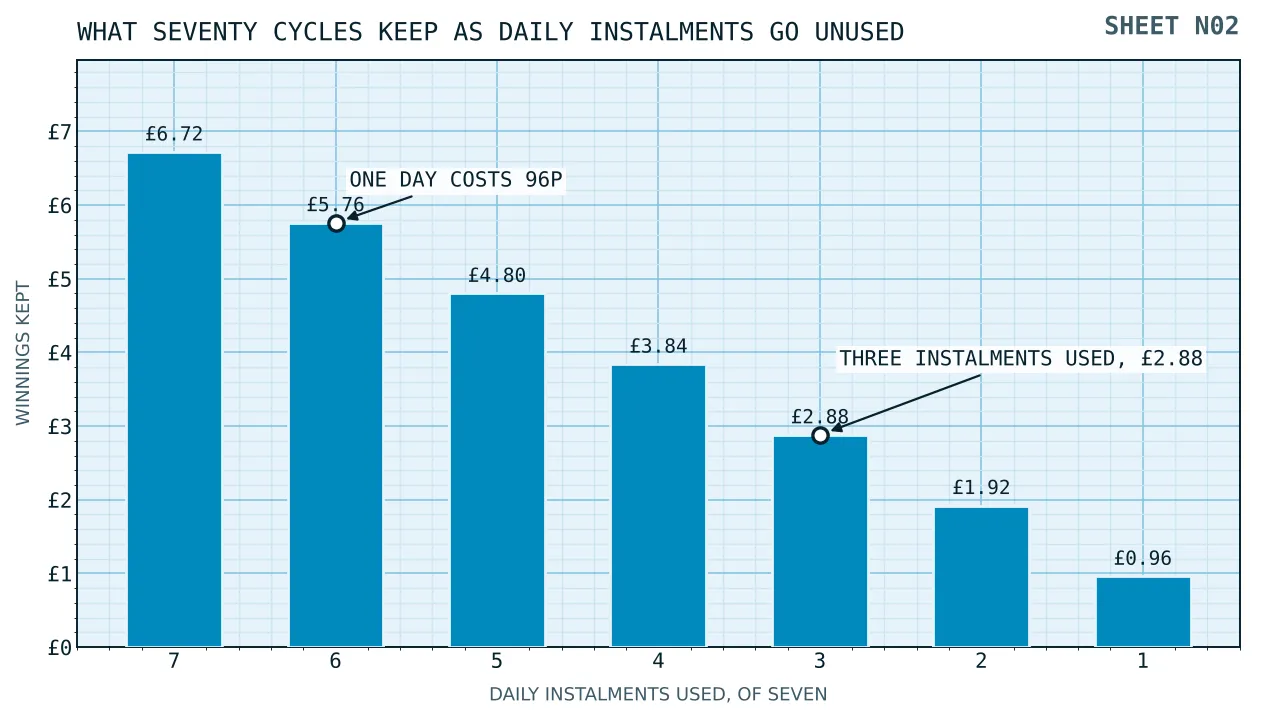
Two further points about instalments, both of which raise the bill.
A drip cannot be front-loaded. Even a reader who wants to finish the whole thing on the first evening cannot, because only ten cycles exist on day one. The offer owns the schedule, and the schedule is what prices it.
And the last instalment is the one most likely to die. It lands a week after the decision to sign up, by which time the account is often one of several and the promotional message carrying the reminder has been filed somewhere unread.
5
When a window is short enough to bite
A clock only costs something if it is shorter than the time the cycles need. So work out the time the cycles need, which under British rules is a known quantity rather than a guess.
No slot may open a fresh cycle until 2.5 seconds have passed since the last one opened, which is the floor RTS 14D sets. Seventy cycles at that floor occupy 175 seconds. Two minutes and fifty-five seconds, and that is the minimum, not the likely.
Set that against the windows a set of terms might carry:
| Window on all seventy | Cycles it leaves room for |
|---|---|
| 24 hours | 34,560 |
| 1 hour | 1,440 |
| 10 minutes | 240 |
| 3 minutes | 72 |
Only the bottom row is anywhere near seventy. A window stated in hours cannot bite on a round this size, and a window stated in days certainly cannot. Which is the point: when a clock does cost a player money, it is almost never because the clock was too short to play in. It is because the player was not at the keyboard.
That changes what a reader should be looking for. The question is not how long the window is. It is how many separate occasions the offer requires somebody to turn up, because each occasion is a chance for 96p to evaporate.
One other clock sits further down the same document and is easier to miss. A window on the winnings is not the same object as a window on the cycles. Where winnings have to be withdrawn inside a stated period and an identity check is still outstanding, the two clocks run against each other. That collision is priced on free £10 no deposit.
6
The one debit the advertising rules name outright
Section 7 of this sheet shows that most of what decides a no-wager offer has no specific rule behind it. A time limit is the exception, and it is worth knowing that the exception exists.
When the advertising regulator sets out which conditions in a gambling promotion count as significant, a limit on the time for claiming an offer or for using it is named explicitly, alongside who is eligible, what has to be staked or deposited, and any restriction on bet type or minimum price. Rule 8.17 of the CAP Code then requires significant conditions to be carried plainly and prominently in any case where dropping one would tend to mislead a consumer.
Three published rulings give that some weight, and the dates are the useful part.
A deadline for replying to a text message, nowhere stated in the advertisement that offered a £10 free bet, was ruled on 17 July 2024 to be a significant condition whose absence was apt to mislead. A fortnight later, on 31 July 2024, an excluded payment method sitting in small type among the full terms was judged to lack sufficient prominence. The sharpest of the three came on 27 August 2025: a £5 voucher carried no value on exactly one day of the year. The day was 14 March, when the Cheltenham Gold Cup runs. Nothing on the voucher said so, and the Code was found breached.
There is also a limb of the incentives code aimed squarely at the structure this sheet prices. A licensee may not alter what an incentive is worth where the qualifying activity is finished in less than the whole offer period. That rule binds only a British licensee, and it is a rule about the shape of a drip rather than about its length.
Where the instalments arrive as marketing messages, a separate British rule applies to the message rather than the offer. Since 1 May 2025, consent for direct marketing of online gambling has had to be given channel by channel and product by product. That date moved once: 17 January 2025 was announced first, and the change is recorded in the later release.
7
A drip under the British rules, and without them
A cashier that holds no Great Britain licence is free of everything in this part, and naming the parts is more useful than saying so in general terms.
Being brought back
RTS 14A, which applies to all gambling, says a product must not actively push a customer into chasing losses, into raising a stake, or into carrying on after deciding to stop. Its guidance goes further and gives an example that lands exactly on a seven-day drip: a customer who has signalled a wish to stop ought not be drawn back in, and the guidance names a free game as the way it happens. An instalment schedule is a machine for producing exactly that invitation, once a day, for a week.
Nothing resembling that was found in the Curaçao policy this site worked from. Nine things sit on its mandatory list: age verification, reachable information, self-assessment by the player, tracking of behaviour, cooling-off, self-exclusion, deposit limits, training for staff and affiliates, and general principles on marketing. Product design is absent from it.
The pace that is not set
The 175 seconds in part 5 is a British figure, got from holding one slot cycle 2.5 seconds clear of the last. The same standards bar autoplay outright: under RTS 8A a cycle begins only when the player says so, once per cycle. Offshore that floor was never laid. Curaçao’s own rulebook sets no minimum cycle, leaves autoplay alone, and says nothing of turbo or slam stop, so seventy cycles take whatever time the software allows.
What else does not cross the border
Ten times the bonus money is the ceiling on a wagering requirement for a British licensee, effective from 19 January 2026, and an incentive may not mix betting with casino, bingo or lottery from the same date. A slot cycle is held to £5 for players of twenty-five and over and £2 for those younger. Identity is established before any gambling, bonus play included. Complaints finish inside eight weeks and escalate to an approved adjudicator. Every British licensed online operator is in Gamstop Online.
One comparison genuinely runs the other way, and leaving it out would be dishonest: seven days is how long Curaçao makes a player wait before a deposit limit goes up, against a British minimum of a day’s cooling off.
8
Pricing a window before you accept it
Four questions, in this order, and the second is the one that decides it.
| The question | On these figures |
|---|---|
| How many cycles, at what price | 70 at £0.10 |
| How many separate occasions | 7 |
| Value riding on each occasion | £0.96 |
| Whole round if every one is met | £6.72 |
A reader honest with themselves about the second line will usually discount the fourth. Somebody certain of two of the seven days is looking at £1.92, and should price the offer at that rather than at the headline.
Two things the answer is not.
It is not a payment. £6.72 is the average of a distribution whose commonest outcome over a short round is a good deal less, and on a game with large rare prizes the commonest outcome is nothing. The figure prices the offer; it does not forecast an evening.
And a round with a generous window is not thereby generous. Its cost has gone somewhere else, and the rest of this section is where the other places are measured. Sheet N01 takes a ceiling over the win: 50 free spins no deposit no wager. Sheet N04 takes the one compulsory pass a cash credit makes: £20 free no deposit casino. Sheet N09 takes the form the winnings are credited in: 30 free spins, keep what you win. All of them stand together at Nothing asked back.
Questions
- What are 70 free spins with no wagering worth?
- £6.72 if every cycle is used. Seventy cycles priced at 10p make a face of £7.00, and 9.6p comes back from each of them on a game that returns 96 per cent. No play-through is attached, so nothing is billed against that total. What reduces it is cycles that never get played, at a flat 9.6p apiece.
- Why do spins arrive ten a day instead of all at once?
- Because a schedule is worth money to whoever writes it. Seventy cycles delivered in seven instalments of ten is seven separate occasions on which somebody has to come back, and each occasion carries 96p of expected winnings. Three days missed out of seven leaves £3.84 of the £6.72, with no term broken and nothing forfeited by a rule.
- How much does one missed day cost?
- 96p, on these figures. Ten cycles at 10p is £1.00 of face and 96p of average winnings at a 96 per cent return. The loss is linear, so two days missed is £1.92 and half the round is £3.36. There is no threshold and no carry-over, which makes it one of the few debits on this site that can be worked out in the head.
- Is a 24-hour window too short to use 70 free spins?
- Not remotely. RTS 14D keeps consecutive slot cycles 2.5 seconds apart at the least, so seventy of them occupy 175 seconds or more, which is two minutes and fifty-five seconds. A day holds room for 34,560 cycles at that floor. A window almost never costs a player money by being too short to play in. It costs them money when they are not there.
- Do the advertising rules treat a time limit as important?
- Yes, and it is the one debit on a no-wager offer that is named outright. The advertising regulator lists a limit on the time for claiming or using an offer among the conditions that count as significant, and CAP Code rule 8.17 wants significant conditions carried plainly and prominently. A ruling of 17 July 2024 turned on a £10 free bet whose advertisement omitted the hour by which a text had to be answered.
- Can an operator change the offer part-way through a drip?
- Not a British licensee. The incentives code bars a licensee from altering what an incentive is worth where the qualifying activity is completed in less than the full offer period. That rule binds the holder of a British licence and nobody else, and nothing like it appears in the Curaçao policy read for this site.
- Does a daily free spin offer count as being brought back to gamble?
- Under British rules the question has a published answer. RTS 14A says a product must not push a customer to chase losses, to raise a stake, or to keep going once they have indicated a wish to stop, and a free game is what its guidance names as the lure that draws a departing customer back. A seven-day instalment schedule issues that invitation once a day for a week.
- What goes missing where there is no Great Britain licence?
- The floor under the pace and under the terms. No minimum of 2.5 seconds between cycles, no autoplay bar, no ten-times ceiling on a wagering requirement, no £5 and £2 slot stake limits, no identity check ahead of bonus play, and no place in Gamstop Online. Product design requirements are absent from Curaçao’s rulebook altogether, though it does make a deposit limit increase wait a week where Britain asks for a day.