
Sheet R11 Revision 1 Checked 15 October 2026
Mastercard casino
A card deposit of £120.00 costs nothing to make, and the matched £120.00 behind it needs £4,800.00 of staking at forty times, which is 48,000 spins of ten pence. Nothing can be withdrawn until the last of them. Each tenth of that condition costs £19.20 in expectation, and £72.00 is what the whole of it was expected to leave at the British ceiling of ten.
£19.20 a tenth, 48,000 spins, and nothing withdrawable until the end
What a condition costs while it is being served
Every destination on this spike is bought advertising. The site takes a fee if a reader goes on to register, and no figure printed below moves because of it.
The Spin Sheet
Till receipt No 01
Betportal
Lowest multiple here
For every €1 of spin credit at face per €1
Credit
Debit
No Great Britain licence
Licensed in Anjouan, Comoros, run by BetPortal Gaming Ltd, with Excite Ultra Media Ltd, reference ALSI-202601040-FI2.
Terms read 15 October 2026
Open the offer at Betportal, opens in a new tabThe Spin Sheet
Till receipt No 02
WinBeast
Five staged matches
For every €1 of spin credit at face per €1
Credit
Debit
No Great Britain licence
Licensed in Curaçao, operator not named on the site.
Terms read 15 October 2026
Open the offer at WinBeast, opens in a new tabThe Spin Sheet
Till receipt No 03
EliteSpin
Longest spin window
For every £1 of spin credit at face per £1
Credit
Debit
No Great Britain licence
Licensed in Costa Rica, run by PrimeTier Limited.
Terms read 15 October 2026
Open the offer at EliteSpin, opens in a new tabThe Spin Sheet
Till receipt No 04
Crown Jewelz
Multiple unpublished
No total struck
Credit
Debit
No Great Britain licence
Licensed in Curaçao, number not verified, operator not named on the site.
Terms read 15 October 2026
Open the offer at Crown Jewelz, opens in a new tabThe figure at the foot of a receipt is this site's own arithmetic and nothing an operator has published: the credit, less the share a spin gives back at 96 per cent return to player, less what playing the wagering through costs at the same return. It describes the offer, not one reader's afternoon. Where the conditions price above the credit the receipt prints nothing rather than a negative sum, and where a figure the sum needs is unpublished it prints the condition in the operator's words instead.
Three words stand in the amount column where no figure can. Noted is a published condition that takes value away without leaving the sum a figure to take. Unpriced is a condition whose figure nobody has published, or a credit that is not a sum until a deposit of your own sets it. Own money is money of yours, which is never part of a total.
Not one of the operators printed above holds a Great Britain licence, so the duties that licence carries do not reach them. Every online gambling company licensed in Great Britain has to be part of Gamstop Online, and a reader who has shut themselves out through the scheme is therefore not shut out here. The ceiling of ten times the bonus funds on a wagering requirement, in force since 19 January 2026, is a condition of that licence and binds the companies that hold one. Where a dispute goes instead is a matter for the authority named on the receipt, and the Gambling Commission describes what a reader faces without a British licence as a lack of recourse if things go wrong. Nobody under 18 may hold an account at any of them.
Every term printed on a receipt is the operator's own, and each receipt carries the day it was read. The oldest of those readings is 15 October 2026. What binds a reader is the operator's own full terms, and not a line printed here.
1
A rail that can be withdrawn from under a cashier
Among the consequences the British regulator names for a business trading without a licence is the loss of its payment facilities, withdrawn by the large card schemes themselves. That is a sourced fact about this rail and not a prediction, and it is why this sheet is about duration rather than about charges.
Nothing is charged to put £120.00 on a card, exactly as nothing is charged on the debit sheet next door. What this rail has instead is a condition long enough for the arrangements behind it to change while the condition is still being served, and a credit that cannot be touched until the condition is finished.
So the quantity to price here is exposure: how much of a reader’s own staking has to happen before an entitlement exists at all. That figure is large, it is calculable to the penny, and no cashier prints it.
Three things are true at once on a part-served condition:
- The staking has happened and its expected cost has been paid.
- The credit is still the cashier’s, because the condition is unmet.
- And the expected value of the offer only exists at the far end of it.
What happens to an unfinished condition if a payment route closes is not published by any source this site may cite, so this sheet does not assert it. What it prices is the part that is certain: the staking already made, and the expected cost of having made it.
2
£120.00 matched, and what forty times asks for it
A full match on £120.00 credits £120.00, which is a larger credit than most of this section works with, and that makes the turnover figures worth looking at properly. The return is 96 per cent and the weighting is one.
| Multiple | Spins at 10p | Staking owed | Expected cost | Left standing |
|---|---|---|---|---|
| 10x | 12,000 | £1,200.00 | £48.00 | £72.00 |
| 20x | 24,000 | £2,400.00 | £96.00 | £24.00 |
| 25x | 30,000 | £3,000.00 | £120.00 | £0.00 |
| 40x | 48,000 | £4,800.00 | £192.00 | £0.00 |
The spin count is the column this sheet adds to the usual schedule. Turnover is an abstraction and a spin count is not: at ten pence a spin, the house value this site works at, a forty times condition on this credit is forty-eight thousand presses of a button, and a ten times condition is twelve thousand.
The last column behaves as it does everywhere. Ten times, the British ceiling, is expected to leave £72.00 of the credit standing. At twenty-five times it is expected to leave nothing, four pence multiplied by twenty-five being a pound in the pound. At forty times the expected cost of the staking is £192.00 against a credit of £120.00, so the credit goes and £72.00 of expected cost is left to fall on the deposit.
£72.00 standing at ten times, and £72.00 of overrun at forty times
3
The line prices a condition finished, not one begun
The expression this site works with is the same here as elsewhere, and the point of this part is what it quietly assumes.
E = B × (1 – (W × (1 – RTP)) / g)
Duration is absent from it, and that absence is the subject here. B stands at £120.00, the deposit having arrived whole. W is the multiple. A return of 0.96 and a weighting of one mean each pound staked on slots settles a pound of the requirement.
Substituted at forty, four pence by forty is 1.60, which leaves the bracket at minus 0.60, and three-fifths of £120.00 is £72.00 with the sign against the reader. Substituted at ten, the same three-fifths runs the other way and £72.00 is expected to survive.
Now the assumption. Every figure that expression produces is the value of a condition carried all the way to its end. It contains no term for stopping half way, for a cashier closing an account, for a payment route being shut off, or for a reader simply having had enough at eleven o’clock at night. A condition abandoned at any point returns nothing from it, while the staking cost already incurred stays incurred, which means the honest reading of E is a figure available only to somebody who finishes.
That is a general truth about play-through and it bites hardest where the multiple is largest. A ten times condition puts £1,200.00 of staking between a reader and an entitlement. A forty times condition puts £4,800.00 there, and the entitlement at the end of it is worth nothing anyway.
4
Thirty-three hours and twenty minutes
Exposure has a length as well as a size, and British rules make the length calculable because they put a floor under how fast a slot may run.
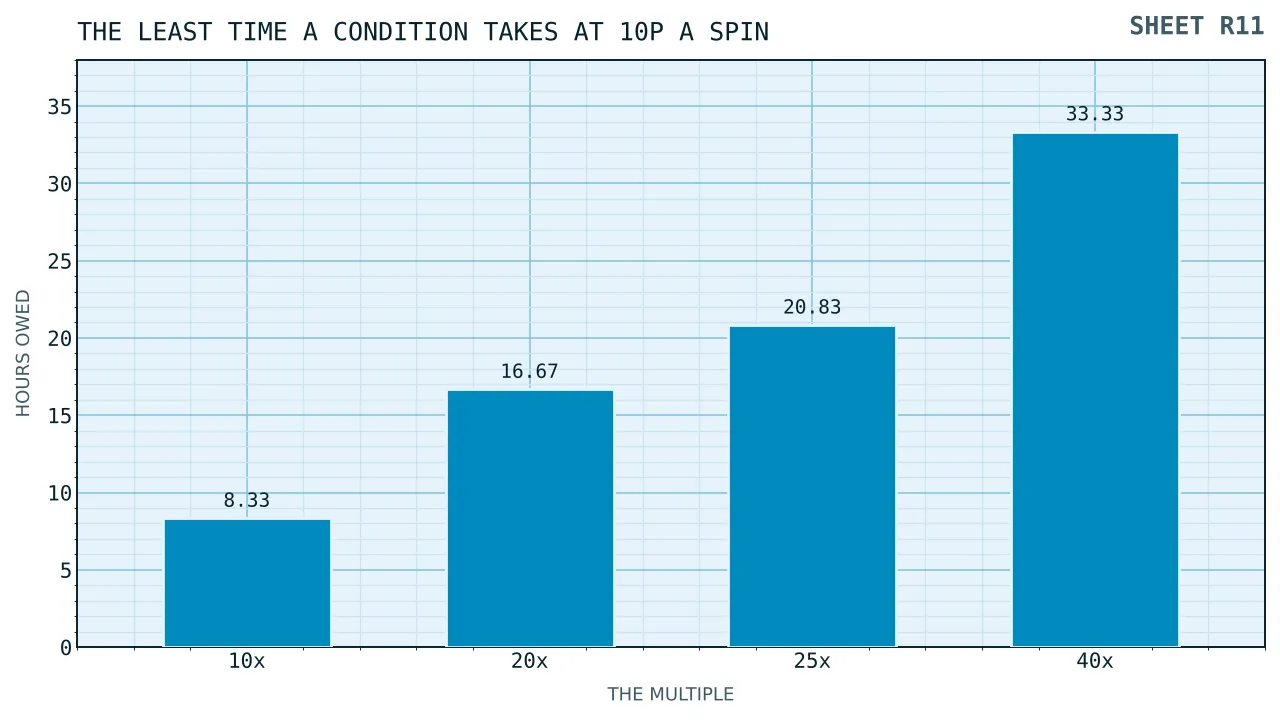
On a British slot, 2.5 seconds has to pass from the start of one game cycle before the next may begin. Set that against the spin counts in part 2. Forty-eight thousand spins at two and a half seconds each is a hundred and twenty thousand seconds, which is thirty-three hours and twenty minutes of uninterrupted play. The twelve thousand spins a ten times condition needs come to eight hours and twenty minutes.
Those are floors rather than estimates, and nothing about them is a forecast of how long anybody would take. What they establish is that a forty times condition on a credit this size is not an evening’s work, so the window during which the arrangements behind the cashier have to hold still is measured in days of play rather than minutes.
Stake size changes the clock and British rules bound that too. On a British slot the most that may be staked in a game cycle is £5.00, and £2.00 where the player is under twenty-five. Neither figure reaches roulette or blackjack, both being rules for slots alone, and the two came into effect on 9 April 2025 and on 21 May 2025 respectively.
| Stake a spin | Spins needed |
|---|---|
| £0.10, this site’s working figure | 48,000 |
| £0.50 | 9,600 |
| £2.00, the British cap under twenty-five | 2,400 |
| £5.00, the British cap at twenty-five and over | 960 |
Read that schedule the right way round. Staking more per spin shortens the clock and changes nothing about the arithmetic: the expected cost of £4,800.00 of turnover is £192.00 whether it arrives in nine hundred and sixty spins or in forty-eight thousand. Faster is not cheaper. It is the same cost paid sooner, with the variance concentrated into fewer events.
Out here neither bound survives: the island policy examined for this build has no minimum cycle in it, nothing capping a stake, and no word about turbo. The clock worked out above is therefore the British version of a condition rather than the one a reader would meet.
5
£19.20 for every tenth of the way
Progress through a condition can be priced in tenths, and doing so turns a vague worry into a figure.
Each tenth of a forty times condition on this credit means £480.00 staked, and four pence in the pound makes the expected cost of that £19.20. A reader who serves six tenths of it and stops has staked £2,880.00, has paid £115.20 of expected cost for the privilege, and holds no entitlement to any part of the credit, because an unmet condition is an unmet condition.
| Served | Staked | Expected cost paid | Withdrawable |
|---|---|---|---|
| One tenth | £480.00 | £19.20 | £0.00 |
| Half | £2,400.00 | £96.00 | £0.00 |
| Six tenths | £2,880.00 | £115.20 | £0.00 |
| Nine tenths | £4,320.00 | £172.80 | £0.00 |
| All of it | £4,800.00 | £192.00 | £0.00 |
That last column is the finding, and it reads the same all the way down. At forty times there is nothing at the end either, so every row of that schedule is money spent against an entitlement that was never expected to be worth anything.
At the British ceiling the same schedule reads differently and is worth setting out, because it shows where the exposure actually matters. A tenth of a ten times condition is £120.00 of staking and £4.80 of expected cost. Interrupted half way, that condition has cost £24.00 of expected staking and the £72.00 it was going to leave does not arrive. So an interruption at the halfway mark of the best lawful offer costs £96.00 of expectation on a £120.00 deposit.
£19.20 a tenth at forty times, £4.80 a tenth at ten
6
What the regulator publishes about unlicensed sites
This sheet opened on a sourced fact about payment facilities, and the same body publishes three more things that belong beside it.
Dated 20 January 2025, the regulator’s industry warning notice says the controls at such a website may be inadequate, the anti-money-laundering ones and those for social responsibility alike. The exposure it names runs to unfair practices, difficulties over data privacy, and fraud. Those sites, the notice adds, are often aimed at customers who are vulnerable, among them people who have taken themselves out of gambling through the national scheme.
Second, a game made by a licensed supplier has turned up at websites holding no licence, so recognising the game tells a reader nothing at all about what stands behind it. That is the one piece of reassurance a reader is most likely to reach for, and it is worth precisely nothing.
Third, the enforcement is real and it is published with figures. The sum agreed on 23 July 2026 by one supplier was £4.75m, its games having appeared at six unlicensed websites that a British consumer could reach. Penalties elsewhere on the same published list run to £10m against one operator on 22 October 2025 and £2m against another on 17 December 2025.
None of that is an argument that an offshore cashier will fail. It is the reason the duration arithmetic above is not academic: a condition measured in tens of hours of play is a condition served inside a market the regulator is actively working against, and the reader’s staking goes in first and comes out last.
7
Duties that would have stood behind the card
Welcome offers on this rail are paid by cashiers holding no Great Britain licence. Taken one at a time, these are the duties the badge on a card does not carry with it.
| Under a British licence | Worth, on these figures |
|---|---|
| Wagering capped at ten times | £72.00 |
| A slot cycle of at least 2.5 seconds | 33h 20m |
| A stake cap of £5.00, or £2.00 under 25 | 960 spins |
| Turbo and slam stop not permitted | Pace |
| No fanfare over a return under the stake | Candour |
| A register covering every licensed site | None |
Row one is where the money is. Ten times rather than forty turns a credit of £120.00 from nothing into £72.00 of expectation, and it is the only line in the schedule that moves the total rather than the experience.
The rest move the experience, and two of them deserve their figures. A minimum cycle and a stake cap together decide how long a condition takes and how many events it is spread across. Turbo and slam stop are both barred, so a British game cannot be hurried, and no return that fails to beat the stake may be celebrated, so forty-eight thousand spins at ten pence cannot be presented as forty-eight thousand small victories.
The offshore rulebook examined for this build contains none of the first five, and saying so is not the same as saying it contains nothing. It does require deposit limits, a cooling-off facility reachable in a single click, and self-exclusion from the operator itself, running from a year up to a lifetime. What it has no equivalent of is a register covering every licensed site at once, which is the difference between excluding yourself from one cashier and excluding yourself from all of them.
8
Four readings, and the one off the banking page
A card costs nothing to use, so the banking page has nothing to tell a reader. Every reading below sits in the terms or in the arithmetic instead.
| Reading | Here |
|---|---|
| Charge to deposit | £0.00 |
| Multiple in the terms | 40x |
| Staking that buys the entitlement | £4,800.00 |
| Spins at £0.10, and the least time | 48,000, 33h 20m |
| Expected value at the end of it | £0.00 |
Multiply the second reading by the credit and divide by the stake a reader actually uses. That gives the third and fourth readings, which is the whole trick of this page: a multiple is a quantity of your own time and your own money, and it is published in a form that hides both.
Then ask the only question that matters on a long condition. Not whether the offer is worth having at the end, though at forty times it is not. Whether the reader expects to be there at the end at all, because every tenth left unserved costs £19.20 and returns nothing, and the cashier keeps the credit either way.
The usual note on averages applies with more force here than anywhere. Seventy-two pounds is a long-run average over identical attempts, not a sum anybody collects, and a single attempt on a hundred and twenty pounds of credit will most often finish at nothing. Forty-eight thousand spins, on the other hand, is not an average at all. It is the count, and it has to be served in full.
The neighbouring sheets take other charges along the same rail. For the debit card, whose entrance is free and whose cost is a cancel button, see visa casino. Borrowed money, refused outright under a British licence, is at credit card casino. The prepaid case, remainder and all, is at paysafecard casino, and a wallet round trip with its floor charged on the homeward leg is at skrill/neteller/trustly casino. Everything else on this rail is listed under The rail.
Questions
- What does a card deposit cost at an offshore cashier?
- Nothing, on the figures used here, which is why this sheet prices time instead. A £120.00 deposit arrives whole and is matched whole. The cost of this rail is the length of the condition attached to the credit and the staking that has to happen before any of the credit belongs to the reader.
- Can a casino lose the ability to take card payments?
- Among the consequences the British regulator names for a business trading without a licence is the loss of its payment facilities, withdrawn by the large card schemes themselves. That is published rather than predicted. What happens to a part-served bonus condition if a route closes is not published anywhere this site may cite, so this sheet prices only the part that is certain: the staking already made and its expected cost.
- What does forty times ask of £120.00 of credit?
- £4,800.00 of staking, which at ten pence a spin is forty-eight thousand spins. Four pence in the pound puts the expected cost of that staking at £192.00, against a credit of £120.00, so the credit is exhausted and £72.00 of the cost falls on the deposit. At the British ceiling of ten the staking owed is £1,200.00 and the expected cost £48.00, leaving £72.00 of the credit expected to stand.
- How long would such a condition take to serve?
- At least thirty-three hours and twenty minutes of uninterrupted play. A slot in Britain may not begin a new game cycle until 2.5 seconds have passed from the start of the last, and forty-eight thousand spins at two and a half seconds each come to a hundred and twenty thousand seconds. A ten times condition on the same credit needs twelve thousand spins, or eight hours and twenty minutes.
- Would staking more per spin make it cheaper?
- No, only quicker. The expected cost of £4,800.00 of turnover is £192.00 whether it arrives in nine hundred and sixty spins at five pounds or forty-eight thousand at ten pence. What changes is the clock and the spread of outcomes: fewer, larger events mean the same expected cost with the variance concentrated. On a British slot the most that may be staked in a game cycle is £5.00, and £2.00 where the player is under twenty-five, both rules for slots alone.
- What does stopping part way through cost?
- Each tenth of a forty times condition on this credit is £480.00 of staking and £19.20 of expected cost, and nothing is withdrawable at any point short of the end. Serve six tenths and stop: £2,880.00 staked, £115.20 of expected cost paid, and no entitlement to a penny of the credit. At the British ceiling a tenth costs £4.80, and an interruption half way costs £24.00 of staking plus the £72.00 that never arrives.
- Does the house formula allow for not finishing?
- It does not, and that is worth knowing before relying on it. Every figure the expression produces is the value of a condition carried to its end. There is no term in it for stopping half way, for an account being closed, for a payment route shutting, or for having had enough late at night. A condition abandoned returns nothing while the staking cost already incurred stays incurred.
- Is a familiar game a sign the site is licensed?
- No. A game made by a licensed supplier has turned up at websites holding no licence, so recognising the game tells a reader nothing at all about what stands behind it. The sum agreed on 23 July 2026 by one supplier was £4.75m, its games having appeared at six unlicensed websites that a British consumer could reach.
- What else does the regulator publish about such sites?
- Dated 20 January 2025, its industry warning notice says the controls at such a website may be inadequate, the anti-money-laundering ones and those for social responsibility alike. The exposure it names runs to unfair practices, difficulties over data privacy, and fraud. Those sites, the notice adds, are often aimed at customers who are vulnerable, among them people who have taken themselves out of gambling through the national scheme.
- What would a British licence have added to this deposit?
- Wagering capped at ten times, which on these figures is the difference between nothing and £72.00 of expectation. A minimum game cycle of 2.5 seconds on a slot. A stake capped at £5.00 a cycle, and at £2.00 for a player under twenty-five. No turbo and no slam stop, so a game cannot be hurried. No fanfare where the return fails to beat the stake. And membership of a register covering every licensed site at once, rather than exclusion from one cashier at a time. Welcome offers on this rail are paid by cashiers holding no Great Britain licence.