
Sheet P05 Revision 1 Checked 15 October 2026
Mobile casinos
Six pounds of credit owes £240.00 of staking at forty turnovers. The expected cost of that is £9.60, against six pounds credited, so nothing is left. On a phone that is 2,400 taps and a floor of an hour and forty minutes. The glass moves none of the arithmetic and quite a lot of the reading.
2,400 taps, 100 minutes, and £0.00 at the foot
What a phone cashier's conditions leave
Every destination on this spike is bought advertising. The site takes a fee if a reader goes on to register, and no figure printed below moves because of it.
The Spin Sheet
Till receipt No 01
Betportal
Lowest multiple here
For every €1 of spin credit at face per €1
Credit
Debit
No Great Britain licence
Licensed in Anjouan, Comoros, run by BetPortal Gaming Ltd, with Excite Ultra Media Ltd, reference ALSI-202601040-FI2.
Terms read 15 October 2026
Open the offer at Betportal, opens in a new tabThe Spin Sheet
Till receipt No 02
WinBeast
Five staged matches
For every €1 of spin credit at face per €1
Credit
Debit
No Great Britain licence
Licensed in Curaçao, operator not named on the site.
Terms read 15 October 2026
Open the offer at WinBeast, opens in a new tabThe Spin Sheet
Till receipt No 03
EliteSpin
Longest spin window
For every £1 of spin credit at face per £1
Credit
Debit
No Great Britain licence
Licensed in Costa Rica, run by PrimeTier Limited.
Terms read 15 October 2026
Open the offer at EliteSpin, opens in a new tabThe Spin Sheet
Till receipt No 04
Crown Jewelz
Multiple unpublished
No total struck
Credit
Debit
No Great Britain licence
Licensed in Curaçao, number not verified, operator not named on the site.
Terms read 15 October 2026
Open the offer at Crown Jewelz, opens in a new tabThe figure at the foot of a receipt is this site's own arithmetic and nothing an operator has published: the credit, less the share a spin gives back at 96 per cent return to player, less what playing the wagering through costs at the same return. It describes the offer, not one reader's afternoon. Where the conditions price above the credit the receipt prints nothing rather than a negative sum, and where a figure the sum needs is unpublished it prints the condition in the operator's words instead.
Three words stand in the amount column where no figure can. Noted is a published condition that takes value away without leaving the sum a figure to take. Unpriced is a condition whose figure nobody has published, or a credit that is not a sum until a deposit of your own sets it. Own money is money of yours, which is never part of a total.
Not one of the operators printed above holds a Great Britain licence, so the duties that licence carries do not reach them. Every online gambling company licensed in Great Britain has to be part of Gamstop Online, and a reader who has shut themselves out through the scheme is therefore not shut out here. The ceiling of ten times the bonus funds on a wagering requirement, in force since 19 January 2026, is a condition of that licence and binds the companies that hold one. Where a dispute goes instead is a matter for the authority named on the receipt, and the Gambling Commission describes what a reader faces without a British licence as a lack of recourse if things go wrong. Nobody under 18 may hold an account at any of them.
Every term printed on a receipt is the operator's own, and each receipt carries the day it was read. The oldest of those readings is 15 October 2026. What binds a reader is the operator's own full terms, and not a line printed here.
1
Six pounds, and the room in a pocket
Six pounds of credit on a phone owes £240.00 of staking at forty turnovers, and the glass it is played through changes none of that. Four quantities decide the answer, and not one of them has a screen size in it: the multiple, the weight, the return and the credit.
That is worth establishing before anything else, because a page about mobile play can easily become a page about handsets. The arithmetic is indifferent to the device. What the device genuinely alters is how much of the document a reader sees before deciding, and that is a matter the published rules do address, in terms of prominence rather than in terms of pixels.
So this sheet runs the usual total, then spends its middle on the two things a short screen really does change: where the significant conditions have to sit, and how many taps stand between a customer and the facilities for limiting what they spend. Both have sourced rules behind them and neither mentions a phone.
Six pounds is a deliberately small working credit, because the ratios on this site hold at any size and a small one keeps the counts legible. Two thousand four hundred taps on six pounds is easier to picture than a hundred thousand on three hundred.
Four inputs, none of them a property of the handset:
- Credit of £6.00 at face, with no payment standing behind it.
- Forty turnovers, the order of multiple terms reach for once a British register is out of the picture. Ten is a licensee’s limit.
- A reel return of 96 per cent, the constant this site works to.
- Weight held at one, so a staked pound clears a whole pound, until part 4 moves it.
- Stakes of 10p, which converts money into taps and taps into seconds.
2
£240.00, and a clock the phone cannot shorten
Forty lots of £6.00 make £240.00 of required contribution, out of the credit and the multiple and nothing else. Behind each pound of credit stands £40.00 of staking, the multiple in another dress.
At 10p a cycle, £240.00 of staking is 2,400 commitments, and on a British reel each one waits 2.5 seconds behind the last, which floors the exercise at 6,000 seconds: an hour and forty minutes.
Nothing about a touchscreen compresses that, and the standards go out of their way to say so. The touchscreen gets an express mention in the standard, which is worth knowing. A start control has to be released and then pressed again before a cycle begins, and the guidance says that a cycle must not be started by keeping a button, a key or a screen pressed. Automatic play is barred across gaming. Nobody may be handed a means of cutting the wait for a result short, so turbo goes, and quick spin, and slam stop. And functionality for running several games at once is out, split screens and multiple screens included, so an hour and forty minutes cannot be divided between four windows on a tablet.
A phone does remove the one thing that used to pace play without any rule at all, which is having to be at a desk. The floor stays where it is; the opportunity to reach it moves into a queue, a waiting room and a bus. None of that is in the facts sheet behind this page and none of it is asserted as a finding here. What is sourced is the clock, and the clock is a floor rather than a forecast.
6,000 seconds owed on £6.00 of credit
3
The expression, which the glass does not touch
Everything on a phone goes through the same expression as everything on a desk.
E = B × (1 – (W × (1 – RTP)) / g)
Pounds of credit make B, six of them. W is the forty turnovers demanded. RTP sits at 0.96, which leaves four pence per staked pound in the house’s hands. The weight g holds at one for the moment. E is the residue.
Forty turnovers of £6.00 = £240.00 owed
Four pence of each staked pound comes to £9.60
E = £6.00 less £9.60, which is -£3.60
Four pence in the pound over £240.00 of staking bills £9.60 against credit of £6.00, overshooting it by £3.60, and the foot therefore reads nought. With no payment in the balance and nought for a floor under it, the three pounds sixty is staking that never gets taken.
Held to ten turnovers the same credit owes £60.00, costs £2.40 and keeps £3.60, which is three-fifths of what was credited. Twenty turnovers keeps £1.20. Twenty-five keeps nothing.
The reason twenty-five is the hinge is that the credit cancels out of the test. Set the residue to nought, divide B off both sides, and the condition that survives is the multiple over the weight coming in under the inverse of the house’s four pence, which is twenty-five. Put on the weight instead: it must exceed the multiple over twenty-five. Ten turnovers therefore calls for more than forty pence of each staked pound; twenty calls for more than eighty; and twenty-five or more is unreachable at any rate, since a pound staked never books above its own face.
£9.60 billed against £6.00 credited
4
Weighting, and the hours it adds
Weighting is a divisor, and on a page about a phone its most interesting consequence is measured in hours rather than in pounds.
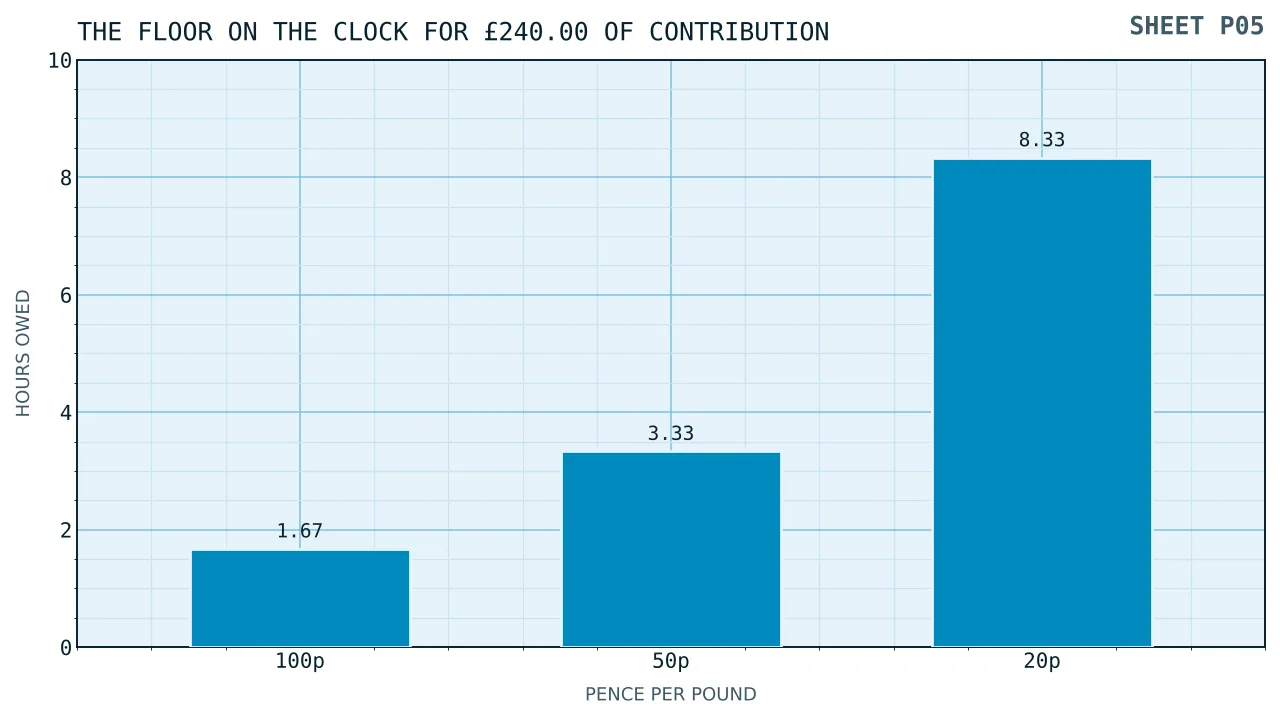
The obligation stays at £240.00 of contribution whatever the rate. What changes is the stake needed to deliver it, which rises by the reciprocal, and with the stake the number of taps and with the taps the hours on the floor.
| A staked pound is booked at | Owed, in contribution | Stake to put through | Taps at 10p | Floor on the clock | Residue |
|---|---|---|---|---|---|
| A whole pound | £240.00 | £240.00 | 2,400 | 1h 40m | -£3.60 |
| Half a pound | £240.00 | £480.00 | 4,800 | 3h 20m | -£13.20 |
| A fifth of a pound | £240.00 | £1,200.00 | 12,000 | 8h 20m | -£42.00 |
Eight hours and twenty minutes, as a floor, on six pounds of credit. The obligation column has not moved and the published multiple still reads forty. Everything that changed sits in a game list, and a game list is the document least likely to be one tap from a cashier’s deposit screen.
Of the rates on this sheet only one has provenance anywhere near it, thirty pence in the pound, and it comes from a consultation response rather than from a cashier: a hundred pound bonus at ten turnovers, with a wagered pound counted at thirty pence against the requirement. The submission was recorded; weighting was not touched. Rates on this sheet are inputs chosen to show a shape, because no citable schedule of game contributions is published.
5
Where a short screen puts the terms
What a phone genuinely changes is where the terms sit, and the published rules on that are about prominence rather than about screens.
Promotional material has to put all the applicable significant conditions clearly and prominently where omitting them would be likely to mislead, and the advertising regulator’s worked list of what qualifies runs to restrictions on eligibility, age or location among them and new customers only; requirements on deposit or on wagering; limits of time on claiming the offer or using it; and minimum odds or types of bet. Every one of those is a line on a no-deposit offer, and the first three are the ones that decide the arithmetic on this sheet.
For an advertisement online the full conditions should usually be a single click away, and the link to them belongs somewhere other than a footer or a patch of small print. The British regulator puts the consequence plainly. Significant terms are to be shown prominently within the advertisement, placed near the headline offer on the relevant landing page and sign-up page, and where the prominence falls short the advertisement will be seen as misleading.
Three rulings on the advertising regulator’s own page show what that looks like when it goes wrong, and none of the three is about a handset. On 17 July 2024 a free bet of ten pounds turned out to need a text message answered before a stated hour; the advertisement had kept that quiet, and the deadline ranked as a significant condition that was likely to mislead by its absence. On 31 July 2024 a payment method excluded from an offer was found only in the small print of the full terms, and the prominence given to that significant condition was held insufficient. A five pound free bet voucher was void on 14 March because of the Cheltenham Gold Cup, the voucher did not say so, and on 27 August 2025 the advertisement was found to have breached the code.
Read that against the arithmetic and the mobile point sharpens. The two terms that settle the total on this sheet are the multiple and the weight. The multiple is one of the significant conditions the regulator names, so there is a published argument for its being close to the headline. The weight is not on that list anywhere, which is why a game list can sit several taps away without any rule being broken, and why a reader on a small screen is far more likely to find the forty than the fifth.
From 17 January 2025 a British licensee also has to put a customer’s net spend, and the time they have been gambling, in front of them as they play. On an hour and forty minutes of floor, that display is the only published furniture on the page that reports the clock back to the person watching it.
6
Rules written per cycle, not per device
A persistent idea about mobile play is that the rules are looser there. They are not written about devices at all, which cuts both ways, and the detail is worth having exactly.
The pace rules attach to the game. A 2.5-second floor belongs to slots. Five seconds covers the casino’s non-reel games, poker between customers struck out, which the updates page the regulator publishes dates to 17 January 2025. Commencement dates are absent from the standard for every RTS 14 requirement, and none is invented here. Bingo makes its own product type and no interval attaches to it.
The stake caps attach to the game as well. The instrument of 25 February 2025 reads online slots game as a casino game running on reels and running online, reels being images that move or change whose final arrangement settles a prize or other advantage. Both figures are kept to online slots by the regulator, which supplies the dates as well: 9 April 2025 for one and 21 May 2025 for the other. A phone makes no difference in either direction: five pounds a cycle on a handset, five pounds a cycle on a desk.
The design rules attach to the game too. Where the money coming back does not beat the total staked there is no sound of the win-related sort and no animation either, the guidance offering three substitutes: the total awarded displayed, the winning lines briefly shown, and one short note when the credit arrives. An outcome that loses may not be dressed as one that nearly won, and a device simulated on screen may not run on odds the real device does not have. Mid-play alteration of rules, payouts or probabilities is out, and the guidance offers as unacceptable a term saying the rules may change whenever.
And the bonus rules attach to the incentive. A licensee’s condition has been barred from passing ten turnovers of the bonus money since 19 January 2026, the provision reaching all licences save the technical and the software ones, and the regulator attached a figure of sixty times to what the ceiling was correcting. From the same day one incentive holds one product type out of betting, casino, bingo and lottery, with three carve-outs: two items of a single type together, a raffle beside a scratchcard being the illustration; two offers sharing an email where marketing consent covers each of the products; and a credit whose holder may spend it on whatever they like, which falls outside the ban.
None of it holds away from the British register, and a cashier reached through a phone in the part of the market this site covers holds no Great Britain licence. Nothing in the Curaçao policy opened for this build paces a game cycle, caps a stake, caps a multiple, mentions weighting, bars automatic play or says a word about near misses. Bonuses have two sentences there: transparent terms, and nothing aggressive in a promotion that would push play too far.
7
Limits, blocks and the device itself
Two things on a phone are genuinely about the device rather than about the game, and both have sourced rules. One is the furniture for limiting what a customer spends. The other is blocking software.
Clicks, which the standard counts
A limit on spending is the one piece of furniture the standard measures in clicks. The facilities want a direct link on the homepage, clear visibility and access on a deposit page or through a link on one, and a system that keeps the clicks and pages between a customer and those facilities to a minimum.
Setting a limit is the default answer rather than an option. A customer has to act in order to decline one, and a decision to go without has to be confirmed by them before they go on to deposit or to gamble. On the live standard’s wording the prompt arrives as part of registration, or else at a first deposit or payment. A summary page the regulator publishes asks instead for the prompt as early as possible, and this sheet quotes the standard and names the looser phrasing rather than choosing between them.
Durations on offer must take in 24 hours, 7 days and 1 month; the account is the minimum level a limit applies at; and a free text box is how the figure gets entered. Gross deposit limits, where the cap falls on what a customer pays in over a period, are the only sort that may be called a deposit limit, and no other kind may be given greater prominence than they get.
Cutting a limit happens at once, barring a systems or technical failure. Raising one has to sit out twenty-four hours as a minimum, and then wants a fresh positive act from the customer at the close of that wait. Customers active inside a rolling year are prompted at six-monthly intervals or better to look over their own account and transactions, and a customer without a limit gets prompted once a year.
Where two limits overlap the tighter one governs. The worked example the regulator supplies sets a daily limit of £10 beside a weekly limit of £100, and the system must then permit £10 a day with £70 across the week. Set beside the arithmetic on this sheet, a £10 daily limit against £240.00 of required staking is a useful comparison: the obligation would take twenty-four days of deposits at the ceiling to fund from a customer’s own money, which is one way of seeing how large a condition forty turnovers really is.
Blocking, which is a device question
Blocking software is the part of this that is genuinely about devices. One supplier describes blocking in layers, over gambling sites and apps in their tens of thousands, installed under a single licence on all the major device platforms, with the App Store and Google Play as the download routes.
A free trial lasting seven days is what its own site offers, and no free route for British users appears there, though the software is stated to be free for all Ohio residents through a state scheme. The free British route is published by the charity rather than by the software company, and it has a name: Talk, Ban and Stop, pairing the National Gambling Helpline with the blocking software and with the national self-exclusion scheme. The page stating that the software is free to anybody ringing the helpline carries a date of 12 April 2021 and is a news article, and it gives no duration, so none is given here.
The national scheme itself is the other half. Belonging to it arrives with a British online licence, which is why it reaches one side of this market and not the other, and the scheme’s terms draw the boundary: it cannot act to shut anybody out of gambling services put up by an operator that has not joined. Its figures of 16 July 2026 count 614,738 registrants, with under-25s making close to one self-exclusion in three. A registration will not end before its minimum period expires, and four lengths are offered at sign-up: half a year, a year, five years, or five years renewing by themselves. Nothing on this page helps anybody get round any of that, and the help numbers follow the questions.
Written as an inventory of what the operator is carrying rather than a list of what the player receives, the British licence holds: a ceiling of ten turnovers on its own conditions; one product type to an incentive; a reel stake capped at five pounds, or two under 25; a 2.5-second floor on a reel cycle and a five-second floor elsewhere in the casino; no automatic play; no slam stop and no quick spin and no turbo; no celebrating a return that does no better than the stake; no running of two games together; no near miss put where a loss belongs; no button to undo a withdrawal; nothing capping what may be drawn from the money a customer paid in; identity verified before any play; no credit cards; the limit furniture set out in this part; eight weeks as the limit on a complaint, with an adjudicator off the approved list at the finish; and a standing place on the national self-exclusion register.
8
Pricing a credit on a phone
Six readings, two of which a small screen hides better than a desk does.
| The line | Here |
|---|---|
| Face value of the credit | £6.00 |
| Turnovers, off the wagering line | 40x |
| Owed in contribution, exact | £240.00 |
| Weight, from the game list | 1.00 assumed |
| Taps, and the floor under them | 2,400, 1h 40m |
| The test, and what is left | 40.0 against 25, then £0.00 |
The first three readings come off the offer itself. The fourth comes off a game list and is the one most often several taps away. The fifth follows from the third and a stake. The sixth is the test, and at forty over one it sits a long way the wrong side of twenty-five before any clause about games has been opened.
Then a habit worth having on a handset specifically. Before depositing, find the wagering line and the game list, and if the game list cannot be found in a couple of taps, treat the weight as unknown rather than as one. An unknown weight makes the fifth and sixth lines estimates, and saying so is better than assuming the generous reading.
Two cautions on the £0.00. It is a mean over a great many runs of the same credit, and a single sitting is not described by it: there the commonest outcome is an emptied balance with most of the £240.00 never staked. And a clause well clear of the expression can shut the whole answer down, leaving W, g and the return exactly as they stood: a lid on what the bonus may win and an expiry window are the two worth hunting for. The one clause of that family with a published enforcement outcome behind it cost £170,000 on 3 July 2025: a discretion the operator had kept to close accounts or to forfeit winnings, written into the promotional rules it published for new casino customers.
What to read next depends on the room and not on the device. The whole building sits at online casino UK. The missing percentage in a ticket room is at online bingo. Ticket money of five pounds gets priced at bingo no deposit bonus, and a cashier with no record behind it at new casino sites. The room carries every sheet whose total hangs on where a credit must go, and the arithmetic they share is set down at How a receipt is struck.
Four of the six readings are available before a deposit.
Questions
- Is a mobile casino bonus worth less than one on a desktop?
- No, and the arithmetic says why. Six pounds of credit at forty turnovers owes £240.00 of staking, and the expected cost of that is £9.60 against six pounds credited, whichever device it is played on, so nothing is left. The multiple, the weight, the return and the credit decide the answer, and no screen size appears among them.
- How long does £6 of mobile credit take to clear?
- An hour and forty minutes as a floor. At 10p a cycle, £240.00 of staking makes 2,400 commitments, and on a British reel each waits 2.5 seconds behind the last, so 6,000 seconds is the minimum. At half weight the stake doubles to £480.00 and the floor goes to three hours twenty. At a fifth it is £1,200.00 and eight hours twenty.
- Can holding the screen down speed up a slot?
- Not on a British licensee. A start control wants releasing and pressing afresh before a cycle begins, and the guidance says a cycle must not be started by keeping a button, a key or a screen pressed. Automatic play is barred across gaming, no customer may be given a way to shorten the wait for a result, and functionality for running several games at once is out.
- Where do a mobile offer’s terms have to be?
- The rules are about prominence rather than about screens. All the applicable significant conditions have to be put clearly and prominently wherever omitting them would be likely to mislead; for an advertisement online the full conditions should usually be one click off; and the link is not to be hidden in a footer or in small print. The British regulator adds that significant terms belong close to the headline offer on the relevant landing and sign-up pages, and that prominence falling short makes an advertisement misleading.
- Which terms count as significant?
- The advertising regulator’s worked list runs to restrictions on eligibility, age or location among them and new customers only; requirements on deposit or on wagering; limits of time on claiming the offer or using it; and minimum odds or types of bet. The wagering requirement is on that list, which gives a published argument for its being near the headline. Game weighting is not on it anywhere, which is why a game list can sit several taps away.
- How many taps should a deposit limit be?
- As few as possible, and that is a published requirement rather than a preference. The facilities want a direct link on the homepage, clear visibility and access on a deposit page or through a link on one, and a system that keeps the clicks and pages between a customer and those facilities to a minimum. Setting a limit is the default answer, declining one takes an act by the customer, a cut takes effect immediately, and a rise has to wait twenty-four hours before a fresh confirmation is wanted.
- If a daily limit and a weekly one disagree, which wins?
- The tighter one governs. The worked example the regulator supplies sets a daily limit of £10 beside a weekly limit of £100, and the system must then permit £10 a day with £70 across the week. Durations on offer must take in 24 hours, 7 days and 1 month, and a limit applies at account level as a minimum.
- Do the £5 and £2 stake caps apply on a phone?
- They apply to the game, not to the device, so yes on a reel game and no anywhere else. The instrument of 25 February 2025 reads online slots game as a casino game running on reels and running online, and the regulator keeps both figures to online slots, dating the five pound one 9 April 2025 and the two pound one 21 May that year. Five pounds a cycle on a handset, five pounds a cycle on a desk.
- Is there blocking software for a phone?
- Yes, and it is the one part of this that really is about devices. One supplier describes blocking in layers, over gambling sites and apps in their tens of thousands, installed under a single licence on all the major device platforms, with the App Store and Google Play as the download routes. Its own site offers a free trial lasting seven days and names no free route for British users; the free British route is published by the charity instead, pairing the National Gambling Helpline with the software and with the national self-exclusion scheme.
- Does the self-exclusion scheme cover an app?
- It covers accounts at participating operators, and belonging to the scheme arrives with a British online licence rather than by choice. The scheme’s terms draw the boundary: it cannot act to shut anybody out of gambling services put up by an operator that has not joined. Its figures of 16 July 2026 count 614,738 registrants, with under-25s making close to one self-exclusion in three, and four lengths are offered at sign-up: half a year, a year, five years, or five years renewing by themselves.
- What does a phone cashier with no Great Britain licence skip?
- An inventory of duties, and the handset is irrelevant to every one of them. A ceiling of ten turnovers on a condition. One product type to an incentive. A reel stake capped at five pounds, or two under 25. Floors of 2.5 and five seconds between cycles. No automatic play, no turbo, no slam stop. No celebrating a return that does no better than the stake. No two games running together. No near miss put where a loss belongs. No button to undo a withdrawal, and nothing capping what may be drawn from money the customer paid in. Identity verified before any play. No credit cards. The limit furniture, down to the number of clicks. Eight weeks on a complaint with an approved adjudicator at the finish. A place held on the national self-exclusion register. Nothing in the Curaçao policy opened for this build paces a cycle, caps a stake, caps a multiple or mentions weighting.