
Sheet P16 Revision 1 Checked 15 October 2026
Bitcoin slots
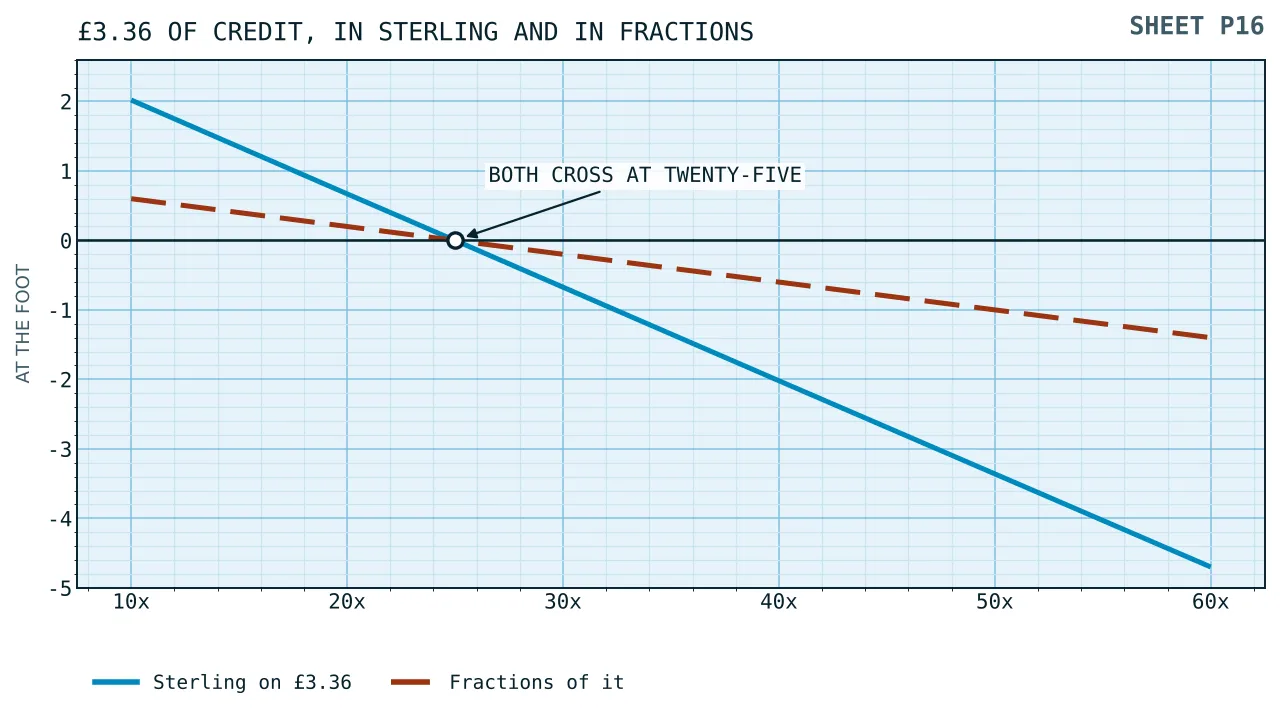
Thirty-five cycles at 10p hold £3.50 at face and £3.36 of average winnings. A ten times requirement leaves three-fifths of that, which is £2.02; forty times leaves nothing and overshoots by the same £2.02. Change the unit the room counts in and both figures scale together.
Three-fifths kept at ten times, in sterling or in any coin
What the conditions leave
Every destination on this spike is bought advertising. The site takes a fee if a reader goes on to register, and no figure printed below moves because of it.
The Spin Sheet
Till receipt No 01
Betportal
Lowest multiple here
For every €1 of spin credit at face per €1
Credit
Debit
No Great Britain licence
Licensed in Anjouan, Comoros, run by BetPortal Gaming Ltd, with Excite Ultra Media Ltd, reference ALSI-202601040-FI2.
Terms read 15 October 2026
Open the offer at Betportal, opens in a new tabThe Spin Sheet
Till receipt No 02
WinBeast
Five staged matches
For every €1 of spin credit at face per €1
Credit
Debit
No Great Britain licence
Licensed in Curaçao, operator not named on the site.
Terms read 15 October 2026
Open the offer at WinBeast, opens in a new tabThe Spin Sheet
Till receipt No 03
EliteSpin
Longest spin window
For every £1 of spin credit at face per £1
Credit
Debit
No Great Britain licence
Licensed in Costa Rica, run by PrimeTier Limited.
Terms read 15 October 2026
Open the offer at EliteSpin, opens in a new tabThe Spin Sheet
Till receipt No 04
Crown Jewelz
Multiple unpublished
No total struck
Credit
Debit
No Great Britain licence
Licensed in Curaçao, number not verified, operator not named on the site.
Terms read 15 October 2026
Open the offer at Crown Jewelz, opens in a new tabThe figure at the foot of a receipt is this site's own arithmetic and nothing an operator has published: the credit, less the share a spin gives back at 96 per cent return to player, less what playing the wagering through costs at the same return. It describes the offer, not one reader's afternoon. Where the conditions price above the credit the receipt prints nothing rather than a negative sum, and where a figure the sum needs is unpublished it prints the condition in the operator's words instead.
Three words stand in the amount column where no figure can. Noted is a published condition that takes value away without leaving the sum a figure to take. Unpriced is a condition whose figure nobody has published, or a credit that is not a sum until a deposit of your own sets it. Own money is money of yours, which is never part of a total.
Not one of the operators printed above holds a Great Britain licence, so the duties that licence carries do not reach them. Every online gambling company licensed in Great Britain has to be part of Gamstop Online, and a reader who has shut themselves out through the scheme is therefore not shut out here. The ceiling of ten times the bonus funds on a wagering requirement, in force since 19 January 2026, is a condition of that licence and binds the companies that hold one. Where a dispute goes instead is a matter for the authority named on the receipt, and the Gambling Commission describes what a reader faces without a British licence as a lack of recourse if things go wrong. Nobody under 18 may hold an account at any of them.
Every term printed on a receipt is the operator's own, and each receipt carries the day it was read. The oldest of those readings is 15 October 2026. What binds a reader is the operator's own full terms, and not a line printed here.
1
A room that keeps its books in a coin
A reel does not know what currency the ledger behind it is denominated in. The share a build gives back is a fraction. The share of a staked unit a cashier counts towards a requirement is another fraction. Fractions have no currency in them, and that single observation is what this sheet is built on.
So the useful question is not what a round is worth in a coin, which nobody can state for tomorrow. It is what fraction of the credit survives the conditions, because the fraction holds whatever the unit does afterwards.
The working round is thirty-five cycles priced at 10p, so £3.50 at face, and a 96 per cent return brings the average winnings to £3.36. Sterling is used for the arithmetic because a reader prices their life in it, and part 4 shows that nothing in the answer depends on that choice.
Two assumptions, both labelled. Ten pence a cycle is a working figure, since no British rule settles what a spin is worth, appoints anybody to settle it, or requires the figure to be printed. A coin-denominated room compounds that, because the amount credited is expressed in a unit whose sterling value moves between the claim and the clearing. Forty turnovers is the requirement run through this sheet, an order common in this bracket. Ten turnovers is as far as a British licence lets the figure go, and that has held since 19 January 2026.
What the unit changes, and what it cannot reach:
- Out of reach: the return, the contribution rate, the requirement, and the fraction of the credit that survives them.
- Out of reach: the crossing, which is a quotient of two unitless numbers.
- Reached: the sterling size of the credit, of the shortfall and of anything left, all three moving by the same factor.
- Reached: whether the pence a cycle carries can be worked out at all, which part 9 deals with.
2
Thirty-five cycles, three pounds thirty-six
Price it in sterling first, so that the fractions in part 4 have figures behind them.
Forty lots of £3.36 make £134.40 of required staking. Four pence of edge is expected to take £5.38 out of it, running £2.02 beyond the credit, so the closing figure is £0.00.
Two pounds and two pence is charged to nobody. Nothing went in behind the cycles, so a balance has nowhere below nought to go, and the minus measures the overshoot of the condition and nothing else.
At the British ceiling the same credit reads differently. Ten turnovers want £33.60 of staking at £1.34 of expected cost, and £2.02 is expected to remain. Twenty turnovers leave £0.67. Twenty-five leave nothing exactly. Sixty take the overshoot to £4.70.
Twenty-five is the point at which the credit is spent to the penny, and the return produces it rather than anybody’s choice. Hold the expected cash at nought, strike the credit from either side, and one over an edge of four pence is what remains. That figure moves with the build: a 95 per cent room would cross at twenty, a 97 per cent room at 33.3.
3
No exchange rate appears in the line
Four quantities and an answer, none of which is a price in any currency.
E = B × (1 – (W × (1 – RTP)) / g)
£3.36 stands as B, the credit once the return is taken into account. W is the requirement. RTP is the share a build gives back. g is the share of a staked unit the cashier counts. E is the quantity at the foot.
Everything inside the bracket is dimensionless. W is a multiple, RTP is a fraction and g is a fraction, so the bracket is a plain number with no unit attached to it. B is the only quantity carrying a denomination at all, and E is B multiplied by that plain number.
Which has a consequence worth stating in full, because it is the honest answer to a reader who arrived asking whether a coin changes the deal. Multiply B by any factor and E multiplies by the same factor. The ratio between them does not move. A credit converted at twice the sterling rate is twice the credit and twice the shortfall, and the share that survives is identical.
Only one contribution rate anywhere has any provenance. A consultation respondent put a case in which a staked pound contributed thirty pence; the regulator wrote it down, and weighting came out of the process exactly as it went in. No public schedule of rates in use exists, so the rates in part 5 are inputs picked to bracket the answer.
The bracket has no unit, so the answer is a share before it is a sum
4
Three-fifths, in whatever unit
Here is the table this page exists to print. The right-hand column is the finding, and it is deliberately given in words rather than in money, because it is the one column a change of unit cannot touch.
| Turnovers asked | Staking owed | Expected price | E | Of the credit |
|---|---|---|---|---|
| Ten | £33.60 | £1.34 | £2.02 | Three-fifths kept |
| Twenty | £67.20 | £2.69 | £0.67 | One-fifth kept |
| Twenty-five | £84.00 | £3.36 | £0.00 | Nothing kept |
| Forty | £134.40 | £5.38 | -£2.02 | Three-fifths short |
| Sixty | £201.60 | £8.06 | -£4.70 | Seven-fifths short |
Read the last column and the pounds beside it become illustrations. Ten turnovers keep three-fifths of whatever the credit was. Twenty keep a fifth. Twenty-five keep nothing. Forty fall short by three-fifths of the credit, and sixty by seven-fifths of it, which is to say by more than the credit itself.
Those shares hold in sterling, in a coin, in a token, and in a unit nobody has invented yet. They hold if the coin halves overnight and they hold if it doubles. What a change in the unit does is rescale the four money columns in step, leaving the proportion between any two of them exactly where it was.
So the usual way of arguing about a coin-denominated round has the question upside down. Whether the unit rises or falls decides how large the answer is. It has nothing to say about whether the answer is positive, and only the requirement, the return and the rate decide that.
5
Two-fifths in the pound, exactly on the line
A share survives only where the quotient of requirement and rate stays under one over the edge. An edge of four pence is what a 96 per cent build keeps, so g has to clear the requirement divided by twenty-five.
At the British ceiling of ten that works out at two-fifths of a staked unit, and two-fifths is the crossing itself. A room counting a staked unit as exactly 0.40 towards a requirement of ten turnovers hands back precisely nothing, with the credit spent to the last penny and no margin either way. Anything above two-fifths leaves something; anything below leaves nought.
Ten turnovers, 96 per cent, and 0.40 is the crossing
Notice that the crossing has no currency either. It is a requirement divided by a reciprocal, both of them bare numbers, so a reader can work it out without knowing what the room’s unit is worth or what the credit converts to. That makes it the one test on this page that a coin-denominated set of terms cannot obscure.
At the forty turnovers this sheet carries, the same test asks for a rate above 1.60, which is unreachable: no staked unit counts for more than one of itself. So the ladder below is a measure of how much worse an unreachable condition gets, rather than a route to making it reachable.
| A staked unit counts as | Staking needed | Effective multiple | Minutes | E |
|---|---|---|---|---|
| The whole of it | £134.40 | 40.0 | 56 | -£2.02 |
| Four-fifths | £168.00 | 50.0 | 70 | -£3.36 |
| Three-fifths | £224.00 | 66.7 | 93 | -£5.60 |
| Two-fifths | £336.00 | 100.0 | 140 | -£10.08 |
| One-fifth | £672.00 | 200.0 | 280 | -£23.52 |
Contribution owed holds at £134.40 down that whole ladder. What grows is the staking that earns it, and the effective multiple grows with it: forty turnovers at two-fifths is an effective hundred, and at a fifth an effective two hundred. The wagering line goes on reading forty, and no rule requires the larger figure to appear anywhere.
One row of the ladder deserves its own sentence. At two-fifths the shortfall is £10.08 on a credit of three pounds thirty-six, which is three times the credit. The same rate at ten turnovers would have landed exactly on nought. A requirement four times the regulated ceiling, multiplied by a rate nobody regulates, is how a round gets from level to three times under.
6
Fifty-six minutes, where a licence paces them
Cycles owed come out of the count, the requirement and the return together: thirty-five, forty and 0.96 give 1,344 presses.
On a British licence those presses are paced. At minimum two and a half seconds separate a slot game starting from the moment the cycle after it may be commenced. The start control has also to be let go and pressed afresh, so nothing begins by holding anything down. That turns 1,344 presses into 3,360 seconds, which is fifty-six minutes. The thirty-five cycles given away take eighty-seven and a half seconds.
Three further standards keep the fifty-six minutes in place. Automatic play is barred across gaming, bingo included, by a requirement for an individual commitment to each cycle, carving out only a blind the system posts in peer-to-peer poker. A customer is given no handle on how soon a result arrives, which rules out turbo, slam stop and quick spin by name, at any speed a game runs at by nature. And functionality that would set casino games running together is prohibited, split screens and multiple screens with it.
A fourth governs what the hour looks like rather than how long it is. A return at or below the whole stake draws neither a celebratory sound nor a celebratory animation, and across 1,344 presses at a 96 per cent return that covers a very large number of results. Three plainer things are suggested in its place: a brief sound at the moment of crediting, the paying lines shown for an instant, and the total awarded in figures.
Where a room holds no Great Britain licence, every one of those standards is absent, and the arithmetic is unchanged by their absence. Staking owed stays at £134.40. Expected cost stays at £5.38. What disappears is the fifty-six minutes, because nothing is left to stop the 1,344 presses running as fast as a platform can serve them.
87.5 seconds given, 3,360 seconds owed
7
No ceiling on a cycle, and what one is worth
Statute puts a ceiling on a single slots cycle in Great Britain, and the ceiling is written in sterling, which is the first thing a coin-denominated room does away with.
Five pounds is the figure, and two pounds for an individual under the age of 25, under regulations dated 25 February 2025. A formula appears in the regulations where a calendar would be, six weeks from the making, so the dates belong to the regulator: 9 April 2025 for the higher ceiling, 21 May 2025 for the lower. The definition reaches a casino game built on reels and run online, and the regulator says in terms that the limits belong to online slots alone, leaving roulette and blackjack outside.
Priced against this round, a ceiling bears on the clock and not on the cost. The £134.40 owed at full weight would take 27 presses at five pounds a go, or 68 at two pounds, instead of 1,344 at 10p. Expected cost stays at £5.38 on each of those routes, an edge of four pence taking the same share however a pound is split up, and the spread around the figure widens a great deal as the stake rises.
The island policy consulted here puts no ceiling of any size on a game cycle, and draws no line between a reel-based game and any other. So the ladder above has no top out there, and a round that could be cleared in twenty-seven presses in Great Britain could be cleared in fewer still somewhere that sets no limit.
Two protections about money leaving an account are worth setting beside that, because they are the ones a coin balance interacts with. Put a maximum on the money a consumer may draw out of a deposit balance and the term is barred, whether that was its object or merely its effect. The regulator’s own instance of such a term puts a daily figure of fifty pounds behind a weekly one of five hundred. Payment for gambling by credit card is also something a licensee may not take, from 14 April 2020, and the ban reaches a credit-card payment sent through a money service business.
Two protections are easy to confuse, so one distinction has to be kept straight. The withdrawal rule is written about the deposit balance. Quite another object is a ceiling on bonus winnings; no published rule prohibits one; and both can sit in a single set of terms at the same moment. Where nothing was deposited there is no deposit balance at all, so only the second of the two is ever in play.
8
The duty that follows the player
One thing does reach a coin-denominated room wherever it sits, and it is not a consumer protection. It is a tax, and the taxpayer is the operator rather than the reader.
Remote Gaming Duty attaches to the profits a gaming provider makes out of remote gaming, where the customer playing it usually lives in the United Kingdom. Wherever a business is based, if it offers remote gambling other than spread betting to such a person, it owes one or more of these duties. The charge falls on profits, which is stakes received less winnings paid out, and the guidance addresses the operator throughout without describing any charge on a player.
The rate is the figure worth carrying away. It reads forty per cent from 1 April 2026 onward. Before that it stood at twenty-one per cent, running from 1 April 2019, and fifteen per cent earlier still. The page carrying those figures was published on 14 August 2014 and last updated on 1 April 2026.
Registration and payment fall on an operator outside the United Kingdom that offers such gambling to a person usually living here. Where it is not part of a group, a representative in the United Kingdom with the revenue’s approval generally has to be appointed, save where the operator is based in a jurisdiction treated as exempt, Norway and Gibraltar and the EU member states among them. Which yields something precise about the offshore side, and more useful than loose talk about legality: an operator taking a British player’s money sits inside the scope of British gaming duty, licence or no licence.
On the player’s own position the sheet states the published wording and stops. Trading is not what betting and gambling, as such, constitute: that is the tax manual’s own formulation. Behind it sits a 1925 decision about a taxpayer whose whole livelihood came from backing horses at starting prices, who was held not to be trading, and whose judge wrote that there is no tax on a habit. The manual records four things as insufficient to make a trade of it: living on the proceeds, studying form, being systematic, and having a system.
What the sheet will not do is put words in the revenue’s mouth. Nothing on gov.uk was located declaring in terms that winnings go untaxed. The position here is assembled from manual pages about whether gambling amounts to a trade, and nothing on this sheet addresses an individual’s circumstances or amounts to tax advice. Both manual pages were published on 22 November 2013 and last updated on 4 August 2026.
9
Reading a round priced in a coin
Convert the duties into the coin and not one of them travels: membership of the national blocking scheme; the eight weeks a complaint gets, with an approved adjudicator beyond them; the whole apparatus of financial limits, prompts and cooling-off periods; the credit-card ban; identity verified before any play at all, demonstration rounds and bonus rounds included; the bar on capping withdrawals from a deposit balance; the rule against offering to cancel a withdrawal request; the prohibition on substituting a near miss; the bar on a fanfare for a return no bigger than its own stake; the bans on turbo, on two games running together and on automatic play; the two and a half seconds between cycles; the five pound and two pound limits on a slots cycle; and the ceiling of ten turnovers on bonus funds. Where no Great Britain licence stands behind a round, the arithmetic of part 4 is all that survives, and nothing from that list does.
The regulator has set out what it says a player faces instead. Age verification is one of the things it says unlicensed sites often go without, along with responsible gambling tools and secure payment systems. It puts the consequence for a consumer as greater exposure to gaming practices that are unfair, to loss of money, and to finding no recourse when matters go wrong. Two failure modes are named in the same post. One is a payout simply blocked. The other is a withdrawal limit pitched at a figure nobody could reach. Alongside that it records serious data protection concerns for players, and risks of identity theft and of fraud.
Two sentences from that post cut against overconfidence in either direction. On scale: given the revenue in play, the regulator doubts the ecosystem will ever be fully dismantled. On effect: traffic data was assessed for 160 websites that enforcement action had targeted, and the drop came to 32 per cent The illegal market gets three adjectives in the same post, sophisticated and increasingly so, digitally driven, and global in its scale, and no revenue figure is attached to any of them.
Six readings settle a round priced in a coin, and the first is the one a coin-denominated cashier makes hardest.
| What to read | Here |
|---|---|
| What one cycle is worth | Assumed at £0.10 |
| Cycles in the offer | 35 |
| Credit, once the return applies | £3.36 |
| The requirement in the terms | 40 |
| The rate the schedule gives | 1.00 |
| Share of the credit surviving | None of it |
Work the first reading backwards where a cashier reports a credit without a stake per cycle: divide the credit first by the count and then by the return, and the price of one cycle drops out. Then take the fourth and fifth readings together, divide one by the other, and set the answer against twenty-five. That comparison needs no exchange rate and no price for the unit, which makes it the most useful line here.
Two cautions, as on every sheet here. The figures are means. Over thirty-five cycles nothing at all is the commonest single result, so a mean of this kind speaks about a long run of rounds and not about the one in front of a reader. And a condition sitting outside the bracket can close the answer down while the requirement, the rate and the return stay untouched: a win ceiling on the bonus, or a discretion inserted to suit the operator.
Sheets nearby take the parts this one sets aside. Crypto casino no deposit bonus prices the charges that meet a win on its way out, online slots UK prices the room in sterling, and top 10 best online slots and Big Bass slots take a game list and a game family in turn. Sheet by sheet the section stands at The room.
Questions
- Does a coin-denominated room change what a bonus is worth?
- Not as a proportion, which is the only part that can be settled in advance. Everything inside the bracket of the standing expression is dimensionless: a multiple, a return and a contribution rate. Only the credit carries a denomination, so multiplying the credit by any factor multiplies the answer by the same factor and leaves the share surviving exactly where it was.
- What is a round of thirty-five cycles worth here?
- Thirty-five cycles at 10p hold £3.50 at face, and a 96 per cent return brings the average winnings to £3.36. Forty turnovers then want £134.40 of staking at £5.38 of expected cost, overshooting the credit by £2.02, so nothing at all reaches the foot. Ten turnovers want £33.60 of staking and are expected to leave £2.02, which is three-fifths of the credit.
- How much of the credit survives at each requirement?
- Three-fifths at ten turnovers, a fifth at twenty, nothing at twenty-five, and then a shortfall: three-fifths of the credit at forty turnovers and seven-fifths at sixty, which is more than the credit itself. Those shares hold in sterling, in a coin or in any other unit, and they hold whether the unit rises or falls.
- What contribution rate does a round like this need?
- Any rate over the requirement divided by twenty-five, on a build returning 96 per cent. At ten turnovers that is two-fifths of a staked unit, and two-fifths is the crossing itself: a room counting a staked unit at exactly 0.40 hands back precisely nothing. At forty turnovers the test asks for 1.60, which is unreachable, since a staked unit cannot count for more than itself.
- What does a low contribution rate cost on this round?
- Up to £23.52 against a credit of three pounds thirty-six. Contribution owed holds at £134.40 whatever the rate, but the staking needed to earn it climbs: £168.00 at four-fifths, £224.00 at three-fifths, £336.00 at two-fifths and £672.00 at a fifth. Forty turnovers at two-fifths gives an effective hundred, and the wagering line still reads forty.
- How long does the play-through take?
- Fifty-six minutes on a British licence. There are 1,344 presses owed, and at minimum two and a half seconds separate a slot game starting from the moment the next cycle may be commenced. The thirty-five cycles given away take eighty-seven and a half seconds. Automatic play is barred, turbo is barred, and so is running two games together, so none of the fifty-six minutes compresses.
- Does anything cap the stake on one cycle?
- In Great Britain, yes, and the figure is written in sterling: five pounds on a single slots cycle, and two pounds for an individual under the age of 25. The regulations carry 25 February 2025, and commencement came in the April and the May that followed. The limits belong to online slots alone, which the regulator says in terms, and the island policy consulted here puts no ceiling of any size on a game cycle.
- Who pays tax on a coin-denominated casino?
- The operator, and the duty attaches to the player’s country of residence rather than to the operator’s licence. Remote Gaming Duty attaches to the profits a gaming provider makes out of remote gaming, where the customer playing it usually lives in the United Kingdom, at forty per cent from 1 April 2026 onward, and twenty-one per cent from 1 April 2019 before that. An operator abroad has to register and pay, and one outside a group generally appoints a representative approved by the revenue, unless its base is somewhere exempt.
- Are winnings taxed in the player’s hands?
- This sheet states the published wording and stops there. Trading is not what betting and gambling, as such, amount to, on the tax manual’s own wording. Behind it sits a 1925 decision about a taxpayer whose whole livelihood came from backing horses at starting prices, who was held not to be trading, and whose judge wrote that there is no tax on a habit. Nothing on gov.uk was located declaring winnings untaxed in terms, so none is quoted, and nothing here addresses an individual’s circumstances.
- What is lost with no Great Britain licence behind the room?
- Convert the duties into the coin and not one travels: membership of the national blocking scheme, the eight weeks a complaint gets, the financial-limit apparatus, the credit-card ban, identity verified before any play, the bar on capping withdrawals from a deposit balance, the near-miss prohibition, the bans on turbo, on two games running together and on automatic play, the two and a half seconds between cycles, the five pound and two pound limits on a slots cycle, and the ceiling of ten turnovers. The regulator records that such sites often go without age verification, without responsible gambling tools and without secure payment systems, and it names payouts being blocked and withdrawal limits pitched beyond reach.