
Sheet P13 Revision 1 Checked 15 October 2026
Top 10 best online slots
Ninety cycles at 10p average £8.64, and a ten times requirement is expected to leave £5.18 of it. Put the same staking across a list of ten whose rates average forty pence in the pound and the bill is £864.00 of turnover, six hours, and £0.00.
A list is worth no more than its best-weighted member
What the conditions leave
Every destination on this spike is bought advertising. The site takes a fee if a reader goes on to register, and no figure printed below moves because of it.
The Spin Sheet
Till receipt No 01
Betportal
Lowest multiple here
For every €1 of spin credit at face per €1
Credit
Debit
No Great Britain licence
Licensed in Anjouan, Comoros, run by BetPortal Gaming Ltd, with Excite Ultra Media Ltd, reference ALSI-202601040-FI2.
Terms read 15 October 2026
Open the offer at Betportal, opens in a new tabThe Spin Sheet
Till receipt No 02
WinBeast
Five staged matches
For every €1 of spin credit at face per €1
Credit
Debit
No Great Britain licence
Licensed in Curaçao, operator not named on the site.
Terms read 15 October 2026
Open the offer at WinBeast, opens in a new tabThe Spin Sheet
Till receipt No 03
EliteSpin
Longest spin window
For every £1 of spin credit at face per £1
Credit
Debit
No Great Britain licence
Licensed in Costa Rica, run by PrimeTier Limited.
Terms read 15 October 2026
Open the offer at EliteSpin, opens in a new tabThe Spin Sheet
Till receipt No 04
Crown Jewelz
Multiple unpublished
No total struck
Credit
Debit
No Great Britain licence
Licensed in Curaçao, number not verified, operator not named on the site.
Terms read 15 October 2026
Open the offer at Crown Jewelz, opens in a new tabThe figure at the foot of a receipt is this site's own arithmetic and nothing an operator has published: the credit, less the share a spin gives back at 96 per cent return to player, less what playing the wagering through costs at the same return. It describes the offer, not one reader's afternoon. Where the conditions price above the credit the receipt prints nothing rather than a negative sum, and where a figure the sum needs is unpublished it prints the condition in the operator's words instead.
Three words stand in the amount column where no figure can. Noted is a published condition that takes value away without leaving the sum a figure to take. Unpriced is a condition whose figure nobody has published, or a credit that is not a sum until a deposit of your own sets it. Own money is money of yours, which is never part of a total.
Not one of the operators printed above holds a Great Britain licence, so the duties that licence carries do not reach them. Every online gambling company licensed in Great Britain has to be part of Gamstop Online, and a reader who has shut themselves out through the scheme is therefore not shut out here. The ceiling of ten times the bonus funds on a wagering requirement, in force since 19 January 2026, is a condition of that licence and binds the companies that hold one. Where a dispute goes instead is a matter for the authority named on the receipt, and the Gambling Commission describes what a reader faces without a British licence as a lack of recourse if things go wrong. Nobody under 18 may hold an account at any of them.
Every term printed on a receipt is the operator's own, and each receipt carries the day it was read. The oldest of those readings is 15 October 2026. What binds a reader is the operator's own full terms, and not a line printed here.
1
Ten names, and two figures left out
A list of ten games is a list about a room, and a room decides what a credit is worth through exactly two quantities. One is the share the game gives back. The other is how much of a staked pound gets counted towards a requirement. A list carrying neither figure has sorted ten pictures.
So this sheet orders the two quantities rather than the titles. That is not a dodge. No primary source behind this site publishes a return percentage for any named game, and none publishes a contribution schedule either, so a list ordered by those figures could not be printed here without being invented.
What can be done instead is to say, exactly, what figures a game would have to carry to earn a place. That test is arithmetic rather than opinion, it survives every change of fashion in which ten titles are popular, and it is the whole of parts 4 and 5.
The product is worth sizing first. Out of £8.3 billion produced by the remote sector that gathers casino, betting and bingo together in one line, casino games made up £5.7 billion of it, with slots at £4.8 billion, over April 2025 to March 2026. The release carries 17 September 2026. Licensed activities stood at 3,097 when that report closed its count on 31 March 2026. Strip every reported lottery out of the national total and £13.2 billion of gross gambling yield remains.
Ninety cycles priced at 10p are the working round, so £9.00 on the front and £8.64 averaged out of it at a 96 per cent return. Ten pence a cycle is a house assumption. No British rule settles a spin’s cash value, and none obliges anybody to state one. Forty turnovers is the requirement run through the page, since that is the order this bracket of the market tends to attach. Ten stands beside it, being as high as a British licence permits.
The two figures a top-ten list would need, and what each does:
- The return. It fixes the edge, and the edge fixes the multiple at which a credit is exactly spent.
- The rate. It fixes how much staking is needed to earn a pound of contribution.
- Neither is published for any named game by a source this sheet may cite.
- Both are properties of the room, which is why this page sits in this section and not in the one about play-through.
2
Ninety cycles, eight pounds sixty-four
Before a game list enters the arithmetic, the round prices like any other, and these are the figures the rest of the sheet departs from.
Forty lots of £8.64 make £345.60 of required staking. A room keeping four pence out of every pound expects £13.82 of that, which overruns the credit by £5.18, so the closing line is £0.00.
Nobody is invoiced the five pounds eighteen. Nothing was paid in, so nought is the floor a balance rests on, and the minus sizes the gap between the condition and the gift.
Run the requirement up and down and the pattern is the one every sheet in this tree arrives at, because the per-pound answer depends on the multiple and the return alone.
| Requirement | Turnover owed | Expected cost | E | Hours |
|---|---|---|---|---|
| Ten turnovers | £86.40 | £3.46 | £5.18 | 0.60 |
| Twenty turnovers | £172.80 | £6.91 | £1.73 | 1.20 |
| Twenty-five turnovers | £216.00 | £8.64 | £0.00 | 1.50 |
| Forty turnovers | £345.60 | £13.82 | -£5.18 | 2.40 |
| Sixty turnovers | £518.40 | £20.74 | -£12.10 | 3.60 |
Twenty-five is where the credit runs out exactly, and the figure is not a convention. Setting E to nought drops the credit out of both sides, and twenty-five is what one divided by an edge of four pence comes to. Change the return and the crossing moves with it, which is what part 4 is about.
3
The line, with a game schedule underneath
Everything on the sheet comes out of one quotient.
E = B × (1 – (W × (1 – RTP)) / g)
£8.64 goes in as B, the credit after the return has been applied. Turnovers demanded are W. The share the game gives back is RTP. The game schedule supplies g. E is the money at the end.
A list of ten is a statement about g, and about nothing else in that quotient. Each title on it either counts whole, counts at a fraction, or does not count at all. Where a schedule gives a rate of nought against a title, the credit cannot be worked through that game however long a reader sits at it.
The position of g is the thing to notice. Its place is beneath the multiple rather than alongside, which makes it a divisor of the obligation rather than an addition to it. Halve the rate and the staking doubles. Quarter it and the staking quadruples. Nothing of the sort happens when the multiple moves by the same proportion, because the multiple also scales the contribution owed.
Divide W by g and out comes the effective multiple, the figure a list of ten would carry if lists were drawn up arithmetically. Forty turnovers at fifty pence in the pound is an effective eighty. At twenty-five pence it is a hundred and sixty. The wagering line still reads forty, and nothing obliges the larger figure to appear anywhere.
One rate has any provenance, and thirty pence is the exception. An operator answering the regulator’s consultation set out a case at that contribution; the point went on the record and weighting survived the exercise intact. Every rate used below is an input chosen to bracket the arithmetic, never a measurement of the market.
4
What rate a multiple needs, return by return
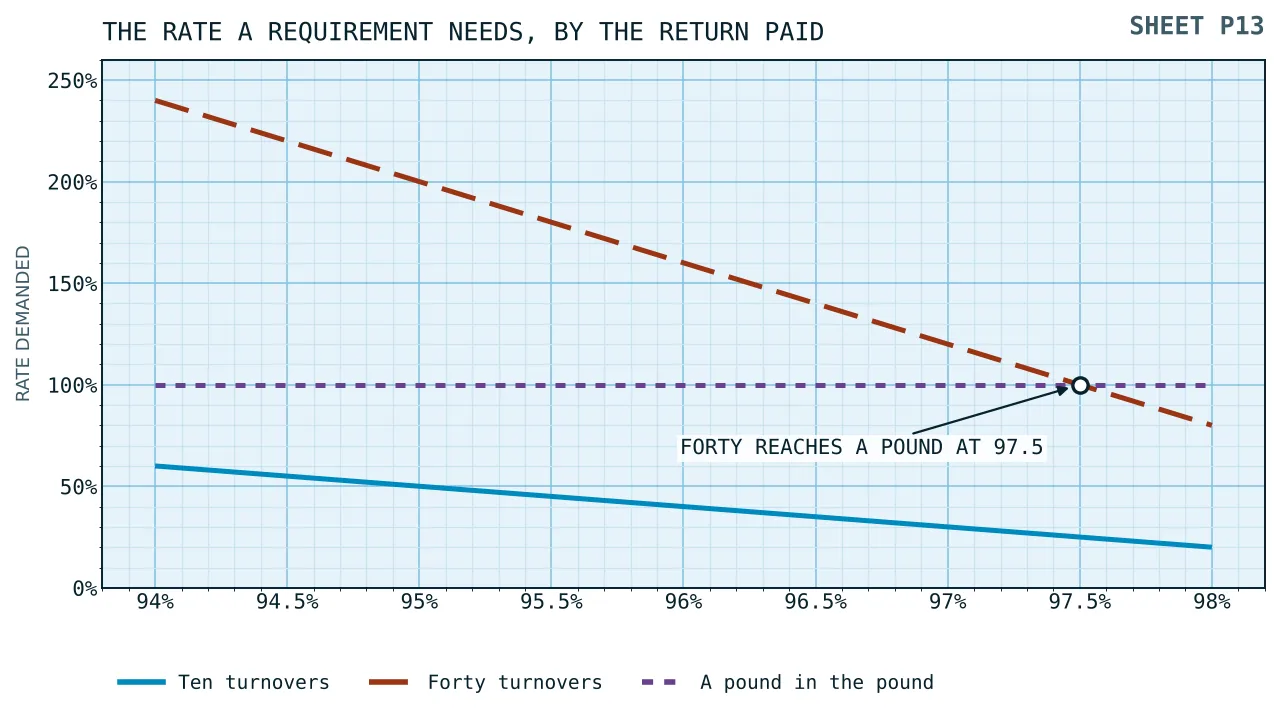
Anything survives only where the multiple divided by the rate comes in under the reciprocal of the edge. Rearranged, that is a condition on the rate alone: g has to exceed the multiple multiplied by the edge. A 96 per cent return puts the edge at four pence, which turns the test into g above the requirement divided by twenty-five.
Worked out across a band of returns, because the return is the other figure a list does not carry, the test becomes a schedule. Read a row for the requirement and a heading for the return, and the cell is the rate a game must beat before a penny survives.
| Requirement | Ninety-four | Ninety-five | Ninety-six | Ninety-seven | Ninety-eight |
|---|---|---|---|---|---|
| Ten turnovers | 0.60 | 0.50 | 0.40 | 0.30 | 0.20 |
| Twenty turnovers | 1.20 | 1.00 | 0.80 | 0.60 | 0.40 |
| Twenty-five turnovers | 1.50 | 1.25 | 1.00 | 0.75 | 0.50 |
| Forty turnovers | 2.40 | 2.00 | 1.60 | 1.20 | 0.80 |
Anything over a pound in the cell is unreachable, since a staked pound is not able to count for more than a pound. That single fact disqualifies most of the schedule. A requirement of forty turnovers needs a rate above 0.80 even on a 98 per cent game, and above 1.60 on a 96 per cent one, which is to say it cannot be met at all at the return this site works to.
Ten turnovers, the regulated ceiling, is the row where the test is survivable throughout. Even there a 94 per cent game has to count at better than sixty pence in the pound, and a 96 per cent game at better than forty. Forty pence exactly lands on nought, which makes it the one figure in the schedule worth memorising.
g above W times the edge, or the sheet closes at nothing
Read the schedule backwards and it prices an editorial decision. Leave the high-return titles off a bonus list, or count them at a fifth, and the headline figure on the front of the offer has not changed by a digit. What has changed is which row of the schedule the offer now sits in.
5
A list is worth its best-weighted member
Here is the finding this page exists for, and it runs against the way a list of ten is normally read.
Contribution owed is fixed by the credit and the multiple, which on this round is £345.60 whatever is played. Staking needed is that figure divided by the rate of whichever game the staking goes through. So the cheapest way to finish is to put every pound through the highest-rated title and ignore the other nine, and the list is therefore worth no more than its best-weighted member.
Spread the staking instead and the arithmetic charges for it. Put a pound through a game counting at twenty-five pence and it earns a quarter of what the same pound earns on a whole-weight game. Earning one pound of contribution costs £4.00 of staking there against £1.00 on the full-weight title, so every pound of contribution bought on the low-rated game carries £3.00 of extra staking and twelve pence of extra expected cost.
Taken across a whole list, what matters is the average rate of the games the staking actually passes through. Two lists, both of ten titles, priced below.
| How the list counts | Average rate | Staking needed | Expected cost | E | Effective multiple |
|---|---|---|---|---|---|
| One title, counting whole | 1.00 | £345.60 | £13.82 | -£5.18 | 40.0 |
| Five whole, five at fifty pence | 0.75 | £460.80 | £18.43 | -£9.79 | 53.3 |
| Two whole, eight at a quarter | 0.40 | £864.00 | £34.56 | -£25.92 | 100.0 |
The middle row costs £115.20 more of staking than the top row for no change in the credit and no change in the wagering line. The bottom row costs £518.40 more, which is one and a half times the whole original obligation, and turns a shortfall of five pounds eighteen into one of twenty-five pounds ninety-two.
Which is why a long list is not a generosity. Variety in a game schedule is only variety in the rate, and a reader who uses the variety pays for it in staking. The honest way to read ten titles is to find the best-weighted one, work out whether it clears the test in part 4, and treat the other nine as decoration.
6
Two hours twenty-four, and the rate that trebles it
Cycles owed come out of the credit, the requirement and the return together: ninety multiplied by forty multiplied by 0.96 is 3,456 presses.
A licensed slot cycle may be no shorter than two and a half seconds, counted from one game starting to the commencement of the next. The start control must also come up before going down again, so leaning on a screen or a key begins nothing. That floor turns 3,456 presses into 8,640 seconds, which is two hours and twenty-four minutes. The ninety cycles on the front take three minutes and forty-five seconds.
Move the rate and the clock moves with the staking. At seventy-five pence in the pound the round runs to 4,608 cycles, three hours and twelve minutes. At forty pence it runs to 8,640 cycles, six hours to the minute. A list of ten that averages forty pence has not changed the gift and has trebled the work.
Four standards hold the clock where it is, and together they close the obvious ways round it. Automatic play is out across gaming and bingo alike, every game cycle wanting its own commitment, with one carve-out for blinds posted by the system in peer-to-peer poker. A customer gets no means of hurrying a result along. Quick spin, slam stop and turbo are named casualties, and the rule bites at any native game speed. Functionality letting casino games run at the same time is forbidden, split and multiple screens with it, so six hours cannot be divided between windows. And a return no greater than the stake gets no celebratory sound or animation, which across 8,640 presses is a very large number of results left undressed.
The exceptions are worth knowing because they are narrow. That bar leaves a feature game alone where no further stake goes in, and it permits a control that scratches or reveals the lot in one action. The bar on celebration asks for three plainer things in its place: the amount awarded shown, the winning lines put up briefly, and a short sound as the money is credited.
3,456 presses at a pound in the pound, 8,640 at forty pence
7
What a licence makes an incentive carry
Four prohibitions attach to an incentive on a British licence, and the first supplies the only regulated number in this page’s arithmetic.
It may not put a wagering requirement above ten turnovers of the bonus funds, a limit that took effect on 19 January 2026. It may not gather two types of gambling product into one incentive, out of the four the rule names: bingo, lottery, betting and casino. It may not move an incentive’s value where the qualifying play came to an end before the offer period did. And it may not dangle subsidised travel or accommodation that pulls a customer towards a premises on terms pegged to the gambling expected of them.
Slots sit inside the casino type, so a round of spins beside a cash match keeps one incentive to one product. Spins beside bingo tickets do not. Three carve-outs sit alongside. An incentive may hold two products drawn from one type, the published instance pairing a raffle with a scratchcard. A single email may hold one offer for casino and another for betting, kept apart, where consent runs to both products. And a credit spendable at the customer’s own discretion is untouched by the ban.
Two further limbs cover the customers a list like this one is often aimed at. Where a customer carries a high-value label, a VIP label or some equivalent, an incentive offered to them must square with the licensing objectives, and published guidance on such incentives is something the licensee has to weigh.
Proportionality is what the advertising code adds, and it is the part bearing on a ranked list. A reward should answer to the time and the money a player has already put in, a promotion should not accelerate as spending accelerates, and substantial amounts gambled at a fixed, regular rhythm are not something to encourage. One example of something that can pass is published, and it comes with a condition fastened to it. A one-off free bet handed over once £50 has gone through may be acceptable, provided a free bet is not an unusual thing to give at that level, for that sort of gambling.
Enforcement on casino advertising is current rather than historical. Three rulings sit on the regulator’s own casino advice page, with an outcome apiece and no subject matter at all. HRY Games, upheld, carries the latest date of the three, 14 October 2026. Dribble Media Ltd, also upheld, is dated a month earlier, 16 September 2026. White Hat Gaming Ltd shares that September date and was not upheld.
8
Ten names, and nobody reviewing them
Ten titles offered where no Great Britain licence applies is a list nobody checks, and the way to see what that means is to strike the duties out one at a time.
Strike out the ceiling of ten turnovers, and forty times is available again, with sixty behind it. Strike out the ban on gathering product types into one incentive. Strike out the rule against altering an incentive because the qualifying play finished early. Strike out the proportionality expected of a reward, and the list of what counts as a significant condition, and the test of prominence that puts a condition beside the headline. Strike out the two and a half seconds. Strike out the bars on automatic play, on turbo and on two games running at once, and the silence imposed over a return that merely matches a stake. Strike out five pounds a cycle, and two for a player under 25. Strike out the verified date of birth, the verified address and the verified name, all of them owed before any play at all. What is left of a top-ten list after that is ten pictures and a wagering line.
The island rulebook consulted for this build confirms the subtraction rather than softens it. Its mandatory responsible gaming requirements cover deposit limits, behaviour tracking, self-exclusion and the cooling-off periods beside it, player self-assessment, information a player can reach, age verification, the training of employees and marketing partners, and some general principles on advertising. Nowhere in it is a multiple capped, a cycle given a ceiling, or an interval set between one game and the next. Bonuses have two sentences, asking for transparent terms and for promotion that stops short of driving excessive play.
Nor does a familiar title settle anything about a licence. Games from licensed suppliers have been found by the regulator on sites holding no licence. One supplier settled for £4.75m in July 2026 over its games appearing on six such websites within reach of consumers here. A list of ten well-known names is therefore evidence about a catalogue and about nothing else.
One protection goes with the licence rather than with the catalogue. Gamstop Online membership comes attached to the British licence, and the scheme is plain about its own edge: services run by organisations that never joined are beyond what a registration can do. On 16 July 2026 the scheme published 614,738 registrations, sixteen per cent up on the previous half year. Nothing on this sheet will assist anybody in getting round a block, and the free routes to help are at the foot of the page.
9
Ordering a list of your own
Five readings order ten titles properly, and two of them are not on the promotion page.
| What to establish | Here |
|---|---|
| Cycles, and the stake each takes | 90 at £0.10 |
| Credit, once the return is applied | £8.64 |
| The requirement, as the terms put it | 40x |
| The best rate on the schedule | 1.00 |
| W over g, set against twenty-five | 40.0 |
Take the fourth reading from the game schedule and not from the list of ten, and take the best rate rather than an average, because a reader is free to stake on one title only. Where the schedule gives a rate of nought against a title, that title is not in the arithmetic at all, whatever a list says about it.
Then the test. Divide the requirement by the rate and set the quotient against twenty-five. Below it, the foot of the sheet holds something, and the best-weighted title is where the round should be finished. Above it, the answer is nought and the only remaining question is how long the nought takes to arrive.
Two limits on all of it. The answer is a mean, and over ninety cycles the single commonest outcome is nothing at all, so the mean speaks about a great many rounds and not about one evening. And a condition outside the quotient can close the sheet with the requirement, the rate and the return all exactly as they stand. A ceiling on the winnings a bonus is allowed to produce is one such. A discretion the operator kept back for itself is another.
Related sheets run the same two figures through other rooms. Online slots UK takes the room at large, top 20 slots UK doubles the length of the list, pragmatic slots narrows it to one studio’s catalogue, and free slots no deposit prices a reel that takes no stake at all. The whole section is indexed at The room.
Questions
- What should a top ten list of online slots actually be ordered by?
- By two figures, and most lists carry neither. The first is the share the game gives back, which fixes the edge and therefore the multiple at which a credit is exactly spent. The second is how much of a staked pound gets counted, which fixes the staking a pound of contribution costs. A list with neither figure on it has sorted ten pictures.
- Why does this sheet not name ten games?
- Because no primary source behind it publishes a return percentage for any named game, and none publishes a contribution schedule either. A list ordered on those figures would have to be invented, so the page orders the test instead: what a game would have to carry to earn a place. That test is arithmetic, and it holds whichever ten titles happen to be fashionable.
- What is a round of ninety cycles worth after the room takes its cut?
- Ninety cycles at 10p are £9.00 on the front and £8.64 averaged out at a 96 per cent return. Forty turnovers then want £345.60 of staking, and a four pence edge is expected to take £13.82 of it. That overruns the credit by £5.18, so the foot reads £0.00. At ten turnovers the staking is £86.40 and £5.18 is expected to survive.
- How high does a game’s contribution rate have to be?
- Above the requirement multiplied by the edge. On a 96 per cent return that becomes the requirement divided by twenty-five, so ten turnovers needs more than forty pence in the pound, and forty turnovers needs more than £1.60, which cannot exist. On a 94 per cent game the ten-turnover test rises to sixty pence. Forty pence exactly lands on nought.
- Is a list of ten games better than a list of one?
- Not for the arithmetic. Contribution owed is fixed by the credit and the requirement, and staking needed is that figure divided by the rate of whatever is played, so the cheapest route is to put every pound through the best-weighted title. A list is worth no more than its best-weighted member, and using the variety costs staking rather than saving it.
- What does spreading a credit across ten titles cost?
- On this round, between £115.20 and £518.40 of extra staking. A list averaging seventy-five pence in the pound needs £460.80 instead of £345.60, and E falls from minus £5.18 to minus £9.79. A list averaging forty pence needs £864.00, which is an effective multiple of a hundred, and E falls to minus £25.92. The credit and the wagering line never moved.
- How long does the play-through take?
- Two hours and twenty-four minutes at a pound in the pound. There are 3,456 presses owed, and the shortest interval a licensed slot may keep between cycles is two and a half seconds. Three minutes and forty-five seconds is all the ninety advertised cycles take. At forty pence in the pound the obligation runs to 8,640 presses, which is six hours, and automatic play, turbo and two games at once are all barred.
- What does a British licence stop an incentive doing?
- Four things, from 19 January 2026. A requirement above ten turnovers of bonus funds is out. Two product types inside one incentive is out, the four named being bingo, lottery, betting and casino. Changing an incentive’s value because the qualifying play finished early is out. And subsidised travel or accommodation pegged to expected gambling is out. Slots count as casino, so spins beside a cash match stay within one type.
- Has casino advertising been ruled on recently?
- Three, each with an outcome and none with a subject. HRY Games was upheld, and 14 October 2026 is its date. Dribble Media Ltd, upheld as well, carries 16 September 2026. White Hat Gaming Ltd shares the September date, and that one was not upheld. What those cases were about is not stated there, so naming them as recent casino-advertising rulings is as far as this sheet goes.
- What goes missing on a list with no Great Britain licence behind it?
- Strike the duties out one at a time. Out goes the ceiling of ten turnovers, so forty and sixty are available again. Out goes the ban on gathering product types into one incentive. Out go proportionality, the list of significant conditions and the test of prominence. Out go the two and a half seconds, and out go the bars on automatic play, on turbo and on two games at once. Out go five pounds a cycle and two below the age of 25. Out goes identity verified before any play. Ten pictures and a wagering line is what remains.