
Sheet R12 Revision 1 Checked 15 October 2026
Fast withdrawal casinos
A £120.00 balance leaves in a single payment for £3.50, or in three payments for £10.50 where a daily ceiling stands in the way. That is 8.75 per cent of the win, charged after the game had already finished with it.
£10.50 to collect £120.00 in instalments, 8.75 per cent
What a payout clause costs on the way out
Every destination on this spike is bought advertising. The site takes a fee if a reader goes on to register, and no figure printed below moves because of it.
The Spin Sheet
Till receipt No 01
Betportal
Lowest multiple here
For every €1 of spin credit at face per €1
Credit
Debit
No Great Britain licence
Licensed in Anjouan, Comoros, run by BetPortal Gaming Ltd, with Excite Ultra Media Ltd, reference ALSI-202601040-FI2.
Terms read 15 October 2026
Open the offer at Betportal, opens in a new tabThe Spin Sheet
Till receipt No 02
WinBeast
Five staged matches
For every €1 of spin credit at face per €1
Credit
Debit
No Great Britain licence
Licensed in Curaçao, operator not named on the site.
Terms read 15 October 2026
Open the offer at WinBeast, opens in a new tabThe Spin Sheet
Till receipt No 03
EliteSpin
Longest spin window
For every £1 of spin credit at face per £1
Credit
Debit
No Great Britain licence
Licensed in Costa Rica, run by PrimeTier Limited.
Terms read 15 October 2026
Open the offer at EliteSpin, opens in a new tabThe Spin Sheet
Till receipt No 04
Crown Jewelz
Multiple unpublished
No total struck
Credit
Debit
No Great Britain licence
Licensed in Curaçao, number not verified, operator not named on the site.
Terms read 15 October 2026
Open the offer at Crown Jewelz, opens in a new tabThe figure at the foot of a receipt is this site's own arithmetic and nothing an operator has published: the credit, less the share a spin gives back at 96 per cent return to player, less what playing the wagering through costs at the same return. It describes the offer, not one reader's afternoon. Where the conditions price above the credit the receipt prints nothing rather than a negative sum, and where a figure the sum needs is unpublished it prints the condition in the operator's words instead.
Three words stand in the amount column where no figure can. Noted is a published condition that takes value away without leaving the sum a figure to take. Unpriced is a condition whose figure nobody has published, or a credit that is not a sum until a deposit of your own sets it. Own money is money of yours, which is never part of a total.
Not one of the operators printed above holds a Great Britain licence, so the duties that licence carries do not reach them. Every online gambling company licensed in Great Britain has to be part of Gamstop Online, and a reader who has shut themselves out through the scheme is therefore not shut out here. The ceiling of ten times the bonus funds on a wagering requirement, in force since 19 January 2026, is a condition of that licence and binds the companies that hold one. Where a dispute goes instead is a matter for the authority named on the receipt, and the Gambling Commission describes what a reader faces without a British licence as a lack of recourse if things go wrong. Nobody under 18 may hold an account at any of them.
Every term printed on a receipt is the operator's own, and each receipt carries the day it was read. The oldest of those readings is 15 October 2026. What binds a reader is the operator's own full terms, and not a line printed here.
1
The hours, and the pounds behind them
Hours are what gets advertised on this rail, and pounds are what gets deducted, and the two are decided by different people. A payout time is a promise about when and never about how much, so it can be kept in full while the sum arriving is smaller than the sum that was asked for.
This sheet works a £120.00 withdrawal, because it is a plausible balance after a small win and it divides awkwardly against the ceilings that get written into terms. Two quantities are modelled and both are assumptions: £3.50 for each payment a cashier sends, and a ceiling of £50.00 on what may leave in one day. No regulator publishes a withdrawal charge and none publishes an offshore ceiling, so both figures are this sheet’s, offered to be swapped for whatever your own terms print.
The ceiling, at least, is not invented. Fifty pounds in a day with five hundred in a week behind it is the British regulator’s own specimen of a term a licensee may not use, and a specimen of a forbidden term is the best available description of an unforbidden one.
The order of events matters more than either figure. A speed is advertised, a charge is taken, and a ceiling decides how many times the charge is taken.
Four quantities decide what a withdrawal is worth, and only the first is ever in the headline:
- How long the payment takes.
- What each payment costs to send.
- How much may leave inside a day or a week.
- The least that may leave at all.
2
A ceiling multiplies a flat charge
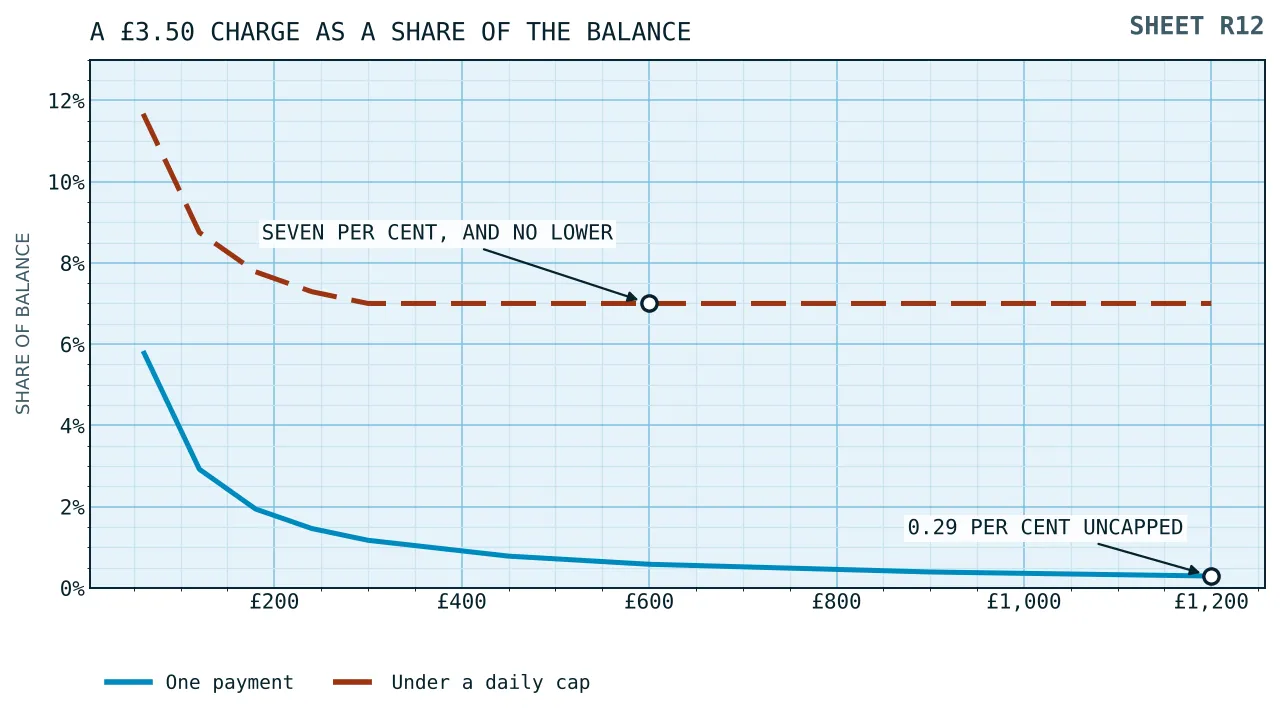
Divide the charge by the ceiling and you have the rate the charge settles at: £3.50 against £50.00 is 7 per cent, and no balance however large does better than that.
Which inverts what a flat charge usually does. A flat charge normally shrinks as a share of a larger sum; a flat charge under a ceiling does not, because a larger sum buys nothing but more instalments of it. The first £50.00 costs £3.50 to collect, the second £50.00 costs £3.50 to collect, and the last £20.00 costs £3.50 to collect as well.
| Balance out | Uncapped charge | Rate | Under a £50.00 ceiling | Rate |
|---|---|---|---|---|
| £60.00 | £3.50 | 5.83% | £7.00 | 11.67% |
| £120.00 | £3.50 | 2.92% | £10.50 | 8.75% |
| £300.00 | £3.50 | 1.17% | £21.00 | 7.00% |
| £1,200.00 | £3.50 | 0.29% | £84.00 | 7.00% |
Set the capped rate against the uncapped one and the ceiling is doing all the damage. Uncapped, the charge falls away to nothing as a proportion, and at £1,200.00 it is three pence in the pound of one per cent. Capped, the rate stops falling at 7 per cent and stays there for ever, because twenty-four payments of £3.50 is £84.00 and £84.00 is 7 per cent of £1,200.00.
Under a ceiling the charge stops shrinking at 7 per cent
A smaller balance does worse still, because the last instalment is a stub. Sixty pounds needs two payments and pays £7.00, which is 11.67 per cent, and the second of those payments carries only £10.00 for its £3.50. A stub instalment is the worst value in the whole schedule and it is the one a reader never plans for.
3
What a bonus leaves to take out
None of this matters unless something survives to be collected, and what decides that is the condition rather than the rail.
E = B × (1 – (W × (1 – RTP)) / g)
£120.00 is B, a full match on a deposit of the same size. RTP is 0.96, the return this site works at throughout. The weighting g is one, slots counting at their whole face towards the condition. W is the multiple, and it is the only term anybody argues about.
Said in words at the British ceiling: ten lots of four pence of edge is forty pence in the pound, the bracket therefore holds 0.60, and £72.00 is six-tenths of £120.00. Turnover of £1,200.00 is owed before a withdrawal is permitted, and £48.00 is the expected cost of producing it.
Britain stops the multiple at ten, and has done since 19 January 2026, when the code provision carrying that cap began to bite. Where no British licence applies, the figure fastened to a credit of this size is commonly forty, and at forty the same credit asks for £4,800.00 of turnover, costs £192.00 in expectation, and leaves £0.00 with £72.00 of overrun behind the nought.
| Multiple | Turnover owed | Expected to remain |
|---|---|---|
| 10x | £1,200.00 | £72.00 |
| 20x | £2,400.00 | £24.00 |
| 25x | £3,000.00 | £0.00 |
| 40x | £4,800.00 | £0.00 |
At forty times the withdrawal page is decoration, because nothing ever reaches it. Which settles what a payout speed is actually about. It is about a deposit balance and about the winnings of a cleared bonus, and a cleared bonus at the loose end of the market is a thing the arithmetic says will not often exist. Speed is therefore a promise most readers will test with their own money rather than with a credit.
4
The undo button Britain will not allow
Ask a British licensee for your money and its system is barred from offering to undo the request. The guidance behind that rule goes further, telling an operator to keep requested funds out of reach of a fresh deposit and to make leaving as frictionless as it can be made.
So a pause is not a neutral delay. A balance that can be put back is a balance with a four per cent toll standing behind it, and the toll is charged on every pass the balance makes. Put £120.00 back once and £115.20 is the expectation; twice and it is £110.59; three times and £106.17. Three days of pending with a cancel button fitted is three invitations to stake £120.00 again, and each one accepted is expected to cost £4.80.
Set that beside the charge the page opened with. Collecting the balance in instalments cost £10.50. Accepting the undo button twice costs £9.41, and the second figure arrives without a line item anywhere, because nothing was charged. The player simply gambled again.
There is a second protection in the same area and it is easy to confuse with the first. Rationing a player’s own money is the thing a British licensee may not do. The regulator’s wording is broad: withdrawal from the deposit balance, winnings included, is available whenever the player wants it; no maximum may be imposed on the sum; and a limit on how big or how numerous withdrawals are has to be a reasonable one.
The protection stops short of the winnings a bonus produces. Since the withdrawal rule speaks of a deposit balance, a cap on bonus winnings and an unfettered right to collect that balance are compatible, and both can be printed in one document. A reader who sees a cap should establish which of the two objects it is attached to before deciding whether it is permitted.
5
An identity check that waits for the payout
A charge is the cheap half of this page. The expensive half is a condition that cannot be priced in pence at all, which is an identity check held back until the money is asked for.
Date of birth, then an address, then a name: a British licensee settles all three before anybody is let near a game. Bonus rounds fall inside that rule, and so do the no-stake demonstration versions of the games, which is the floor underneath every offer this site prices. A British licensee may not then ask for identity documents at the withdrawal where it could reasonably have asked earlier, and information wanted for anti-money-laundering purposes is to be sought early rather than held back for the moment a payout is requested.
What the documents may be is left open: a passport, a driving licence or a household bill are the examples given, and the regulator declines to say which a business must ask for. Delay a payout for want of identity information and the verification condition may have been broken, which is the regulator’s own reading of it. The consumer page carrying that reading is older than the rest of the material here, put up in September 2020 and last touched in April 2022, so the licence condition is the better citation and the one this sheet leans on.
The island rulebook read for this build runs the same checks in a different order, and the order is the whole of the difference. A player may not deposit or stake unless the operator is satisfied they are over eighteen, which at registration can be a date of birth, a tick box and whatever the payment method implies. Documentary identity, a passport or a national card or a driving licence, attaches to the operator’s own money-laundering milestones, and only a doubt about age pulls it earlier. A milestone is reached when the operator says it is reached, and a payout request is the obvious moment to say so.
Which is why the hours in a headline cannot be read on their own. Twenty-four hours after verification is a different product from twenty-four hours after the request, and only one of the two is a number a reader can plan around.
6
Eight weeks, and then somebody else
Where a payout does not arrive, the question becomes who hears about it and on what clock. Britain publishes both.
Acknowledgement is due within three working days, and within a single day at a cashier that never shuts. Eight weeks is the whole of it, escalation included, and the clock may be stopped where a reasonable request for information goes seven days unanswered, restarting from the point it stopped rather than from the beginning. A complaint may be brought up to six months after the incident it concerns, and a term barring one inside that window is not available to a licensee. The closing letter has three jobs: give the reasons, state that the operator has now finished with the matter, and explain the route to an independent dispute body.
Britain’s regulator vets those dispute bodies itself, and nothing outside the vetted set may be used by a licensee. Eight bodies stand on the published list and their coverage is uneven. Remote across all sectors covers five of them; two further bodies are shown for every sector in the table, though one of those two lists only betting in its own entry; and the remaining body covers premises of several kinds and therefore not remote casino. A reader whose complaint concerns an online slot should check which of them the operator has named before assuming the route exists.
An ombudsman is the one thing the British regulator says it is not. It has no power to recover a player’s money, and no sight of an account to work out what went on inside it. What it tells a player to do instead is to complain to the gambling business first.
The island regulator read for this build publishes a timetable that matches the British one more closely than a reader would expect. A complaint costs nothing to lodge and may be lodged up to six months after the incident it concerns. The operator answers inside four weeks, with one extension of four more weeks available on written notice, and acknowledges receipt inside seven days. Complaints about safer play are pushed to the front, with five working days as the target. That regulator declines individual disputes in the same terms the British one does, so neither of them is going to collect your £120.00.
Where the two regimes part company is over who writes the terms of the dispute service. On the island the service is obligatory, the operator pays for it and the player pays nothing, and the operator may also fix how it works. A floor under the claim value, the question of whether a finding ties the player’s hands, and whether a court may be reached before the service has been tried: all three are left to the operator to set, with the regulator saying it will weigh the circumstances afterwards. A floor under the claim value is the one to notice on a page about a £120.00 payout, because a floor set anywhere above that figure takes the route away without taking it away in terms.
7
What a number of hours stands in for
Out here there is no Great Britain licence behind the promise, and what goes missing can be named duty by duty rather than waved at.
The regulator has published what it has seen out there: payouts blocked, and withdrawal ceilings set so high that they cannot be reached. It has also recorded serious data protection concerns for players, with identity theft and fraud among them. Its enforcement director has put the shortfall in a line, naming absent age checks, absent tools for safer play and insecure payment handling, and adding that a player faces unfair practice, money lost and no route of redress when something goes wrong.
Duty by duty, these are the things a British licence would have fastened to a payout. The multiple held at ten rather than forty, worth the distance between £1,200.00 and £4,800.00 of turnover on this credit. A prohibition on rationing the deposit balance, which is what makes the £50.00 ceiling in part two a British specimen of what not to write. A ban on offering to undo a withdrawal request, worth £4.80 an acceptance. Identity settled before the first spin instead of at the cash desk. An eight-week process ending at a vetted dispute body. And a financial limit the system must prompt for and must apply as the default choice.
What enrols a company in the national blocking scheme is a British licence, and nothing else does it. The scheme publishes its own boundary for exactly that reason, and a company outside the membership sits beyond what any registration can reach. Offshore the equivalent is narrower: one operator, that operator’s own addresses, a year at the shortest and a lifetime at the longest, with no way back until the period has run out. No part of this sheet is of any use to someone trying to get round a block, and the help line stands below.
One thing does follow a British player across. The duty on gaming attaches to a player’s ordinary home rather than to the place the paperwork came from, is levied on the operator’s profit, and has stood at 40 per cent since April 2026. Registration here is generally required of an operator abroad. So the revenue travels and the protections do not, which is the whole of the offshore position in one sentence.
8
Four readings taken before the deposit
Everything on this sheet can be settled from the banking page and the bonus terms before any money moves. Afterwards it is all arithmetic.
| Reading | On this balance |
|---|---|
| Charge for each payment sent | £3.50 |
| Ceiling on what leaves in a day | £50.00 |
| Payments needed for £120.00 | 3 |
| Charge in total, and as a rate | £10.50, 8.75% |
The first reading over the second is the rate the charge cannot fall below, 7 per cent here. Multiply the third by the first and you have what the exit costs. A fifth reading, the least that may leave at all, decides whether the exit exists: a £20.00 floor under a £12.00 balance means the balance cannot move, and the only route to the floor is a further deposit, which makes the floor a condition that asks for money rather than a charge that takes it.
Any positive total struck on this sheet is an average over many repetitions. One attempt at a bonus most often finishes at nothing, whatever multiple was fastened to it. The charges do not behave that way. Three payments at £3.50 is £10.50 every time, and the ceiling that caused the third payment was in the terms before the first spin.
Related sheets on the way in rather than the way out: visa casino for the card that clears slowly, paysafecard casino for the voucher a payout cannot be sent back along, and skrill/neteller/trustly casino for the wallets most payouts do travel back through. The whole section is listed at The rail.
Questions
- What does a fast withdrawal cost in pounds?
- In pounds, £3.50 for one payment of £120.00, which is 2.92 per cent. Under a £50.00 daily ceiling the same balance leaves in three payments and the charge is £10.50, or 8.75 per cent. The hours are the part that gets advertised and the pence are the part that gets deducted, and a cashier can be entirely truthful about the first while the second does the work.
- Why does a daily ceiling cost me money?
- Because a ceiling multiplies a flat charge instead of diluting it. Divide the charge by the ceiling and you get the rate it settles at, which is £3.50 over £50.00, or 7 per cent, and no balance however large beats that rate. A charge of £3.50 on an uncapped £1,200.00 payout is 0.29 per cent; the same £1,200.00 under a £50.00 ceiling needs twenty-four payments and £84.00.
- How much of a bonus is there to withdraw?
- On £120.00 of bonus credit at the British ceiling of ten, £72.00 is the expectation, and £48.00 of expected loss has gone on turnover of £1,200.00 to get there. Forty times instead asks for £4,800.00, costs £192.00 in expectation, and leaves nought with an overrun of £72.00 behind the nought. The withdrawal charge is then beside the point, because nothing arrives at the withdrawal page.
- Can a cashier offer to cancel my withdrawal?
- Not if it holds a British licence. Its system is barred from offering to undo a request, and the guidance behind the rule tells it to keep requested funds away from a fresh deposit and to make leaving as frictionless as it can. Offshore nothing bars the offer, and the offer is priced: a £120.00 balance staked through once more is expected to come back as £115.20, twice as £110.59, three times as £106.17.
- Can documents be demanded when I ask to be paid?
- Not where the cashier could reasonably have asked sooner. A British licensee settles date of birth, address and name before anybody is let near a game, and the rule covers a bonus round and a free-to-play game as readily as a staked one. Information wanted for anti-money-laundering purposes is to be asked for early, not held back until a payout is requested. The consumer guide those words come from is an old page, put up in September 2020 and last touched in April 2022, so the licence condition is the better citation.
- How long may a payout complaint take?
- Eight weeks is the whole of it, escalation included, and the clock may be stopped where a reasonable request for information goes seven days unanswered, restarting from the point it stopped. A complaint may be brought up to six months after the incident. The regulator itself will not settle it: an ombudsman is the one thing it says it is not, it cannot recover money, and it cannot see inside an account.
- What does a minimum withdrawal do to a small balance?
- It makes a small balance worth nothing until it is topped up. A £12.00 balance under a £20.00 floor cannot move, and the only route to the floor is a further deposit, which is to say the floor is a condition that asks for money rather than a charge that takes it.
- Is a capped withdrawal lawful at a British cashier?
- Not where it rations money the player paid in. The regulator’s position is that withdrawal from the deposit balance, winnings included, is available whenever the player wants it, that no maximum may be imposed on the sum, and that a limit on how big or how numerous withdrawals are has to be reasonable. A win cap on a bonus is a separate object. The withdrawal rule speaks of the deposit balance, so a cap on bonus winnings can stand in the same terms as an unfettered right to collect that balance, and a reader has to work out which of the two any cap is fastened to.
- What am I without at a cashier that advertises only hours?
- A cashier whose strongest claim is a number of hours holds no Great Britain licence, so the whole apparatus around a payout goes with it. Nothing caps the multiple at ten. Nothing forbids a term rationing the deposit balance into instalments. A withdrawal may be handed back to be cancelled. Identity may be left until the payout is asked for. And the national blocking scheme, which a British licence compels a company to join, has no hold on a company outside it.