
Sheet P14 Revision 1 Checked 15 October 2026
Mobile slots
Twenty-five cycles at 10p average £2.40, and forty turnovers of that want £96.00 put through the reels for £3.84 of expected cost. That is 960 separate presses of a thumb, forty minutes at the quickest a licence allows, and £0.00 at the foot.
960 presses, 40 minutes, eight bursts of five
What the conditions leave
Every destination on this spike is bought advertising. The site takes a fee if a reader goes on to register, and no figure printed below moves because of it.
The Spin Sheet
Till receipt No 01
Betportal
Lowest multiple here
For every €1 of spin credit at face per €1
Credit
Debit
No Great Britain licence
Licensed in Anjouan, Comoros, run by BetPortal Gaming Ltd, with Excite Ultra Media Ltd, reference ALSI-202601040-FI2.
Terms read 15 October 2026
Open the offer at Betportal, opens in a new tabThe Spin Sheet
Till receipt No 02
WinBeast
Five staged matches
For every €1 of spin credit at face per €1
Credit
Debit
No Great Britain licence
Licensed in Curaçao, operator not named on the site.
Terms read 15 October 2026
Open the offer at WinBeast, opens in a new tabThe Spin Sheet
Till receipt No 03
EliteSpin
Longest spin window
For every £1 of spin credit at face per £1
Credit
Debit
No Great Britain licence
Licensed in Costa Rica, run by PrimeTier Limited.
Terms read 15 October 2026
Open the offer at EliteSpin, opens in a new tabThe Spin Sheet
Till receipt No 04
Crown Jewelz
Multiple unpublished
No total struck
Credit
Debit
No Great Britain licence
Licensed in Curaçao, number not verified, operator not named on the site.
Terms read 15 October 2026
Open the offer at Crown Jewelz, opens in a new tabThe figure at the foot of a receipt is this site's own arithmetic and nothing an operator has published: the credit, less the share a spin gives back at 96 per cent return to player, less what playing the wagering through costs at the same return. It describes the offer, not one reader's afternoon. Where the conditions price above the credit the receipt prints nothing rather than a negative sum, and where a figure the sum needs is unpublished it prints the condition in the operator's words instead.
Three words stand in the amount column where no figure can. Noted is a published condition that takes value away without leaving the sum a figure to take. Unpriced is a condition whose figure nobody has published, or a credit that is not a sum until a deposit of your own sets it. Own money is money of yours, which is never part of a total.
Not one of the operators printed above holds a Great Britain licence, so the duties that licence carries do not reach them. Every online gambling company licensed in Great Britain has to be part of Gamstop Online, and a reader who has shut themselves out through the scheme is therefore not shut out here. The ceiling of ten times the bonus funds on a wagering requirement, in force since 19 January 2026, is a condition of that licence and binds the companies that hold one. Where a dispute goes instead is a matter for the authority named on the receipt, and the Gambling Commission describes what a reader faces without a British licence as a lack of recourse if things go wrong. Nobody under 18 may hold an account at any of them.
Every term printed on a receipt is the operator's own, and each receipt carries the day it was read. The oldest of those readings is 15 October 2026. What binds a reader is the operator's own full terms, and not a line printed here.
1
The same room, at 346 pixels
A handset changes nothing in the arithmetic and a great deal in the reading of it. The return a game pays is a property of the build. The share of a staked pound a cashier counts is a line in a schedule. Neither figure knows what it is being displayed on.
So this sheet resists the obvious claim that a phone is worse value. It is not. What a phone does is put the two deciding figures further from the thumb than the spin control is, and put the spin control under it. That is a difference in geometry rather than in expectation, and the honest page says which is which.
Twenty-five cycles at 10p are the working round: £2.50 on the front, and £2.40 once a 96 per cent return has been applied to it. A small count suits the subject, since a phone round is the one a reader is most likely to begin while standing up.
A cycle priced at ten pence is this site’s standing assumption rather than a published figure. Britain fixes no cash value for a spin, appoints nobody to fix one, and compels no disclosure of whatever an operator has chosen. Forty turnovers runs through the page as the requirement, since that is the order a count of this size attracts in this bracket, with ten beside it as the regulated ceiling since 19 January 2026.
What the screen alters, and what it leaves untouched:
- Unaltered: the return, the contribution rate, the credit, the turnover owed and the expected cost of producing it.
- Unaltered: the minimum interval between cycles, which is a licence condition and not a device setting.
- Altered: how many taps separate a reader from the game schedule and from the limit controls.
- Altered: the chance that a session is interrupted, which part 5 counts in five-minute bursts.
2
Twenty-five cycles, two pounds forty
Take the baseline first, at a pound counting as a pound, and the rest of the sheet can move away from it.
Forty lots of £2.40 come to £96.00 of staking owed. The reels are expected to keep four pence of every pound that goes over them, which is £3.84, and that runs £1.44 past the credit, leaving £0.00 as the closing line.
One pound forty-four is not a debt. No money went in, so there is no balance to carry it, and nought is where a balance stops. The minus purely measures overshoot.
Run the requirement through its usual range and the per-pound answer behaves the way it behaves everywhere in this tree, because it is settled by the requirement and the return between them.
| Turnovers asked | Staking owed | Presses owed | Expected cost | E |
|---|---|---|---|---|
| Ten | £24.00 | 240 | £0.96 | £1.44 |
| Twenty | £48.00 | 480 | £1.92 | £0.48 |
| Twenty-five | £60.00 | 600 | £2.40 | £0.00 |
| Forty | £96.00 | 960 | £3.84 | -£1.44 |
| Sixty | £144.00 | 1,440 | £5.76 | -£3.36 |
Twenty-five turnovers is where the credit finishes level, and the figure arrives out of the return rather than out of anybody’s judgement. Put the expected cash at nought, let the credit cancel from each side, and an edge of four pence inverted is what remains. A build returning 95 per cent would put the level point at twenty, and one returning 97 at 33.3.
3
The line, and what a screen cannot move
One expression carries the whole sheet, and no handset appears among its five terms.
E = B × (1 – (W × (1 – RTP)) / g)
£2.40 enters as B, the credit once the return has been taken into account. The requirement is W. The share the build gives back is RTP. The share of a staked pound the cashier counts is g. What reaches the foot is E.
A phone is absent from that, which is the first thing to settle on a page with this title. There is no term for a device, no term for a screen width and no term for an app as against a browser. A reader comparing a handset round with a desktop round at the same credit, the same requirement, the same return and the same schedule is comparing two identical quantities.
Where g is placed does the damage, and it is placed beneath the requirement. A divisor does not add to an obligation; it stretches the staking that discharges the obligation. Halving the rate doubles the staking and doubles the minutes. Nothing similar happens when the requirement halves, because the requirement also halves the contribution owed.
Divide the requirement by the rate for the effective multiple, and that is the figure worth carrying between a desktop and a handset, since it is the figure a wagering line never prints. Fifty pence in the pound turns forty turnovers into eighty. A quarter turns them into a hundred and sixty.
Only one contribution figure anywhere has a trail behind it. A consultation respondent put a case to the regulator in which a staked pound counted as thirty pence towards a requirement; the regulator wrote the point down and weighting left the exercise as it arrived. Every rate in part 5 is accordingly an input, picked to bracket the answer.
4
Nine hundred and sixty presses of a thumb
Presses owed are the count on the front, taken against the requirement and against the return: twenty-five, forty and 0.96 together make 960.
Each of those presses has to be a separate act, and the standard says so in a way that names the screen. A gap of two and a half seconds is required, measured from the start of the previous game, before another cycle may start, and the control has to come up and go down once more. Holding down a button, a key or a screen is specifically not a way to begin the next cycle. That last clause is the one worth knowing on a handset, because a held thumb is the mobile version of the thing the rule rules out.
Nine hundred and sixty presses two and a half seconds apart occupy 2,400 seconds, which is forty minutes. The twenty-five cycles handed over take sixty-two and a half seconds. So a minute of gift carries thirty-eight minutes of obligation behind it, and that multiple is the requirement times the return, which is why it recurs whatever the count on the front says.
Automatic play would shorten none of it, being barred across gaming and bingo alike by a standard that wants an individual commitment to every cycle. Its only exception is a poker blind the system posts on a player’s behalf. Nor may a customer cut the wait for a result. Turbo goes, quick spin goes and slam stop goes, whatever pace a game keeps natively. And functionality letting casino games run side by side is forbidden, split screens and multiple screens along with it, which on a handset is academic anyway: there is no room for a second table.
A fourth standard shapes what those forty minutes look like rather than how long they last. A return that does not exceed the whole stake is given no sound and no animation of the celebratory kind. Across 960 presses on a 96 per cent build that is a great many results presented plainly, and the guidance asks for three plain things in place of a fanfare: the sum awarded put up, the paying lines flashed for a moment, and one short sound at the point of crediting.
62.5 seconds given, 2,400 seconds owed
5
The ladder, counted in bursts of five minutes
A handset round is an interrupted round, so the useful unit is not the hour. It is the burst a reader can actually finish standing at a bus stop, and five minutes is a fair one.
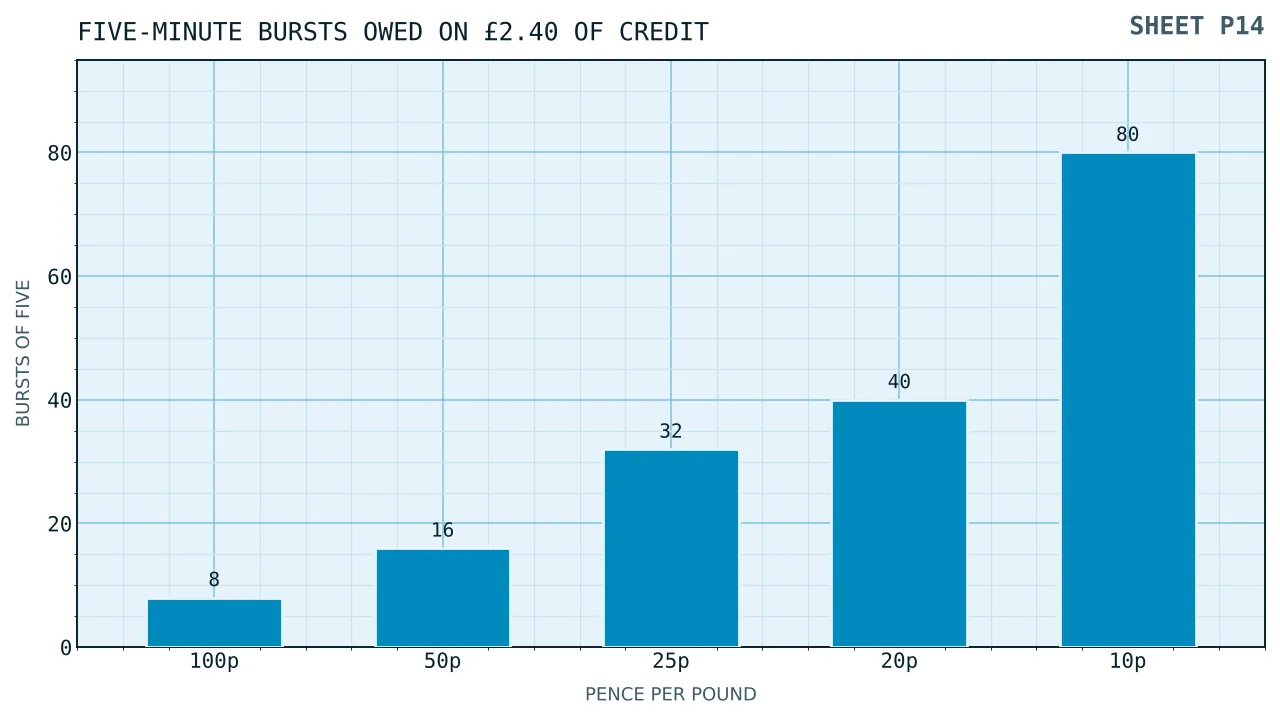
Five minutes at the licensed floor is a hundred and twenty presses, which is £12.00 of staking at 10p. The table below counts the whole obligation in those units, at five contribution rates, with the credit and the requirement held exactly where part 2 left them.
| What a pound counts as | Staking needed | Presses | Minutes | Bursts of five | E |
|---|---|---|---|---|---|
| A whole pound | £96.00 | 960 | 40 | 8 | -£1.44 |
| Fifty pence | £192.00 | 1,920 | 80 | 16 | -£5.28 |
| Twenty-five pence | £384.00 | 3,840 | 160 | 32 | -£12.96 |
| Twenty pence | £480.00 | 4,800 | 200 | 40 | -£16.80 |
| Ten pence | £960.00 | 9,600 | 400 | 80 | -£36.00 |
Contribution owed never shifts from £96.00 down that ladder. Everything else multiplies. Where a pound counts as a tenth, the staking is ten times over, so are the presses, the clock reads six hours and forty minutes, and the shortfall is £36.00 against a credit of two pounds forty.
Eighty bursts is the figure to sit with. A reader who gives a phone round five minutes at a time, four times a day, would reach the end of that obligation in twenty days, and the arithmetic says the expected balance at the end of them is £0.00. A round advertised as twenty-five spins has become three weeks of a daily habit, and nothing on the front of the offer says so.
Which is the finding this page is for. On a desktop the bottom of that ladder reads as a long evening. On a handset it reads as a routine, because five minutes is always available, and a routine is the thing the pace of a credit quietly converts itself into.
6
Forty pence in the pound, exactly on the line
Something reaches the foot only where the requirement divided by the rate stays under the reciprocal of the edge. On a 96 per cent build the edge is four pence, so the test is the requirement divided by twenty-five, and the rate has to sit above whatever that gives.
Forty turnovers therefore want a rate above 1.60, which is unavailable anywhere, a staked pound having no way of counting for more than one pound. At the regulated ceiling of ten the test comes down to forty pence in the pound, and forty pence exactly lands on nought: the credit is spent precisely, with nothing either side of the line.
Ten turnovers need better than 40p in the pound
Three rows of that test are worth having in words. Twenty turnovers need better than eighty pence. Twenty-five turnovers need better than a whole pound, so they fail at every rate that exists. Anything above twenty-five is beyond rescue by arithmetic, and no game schedule, however generous, can alter that.
The crossing also moves with the build. A 94 per cent return leaves an edge of six pence, which makes the divisor 16.7, and ten turnovers would want better than sixty pence in the pound. Where the return is 98 per cent the edge is two pence, the divisor is fifty, and ten turnovers need only twenty pence. Two builds of one game, identical on screen, can therefore sit on opposite sides of their own crossing.
None of which a phone can affect, and that is worth stating plainly because the opposite is widely assumed. A handset does not lower the return, does not alter the schedule and does not move the crossing by a penny. What a handset does is make both figures harder to go and look at while a credit is live.
7
Five pounds, two pounds, and forty-eight presses
The stake is the one quantity under a reader’s thumb, and on slots a statutory instrument bounds it rather than a cashier’s own policy.
A single game cycle may not be loaded above five pounds, or above two where the individual has yet to reach 25. The regulations behind that were made on 25 February 2025. Calendar dates are the regulator’s rather than the instrument’s, the instrument giving only a formula of six weeks from the making. Nine April 2025 brought in the five pound figure. Twenty-one May 2025 brought in the two pound one, and everybody sat under the higher ceiling in the six weeks between.
The definition is narrow and worth having on a page about a device, because it is written about the game and not about the screen it appears on. A casino game, reel-based and played online, is what the regulations mean by an online slots game. Reel-based in turn means a game where images that move or change, put up through representations of reels or by some other device, decide whether a prize or another advantage becomes due. The regulator puts it in terms: these limits belong to online slots, and the rest of the casino is untouched, roulette and blackjack being the examples given.
Priced against part 2, the ceiling matters to the clock rather than to the cost. The £96.00 owed at forty turnovers could be discharged in 48 presses at two pounds a go, or a shade over nineteen at five pounds, instead of 960 at 10p. Expected cost sits at £3.84 on every one of those routes, because an edge of four pence is indifferent to how a pound is parcelled out. What changes enormously is the spread around that figure, so the faster route is not a safer one.
The two pound band has a published context worth attaching to it. On 16 July 2026 the national self-exclusion scheme reported registrations by people under 25 rising 26 per cent year on year. Nearly a third of all self-exclusions belong to that age group, and 38 per cent of them chose the six-month period rather than anything longer. Taking every age together, the five-year option had been chosen by over half of the 614,738 registrants.
A bonus document will frequently set a maximum stake of its own for as long as a credit is live. No published rule fixes such a figure. It is a line to find rather than to deduce, and read against the test in part 6 a low stake cap beside a low contribution rate is the pair that makes a round unfinishable rather than merely unprofitable.
8
The controls a licence keeps within reach
One British standard is written almost as though it had a handset in mind, and it is the standard on financial limits.
Access is where it speaks to a small screen. A direct link from the home page is required, clearly visible and reachable. The facilities have to be clearly visible and reachable on deposit pages or screens, or through a link on them. And the clicks or pages a customer goes through to reach them have to be kept to a minimum by the system. That last requirement is the one a phone tests hardest, since a desktop menu that costs one glance can cost four taps.
The shape of a limit is set out as well. A free text box is required for setting one, or the equivalent by telephone. Limits apply at account level as a minimum. Gross deposit limits have to be offered, meaning a ceiling on what goes into an account over a stated period, and only a limit meeting that description may be called a deposit limit at all. It also has to be put forward no less prominently than the other kinds are. Durations on offer have to take in one month, seven days, and a period of twenty-four hours.
Two periods overlapping is covered by the regulator’s own worked example, which settles the arithmetic: a daily ceiling of £10 alongside a weekly one of £100 leaves a system obliged to allow £10 a day and £70 a week, because the most restrictive limit always governs. Once a ceiling is met, further deposits stop, and they stay stopped until the period begins again or the customer moves to raise the figure.
The two directions run at different speeds, and that asymmetry is the protection. A reduction takes effect immediately unless a technical failure prevents it. An increase needs three things: the customer’s request, a wait of twenty-four hours or more, and a positive act at the end of the wait confirming the request. Setting a limit is also the default choice: declining one requires an action, and a confirmation that no limit is wanted has to be received before deposit or play continues.
Two prompts sit on top. A prompt to set a limit is owed either inside the registration process or when a first deposit or payment is made. A summary page of the regulator’s puts that timing more loosely, as early as possible, and the live standard is the wording to prefer. Accounts with activity inside a rolling twelve months are owed a prompt to review their own account and transaction history at six-month intervals or better, and facilities for more frequent reminders where a customer wants them. Since 17 January 2025 a licensee has also had to put net spend and time gambled in front of a customer in real time, which on a handset is the one figure a reader can take in without leaving the game.
9
Before the first tap, off the register
Were the room on your screen licensed in Great Britain, it would arrive with every duty named on this sheet attached to it. It would hold the requirement to ten turnovers of bonus funds. It would keep a slots cycle under five pounds, and under two below the age of 25. It would hold the next cycle back two and a half seconds and insist the control came up before it went down. It would refuse automatic play, refuse turbo and refuse two games at once. It would put a limit control a click from the home page and prompt for a limit before the first payment. It would have verified the address, the date of birth and the name before anything turned. And it would owe a complaint an answer inside eight weeks, with an escalation to a body the regulator had approved.
Where an app or a page has no Great Britain licence, none of that comes with it, and no substitute arrives from the island rulebook read for this build. Searched end to end, it sets no ceiling on a game cycle, no cap on a multiple, no minimum interval, no bar on automatic play and nothing about a return celebrated at or under its own stake. Bonuses occupy two sentences of it: terms put transparently, and promotion held back from driving excessive play.
Two things it does carry are worth knowing precisely, because overstating the absence is as inaccurate as overstating the protection. There is no charge for lodging a complaint, and the window runs to six months after the incident, matching the British one; the operator answers inside four weeks, extendable once in writing to eight. And a reduction in a deposit limit bites immediately, while an increase sits out seven days, a longer wait than the twenty-four hours Britain asks for.
Where the gap bites on a handset is self-exclusion, and the arithmetic of that is the sharpest thing on this page. Britain runs one register covering every licensed operator, with 614,738 people on it as at 16 July 2026. The island version bars a player from one operator and the domains that operator owns, and then asks the player to go and repeat the exercise site by site. One registration against an unbounded number of apps is not a comparison that ends well. No sentence on this sheet is of any use to somebody trying to get past a block.
Five readings settle a handset round, and the third and fourth take taps to reach.
| The reading | This round |
|---|---|
| Cycles given, and the stake on each | 25 at £0.10 |
| Credit, after the return is applied | £2.40 |
| Turnovers asked in the terms | 40 |
| The rate on the game schedule | 1.00 |
| Presses, minutes, bursts of five | 960, 40, 8 |
Then divide the third reading by the fourth and compare the answer with twenty-five. Under it, an expectation survives and the round can be finished. Over it, nought is the answer and the only live question is how many bursts of five minutes the nought will take.
Two cautions, as everywhere on this site. The answer is an average, and twenty-five cycles produce nothing far more often than they produce anything, so the average is a statement about many such rounds. And a term outside the expression, a ceiling on what the bonus may produce or a discretion the operator reserved, can shut the answer down with every reading above standing exactly as it stood.
Nearby sheets take the parts this one leaves alone. Mobile casinos looks at the cashier rather than the reels, online slots UK prices the room at large, top 10 best online slots takes a game list as a statement about the rate, and new online slots asks what a recent build changes. Sheet by sheet, the section is set out under The room.
Questions
- Do mobile slots pay less than the same game on a desktop?
- Nothing in the arithmetic says so. The expression that settles a credit holds the credit, the requirement, the return and the contribution rate, and it has no term for a device, a screen width or an app. A reader comparing a handset round with a desktop round at the same four inputs is comparing two identical quantities.
- What is a round of twenty-five mobile spins worth?
- Twenty-five cycles at 10p are £2.50 on the front, and a 96 per cent return brings that to £2.40 of average winnings. Forty turnovers then want £96.00 of staking, which the reels are expected to take £3.84 out of, running £1.44 past the credit, so the foot reads £0.00. Ten turnovers would want £24.00 of staking, and £1.44 would be expected to survive.
- How many presses does the wagering actually take?
- Nine hundred and sixty. Presses owed are the count on the front, taken against the requirement and against the return, so twenty-five, forty and 0.96 together give 960. Divide any staking figure by its own stake per cycle and the same 960 comes back out, which is why the figure holds at any spin value.
- How long is that on a phone?
- Forty minutes at the quickest a licence allows, and it cannot be compressed. A gap of two and a half seconds is required from the start of the previous game before another cycle may start, the control has to come up and go down once more, and holding a button, a key or a screen down is specifically not a way to begin one. The twenty-five cycles handed over take sixty-two and a half seconds.
- Why count the obligation in five-minute bursts?
- Because a handset round is an interrupted round, and five minutes at the licensed floor is a hundred and twenty presses, or £12.00 of staking at 10p. Forty minutes is eight bursts. At a tenth of a pound in the pound the same credit wants eighty bursts, which is six hours and forty minutes, and a reader giving it five minutes four times a day would be at it for twenty days.
- What contribution rate does a phone round need?
- A rate above the requirement divided by twenty-five, where the build returns 96 per cent. Forty turnovers want a rate above 1.60, and no cashier can supply it: one pound of stake will never count as more than one pound. At ten turnovers the figure is forty pence in the pound, and forty pence exactly lands on nought. Twenty-five turnovers and anything beyond cannot be rescued at any rate.
- Can bigger stakes clear it faster on a phone?
- Up to a statutory ceiling, yes. The £96.00 owed would take 48 presses at two pounds a go, or a shade over nineteen at five pounds, rather than 960 at 10p. Expected cost stays at £3.84 on every route, a four pence edge being indifferent to the size of the pieces a pound is broken into. The spread around that figure widens enormously, and a bonus document may well impose a stake cap of its own far below the statutory one.
- What are the stake limits on mobile slots?
- Five pounds for one game cycle, dropping to two pounds where the individual has not reached 25, under regulations dated the twenty-fifth of February 2025. Only a formula appears in the instrument, six weeks from the making, so the calendar belongs to the regulator: the higher figure from 9 April 2025, the lower from 21 May that year. These limits belong to online slots, which the regulator puts in terms, and the rest of the casino is untouched.
- What limit controls must a licensed app put within reach?
- A direct link from the home page, clear visibility on deposit pages or screens, and a system built to keep the clicks and pages to a minimum. Setting a limit needs a free text box. A limit binds at account level or wider. Gross deposit limits must be among those offered, as prominently as any other kind, and three durations are compulsory: one month, seven days, twenty-four hours. Reductions take effect immediately; an increase needs a request, twenty-four hours of cooling off, and a further act to confirm.
- What does a phone round lose with no Great Britain licence behind it?
- Everything on this sheet that a licence attaches. Gone is the requirement held to ten turnovers of bonus funds. Gone are five pounds and two pounds a cycle. Gone are the two and a half seconds and the control that has to come up before it goes down. Gone are the bars on turbo, on automatic play and on two games running together. Gone is the limit control one click from the home page. And gone is the verified address, date of birth and name owed before anything turns. No ceiling on a cycle, no cap on a multiple and no minimum interval appear in the island rulebook read for this build, where bonuses get two sentences.