
Sheet M17 Revision 1 Checked 15 October 2026
Slots free spins
Seventy-five cycles at 10p average £7.20. Forty times at full contribution owes £288.00 of staking. Drop the contribution rate to thirty pence in the pound and the same requirement wants £960.00, which is an effective multiple of 133.3.
W over g below 25, or the foot reads nothing
What the conditions leave
Every destination on this spike is bought advertising. The site takes a fee if a reader goes on to register, and no figure printed below moves because of it.
The Spin Sheet
Till receipt No 01
Betportal
Lowest multiple here
For every €1 of spin credit at face per €1
Credit
Debit
No Great Britain licence
Licensed in Anjouan, Comoros, run by BetPortal Gaming Ltd, with Excite Ultra Media Ltd, reference ALSI-202601040-FI2.
Terms read 15 October 2026
Open the offer at Betportal, opens in a new tabThe Spin Sheet
Till receipt No 02
WinBeast
Five staged matches
For every €1 of spin credit at face per €1
Credit
Debit
No Great Britain licence
Licensed in Curaçao, operator not named on the site.
Terms read 15 October 2026
Open the offer at WinBeast, opens in a new tabThe Spin Sheet
Till receipt No 03
EliteSpin
Longest spin window
For every £1 of spin credit at face per £1
Credit
Debit
No Great Britain licence
Licensed in Costa Rica, run by PrimeTier Limited.
Terms read 15 October 2026
Open the offer at EliteSpin, opens in a new tabThe Spin Sheet
Till receipt No 04
Crown Jewelz
Multiple unpublished
No total struck
Credit
Debit
No Great Britain licence
Licensed in Curaçao, number not verified, operator not named on the site.
Terms read 15 October 2026
Open the offer at Crown Jewelz, opens in a new tabThe figure at the foot of a receipt is this site's own arithmetic and nothing an operator has published: the credit, less the share a spin gives back at 96 per cent return to player, less what playing the wagering through costs at the same return. It describes the offer, not one reader's afternoon. Where the conditions price above the credit the receipt prints nothing rather than a negative sum, and where a figure the sum needs is unpublished it prints the condition in the operator's words instead.
Three words stand in the amount column where no figure can. Noted is a published condition that takes value away without leaving the sum a figure to take. Unpriced is a condition whose figure nobody has published, or a credit that is not a sum until a deposit of your own sets it. Own money is money of yours, which is never part of a total.
Not one of the operators printed above holds a Great Britain licence, so the duties that licence carries do not reach them. Every online gambling company licensed in Great Britain has to be part of Gamstop Online, and a reader who has shut themselves out through the scheme is therefore not shut out here. The ceiling of ten times the bonus funds on a wagering requirement, in force since 19 January 2026, is a condition of that licence and binds the companies that hold one. Where a dispute goes instead is a matter for the authority named on the receipt, and the Gambling Commission describes what a reader faces without a British licence as a lack of recourse if things go wrong. Nobody under 18 may hold an account at any of them.
Every term printed on a receipt is the operator's own, and each receipt carries the day it was read. The oldest of those readings is 15 October 2026. What binds a reader is the operator's own full terms, and not a line printed here.
1
What a slots round is, and the term that decides it
Every other sheet in this part of the tree treats the contribution rate as a complication at the end. Here it is the subject, because on a slots round it is the term most able to make a survivable requirement unsurvivable.
A slots round is also where every one of the design standards bites at once, which is the second reason it earns its own sheet. A slots game carries the paced game cycle of 2.5 seconds, the autoplay ban, the bar on turbo, the rule against cheering a return that merely equals a stake, and the statutory stake ceilings. No other casino product carries the whole set.
Seventy-five cycles priced at 10p are £7.50 at face, averaging £7.20 on a 96 per cent game. That is B. The count is chosen as a middling one, neither the five-cycle end of the market nor the four-figure end.
Slots games produced £4.8 billion of the £8.3 billion the remote casino, betting and bingo sector took between April 2025 and March 2026, on figures the regulator released on 17 September 2026. The same report counts 25.7 million active accounts at the end of its last quarter, and 2,154 licensed operators at 31 March 2026. So the product this page prices is the largest single thing in British online gambling, and the term that decides its offers is the one term nobody regulates.
Forty times is the requirement carried through here, that order of multiple being what this part of the market tends to fasten on. A British licence stops the multiple at ten times the bonus funds, and has done since 19 January 2026.
Four inputs, and the one that moves everywhere on this page:
- Seventy-five cycles at 10p, so £7.50 on the front and £7.20 in hand.
- A 96 per cent theoretical return, which parts the house from ninety-six pence in the pound and no more.
- W at forty, except where part 5 varies it.
- g, the contribution rate, taken at one, a half, three-tenths, a fifth and a tenth.
- Nothing paid in, which makes the credit the whole exposure.
2
Seventy-five cycles, seven pounds twenty
Before contribution comes into it, the round prices like any other in this section, and the figures are worth having in mind as the baseline the rest of the page departs from.
Forty lots of £7.20 make £288.00 of required staking. A machine keeping four pence in every pound expects to take £11.52 of that, so E comes to minus £4.32 and the closing line is £0.00.
Required staking of £288.00 at 10p is 2,880 cycles, which the 2.5 second floor turns into 7,200 seconds. Two hours, and a floor rather than an estimate.
Seventy-five cycles take just over three minutes. At full contribution the requirement takes two hours; at thirty pence in the pound, six hours and forty minutes. The whole of this page lives in the gap between those two figures.
Ten pence a cycle is an assumption and nothing more. Nothing published in Britain fixes a spin’s cash value, says whose decision it is, or requires the figure to appear anywhere, so it is an input a reader has to supply from the credit they were actually given.
3
g inside the fraction
The whole page turns on one fraction.
E = B × (1 – (W × (1 – RTP)) / g)
Contribution is the letter on the bottom of it, and the only one a reader is likely to skip. The credit is B, the turnovers demanded are W, the share a machine gives back is RTP, and E is what the arithmetic leaves.
g is the share of each staked pound a cashier agrees to count towards the requirement, and it sits beneath W rather than next to it. That position is the whole story. A term in a denominator does not add to the obligation; it divides into it, which means a small change in g does far more damage than a large change in W.
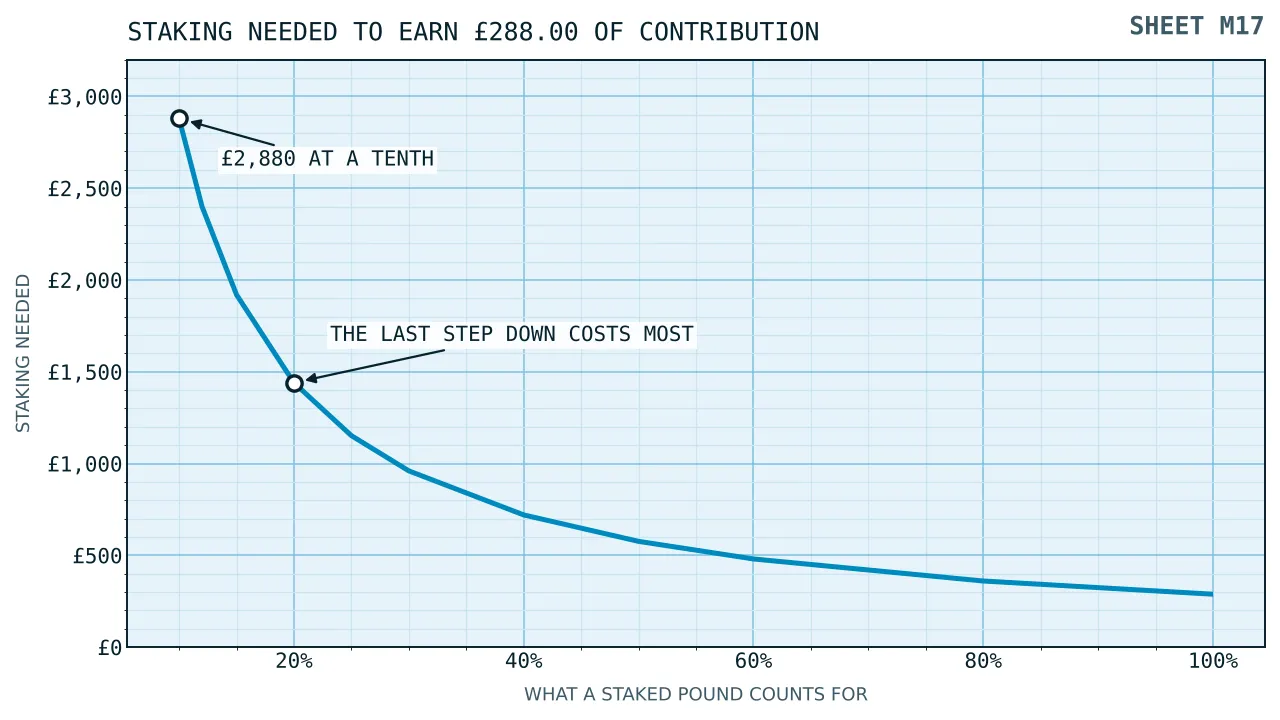
What a rate below one does is leave the requirement alone and multiply the staking needed to satisfy it. Forty times £7.20 is £288.00 of contribution owed whatever the rate. At a pound in the pound that costs £288.00 of staking to earn. At thirty pence in the pound it costs £960.00.
Divide the multiple by the contribution rate and the answer is the effective multiple, which is the figure that ought to be printed on the front of a slots offer and never is. At forty times and thirty pence in the pound the effective multiple is 133.3, which is five times what a British licence would allow on the headline figure. The headline would read forty. The arithmetic reads a hundred and thirty-three.
40 ÷ 0.30 = an effective multiple of 133.3
4
The contribution ladder
One credit, one multiple, and five rates. The contribution owed never moves from £288.00, and everything else moves a long way.
| Rate | Effective W | Staking needed | Expected cost | E | Hours |
|---|---|---|---|---|---|
| 100p in the pound | 40.0 | £288.00 | £11.52 | -£4.32 | 2.00 |
| 50p in the pound | 80.0 | £576.00 | £23.04 | -£15.84 | 4.00 |
| 30p in the pound | 133.3 | £960.00 | £38.40 | -£31.20 | 6.67 |
| 20p in the pound | 200.0 | £1,440.00 | £57.60 | -£50.40 | 10.00 |
| 10p in the pound | 400.0 | £2,880.00 | £115.20 | -£108.00 | 20.00 |
Drop the rate to a tenth and the staking becomes £2,880.00, the cycles 28,800 and the clock twenty hours. On a credit of seven pounds twenty. The shortfall at that rate is fifteen times the credit itself, which is the point at which the word offer stops describing the thing accurately.
No published source gives a contribution rate currently in use, which is why every rate on this page is labelled as an input rather than a finding. Thirty pence in the pound is the one figure with any provenance: a consultation respondent put to the regulator a case where each wagered pound contributed thirty pence. The regulator recorded the submission and then left weighting entirely alone.
5
The threshold: W over g below twenty-five
What has to be below twenty-five is W over g, not W, so a contribution rate belongs in the comparison from the start.
Anything is left at the foot only where W divided by g comes in under twenty-five. Rearranged, that gives the condition on the rate: g has to exceed W divided by twenty-five. The table below is that condition, worked out at the multiples this part of the market publishes.
| W | g needed | Possible? |
|---|---|---|
| 10 times | above 0.40 | yes |
| 20 times | above 0.80 | yes |
| 25 times | above 1.00 | no |
| 40 times | above 1.60 | no |
| 60 times | above 2.40 | no |
Ten times is the regulated ceiling, and even there a game must count at forty pence in the pound or better before a penny survives. Above twenty-five times no rate can rescue the round, because a staked pound cannot count for more than a pound. That is the sharpest thing on this sheet: the ceiling binds the multiple, the rate is unregulated, and the two together decide whether the arithmetic has any chance at all.
Read the other way, the threshold prices a game list. A cashier that excludes the high-return slots from a bonus, or counts them at a fifth, has altered no digit of the figure advertised on the front. It has moved the offer from the first two rows of that table to the last three.
Twenty-five itself is not a choice anybody made. Set E to nought, watch B leave both sides, and the survivor is the reciprocal of four pence in the pound. A game returning 95 per cent would put the threshold at twenty, and one returning 97 would put it at 33.3, so the figure moves with the return as well as with the rate. Return by return, that point is worked out on the sheet for 150 free spins on Book of Dead, where a named game raises it.
6
What the slots rulebook paces
Everything in the tables above assumes a reader can get through the staking. Six British standards decide how long that takes, and they are all specific to the product.
RTS 14D sets the interval, and it is written about slots in terms: at least 2.5 seconds must pass between a game starting and the commencement of the cycle after it. It is also necessary to release and then press the start control again, so holding a button down starts nothing. The guidance defines a game cycle as running from the moment a player starts the game until the money staked or won has been lost or made available, with the start control live again, and asks for a separate commitment to each cycle.
RTS 8A bars automatic play across gaming, bingo included, by requiring an individual commitment to every game cycle; its single exception is the automatic posting of a blind in peer-to-peer poker. RTS 14E stops a customer shortening the wait for a result, quick spin, slam stop and turbo being the named casualties, with carve-outs for feature games taking no further stake and for controls that reveal or scratch everything at once.
RTS 14F keeps the presentation honest while the staking is being worked through. A return no greater than the total staked gets no win-related sound and no animation, which across 28,800 cycles at the foot of the ladder is a very large number of results not dressed up as wins. The guidance suggests three things instead: the amount awarded put on screen, the winning lines flashed up, and a single short note as the money lands.
RTS 14C bars functionality that would let casino games run at the same time, split screens and multiple screens included, so twenty hours of obligation cannot be divided between four windows. And RTS 7C prohibits any design apt to leave a customer with a false idea of how probable a result is, naming two: a losing event swapped for a near-miss losing event, and a real device simulated without the probabilities it really has.
2,880 cycles at full weight, 28,800 at a tenth
7
Five pounds, two pounds, and what counts as a slot
The stake is the one quantity a player controls, and on slots alone it is bounded by statute rather than by a cashier.
A single game cycle may not carry a stake above five pounds, nor above two where the player has yet to reach 25, under an instrument dated 25 February 2025. Commencement comes from the regulator rather than the instrument: the five pound limit from 9 April 2025, the two pound one from 21 May, with a six-week transition during which everybody sat under the higher figure.
The regulatory definition is narrow: an online casino game built on reels, the reels being any device by which images that move or change decide whether a prize or other advantage becomes due. The regulator states in terms that the limits reach online slots only and do not touch the rest of the casino, roulette and blackjack included. So a bonus that can be cleared on roulette is a bonus with no statutory ceiling on the stake, which cuts both ways: faster to clear, and nothing standing between a player and a very large single wager.
Against the ladder in part 4, the ceiling matters most at the bottom. The £2,880.00 of staking at a tenth of a pound would be 576 presses at five pounds a go rather than 28,800, which is twenty-four minutes rather than twenty hours. The expected cost would be £115.20 on either route, since the edge takes its four pence regardless of how the staking is parcelled up, and the spread around that figure would be enormous.
Bonus terms frequently set their own maximum stake for the period a credit is live. Nothing published fixes such a figure, which puts it among the lines a reader has to find rather than deduce. Read against the threshold in part 5, a low maximum stake and a low contribution rate in the same document are the two conditions that between them make a slots offer unfinishable rather than merely unprofitable.
8
One product type, and the ceiling on the multiple
Two provisions of Social Responsibility Code 5.1.1 shape a slots offer directly, and both came into force on 19 January 2026.
The first caps the multiple. A licensee may not demand more than ten turnovers of bonus funds, which is the only regulated number anywhere in this page’s arithmetic. Sixty times is its own note of what it was correcting, a figure it recorded in use at some licensees before the cap. Whether the cap reaches a free spin itself is not published, and this sheet will not fill that gap either way; what is published is that where winnings off a free spin arrive as bonus funds, the ten-times limit applies to them.
The second bars mixing products. Slots sit inside the casino product type, so free spins handed over with a casino match do not breach the ban on mixing products. Pair the spins with bingo tickets, though, and two product types have been combined inside one incentive, which the rule reaches. Three exemptions sit alongside. Two products of one type together are fine, a scratchcard with a raffle being the regulator’s instance. Offers for two different products may share one email where consent covers each of them. And a credit the customer may spend as they please is outside the ban altogether.
What neither provision touches is g. The cap is written about the multiple and about bonus funds, and the consultation that produced it recorded weighting without acting on it. So a licensee can comply with the ceiling exactly and still publish an effective multiple of a hundred and thirty-three, which is the thing most worth understanding about a regulated slots bonus.
The terms themselves do have a standard. Code 5.1.1 asks for an incentive’s conditions to be clear, to be transparent and to be fair, and to be within reach of anybody offered it. A contribution schedule that reaches a reader only after three clicks is a poor fit for that standard, though nothing published says how many clicks is too many.
9
Where none of it reaches
Where a site holds no Great Britain licence, contribution is settled by its bonus terms and reviewed by nobody.
Nothing in the Curaçao rulebook caps a multiple, and nothing in it mentions weighting at all, so the effective multiple out there is whatever two unregulated numbers happen to make it. A rate of a tenth and a multiple of sixty would give an effective multiple of 600, and no published rule anywhere would stop it. Its mandatory responsible gaming list reaches deposit limits, cooling-off periods and self-exclusion, behaviour tracking, player self-assessment, age verification, accessible information, the training of staff and affiliates, and general principles for marketing. Bonuses occupy two sentences of it, about transparent terms and about not promoting aggressively enough to encourage excessive play.
The six standards in part 6 go missing together, which matters more on this page than on any other in the section. With no paced game cycle, no autoplay ban and no bar on turbo, the twenty hours at the foot of the ladder stop being twenty hours. The staking is unchanged, the expected cost is unchanged, and the only thing that has altered is how quickly a player can reach the end of it.
The stake ceilings go too, so the five pound figure in part 7 is a British figure and nothing else. Nothing in the Curaçao policy sets a maximum on a single game cycle, and nothing in it distinguishes a reel-based game from any other.
A British licence is also what puts a site inside the national self-exclusion scheme, and the scheme states its own boundary: it cannot help prevent access to services run by organisations that do not participate in it. The offshore equivalent bars a player from a single operator and the domains it owns, and then suggests they repeat the exercise site by site. On 16 July 2026 the British scheme published a register of 614,738 people, 16 per cent more than six months earlier.
10
Pricing the round in front of you
Six readings, and two of them are the ones nobody takes.
| What to read | Here |
|---|---|
| Count, and price per cycle | 75 at £0.10 |
| Credit after the return | £7.20 |
| W, from the wagering line | 40x |
| g, from the game list | 0.30 |
| W over g, against 25 | 133.3 |
| E, and the foot | -£31.20 |
The fourth line is the one to hunt for, and it is rarely on the same page as the third. Where a game list gives several rates, use the rate for the games the credit can actually be spent on, which is usually the lowest of them.
Then the test. Divide W by g and compare the answer with twenty-five. Below it, there is something at the foot and the sheet is worth finishing. Above it, the answer is nothing and the only remaining question is how many hours the nothing costs.
Two limits on all of this. It is an average, and on a round of seventy-five cycles the commonest single outcome is nothing whatever; the mean describes a great many such rounds rather than one evening. And a term sitting outside the fraction, a win cap on the bonus or a discretion the operator wrote in for itself, can close the answer with W, g and the return all untouched.
Other sheets in the section run the same fraction with g held at one, which is how the contribution rate came to be this page’s job: free spins no deposit sets out the method on a round of fifty, 200 free spins runs a count nearly three times this one, and 1000 free spins no deposit shows what the same rate does to four figures of cycles. The multiple holds every sheet whose answer turns on the play-through.
Questions
- What are slots free spins worth after the wagering is priced?
- Seventy-five cycles at 10p are £7.50 advertised and £7.20 averaged where the game returns 96 per cent. At full contribution, forty times wants £288.00 of staking, costing £11.52, so E is minus £4.32 and the foot reads £0.00. At thirty pence in the pound the staking becomes £960.00 and E falls to minus £31.20.
- What does game contribution actually mean?
- It is the share of each staked pound a cashier counts towards the requirement. It does not reduce what is owed. It multiplies the staking needed to earn it, because the rate sits underneath the multiple in the arithmetic rather than beside it. At thirty pence in the pound, £288.00 of contribution takes £960.00 of staking.
- What is the effective multiple?
- The multiple divided by the contribution rate, which is the figure that decides the answer. Forty times at thirty pence in the pound is an effective multiple of 133.3. The headline still says forty, and nothing requires the larger figure to be printed anywhere.
- How high does contribution have to be for anything to be left?
- Above the multiple divided by twenty-five. At ten times, the regulated ceiling, a game has to count at more than forty pence in the pound. At twenty times it has to count at more than eighty. From twenty-five times upward nothing can save the round, because a staked pound cannot count for more than a pound.
- Does the ten times ceiling cover contribution as well?
- No. It is written about the multiple and about bonus funds, and the consultation that produced it recorded weighting without acting on it. So a licensee can sit exactly inside the ceiling and still publish an effective multiple of a hundred and thirty-three.
- How long does a slots play-through take?
- Two hours at full contribution on this round, because £288.00 at 10p is 2,880 cycles and RTS 14D requires 2.5 seconds between one slot game starting and the commencement of the next. At thirty pence in the pound it runs to six hours and forty minutes, and at a tenth to twenty hours. Autoplay is barred and turbo is barred, so none of that compresses.
- Can the staking be cleared with bigger stakes?
- Up to a point. The £2,880.00 owed at the bottom of the ladder would take 576 presses at five pounds rather than 28,800 at ten pence, which is twenty-four minutes instead of twenty hours. The expected cost is £115.20 either way, the spread around it becomes very wide, and the bonus terms may cap the stake well below the statutory five pounds.
- Do free spins and a casino match count as mixing products?
- No, because slots are a casino product and so is a match, which keeps the incentive inside a single product type. Put the spins alongside bingo tickets and two types have been combined, which the rule has caught since 19 January 2026. Two products of one type are allowed, a scratchcard with a raffle being the regulator’s instance.
- What happens to contribution at an offshore casino?
- It becomes whatever the bonus terms say, with nobody reviewing the figure. Nothing in the Curaçao rulebook caps a multiple and nothing in it mentions weighting, so a rate of a tenth with a multiple of sixty would give an effective multiple of 600 and no published rule would stop it. The paced game cycle, the autoplay ban and the stake ceilings are absent from it too.