
Sheet M13 Revision 1 Checked 15 October 2026
10 free spins
Ten cycles at 10p are £1.00 of face value and 96p of average winnings. Forty times puts £38.40 of staking behind them, at an expected price of £1.54, which is sixty per cent more than the credit it is fastened to.
96p of credit, £1.54 of expected cost, 16 minutes of reels
What the conditions leave
Every destination on this spike is bought advertising. The site takes a fee if a reader goes on to register, and no figure printed below moves because of it.
The Spin Sheet
Till receipt No 01
Betportal
Lowest multiple here
For every €1 of spin credit at face per €1
Credit
Debit
No Great Britain licence
Licensed in Anjouan, Comoros, run by BetPortal Gaming Ltd, with Excite Ultra Media Ltd, reference ALSI-202601040-FI2.
Terms read 15 October 2026
Open the offer at Betportal, opens in a new tabThe Spin Sheet
Till receipt No 02
WinBeast
Five staged matches
For every €1 of spin credit at face per €1
Credit
Debit
No Great Britain licence
Licensed in Curaçao, operator not named on the site.
Terms read 15 October 2026
Open the offer at WinBeast, opens in a new tabThe Spin Sheet
Till receipt No 03
EliteSpin
Longest spin window
For every £1 of spin credit at face per £1
Credit
Debit
No Great Britain licence
Licensed in Costa Rica, run by PrimeTier Limited.
Terms read 15 October 2026
Open the offer at EliteSpin, opens in a new tabThe Spin Sheet
Till receipt No 04
Crown Jewelz
Multiple unpublished
No total struck
Credit
Debit
No Great Britain licence
Licensed in Curaçao, number not verified, operator not named on the site.
Terms read 15 October 2026
Open the offer at Crown Jewelz, opens in a new tabThe figure at the foot of a receipt is this site's own arithmetic and nothing an operator has published: the credit, less the share a spin gives back at 96 per cent return to player, less what playing the wagering through costs at the same return. It describes the offer, not one reader's afternoon. Where the conditions price above the credit the receipt prints nothing rather than a negative sum, and where a figure the sum needs is unpublished it prints the condition in the operator's words instead.
Three words stand in the amount column where no figure can. Noted is a published condition that takes value away without leaving the sum a figure to take. Unpriced is a condition whose figure nobody has published, or a credit that is not a sum until a deposit of your own sets it. Own money is money of yours, which is never part of a total.
Not one of the operators printed above holds a Great Britain licence, so the duties that licence carries do not reach them. Every online gambling company licensed in Great Britain has to be part of Gamstop Online, and a reader who has shut themselves out through the scheme is therefore not shut out here. The ceiling of ten times the bonus funds on a wagering requirement, in force since 19 January 2026, is a condition of that licence and binds the companies that hold one. Where a dispute goes instead is a matter for the authority named on the receipt, and the Gambling Commission describes what a reader faces without a British licence as a lack of recourse if things go wrong. Nobody under 18 may hold an account at any of them.
Every term printed on a receipt is the operator's own, and each receipt carries the day it was read. The oldest of those readings is 15 October 2026. What binds a reader is the operator's own full terms, and not a line printed here.
1
Ten cycles, ninety-six pence
The round is the smallest this section prices, and smallness is useful: every figure fits in pence, where the arithmetic is hard to look away from.
Ten cycles at 10p are a pound of face value, and a pound of face value on a 96 per cent game averages ninety-six pence. Ninety-six pence is B, and the rest of this page is what forty times does to ninety-six pence.
Nothing published in Britain fixes what a single cycle is worth in pence, names whoever fixes it, or compels anybody to disclose the figure. The 10p used here is this site’s working price, chosen because the whole sheet has to start somewhere and because every other line moves with it in exact proportion.
Forty times is the multiple carried through. Since 19 January 2026 a licensee has not been allowed to ask customers to play through bonus funds more than ten times over. Before that limit the regulator recorded multiples running as high as sixty times among some licensees, which is its own figure and the only market multiple on this site’s evidence attributable to it. Forty sits between the ceiling and the old high water mark, which is where this part of the market tends to pitch.
The four quantities this page turns on, and the fifth it holds still:
- Ten cycles, priced at 10p, so £1.00 advertised and 96p averaged.
- A theoretical return of 96 per cent, which keeps four pence from every pound.
- W at forty until part 3 widens it.
- Contribution at a pound in the pound, until part 9 relaxes it.
- No payment in, so ninety-six pence is the whole of what can be lost and the whole of what can be won back.
2
Ninety-six pence through the expression
Every total on this page falls out of a single formula.
E = B × (1 – (W × (1 – RTP)) / g)
Letter by letter: B is the credit, W the turnovers asked of it, RTP the proportion a machine returns, g the slice of a stake that counts, and E the money left at the end.
Forty lots of ninety-six pence is £38.40 of required staking. The edge bills four pence on every pound of it, so the expected price is £1.54.
Subtract the one from the other and E comes to minus 58p, on a credit of 96p.
Through the bracket it comes out the same. Four pence forty times over is 1.60, one less that figure is -0.60, and three-fifths of 96p is 58p.
The expected price of the condition is sixty per cent more than the credit it hangs from, which is the whole of the finding. Nobody is pursued for the fifty-eight pence, because no money was paid in and the balance cannot go under nought. The credit is simply used up part way along the £38.40, and the closing line reads £0.00.
A smaller round is where that result is easiest to believe, and that is the argument for reading this page rather than one about a four-figure count. A hundred times the credit behaves identically and takes a hundred times as long to prove.
3
Five multiples on a credit under a pound
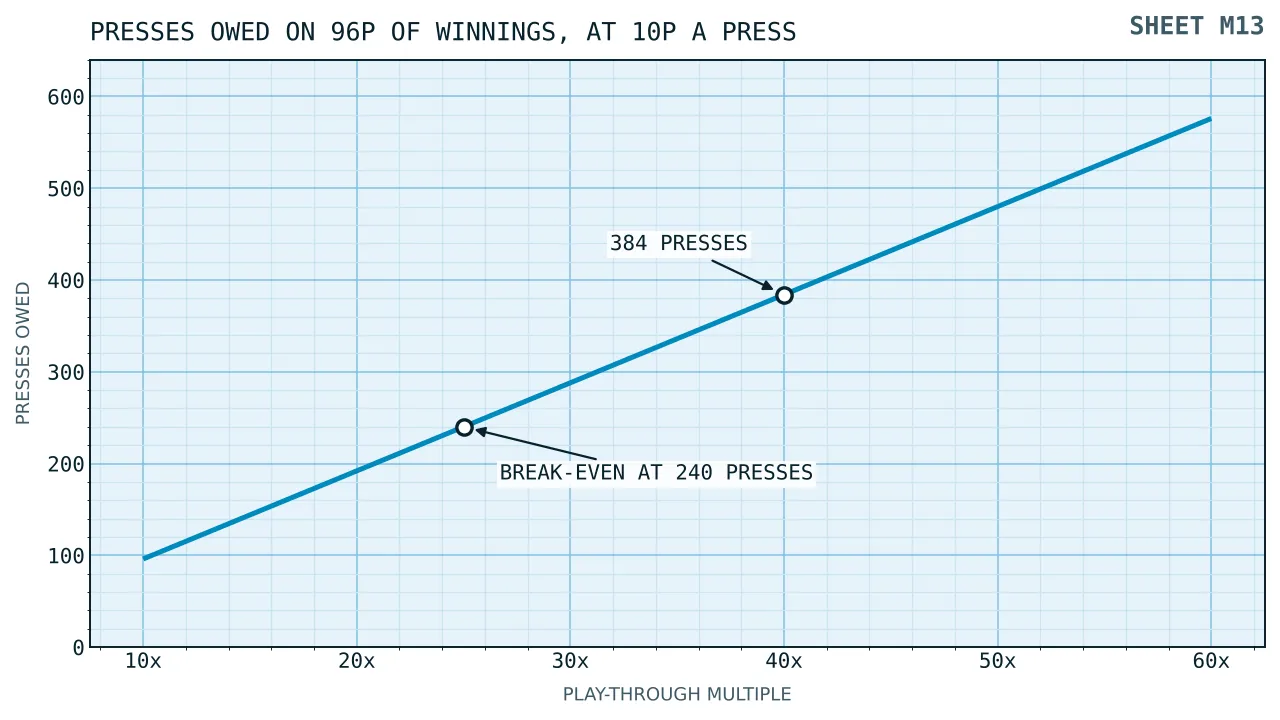
Ninety-six pence held constant, with W moved through the range this part of the market publishes, and the presses counted rather than the pounds.
| W | Staking owed | Presses at 10p | Expected price | E |
|---|---|---|---|---|
| 10 times | £9.60 | 96 | £0.38 | £0.58 |
| 20 times | £19.20 | 192 | £0.77 | £0.19 |
| 25 times | £24.00 | 240 | £0.96 | £0.00 |
| 40 times | £38.40 | 384 | £1.54 | -£0.58 |
| 60 times | £57.60 | 576 | £2.30 | -£1.34 |
A credit of ninety-six pence crosses out where a credit of ninety-six pounds does, the crossing being a property of the game rather than of the gift. Twenty-five is where E lands on nought, because solving for nought takes the credit out of the equation and leaves one divided by the edge. On this round that crossing costs 240 presses of a button and pays nothing.
The column worth dwelling on is the third. At the regulated ceiling of ten times, a ninety-six pence credit buys 96 cycles of obligation and keeps 58p. At sixty times it buys 576 cycles and owes a pound thirty-four more than it has. Six times the multiple is six times the work and a reversal of the answer.
4
Sixteen minutes, three hundred and eighty-four presses
Sixteen minutes is the floor under a forty times requirement here, because £38.40 at 10p is 384 cycles and each one is paced. The relevant standard is RTS 14D, under which 2.5 seconds must elapse between a slot game starting and the earliest moment a further cycle may commence. That makes 960 seconds.
Ten cycles at ten pence take twenty-five seconds. The condition fastened to them takes sixteen minutes. Thirty-eight to one, near enough, is the ratio of obligation to gift, and it holds at any count, being nothing more than W multiplied by the return.
Each of those cycles is a separate press, because RTS 8A requires an individual commitment to every game cycle and spares only blinds posted at a poker table. Speeding the result up is forbidden too. RTS 14E denies a customer any control over the wait, and its guidance lists slam stop, turbo and quick spin among the features that cannot be offered. The rule holds for remote games of every native speed, excusing only a bonus or feature round that takes no further stake, and a control that reveals or scratches everything at once.
Under RTS 14F a win of 10p on a 10p cycle gets no celebration, since a return at the level of the stake or below it may carry no win-related sound or animation. On a round this small that rule does real work: at ten pence a go, a great many of the 384 results will be returns of exactly that shape, and what the guidance leaves the system is the total awarded on screen, the winning lines shown briefly, and one short sound at the moment of crediting.
Running several games at once would halve the clock, and RTS 14C closes that route for casino games outside peer-to-peer poker: the gambling system may offer no functionality that makes playing two at once possible, which its guidance extends to split and multiple screens. From 17 January 2025 operator-led functionality for several products at once went the same way, roulette and blackjack tables being the pairing named, and a duty arrived with it to show net spend and elapsed time as they happen.
25 seconds of free play, 960 seconds of obligation
5
One permitted stake, five of these credits
A single slot cycle staked at the statutory maximum puts more than five times this credit at risk in two and a half seconds. That comparison is the sharpest way to size a round of ten.
The stake ceilings are statutory: SI 2025 No. 215 holds a slots game cycle to five pounds, and to two pounds for a player under 25. The regulator puts the five pound ceiling at 9 April 2025, the two pound one at 21 May 2025, and says plainly that both reach online slots alone. Roulette and blackjack are outside them, as is every other casino game that is not reel-based.
Set the two figures side by side. The credit is 96p. One cycle at the adult ceiling is £5.00, and one at the under-25 ceiling is £2.00. A round of ten free cycles at 10p is therefore worth about a fifth of a single maximum press, and the obligation attached to it is worth between eight and twenty of them.
| Quantity | Figure |
|---|---|
| Credit from ten cycles | £0.96 |
| Staking owed at 40x | £38.40 |
| One cycle, adult ceiling | £5.00 |
| One cycle, under-25 ceiling | £2.00 |
| Maximum presses to clear it | 8 |
Eight presses at five pounds would discharge the whole requirement in twenty seconds, which sounds like an escape and is not one. The expected price stays at £1.54, because four pence in the pound is indifferent to how the pound is split, and the spread around that price widens enormously. Bonus terms also commonly impose a maximum stake of their own while a credit is live. No published rule sets such a figure, so it is a line to find in the document rather than to deduce.
6
Ninety-six pence against an eight-week complaint
Ninety-six pence is the sum in dispute. Eight weeks is the timetable for disputing it, and nothing in the rules scales either to the other.
A complaint about ninety-six pence has the same timetable as a complaint about ninety-six thousand pounds. Acknowledgement is owed within three working days of receipt, cut to a single day where the operator keeps its tables open around the clock. The procedure as a whole, including any escalation inside the firm, is capped at eight weeks from the day it began. The window for bringing it runs six months at minimum from the incident, and a term that tries to close it sooner is not allowed.
Where seven days pass with a reasonable information request unanswered, the eight weeks may be paused and then resumed from the same point. What ends the procedure is a letter: the decision and its reasons, a statement that the firm has nothing further to offer, and directions to an independent adjudicator.
Escalation may only go to an adjudicator carrying the regulator’s approval, and the published list of them runs to eight names. Coverage is uneven. Most of the list is open to remote gambling across the sectors, one entry’s own description runs to betting alone, and another is restricted to physical venues, which leaves it no use whatever to a remote casino player. The route costs the player nothing, which is the point: proportionality cuts the other way here, and a sum of under a pound is still worth pursuing where pursuing it is free.
What the regulator will not do, it says itself. It describes itself as something other than an ombudsman, in those terms. The powers to settle a complaint or recover money are not there; a quarrel over a withdrawal, or over a game that has gone wrong, is outside its reach; and it has no sight of anybody’s account. The first step it names is a complaint to the business itself.
7
Proportionate to what
A round of ten is small enough that the advertising rules about proportion become readable rather than abstract.
An inducement is to stay in proportion to a player’s own outlay of cash and hours, and must not be allowed to climb faster than the outlay does. A promotion is not to encourage repetitive or frequent participation, nor to push a player past what losing would cost them. On a no-deposit round the outlay is nought at the door, which makes the proportion question arrive later, at the point where £38.40 of staking is being asked for a ninety-six pence gift.
The regulator’s own example of something that can pass is a single free bet handed over once fifty pounds has been wagered, and it carries a proviso: handing one over at that point must not be unusual for the sort of gambling involved. Read against this round, fifty pounds of wagering is more than the £38.40 the round itself demands.
An offer may not be billed as free where qualifying obliges a customer to stake money of their own. A round of ten handed over at registration clears that test on the way in. The question returns at the foot of the sheet, where the thing described as free turns out to have carried an expected price of £1.54 from the moment it was claimed.
The terms themselves have a standard to meet. Social Responsibility Code 5.1.1 asks three things of an incentive’s conditions, that they be clear, that they be transparent and that they be fair, and a fourth, that anybody offered the incentive can find them without difficulty. Prominence decides it. Conditions buried too deep leave the advertisement misleading, in the Commission’s own view, and the full terms of an online advertisement are expected roughly a click away, with no burying of the link in a footer. On a credit of this size the multiple is the significant condition, because it is the only term large enough to matter.
8
The same ninety-six pence, off the register
Ninety-six pence won at a site that has no Great Britain licence is ninety-six pence with none of the rules above standing behind it.
On the Curaçao side the obligations run to age checks, self-assessments, behaviour tracking, cooling-off, self-exclusion, deposit limits and staff training, and stop there. No ceiling on the multiple, no limit on a stake, no pace between cycles, no bar on automation and nothing about celebrating a return that matches the stake. Two sentences are all that policy gives to bonuses: terms are to be communicated transparently, and promotion must not be aggressive enough to encourage excessive play.
Complaints are the exception, and a page claiming there is no route offshore would be wrong. Curaçao answers much the same with much the same numbers. Six months to bring the complaint, a reply inside four weeks, and one written extension to eight. Its alternative dispute route is obligatory, the operator bears its whole cost, and the player pays nothing. The regulator there also stands back from individual quarrels.
The parameters, though, are the operator’s to write. Whether a dispute may be escalated at all can be made to depend on a floor under what it is worth, and ninety-six pence will clear no floor anybody sets. Once a process there has concluded, no second attempt before another body is open, and a player who abandons one midway forfeits the right to raise the matter again. Set against the British arrangement, where the adjudicators are approved by the regulator and nothing else may be used, the difference is not whether a route exists but who writes the conditions of entry.
Registration with the national scheme reaches the operators that participate in it and no further, which the scheme states itself: services offered by organisations outside the scheme are beyond anything it can block. Gamstop Online is a licence condition in Great Britain, so the boundary of the scheme and the boundary of the register are the same boundary. Offshore the equivalent is an exclusion from one operator and its own domains, with the player encouraged to repeat the exercise elsewhere.
9
Scaling a round of ten
At 10p a cycle, 96p of credit and £38.40 of staking are a ratio rather than a coincidence: forty times the credit, every time, whatever the credit happens to be. Twenty cycles double both figures. Five halve them. Nothing in the expression knows how many cycles were handed over, only what they add up to.
Take the staking, divide by what a cycle costs, and the count of presses drops out: 384 at 10p, 192 at 20p, 77 at 50p. Multiply the presses by 2.5 seconds and the floor under the clock appears.
Then the term that has been held at a pound throughout. Put contribution at three pounds in ten and the requirement stays at £38.40 of contribution, while the staking needed to earn it rises to £128.00, priced at £5.12, which pushes E to -£4.16 and the clock to fifty-three minutes. Even at ten times, the regulated ceiling, that rate leaves minus 32p. The rate is illustrative. A respondent to the regulator’s own consultation described thirty pence in the pound, the regulator recorded it and left weighting alone, and nobody publishes a schedule of the rates actually in use.
Two caveats. The answer is a mean, and the single likeliest outcome of ten cycles is nothing at all; on a round this short the mean describes many repetitions and not this one. And it treats the credit as reaching the end of the staking and the winnings as reaching a withdrawal, when a cap on bonus winnings or a discretion written into the terms can close the answer earlier.
Rounds of other sizes are priced the same way: 5 free spins no deposit halves every line of this one, 40 free spins no deposit quadruples them, and 25 free spins on registration no deposit adds the sign-up duties to the sum. Everything in The multiple is ordered by the count on its front.
Questions
- What are 10 free spins worth once the wagering is priced?
- Ten cycles at 10p are advertised as a pound and average 96p on a 96 per cent game. Forty times then wants £38.40 of staking, whose expected price is £1.54. The price is 58p bigger than the credit, so the credit cannot cover it and the closing line is £0.00.
- Why is a round of ten worth less than the pound on the front?
- Because a cycle is not money until it has been played, and a machine at 96 per cent keeps four pence in every pound crossing it. Ten cycles at 10p are a pound advertised and 96p averaged. That missing four pence is the edge on the spins themselves, taken before any wagering requirement has been read.
- How long does the forty times requirement take on a round of ten?
- Sixteen minutes, and that is the floor rather than an estimate. Required staking of £38.40 is 384 cycles at 10p, and RTS 14D holds the next slot game back for 2.5 seconds measured from the start of the one before, so 960 seconds in all. The ten advertised cycles are twenty-five seconds of it.
- At what multiple does a credit of 96p come to nothing?
- Twenty-five times, and the credit’s size makes no difference to it. Put the expected cash at nought, the credit leaves both sides of the working, and the multiple left standing is the reciprocal of a four pence edge. The crossing costs 240 presses here and pays nothing for them.
- Can the requirement be cleared with a few large stakes instead?
- Eight presses at the five pound ceiling would cover £38.40 in twenty seconds, and the expected price would still be £1.54, because the edge is indifferent to how a pound is divided. What changes is the spread, which widens sharply. Statute holds a slots cycle to five pounds, and to two for anyone under 25, while the bonus terms may well impose a tighter limit of their own.
- Is a sum this small worth complaining about?
- The British route costs nothing, which is what makes it worth using. An operator owes acknowledgement inside three working days, or inside a day if it trades around the clock, and has eight weeks in all. A player gets six months from the incident at the very least. Escalation then goes to an adjudicator the Commission has approved, from a published list of eight.
- Does the regulator get a player’s money back?
- No, and it says as much itself. It is not an ombudsman: the power to resolve a complaint or recover funds is not among its powers; a dispute over a withdrawal or a faulty game is not something it can take on; and nobody there can see inside an account. What it tells a player to do is complain to the business first.
- What does 30 per cent contribution do to a round of ten?
- It turns a 58p shortfall into £4.16. The contribution owed stays at £38.40, but at thirty pence in the pound earning it takes £128.00 of staking, priced at £5.12, and fifty-three minutes of reels. At ten times, the regulated ceiling, that rate still leaves minus 32p.
- What is different at a casino licensed offshore?
- The multiple has no ceiling, stakes have no statutory limit, cycles have no minimum interval and automation is unrestricted. The Curaçao rulebook carries none of those. It does publish a complaints timetable close to the British one, six months to lodge and up to eight weeks to answer, with free alternative dispute resolution, but the operator may set the conditions of entry, including a minimum value below which a claim goes nowhere.