
Sheet M14 Revision 1 Checked 15 October 2026
120 free spins for real money
A hundred and twenty cycles at 10p average £11.52. Where the winnings are genuinely cash, that is the figure kept. Where forty times is attached, £460.80 has to cross the reels at an expected price of £18.43, and the foot reads nothing.
£11.52 kept at W = 0, £0.00 kept at W = 40
What the conditions leave
Every destination on this spike is bought advertising. The site takes a fee if a reader goes on to register, and no figure printed below moves because of it.
The Spin Sheet
Till receipt No 01
Betportal
Lowest multiple here
For every €1 of spin credit at face per €1
Credit
Debit
No Great Britain licence
Licensed in Anjouan, Comoros, run by BetPortal Gaming Ltd, with Excite Ultra Media Ltd, reference ALSI-202601040-FI2.
Terms read 15 October 2026
Open the offer at Betportal, opens in a new tabThe Spin Sheet
Till receipt No 02
WinBeast
Five staged matches
For every €1 of spin credit at face per €1
Credit
Debit
No Great Britain licence
Licensed in Curaçao, operator not named on the site.
Terms read 15 October 2026
Open the offer at WinBeast, opens in a new tabThe Spin Sheet
Till receipt No 03
EliteSpin
Longest spin window
For every £1 of spin credit at face per £1
Credit
Debit
No Great Britain licence
Licensed in Costa Rica, run by PrimeTier Limited.
Terms read 15 October 2026
Open the offer at EliteSpin, opens in a new tabThe Spin Sheet
Till receipt No 04
Crown Jewelz
Multiple unpublished
No total struck
Credit
Debit
No Great Britain licence
Licensed in Curaçao, number not verified, operator not named on the site.
Terms read 15 October 2026
Open the offer at Crown Jewelz, opens in a new tabThe figure at the foot of a receipt is this site's own arithmetic and nothing an operator has published: the credit, less the share a spin gives back at 96 per cent return to player, less what playing the wagering through costs at the same return. It describes the offer, not one reader's afternoon. Where the conditions price above the credit the receipt prints nothing rather than a negative sum, and where a figure the sum needs is unpublished it prints the condition in the operator's words instead.
Three words stand in the amount column where no figure can. Noted is a published condition that takes value away without leaving the sum a figure to take. Unpriced is a condition whose figure nobody has published, or a credit that is not a sum until a deposit of your own sets it. Own money is money of yours, which is never part of a total.
Not one of the operators printed above holds a Great Britain licence, so the duties that licence carries do not reach them. Every online gambling company licensed in Great Britain has to be part of Gamstop Online, and a reader who has shut themselves out through the scheme is therefore not shut out here. The ceiling of ten times the bonus funds on a wagering requirement, in force since 19 January 2026, is a condition of that licence and binds the companies that hold one. Where a dispute goes instead is a matter for the authority named on the receipt, and the Gambling Commission describes what a reader faces without a British licence as a lack of recourse if things go wrong. Nobody under 18 may hold an account at any of them.
Every term printed on a receipt is the operator's own, and each receipt carries the day it was read. The oldest of those readings is 15 October 2026. What binds a reader is the operator's own full terms, and not a line printed here.
1
A hundred and twenty cycles, and the phrase on the front
The phrase on the front of this offer makes a claim about W rather than about the count, and W is the only term in the sum that can take the value nought. That is what makes the key worth a page of its own: everywhere else in this part of the tree the question is how large the multiple is, and here the question is whether there is one.
A hundred and twenty cycles at 10p are £12.00 advertised. Theoretical return of 96 per cent turns that into £11.52 of average winnings. That smaller figure is B, and it is the figure the words on the front are promising to hand over.
The 10p a cycle is an assumption and is labelled as such throughout. A spin’s cash value is set by whoever is giving the spins away, with no rule in Britain fixing it, naming who fixes it or requiring the figure to be printed anywhere. Change it and every pound figure on this page moves in the same proportion, while the counts of cycles and the clock do not move at all.
Forty times is the alternative reading carried through for comparison, because it is where this part of the market pitches a requirement when it attaches one. The ceiling a British licence puts on a multiple is ten times the bonus funds, and it took effect on 19 January 2026.
Two offers are being priced here, not one:
- The offer the phrase describes, where W is nought and £11.52 is withdrawable as it stands.
- The offer the terms may actually describe, where W is forty and the same £11.52 has to be turned over £460.80 worth.
- In both, a hundred and twenty cycles priced at 10p, a return of 96 per cent, and a pound counting as a pound until part 9.
- In both, no payment in, which makes the credit the outer limit of what can be lost.
2
Eleven pounds fifty-two, at two values of W
Every figure on these sheets is struck from one short statement.
E = B × (1 – (W × (1 – RTP)) / g)
Nought is the value of W that the phrase on the front is claiming, and nought is the only value at which £11.52 arrives as £11.52. The credit is B. The turnovers asked of it are W, the slice a machine gives back is RTP, the proportion of a stake that counts is g, and the money at the end is E.
Set W to nought and the bracket collapses to one, so E equals B and the headline survives intact at £11.52. Set W to forty and the same credit owes £460.80 of staking, costs £18.43 to put through, and closes at nothing with £6.91 to spare.
At forty times: 40 × 0.04 = 1.60, and one taken from that leaves -0.60.
Three-fifths of £11.52 is £6.91, so E = -£6.91 and the closing line is £0.00, the credit having run out before the staking did.
The difference between those two readings of the same offer is £11.52 of cash against three hours and twelve minutes of button pressing for nought. No other term on the document is capable of moving the answer that far, which is why the phrase is worth checking against the small print rather than taking at face value.
A requirement is a quantity of wagers a customer has to make before funds turn withdrawable, which is the regulator’s own definition and the reason W belongs in the numerator. Where the small print sets out no such quantity, W is nought and this page ends at part 2. Where it sets one out, the rest of the page applies.
3
The ladder from nought to sixty
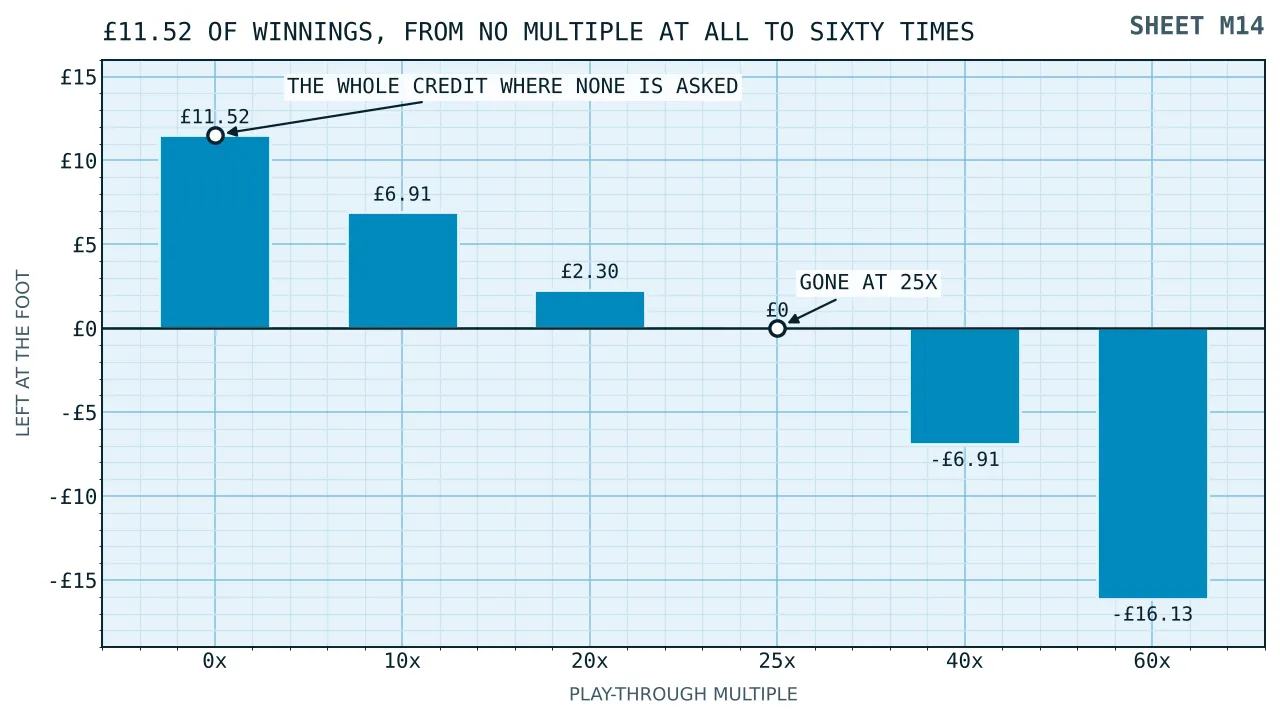
One credit of £11.52, six values of W, and the floor under the clock beside each of them.
| W | Staking owed | Expected price | E | Time at the floor |
|---|---|---|---|---|
| Nought | £0.00 | £0.00 | £11.52 | 5 min |
| 10 times | £115.20 | £4.61 | £6.91 | 48 min |
| 20 times | £230.40 | £9.22 | £2.30 | 1 h 36 |
| 25 times | £288.00 | £11.52 | £0.00 | 2 h 00 |
| 40 times | £460.80 | £18.43 | -£6.91 | 3 h 12 |
| 60 times | £691.20 | £27.65 | -£16.13 | 4 h 48 |
Nought and twenty-five are the two values of W worth knowing: at nought the credit survives intact, at twenty-five the expected cost has eaten all of it. Twenty-five is not a figure anybody chose. Solve for E at nought, watch the credit leave both sides, and the figure standing is the inverse of a four pence edge. Every count in this section crosses there.
The top row is the one the key is about, and it is also the only row where the time column means what a reader expects. Five minutes buys £11.52. Two hours buys nothing at all. Three hours and twelve minutes buys nothing and leaves the credit £6.91 short of the cost of getting there.
4
What real money has to mean to be worth it
For the phrase to be worth £11.52, the winnings have to arrive as cash in a withdrawable balance rather than as a credit with a condition behind it. The published rules are thinner on that distinction than a reader would expect, and this is where the sheet has to be careful about what it does not know.
Is a free spin itself bonus funds, so far as the ceiling is concerned? The evidence file declines to answer, and no page built on it may fill the gap in either direction. One thing can be said with a source behind it. Where the winnings off a free spin land as bonus funds, nothing above ten times may be required of them, and the published wording stops at that.
Nothing published converts bonus winnings into bonus funds, so a cashier that calls the winnings cash and a cashier that calls them bonus credit are both describing a commercial choice rather than following a rule. Nor is it published whether a requirement that takes in the deposit alongside the bonus is caught, since the ceiling speaks only of bonus funds. On a no-deposit round the second question does not arise, which is one of the few simplifications this part of the market offers.
What follows for a reader is a test rather than a trust exercise. Three lines in the terms settle whether the phrase on the front survives contact with the document.
Where the winnings go, and what is asked of them once they get there:
- Into a withdrawable balance with no wagering attached, in which case W is nought and E is £11.52.
- Into bonus funds with a requirement attached, in which case W is whatever the terms say and the ladder in part 3 applies.
- Into a withdrawable balance but subject to a maximum win on the bonus, in which case the ceiling is the answer rather than the arithmetic.
A standard maximum win on bonus winnings has no primary source behind it, so no figure for one appears here and the document in hand is the only place to look. A cap on a bonus’s winnings and an unrestricted right to empty a deposit balance can both hold at once, and a page that runs them together is wrong about which is which.
5
Getting it out again
Real money is money that leaves. On a British licence several rules protect the exit, and each of them answers a failure the regulator has seen.
What an operator may not do is put a maximum on what leaves a player’s deposit balance. A forbidden term, by the regulator’s own illustration, would ration withdrawals to fifty pounds daily and five hundred weekly. On £11.52 of winnings a cap of that size would never bind, which is precisely why the rule is written about a balance rather than about a bonus.
Money sitting in a deposit balance, winnings included, is withdrawable at any time; no maximum may be set on the amount; and whatever limits attach to how big or how frequent a withdrawal is have to be reasonable. That rule’s page prints neither a publication date nor a revision date, so it is cited for its content alone and never for its vintage.
Under RTS 14B a withdrawal request cannot be handed back: a system must not offer the customer the option of cancelling it. The guidance adds that funds under a withdrawal request should not be available to deposit again, and that the route out should carry as little friction as possible. On a credit of this size that matters more than it sounds, because £11.52 is exactly the sort of balance a player talks themselves into putting back.
Identity cannot be sprung at the till either. Where the licensee could reasonably have asked earlier, a withdrawal must not trigger a fresh demand for information. Information for money laundering purposes is meant to be collected early rather than at the moment a balance is wanted, and a withdrawal stalled for lack of it may leave the operator in breach of licence condition 17. The consumer guidance saying so dates from 23 September 2020 and was revised in April 2022, making it older than most of the material cited on this site; the live wording on identity is in the licence condition.
No cap on a deposit balance, no cancel button on a withdrawal
6
A term the regulator has fined somebody for
One clause in a bonus document has a published enforcement outcome behind it, and it is the clause most capable of turning £11.52 of real money into nothing.
On 3 July 2025 an operator paid £170,000 because of what its bonus rules said about new casino promotions. The wording complained of reserved to the operator a discretion to shut accounts down or to take winnings away. A discretionary term of that shape, exercised without clear justification, was found to breach the licensing condition on fair and open dealing, the regulator adding that terms like it want transparency and can end badly for consumers. An independent audit by a third party was required in the same case, reaching both the money laundering controls and the safer gambling ones.
What a reader may take from that is precise and limited. The regulator has fined a licensee over a clause of that shape and named the condition it breached. It has not said the clause is void, because the published outcome is a fine rather than a term struck down. So a discretion of that kind in a document is a reason to walk away from the offer rather than a reason to expect a refund later.
Licence condition 7.1.1 is the standard behind it, and it has four limbs. Consumer notices and the terms of gambling may not be unfair under the Consumer Rights Act 2015, and the licensee has to keep to them. They have to be transparent under the same Act, and contract terms easy for a customer to get at. A material change has to be notified before it bites. Unfair commercial practices, as the consumer statute of 2024 defines them, are out at every stage of dealing with a consumer. The condition reaches all operating licences but the gaming machine technical and gambling software categories, and its page states no effective date.
Set that against the arithmetic. A forfeiture clause does not appear anywhere in the expression in part 2. It sits outside it, and it can take £11.52 to nought without W moving a point.
7
Real money and the tax position
A phrase about real money invites a question about tax, and the answer is more interesting than the usual slogan.
HMRC publishes the position as an absence: betting and gambling, as such, are not trading, so winnings fall outside the charge rather than being exempted from it. The case law is a decision of 1925. A man whose livelihood came wholly from betting on horses at starting prices was held to be carrying on no trade, the judge remarking that a habit attracts no tax. Nor does betting to a system turn it into one, or studying form, or taking a living from the proceeds.
There is no page on which HMRC declares gambling winnings untaxed, and this sheet does not pretend otherwise. The manuals do record where a gambler can be trading, appearance money for a television programme being the example given, with the answer depending on the facts. Nothing here addresses anybody’s own circumstances, and nothing here is tax advice.
The duty falls on the operator and follows the player’s address rather than the licence: remote gaming duty is charged on a provider’s profits from gaming played by a customer who usually lives in Britain. Remote Gaming Duty has stood at 40 per cent since 1 April 2026; before that it was 21 per cent from April 2019, and 15 per cent earlier still. Any operator outside the United Kingdom that takes a British player’s money is inside the scope of that duty, licence or no licence.
That is a sourced statement about the offshore side, and it carries further than any loose assertion about what is lawful. The tax reaches the operator regardless. The protections in parts 5 and 6 do not.
8
The same phrase, printed off the register
Packages of this sort hold no Great Britain licence, which puts the withdrawal rules just set out beyond a player’s reach.
The Curaçao policy lists what an operator must do about responsible gaming, and a wagering ceiling is not among the items. Nor is a stake limit, nor a minimum gap between cycles, nor a bar on automation, nor any rule about what noise a small return may make. On bonuses it offers two lines: transparent communication of terms, and promotion kept short of the point where it encourages excessive gambling. Nothing in it reaches the question part 4 turns on, which is what the winnings become when they land.
The regulator has set out the withdrawal failures it has found on unlicensed sites, and they are the failures this page is about: payouts stopped, and limits on withdrawal pitched at levels nobody could reach. Its blog of 21 October 2025 adds that unlicensed sites often go without age checks, safer gambling tools and secure payment, and that the consumer meets unfair play, loss of money, and nobody to appeal to. Serious data protection concerns are recorded alongside, with identity theft and fraud among the risks.
The same post is candid in both directions, which is worth repeating on a page that prices offshore offers. On scale, the regulator does not expect ever to dismantle the ecosystem fully, given the revenue involved. On effect, traffic data from 160 websites targeted for enforcement showed a 32 per cent drop. Neither sentence supports a confident claim in either direction, and this sheet makes none.
A British licence is enforced with published money, which is the difference a reader can check rather than take on trust. The register of enforcement action carries penalties of £10m, £4.75m, £2m and smaller sums against named licensees, and it carries licence suspensions as well. Nothing equivalent could be found for the jurisdictions whose licences appear on this part of the market.
9
Pricing the claim against the small print
The method is four readings and one subtraction.
| What to find | Here |
|---|---|
| The count, and what a cycle costs | 120 at £0.10 |
| Winnings after the return | £11.52 |
| W, in the bonus terms | 0 or 40 |
| Any maximum win on the bonus | unpublished |
| E, at W of nought | £11.52 |
| E, at W of forty | £0.00 |
Then the term held at a pound in the pound throughout. Put contribution at thirty pence and forty times £11.52 is still £460.80 of contribution owed, but earning it wants £1,536.00 of staking, priced at £61.44, which takes E to -£49.92 and the clock to ten hours and forty minutes. Ten times, the regulated ceiling, still leaves -£3.84.
Nobody publishes a table of contribution rates presently in use, so the thirty per cent above is this site’s arithmetic applied to a figure quoted by a respondent to the regulator’s consultation. The ceiling left weighting alone, which is how a multiple well within the regulated limit comes out at nothing once a rate is working against it. The rate has a page of its own at slots free spins, which works out the level it must reach before anything is left.
Two limits on the answer. It is an average rather than a forecast: the commonest single outcome of a hundred and twenty cycles is nothing, whatever W turns out to be, and the £11.52 is the centre of a wide spread. And it assumes the figures printed are the figures applied, which is the one assumption a reader can actually check.
Where no requirement is attached at all, the section next door prices the same shape of offer without the multiple: Nothing asked back collects those. Inside this section, 100 free spins no deposit runs a slightly shorter count, 150 free spins no deposit a longer one, and 40 free spins no deposit a third of this one. Everything here is indexed at The multiple, arranged by the figure on the front.
Questions
- What does a round of 120 free spins for real money actually leave?
- At 10p a cycle, £12.00 of face value averages £11.52 on a game returning 96 per cent. If the winnings really are cash with nothing asked of them, £11.52 is the figure kept. If forty times is attached instead, £460.80 has to cross the reels at an expected price of £18.43, and the credit is £6.91 short of that price.
- Does for real money mean there is no wagering requirement?
- It is a claim about the terms, not a term in itself. The only reading that leaves £11.52 intact is a requirement of nought, so the phrase has to be checked against the wagering line in the bonus terms. Nothing published converts bonus winnings into cash or into bonus funds, which makes it a commercial choice rather than a rule.
- Is a free spin itself bonus funds, where the ten times ceiling is concerned?
- That is not published, and no page here will guess at it either way. What is published is narrower: where the winnings off a free spin land as bonus funds, nothing above ten times may be required of them. The ceiling itself is written about bonus funds and took effect on 19 January 2026.
- At what multiple does a credit of £11.52 come to nothing?
- Twenty-five. At a 96 per cent return the house keeps four pence of each pound, and the multiple that exactly consumes a credit is the inverse of that: the credit drops out of the working, so the count makes no difference.
- Can an operator cap what a player withdraws?
- Not from a deposit balance. A term imposing a maximum on what comes out of that balance is prohibited, money there can be taken at any time, and limits on how large or how frequent a withdrawal may be have to be reasonable ones. A maximum win fastened to a bonus is another matter and falls outside that rule, so one account can carry both at once.
- Can a withdrawal request be cancelled and the money played again?
- Not on a British licence. RTS 14B says the option to cancel must not be offered, and its guidance adds that funds under a request should not be available to deposit again and that the operator should strip as much friction as it can out of the route.
- Are winnings from these spins taxed?
- The position HMRC publishes is that betting and gambling, of themselves, are not trading, so winnings are not trading income. No page declares them untaxed in terms, and nothing here is advice about anybody’s own circumstances. The charge runs the other way, falling on a provider’s profits at 40 per cent since 1 April 2026.
- Does an offshore operator pay British duty on a British player?
- Yes, and that is the sourced part of the offshore position. An operator anywhere that offers remote gaming to somebody who usually lives in Britain is within the scope of the duty, whether it holds a British licence or not. What it does not carry are the licence conditions, which is where the protections in parts 5 and 6 go missing.
- What is the worst term a reader can find in a document like this?
- A discretion for the operator to close accounts or forfeit winnings. An operator paid £170,000 on 3 July 2025 over wording of that shape in its new-casino bonus rules, with the regulator finding the fair and open licensing condition breached. A term of that kind sits outside the arithmetic entirely and can take £11.52 to nothing without the multiple moving.