
Sheet R13 Revision 1 Checked 15 October 2026
Muchbetter casino
Forty pounds leaves a bank and £38.15 reaches the tables, because the journey is made in two hops and each hop takes something. One of the two charges is a percentage and the other is a flat sum, which is why the cost of arriving changes shape as the deposit changes size.
£1.85 of £40.00 gone in two hops, 4.63 per cent
What two hops leave to be matched
Every destination on this spike is bought advertising. The site takes a fee if a reader goes on to register, and no figure printed below moves because of it.
The Spin Sheet
Till receipt No 01
Betportal
Lowest multiple here
For every €1 of spin credit at face per €1
Credit
Debit
No Great Britain licence
Licensed in Anjouan, Comoros, run by BetPortal Gaming Ltd, with Excite Ultra Media Ltd, reference ALSI-202601040-FI2.
Terms read 15 October 2026
Open the offer at Betportal, opens in a new tabThe Spin Sheet
Till receipt No 02
WinBeast
Five staged matches
For every €1 of spin credit at face per €1
Credit
Debit
No Great Britain licence
Licensed in Curaçao, operator not named on the site.
Terms read 15 October 2026
Open the offer at WinBeast, opens in a new tabThe Spin Sheet
Till receipt No 03
EliteSpin
Longest spin window
For every £1 of spin credit at face per £1
Credit
Debit
No Great Britain licence
Licensed in Costa Rica, run by PrimeTier Limited.
Terms read 15 October 2026
Open the offer at EliteSpin, opens in a new tabThe Spin Sheet
Till receipt No 04
Crown Jewelz
Multiple unpublished
No total struck
Credit
Debit
No Great Britain licence
Licensed in Curaçao, number not verified, operator not named on the site.
Terms read 15 October 2026
Open the offer at Crown Jewelz, opens in a new tabThe figure at the foot of a receipt is this site's own arithmetic and nothing an operator has published: the credit, less the share a spin gives back at 96 per cent return to player, less what playing the wagering through costs at the same return. It describes the offer, not one reader's afternoon. Where the conditions price above the credit the receipt prints nothing rather than a negative sum, and where a figure the sum needs is unpublished it prints the condition in the operator's words instead.
Three words stand in the amount column where no figure can. Noted is a published condition that takes value away without leaving the sum a figure to take. Unpriced is a condition whose figure nobody has published, or a credit that is not a sum until a deposit of your own sets it. Own money is money of yours, which is never part of a total.
Not one of the operators printed above holds a Great Britain licence, so the duties that licence carries do not reach them. Every online gambling company licensed in Great Britain has to be part of Gamstop Online, and a reader who has shut themselves out through the scheme is therefore not shut out here. The ceiling of ten times the bonus funds on a wagering requirement, in force since 19 January 2026, is a condition of that licence and binds the companies that hold one. Where a dispute goes instead is a matter for the authority named on the receipt, and the Gambling Commission describes what a reader faces without a British licence as a lack of recourse if things go wrong. Nobody under 18 may hold an account at any of them.
Every term printed on a receipt is the operator's own, and each receipt carries the day it was read. The oldest of those readings is 15 October 2026. What binds a reader is the operator's own full terms, and not a line printed here.
1
Two hops, two kinds of charge
An app of this sort sits between a bank and a cashier, and the money stops twice on the way. Hop one fills the app from a card or a bank account. Hop two sends the balance on to the cashier. Neither hop is free, and the charge on one of them does not care how much is being moved.
The figures modelled here are 1.5 per cent to load the app and a flat £1.25 to send the balance out of it. Both are this sheet’s assumptions, because no regulator publishes an app’s fee schedule and an app may revise its own whenever it likes. Swap them for the figures on your own statement and every line below still works.
Take £40.00 along the chain in the order the charges actually fall. The load takes 1.5 per cent, so £0.60 stays behind and £39.40 sits in the app. The send takes a flat £1.25, so £38.15 is what the cashier displays.
One pound eighty-five has gone, which is 4.63 per cent of the deposit, and the cashier’s banking page shows a charge of nothing. It is true, as far as it goes. The cashier did not charge. The app charged, twice, before the cashier was involved at all, and a debit struck before any credit is counted is the subject of this whole section.
The two hops behave differently and the difference is the page:
- A percentage charge keeps its rate and grows with the sum.
- A flat charge keeps its size and shrinks as a rate.
- Put together, they make a rate that falls but never reaches the percentage.
2
Where the charges cross, at £83.33
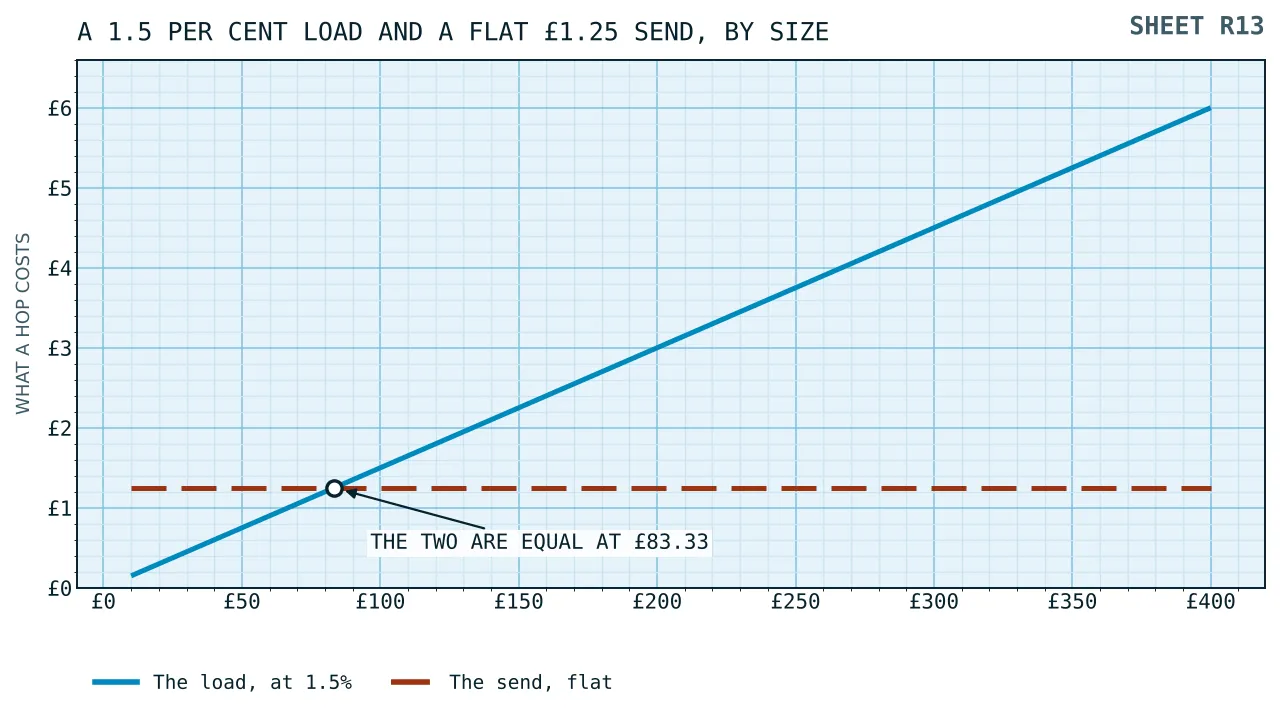
Set the two charges equal to each other and the deposit size where they cross is £83.33, because 1.5 per cent of £83.33 is £1.25. Below £83.33 the flat send is the larger charge; above it the percentage load is. Which makes £83.33 the figure worth remembering before deciding how much to move in one go.
| Sent | Load at 1.5% | Send, flat | Credited | Rate |
|---|---|---|---|---|
| £10.00 | £0.15 | £1.25 | £8.60 | 14.00% |
| £20.00 | £0.30 | £1.25 | £18.45 | 7.75% |
| £40.00 | £0.60 | £1.25 | £38.15 | 4.63% |
| £100.00 | £1.50 | £1.25 | £97.25 | 2.75% |
| £400.00 | £6.00 | £1.25 | £392.75 | 1.81% |
A ten pound deposit pays £1.40 in charges, which is 14.00 per cent, and £1.25 of that is the flat send. A four hundred pound deposit pays £7.25, which is 1.81 per cent, and the flat send is down to three tenths of one per cent. The rate never reaches 1.5 per cent and never falls below it, because the percentage charge is the floor the whole curve settles on.
14.00 per cent at £10.00, 1.81 per cent at £400.00
There is a reading of that table which is worth taking away whole. A reader who deposits £10.00 four times has paid £5.60 in charges to put £34.40 on the tables. A reader who deposits £40.00 once has paid £1.85 to put £38.15 there. Same money out of the bank, and £3.75 of difference, decided by nothing except how many times the flat charge was paid.
3
A match struck on £38.15
A cashier matches what its own screen says, and its screen says £38.15. So a full match adds £38.15 of bonus rather than the £40.00 the reader intended, and the two hops have cost £3.70 of balance while taking £1.85 of money.
Double the headline and the hole doubles with it: at two hundred per cent the chain has cost £5.55 of balance, and at three hundred per cent £7.40. This is the part of a payment charge nobody prices, because the charge is quoted against the deposit and then quietly multiplied by whatever the offer does next.
Tiers are read off the credited figure too, which is the same arithmetic wearing a different hat. Aim at a forty pound step and you land beneath it; clearing a credited £40.00 wants £41.88 leaving the bank. Either way the money sits in the balance. The better percentage does not.
4
What forty times does to £38.15
Carriage is done with. The condition is the other debit, and the line below does the striking.
E = B × (1 – (W × (1 – RTP)) / g)
Credited and matched in full, B is £38.15. The return runs at 96 per cent. Slots count at full weight, which puts g at one. That leaves W, the multiple, as the only term in the line a cashier chooses.
In words at forty times: four pence of edge taken forty times is 1.60, which drops the bracket to minus 0.60, and six-tenths of £38.15 is £22.89 the wrong way round.
The turnover owed is forty lots of £38.15, which is £1,526.00, and a four per cent toll on that turnover is £61.04 of expected cost. Sixty-one pounds of expected cost against £38.15 of credit leaves nothing at the foot and £22.89 of overrun behind it.
Ten is where Britain stopped it, by a provision that began on 19 January 2026. Ten lots of £38.15 is £381.50 of turnover, £15.26 of expected cost, and £22.89 expected to survive.
| Multiple | Staking demanded | Expected at the foot |
|---|---|---|
| 10x | £381.50 | £22.89 |
| 20x | £763.00 | £7.63 |
| 25x | £953.75 | £0.00 |
| 40x | £1,526.00 | £0.00 |
Empty a credit and the multiple that did it is the reciprocal of the edge, so four pence of edge puts it at twenty-five, and no payment app moves it. Put the two debits side by side and the proportions are plain. The app took £1.85. The condition at forty times is expected to take £61.04, which is thirty-three times as much. Price the rail alone and you have accounted for three per cent of the problem.
5
Home again, and £2.61 for standing still
Winnings usually travel back the way they came, which on this rail means the app receives them free and the app charges to pass them to a bank. Two per cent is the figure modelled for that last leg, and it is this sheet’s assumption like the other two.
Take the clean measurement first, with no gambling in it at all. Send £40.00, accept the credited £38.15, then take the whole balance straight back out: the app hands £37.39 to the bank, £2.61 of the original £40.00 has gone, and not a penny was staked.
£40.00 there and back is £2.61, with nothing wagered
Six and a half per cent for doing nothing is what belongs beside any headline percentage a reader is weighing. A full match sounds like a doubling and, at forty times, settles at nought. Against that, a round trip prices at minus £2.61, and prices there on every attempt.
Now the lawful best case. At ten times, £22.89 of expectation clears the condition, and 2 per cent on the way home leaves £22.43. Three legs of charge, two in and one out, have cost £2.31 on a journey whose whole purpose was to collect £22.89, which is about a tenth of the prize.
One structural point about the exit belongs here rather than in the schedule. An app that can receive a payout is an app that keeps the entrance and the exit on the same account, so a refusal at either end stops both. A rail with the same party at both doors is not twice as reliable as a rail with one door.
6
The limit asked for at the first deposit
A British cashier has to offer a financial limit and has to ask about it early. This is the protection that belongs to a page about paying in, because the rule is pinned to the deposit itself.
The live standard puts the prompt either inside registration or at the moment of a first deposit or payment, which on this rail is the moment the app sends its first £38.15. A summary page published by the same regulator says instead that the prompt must come as early as possible, so the two wordings do not match and this sheet quotes the standard.
The limit has to be set in a free text box rather than picked off a list, and it has to bind at the level of the account as a minimum. A limit on the money going in is the only kind that may wear the name deposit limit, and it must be shown with no less prominence than the others. The shortest list the standard will accept runs to a single day, a week and a calendar month. Access is specified too: a direct link from the home page, and visibility on the deposit screens themselves, with the number of clicks kept down.
Reductions take effect at once. Going the other way, the request sits for a day at the least, and then only a fresh act by the customer at the end of that wait puts it through. Setting a limit is the default: declining one takes a deliberate action and a confirmation before any deposit or play can follow. An account that has been active inside a rolling year gets a prompt to review its own figures at six-month intervals, and a customer of long standing with no limit at all gets asked about it annually.
Set two periods at once and the tighter one governs. The regulator does the sum itself: a daily cap of ten pounds under a weekly cap of a hundred yields ten in a day and, over seven of them, seventy. Once a limit is reached the system has to stop taking money until the period restarts or the customer goes through the waiting period to lift it.
The island rulebook read for this build is tighter than Britain on exactly this point, which runs against what a reader would expect. A reduction there is immediate as well. An increase, though, sits for seven days where Britain asks for one. The periods offered are daily, weekly or monthly. What is absent is everything around the limit: no rule makes it the default, none demands a free text box, and none fixes the moment it has to be asked for.
7
Ten times, sixty times, and the weighting under both
Ten times the bonus funds is the British ceiling on a wagering requirement, and it has applied since 19 January 2026. The regulator published what it was fixing, in its own figure: some licensees had been applying as much as sixty times.
Sixty times on this credit would be £2,289.00 of turnover and £91.56 of expected cost, against a bonus of £38.15. A single respondent told the consultation that 75 per cent of what it offered already fell inside one to ten times, which is one operator describing its own book rather than a reading of the market.
Weighting survived the cap, and that is what lets the staking needed exceed ten times while the offer stays inside the rule. At the 30 per cent contribution rate quoted on the regulator’s page, a hundred pounds of required contribution takes about £333.33 of staking to produce. Applied here, a ten times condition on £38.15 wants £381.50 of contribution, which at that rate would mean roughly £1,271.67 of staking and about £50.87 of expected cost. That arithmetic is this sheet’s own, worked against the contribution rate the regulator’s page quotes.
What the cap binds is the multiple; the match percentage is left alone, so a louder headline buys no better ratio. On a £38.15 credit the ratio is ten to one at the ceiling whatever the match percentage was, and a larger match simply enlarges both sides of it.
An app-friendly cashier at the loose end of this market holds no Great Britain licence, and the cap goes with the licence. Nothing out there holds the multiple to ten, which is the difference between £381.50 and £1,526.00 of turnover on this credit. Nothing out there prompts a deposit limit, insists on a free text box, or makes limit-setting the default choice. Bonuses occupy two sentences of the island policy, one asking for transparent terms and one telling operators not to push play too hard with a promotion. It sets no cap, no stake limit, no minimum game cycle and no bar on turbo or autoplay anywhere in its text.
Membership of the national blocking scheme is fixed by the British licence as well, and the scheme states its own limit without hedging: a company outside the membership is past its reach. Nothing on this sheet is of any help to a person trying to get past a block, and the help line is printed below.
8
Five readings off an app deposit
All five can be had before any money moves, three from the app and two from the bonus terms.
| Reading | Value here |
|---|---|
| Rate to load the app | 1.5% |
| Charge to send it onward | £1.25 |
| Rate to pass a payout to a bank | 2.0% |
| Figure the cashier will display | £38.15 |
| Multiple fastened to the credit | 40x |
Divide the second reading by the first and you have £83.33, the deposit at which the two charges weigh the same. Take the fourth reading from what left the bank and you have the cost of arriving, which is £1.85. Multiply the fourth by the fifth and you have the turnover owed, which is £1,526.00, and a twenty-fifth of that is the expected cost of producing it.
The caution that applies to every total on this site applies here. An expectation is a long-run average, and one attempt at a bonus most often ends at nothing whatever the multiple. The charges are not like that. One pound eighty-five is one pound eighty-five, taken on the way in, every time, by two parties neither of whom is the casino.
Sheets on the same rail, read in this order if the charges matter: skrill/neteller/trustly casino for wallets where the load is usually free and the exit is not, paypal casino for the wallet whose cost is an eligibility line rather than a fee, and pay by phone casino for the rail where the charge is taken by a telephone company before a cashier sees the money. The section index is The rail.
Questions
- What reaches the tables from a £40 deposit?
- £38.15. Loading the app takes 1.5 per cent of £40.00, so £0.60 stays behind and £39.40 is in the app; sending the balance on takes a flat £1.25. The pair costs £1.85, which is 4.63 per cent, and the cashier’s own banking page records a charge of nothing, because the cashier charged nothing.
- Which of the two charges should I worry about?
- The flat one, below £83.33, and the percentage one above it. Set 1.5 per cent of a deposit equal to £1.25 and the deposit comes out at £83.33, which is where the two charges are the same size. Under that figure the flat send dominates and depositing less often is the only lever; over it the percentage load dominates and the lever does nothing.
- Why is a small deposit so much worse on this rail?
- Because a flat charge takes no notice of the sum. On £10.00 the two hops cost £1.40, which is 14.00 per cent, and £1.25 of the £1.40 is the flat send. On £400.00 they cost £7.25, which is 1.81 per cent. The rate falls towards 1.5 per cent and never reaches it, because the percentage charge is the floor underneath the whole curve.
- What do the two hops cost the match?
- Twice what the deposit loses. A match is struck on the credited figure, which is £38.15, so £38.15 of bonus is added where £40.00 was intended and £1.85 of money becomes £3.70 of balance. At two hundred per cent it is £5.55 and at three hundred per cent £7.40. A larger headline enlarges the gap in exactly the same proportion as it enlarges the credit.
- What is forty times worth on £38.15 of credit?
- Nothing. Forty lots of £38.15 is £1,526.00 of turnover, a four per cent toll on that turnover is £61.04 of expected cost, and £61.04 against £38.15 of credit leaves £0.00 at the foot with £22.89 of overrun behind the nought. Ten times, the British ceiling, owes £381.50 of turnover for £15.26 of expected cost and is expected to leave £22.89.
- What does a round trip cost with nothing staked?
- £2.61 on £40.00, which is 6.53 per cent. Send £40.00, accept the credited £38.15, then withdraw the whole balance: the app receives it and passes £37.39 to a bank at the 2 per cent modelled here. No game is involved, so it is the cleanest measurement of this rail available, and it is the figure to set beside any headline percentage.
- Must a cashier offer me a deposit limit?
- If it is licensed in Britain, yes, and early. Registration is one of the two permitted moments; the other is the first deposit or payment, which on this rail is when the app sends its opening £38.15. The limit goes in a free text box, binds at account level at the least, and has to be offered for a day, a week and a month. Setting one is the default, declining takes a deliberate action and a confirmation, a reduction applies at once, and a rise waits twenty-four hours and then a fresh confirmation. Only a limit on money going in may be called a deposit limit.
- Can a wagering requirement be more than ten times?
- Not at a British cashier, where ten times the bonus funds has been the ceiling since 19 January 2026. The regulator published the figure it was correcting, which was licensees applying as much as sixty times. Weighting survived the cap, so the staking needed can still exceed ten times the credit: at the 30 per cent contribution rate quoted on the regulator’s page, a hundred pounds of required contribution takes about £333.33 of staking.
- What am I giving up at an app-friendly offshore cashier?
- An app-friendly cashier at the loose end of this market holds no Great Britain licence, and three protections go with the licence. The ten-times ceiling goes, which is the distance between £381.50 and £1,526.00 of turnover on this credit. The financial-limit apparatus goes: no prompt, no free text box, no default. And membership of the national blocking scheme goes, because a British licence is the thing that compels it.