
Sheet P15 Revision 1 Checked 15 October 2026
Big Bass slots
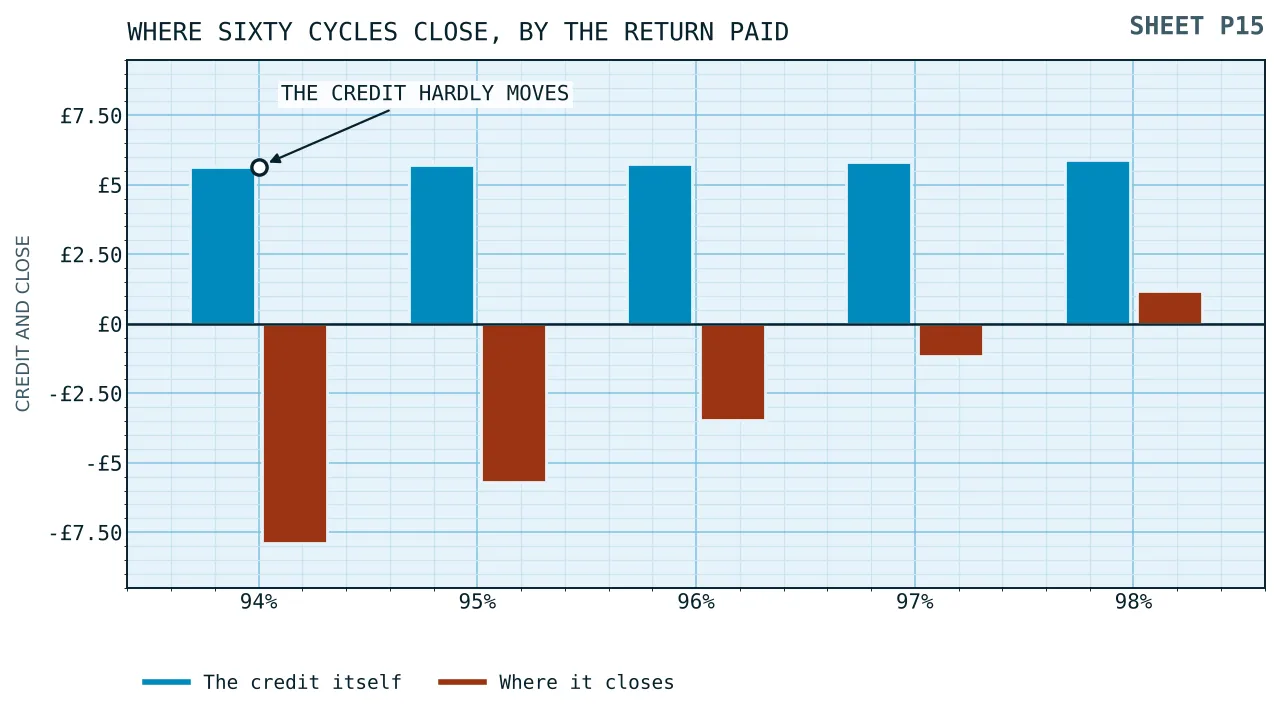
Sixty cycles at 10p are £6.00 at face. What the credit then comes to depends on a figure this sheet may not assert, so it is run across a band. Where the build returns 94 per cent the credit is £5.64; where it returns 98 the credit is £5.88, and the closing line travels from minus £7.90 to plus £1.18.
Four points of return, and the foot crosses the rule
What the conditions leave
Every destination on this spike is bought advertising. The site takes a fee if a reader goes on to register, and no figure printed below moves because of it.
The Spin Sheet
Till receipt No 01
Betportal
Lowest multiple here
For every €1 of spin credit at face per €1
Credit
Debit
No Great Britain licence
Licensed in Anjouan, Comoros, run by BetPortal Gaming Ltd, with Excite Ultra Media Ltd, reference ALSI-202601040-FI2.
Terms read 15 October 2026
Open the offer at Betportal, opens in a new tabThe Spin Sheet
Till receipt No 02
WinBeast
Five staged matches
For every €1 of spin credit at face per €1
Credit
Debit
No Great Britain licence
Licensed in Curaçao, operator not named on the site.
Terms read 15 October 2026
Open the offer at WinBeast, opens in a new tabThe Spin Sheet
Till receipt No 03
EliteSpin
Longest spin window
For every £1 of spin credit at face per £1
Credit
Debit
No Great Britain licence
Licensed in Costa Rica, run by PrimeTier Limited.
Terms read 15 October 2026
Open the offer at EliteSpin, opens in a new tabThe Spin Sheet
Till receipt No 04
Crown Jewelz
Multiple unpublished
No total struck
Credit
Debit
No Great Britain licence
Licensed in Curaçao, number not verified, operator not named on the site.
Terms read 15 October 2026
Open the offer at Crown Jewelz, opens in a new tabThe figure at the foot of a receipt is this site's own arithmetic and nothing an operator has published: the credit, less the share a spin gives back at 96 per cent return to player, less what playing the wagering through costs at the same return. It describes the offer, not one reader's afternoon. Where the conditions price above the credit the receipt prints nothing rather than a negative sum, and where a figure the sum needs is unpublished it prints the condition in the operator's words instead.
Three words stand in the amount column where no figure can. Noted is a published condition that takes value away without leaving the sum a figure to take. Unpriced is a condition whose figure nobody has published, or a credit that is not a sum until a deposit of your own sets it. Own money is money of yours, which is never part of a total.
Not one of the operators printed above holds a Great Britain licence, so the duties that licence carries do not reach them. Every online gambling company licensed in Great Britain has to be part of Gamstop Online, and a reader who has shut themselves out through the scheme is therefore not shut out here. The ceiling of ten times the bonus funds on a wagering requirement, in force since 19 January 2026, is a condition of that licence and binds the companies that hold one. Where a dispute goes instead is a matter for the authority named on the receipt, and the Gambling Commission describes what a reader faces without a British licence as a lack of recourse if things go wrong. Nobody under 18 may hold an account at any of them.
Every term printed on a receipt is the operator's own, and each receipt carries the day it was read. The oldest of those readings is 15 October 2026. What binds a reader is the operator's own full terms, and not a line printed here.
1
A game family, and a digit left blank
A key naming a family of games asks this sheet for one number it does not have. No source in the evidence behind this site publishes a configured return for the family on the front, so no figure for it is printed anywhere below.
Nor would a British licence produce one on demand. The standard governing what a game must tell a player holds four items with or between them, and a published margin discharges it as completely as a percentage would. The gap is therefore structural rather than accidental, which is why this page makes the gap its subject.
What a sheet can do instead of guessing is run the arithmetic over a band wide enough to contain any plausible answer, and then say how much of the answer the band actually decides. On a count of sixty that turns out to be most of it, which is the finding in part 4.
Sixty cycles priced at 10p are £6.00 on the front. At the house assumption of a 96 per cent return the average winnings are £5.76, and that figure is labelled an assumption every time it appears. A cycle at ten pence is the other assumption, resting on the same absence. No British rule puts a cash value on a spin, nominates anybody to put one on it, or compels publication of whatever has been chosen.
Forty turnovers runs through the sheet as the requirement, that order being usual in this bracket for a count of this size. On a British licence the requirement stops at ten turnovers of the bonus funds, a ceiling live since 19 January 2026. Sixty turnovers is what the regulator noted in use at some licensees before it acted.
Assumed, sourced, and simply unavailable:
- Assumed: a cycle at 10p, a requirement of forty turnovers, and a whole pound of credit for every pound staked, right up to part 7.
- Assumed and varied: the return, taken at 96 per cent and then run from 94 to 98.
- Sourced: the ten-turnover ceiling, the paced game cycle, the bars on automation and on turbo, the stake limits, and what the game-information standard requires.
- Unavailable: the family’s own configured return, which is the reason part 4 exists at all.
2
Sixty cycles, five pounds seventy-six
Take the house figure first so that part 4 has a baseline to move away from.
Forty lots of £5.76 are £230.40 of staking owed. An edge of four pence in the pound expects £9.22 out of that, which overshoots the credit by £3.46, so the closing figure is £0.00.
Three pounds forty-six is not charged to anybody. No deposit sits behind the cycles, so a balance cannot travel below nought, and the minus records the excess of the condition over the thing it was attached to.
At the regulated ceiling of ten the same credit is a different proposition. Staking owed falls to £57.60, the expected price to £2.30, and £3.46 is expected to survive. Twenty turnovers leaves £1.15. Twenty-five leaves £0.00 exactly. Sixty takes the shortfall out to £8.06.
Twenty-five is the point at which a credit is spent precisely, and it belongs to the return rather than to anybody’s judgement. Drive the expected cash down to nought, let the credit cancel, and what stands at the end is one over an edge of four pence. Which is the whole reason the next three parts matter: move the return and that figure moves with it.
3
The line, and the two terms the family owns
Five letters settle a credit, and a game family supplies the second and the fourth.
E = B × (1 – (W × (1 – RTP)) / g)
£5.76 is B at the house return, and B itself is built out of the return, so the family reaches the arithmetic twice over. W comes from the wagering line. g comes from the game schedule. E is the sum at the end.
Trace the return through and it appears in two places with opposite effects. A higher return raises the credit, since average winnings are the stake multiplied by the return, and it lowers the edge, since the edge is one less the return. The first effect is small and the second is large, which is the reason a single point of return can move a closing line by pounds while barely touching the credit.
The contribution rate sits beneath the multiple rather than beside it, and a divisor stretches an obligation where an addend would merely enlarge it. Halve it and the staking doubles. A room that counts a wagered pound as a quarter has quadrupled the staking while leaving the requirement on the front exactly as written.
Only one rate anywhere has a trail. A consultation respondent described a pound of stake counting as thirty pence; the regulator took the submission down and weighting came through the exercise unchanged. There is no published schedule of rates in use, so every rate in part 7 is an input and none is a measurement.
The return enters twice: once raising B, once cutting the edge
4
Five returns against one count
This part is the reason the key gets a sheet of its own. The count is printed on the front, the requirement is printed in the terms, and the return is a property of the build that nothing obliges anybody to print at all.
| The build returns | Credit | Staking owed | Expected price | E | Rate that would rescue it |
|---|---|---|---|---|---|
| Ninety-four per cent | £5.64 | £225.60 | £13.54 | -£7.90 | above 2.40 |
| Ninety-five per cent | £5.70 | £228.00 | £11.40 | -£5.70 | above 2.00 |
| Ninety-six per cent | £5.76 | £230.40 | £9.22 | -£3.46 | above 1.60 |
| Ninety-seven per cent | £5.82 | £232.80 | £6.98 | -£1.16 | above 1.20 |
| Ninety-eight per cent | £5.88 | £235.20 | £4.70 | £1.18 | above 0.80 |
Four points of return across the whole band move the credit by twenty-four pence, from £5.64 to £5.88. Over the same four points the expected price of the staking falls from £13.54 to £4.70, which is a factor of nearly three, and the closing line travels £9.08. So the digit nobody has to publish decides almost the whole answer while leaving the advertised round untouched.
Where the line is crossed is between the two highest rows. At 97 per cent the round is still a pound and sixteen pence short of finishing level. At 98 it finishes £1.18 ahead, which is the only row in the table with anything at the foot of it. Two builds of one family, indistinguishable on screen, can therefore land either side of their own arithmetic.
The last column is the part a reader can act on. It gives the contribution rate that would have to apply for forty turnovers to survive at each return, and four of the five figures are above a pound in the pound, which cannot happen. Only the 98 per cent row asks for something a cashier could actually grant, at eighty pence.
5
The crossing moves with the build
Twenty-five is this section’s reference point, and it is the reference point only because the house return is 96 per cent. Written properly, the crossing is one divided by the edge, and the edge is whatever a build keeps.
So the general condition is that the requirement divided by the rate has to come in under one over the edge. Multiply out and it falls on the rate: g has to exceed the requirement multiplied by the edge. At 96 per cent it reads as the requirement divided by twenty-five, the form used throughout this part of the tree, and that is a special case rather than a law.
Return by return, the crossing runs 16.7 at 94 per cent, twenty at 95, twenty-five at 96, 33.3 at 97 and fifty at 98. A requirement of forty turnovers therefore sits above the crossing on four of those builds and below it on one. Nothing in the advertised round, in the count or in the terms distinguishes the five cases.
g above W times the edge, whatever the edge turns out to be
The two unknowns compound rather than cancel, which is the uncomfortable part. A reader facing a round on this family does not know the return and does not know the rate, and the two of them multiply inside the same condition. Guessing one right is no help if the other is wrong.
At the regulated ceiling of ten the condition is survivable across the whole band, which is worth saying, since it is the only cheerful line here. Ten turnovers wants better than sixty pence in the pound at 94 per cent, better than forty at 96, and better than twenty at 98. All three are rates a cashier could publish. Forty turnovers is not, on any build in the band bar the highest.
6
What a licence fixes about a return
A return figure is only worth putting in an expression if something holds the game to it, and five British standards on random outcomes are what do that.
Game results are required to be acceptably random, and a game that compensates is not permitted. The guidance explains the second half: automatic or manual interventions that change the probabilities are prohibited, and outcomes have to fall out in line with the expected or theoretical probabilities. That sentence is what turns a published return into a quantity rather than an aspiration.
Random numbers go into the game in the order they come out of the generator, and none may be thrown away for adaptive reasons, which closes the obvious route round the first rule. Nothing may be filtered on its way to the reels.
Rules, payouts and outcome probabilities all stay as they are while a game is in play. A change of any of them has to be drawn to a customer’s notice. Suspend the game or take it offline is where the guidance puts such work. One clause is named outright as unacceptable: a rule reserving the right to alter the game rules whenever the operator pleases would not do. Where a bonus round has been described to the customer properly, the change it brings is a legitimate one and falls outside the rule.
A separate prohibition catches design liable to give a customer the wrong idea of how likely a particular result is, and names two instances. One substitutes a near-miss loser for an ordinary loser. The other simulates a real device without simulating the probabilities that device really has. The guidance is blunter still: near-miss results may not be displayed falsely, and a losing outcome may not be substituted for a different losing outcome.
And the result, together with the customer’s own gamble, has to be put up clearly and accurately, for a length of time that may reasonably be expected to suffice. Taken together those five are the apparatus behind the number this page cannot print, which is the paradox worth sitting with: the figure is protected but not required.
7
Ninety-six minutes, and the ladder that stretches them
At the house return, the cycles owed are sixty multiplied by forty multiplied by 0.96, which is 2,304 presses.
A licensed slot has to leave two and a half seconds at minimum from a game starting until the next cycle may be commenced, with the control coming up before it goes down once more. So 2,304 presses occupy 5,760 seconds, which is an hour and thirty-six minutes. The sixty cycles handed over take two and a half minutes. Automation is barred, turbo and slam stop are barred, and casino games running in parallel are barred, so none of the ninety-six minutes can be compressed.
Then the contribution rate, which stretches the same obligation without changing a digit of it. Contribution owed stays at £230.40 down the whole ladder.
| A staked pound counts as | Staking needed | Presses | Hours | E |
|---|---|---|---|---|
| A whole pound | £230.40 | 2,304 | 1.60 | -£3.46 |
| Three-quarters | £307.20 | 3,072 | 2.13 | -£6.53 |
| A half | £460.80 | 4,608 | 3.20 | -£12.67 |
| A quarter | £921.60 | 9,216 | 6.40 | -£31.10 |
| A tenth | £2,304.00 | 23,040 | 16.00 | -£86.40 |
Sixteen hours at the foot of that ladder, on a credit of five pounds seventy-six, with a shortfall fifteen times the credit itself. That is the point where the word offer has stopped describing the object accurately, and no digit of the advertised round has altered to get there.
The statutory stake ceiling is where the ladder stops climbing. Five pounds is the ceiling a statutory instrument puts on a single slots cycle, two pounds where the individual is under 25. The instrument was made on 25 February 2025 and states only a formula of six weeks, so the calendar comes from the regulator, which gives the ninth of April 2025 for the first figure, and for the second the twenty-first of May. Against this round the ceiling touches the clock rather than the cost. The £230.40 owed at full weight could go through in 47 presses at five pounds a go, or 116 at two, with the expected price still £9.22, an edge taking its four pence whether a pound arrives in one piece or in fifty. The spread around that price would be very much wider, so the faster route buys speed and nothing else.
A bonus document frequently fixes a maximum stake of its own while a credit is live, and no published rule sets such a figure. Read beside part 5, a low stake cap next to a low contribution rate is the pairing that makes a round on a named family unfinishable rather than merely unprofitable.
8
A known reel set, and no register
Recognising the reels tells a reader which supplier built the game, and tells them nothing at all about whose hands the money is in. Games built by licensed suppliers have been recorded by the regulator on websites holding none, so a known title is evidence about a catalogue rather than about a licence.
Where a round on this family is offered with no Great Britain licence behind it, the standards in part 6 go first, and they are the ones that matter most on a page about a configured return. The island policy consulted here requires no acceptable randomness, bars no compensated game, fixes no order for the random numbers, and forbids no losing outcome dressed up as a near miss. The return becomes whatever the software is set to, reviewed by nobody a British player can write to.
What a British licence imposes, against what the island policy read for this build contains:
- Ten turnovers of bonus funds as a ceiling on the requirement: nothing equivalent.
- Five pounds, and two pounds under 25, on a single slots cycle: no ceiling of any size.
- Two and a half seconds between cycles, with no automation and no turbo: no interval and no bar.
- Acceptable randomness, no compensated game, no near-miss substitution: none of the three.
- Identity verified before anything is played, demonstration reels and bonus rounds alike: the document check waits on the operator’s own anti-money-laundering milestones.
- Bonuses: two sentences in all, one on transparent terms and one against promoting hard enough to drive excessive play.
A British licence is also enforced with money a reader can look up, and that is a difference worth showing rather than asserting. The regulator’s published enforcement list carries £609,104 dated 20 August 2026, £4.75m settled on 23 July 2026, £2m dated 17 December 2025, and £10m carrying 22 October 2025. Licence suspensions are published beside them, one of them against a games supplier on 30 October 2025.
The self-exclusion gap is the last of it and the plainest. Gamstop Online takes in every online gambling business holding a British licence, and it had 614,738 people registered as at 16 July 2026. Its own terms draw the boundary: a service run by an organisation outside the scheme is not something a registration can shut off. The island equivalent covers one operator and the domains that operator holds, starts at twelve months, and cannot be lifted early. Nothing on this sheet will assist anybody past a block, and free help is listed underneath.
9
Running it on the build you were given
Six readings, and the first two are the ones a promotion is least likely to supply.
| The reading | On this sheet |
|---|---|
| The build’s own return | Assumed at 96% |
| The rate on the game schedule | Assumed at 1.00 |
| Cycles, and the stake on each | 60 at £0.10 |
| Credit, once the return applies | £5.76 |
| Turnovers in the terms | 40 |
| E, and the closing figure | -£3.46, so £0.00 |
Where a build does publish its return, substitute the figure and read the matching row of part 4. Where it publishes a house edge instead, that is the same information in reciprocal form, and one divided by it is the crossing directly. Where neither appears, the band is the answer: between minus seven pounds ninety and plus one pound eighteen, and the sheet will not narrow it further than the sources allow.
Then the test, which needs both unknowns. Multiply the requirement by the edge and compare it with the rate. Rate above the product, and something survives at the foot. Rate below it, and the answer is nought however many hours go into reaching it.
Two cautions. The figures are means, and on sixty cycles the commonest single result is nothing, so a mean here describes a long series of such rounds rather than the next one. And a condition sitting outside the expression altogether can close the answer with the return, the rate and the requirement all precisely as they stand: a ceiling on the bonus winnings, or a discretion kept back in the operator’s own favour.
Sheets either side of this one take the pieces it leaves alone. Online slots UK prices the room rather than a family, pragmatic slots takes one studio’s catalogue, top 10 best online slots turns a game list into a statement about the rate, and 20 free spins on a named reel set runs a smaller count through the play-through instead. The section is indexed under The room.
Questions
- What return do Big Bass slots pay?
- This sheet does not say, because no source in the evidence behind it publishes a configured return for the family, and a British licence does not compel one to be printed. The game-information standard holds four items with or between them, and a published margin discharges it as fully as a percentage. So the arithmetic is run over a band from 94 to 98 per cent instead.
- What is a round of sixty cycles worth on this family?
- Between minus £7.90 and plus £1.18 at forty turnovers, depending on the build. Sixty cycles at 10p are £6.00 at face. At a 94 per cent return the credit is £5.64 and the expected price of the staking is £13.54. At 98 per cent the credit is £5.88 and the price is £4.70, which is the only row in the band with anything at the foot.
- How much does one point of return change?
- Almost everything except the credit. Across the whole band the credit moves twenty-four pence, from £5.64 to £5.88. The expected price of the staking falls from £13.54 to £4.70 over the same span, a factor of nearly three, and the closing line travels £9.08. The advertised count and the wagering line never move at all.
- At what requirement does a round on this family come to nothing?
- At one divided by the edge, which is not a fixed figure. Return by return the crossing runs 16.7 at 94 per cent, twenty at 95, twenty-five at 96, 33.3 at 97 and fifty at 98. Forty turnovers therefore sits above the crossing on four builds in that band and below it on one, and nothing in the advertised round tells the five cases apart.
- How high does contribution have to be here?
- Above the requirement multiplied by the edge, which is the general form of the test. At forty turnovers that asks for better than 2.40 in the pound at a 94 per cent return, 1.60 at 96, and eighty pence at 98, so four of those five are impossible: no pound of stake counts as more than one pound. At the ceiling of ten the test is survivable across the band: sixty pence at 94 per cent, forty at 96, twenty at 98.
- What holds a game to its stated return?
- Five British standards on random outcomes. Game results must be acceptably random, and a game that compensates is not permitted: interventions altering the probabilities are prohibited, and outcomes have to arrive in line with the probabilities a build is theoretically set to. Random numbers are taken in the sequence the generator yields them. Rules, payouts and probabilities may not change in play. A near-miss result may not be falsely displayed. And the result must be shown clearly for a sufficient length of time.
- How long does the wagering take?
- An hour and thirty-six minutes at full weight. There are 2,304 presses owed, and a licensed slot has to leave two and a half seconds at minimum from a game starting until the next cycle may be commenced. The sixty cycles handed over take two and a half minutes. At a quarter of a pound the obligation runs to 9,216 presses, and at a tenth to sixteen hours.
- Can larger stakes clear it faster?
- Up to the statutory ceiling. The £230.40 owed at full weight could go through in 47 presses at five pounds a go, or 116 at two pounds, rather than 2,304 at 10p. The expected price stays at £9.22 on any of those routes, because a four pence edge is indifferent to how a pound gets broken up, and the spread around that price becomes very much wider.
- Does a well-known reel set mean the site is licensed here?
- No. Recognising the reels tells a reader which supplier built the game and nothing at all about who the money belongs to, and games built by licensed suppliers have been recorded by the regulator on websites holding none. A British licence is enforced with money anybody can look up. The published list carries £10m dated 22 October 2025, then £4.75m on 23 July 2026, £2m dated 17 December 2025, and £609,104 on 20 August 2026.
- What is missing on a round with no Great Britain licence behind it?
- The standards that make a return mean anything, first of all. The island policy consulted here requires no acceptable randomness, bars no compensated game, fixes no order for the random numbers, and forbids no losing outcome dressed up as a near miss. Nor does it cap a requirement, put a ceiling on a cycle, set an interval between cycles or bar automation. Bonuses get two sentences in it, wanting transparent terms and promotion short of driving excessive play.