
Sheet R16 Revision 1 Checked 15 October 2026
Crypto casino no deposit bonus
Fifty spins at 10p carry £5.00 of face value and £4.80 of average winnings, and at the British ceiling of ten the expectation is £2.88. Carrying that £2.88 home over a coin network costs £1.62, so £1.26 arrives in a British bank, and the whole of the rail’s charge has fallen on the only money the reader was ever going to keep.
£1.26 of a £2.88 expectation reaches a bank, 56.25 per cent gone
What a no deposit round leaves to carry
Every destination on this spike is bought advertising. The site takes a fee if a reader goes on to register, and no figure printed below moves because of it.
The Spin Sheet
Till receipt No 01
Betportal
Lowest multiple here
For every €1 of spin credit at face per €1
Credit
Debit
No Great Britain licence
Licensed in Anjouan, Comoros, run by BetPortal Gaming Ltd, with Excite Ultra Media Ltd, reference ALSI-202601040-FI2.
Terms read 15 October 2026
Open the offer at Betportal, opens in a new tabThe Spin Sheet
Till receipt No 02
WinBeast
Five staged matches
For every €1 of spin credit at face per €1
Credit
Debit
No Great Britain licence
Licensed in Curaçao, operator not named on the site.
Terms read 15 October 2026
Open the offer at WinBeast, opens in a new tabThe Spin Sheet
Till receipt No 03
EliteSpin
Longest spin window
For every £1 of spin credit at face per £1
Credit
Debit
No Great Britain licence
Licensed in Costa Rica, run by PrimeTier Limited.
Terms read 15 October 2026
Open the offer at EliteSpin, opens in a new tabThe Spin Sheet
Till receipt No 04
Crown Jewelz
Multiple unpublished
No total struck
Credit
Debit
No Great Britain licence
Licensed in Curaçao, number not verified, operator not named on the site.
Terms read 15 October 2026
Open the offer at Crown Jewelz, opens in a new tabThe figure at the foot of a receipt is this site's own arithmetic and nothing an operator has published: the credit, less the share a spin gives back at 96 per cent return to player, less what playing the wagering through costs at the same return. It describes the offer, not one reader's afternoon. Where the conditions price above the credit the receipt prints nothing rather than a negative sum, and where a figure the sum needs is unpublished it prints the condition in the operator's words instead.
Three words stand in the amount column where no figure can. Noted is a published condition that takes value away without leaving the sum a figure to take. Unpriced is a condition whose figure nobody has published, or a credit that is not a sum until a deposit of your own sets it. Own money is money of yours, which is never part of a total.
Not one of the operators printed above holds a Great Britain licence, so the duties that licence carries do not reach them. Every online gambling company licensed in Great Britain has to be part of Gamstop Online, and a reader who has shut themselves out through the scheme is therefore not shut out here. The ceiling of ten times the bonus funds on a wagering requirement, in force since 19 January 2026, is a condition of that licence and binds the companies that hold one. Where a dispute goes instead is a matter for the authority named on the receipt, and the Gambling Commission describes what a reader faces without a British licence as a lack of recourse if things go wrong. Nobody under 18 may hold an account at any of them.
Every term printed on a receipt is the operator's own, and each receipt carries the day it was read. The oldest of those readings is 15 October 2026. What binds a reader is the operator's own full terms, and not a line printed here.
1
Nothing in, so the charge waits at the exit
A no-deposit round is the one offer in this section with no entrance to price. Nothing was sent, nothing was converted, nothing was carried, and the arrival cost is nought because there was no arrival.
Which does not make the rail free. What it does is shift every charge to the exit, so the thing being charged is a win and not a deposit. This sheet is about that reversal, which changes which figures are worth reading.
On a deposit page a flat charge is diluted by sending more. Here nothing can be sent, so there is nothing to dilute it with, and the flat charge meets whatever the spins produced.
Three charges are modelled on the way out and all three are this sheet’s assumptions: a flat £1.60 to carry the unit across its network, 0.4 per cent at the exchange, and 1.1 per cent to cross back into sterling. No regulator publishes a network charge, an exchange charge or a currency spread, so replace all three with the figures your own statements show and the method survives.
Four quantities, in the order they arrive:
- The spins, and the stake each one carries.
- The average winnings, which is what a condition is applied to.
- The multiple, which decides whether anything survives.
- The flat charge for carrying a survivor home.
2
Fifty spins at 10p, and why 10p
Fifty spins at 10p is the house reckoning on this site and it is worth saying why. No primary source defines what a free spin is worth. Nothing published fixes its cash value, nothing says who fixes it, and nothing requires a licensee to disclose it.
So 10p a spin is a working figure held steady across eighty-five sheets rather than a rule, and a reader whose terms print a different stake should substitute it.
Face value first. Fifty lots of 10p is £5.00 of stake put through the reels. Average winnings next: a 96 per cent return on £5.00 of stake is £4.80, which is the figure a condition is applied to.
The two are commonly confused and the difference is twenty pence, which matters less than the fact that only one of them is ever credited. The £4.80 is not money yet. It is the quantity the multiple is about to be applied to.
3
What the multiple does to £4.80
There was no entrance to charge, so the condition is the only debit until the exit. The standing line does the work.
E = B × (1 – (W × (1 – RTP)) / g)
Average winnings of fifty spins, £4.80, go in as B, not the £5.00 of face value. The return sits at 96 per cent. Slots take their full weight, so g is one. W is whatever multiple the terms attach to the winnings.
Forty times in words. The edge is four pence; forty of them make 1.60; the bracket falls to minus 0.60; and £2.88 is what six-tenths of £4.80 comes to, with the sign reversed.
Turnover of £192.00 is owed; producing it is expected to cost £7.68, which is an overrun of £2.88 on the winnings. At the British ceiling of ten the turnover is £48.00, the expected cost £1.92, and £2.88 is expected to remain.
| Multiple | Turnover | Balance expected | Expected cost | Into a bank |
|---|---|---|---|---|
| Ten times | £48.00 | £2.88 | £1.92 | £1.26 |
| Twenty times | £96.00 | £0.96 | £3.84 | £0.00 |
| Twenty-five times | £120.00 | £0.00 | £4.80 | £0.00 |
| Forty times | £192.00 | £0.00 | £7.68 | £0.00 |
Set the expected balance beside what reaches a bank and the gap between them is the whole of this page. At twenty times a balance of £0.96 is expected and £0.00 reaches a bank, and the reason is not the game. The reason is that £0.96 is less than the £1.60 it costs to carry a balance anywhere.
4
Sixteen and two-thirds, the ceiling that bites first
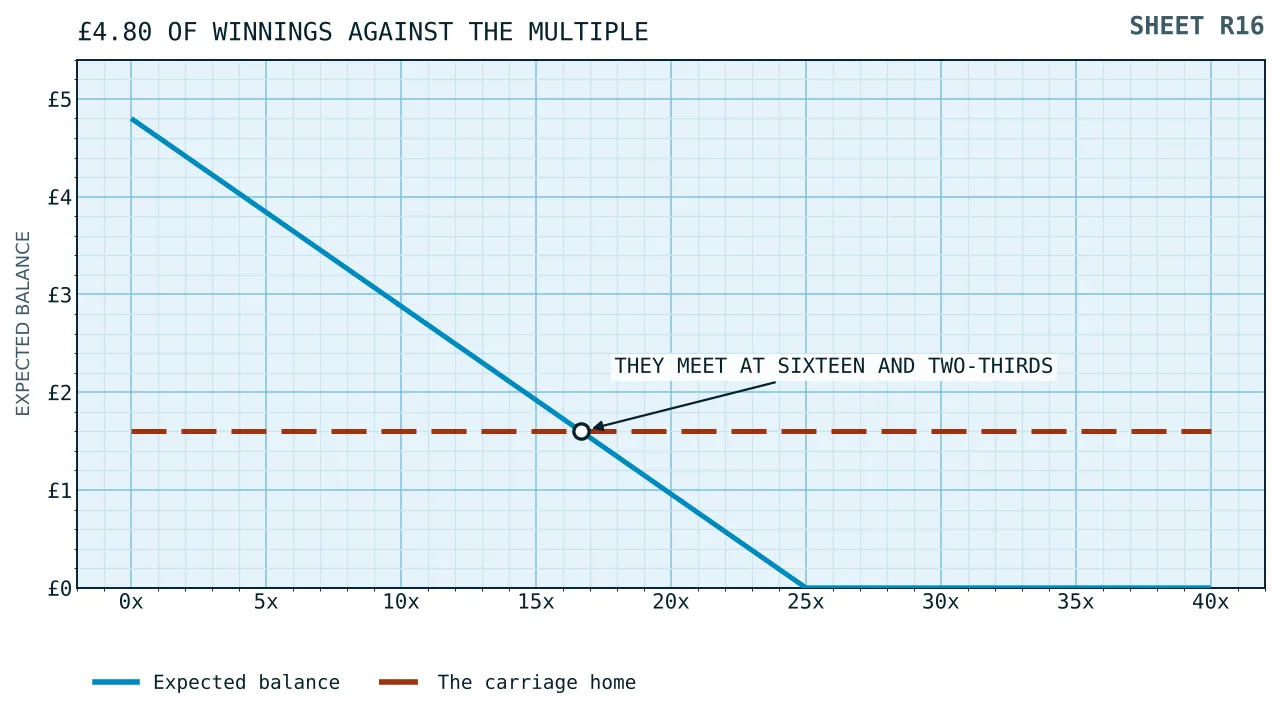
Twenty-five times is where a credit is extinguished whatever its size, because one divided by a four pence edge is twenty-five. On this rail the useful ceiling arrives earlier, at about sixteen and two-thirds, and that figure is the whole point of the page.
Sixteen and two-thirds is the multiple at which the expected balance falls to £1.60, which is exactly what it costs to carry a balance home. Above that multiple the expectation is smaller than the carriage, the win cannot be moved at all, and the nought at the foot is produced by a payment network rather than by a slot.
Above 16.67 times the expected balance is worth less than the carriage
Now put the exit charges against each of those figures, because this is where a no-deposit round differs from everything else in the section. Take the £2.88 that ten times is expected to leave. Carriage takes a flat £1.60 and leaves £1.28. Four tenths of one per cent goes at the exchange, which brings it to £1.27. The crossing into sterling takes 1.1 per cent, and £1.26 arrives.
One pound sixty-two of a £2.88 expectation has gone on getting it home, which is 56.25 per cent, and £1.60 of the £1.62 is the flat charge. The two percentage charges together took a penny each, which is the whole of their contribution at this size.
That is the inversion worth carrying away from this sheet. On a deposit of any size the percentage charges dominate and the flat one is rounding. On a no-deposit win the flat charge is the entire cost and the percentages are the rounding. A reader with a larger win sees the ordinary pattern return: £1.88 of £20.00 is 9.40 per cent, and £3.07 of £100.00 is 3.07 per cent.
5
A ceiling on winnings is not the withdrawal rule
A cap on what a bonus may win is not forbidden by the British withdrawal rule, and the distinction is worth getting right.
That rule is written about the deposit balance, and a no-deposit round has no deposit balance to protect. So a ceiling on bonus winnings and an unrestricted right to collect a deposit balance can both appear in one set of terms, and on this page only the first of them is in play.
What a cap does to the arithmetic is specific. A no-deposit round is a distribution whose mean is carried by its tail: most attempts finish at nothing and a few finish large. Cut the tail off with a ceiling and the mean falls, while the headline, the spin count and the stake all stay exactly where they were.
No source behind this site publishes a usual figure for such a ceiling, so none is modelled here and none should be assumed from anywhere else. What can be said is the direction of travel: a ceiling can only reduce the £2.88, never raise it, and it reduces it by removing the outcomes that were doing the work.
A British licensee is also held to a code provision covering any incentive it offers, and that provision asks two things of the terms: that they be clear, transparent and fair, and that anybody the offer is made to can reach them easily. A ceiling buried where a reader will not meet it fails the second limb before anybody argues about the first.
6
Nothing was deposited, so when is identity settled
Nothing was deposited here, which raises a question about when identity is settled.
A British licensee has three items in hand before anybody gambles: when the customer was born, the address they give, and the name on it. The rule covers play on a bonus and play on a demonstration game with no stake in it. Nor may it spring a document request on a withdrawal that it could have made earlier, and material wanted for money-laundering purposes belongs at the start rather than in a queue behind a payout.
Which is exactly the shape of a no-deposit offer, where the first money to move is the player’s winnings and the first check could easily be timed to meet them. The regulator’s examples are a household bill, a driving licence and a passport, and it will not say which of them a business has to ask for.
The island rulebook read for this build will not let a player stake or deposit while an operator remains unsatisfied about age, and leaves the passport or the national card to whenever its own money-laundering milestones fall. Those milestones fall when an operator decides they have fallen, and a request to collect £2.88 is as convenient an occasion as any.
So the timing is the risk rather than the documents. A check before the first spin costs a reader ten minutes. A check at the payout costs them whatever the payout was worth, for as long as it lasts, and on this page the payout was worth £1.26.
7
The clause with a published fine behind it
There is one published enforcement outcome about the terms attached to a new casino promotion, and it is the nearest thing on this sheet to a decided case on the facts in front of you.
July 2025 is the date, specifically the third, and £170,000 is what was paid. What drew it was a reserved power, written into the bonus rules, to close an account at will or to keep the winnings. Fair and open dealing is the licensing condition the regulator found had gone. Transparency is what such wording lacks, it said, and an unfair result for the consumer is what it may produce. Besides the payment it ordered a third party to audit the operator’s money-laundering and safer-play controls.
Two consequences, the second of which fences in the first. With a source behind them, a reader may state that a fine has been imposed over wording of that shape and name the condition that went. What nobody may state is that the wording is void: a payment was made, and the clause itself was not struck out.
Against a £2.88 expectation a discretionary forfeiture is the whole of the page, since there is no deposit alongside it for the clause to miss. On a matched offer such a clause can take the bonus and leave the deposit. Here there is nothing but bonus, so the clause and the offer are the same size.
Out here no Great Britain licence stands behind any of it, and the losses are countable. Ten times as a ceiling has gone, and on £4.80 of winnings that is the distance between £48.00 and £192.00 of turnover. The provision on an incentive’s terms is gone. Identity before the first spin is gone, and so is the bar on asking for documents at the payout. Two sentences are what the island policy gives to bonuses: clarity in the terms is one of them, restraint in the promotion the other.
The national blocking scheme hangs off the British licence alone, and its own terms say what that means: a company that never joined is outside the reach of any registration. Offshore the equivalent covers a single operator together with the sites it runs, beginning at twelve months, and it cannot be lifted before the term expires. Nothing written on this sheet will help anybody defeat a block, and free help is listed below.
8
Four readings before the first spin
Four readings settle a no-deposit round on a coin rail, and the second one is the hardest to find.
| Reading | This round |
|---|---|
| Spins in the offer | 50 |
| Stake each spin carries | 10p |
| Multiple on the winnings | 40x |
| Flat charge to carry a balance home | £1.60 |
Multiply the first by the second for the face value, then apply the return to get the average winnings. Apply the multiple to the winnings and the turnover owed appears; divide the turnover by twenty-five for what producing it is expected to cost. Then compare whatever survives with the flat carriage, and where the carriage is the larger figure the exercise was over before it began.
An expectation averages many attempts. A single round of fifty spins finishes at nothing more often than at any other figure. The carriage is not an average. One pound sixty is one pound sixty, and it is charged at the one moment a reader has something to lose.
Related sheets for the parts this one passes over: crypto casino for the same network with a deposit in front of it, usdt casino for the currency leg isolated from the price swing, and ethereum casino for a flat charge measured against a deposit instead of a win. The index for the section sits at The rail.
Questions
- What is a fifty spin no deposit round worth at forty times?
- Nothing. Fifty spins at 10p hold £5.00 of face value, which at a 96 per cent return averages out at £4.80 of winnings. Forty times on £4.80 asks £192.00 of turnover for £7.68 of expected cost, which overruns the winnings by £2.88. Ten times, the British ceiling, asks £48.00 of turnover, costs £1.92, and is expected to leave £2.88.
- How much of a £2.88 win does the coin rail take?
- Fifty-six per cent of it, on the charges modelled here. Carriage takes a flat £1.60 off the £2.88, the exchange takes 0.4 per cent and the crossing into sterling 1.1 per cent, so £1.26 reaches a British bank and £1.62 has gone. The flat charge is £1.60 of that £1.62, which is why a no-deposit win is the worst thing a flat charge can be charged against.
- At what multiple does the win stop being worth collecting?
- About sixteen and two-thirds, on these figures, and the figure is worth knowing because it is lower than the twenty-five everybody quotes. Twenty-five times is where a credit is extinguished by the house edge alone. Sixteen and two-thirds is where the expected balance falls to £1.60, which is what carriage costs, so above that multiple the win cannot be moved at all. At twenty times the expectation is £0.96 against a £1.60 charge.
- Why is there no charge for claiming the offer?
- Because nothing was sent. A no-deposit round is the one offer in this section with no entrance to price, so nothing is charged, nothing is converted and nothing is carried on the way in. That does not make the rail free. It moves every charge to the exit, where it meets a win rather than a deposit, and a win is a far smaller thing to charge a flat sum against.
- What is a free spin actually worth?
- Nothing published fixes it. No primary source puts a cash value on a spin, names who may put one on it, or obliges a licensee to print it, so the 10p used across this site is a working figure rather than a rule, and a reader whose terms print another stake should use that instead. What is published is narrower: before a commitment is made, a licensee owes information enough to weigh the chances, and a return percentage is only one of the permitted ways of supplying it, the others being the house margin, the chance of a winning event, and an account of how prizes get handed out.
- Can a cashier cap what the spins are allowed to win?
- Not by the rule that protects a deposit balance, because a no-deposit round has no deposit balance. A ceiling on bonus winnings and an unrestricted right to collect a deposit balance can sit in one set of terms at once, and on a no-deposit offer only the first is in play. What a ceiling does to the arithmetic is cut the tail off a distribution whose mean the tail was carrying, so the mean falls while the spin count, the stake and the headline all stay put.
- When will my identity be checked on a no deposit offer?
- At a British cashier, before anybody gambles. A bonus round counts, and so does a demonstration game with nothing staked in it. Documents may not be demanded at a withdrawal that could have been asked for sooner. On the island side the staking and the depositing wait until an operator is satisfied about age, while the documents wait on whatever milestone the operator’s money-laundering policy sets, and a request to collect a win is a convenient moment for one to arrive.
- Could the winnings simply be withheld?
- One published outcome bears on it. Dated the third of July 2025, it cost £170,000, and the offending term reserved a power to close an account at will or to keep the winnings. The regulator found the condition on fair and open dealing had gone, and ordered an audit by a third party of the money-laundering and safer-play controls alongside the payment. Calling such a clause void is not available to anybody: a payment was made and the wording stayed where it was. On a no-deposit round the clause is the whole offer, since there is no deposit beside it to escape.
- What am I without on an offshore no deposit round?
- Out here no Great Britain licence stands behind any of it, and the losses are countable. Ten times as a ceiling has gone, and on £4.80 of winnings that is the distance between £48.00 and £192.00 of turnover. The provision requiring an incentive’s terms to be clear, transparent, fair and easily reached is gone. Identity before the first spin is gone. And the national blocking scheme, which hangs off the British licence alone, cannot reach a company that never joined it.