
Sheet O06 Revision 1 Checked 15 October 2026
Independent casinos not on gamstop
Three hundred per cent on £15.00 is £45.00 of credit, holding £27.00 where ten is the outer figure and nothing at forty times. The word independent costs more than the arithmetic does, because the only self-exclusion on offer out there runs operator by operator, and an operator with one site is an exclusion covering one site.
£27.00 of credit, and an exclusion that covers a single address
What independence leaves at the foot
Every destination on this spike is bought advertising. The site takes a fee if a reader goes on to register, and no figure printed below moves because of it.
The Spin Sheet
Till receipt No 01
Betportal
Lowest multiple here
For every €1 of spin credit at face per €1
Credit
Debit
No Great Britain licence
Licensed in Anjouan, Comoros, run by BetPortal Gaming Ltd, with Excite Ultra Media Ltd, reference ALSI-202601040-FI2.
Terms read 15 October 2026
Open the offer at Betportal, opens in a new tabThe Spin Sheet
Till receipt No 02
WinBeast
Five staged matches
For every €1 of spin credit at face per €1
Credit
Debit
No Great Britain licence
Licensed in Curaçao, operator not named on the site.
Terms read 15 October 2026
Open the offer at WinBeast, opens in a new tabThe Spin Sheet
Till receipt No 03
EliteSpin
Longest spin window
For every £1 of spin credit at face per £1
Credit
Debit
No Great Britain licence
Licensed in Costa Rica, run by PrimeTier Limited.
Terms read 15 October 2026
Open the offer at EliteSpin, opens in a new tabThe Spin Sheet
Till receipt No 04
Crown Jewelz
Multiple unpublished
No total struck
Credit
Debit
No Great Britain licence
Licensed in Curaçao, number not verified, operator not named on the site.
Terms read 15 October 2026
Open the offer at Crown Jewelz, opens in a new tabThe figure at the foot of a receipt is this site's own arithmetic and nothing an operator has published: the credit, less the share a spin gives back at 96 per cent return to player, less what playing the wagering through costs at the same return. It describes the offer, not one reader's afternoon. Where the conditions price above the credit the receipt prints nothing rather than a negative sum, and where a figure the sum needs is unpublished it prints the condition in the operator's words instead.
Three words stand in the amount column where no figure can. Noted is a published condition that takes value away without leaving the sum a figure to take. Unpriced is a condition whose figure nobody has published, or a credit that is not a sum until a deposit of your own sets it. Own money is money of yours, which is never part of a total.
Not one of the operators printed above holds a Great Britain licence, so the duties that licence carries do not reach them. Every online gambling company licensed in Great Britain has to be part of Gamstop Online, and a reader who has shut themselves out through the scheme is therefore not shut out here. The ceiling of ten times the bonus funds on a wagering requirement, in force since 19 January 2026, is a condition of that licence and binds the companies that hold one. Where a dispute goes instead is a matter for the authority named on the receipt, and the Gambling Commission describes what a reader faces without a British licence as a lack of recourse if things go wrong. Nobody under 18 may hold an account at any of them.
Every term printed on a receipt is the operator's own, and each receipt carries the day it was read. The oldest of those readings is 15 October 2026. What binds a reader is the operator's own full terms, and not a line printed here.
1
Fifteen pounds, and what independent means
Two words in this key do real work and they pull in opposite directions. The second half describes a company outside the national self-exclusion scheme. The first half describes a company standing on its own, with no group behind it and, usually, one website rather than a stable of them. Readers treat that first word as reassurance. Part 3 shows that on the one question this key is really about, it is the opposite of reassurance.
The money first, because the money is quick. Fifteen pounds divides into 150 cycles at ten pence each, and across one pass of that sum a 96 per cent slot expects to return £14.40, leaving 60p with the house. Those three figures are the same at any cashier anywhere.
Everything around them is not. An offer answering this key belongs to a business without a Great Britain licence, and a licence of that sort is a schedule of duties with figures and dates attached rather than a mark of respectability. Part 5 runs the list as a set of absences. Part 2 prices the largest of them.
A note on what cannot be said here, since it bears on the word independent. Which licence a particular business holds is stated by no primary source, and no count of the holders of an offshore licence could be cited with a date, so the practice here is to describe what a licence requires and never to attach one to a name. What it can do is open the rulebook that most often stands behind a cashier of this kind and read it against the British one, item by item.
Fixed on this sheet, each with its reason:
- A cycle at ten pence, making fifteen pounds 150 cycles.
- A slot paying 96 per cent, which puts one pass at 60p and returns £14.40 on average.
- Three hundred per cent as the headline, since larger percentages are what this corner of the market prints, giving £45.00 of credit.
- A condition of forty times, against ten times as the licensed outer figure.
- Game weighting of one, slots counting whole.
2
Twenty-seven pounds, written off
Three hundred per cent of fifteen pounds credits £45.00, and one expression finishes the question.
E = B × (1 – (W × (1 – RTP)) / g)
Treat B as £45.00, the return as 0.96 and the weighting as one, and W is whatever a cashier writes.
Written at ten, the outer figure for a British licensee, the condition wants £450.00 of turnover. The toll at four per cent is £18.00, so £27.00 of the credit is expected to come through.
Written at forty, the turnover owed is £1,800.00 and the expected cost £72.00. The credit covers £1,125.00 of that staking and is then spent, which leaves £675.00 of turnover to be funded from the fifteen pound deposit at a further £27.00 of expected cost. The deposit cannot carry it, since £27.00 is nearly twice the deposit, so the practical end of the condition is that it does not get finished.
Twenty-seven pounds is therefore both the prize a ceiling would have protected and the shortfall its absence creates, with £1,350.00 of turnover and £54.00 of edge separating the two.
| Written in the terms | Turnover wanted | Expected cost | Comes through | Shortfall |
|---|---|---|---|---|
| Ten times, the licensed maximum | £450.00 | £18.00 of edge | £27.00 | none |
| Twenty times | £900.00 | £36.00 of edge | £9.00 | none |
| Twenty-five times, the turn | £1,125.00 | £45.00 of edge | £0.00 | none |
| Forty times, the working figure here | £1,800.00 | £72.00 of edge | £0.00 | £27.00 |
| Sixty times, a level the regulator reports | £2,700.00 | £108.00 of edge | £0.00 | £63.00 |
Ten has been the British outer figure since the nineteenth of January 2026. What the provision speaks of is bonus funds, and the moment at which such funds become withdrawable. Whether a spin credit answers to that description is unresolved in anything published, so the question is left where this sheet found it. Sixty times belongs to the regulator, which recorded play-through at that level among some licensees when it explained why a ceiling was wanted, and on £45.00 that condition overruns the credit by £63.00, which is four deposits over.
£63.00 of shortfall at sixty times, on a £15.00 deposit
3
Independence makes an exclusion smaller
Here is the finding this sheet exists for, and it is a point about architecture rather than about good faith.
Self-exclusion is required by the Caribbean rulebook that most often sits behind a cashier of this kind. What it means there is that a player voluntarily bars themselves from all or certain online gaming activities with one specified operator, and that a player who does so must also be excluded from every domain that operator holds. As for every other gambling site in existence, encouragement is the policy’s answer: exclusion from those too should be urged on the player, site by site.
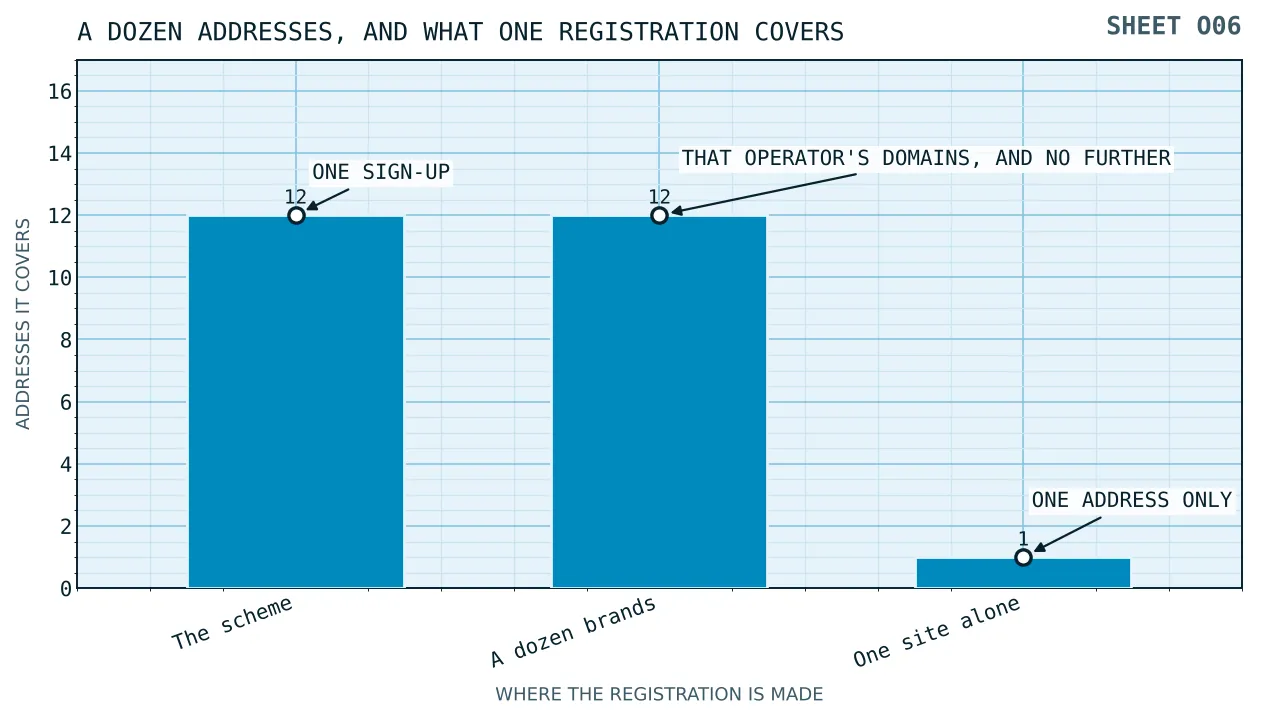
Now read the word in this key against that. An exclusion of that shape is worth exactly as many websites as the operator runs. A company with a dozen brands gives a reader a dozen addresses from one registration. A genuinely independent company, standing alone with one website, gives them one. The more independent the cashier, the narrower the protection its own exclusion provides.
| Where it is registered | What one registration reaches | What is left uncovered |
|---|---|---|
| The British national scheme | Every online account at every company licensed in Great Britain | Anything without that licence, which the scheme states in terms |
| A multi-brand offshore operator | That operator, and all the domains it holds | Every other operator, with encouragement to register again at each |
| An independent offshore cashier | One operator, which is one website | Everything else, at a rate of one registration per address |
The periods run longer offshore at both ends, which is worth stating because it cuts the other way. Under the ordinance there, one year is the minimum long-term exclusion that has to be offered, and the further terms available are a lifetime, ten years, five years and three. Once confirmed, revocation by the player before the term runs out is not available. The shortest available there is accordingly double the shortest here, and the longest runs past anything the British scheme carries. Length is not the problem. Coverage is.
Cooling-off there is stricter than a reader might guess, and a fair account has to include it.
- Four lengths, reachable by one click: twenty-four hours, seven days, one month, three months.
- No email and no operator approval in the way, and each takes effect at once.
- Selectable by product vertical.
- The operator may not talk a player out of it: no questioning the decision, no reassurances offered to delay it, no bonuses or promotions held out to keep play going.
4
The rule that draws the scheme’s edge
The British scheme spells itself Gamstop, and Gamstop Online has been the full name since November 2025, when a refreshed identity and a new website arrived together. The older capitals are still what most readers and most search phrases carry. On its own description the block falls on a registered person’s access to gambling accounts, on websites and in apps, free, quickly and simply.
Membership follows the licence. A company licensed in Great Britain to gamble online cannot opt out of Gamstop Online, and that single requirement is what fixes how far the register reaches. It is also why an independent cashier abroad is outside the scheme as a matter of construction rather than as a matter of attitude, which is a distinction worth keeping in view: nothing about being outside the scheme is a decision somebody took about this reader.
Its terms set the limit themselves. Help reaches the gambling services offered by operators that take part, and for an organisation that does not take part the scheme records being unable to prevent access. Treat it as the edge of a protection, because that is what it describes. Nothing on this sheet assists anybody in acting on it.
Published on 16 July 2026, the register held 614,738 consumers, a sixteen per cent rise over that year’s first six months, with 12,236 sign-ups in May setting a record for a single month. The five-year term, the longest single option, was taken by better than one registrant in two. Six months was taken by one in four, a share rising to 38 per cent among those under twenty-five, a group whose numbers were up 26 per cent on the year and which supplies close to a third of all self-exclusions. Men were seven in ten and more of the new sign-ups.
What the British regulator says about a website holding no licence belongs here too, because it describes the category this key names. Controls against money laundering may be inadequate and so may controls for social responsibility, with customers left open to fraud, to unfair practices and to problems over data privacy. Such websites, its notice of 20 January 2025 records, frequently aim at vulnerable customers, including those who have excluded themselves through the scheme. Whoever arrived here because an exclusion is doing its work belongs to the group that notice describes.
5
No ceiling, no maximum, no floor
The absences, put as absences, because that is the honest grammar for them. Each line names something that does not exist outside the British licence, and prices it on this deposit where a figure can be struck. A business holding no Great Britain licence is bound by none of the fourteen, and that is the plain fact under all of them.
| What does not exist out here | What its absence is worth |
|---|---|
| No ceiling stands over a play-through | £27.00 of expectation on £45.00 of credit, and £1,350.00 of turnover that need not be owed |
| No maximum stands over one slot cycle | Britain holds it to £5.00, and to £2.00 under twenty-five, so this deposit is three lawful cycles or seven |
| No floor stands under the interval between cycles | Britain asks 2.5 seconds, so 150 cycles occupy 375 seconds at the quickest |
| No bar stands against automation or speeding up | 150 separate decisions become one instruction |
| No limit stands on celebrating a small return | A 10p cycle returning 10p may be dressed as an event |
| No prohibition stands against a manufactured near miss | A losing outcome may be shown as a different losing outcome |
| No rule keeps two games from running at once | Attention divided by design rather than by choice |
| No requirement settles identity before play | A £45.00 credit may be played by whoever completed a form |
| No bar stands against a credit card funding play | Fifteen pounds may arrive on borrowed money |
| No prompt or default offers a limit of the reader’s own | Britain makes the limit the default and immediate on the way down |
| No threshold triggers an affordability check | Britain looks at net deposits above £150.00 a month, which is ten payments of this size |
| No prohibition protects a deposit balance | £14.40 of expected winnings against a payout floor that needs no justification |
| No rule stops a requested withdrawal being cancelled | A payout asked for can be turned back into stake |
| No approved body stands at a complaint’s end | A grievance whose final stage the other party may design |
Against that, two things the offshore rulebook does have, and both are real. On deposit limits the island runs tighter in one place. Seven days is what raising a limit there takes to bind, against a single day as the British minimum, while a reduction is immediate on both sides, so the point amounts to six extra days. And affiliates are reached directly, the operator being made responsible for their compliance with responsible gaming standards through binding contracts, through audits and through penalties for failure, which is more than the British regulator’s own advertising material attempts.
Bonuses get two sentences in that rulebook and no more. Transparency in communicating terms, with the conditions made clear. And no aggressive promotion that would encourage gambling to excess. A ceiling over a multiple appears nowhere in it. Neither does any restriction holding an incentive to a single product type. Nor is there anything like the list of significant conditions the British advertising regulator sets out.
6
A grievance at a single-site cashier
A page claiming there is no way to complain offshore would be wrong, and the real differences are narrower and sharper than that.
The clocks almost agree between the two regimes. A complaint may be lodged there without charge at any time within six months of the bet’s settlement or of the incident, which matches the British minimum. Written confirmation of receipt is owed inside a week. The operator has four weeks to assess and reply, extendable one time by four further weeks on written notice, so eight weeks all told, which is also the British maximum. Complaints about responsible gaming come first there: resolution attempted inside five business days, receipt confirmed in two, delay held to a fortnight and extendable by another fortnight where the player answers slowly.
Three features of that process bind the player, and they are the part a reader should take away.
- One attempt only. Once a dispute resolution process has run to completion it cannot be started again by either side with a different provider.
- Walking away ends it. A player who abandons a process already under way is not, on the expectation set out, to resurface the dispute afterwards.
- The claim is not transferable. Complaining is for the registered player alone, since the ordinance bars any claim against a licence holder from being sold, donated, rented, leased, pawned or pledged.
Neither regulator decides an individual dispute, and the wording on each side is strikingly close. The British one calls itself not an ombudsman. Settling a gambling complaint is beyond its powers, and so is recovering a consumer’s money. Trouble over a withdrawal, or a game that faults technically, falls outside what it can settle. No access to customer accounts means no sight of what took place. And its direction to a player is the business first. On the island the regulator likewise declines to resolve or decide a player’s complaint about gambling transactions on an operator’s site, and a decision of the operator or of the dispute provider is not open to its review or reversal unless the handling is judged inadequate, though what it learns feeds supervision and enforcement.
One figure a reader might want does not exist. Complaint numbers go to the regulator there on two dates each year, 15 January and 15 June, with January 2026 the first time they fell due, and the categories reported are totals, upheld, rejected, pending, by category, referred onwards, and gone to law. Nothing published aggregates any of it, so no complaint volume appears here.
7
Twenty-seven pounds against a claim floor
Now the parameter that decides whether any of part 6 reaches a reader with fifteen pounds at stake.
Dispute resolution out there is compulsory, and free to the player, with every expense on the operator. The policy then allows the operator to fix its parameters, naming three. Whether the process must be exhausted before a player goes to court. Whether the player is bound by the result. And whether some minimum value attaches to a claim before escalation is available.
The third one is arithmetic, and on this page the arithmetic is unforgiving. The largest sum that could ever be in dispute here is £45.00 of credit. The most that was ever expected out of it, at a ceiling of ten, is £27.00. The deposit itself is £15.00. A minimum claim value set anywhere above those figures takes the dispute off the table before it is read.
| If the floor reads | What is still escalable |
|---|---|
| Ten pounds | All three figures |
| Twenty pounds | The credit and the £27.00 |
| Thirty pounds | The £45.00 credit alone |
| Fifty pounds | Nothing on this page |
The regulator there does not leave that entirely to the operator. Independent legal advice is what it advises before such a restriction is set, all relevant circumstances will be weighed in deciding whether one is justified, and it names two situations: a claim of low value, where a worry about misuse of the process may be understandable, and the admission of somebody who had self-excluded, which it expects to be treated seriously whatever sum is involved. That second situation is the one a reader of this key should remember, because it is the regulator saying that the smallness of a claim does not excuse the admission.
In Great Britain the question is removed. For six months at the least, measured from the incident, a complaint has to be possible, and no term may bar one inside that window. Eight weeks is the limit on finishing the process. And the final letter has to explain the route to an independent body the regulator itself approves. On the published list there are eight bodies, and coverage between them is uneven. Five carry remote across every sector. One does not carry remote casino.
8
No group, and who the revenue wants
Independence has one consequence in British tax law that is worth setting out, because it is specific and it is sourced.
British gaming duty attaches by reference to where the customer lives. A company’s own base is immaterial: put remote gambling other than spread betting in front of somebody who ordinarily lives in the United Kingdom and one or more of these duties follows, with Remote Gaming Duty charged on the provider’s profit from that play, measured as stakes received less winnings paid. Forty per cent is the rate for accounting periods that begin on 1 April 2026 or later. Twenty-one per cent applied from 1 April 2019, and fifteen before that.
Then the clause that speaks to this key. Where a company sits outside the United Kingdom and belongs to no group, a representative approved by the revenue generally has to be appointed, unless its base is an exempt jurisdiction: Gibraltar, Norway and the EU member states are the examples given. An independent company is by definition not part of a group, so that requirement is aimed squarely at the kind of business this page is about.
Which produces a position worth stating precisely, because most writing on the subject gets it backwards. Take this fifteen pound deposit at a cashier with no British licence and it sits within the scope of a British tax while standing outside all fourteen protections in part 5. A tax’s scope and a licence are different things, and the scope brings no duties with it.
For the reader the tax position comes by absence rather than by any charging provision. On the revenue’s manual, betting and gambling are of themselves no trade, so winnings are not trade income. Behind that sits a 1925 case where a man living wholly on bets placed at starting prices was held not to be trading, the judge remarking that a habit carries no tax. A system, a study of form, a living taken from the proceeds: none of them alters it. In terms, no government page declares winnings untaxed. Nothing above addresses any reader’s own position, and none of it is tax advice.
What an independent cashier has to publish about itself
One more thing the offshore rulebook does require, and it matters most where a company stands alone. Six items have to appear in the footer of a licensee’s website.
- The licence number.
- The licence holder’s name, and its registered address.
- The regulator’s digital seal.
- A statement that the regulator oversees it.
- Links to support for gambling addiction, local and international alike.
- A link through to the responsible gaming policy.
The international examples the rulebook itself gives are GambleAware, Gamblers Anonymous and GamCare, which means its own text directs a British player to British support bodies. For a company with no group behind it, that footer is the whole of its published identity.
9
If a registration brought this page up
Part of the search traffic for a key of this shape is people with a live registration which is working exactly as it was designed to. This section is for them. It carries more weight than anything else here, and no route past anything appears in it.
The figures settle it without assistance. Three hundred per cent on fifteen pounds comes to nothing at forty times, with £27.00 of shortfall behind it, and at sixty times the shortfall reaches £63.00, four times the deposit over. The deposit cannot even fund the rest of the condition. Against those numbers sits a cashier where fourteen protections do not exist, where a self-exclusion covers one website rather than a market, where a claim floor may put £27.00 beyond escalation, and where the complaints process can be designed by the other party. No arrangement of that is worth a defeated registration, and independence makes the self-exclusion question worse rather than better.
Three published things cost nothing and work:
- A number that always answers. GamCare answers it, the National Gambling Helpline, free to ring on 0808 8020 133 at whatever hour, on every day of the year. The ways in are the telephone, live chat and WhatsApp, and a call about a family member or a friend is as welcome as a call about the caller themselves. From outside the country the number reads +44 8088 020 133.
- A block that travels across devices. Gamban takes a layered approach to gambling websites and apps, tens of thousands of them, with one licence serving all the major device platforms and the Apple and Google stores as download routes. Its own pages carry a seven-day trial, and the single no-charge arrangement published there belongs to one American state’s residents, so a free route for a British reader is published elsewhere.
- TalkBanStop, where the British free route is published. GamCare is Talk and supplies the helpline. Gamban is Ban. The national scheme is Stop. GamCare publishes Gamban as free to anybody who telephones the helpline or who takes up GamCare’s support and treatment, on an article dated 12 April 2021 which states no duration, so none is stated here.
Two facts about an exclusion already running, from terms whose latest revision is 20 May 2026. Four options exist at sign-up: a six-month term, a one-year term, a five-year term, and a five-year term that renews by itself, with the renewal switchable off only in such a term’s closing six months. And nothing expires quietly. At the end of a period the scheme will not lift an exclusion of its own accord, and inaction by the registrant carries it on by up to a further seven years. Staying in control is the page here about using all of this.
Nearby sheets. Sixteen questions a licence answers, each priced, sit at best non gamstop casinos. A spins round with nothing deposited behind it is costed under non gamstop casinos no deposit bonus. An identity check, what it is for and what postponing it costs, appears at no kyc casinos. Six regulators opened at source are set out under non uk casinos. The stake assumption shifts at high roller online casinos. Off the register lists the whole section, and every quantity above is this sheet’s own working, stated as an assumption and never as a measurement of what any business publishes.
Questions
- What does independent mean on a key like this?
- Two words in it pull in opposite directions. The second half describes a company outside the national self-exclusion scheme. The first half describes a company standing on its own, with no group behind it and usually one website rather than a stable of them. Readers treat that first word as reassurance. On the one question this key is really about, it is the opposite of reassurance, because the only self-exclusion on offer out there runs operator by operator, and an operator with one site is an exclusion covering one site.
- Why does independence make a self-exclusion smaller?
- Because an offshore exclusion is worth exactly as many websites as the operator runs. The Caribbean rulebook requires self-exclusion, and what it means there is that a player voluntarily bars themselves from all or certain online gaming activities with one specified operator, and that the operator must then exclude them from every domain it holds. As for every other gambling site, encouragement is the policy’s answer: exclusion from those too should be urged on the player, site by site. A company with a dozen brands covers a dozen addresses from one registration. An independent company with one website covers one.
- What is three hundred per cent on £15.00 actually worth?
- Forty-five pounds of credit, holding £27.00 where ten is the outer figure and nothing at forty times. Written at ten, the outer figure for a British licensee, the condition wants £450.00 of turnover; four per cent of it is £18.00, and £27.00 of the credit is expected to come through. Written at forty, the turnover owed is £1,800.00 and the expected cost £72.00; the credit covers £1,125.00 of that staking and is then spent, leaving £675.00 of turnover to be funded from a fifteen pound deposit that cannot carry it.
- Are the offshore exclusion periods shorter?
- They are longer at both ends, and saying so is part of a fair account. Under the ordinance there, one year is the minimum long-term exclusion that has to be offered, and the further terms available are a lifetime, ten years, five years and three. Once confirmed, revocation by the player before the term runs out is not available. The shortest available there is accordingly double the shortest here, and the longest runs past anything the British scheme carries. Length is not the problem. Coverage is.
- Why does the British scheme not reach an independent cashier?
- Because membership follows the licence. A company licensed in Great Britain to gamble online cannot opt out of Gamstop Online, and that single requirement fixes how far the register reaches. An independent cashier abroad is therefore outside the scheme as a matter of construction rather than attitude. Its terms set the limit themselves: help reaches the gambling services offered by operators that take part, and for an organisation that does not take part the scheme records being unable to prevent access. Treat it as the edge of a protection, because that is what it describes, and nothing here assists anybody in acting on it.
- What exactly is missing compared with a British licence?
- Fourteen things, each priceable on this deposit. No ceiling over a play-through, worth £27.00 here and £1,350.00 of turnover that need not be owed. No maximum over one slot cycle, where Britain holds it to £5.00, and to £2.00 under twenty-five. No floor under the interval between cycles, where Britain asks 2.5 seconds, so 150 cycles occupy 375 seconds at the quickest. No bar on automation, on celebrating a small return, or on a manufactured near miss. No requirement settling identity before play. No bar on a credit card. No prompt or default for a limit. No affordability threshold. No protection for a deposit balance. And no approved body at the end of a complaint.
- Is the offshore rulebook ever stricter?
- On two points it is. On deposit limits the island runs tighter in one place. Seven days is what raising a limit there takes to bind, against a single day as the British minimum, while a reduction is immediate on both sides, so the point amounts to six extra days. And affiliates are reached directly, the operator being made responsible for their compliance with responsible gaming standards through binding contracts, through audits and through penalties for failure, which is more than the British regulator’s own advertising material attempts. Cooling-off is also demanding: four lengths reachable by a single click, each effective at once, with the operator forbidden to talk a player out of taking one.
- Can I complain about fifteen pounds at a cashier like this?
- There is a route, and the clocks almost agree with the British ones. A complaint may be lodged there without charge at any time within six months of the bet’s settlement or of the incident. Written confirmation of receipt is owed inside a week. The operator has four weeks to assess and reply, extendable one time by four further weeks on written notice, so eight weeks all told. Complaints about responsible gaming come first there, with resolution attempted inside five business days. Three features then bind the player: one attempt only, walking away ends it, and the claim cannot be sold, donated, rented, leased, pawned or pledged to anybody else.
- Could a claim floor put £27.00 beyond escalation?
- It could. Dispute resolution out there is compulsory, and free to the player, with every expense on the operator, and the policy then allows the operator to fix its parameters, naming three. Whether the process must be exhausted before a player goes to court. Whether the player is bound by the result. And whether some minimum value attaches to a claim before escalation is available. The largest sum ever in dispute here is £45.00 of credit, the most ever expected from it is £27.00, and the deposit is £15.00, so a minimum set above those figures ends the matter before it is read. The regulator there says all relevant circumstances will be weighed, and names the admission of somebody who had self-excluded as a case to be treated seriously whatever sum is involved.
- Does being independent change the tax position?
- It changes one clause, and the clause is specific. British gaming duty attaches by reference to where the customer lives, and a company’s own base is immaterial: put remote gambling other than spread betting in front of somebody who ordinarily lives in the United Kingdom and one or more of these duties follows, with Remote Gaming Duty on the provider’s profit at forty per cent for accounting periods that begin on 1 April 2026 or later. Where a company sits outside the United Kingdom and belongs to no group, a representative approved by the revenue generally has to be appointed, unless its base is an exempt jurisdiction. An independent company is by definition not part of a group.
- A live exclusion is the reason I am reading this. What works?
- Three things, published and free of charge. GamCare answers it, the National Gambling Helpline, free to ring on 0808 8020 133 at whatever hour, on every day of the year, and the telephone, live chat and WhatsApp are the ways in. Gamban takes a layered approach to gambling websites and apps, tens of thousands of them, with one licence serving all the major device platforms. TalkBanStop is where the British free route is published. Talk comes from GamCare, Ban from Gamban, Stop from the national scheme. GamCare publishes Gamban as free to anybody who telephones the helpline or who takes up its support and treatment, on an article dated 12 April 2021 which states no duration.