
Sheet O07 Revision 1 Checked 15 October 2026
No verification casinos
Fifty cycles at 10p give £4.80 back on average. Priced under a ceiling of ten that is worth £2.88; priced at forty times it is worth nothing. The check this key is about is not deleted away from the British register. It is postponed, and the whole £2.88 waits behind it at the exit.
£2.88 of expectation, behind a document request with no clock over it
What an unchecked account leaves at the foot
Every destination on this spike is bought advertising. The site takes a fee if a reader goes on to register, and no figure printed below moves because of it.
The Spin Sheet
Till receipt No 01
Betportal
Lowest multiple here
For every €1 of spin credit at face per €1
Credit
Debit
No Great Britain licence
Licensed in Anjouan, Comoros, run by BetPortal Gaming Ltd, with Excite Ultra Media Ltd, reference ALSI-202601040-FI2.
Terms read 15 October 2026
Open the offer at Betportal, opens in a new tabThe Spin Sheet
Till receipt No 02
WinBeast
Five staged matches
For every €1 of spin credit at face per €1
Credit
Debit
No Great Britain licence
Licensed in Curaçao, operator not named on the site.
Terms read 15 October 2026
Open the offer at WinBeast, opens in a new tabThe Spin Sheet
Till receipt No 03
EliteSpin
Longest spin window
For every £1 of spin credit at face per £1
Credit
Debit
No Great Britain licence
Licensed in Costa Rica, run by PrimeTier Limited.
Terms read 15 October 2026
Open the offer at EliteSpin, opens in a new tabThe Spin Sheet
Till receipt No 04
Crown Jewelz
Multiple unpublished
No total struck
Credit
Debit
No Great Britain licence
Licensed in Curaçao, number not verified, operator not named on the site.
Terms read 15 October 2026
Open the offer at Crown Jewelz, opens in a new tabThe figure at the foot of a receipt is this site's own arithmetic and nothing an operator has published: the credit, less the share a spin gives back at 96 per cent return to player, less what playing the wagering through costs at the same return. It describes the offer, not one reader's afternoon. Where the conditions price above the credit the receipt prints nothing rather than a negative sum, and where a figure the sum needs is unpublished it prints the condition in the operator's words instead.
Three words stand in the amount column where no figure can. Noted is a published condition that takes value away without leaving the sum a figure to take. Unpriced is a condition whose figure nobody has published, or a credit that is not a sum until a deposit of your own sets it. Own money is money of yours, which is never part of a total.
Not one of the operators printed above holds a Great Britain licence, so the duties that licence carries do not reach them. Every online gambling company licensed in Great Britain has to be part of Gamstop Online, and a reader who has shut themselves out through the scheme is therefore not shut out here. The ceiling of ten times the bonus funds on a wagering requirement, in force since 19 January 2026, is a condition of that licence and binds the companies that hold one. Where a dispute goes instead is a matter for the authority named on the receipt, and the Gambling Commission describes what a reader faces without a British licence as a lack of recourse if things go wrong. Nobody under 18 may hold an account at any of them.
Every term printed on a receipt is the operator's own, and each receipt carries the day it was read. The oldest of those readings is 15 October 2026. What binds a reader is the operator's own full terms, and not a line printed here.
1
Fifty cycles, and twenty pence of toll
Begin where the money begins. A round of fifty spins at 10p apiece puts £5.00 of staking through a slot; a slot paying 96 per cent hands £4.80 of that back on average; and the 20p which does not come back is the fee for the pass. Everything below is built on that £4.80, since the winnings off a round of spins are what a condition is ordinarily fastened to.
One caution belongs here rather than in a footnote. The ceiling of ten is drafted over bonus funds, so where a round’s winnings arrive as bonus funds the requirement over them halts at ten times that figure. Nothing published settles whether a spin is bonus funds of itself, and this sheet declines to settle it in either direction. It prices the winnings, and says as much in the open.
Now the key itself. Offers answering to a phrase about missing verification come from cashiers carrying no Great Britain licence, and the first honest thing to report is that the phrase oversells itself. In the jurisdiction this part of the market names most often, a check is required. It simply sits later in the sequence. Part 6 quotes that rulebook, part 3 shows where a British licence puts the same check, and part 5 converts the distance between the two into pounds and pence.
Held constant here, with the reason for each:
- Fifty spins at 10p, so the round stakes £5.00 and averages £4.80 back.
- Ninety-six per cent as the return, the figure this site uses wherever one particular game is not named.
- Forty times for the play-through, since terms written beyond the reach of a British register commonly go that high. Ten times sits beside it, being the figure a licence would have compelled.
- Slots counting pound for pound against a requirement, which puts g at one.
2
Three things a check establishes
A verification request is not a cruelty a cashier invented. Three purposes are given for it by the British regulator, and the useful order to read them in is backwards, starting from the one readers never think about.
Third comes confirming who the business is dealing with. Second comes age. First, and the only one that bears on this page, is that the account can be tested against a self-exclusion. A register of people asking to be kept out is a list of names, and a list of names cannot be matched against an account holding no name. The check is the instrument by which self-exclusion means anything whatever. Remove it and the register has nothing left to match on, which is a mechanical consequence rather than a loophole.
Two smaller points from the same source finish the picture. Age checking was extended to games played for no prize, on the reasoning that such games are not technically gambling because nothing is won, and that children have no business in them regardless. And the player-facing guide carrying the three purposes is old: put up on 23 September 2020 and touched last on 13 April 2022, which is why the operative wording is taken below from the licence condition instead.
3
Seventy-two hours became none at all
British timing is sharper than most readers expect, and it carries a date.
The licence condition on customer identity will not let a licensee allow anybody to gamble until information establishing who that person is has been obtained and verified. Three items make the floor: when the customer was born, where they live, and what they are called. The condition adds that the list does not stop there. Before any money may go in, the licensee owes the customer notice of which documents might be wanted, of the point at which they might be wanted, and of the way to send them. It also owes reasonable steps to keep correct whatever identity information it is already holding.
The announcement that brought those rules in is where the arithmetic of time shows up. Name, address and date of birth are to be verified as a minimum before a customer is allowed to gamble. Play funded by a free bet or a bonus falls inside that rule, which is exactly the play this sheet prices. A licensee’s games played for no prize at all are inside the age rule too, access to them included. And a window that had stood at seventy-two hours for finishing an age check was shut. The rules took effect on 7 May 2019, a date the network has used and which the announcement’s own date of 7 February 2019 makes the only available reading, although the article prints no year itself.
Seventy-two hours down to nil is the whole movement, and it is the sentence to keep. Under a British licence the period in which an unverified person can play is not shortened. There is none.
Seventy-two hours of unchecked play, reduced to none, from 7 May 2019
4
The trapdoor a licence nails shut
Here is the rule that decides this page, and the one nobody hunting for an unchecked cashier has read.
A licensee may not let a withdrawal request become the trigger for a demand for further information, in circumstances where it could reasonably have asked at an earlier point. The player-facing version runs the same way: age and identity are not permitted to become conditions of a payout where the asking was available earlier. Money-laundering information has to be requested in good time, instead of being saved up for the moment a payout is wanted. One carve-out stands, and stating it fairly matters: where some other legal duty obliges the business to obtain something at that moment, it may.
What the rule forbids is a particular manoeuvre. Open the account with no question asked, take the money, let the play happen, and raise the documents at the single moment when the answer is worth money to the business. A licence shuts that off. The regulator goes one step further and says an operator who delays a withdrawal for want of sufficient identity information may be in breach of the condition. On what may be wanted, the published examples run to passports, household bills and driving licences, and the regulator expressly declines to say which a business ought to choose.
Away from the British register that rule has no counterpart in anything read for this build. The sequence a licence forbids is the sequence a cashier is free to run, and the reader’s place in it is the worst available: documents produced after the money has gone in, by somebody who now wants something, to somebody under no published obligation about the hour of the asking.
5
Two pounds eighty-eight, waiting at the exit
Give the thing a number, because an argument about documents is only as strong as the sum standing behind it. The sum is what a round of spins is expected to leave, and one expression settles that.
E = B × (1 – (W × (1 – RTP)) / g)
Winnings from the round go in as B, which is £4.80 of them. RTP reads 0.96 and the weighting g reads one, which leaves W as the open question a cashier answers for itself.
The nineteenth of January 2026 set ten as the furthest a British licensee may reach, and at ten the requirement calls for £48.00 of staking. The toll at four pence in every pound is £1.92, which leaves £2.88 standing. At forty times the requirement calls for £192.00 instead, the toll on which is £7.68, and because the credit was only four pounds eighty the foot comes out at nothing, with £2.88 of expected cost running past it.
| What the terms ask | Staking owed | Cycles at 10p that takes | Toll on the staking | Expected at the foot |
|---|---|---|---|---|
| Ten times, a licensee’s limit | £48.00 | 480 | £1.92 | £2.88 |
| Twenty times | £96.00 | 960 | £3.84 | £0.96 |
| Twenty-five times | £120.00 | 1,200 | £4.80 | £0.00 |
| Forty times, modelled here | £192.00 | 1,920 | £7.68 | £0.00 |
The middle column is in the schedule because it converts a condition into an evening. A British licence will not let one slot cycle follow its predecessor inside 2.5 seconds, so the 1,920 cycles in the bottom row occupy 4,800 seconds at the very least, which is eighty minutes of pressing a button for nothing expected at the end. The 480 cycles in the top row run twenty minutes and are expected to leave £2.88. Out here no floor under the pace exists at all, so the eighty minutes is a minimum nobody has to observe.
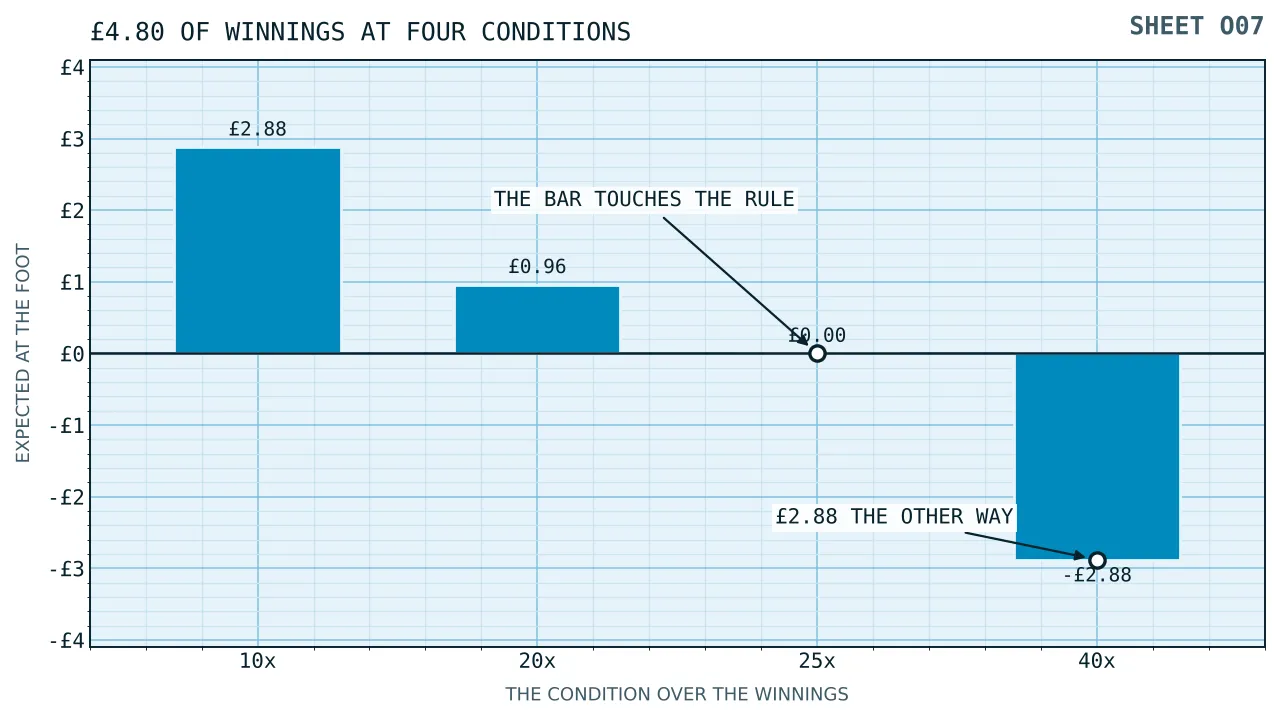
Now attach the document question to those figures, which is the business of the page. Every penny in the right-hand column has to be asked for before it is money. Under a licence the asking cannot be held back for that moment. Out here it can be, so the share of an expected balance exposed to a request made at the exit is not a fraction at all. It is the whole of it, in every row of the schedule, and it is largest in the one row where the offer was worth having.
100 per cent of any balance reachable, where the asking has no fixed hour
6
What the island rulebook asks about age
Calling these cashiers unverified is the mistake this section corrects. The Caribbean regulator whose licence turns up most often in this corner publishes a responsible gaming policy, and that policy does ask for checks. Reading it is how the real gap gets measured.
Nobody there may deposit, and nobody may wager, until the operator has satisfied itself that the player has turned eighteen. Registration satisfies that with a confirmed date of birth, a declaration from the player, the payment method confirmed, and an open-source check where one can be managed. The documents themselves, at minimum a driving licence or a national identity card or a passport issued by a government, attach to the later compliance milestones. Doubt about age is the only thing that brings those documents forward, and the policy says any doubt whatever will do it.
Set that beside the British position and the difference is not presence against absence. It is a sequence. Cycle one is where Britain settles the whole question, with bonus-funded rounds and prize-free rounds both caught by the rule. The island policy puts a declaration in front of cycle one and the documents at a milestone further along, and the milestone that arrives most often is a withdrawal.
| Stage | Under a British licence | Under the island policy |
|---|---|---|
| Registering | Birth date, address and name obtained, and verified | Birth date confirmed, a declaration, the payment method |
| Cycle one, funded by a bonus | Not allowed until the check has finished | Allowed once the operator is satisfied as to age |
| A game carrying no prize | Age verified ahead of access | No provision read for this build |
| Documents proper | Held already | At a compliance milestone further on |
| A demand raised at withdrawal | Barred where it could have been raised earlier | No equivalent bar read for this build |
Where the island policy is silent runs much further than age. It carries no ceiling over a play-through, no cap over one stake, no floor under the gap between cycles, no bar on automatic play or on a turbo button, and no restriction on making a fuss of a return that fails to beat its own stake. That silence is the sourced core of what this page is about, and it is what lets part 5 model forty times at all.
7
Nobody out here has to
A British licence is a list of obligations, each with a figure or a date fastened to it. Turned round and written as obligations nobody is under, the list reads as follows. Not one item on that list turns up in the island policy read for this build.
- Who the customer is, settled ahead of cycle one, with play on a bonus and play for no prize caught as well.
- A requirement over bonus funds kept down to ten times their figure, which is why part 5 could model four times as much.
- One slot cycle kept under £5.00, or under £2.00 for a player not yet twenty-five.
- Two and a half seconds left clear between slot cycles. Five seconds is the floor between cycles of a casino game outside the slots category, peer-to-peer poker excepted.
- An automatic cycle, a turbo button and a slam stop all declined.
- A 10p return on a 10p cycle shown plainly, with no sound and no celebration over it.
- A losing outcome left as it fell, rather than a near-miss losing outcome put in its place.
- One game at a time, and the rules and the odds of a game held still while it is being played.
- A deposit balance free of any term rationing what comes out of it, and no offer to a player of the chance to cancel a withdrawal already asked for.
- A credit card refused, a payment routed by way of a money service business included.
- Prompting for a financial limit and offering one as the default, with a reduction biting at once and an increase held back a day.
- A light-touch check at the point where net deposits inside one month exceed £150.00.
- Eight weeks is the whole of a complaint, with a dispute body approved by the regulator standing at the end of it.
- Belonging to the national self-exclusion scheme, which the British licence and nothing else makes compulsory.
Fourteen obligations, and the first of them is this page’s subject. The list is worth printing whole because a reader shopping for the absence of one duty is buying the absence of all fourteen, and part 5 shows what the second item by itself is worth on a round of fifty spins.
8
Where a passport photograph ends up
A postponed check is still a check, so the documents are still handed over. The question worth asking is who finishes up holding them, and about sites of this description the British regulator has published an answer.
On 20 January 2025 the regulator issued an industry warning notice, and what it records about websites of that description is specific. Social responsibility controls and anti-money-laundering controls may each be inadequate, and the exposures listed are fraud, unfair dealing and trouble over the privacy of data. People who have shut themselves out through the scheme are named among the vulnerable customers such sites are recorded as pursuing. A post of 21 October 2025 by the regulator’s enforcement and intelligence director adds the rest. Identity theft and fraud are named among the risks, under a heading of grave concern about the protection of player data. Missing age checks, missing tools for responsible gambling and payment systems that are not secure were all named in the same place. Unfair practice at the tables, money lost, and nothing to appeal to afterwards is how the consumer position is put.
Plainly stated, then, the trade in this key is not documents against no documents. It is documents handed to a business bound by the fourteen obligations in part 7, against the same documents handed later to a business bound by none of them, at the moment that business has an interest in the answer. Nothing in that trade runs the reader’s way.
9
If a check is why this sheet was found
Some of the people who reach a page carrying this title are registered with the national scheme, have met the identity check that enforces it, and are hunting for a cashier where it is not asked. This section is written for them, it is the part of the sheet that matters most, and there is no route in it.
Take the arithmetic first, since the arithmetic is the argument. Fifty cycles return £4.80 on average. At the condition modelled throughout, the foot comes to £0.00 with £2.88 of expected cost beyond the credit, and under the most generous condition a licence ever permitted it comes to £2.88. That is the size of the prize. Standing against it is a cashier with no ceiling over a multiple, no duty to pay a balance out, no fixed hour for demanding documents, and no regulator this reader could complain to. No arrangement of those figures makes the offer repay defeating a registration, and this sheet will not help anybody attempt it. No route past a check is described here, and none will be.
What is published, costs nothing, and does work:
- Talk. GamCare runs what it calls the National Gambling Helpline, and the number, free to ring, is 0808 8020 133. A telephone, a live chat window and WhatsApp all reach it, and a caller may ring about themselves or about somebody else. From abroad the number is written +44 8088 020 133. Its footer gives three registrations: 03297914 as an English company limited by guarantee, 1060005 as an English charity, and SC050547 in Scotland.
- Ban. Gamban blocks gambling websites and applications in the tens of thousands, by several layers at once, on one licence across every major platform for devices. Downloads come from the Apple App Store and from Google Play, and the company’s own pages offer a trial of seven days without charge. No free British route appears on the software company’s pages, which is why the route below belongs to GamCare instead.
- Stop. GamCare publishes the pairing under the name TalkBanStop: itself as Talk with the helpline, the software as Ban, and the national scheme as Stop. On that page GamCare states that the software costs nothing for a caller to the helpline, or for anybody using its own support and treatment. The page is a news item of 12 April 2021 which gives no length for that free access, so no duration goes on this sheet.
A pair of facts about a registration already running, taken from the scheme’s own terms, because both get read as faults when they are the mechanism working. A registration will not finish early, before the minimum period it was taken for has elapsed. And a deliberate deactivation runs at least a day of cooling off first, and the exclusion holds for the whole of it. Six months, a year or five years are the extensions available at the end of a term. The sheet this site keeps on the subject is called Staying in control.
10
Four readings, none of them a document
Four questions settle a round of spins made away from the British register, and a passport answers none of them.
| What to settle | On fifty cycles |
|---|---|
| What the round returns on average | £4.80 of £5.00 staked |
| When identity is settled under a licence | Ahead of cycle one, since 7 May 2019 |
| What the modelled condition leaves | £0.00, against £2.88 |
| Who the withdrawal-time rule binds | A licensee, and nobody else |
Rows two and four are the whole of the page, and both are rules rather than figures, which is what makes them so easy to shop straight past. A reader who takes nothing else from this sheet should take the pairing: the hour at which identity is settled and the bar on raising it later are one protection and not two, and they stand or fall together.
The caution this site puts under every mean belongs here too. £2.88 is an average across a very long run of identical rounds, not a sum anybody is handed. A slot carrying rare large prizes lands a round of fifty under £4.80 far more often than over it, and lands it on nothing often enough. The 20p toll on the pass is the one exact quantity in the arrangement.
Related sheets. The same question under its other common search phrase is at no kyc casinos. The jurisdiction whose policy part 6 quotes has a sheet to itself at Curaçao licensed sites. What the design rules in part 7 are worth, reckoned in seconds and in stake ceilings, is at slots not on gamstop, and the licence question put about a whole site rather than about one check is at non uk casinos. This corner of the tree is indexed under Off the register, and every figure’s working is laid out under How a receipt is struck.
Questions
- Do cashiers away from the British register really ask for nothing?
- The commonest offshore rulebook does ask. Nobody there may deposit, and nobody may wager, until the operator has satisfied itself that the player has turned eighteen. Registration satisfies that with a confirmed date of birth, a declaration from the player, the payment method confirmed, and an open-source check where one can be managed. The documents themselves, at minimum a driving licence or a national identity card or a passport issued by a government, attach to the later compliance milestones. So the difference is not presence against absence. It is when.
- Why does a licence put the check before the first spin?
- Because of what the check is for. Three purposes are given for it by the British regulator: that the account can be tested against a self-exclusion, that age is settled, and that the business can confirm who it is dealing with. The first decides this page. A register of people asking to be kept out is a list of names, and a list of names cannot be matched against an account holding no name. The verification is the instrument by which self-exclusion works at all.
- How long may a British site let somebody play before checking?
- It may not. A window had stood at seventy-two hours for finishing an age check and it was shut, with the rules taking effect on 7 May 2019. The licence condition will not let a licensee allow anybody to gamble until information establishing who that person is has been obtained and verified, and three items make the floor: when the customer was born, where they live, and what they are called. Play funded by a free bet or a bonus falls inside the rule, and so does access to games played for no prize.
- What is the rule about documents demanded at withdrawal?
- A licensee may not let a withdrawal request become the trigger for a demand for further information, in circumstances where it could reasonably have asked at an earlier point. Money-laundering information has to be requested in good time, instead of being saved up for the moment a payout is wanted. The regulator says an operator who delays a withdrawal for want of sufficient identity information may be in breach of the condition. One carve-out stands: where some other legal duty obliges the business to obtain something at that moment, it may. Nothing read for this build gives the rule a counterpart offshore.
- What is a round of fifty free spins expected to leave?
- Fifty cycles at 10p stake £5.00 and return £4.80 on average where the slot pays 96 per cent, the fee for the pass being 20p. The nineteenth of January 2026 set ten as the furthest a British licensee may reach, and at ten the requirement calls for £48.00 of staking. The toll at four pence in every pound is £1.92, which leaves £2.88 standing. At forty times the requirement calls for £192.00 instead, the toll on which is £7.68, so the foot comes out at nothing, with £2.88 of expected cost running past the credit.
- How much of a balance is exposed to a late document request?
- All of it, under every multiple. Money has to be asked for before it is money, so a request made at the exit reaches the entire expected balance rather than a slice. The exposure is therefore largest in exactly the row where the offer was worth having: £2.88 under a ceiling of ten, 96p at twenty times, and nothing from twenty-five times upwards, because by then the condition has already taken everything there was.
- Is the ten times ceiling about free spins or about bonus funds?
- Bonus funds. The ceiling of ten is drafted over bonus funds, so where a round’s winnings arrive as bonus funds the requirement over them halts at ten times that figure. Nothing published settles whether a spin is bonus funds of itself, and this sheet declines to settle it in either direction. It prices the winnings off the round instead, and says as much in the open.
- What else goes missing along with the check?
- Thirteen further obligations, because a British licence is a list rather than a badge. Nobody out here has to keep a requirement over bonus funds down to ten times their figure, cap one slot cycle at £5.00 or at £2.00 below twenty-five, leave 2.5 seconds clear between slot cycles, decline a turbo button or an automatic cycle, show a small return plainly, leave a losing outcome unsubstituted, carry a deposit balance free of a rationing term, turn a credit card away, prompt for a financial limit, run a check where net deposits inside one month exceed £150.00, finish a complaint in eight weeks with an approved dispute body after it, or belong to the national self-exclusion scheme.
- Who ends up holding the documents at an unlicensed site?
- A business the regulator has described in published terms. On 20 January 2025 it issued an industry warning notice recording that social responsibility controls and anti-money-laundering controls may each be inadequate, and listing fraud, unfair dealing and trouble over the privacy of data as the exposures. A post of 21 October 2025 from its enforcement and intelligence director names identity theft and fraud among the risks, under a heading of grave concern about the protection of player data. The trade is not documents against none. It is the same documents, later, to somebody under no obligations.
- Does the arithmetic change if the check never comes?
- No, and that is the point worth carrying away. The condition decides the balance before any document question arises, so at forty times the foot comes to £0.00 whether or not a passport is ever asked for. A check that never happens cannot improve a figure the play-through has already taken, which means the absence being advertised is fastened to an offer the arithmetic has priced at nothing.
- What should somebody do if a check is standing in their way?
- Use three published things, none of which costs anything. GamCare runs what it calls the National Gambling Helpline, and the number, free to ring, is 0808 8020 133, with a telephone, a live chat window and WhatsApp all reaching it, for the caller or for somebody else. Gamban blocks gambling websites and applications in the tens of thousands, on one licence across every major platform for devices. GamCare publishes the pairing under the name TalkBanStop and states that the software costs nothing for a caller to the helpline, or for anybody using its own support and treatment, on a news page of 12 April 2021 which gives no length for that free access. No route past a check appears on this sheet.