
Sheet M06 Revision 1 Checked 15 October 2026
200 free spins
Two hundred cycles at 10p are £20.00 advertised and £19.20 won on average. Forty times turns that into £768.00 of required staking, £30.72 of expected cost and five hours and twenty minutes at the reels.
£19.20 won, £768.00 to stake, 5 hours 20 minutes of it
What the conditions leave
Every destination on this spike is bought advertising. The site takes a fee if a reader goes on to register, and no figure printed below moves because of it.
The Spin Sheet
Till receipt No 01
Betportal
Lowest multiple here
For every €1 of spin credit at face per €1
Credit
Debit
No Great Britain licence
Licensed in Anjouan, Comoros, run by BetPortal Gaming Ltd, with Excite Ultra Media Ltd, reference ALSI-202601040-FI2.
Terms read 15 October 2026
Open the offer at Betportal, opens in a new tabThe Spin Sheet
Till receipt No 02
WinBeast
Five staged matches
For every €1 of spin credit at face per €1
Credit
Debit
No Great Britain licence
Licensed in Curaçao, operator not named on the site.
Terms read 15 October 2026
Open the offer at WinBeast, opens in a new tabThe Spin Sheet
Till receipt No 03
EliteSpin
Longest spin window
For every £1 of spin credit at face per £1
Credit
Debit
No Great Britain licence
Licensed in Costa Rica, run by PrimeTier Limited.
Terms read 15 October 2026
Open the offer at EliteSpin, opens in a new tabThe Spin Sheet
Till receipt No 04
Crown Jewelz
Multiple unpublished
No total struck
Credit
Debit
No Great Britain licence
Licensed in Curaçao, number not verified, operator not named on the site.
Terms read 15 October 2026
Open the offer at Crown Jewelz, opens in a new tabThe figure at the foot of a receipt is this site's own arithmetic and nothing an operator has published: the credit, less the share a spin gives back at 96 per cent return to player, less what playing the wagering through costs at the same return. It describes the offer, not one reader's afternoon. Where the conditions price above the credit the receipt prints nothing rather than a negative sum, and where a figure the sum needs is unpublished it prints the condition in the operator's words instead.
Three words stand in the amount column where no figure can. Noted is a published condition that takes value away without leaving the sum a figure to take. Unpriced is a condition whose figure nobody has published, or a credit that is not a sum until a deposit of your own sets it. Own money is money of yours, which is never part of a total.
Not one of the operators printed above holds a Great Britain licence, so the duties that licence carries do not reach them. Every online gambling company licensed in Great Britain has to be part of Gamstop Online, and a reader who has shut themselves out through the scheme is therefore not shut out here. The ceiling of ten times the bonus funds on a wagering requirement, in force since 19 January 2026, is a condition of that licence and binds the companies that hold one. Where a dispute goes instead is a matter for the authority named on the receipt, and the Gambling Commission describes what a reader faces without a British licence as a lack of recourse if things go wrong. Nobody under 18 may hold an account at any of them.
Every term printed on a receipt is the operator's own, and each receipt carries the day it was read. The oldest of those readings is 15 October 2026. What binds a reader is the operator's own full terms, and not a line printed here.
1
Two hundred cycles at face, and after
A big count on the front of an offer does one thing reliably, which is to make the obligation behind it big in the same proportion. That is the whole finding of this sheet, and the rest of it is the working.
Two hundred cycles priced at 10p are £20.00 at face. Face is an accounting fiction here: the cycles have to be played, and a machine whose theoretical return is 96 per cent gives back nineteen pounds twenty of every twenty put across it. So £19.20 is what two hundred cycles average, and eighty pence has gone to the house before a single condition is read.
That £19.20 is B. Every figure after this point is derived from it rather than from the number printed on the front.
Ten pence a cycle is this site’s working value and not a rule. Nothing published in Britain fixes what a spin is worth, names who sets it, or requires the figure to be disclosed anywhere. Where the value is higher the credit rises and the obligation rises with it, in exactly the same ratio, which is a point a named Big Bass round works through across five different spin values.
The requirement used here is forty times, an order of demand this end of the market commonly sets. Sixty times is the figure the Commission named as being in use before it capped anything, and ten is where a British licence now stops.
The inputs behind every figure on this sheet:
- Cycles numbering two hundred, priced at 10p, so £20.00 on the front against £19.20 in hand.
- Theoretical return of 96 per cent, which hands the house four pence out of every pound.
- W at forty, varied in part 3.
- Full contribution until part 6.
- No deposit, so the credit is the limit of the exposure.
2
Nineteen pounds twenty, put through
Every foot-line on these sheets comes off one expression, set out below.
E = B × (1 – (W × (1 – RTP)) / g)
Two of its four letters are set by the offer; the other two belong to the games themselves. The offer supplies B, the credit, and W, the number of turnovers demanded. The games supply RTP, the theoretical return, and g, the portion of a stake allowed to count. E is the answer in pounds.
Split into its two halves, the sum reads like this. Required staking is forty lots of £19.20, or £768.00. The expected cost of pushing that much through a machine that keeps four pence in the pound is £30.72.
£19.20 in, £30.72 out, so E = -£11.52.
By the bracket: 40 × 0.04 = 1.60, one less that is -0.60, and six-tenths of £19.20 is the same £11.52.
That eleven pounds fifty-two is not owed by anybody. Nothing was deposited, so the balance has no path below nought and the credit exhausts itself somewhere inside the £768.00. What the minus records is the extent to which the condition outgrew the thing it was tied to.
Set it beside a smaller round and the proportions are identical. On a round of twenty the credit is £1.92 and the overshoot is £1.15. Ten times the count is ten times the credit and ten times the overshoot. The headline grew and the ratio did not budge.
3
The ladder, from ten to sixty
Five values of W against one credit, with everything else nailed down.
| W | Required staking | Expected cost | E | Hours, at least |
|---|---|---|---|---|
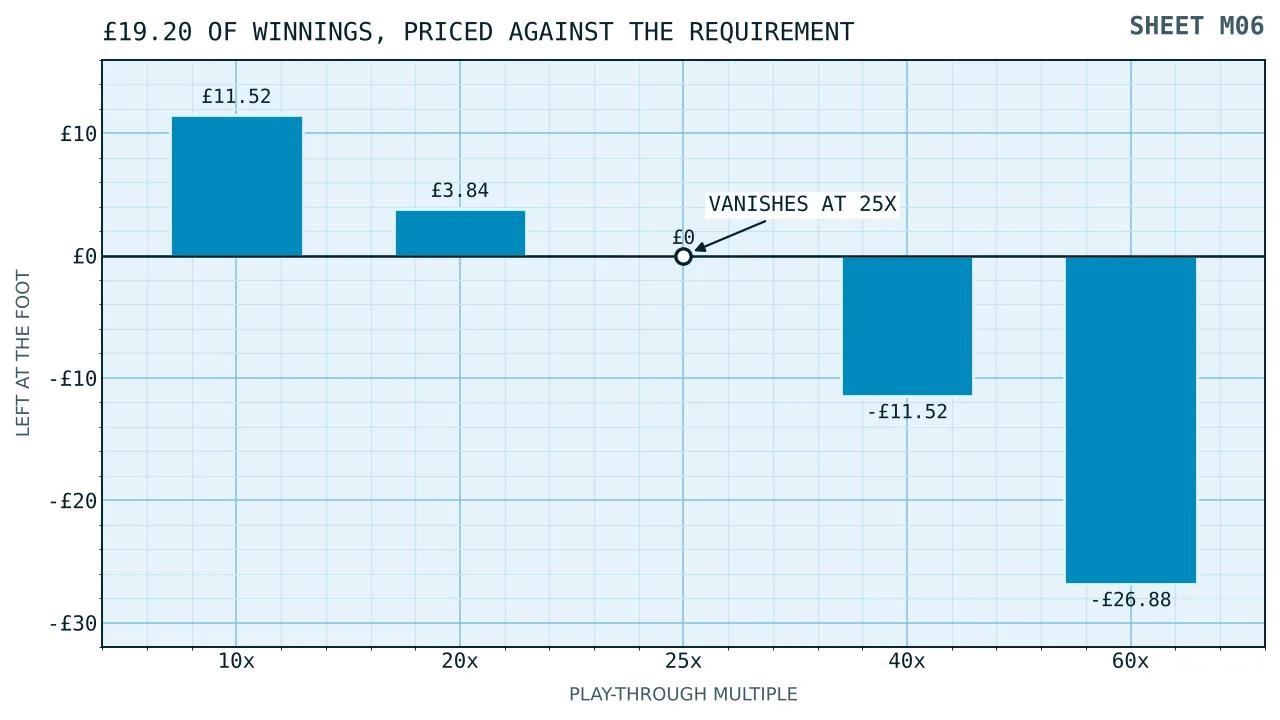
| 10 times | £192.00 | £7.68 | £11.52 | 1.33 |
| 20 times | £384.00 | £15.36 | £3.84 | 2.67 |
| 25 times | £480.00 | £19.20 | £0.00 | 3.33 |
| 40 times | £768.00 | £30.72 | -£11.52 | 5.33 |
| 60 times | £1,152.00 | £46.08 | -£26.88 | 8.00 |
Where E lands on nought the credit cancels out of the working altogether, and twenty-five is the figure left standing: one over the four pence a 96 per cent machine keeps. Two hundred cycles and two cycles cross at the same spot. What differs across the section is the scale of the loss, never its location.
The hours column is the one a big count adds to the discussion. At ten times the whole obligation is an hour and twenty minutes. At sixty it is a full working day. Nothing else on this sheet changes between those two rows except a number in the bonus terms.
4
Five hours twenty, and why it will not shrink
Big counts make the time visible. At 10p a cycle, the £768.00 of required staking is 7,680 cycles, and a British licence paces them. The gap RTS 14D requires before one slot cycle may follow the start of the last is 2.5 seconds, which puts a floor of 19,200 seconds under the obligation. Five hours and twenty minutes.
Two hundred spins at that pace occupy eight minutes and twenty seconds. The gift is eight minutes. The condition is five hours and twenty.
Three separate rules keep that figure from being compressed, and they are worth naming individually, because together they are the reason the hours column in part 3 means anything.
Under RTS 14E a system may not permit a customer to cut short the time before a result appears. Turbo, quick spin and slam stop are the three features its guidance names as being out, and the rule covers remote games of every native speed. The guidance states two carve-outs: a bonus or feature game carrying no extra stake is not caught, and a control that scratches or reveals everything at once is not prohibited.
Autoplay is barred outright by RTS 8A, which asks for an individual commitment to every game cycle, so 7,680 cycles means that many decisions. Its one carve-out covers blinds posted automatically at a table of peer-to-peer poker.
RTS 14F keeps the atmosphere honest while all that is going on. A system must not celebrate a return at or below the total stake, so no win-related sound or animation attaches to a ten pence return on a ten pence cycle. The guidance suggests displaying the amount awarded, briefly showing the winning lines, and a short sound as the result is credited.
None of those three protections travels to a cashier holding no British licence. Curaçao’s responsible gaming policy fixes no minimum between game cycles, leaves turbo and automatic play untouched, and is silent on celebrating a return that merely matches a stake. The identical £768.00 may be run through as fast as that platform permits.
7,680 cycles, 19,200 seconds, eight minutes of them free
5
One game at a time
There is an obvious way to shorten five hours and twenty minutes, which is to run several games at once. On a British licence that route is closed too, and the closure has two halves.
Casino games other than peer-to-peer poker are governed on this by RTS 14C, under which simultaneous play must not be made possible by any functionality the gambling system offers. Split screens, multiple screens and combinations of games that allow two to run together are all covered by its guidance.
From 17 January 2025 a second change banned functionality led by the operator for running several products at once, roulette and blackjack tables being the pairing the Commission gave as its example. Arriving with it was a duty to display, as it happens, how much a customer has spent net and how long they have been playing. On a five-hour obligation that display is the only running total anybody sees without working it out for themselves.
Both of those matter to the figures above, because a reader who assumes four games can be run in parallel has mentally divided five hours and twenty minutes by four. On a site holding a British licence that division is not available. Off the register it may well be, along with the pace and the automation, which is how an obligation that reads as a working day in one jurisdiction reads as an evening in another.
The near-miss rule belongs here too, since it governs what those thousands of cycles may look like. Designs or features apt to give a customer a false impression of how likely a result is are prohibited by RTS 7C, which names two in particular: substituting a losing event with a near-miss losing event, and simulating a real device without simulating that device’s real probabilities. The guidance puts it shortly, that a game may not falsely display near-miss results and may not swap one losing outcome for a different losing one.
Alongside it, RTS 7A requires game results to be acceptably random and forbids adaptive behaviour, which is to say a compensated game. The guidance explains that this rules out interventions, automatic or manual, that change the probabilities, and requires outcomes to fall out in line with the theoretical probabilities. RTS 7B adds that random numbers are to be used in the order they arrive and may not be discarded to achieve adaptive behaviour. Those are the rules that make the 96 per cent in part 1 a usable number rather than an advertisement.
6
Contribution on a large count
Everything so far counts a staked pound in full. A game that counts for less does not shrink the requirement. It stretches the staking needed to satisfy it, and across a long batch that stretch is severe.
Set contribution at three pounds in ten. Forty times £19.20 is £768.00 of contribution owed, exactly as before. Earning it now demands £2,560.00 across the reels, whose expected cost is £102.40. Against £19.20 of credit the overshoot runs from £11.52 to £83.20.
The clock goes the same way. £2,560.00 at 10p is 25,600 cycles, and at two and a half seconds apiece that is 64,000 seconds: seventeen hours and forty-seven minutes, spread over however many sittings a window allows.
Now wind the requirement back to ten times, where a British licence stops, and keep contribution at thirty per cent. Staking lands on £640.00, expected cost on £25.60, and E on -£6.40. What the regulated limit binds is W. Over g it has no reach at all.
That rate is an illustration, not a measurement of the market. A respondent to the regulator’s consultation described a case in which thirty pence of each wagered pound went towards a requirement, and the Commission, having recorded it, left weighting unregulated. Nobody publishes a schedule of the contribution rates currently in use, so the figures above are arithmetic applied to a rate supplied by somebody else. The point is worked harder on slots free spins, where contribution is the subject rather than a complication.
£2,560.00 of staking to earn £768.00 of contribution at 30 per cent
7
A count handed over in instalments
Counts of this size often arrive in pieces rather than all at once, and the pieces change the shape of the exercise without changing the total.
Split two hundred into five tranches of forty. Each tranche is a credit of £3.84 carrying £153.60 of required staking and an expected cost of £6.14. Five of those add back to the same £19.20 and the same £768.00. The money has not moved.
What has moved is the number of deadlines. One credit with one window becomes five credits with five windows, and an unused tranche is usually gone rather than carried forward. Where a single window of a day would have held the whole obligation several times over, five windows of a day each have to be met on five separate days, and each of them asks for sixty-four minutes of play. The arithmetic of a tranche is the arithmetic of the whole divided by five. The logistics are not divisible at all.
British rules reach the structure of such an offer in two places. Social Responsibility Code 5.1.1 requires the terms of any incentive to be set out clearly, transparently and fairly, and to be made easily accessible to anybody it is offered to. The same provision bars a licensee from altering an incentive’s value where the qualifying activity gets completed inside less than the full offer period, and that is the rule aimed squarely at an instalment schedule: finishing ahead of time must not cost a player part of the award.
Only two categories of licence sit outside that provision, gaming machine technical and gambling software, and its condition page states no effective date. The wagering ceiling carried in the same provision began on 19 January 2026.
Curaçao’s rulebook matches neither limb. Bonuses occupy two sentences of it: promotions are to be put across transparently with terms that are clear, and operators are not to encourage excessive play by promoting aggressively. Nothing there addresses altering an incentive’s value partway, nothing caps a multiple, and no standard of accessibility attaches to the terms themselves.
8
Running it on whatever count you were offered
The method does not care how large the count is, which is why it is written as a ratio.
| Quantity | Per 100 cycles |
|---|---|
| Face value | £10.00 |
| Average winnings | £9.60 |
| Staking owed at 40x | £384.00 |
| Expected cost of it | £15.36 |
| Overshoot | £5.76 |
| Hours, at least | 2.67 |
Multiply that column by the count on the front, divided by a hundred. Three hundred cycles is three times every line. Fifty cycles is half of it. The ratio holds because no term in the expression depends on how many cycles there are, only on what they add up to.
Three things the answer does not settle.
It is an average and not a forecast. The £11.52 that ten times would leave here describes the centre of a wide spread, and the commonest single outcome on a round of spins is nothing at all. The arithmetic is honest about the long run and silent about an evening.
It takes for granted that the credit lasts long enough to be played and the winnings last long enough to be paid. A cap on what a bonus is allowed to win, or a discretion the operator has reserved to itself, sits right outside the expression and can empty the answer without help from W.
And it assumes the figures in the terms are the figures used. W, the contribution rate, the window and any cap have to be read off the document in hand, not off this page. Nearby sheets run the same ratio on other counts: 100 free spins no deposit, which is exactly half of this one, 1000 free spins no deposit, which is five times it, and 150 free spins no deposit, which lands in between. Everything in the section is listed at The multiple.
Questions
- What are 200 free spins actually worth?
- At 10p a cycle the count is advertised at £20.00 and averages £19.20 on a machine returning 96 per cent. A forty times requirement then demands £768.00 of staking, whose expected cost is £30.72. The credit falls £11.52 short of that cost, so it is used up partway through and the sheet closes at nothing.
- Is a bigger count of spins better value than a small one?
- Not in proportion. Every term in the calculation scales with the credit, so two hundred cycles produce ten times the credit and ten times the overshoot of twenty cycles. What grows with the headline is the obligation, in step with the gift. A large count changes the hours involved far more than it changes the outcome.
- How long does a 200 spin play-through take?
- Five hours and twenty minutes at the very fastest, on a site with a British licence. The £768.00 of required staking is 7,680 cycles at 10p, and RTS 14D will not let a second slot game begin until 2.5 seconds have run from the start of the first. The two hundred spins themselves take eight minutes and twenty seconds.
- Can turbo or quick spin speed up a wagering requirement?
- Not on a British licence. Under RTS 14E the system will not let a player cut short the wait before a result appears. Slam stop, quick spin and turbo are the named examples. It applies to all remote games whatever their native speed, with carve-outs for bonus or feature games where no extra stake is wagered and for scratch-all or reveal-all controls.
- Can several games be played at once to finish faster?
- Under RTS 14C the system may not hand a player the means to run games side by side, which the guidance extends to split-screen and multi-screen setups. A separate change in force from 17 January 2025 bans operator-led functionality for playing multiple products simultaneously, the Commission’s example being roulette and blackjack tables side by side.
- At what requirement do 200 spins come to nothing?
- On a machine returning 96 per cent, break-even sits at twenty-five. When the expected cash is set to nought the credit cancels out of the working and what remains is one divided by the four pence the house keeps. Two hundred cycles and two cycles reach that point together, because the crossing depends on the return and not on the count.
- On a long batch, what is the price of a contribution rate set at 30 per cent?
- It turns an £11.52 overshoot into an £83.20 one. The requirement stays at £768.00 of contribution, but at thirty pence in the pound it takes £2,560.00 of staking to earn, costing £102.40. The time runs from five hours twenty to seventeen hours and forty-seven minutes. At that rate even ten times, the figure a British licence caps at, lands on minus £6.40.
- What changes when 200 spins arrive in instalments?
- The money does not change and the deadlines multiply. Five tranches of forty are each a credit of £3.84 with £153.60 of required staking, and five of those add back to the same totals. What is different is that five windows have to be met instead of one, each asking for sixty-four minutes of play, and an unused tranche is usually gone rather than carried.
- Do these rules apply to an offshore casino?
- No. Hold no British licence and none of it binds: the multiple has no ceiling, games may run several at a time, turbo and automatic play are unrestricted, and nothing sets a floor between cycles. The Curaçao responsible gaming policy contains none of them, and its whole treatment of bonuses is two sentences about transparent terms and aggressive promotion.