
Sheet N03 Revision 1 Checked 15 October 2026
£30 free no deposit
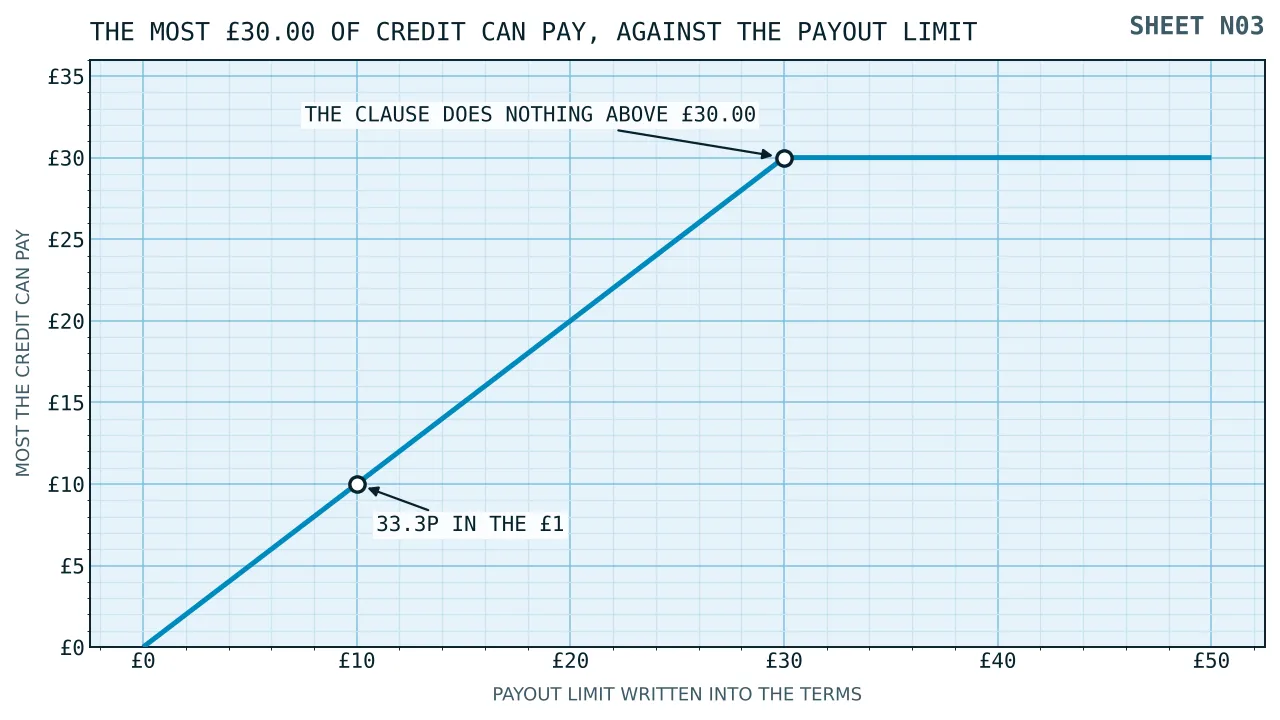
£30.00 of credit with nothing asked back is £30.00 right up to the moment somebody tries to take it out. The term that settles this one is the maximum the cashier will pay against it. Set that at £10.00 and the headline is worth 33.3p in each pound of itself, whatever the credit does in the meantime.
£10.00 paid against £30.00 of credit, or 33.3p in the pound
What the conditions leave
Every destination on this spike is bought advertising. The site takes a fee if a reader goes on to register, and no figure printed below moves because of it.
The Spin Sheet
Till receipt No 01
Betportal
Lowest multiple here
For every €1 of spin credit at face per €1
Credit
Debit
No Great Britain licence
Licensed in Anjouan, Comoros, run by BetPortal Gaming Ltd, with Excite Ultra Media Ltd, reference ALSI-202601040-FI2.
Terms read 15 October 2026
Open the offer at Betportal, opens in a new tabThe Spin Sheet
Till receipt No 02
WinBeast
Five staged matches
For every €1 of spin credit at face per €1
Credit
Debit
No Great Britain licence
Licensed in Curaçao, operator not named on the site.
Terms read 15 October 2026
Open the offer at WinBeast, opens in a new tabThe Spin Sheet
Till receipt No 03
EliteSpin
Longest spin window
For every £1 of spin credit at face per £1
Credit
Debit
No Great Britain licence
Licensed in Costa Rica, run by PrimeTier Limited.
Terms read 15 October 2026
Open the offer at EliteSpin, opens in a new tabThe Spin Sheet
Till receipt No 04
Crown Jewelz
Multiple unpublished
No total struck
Credit
Debit
No Great Britain licence
Licensed in Curaçao, number not verified, operator not named on the site.
Terms read 15 October 2026
Open the offer at Crown Jewelz, opens in a new tabThe figure at the foot of a receipt is this site's own arithmetic and nothing an operator has published: the credit, less the share a spin gives back at 96 per cent return to player, less what playing the wagering through costs at the same return. It describes the offer, not one reader's afternoon. Where the conditions price above the credit the receipt prints nothing rather than a negative sum, and where a figure the sum needs is unpublished it prints the condition in the operator's words instead.
Three words stand in the amount column where no figure can. Noted is a published condition that takes value away without leaving the sum a figure to take. Unpriced is a condition whose figure nobody has published, or a credit that is not a sum until a deposit of your own sets it. Own money is money of yours, which is never part of a total.
Not one of the operators printed above holds a Great Britain licence, so the duties that licence carries do not reach them. Every online gambling company licensed in Great Britain has to be part of Gamstop Online, and a reader who has shut themselves out through the scheme is therefore not shut out here. The ceiling of ten times the bonus funds on a wagering requirement, in force since 19 January 2026, is a condition of that licence and binds the companies that hold one. Where a dispute goes instead is a matter for the authority named on the receipt, and the Gambling Commission describes what a reader faces without a British licence as a lack of recourse if things go wrong. Nobody under 18 may hold an account at any of them.
Every term printed on a receipt is the operator's own, and each receipt carries the day it was read. The oldest of those readings is 15 October 2026. What binds a reader is the operator's own full terms, and not a line printed here.
1
Thirty pounds, and what the word free is doing
A cash credit is simpler than a round of spins. There is no count to multiply by a spin price and no game return to apply before the money is countable: £30.00 arrives as £30.00, sitting in an account under a label that separates it from money a player has paid in.
That label is the whole subject of this sheet. Credit of this shape is not the player’s money. It is a promise to pay, bounded by whatever the terms say about paying, and the boundary is usually a single figure written a long way below the headline.
On the word free, the advertising regulator is specific in one direction. Where qualifying means staking money of the customer’s own, the offer should not be described as free at all. A no-deposit credit clears that test at the door, since nothing goes in to obtain it, and the test says nothing whatever about the other end.
What this sheet holds fixed:
- A credit of £30.00, granted without a deposit.
- No play-through. The forty times used elsewhere on this site is not in play, because this key is about offers that ask nothing back.
- A 96 per cent return where a game is involved at all, and full weighting, since there is no requirement for a contribution rate to slow.
- The credit reaching the cashier intact. Where terms make the credit pass through a game once before it counts, that pass costs 4 per cent and is priced on sheet N04, £20 free no deposit casino.
- Payout limits of £5, £10, £20, £30 and £50, used as illustrations. No primary source publishes a standard figure for one, so none is quoted as a market fact.
2
The line, with the multiple absent
Sheet N03 takes its total down the line this whole site uses:
E = B × (1 – (W × (1 – RTP)) / g)
£30.00 is B. The multiple the credit must be turned over by is W, the game’s return as a proportion of one is RTP, the weighting is g, and what should survive is E. With W at nought the whole bracket resolves to one and the sum is over before it starts:
E = £30.00 × (1 – (0 × 0.04) / 1)
E = £30.00
Which is correct, and which is also the point at which most writing about no-deposit credit stops. The line prices the cost of clearing a requirement. Where there is no requirement, it has nothing to charge for, and the answer it gives is the answer to a question nobody needed to ask.
The question that is left runs the other way. Not what does it cost to release the credit, but how much of the released credit will the cashier actually hand over. A payout limit answers it directly, in pounds, and reading one is what the rest of this sheet does.
3
A limit on the way out, not on the way in
Two very different clauses both get called a cap. Separating them is most of the work on a page like this one.
A limit written over what the credit is allowed to win acts while play goes on. It truncates a distribution, so it only matters when the game produces a result above it, and its cost depends on the shape of the prizes underneath. Sheet N01, 50 free spins no deposit no wager, prices that one across two games whose prize shapes differ.
A limit on what the cashier will pay acts at the end, against the balance however it arose. It does not care whether the balance came from a lucky first spin or sat untouched. Above the limit, every pound is the same pound: unpayable.
The second kind is blunter and easier to price, because it needs no assumption about the game. The arithmetic is one operation. The player receives the lesser of the balance and the figure in the clause.
It also does something a win limit does not. A payout limit converts a credit into a fixed prize. Whatever happens between the credit landing and the withdrawal going in, a limit of £10.00 means the best result available is £10.00, and a run of extraordinary luck on a £30.00 credit produces precisely the same £10.00 as a cautious one.
4
£30.00 against five payout limits
Restate every limit as pence in each pound of the headline, because that is the figure worth carrying away.
| Payout limit | Share of £30.00 | Paid at most | Per £1 of headline | Withheld |
|---|---|---|---|---|
| £5.00 | 1 in 6 | £5.00 | 16.7p | £25.00 |
| £10.00 | 1 in 3 | £10.00 | 33.3p | £20.00 |
| £20.00 | 2 in 3 | £20.00 | 66.7p | £10.00 |
| £30.00 | all of it | £30.00 | 100.0p | £0.00 |
| £50.00 | above it | £30.00 | 100.0p | £0.00 |
The bottom two rows are the same row, which is the useful part. Once the limit reaches the size of the credit it stops doing anything, and a cashier writing £50.00 into that clause has written a number with no effect on a £30.00 headline. The clause only earns its place by standing below the figure on the front.
There is a second way to read the same clause, and it is harsher. Suppose the credit is played rather than simply withdrawn, and suppose it runs well. A £30.00 credit on a 96 per cent game is worth £28.80 on average after a single pass, and occasionally a great deal more than that. Under a £10.00 limit the whole of that upside is unreachable. Measured against the average alone, the clause costs £18.80 on these figures. Measured against a good night, it costs whatever the good night was worth.
£18.80 removed by one clause, before any luck is counted
5
The protection that guards the other balance
British rules do address payout limits, and the gap between what they address and what a no-deposit credit is deserves stating exactly.
The rule bars a licensee from using, applying or leaning on any contract term that works as a ceiling on what a consumer may take out of a deposit balance. One worked example of an unacceptable clause joins a weekly figure of £500 to a daily one of £50. Set beside it are three further statements: that withdrawal from that balance, winnings included, is open at any time; that no restriction may stand on the greatest sum a player takes out whenever they choose to; and that limits on the size or the frequency of payouts have to be reasonable ones.
Every sentence of that is about the deposit balance. A credit granted without a deposit has never been in one. Nothing was paid in, so the protection has no subject matter, and a payout limit written against bonus credit is outside its scope.
Two things can therefore be true of one cashier on one day: it may not cap what comes out of a player’s own money, and it may cap what comes out of the credit it gave away. A reader who merges the two will believe a protection is present that is not, which is the direction of error this site exists to stop.
The page carrying that withdrawal rule states no publication date and no last-updated date, so this sheet cites it for the rule and attaches no freshness to it.
6
One clause with a penalty behind it
Most of what decides a no-deposit credit has no enforcement history attached. One clause shape does, and the figures are worth having.
A penalty of £170,000 was imposed on 3 July 2025 on Taichi Tech Limited, trading as Fafabet, over terms carried in its bonus rules for new casino promotions. The term at issue reserved to the operator, at its own discretion, the closing of accounts or the forfeiting of winnings. The regulator concluded that the fair and open licensing condition had been breached, took the view that wording of that kind is short of transparency and capable of producing unfair outcomes for consumers, and ordered an independent third-party audit over the operator’s controls on safer gambling and on money laundering.
Read that for what it establishes and not for more. An operator was penalised; a condition was identified as breached; an audit was ordered. The source does not say the clause was struck out, so this sheet does not say so either. A reader finding similar wording in a set of terms has a published outcome to point at, and no authority for the proposition that the wording is void.
The distinction matters most on credit of this kind, because a discretionary forfeiture clause and a payout limit do the same work by different means. The limit names a figure in advance. The discretion names none, and arrives afterwards.
Under the incentives code an offer’s terms have to be fair, transparent and clear, and easy to reach for whoever is being offered it. That duty, like the penalty above it, is fastened to a British licence and travels no further than one.
7
What the British rulebook adds
Credit advertised by an operator with no Great Britain licence comes with none of what follows, and naming the items beats asserting the conclusion.
On the terms
Ten times £30.00 is £300.00, and since 19 January 2026 that is as far as a British licensee could push a requirement on credit of this size. The same date stopped an incentive holding more than one kind of gambling product, so casino credit and bingo tickets may no longer share a single set of linked terms. Licence condition 7.1.1 measures a term for fairness and for transparency against the Consumer Rights Act 2015, asks that contract terms be easy to get at, and wants material changes notified before they bite.
On the play
Spend £30.00 at the largest stake a British licence allows on a slot and it buys six cycles at £5, or fifteen at the £2 ceiling that governs anybody under twenty-five. Those limits reach slots and nothing else, with 9 April 2025 and 21 May 2025 given by the Commission as their two start dates. Six cycles cannot be taken inside fifteen seconds, 2.5 seconds being the shortest gap the standards allow between one cycle opening and the next. There is no autoplay to hand them to, no turbo and no slam stop to shorten them, and a return of £5 against a £5 stake may not be announced as a win.
On the account
Name, address and birth date are settled before a penny of credit is played, bonus rounds and free-to-play versions counted in, and a check that could reasonably have been asked for earlier may not be produced for the first time when somebody asks to be paid. Paying in by credit card stopped being possible at a British licensee on 14 April 2020. A financial limit is put forward as the default, and declining one takes a positive act by the customer.
What Curaçao’s own policy carries instead
Bonuses get two requirements and no more: transparent communication with clear terms, and no promotion aggressive enough to encourage excessive gambling. No ceiling on a multiple, no bar on mixing product types, no stake limit, no minimum cycle, and not a word about what a cashier must pay out.
It is not weaker on everything, and a sheet that pretended otherwise would be unreliable in the other direction. A deposit limit takes seven days to go up there and at least a day here, while a reduction is immediate in both places. A player in Curaçao has six months to raise a matter; the operator answers inside four weeks and may take one further extension of the same length on written notice.
8
Finding the payout limit in a document
Three lines, and the first is the one nobody does.
| The step | This credit |
|---|---|
| Read the credit at face | £30.00 |
| Find the figure the cashier will pay at most | £10.00 |
| Divide the second by the first | 33.3p per £1 |
A limit at or above the credit leaves the third line at 100p and the headline intact. Anything below it is the real size of the offer, and the figure on the front is advertising.
Two cautions before the answer gets spent.
A payout limit and a win limit can both appear, and they do not cancel out. The win limit caps the balance that can be built; the payout limit caps what leaves. Where both are written, the smaller governs and the larger is decoration.
And a credit with no payout limit at all has not therefore been given away. The cost has moved to another clause, and the rest of this section finds the others: the clock on sheet N02, 70 free spins no deposit no wager, the floor that stands above a small credit on sheet N08, free £5 no deposit casino, and the identity gate on sheet N05, free £10 no deposit. The section index at Nothing asked back sets them out together.
Questions
- What is a £30 free no deposit credit actually worth?
- Whatever the cashier will pay against it, and no more. With no play-through attached the credit stands at its face of £30.00, so the figure that settles the offer is the payout limit in the terms. A limit of £10.00 makes the headline worth 33.3p in each pound of itself. A limit at or above £30.00 leaves it whole.
- Is a maximum payout the same as a maximum win?
- No, and the difference changes the arithmetic. A win limit acts during play by truncating a distribution, so its cost depends on the prize shape of the game underneath. A payout limit acts at the end against the balance however it arose, and needs no assumption about the game at all. Where both appear, the smaller one governs.
- Can a British licensee cap what I withdraw?
- Not out of a deposit balance. Any contract term working as a ceiling on what a consumer draws from that balance is barred from use, and one worked example of an unacceptable clause joins a weekly figure of £500 to a daily one of £50. Credit granted with no deposit has never been in a deposit balance, so the protection has no subject matter to attach to.
- How much does a £10 payout limit cost on a £30 credit?
- £20.00 against the face. Measured against what the credit would be worth played out, the bill is larger: £30.00 on a 96 per cent game averages £28.80 after a single pass, so a £10.00 limit removes £18.80 of that average before any good luck is counted. The whole of the upside above the limit is unreachable.
- Has any operator been penalised over bonus terms?
- One case is squarely on the point. On 3 July 2025 a penalty of £170,000 was imposed on Taichi Tech Limited, trading as Fafabet, over a term in its new casino promotion rules reserving the discretionary closure of accounts or forfeiture of winnings. The fair and open licensing condition was found breached and an independent third-party audit was ordered. The source does not say the term was struck out, so neither does this sheet.
- Does a no-deposit credit have to be played before it can be withdrawn?
- It depends which noun the terms attach the condition to, and this sheet assumes the credit reaches the cashier intact. Where a single pass through a game is required, that pass costs 4 per cent at a 96 per cent return, which is £1.20 on £30.00. Sheet N04, on a £20 free no deposit casino credit, prices that pass in full.
- Why does a £50 payout limit on a £30 credit change nothing?
- Because the limit only bites below the size of the credit. The player receives the lesser of the balance and the figure in the clause, so once the clause stands at or above £30.00 it has no work to do. A limit is a real condition only when it is smaller than the number on the front.
- What is missing when the offer has no British licence?
- Everything priced in part 7, and the figures make it concrete. A requirement held to £300.00 on credit this size from 19 January 2026. Slot cycles held to £5, or £2 under twenty-five, so £30.00 is six cycles rather than an unbounded number. Fifteen seconds as the floor under those six. Identity settled before any bonus play. Credit cards barred at the cashier since 14 April 2020. A place in Gamstop Online. Curaçao gives bonuses two sentences and says nothing at all about what a cashier must pay.