
Sheet M08 Revision 1 Checked 15 October 2026
40 free spins no deposit
Four pounds advertised, £3.84 of average winnings behind it, and £153.60 of wagering owed at forty times. The cost of that wagering is £6.14, which is more than the credit, so the sheet closes at nothing after sixty-four minutes.
£6.14 of cost against £3.84 of credit, 64 minutes to pay it
What the conditions leave
Every destination on this spike is bought advertising. The site takes a fee if a reader goes on to register, and no figure printed below moves because of it.
The Spin Sheet
Till receipt No 01
Betportal
Lowest multiple here
For every €1 of spin credit at face per €1
Credit
Debit
No Great Britain licence
Licensed in Anjouan, Comoros, run by BetPortal Gaming Ltd, with Excite Ultra Media Ltd, reference ALSI-202601040-FI2.
Terms read 15 October 2026
Open the offer at Betportal, opens in a new tabThe Spin Sheet
Till receipt No 02
WinBeast
Five staged matches
For every €1 of spin credit at face per €1
Credit
Debit
No Great Britain licence
Licensed in Curaçao, operator not named on the site.
Terms read 15 October 2026
Open the offer at WinBeast, opens in a new tabThe Spin Sheet
Till receipt No 03
EliteSpin
Longest spin window
For every £1 of spin credit at face per £1
Credit
Debit
No Great Britain licence
Licensed in Costa Rica, run by PrimeTier Limited.
Terms read 15 October 2026
Open the offer at EliteSpin, opens in a new tabThe Spin Sheet
Till receipt No 04
Crown Jewelz
Multiple unpublished
No total struck
Credit
Debit
No Great Britain licence
Licensed in Curaçao, number not verified, operator not named on the site.
Terms read 15 October 2026
Open the offer at Crown Jewelz, opens in a new tabThe figure at the foot of a receipt is this site's own arithmetic and nothing an operator has published: the credit, less the share a spin gives back at 96 per cent return to player, less what playing the wagering through costs at the same return. It describes the offer, not one reader's afternoon. Where the conditions price above the credit the receipt prints nothing rather than a negative sum, and where a figure the sum needs is unpublished it prints the condition in the operator's words instead.
Three words stand in the amount column where no figure can. Noted is a published condition that takes value away without leaving the sum a figure to take. Unpriced is a condition whose figure nobody has published, or a credit that is not a sum until a deposit of your own sets it. Own money is money of yours, which is never part of a total.
Not one of the operators printed above holds a Great Britain licence, so the duties that licence carries do not reach them. Every online gambling company licensed in Great Britain has to be part of Gamstop Online, and a reader who has shut themselves out through the scheme is therefore not shut out here. The ceiling of ten times the bonus funds on a wagering requirement, in force since 19 January 2026, is a condition of that licence and binds the companies that hold one. Where a dispute goes instead is a matter for the authority named on the receipt, and the Gambling Commission describes what a reader faces without a British licence as a lack of recourse if things go wrong. Nobody under 18 may hold an account at any of them.
Every term printed on a receipt is the operator's own, and each receipt carries the day it was read. The oldest of those readings is 15 October 2026. What binds a reader is the operator's own full terms, and not a line printed here.
1
Forty cycles, and what they average
Forty is a middling count, large enough to look generous on a sign-up screen and small enough that the obligation behind it never reaches three figures. That makes it the clearest case on this part of the site, because the whole of the result fits in a single line of pence.
Priced at 10p, forty cycles carry a face of £4.00. Face is not what arrives. A cycle pays whatever the cabinet returns, and a cabinet set to 96 per cent gives back ninety-six pence of every pound pushed across it, so forty cycles average £3.84 of winnings. Sixteen pence has gone before a word of the terms is read.
That £3.84 is B, and it is the figure everything below is built on. The number forty never appears in the working again.
No British rule puts a price on a single cycle, which makes the 10p above an assumption this part states rather than a measurement. Put a higher price on a cycle and the credit rises with the obligation by one factor, so the ratio struck at the foot survives any spin value.
Forty times is the requirement used throughout. It is the order of demand this corner of the market tends to ask when a no deposit count is handed over, it sits well above the ten a British licence now permits, and it sits below the sixty the regulator recorded in use before it drew that line.
The inputs, so that any of them can be changed and the sheet rerun:
- Forty cycles at 10p, so £4.00 on the front and £3.84 in hand.
- A theoretical return of 96 per cent, leaving four pence of each pound with the cabinet.
- W at forty, run through six values in part 3.
- Contribution at a full pound in the pound, until part 6.
- No deposit behind any of it, so there is nothing in the account but the credit.
2
Three pounds eighty-four, put to work
A single line of algebra does the pricing. The credit is B, the number of turnovers demanded is W, the theoretical return expressed as a share of one is RTP, and the portion of a staked pound the requirement accepts is g. What the credit should leave behind is E.
E = B × (1 – (W × (1 – RTP)) / g)
Now forty cycles, substituted straight into it.
E = £3.84 × (1 – (40 × 0.04) / 1)
E = £3.84 × (1 – 1.60)
E = -£2.30
Taken in two steps: forty lots of £3.84 is £153.60 that has to cross the reels, and the cabinet expects to retain four pence from each of those pounds, or £6.14. A credit of £3.84 is asked to meet a cost of £6.14, and it cannot.
Nothing is owed as a result. No deposit sits behind the account, so the balance has no route below nought, and the credit is exhausted part way through the £153.60. The minus two pounds thirty is a measure of overreach: the distance by which the condition was drawn past the gift it was attached to.
Two pounds thirty on a four pound headline is the kind of figure a reader can hold in mind. Forty times a small credit is not a small condition.
£153.60 of wagering fastened to £3.84 of winnings
3
Six multiples, one credit
Hold B, the return and the weighting still, and move only W. The minutes column is the fastest lawful route through each row at 10p a cycle, and part 4 says where it comes from.
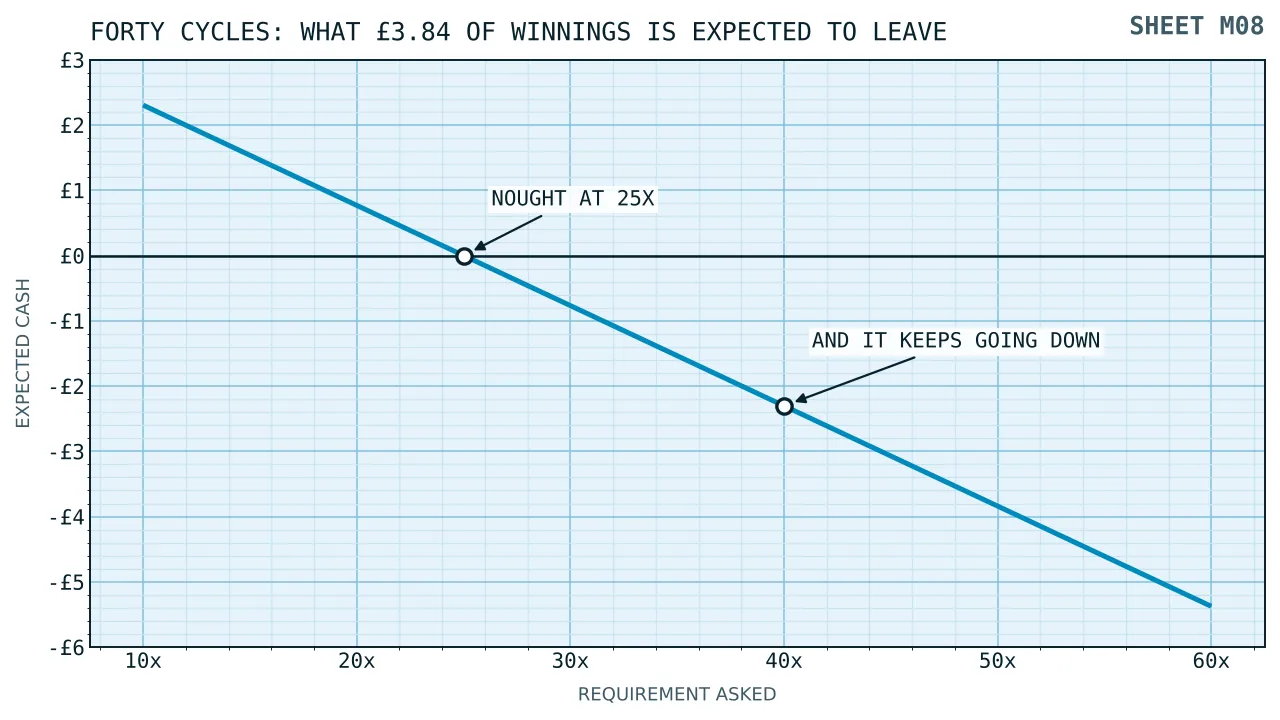
| Requirement | Wagering owed | Cost of it | Expected cash | Minutes, at least |
|---|---|---|---|---|
| 10 times | £38.40 | £1.54 | £2.30 | 16 |
| 20 times | £76.80 | £3.07 | £0.77 | 32 |
| 25 times | £96.00 | £3.84 | £0.00 | 40 |
| 30 times | £115.20 | £4.61 | -£0.77 | 48 |
| 40 times | £153.60 | £6.14 | -£2.30 | 64 |
| 60 times | £230.40 | £9.22 | -£5.38 | 96 |
A multiple of twenty-five is the hinge here, since twenty-five lots of four pence in the pound come to the pound itself. Nothing about forty cycles puts it there. Write the expected cash as nought and B leaves the equation on its own, which strands the requirement alone with the return and makes the crossing a property of the cabinet rather than of the promotion.
Two features of the table are worth more than the crossing itself.
The first is symmetry. Ten times leaves £2.30 and forty times falls £2.30 short, because 0.40 and 1.60 stand the same distance from one in opposite directions. Four times the regulated ceiling costs precisely what the ceiling would have paid.
The second is that the minutes grow while the money shrinks. Between the first row and the last the expected cash falls by £7.68 and the time owed rises by eighty minutes. A reader comparing two offers on their headline count is comparing the one column that has not moved.
4
Sixty-four minutes, and the window that cannot beat them
The time owed is not a matter of patience. It is set by a technical standard, and on a licensed site it cannot be shortened by any means the cashier is allowed to offer.
£153.60 of wagering at 10p a cycle is 1,536 cycles. RTS 14D sets the pace: a slot cycle may not follow the start of the previous one inside 2.5 seconds. Multiply out and the obligation is 3,840 seconds, sixty-four minutes, which is a floor rather than an estimate. The forty cycles that were given away take a hundred seconds of the same clock.
Three rules hold that hour in place.
Automatic play is out altogether. Under RTS 8A a gambling system has to take a separate commitment for every game cycle, and its guidance lets through one thing alone, which is a poker blind posted without the player acting. So sixty-four minutes is also 1,536 deliberate presses.
Speeding up a result is out as well. RTS 14E forbids a system from handing a customer any way of shortening the wait for an outcome. Slam stop, turbo and quick spin are the examples its guidance gives. The rule runs across every remote game whatever its native tempo, and excepts a feature or bonus game carrying no further stake, along with a reveal-all or scratch-all control.
Running several games side by side is out under RTS 14C, which forbids functionality enabling two games to run together, split and multiple screens being named in its guidance. A further change from 17 January 2025 barred functionality led by the operator for several products running at once. The example the Commission printed was a pair of tables, one roulette and one blackjack. The same date brought in a duty to show a customer their net spend and their elapsed time as they play, which on an hour-long obligation is the only running total anyone sees without doing the sum.
Now the window. Bonus terms usually carry an expiry, and on a count of this size the expiry is the wrong thing to worry about. Hold the 2.5 seconds and a day of elapsed time is room for 34,560 cycles, or £3,456.00 of wagering at 10p. The requirement is £153.60. A window would have to shut inside sixty-five minutes before it reached the answer ahead of the multiple, and very few of them do.
1,536 cycles, 3,840 seconds, 100 seconds of them free
Where a window does bite is when the count is handed over in daily pieces, because then the obligation is cut into days whether or not the arithmetic needs it. A count split into instalments is the subject of free daily spins, which prices a drip rather than a lump.
A cashier out here carries no Great Britain licence, so the obligations priced in this part are the ones nobody owes the reader. The pacing rules are the plainest case. The Curaçao responsible gaming policy sets no interval between cycles, leaves turbo and automatic play entirely alone, and says nothing about playing two games at once, so the same £153.60 can be put through as quickly as the software will take it.
5
Conditions that settle it before the sum does
The expression in part 2 prices the requirement. It knows nothing about the conditions that sit alongside the requirement, and on an offer this size two of them can reach the answer first.
What counts as significant
For a casino promotion, the advertising regulator’s own list of the terms likely to be significant runs to three items: any wagering requirements, how a player takes part, and any minimum stakes. On a forty cycle offer all three are present, and the requirement is the one that decides the total. The gambling regulator supplies the consequence: a significant condition shown without enough prominence makes the advertisement a misleading one. It also wants those terms displayed inside the advertisement and placed near the offer itself on the pages where a player lands and signs up.
Proportionality is the other half of that advice. An inducement is supposed to stay in proportion to the time and money a player has already spent, a promotion is not to grow at a faster rate as spending grows, and gambling substantial sums at a regular fixed frequency is not to be urged on anybody. Its own instance of something that can be acceptable is a single reward, a free bet, once fifty pounds has gone through. The instance comes with a condition fastened to it, namely that handing over a free bet at that point is nothing unusual for gambling of that type.
Three casino advertising rulings are listed as recent on that advice page, with their outcomes and nothing else. HRY Games was upheld on 14 October 2026, Dribble Media Ltd was upheld on 16 September 2026, and White Hat Gaming Ltd was not upheld on 16 September 2026. What any of the three was about is not stated anywhere on that page, so nothing more about them belongs here.
The word on the front of it
An offer of this shape passes the advertising regulator’s test on the word free, since that test asks whether qualifying costs the customer any of their own money. Nothing is staked to collect forty cycles. The same advice discourages pairing that word with the language of hazard, unless the customer’s own funds are genuinely not at stake.
Passing at the door is not the same as being free at the foot. Nothing was paid to claim the count, and £6.14 of expected cost was fastened to it on the way in.
6
Weighting takes a workable multiple apart
Everything so far has treated a staked pound as a pound of progress. Where a cabinet counts for part of a pound, the requirement itself does not move; the wagering needed to satisfy it does, and it moves a long way.
Set contribution at thirty pence in the pound. Forty times £3.84 is still £153.60 of contribution owed. Earning it now demands £512.00 of wagering at an expected cost of £20.48, so £3.84 of credit is set against a bill more than three times the size of the one in part 2.
E = £3.84 × (1 – (40 × 0.04) / 0.30)
E = £3.84 × (1 – 5.3333)
E = -£16.64
Sixty-four minutes becomes three hours and thirty-three minutes, since £512.00 at 10p is 5,120 cycles and the floor between them has not changed.
Then wind the requirement back to ten, the figure a British licence permits, and leave contribution at thirty per cent. Contribution owed falls to £38.40, wagering to £128.00, cost to £5.12, and the expected cash to -£1.28. So a requirement sitting inside the regulated ceiling can still come to nothing, and that is the lesson of this part. The ceiling was written around W. Nothing has been written around g.
Treat the thirty per cent as an illustration, because that is all it is. It appears in the regulator’s consultation response as something a respondent submitted, a case in which each wagered pound moved a requirement on by thirty pence, and weighting went unregulated after the submission was recorded. No primary source sets out the rates actually in use, so the three figures above are arithmetic of this site’s own run against a rate supplied by somebody else. The sheet that takes weighting as its subject is slots free spins.
£512.00 of wagering to earn £153.60 of contribution at 30 per cent
7
What a licence puts under forty cycles
Arithmetic does not ask who runs the cabinet. The duties beneath the arithmetic do, and on an offer of this size three of them change the answer rather than decorating it.
The ceiling on the requirement
From 19 January 2026 a licensee may not set the multiple above ten, Social Responsibility Code 5.1.1 having put a ceiling there. The provision reaches every licence except gambling software and gaming machine technical, which takes in all remote casino licensing in Britain, and its definition of a wagering requirement is wagers adding up to a stated total before funds can be withdrawn. On £3.84 that ceiling is £38.40 of wagering, £1.54 of cost and £2.30 of expected cash, which is the one row of part 3 where a reader keeps something.
The ceiling speaks of bonus funds, and that is as far as its words go. Nothing published settles whether one free cycle amounts to bonus funds by itself, and the silence runs both ways. The safe statement is narrower: where the winnings off a cycle arrive as bonus funds, ten times is the ceiling on what may be asked of them.
Eight weeks, and who hears it after that
A complaint about a licensed cashier runs on a published clock. It has to be acknowledged as soon as is reasonably possible, and in any case within three working days. Where the gambling runs at every hour of the day, that becomes twenty-four hours. The whole process, internal escalation included, may not take longer than eight weeks from the day the complaint came in. At least six months run from the incident during which a customer may raise it, and a licensee may not write a term that shuts the door inside those six months. The eight weeks can be paused. Where a reasonable request for information sits unanswered for seven days, stopping the clock may itself be reasonable, and it picks up again from the same point. A final letter has to give the reasons for the decision, record that the operator is done with the matter, and point the way to an independent dispute resolution entity.
That body is approved by the regulator, and only an approved one may be used. The published list names eight: Tattersalls Committee, ProMediate, IBAS, eCOGRA, the Centre for Effective Dispute Resolution, Blexr Limited, Pegasus ADR Service and ADR Group, with a note recording that Lindsays has been removed. Coverage is not uniform across them, which matters to a casino player: the entities listed for remote across all sectors are ADR Group, Blexr Limited, CEDR, eCOGRA and IBAS, while Pegasus ADR Service is listed against public houses and members clubs, family entertainment centres, bingo off the internet and adult gaming centres, which leaves remote casino outside its entry altogether.
The regulator is careful about what it will not do. It calls itself no ombudsman. It has no power to settle a gambling complaint or to get anybody’s money back, it cannot deal with a dispute over a withdrawal or a technical fault in a game, and because customer accounts are closed to it, it cannot see what took place. Its own instruction is that the first complaint goes to the business itself.
The same questions on the offshore side
It would be wrong to tell a reader that no complaints route exists away from the British licence. Curaçao allows a complaint free of charge for six months after the bet was settled or the incident happened, wants its arrival confirmed in writing inside a week, and gives the operator four weeks to reply, with one written extension of four more, which lands on eight weeks as well. Responsible gaming complaints are prioritised there, with best efforts inside five business days. That authority also stands back from individual cases, saying it will make no decision on a player’s complaint about transactions placed on an operator’s site.
The real divergence is over who draws up the terms on which a dispute is escalated. In Britain the list is the regulator’s. In Curaçao the process is obligatory and free to the player, its cost falling on the operator, and the policy openly leaves the operator to set the parameters. Three of them are named: a minimum claim value below which nothing is escalated, the binding effect of the outcome on the player, and whether court proceedings must wait until the process is done. On a credit of £3.84 a minimum claim value is not an abstraction.
The rest of the gap is quickly listed. The Curaçao rulebook spends two sentences on promotions, asking for clear terms and no aggressive encouragement of excessive gambling. Nowhere in it is there a ceiling on a multiple, a stake limit, a floor under the interval between cycles, a bar on automatic play, or a word about celebrating a return that does not beat its own stake. Hold a British online gambling licence and membership of Gamstop Online comes with it. The scheme is candid about the edge of its own reach, which stops at operators that do not take part. On the Curaçao side exclusion is demanded one operator at a time, a year being its shortest period, and nothing on this sheet helps anybody reach a site they have already shut off.
8
Running the method on any count
Five lines price any count of cycles, and nothing in them depends on the count being forty.
| The line | Forty cycles |
|---|---|
| Count times the price of a cycle | £4.00 |
| Times the theoretical return | £3.84 |
| Times the requirement, over g | £153.60 |
| Times the house edge | £6.14 |
| Credit less cost, floored at nought | £0.00 |
Because every line is a proportion of the one above it, the whole sheet scales. Double the count and each money figure doubles. Halve it and each one halves. The expected cash per pound of credit does not budge, which is why a reader choosing between a count of forty and a count of four hundred is choosing how much time to spend rather than how much to keep.
Three limits on the answer, each of which can matter more than the sum.
It is an average over many repetitions and not a statement about one session. The £2.30 that ten times would leave here is the middle of a broad distribution whose commonest single result is nothing whatever.
It prices the requirement and not the rest of the document. A cap on what the credit is allowed to win, a discretion the house has kept back for itself, or a minimum claim value standing between a dispute and a hearing: all three stand outside the brackets and can empty the answer while W sits still.
And it uses the figures it was given. Read the requirement, the contribution rate, the window and any win ceiling off the terms actually in front of you, substitute them into part 2, and the total is yours. The same five lines are run on other headline counts across the section: a count of five is priced at 5 free spins no deposit, a count two and a half times this one at 100 free spins no deposit, and the method itself is set out at greater length on free spins no deposit. Each of them is listed at The multiple, under the number that stands on its front.
Questions
- What are 40 free spins with no deposit worth?
- Four pounds at face and £3.84 of average winnings, on a cabinet returning 96 per cent at 10p a cycle. A forty times requirement then asks for £153.60 of wagering, which costs an expected £6.14. The credit is £2.30 short of that cost, so it runs out and the sheet closes at £0.00.
- What requirement would let forty cycles keep something?
- Anything under twenty-five. Twenty-five lots of four pence in the pound come to a pound, so at twenty-five the credit exactly pays for its own play-through. Ten times leaves £2.30 of the £3.84, twenty times leaves 77p, and thirty times is already 77p short.
- How long does a 40 spin play-through take?
- Sixty-four minutes at the fastest, with a British licence in place and 10p on each cycle. The £153.60 of wagering is 1,536 cycles, and RTS 14D will not let a slot cycle follow the start of the previous one inside 2.5 seconds. The forty free cycles themselves occupy a hundred seconds.
- Can an expiry window matter more than the wagering requirement?
- Rarely on a count this size. A day of elapsed time leaves room for 34,560 cycles once 2.5 seconds separate them, and at 10p that is £3,456.00 of wagering against a requirement of £153.60. The window would have to shut inside sixty-five minutes to reach the answer before the multiple does.
- Is a count of forty better value than a count of four hundred?
- Per pound of credit they are identical, because every line of the calculation is a proportion of the credit. Ten times the count gives ten times the credit, ten times the wagering owed and ten times the shortfall. What a larger headline really buys is more hours at the reels.
- Does automatic play or turbo shorten the hour?
- Not where a British licence is held. RTS 8A takes a separate commitment for every game cycle, with one exception for a poker blind posted without the player acting, so the hour is 1,536 presses. RTS 14E will not let a customer shorten the wait for an outcome, and slam stop, turbo and quick spin are the features its guidance puts out of bounds.
- What is the price of a 30 per cent contribution rate on forty cycles?
- It turns a £2.30 shortfall into £16.64. Contribution owed stays at £153.60, and at thirty pence to the pound it takes £512.00 of wagering to earn, costing £20.48. The hour becomes three hours and thirty-three minutes. At that rate the regulated ten times itself prices at minus £1.28.
- How long does a complaint about a licensed casino take?
- No longer than eight weeks counted from the day it arrived, any internal escalation included. Acknowledgement is due within three working days, cut to a single day where the gambling is available at every hour. Six months at least are allowed from the incident for a complaint, and the final letter must explain how to escalate to a dispute resolution body the regulator has approved.
- Does an offshore casino have a complaints route at all?
- Yes, and a page saying otherwise is wrong. Curaçao allows six months from the incident, confirms arrival inside a week, and gives the operator four weeks extendable once by four more. The difference is that its policy lets the operator set the parameters of dispute resolution, including a minimum claim value, which on £3.84 of credit is not a small detail.
- What does a reader give up where there is no British licence?
- The ten times ceiling on a requirement, the ban on automatic play, the ban on turbo and slam stop, the bar on running two games side by side, the slot stake limits of five pounds and two pounds, and the 2.5 seconds that must separate one slot cycle from the next. Not one of those turns up in the Curaçao policy consulted here, whose entire treatment of bonuses runs to two sentences.